Understand CHC theory, the three-stratum model, the CHC broad abilities list, what Gwm means, and why this framework underlies modern IQ testing.
0 Quick Answer
Updated September 19, 2026 by Structural. The CHC model is the main modern theory of intelligence used to organize cognitive testing. In short, CHC theory says intelligence has a hierarchical structure with g at the top, broad abilities in the middle, and narrow abilities underneath. In practical terms, it explains why ACIS measures multiple domains instead of collapsing intelligence into a single short puzzle score.
Direct answer: modern CHC references usually describe about 16 broad abilities and 70+ narrow abilities, with exact counts varying by source and update. Individual tests do not measure all of them. They sample the broad abilities that matter most for the intended purpose.
Quick definitions: Gf means fluid reasoning, Gc means crystallized knowledge, Gwm means working memory capacity, Gv means visual processing, Gs means processing speed, and Gq or Grq refers to quantitative knowledge and quantitative reasoning depending on the specific CHC source you are reading. For a focused comparison of the first two abilities, read Fluid vs. Crystallized Intelligence.
The Cattell-Horn-Carroll (CHC) theory is the gold standard framework for understanding human cognitive abilities. In definition form, CHC is a hierarchical model that places general intelligence at the top, broad abilities in the middle, and narrow skills at the bottom. It emerged from the integration of two of the most influential theories in the history of intelligence research: Raymond Cattell and John Horn's Gf-Gc theory and John Carroll's three-stratum theory.
Carroll's theory was based on his monumental 1993 work, "Human Cognitive Abilities: A Survey of Factor-Analytic Studies", which reanalyzed over 460 datasets spanning the entire 20th century of intelligence research. This meta-analytic approach provided unprecedented empirical support for a hierarchical model of cognitive abilities.
The formal integration of these theories into CHC occurred in the late 1990s and early 2000s, primarily through the work of Kevin McGrew. Today, CHC theory represents the consensus framework in differential psychology and serves as the foundation for virtually all modern intelligence tests. For an authoritative overview, see Flanagan & Harrison's Contemporary Intellectual Assessment (2012).
2 The Three-Stratum Structure
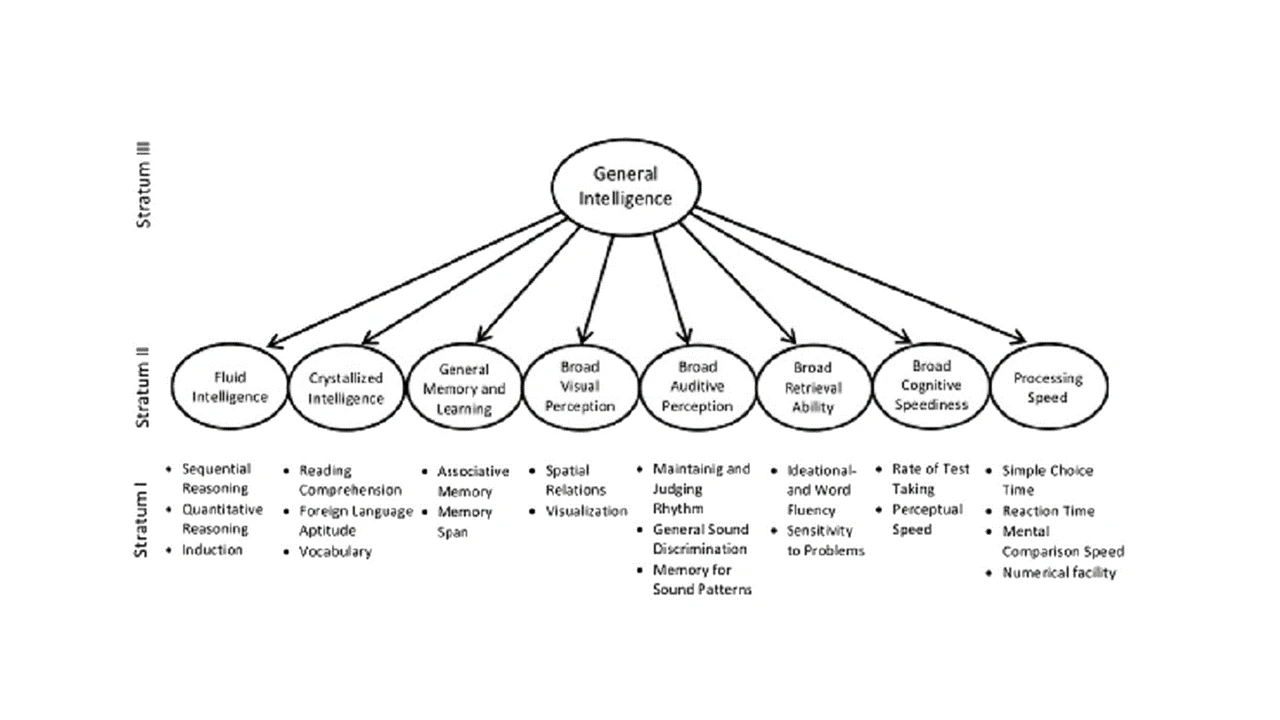
CHC theory organizes cognitive abilities into three hierarchical levels (strata), each representing a different degree of generality:
Stratum I: Narrow Abilities (70+ specific cognitive skills)
Stratum III - General Intelligence (g): The apex of the hierarchy, representing the common variance shared across all cognitive tasks. This general factor accounts for the positive manifold - the observation that people who do well on one cognitive test tend to do well on most others. ACIS measures this as Full Scale IQ (FSIQ).
Stratum II - Broad Abilities: Approximately 16 broad cognitive domains that represent major categories of cognitive function. These include Fluid Reasoning (Gf), Crystallized Intelligence (Gc), Visual Processing (Gv), Processing Speed (Gs), and more.
Stratum I - Narrow Abilities: Over 80 specific abilities that cluster within the broad domains. For example, within Gc (Crystallized Intelligence), narrow abilities include Lexical Knowledge, General Information, and Language Development.
3 The Main Broad Abilities in CHC Theory
CHC theory currently recognizes approximately 16 broad abilities. That answer matters because many people search for how many broad abilities are in CHC theory without realizing that the number comes from the full research framework, not from any one single battery. ACIS currently reports six CHC-aligned broad domains in its public score structure:
Fluid Reasoning Gf
The ability to solve novel problems using logic, pattern recognition, and abstract thinking without relying on prior knowledge. Gf is considered the "purest" measure of reasoning ability - research by Conway et al. (2003) shows it correlates .80-.90 with working memory. Tasks include matrix reasoning, visual analogies, and inductive/deductive logic problems. Gf peaks in early adulthood (mid-20s) and shows gradual decline with age, as documented by Salthouse (2004).
Crystallized Intelligence Gc
The breadth and depth of acquired knowledge and the ability to apply it. Gc reflects cultural learning and educational experience - vocabulary, general information, verbal reasoning. Unlike Gf, crystallized intelligence continues to grow throughout most of the lifespan, often not declining until very late in life.
Visual Processing Gv
The ability to perceive, analyze, synthesize, and mentally manipulate visual patterns and spatial relationships. Includes visualization (imagining how objects would look rotated or transformed), spatial relations, and visual memory. Critical for fields like architecture, engineering, surgery, and art.
The speed and efficiency with which simple cognitive tasks can be performed, particularly under time pressure. Reflects how quickly the cognitive system can execute basic operations. Gs is highly sensitive to brain health and shows notable decline with aging and neurological conditions, as documented in the Scottish Mental Surveys.
Short-Term Memory and Working Memory Gsm / Gwm
Gsm refers to short-term memory: the ability to briefly hold information in conscious awareness. Gwm refers to working memory capacity: the ability to hold information and mentally manipulate it to reach a result. That distinction matters because many readers search for the Gwm definition and assume it means simple short-term storage. In CHC theory, Gwm is the more active, reasoning-relevant construct. See D'Esposito & Postle (2015) in the Annual Review of Psychology for a review of the neural mechanisms that support holding and manipulating information in working memory.
Quantitative Knowledge Gq
The store of acquired mathematical knowledge and the ability to apply quantitative concepts to solve problems. Includes numerical facility, mathematical achievement, and quantitative reasoning. Gq is partially crystallized (learned) but also involves fluid reasoning with numbers.
4 How Many Broad Abilities Are in CHC Theory?
The short answer is that modern CHC references usually discuss about 16 broad abilities, depending on the edition or update you are reading. That is why two pages about CHC sometimes list slightly different totals. The core structure is stable, but the exact count can shift as researchers refine definitions, split constructs, or add under-specified domains.
Beyond the six abilities currently emphasized by ACIS, CHC theory recognizes several other broad abilities. These additional domains help explain why the full CHC model is larger than what most people see on a single web page or a single test report:
Auditory Processing (Ga): Perceiving, analyzing, and synthesizing patterns among auditory stimuli. Important for language acquisition and music.
Long-Term Storage & Retrieval (Glr): The ability to store and fluently retrieve information from long-term memory. Includes associative memory and ideational fluency.
Reading & Writing (Grw): Acquired knowledge and skills related to written language, including reading decoding, comprehension, and writing ability.
Reaction Time/Decision Speed (Gt): The speed of making very simple decisions or responses, often measured in milliseconds.
Psychomotor Speed (Gps): The speed and fluidity of physical body movements (beyond cognitive speed).
Olfactory Abilities (Go): The ability to detect and process information via the sense of smell.
Tactile Abilities (Gh): The ability to detect and process information via touch.
Kinesthetic Abilities (Gk): The ability to perceive body position and movement.
Domain-Specific Knowledge (Gkn): Specialized knowledge in particular domains (e.g., mechanical knowledge, knowledge of games).
5 CHC Narrow Abilities: What Sits Under the Broad Domains
Each broad ability comprises multiple narrow abilities. This is the part many quick summaries skip. If broad abilities are the main domains, narrow abilities are the more specific skills that live inside them. Understanding narrow abilities helps explain why two people can share the same broad score pattern while still looking different at the subtest level.
Within Fluid Reasoning (Gf):
Induction (I): Discovering underlying rules or patterns from specific instances
General Sequential Reasoning (RG): Logical step-by-step reasoning
Quantitative Reasoning (RQ): Reasoning with numbers and mathematical concepts
Within Crystallized Intelligence (Gc):
Lexical Knowledge (VL): Vocabulary breadth and depth
General Information (K0): Store of general factual knowledge
Language Development (LD): General language ability and understanding
Listening Ability (LS): Comprehending spoken language
CHC theory has become essential for modern cognitive assessment because it provides:
Comprehensive Coverage: Ensures that tests sample the full range of human cognitive abilities rather than just a subset, reducing construct underrepresentation.
Theoretical Grounding: Allows test developers to build assessments based on a well-validated empirical framework rather than intuition or tradition.
Clinical Utility: Enables practitioners to identify specific cognitive strengths and weaknesses with greater precision, leading to better intervention planning.
Cross-Battery Assessment: Provides a common language (the "CHC nomenclature") for integrating results from different test batteries to create a comprehensive cognitive profile.
Research Integration: Allows findings from different studies and instruments to be compared and synthesized within a unified framework.
ACIS was designed from the ground up with CHC theory as its foundation. The test's 20 subtests systematically assess abilities across six broad CHC domains, providing comprehensive coverage of the most g-loaded abilities:
This structure is designed to support a broader estimate of general intelligence while also providing interpretable index- and subtest-level information. CHC alignment is a framework for test design and interpretation; it is not, by itself, a substitute for reliability evidence, validity evidence, norming, and transparent technical documentation. Public g-loading and convergent-validity figures will be released in ACIS technical documentation as that reporting is finalized.
CHC theory continues to evolve as researchers refine our understanding of cognitive abilities:
1941: Raymond Cattell proposes the distinction between fluid (Gf) and crystallized (Gc) intelligence.
1965-1998: John Horn expands Gf-Gc theory to include additional broad abilities (Gv, Gs, Gsm, Glr, Ga, Gq).
1993: John Carroll publishes "Human Cognitive Abilities," establishing the three-stratum model based on factor analysis of 460+ datasets.
1998-2005: Kevin McGrew and colleagues formally integrate Horn-Cattell and Carroll frameworks into unified CHC theory.
2012: Major update distinguishes between Short-Term Memory (Gsm) and Working Memory Capacity (Gwm) as separate constructs.
2018-Present: Ongoing refinements including better articulation of processing speed factors and addition of new abilities like Domain-Specific Knowledge (Gkn).
ACIS follows current CHC-informed conventions for public domain reporting while keeping technical claims tied to available norming, reliability, validity, and documentation evidence.
9 Key References
For those wishing to explore CHC theory in greater depth:
Carroll, J.B. (1993): Human Cognitive Abilities: A Survey of Factor-Analytic Studies. WorldCat.
McGrew, K.S. (2009): CHC theory and the human cognitive abilities project: Standing on the shoulders of the giants of psychometric intelligence research. Intelligence, 37(1), 1-10. DOI: 10.1016/j.intell.2008.08.004
Schneider, W.J. & McGrew, K.S. (2018): The Cattell-Horn-Carroll theory of cognitive abilities. In D.P. Flanagan & E.M. McDonough (Eds.), Contemporary intellectual assessment (4th ed.). Guilford Press.
Horn, J.L. & Cattell, R.B. (1966): Refinement and test of the theory of fluid and crystallized general intelligences. Journal of Educational Psychology, 57(5), 253-270. DOI: 10.1037/h0023816
McGrew, K.S. (2003-2004): Cattell-Horn-Carroll (CHC) Definition Project, Institute for Applied Psychometrics: the consensus definitions of the broad and narrow abilities. The original page has been offline since 2011; archived copy (Internet Archive, 2010). Current definitions are in Schneider & McGrew (2018), above.
Conway, A.R.A. et al. (2003): Working memory capacity and its relation to general intelligence. PubMed.
D'Esposito, M. & Postle, B.R. (2015): The cognitive neuroscience of working memory. Annual Review of Psychology, 66, 115-142. DOI: 10.1146/annurev-psych-010814-015031.
Salthouse, T.A. (2004): Age-related changes in cognitive abilities and processing speed. ScienceDirect.
Deary, I.J., Penke, L. & Johnson, W. (2010): The neuroscience of human intelligence differences. Nature Reviews Neuroscience. DOI: 10.1038/nrn2793.
AERA, APA, & NCME (2014): Standards for Educational and Psychological Testing. APA Standards.
10 FAQ: CHC Theory, Broad Abilities, and Gwm
What is the CHC model?
The CHC model is the Cattell-Horn-Carroll theory of intelligence, a hierarchical framework that organizes intelligence into g, broad abilities, and narrow abilities.
What does CHC stand for?
CHC stands for Cattell-Horn-Carroll, the three researchers whose work was integrated into the modern CHC theory of intelligence.
How many broad abilities are in CHC theory?
Most modern CHC references describe about 16 broad abilities, although different summaries may list slightly different totals depending on the update being used.
What is Gwm in CHC theory?
Gwm means working memory capacity: the ability to hold information in mind and mentally manipulate it during reasoning, calculation, or problem solving.
Is Gwm the same as short-term memory?
No. Short-term memory is more about brief storage, while Gwm adds active manipulation and mental control.
What is the difference between broad and narrow abilities?
Broad abilities are large domains like Gf or Gc. Narrow abilities are the more specific skills nested under those domains.
Is CHC theory the same as g?
No. CHC includes g at the top of the hierarchy, but it also includes multiple broad and narrow abilities below it.
Why does CHC matter in IQ testing?
CHC matters because it gives modern tests a shared framework for domain selection, score interpretation, and multi-ability profiling.
Do modern IQ tests measure every CHC broad ability?
No. Most modern IQ tests sample only part of the full CHC framework rather than trying to measure every broad ability in one battery.
Is CHC theory used in professional IQ tests?
Yes. Many modern professional batteries are interpreted through CHC-style domains even when publishers use their own score names and technical language.
Can CHC theory explain uneven cognitive profiles?
Yes. A major strength of CHC is that it helps explain why one person can be strong in some broad abilities and weaker in others rather than being reduced to one number.
Is CHC theory only used with children?
No. CHC is used across the lifespan and informs batteries for children, adolescents, and adults, even though the exact tests differ by age and purpose.
What is Gf in CHC theory?
Gf is fluid reasoning: the ability to solve novel problems, detect patterns, infer rules, and reason without relying mainly on learned facts.
What is Gc in CHC theory?
Gc is crystallized knowledge: accumulated verbal knowledge, concepts, vocabulary, and information learned through education and experience.
How does CHC relate to ACIS?
ACIS uses CHC-style domains to organize subtests, interpret index scores, and explain why a broad profile is more useful than one number alone.
11 See CHC Domains in Public ACIS Subtests
ACIS does not treat CHC as an abstract diagram only. The public subtest pages let you see how broad abilities appear in concrete tasks: Figure Weights for fluid reasoning, Digit Span for working memory, Coding for processing speed, and Antonyms plus Similarities for two language-heavy parts of verbal comprehension.
That matters because CHC becomes much easier to interpret when the framework is tied to recognizable task demands instead of only score labels and abbreviations.