Learn the six cognitive domains in IQ testing and how verbal
comprehension, fluid reasoning, visual-spatial ability, working
memory, processing speed, and quantitative reasoning shape a
cognitive profile.
VCIFRIVSIWMIPSIQRI
1 What Are the Six Cognitive
Domains in IQ Testing?
Updated September 19, 2026 by Structural.
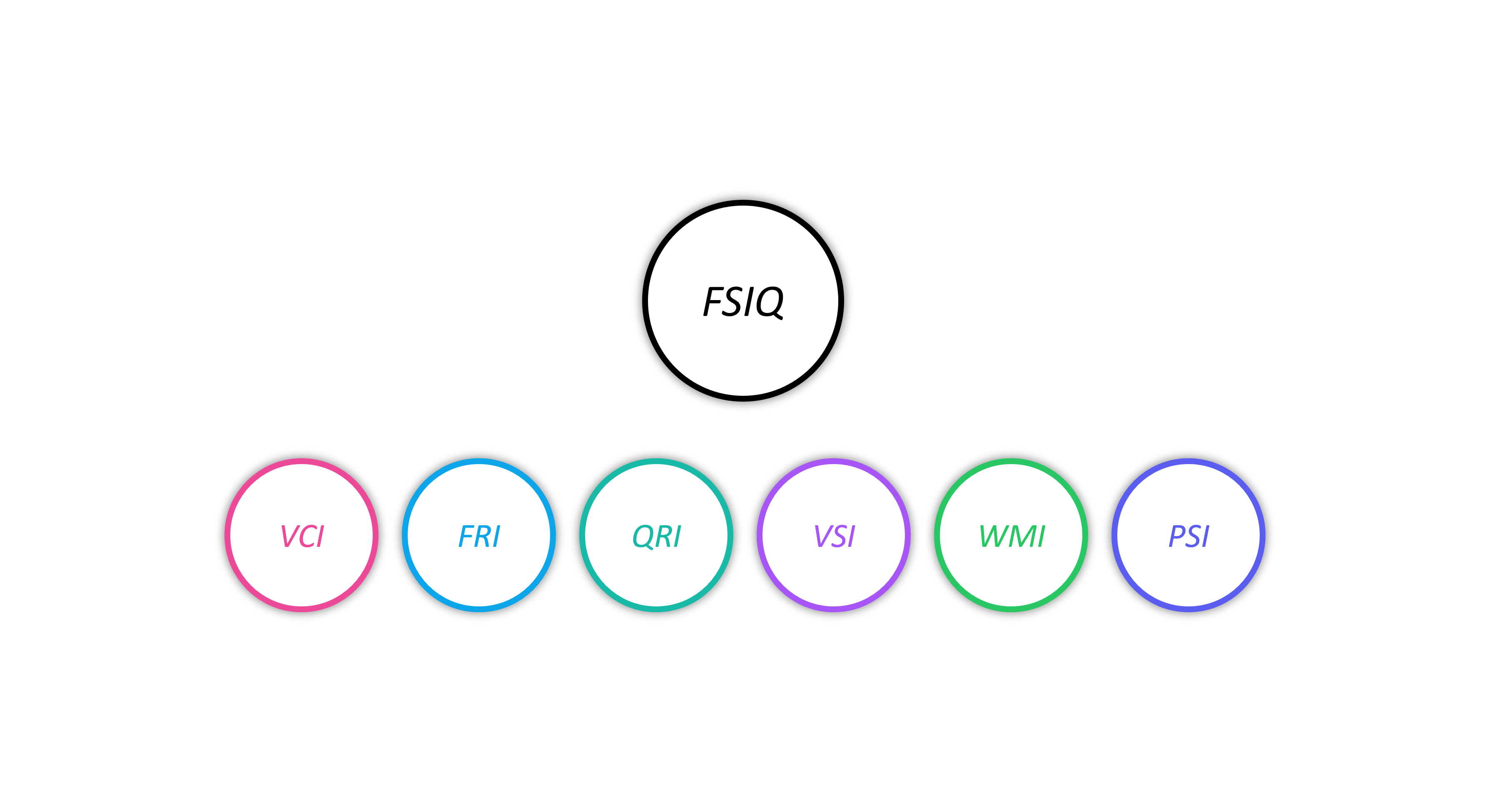
Cognitive domains in IQ testing are the broad ability areas that sit underneath an overall IQ score. The six core domains discussed on this page are verbal comprehension, fluid reasoning, visual-spatial ability, working memory, processing speed, and quantitative reasoning.
Notice that this list carves ability up by function rather than by hemisphere, which is why sorting people into left-brained and right-brained types fails: narrow functions such as language do lean to one side, but nothing as broad as logic or creativity lives there. Sampling all six domains is a question of test design rather than venue, and it is one of the things a serious online IQ test has to do before its overall score can stand for general ability.
ACIS measures six broad cognitive abilities derived from the
Cattell-Horn-Carroll (CHC) theory - the
most comprehensive and empirically validated framework for
understanding human intelligence. This hierarchical model,
synthesized by
Kevin McGrew
from the work of
Cattell & Horn
and
John Carroll, now underlies all major intelligence tests.
Research from
Flanagan & Harrison (2012)
in Contemporary Intellectual Assessment demonstrates that
these broad abilities are reliably measurable, developmentally
stable, and predictive of real-world outcomes. Each domain
represents a distinct aspect of cognitive functioning, though all
are interrelated through the
general factor of intelligence (g).
For a focused explanation of that shared factor, read
G Factor Explained. For the Gf and Gc split, read Fluid vs. Crystallized Intelligence.
If you are comparing online assessments, the
Best Online IQ Tests ranking
uses domain coverage as one of the reasons broad batteries score
higher than narrow puzzle tests.
Your cognitive profile shows your relative strengths and weaknesses
across these domains. Understanding your pattern helps with
educational planning, career choices, and self-awareness. Two people
with identical Full Scale IQs can have dramatically different
profiles.
Verbal Comprehension measures
crystallized intelligence (Gc) - your accumulated
knowledge, vocabulary depth, verbal reasoning, and ability to
communicate ideas through language. According to
Horn & Cattell's research, Gc reflects both innate language aptitude and the accumulated
effects of education, reading, and cultural exposure.
Academic aptitude in humanities and social sciences
Developmental trajectory: Unlike fluid abilities,
crystallized intelligence continues growing throughout most of the
lifespan, often not declining until very late in life. See
Salthouse (2004)
for research on cognitive aging trajectories.
Fluid Reasoning assesses your ability to solve novel problems,
identify patterns, and think logically
without relying on previously acquired knowledge.
According to
Carroll's taxonomy, Gf is considered the "purest" measure of reasoning ability and is
highly g-loaded.
High g-loading is what the validity pillar of an accurate IQ score asks for: a task that tracks general ability rather than one learned trick, which is why matrix items anchor so many batteries.
High potential for STEM fields and complex analysis
Developmental trajectory: Fluid intelligence peaks
in the mid-20s and shows gradual decline with age. However, this
decline can be partially offset by crystallized knowledge and
expertise. Research by
Horn & Cattell
established this differential aging pattern, later confirmed by
decades of longitudinal research.
Visual-Spatial Processing measures your ability to perceive,
analyze, synthesize, and mentally manipulate visual patterns and
spatial relationships. This includes mental rotation, visualization
of objects from different perspectives, and understanding spatial
arrangements. Mental imagery is not a prerequisite for any of it, because people with aphantasia solve the same spatial items with no voluntary visual image at all, which is the clearest evidence that imagery is a strategy rather than the capacity being scored.
Within the visual domain, spatial intelligence includes several related abilities; rotation, visualization and navigation should not be treated as identical tasks.
What high VSI indicates:
Strong mental rotation and visualization abilities
Excellent spatial reasoning and navigation
Aptitude for engineering, architecture, and design
Strong geometric and mechanical reasoning
Ability to understand complex diagrams and blueprints
Career relevance: High visual-spatial ability is
particularly predictive of success in STEM fields, surgery,
athletics, art, and any occupation requiring manipulation of objects
or navigation through space. See
Wai, Lubinski & Benbow (2009)
in Psychological Science and
research on spatial ability and STEM.
Working Memory is your ability to hold information in conscious
awareness and manipulate it in real-time. It's the "mental
workspace" where you temporarily store and process information
needed for complex cognitive tasks. Research by
Conway et al. (2003)
demonstrates that working memory capacity correlates .80-.90 with
fluid intelligence.
Capacity of this kind is nothing like camera-like storage, and claims of literal photographic memory come apart under controlled testing: even people with exceptional autobiographical recall still fall for standard false-memory procedures.
What high WMI indicates:
Strong capacity to hold multiple pieces of information
simultaneously
Excellent mental arithmetic and calculation abilities
Ability to follow complex, multi-step instructions
Resistance to distraction during cognitive tasks
Why it matters: Working memory is strongly
implicated in nearly all complex cognition. Deficits are associated
with learning disabilities, ADHD, and age-related cognitive decline.
For the neural mechanisms of working memory, see
D'Esposito & Postle (2015)
in the Annual Review of Psychology.
Processing Speed measures how quickly and efficiently you can
perform simple cognitive operations, particularly under time
pressure. It reflects the speed at which the cognitive system can
execute basic mental operations.
Speed is also the most age-sensitive of the six, which is why an IQ test built for adults has to compare a 60 year old with other adults of similar age rather than with a pooled sample dominated by people in their twenties.
The focused processing speed measurement guide explains how timed task performance contributes to an index without standing in for general intelligence.
What high PSI indicates:
Rapid execution of simple cognitive tasks
Quick visual scanning and pattern matching
Efficient cognitive processing under time pressure
Fast reaction times in cognitive contexts
Good performance on timed tests and deadline-driven work
Clinical significance: Processing speed is
particularly sensitive to brain health and shows notable decline
with aging and neurological conditions. It's often the first
cognitive domain to show deficits in conditions like traumatic brain
injury, multiple sclerosis, and normal aging. See
Whalley & Deary (2001)
in the BMJ and
Salthouse's processing speed theory.
Quantitative Reasoning measures your mathematical knowledge,
numerical facility, and ability to reason with numbers and
quantities. According to
CHC theory, it combines crystallized knowledge (learned mathematical facts
and procedures) with fluid reasoning applied to quantitative
problems.
What high QRI indicates:
Strong mathematical knowledge and numerical skills
Ability to solve quantitative word problems
Aptitude for data analysis and statistics
Facility with mental calculation and estimation
Strong foundation for STEM and finance careers
Educational implications: QRI is particularly
predictive of success in mathematics, science, engineering,
economics, and quantitative fields. Research from the
Journal of Educational Psychology
shows that early quantitative reasoning predicts later mathematical
achievement. See also
research on intelligence and educational outcomes.
Practice effects are minimal for well-constructed
tests, but significant prior exposure to similar tests may
slightly inflate scores
Context matters: temporary factors like fatigue,
anxiety, or distraction can affect performance
Remember that your cognitive profile is one dimension of who you
are. Personality, motivation, opportunity, and life circumstances
all interact with cognitive ability to shape real-world outcomes.
For more on the relationship between IQ and life outcomes, see our
article on IQ and Success; for career-group estimates and occupational selection cautions, see Average IQ by Profession.
Baddeley, A. (2003). Working memory: Looking back and looking forward. Nature
Reviews Neuroscience, 4, 829-839.
Salthouse, T.A. (1996). The processing-speed theory of adult age differences in
cognition. Psychological Review, 103(3), 403-428.
Uttal, D.H. et al. (2013). The malleability of spatial skills: A meta-analysis of training
studies. Psychological Bulletin, 139(2), 352-402.
Miyake, A. et al. (2000). The unity and diversity of executive functions and their
contributions to complex "frontal lobe" tasks. Cognitive
Psychology, 41(1), 49-100.
Nisbett, R.E. et al. (2012). Intelligence: New findings and theoretical developments.
American Psychologist, 67(2), 130-159.
Take the assessment
You get a profile, not a number
ACIS measures six CHC domains across 20 subtests and reports each one with its own normed score and confidence interval, so you can see where you are strong and where you are not.