Mathematical Achievement
About Mathematical Achievement
Mathematical-achievement tasks emphasize learned quantitative knowledge, familiar procedures, and the application of school-based mathematical content. They sit closer to educational attainment than to pure novel reasoning, even when the problems still require care, interpretation, and accurate execution.
The historical roots here are educational measurement and school achievement testing, where examiners needed ways to compare what students had actually learned from instruction. When such tasks appear near intelligence measures, they can help separate acquired quantitative knowledge from more abstract or unfamiliar forms of reasoning.
These tasks are most informative when read beside arithmetic and broader domain discussions. A person can show solid learned mathematics while being more average on nonverbal abstraction, or the reverse, which is exactly why many batteries keep quantitative attainment distinct from fluid reasoning.
What it measures
Mathematical-achievement tasks measure acquired quantitative knowledge and the ability to apply learned procedures. They can include number concepts, operations, formulas, or school-based problem solving. This differs from pure fluid reasoning because the score depends partly on instruction, practice, and familiarity with conventional mathematical notation.
CHC domain
In CHC terms, this task is related to quantitative knowledge and reasoning (Gq). Gq covers acquired mathematical knowledge, number concepts, and the use of quantitative procedures. Interpretation should separate learned mathematics from unfamiliar fluid reasoning, because a person may be strong in one of those areas without being equally strong in the other.
How to interpret performance
A strong result suggests that learned math knowledge is available and usable under structured conditions. A weaker result can reflect gaps in instruction, anxiety, speed, working memory, or unfamiliar notation. It should be interpreted separately from nonverbal reasoning because a person can reason well while having uneven academic math exposure.
Profile context
One subtest should never be read as the whole construct. CHC-informed interpretation is strongest when related tasks are compared across domains: verbal knowledge with other verbal tasks, fluid reasoning with other novel problem-solving tasks, spatial work with other visual tasks, and speed or memory tasks with their closest neighbors. The pattern is usually more informative than any isolated score.
Interpretation cautions
This public page describes the task family and the general cognitive construct. It does not disclose protected ACIS item content, scoring keys, adaptive rules, or administration details. A serious interpretation should use the full score profile, reliability evidence, age norms, confidence intervals, and the reason the assessment was taken.
This public version keeps the background and interpretive context visible while the interactive task remains locked.
Quick FAQ
What does Mathematical Achievement measure?
Mathematical-achievement tasks measure acquired quantitative knowledge and the ability to apply learned procedures. They can include number concepts, operations, formulas, or school-based problem solving. This differs from pure fluid reasoning because the score depends partly on instruction, practice, and familiarity with conventional mathematical notation.
Which CHC domain is Mathematical Achievement related to?
In CHC terms, this task is related to quantitative knowledge and reasoning (Gq). Gq covers acquired mathematical knowledge, number concepts, and the use of quantitative procedures. Interpretation should separate learned mathematics from unfamiliar fluid reasoning, because a person may be strong in one of those areas without being equally strong in the other.
How should Mathematical Achievement performance be interpreted?
A strong result suggests that learned math knowledge is available and usable under structured conditions. A weaker result can reflect gaps in instruction, anxiety, speed, working memory, or unfamiliar notation. It should be interpreted separately from nonverbal reasoning because a person can reason well while having uneven academic math exposure.
Does the Mathematical Achievement page reveal ACIS test items?
No. The public Mathematical Achievement page explains the task family and cognitive construct, but it does not disclose protected ACIS item content, scoring keys, adaptive rules, or administration details.
Instructions
- You will answer 25 mathematical questions.
- Total time limit: 35 minutes.
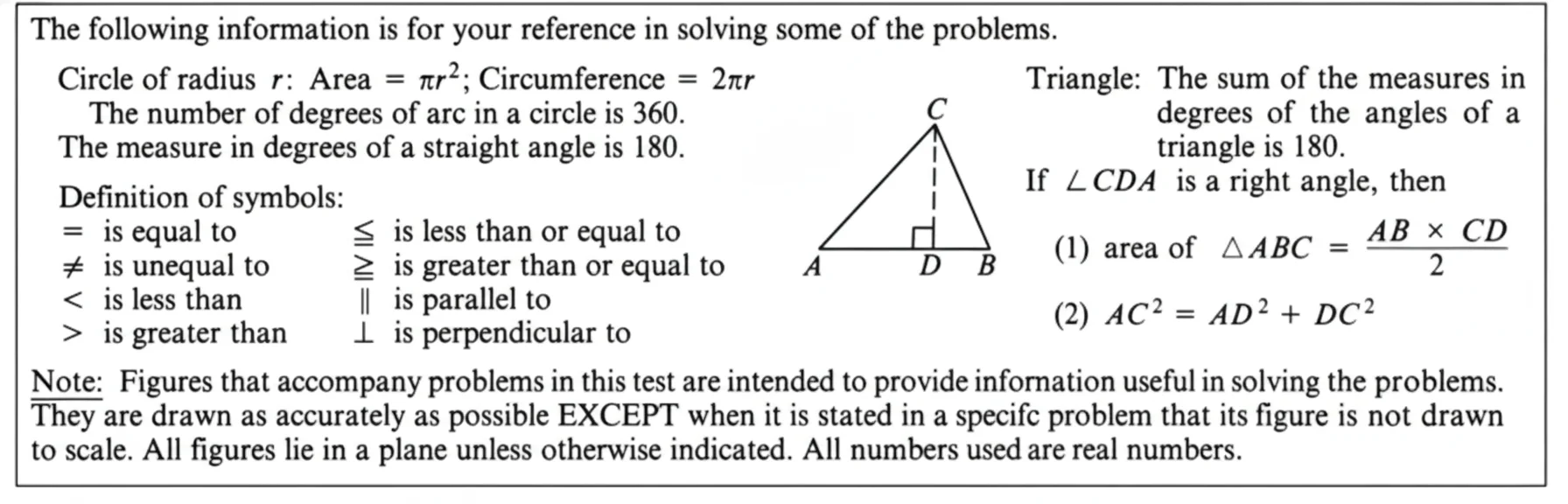
- A reference table with formulas is available. Click its header to expand or collapse it when needed.
- Pen and scratch paper are allowed (no calculators).
- No external aids are allowed, including calculators, websites, or outside assistance.
- Each correct answer scores 1 point; incorrect answers have no penalty.
- Select I don't know if unsure. There is no penalty for wrong answers.
- Press Begin to start.
Loading items...