Verbal Comprehension
Antonyms, Information, Vocabulary, Similarities, Synonyms.
- Adaptive reading
- Pragmatic markers
The ACIS IQ Test is a carefully developed, professional online intelligence assessment for individuals who want to understand their cognitive abilities, identify their strengths and weaknesses, and see how they compare to others. It is also designed to be useful for psychologists, researchers, clinicians, and employers.
Every plan gives your Full Scale IQ with its 95% confidence interval; Full Scale measures all 20 subtests across six domains. Plans start at $15, one-time payment, no subscription.
✓ Free trial, no card needed ✓ Quality guarantee included ✓ 45 minutes to 3 hours, breaks allowed
Built on published psychometric evidence
A 45 second demo of the Full Scale assessment, including the subtest list, Visual Sequence, Digit Span, Coding, Symbol Search, assessment progress and the results dashboard. Illustrative scores. The assessment flow is condensed. Silent playback, no spoken narration.
Same platform, checkout, and report flow. The difference is how much of the battery you unlock. You can try any tier free before you pay.
Fast baseline across core ACIS domains. You can take breaks and resume your test anytime within 30 days.
Overall balance between breadth and time. You can take breaks and resume your test anytime within 30 days.
Complete battery with the highest detail level. You can take breaks and resume your test anytime within 30 days.
Build a battery from the exact subtests you want. Any domain you complete returns its full index score, and every subtest returns its scaled score.
Every paid ACIS assessment returns a complete, readable profile. You see how each score was built and what it means.
Most online IQ tests produce a fast number from a handful of puzzles. ACIS is a structured battery with adult norms, transparent scoring, and a report that explains the profile behind the score.
Broad coverage of verbal, fluid, visual spatial, working memory, processing speed, and quantitative reasoning.
Scores are interpreted within an adult reference frame of 3,243 eligible records, ages 16 to 90.
Designed on CHC theory and refined through factor analytic (CFA) review, with reliability reporting.
Index scores, subtest scores, percentiles, and interpretation, not only a single final number.
Each domain is measured through multiple subtests, providing granular insight into distinct cognitive faculties.
Antonyms, Information, Vocabulary, Similarities, Synonyms.
Visual Puzzles, Layer Rotation, Spatial Comprehension.
Matrix Reasoning, Figure Weights, Visual Number Series, Logic Grid, Complex Relations.
Mathematical Achievement, Arithmetic.
Digit Span, Alphanumeric Sequencing, Visual Sequence.
Coding, Symbol Search.
Start free, then unlock your Full Scale IQ and the complete report whenever you are ready.
Each option uses the same ACIS platform, checkout, and reporting flow. The difference is how much of the battery you unlock and how much detail you want in your final profile.
Fast baseline across core ACIS domains. You can take breaks and resume your test anytime within 30 days.
Overall balance between breadth and time. You can take breaks and resume your test anytime within 30 days.
Complete battery with the highest detail level. You can take breaks and resume your test anytime within 30 days.
Build a battery from the exact subtests you want. Any domain you complete returns its full index score, and every subtest returns its scaled score.
Overall balance between breadth and time.
Best for most users who want solid breadth without the full battery.
Keep your completed trial results and unlock the remaining subtests.
One time payment. Your completed subtests are kept.
This information helps us improve the accuracy of our norms. All data is securely stored; your username may appear on shared reports.
Your data is securely stored and not shared unless you create a verified dashboard link.
Please confirm each condition below to ensure the most accurate and valid assessment results.
These conditions help ensure your results accurately reflect your true cognitive abilities.
Please read carefully before enabling
Extended norms allow measurement beyond the standard ceiling of 160 (up to 169 in Full Scale), but please be aware:
Extended norms are best suited for research or exploratory purposes.
ACIS is built on the Cattell-Horn-Carroll (CHC) framework, the most widely accepted theory of cognitive abilities. We focus on adult norms, structured subtest coverage, careful score interpretation, and continuous technical refinement.
Full Scale FSIQ shows a tight score margin, so users can see the precision behind their result.
Adult English-speaking reference frame covers ages 16 to 90; technical tables use N = 2,750 complete records.
The Full Scale score shows a very strong general-intelligence signal while preserving domain-level interpretation.
Access the ACIS technical manual for structure, norming, reliability, validity evidence, confirmatory factor analysis, g-loadings, and composite interpretation.
For score interpretation, start with What Is a Good IQ?, IQ Score Chart, and IQ Percentile Calculator.
For a faster public-facing overview, see How IQ Scores Are Normed, ACIS Technical Manual, Average IQ by Country, and Average IQ by Education.
Twenty subtests organized into six cognitive domains. A symmetrical framework designed for comprehensive assessment.
Antonyms, Information, Vocabulary, Similarities, Synonyms.
Visual Puzzles, Layer Rotation, Spatial Comprehension.
Matrix Reasoning, Figure Weights, Visual Number Series, Logic Grid, Complex Relations.
Mathematical Achievement, Arithmetic.
Digit Span, Alphanumeric Sequencing, Visual Sequence.
Coding, Symbol Search.
The ACIS framework is built on a symmetrical, hierarchical model. This blueprint visualizes the interconnections between the six core indices and their respective subtests, ensuring comprehensive cognitive coverage.
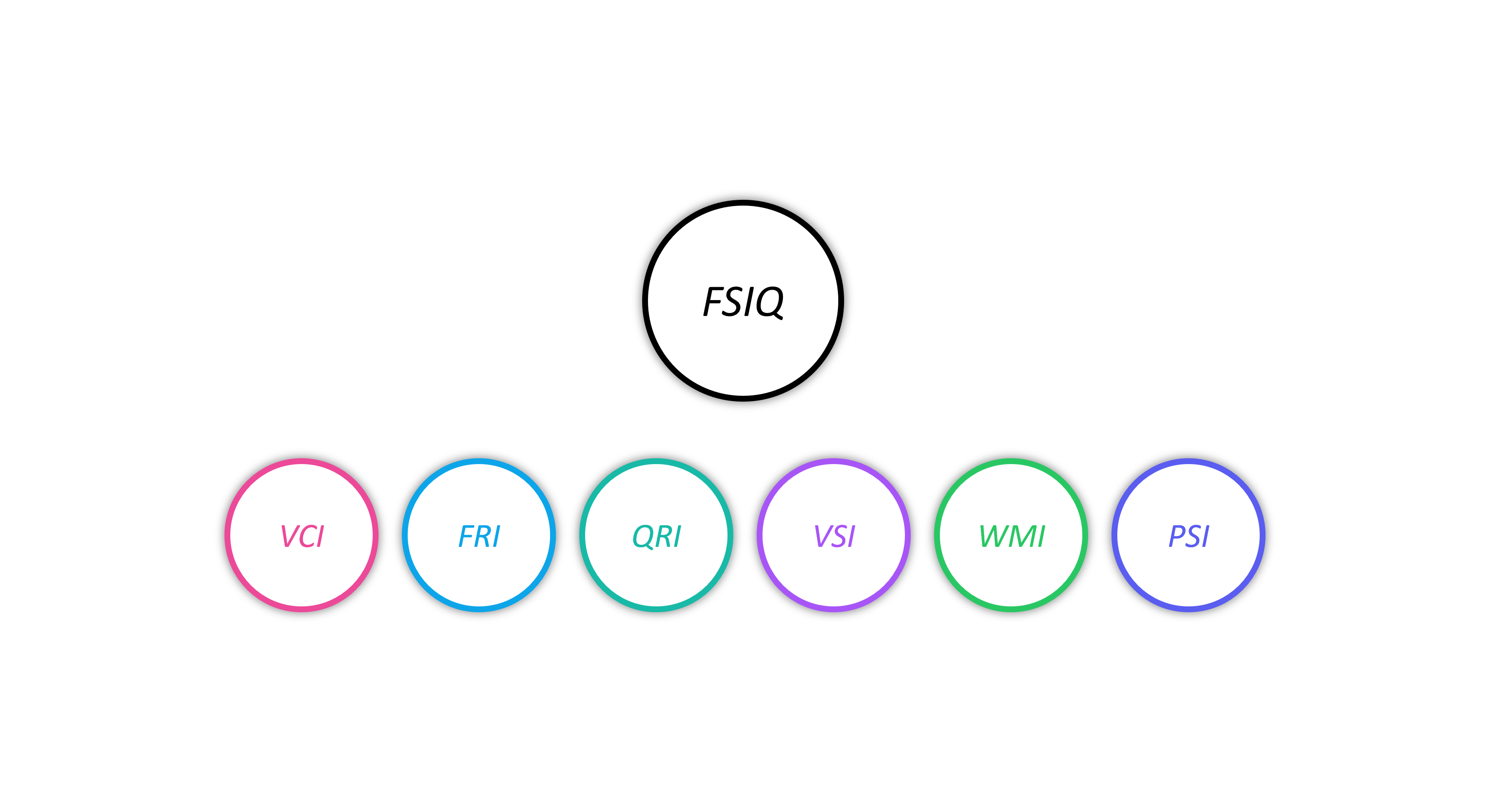
Measures the ability to access and apply acquired word knowledge. Involves verbal concept formation, reasoning, and expression.
Evaluates the ability to evaluate visual details and understand how visual and spatial relationships work together.
Measures the ability to solve new problems, use logic, and adapt to novel situations without relying on prior knowledge or experience.
Measures the ability to perform mental math operations and solve quantitative problems using numerical reasoning.
Measures the ability to register, maintain, and manipulate visual and auditory information in conscious awareness.
Measures speed and accuracy of visual scanning, decision making, and rapid implementation of simple cognitive tasks.
Create a cohort, invite participants through private links, choose whether participants can see results, and manage every ACIS administration from one focused workspace.
A 34 second product demo showing cohort creation, participant links, progress, results, cognitive profiles, analytics and CSV export. Illustrative data. Silent playback, no spoken narration.
A free Professional account includes three Quick administrations. One credit equals one US dollar in pay as you go value. Credits are charged when administration links are created. Subscription credits are used first, followed by pay as you go credits.
Compact screening level profile across core verbal, fluid reasoning, and working memory indicators.
15 credits · 6 subtests · ≈45 minThe complete 20 subtest form for the broadest ACIS profile and most detailed interpretation.
50 credits · 20 subtests · ≈175 minBroader balance of cognitive coverage and administration time across five primary domains.
30 credits · 13 subtests · ≈110 minFlexible billing: start with three Quick administrations on us, pay as you go for a single cohort, or pick a monthly plan when your volume is recurring.
Every Professional account includes three Quick administrations at no cost. After that, purchase exactly the administration links you need with no monthly commitment: two Quick and one Optimized administration use 60 credits in total. See how research teams use ACIS Professional.
For an independent professional or researcher running a focused recurring cohort.
For repeat cohorts and larger monthly administration volume in one Professional account.
For the highest recurring administration volume in a single Professional account.
ACIS remains a self administered online cognitive assessment. It is not a clinical diagnosis, a proctored professional evaluation, or evidence for accommodations, employment selection, legal decisions, or high IQ society admission.
ACIS Professional is designed for people coordinating repeated administrations who need participant control, transparent technical documentation, and a predictable way to pay for volume.
Organize cohorts, use participant IDs, keep results administrator only when needed, and export structured score summaries.
Best first use fitUse ACIS as an informational cognitive self assessment, choose the appropriate form, and control the participant report experience.
Recurring workflowRun higher volume cohorts from one Professional account with predictable monthly capacity and structured exports.
High volume workflowName the batch, choose its ACIS forms, and set a completion window.
Set participant codes and choose whether participants can see their results.
Send private links while your workspace tracks starts and completions.
Open reports, monitor the cohort, and export permitted score summaries.
Control the participant experience without silently changing scoring rules or mixing forms in ways that weaken interpretation. Each administration records the ACIS form and context used.
Choose whether results stay with the administrator or can also be viewed by the participant.
Keep cohort timelines organized with links that expire after the selected window.
See invitations, starts, completions, and eligible result records in one view.
Export permitted score summaries without exposing test content or scoring keys.
Choose the plan that fits your volume, configure your first cohort, and manage every administration from one focused workspace.
ACIS Professional supports research and informational administration workflows. ACIS remains a self administered cognitive assessment and is not a clinical diagnosis or a proctored professional evaluation.
ACIS is the result of years of dedicated research, psychometric analysis, and a passion for cognitive science. From 2022 to 2025, we built a tool for everyone.
ACIS was developed between 2022 and 2025 through sustained research reading, CHC-based blueprinting, iterative item development, norming work, reliability review, and ongoing psychometric analysis. My goal has been to provide a serious cognitive assessment that is far more accessible than traditional in-person testing while still supporting careful interpretation of cognitive profiles.
ACIS will continue to evolve through regular normative updates and improvements to measurement quality, usability, and accessibility. The platform is now compatible with mobile devices as well as larger screens, while expanded language support and ongoing cross-device refinements remain active priorities. ACIS is not a licensed clinical evaluation or an official substitute for proctored testing; it is a transparent web-based assessment built around psychometric standards, technical documentation, and responsible score limits. Feedback and collaboration inquiries are welcome.
From concept to validation, the evolution of ACIS.
Conceptualization of the CHC-based framework. Initial item drafting and domain selection.
Platform engineering and rigorous item creation. Pilot testing of subtest mechanics.
Extensive norming studies. Psychometric validation against g-loadings and reliability checks.
Official release of ACIS v1.0. Continuous improvement of norms and accessibility features.
ACIS methodology is guided by educational and psychological testing standards, ITC test-use and adaptation guidance, CHC theory, factor-analytic research, and professional battery documentation.
Credit is also due to the open psychometric literature, official professional-test documentation, open web technologies, and user feedback that shaped the ACIS blueprint, item formats, reporting language, accessibility work, and technical documentation.
Transparent answers about validity, scoring, and the science behind ACIS.
The Advanced Comprehensive Intelligence Scale (ACIS) is a high-range cognitive assessment tool designed to measure general intelligence (g) through 20 distinct subtests. It is built on the Cattell-Horn-Carroll (CHC) theory of cognitive abilities, one of the most widely accepted frameworks for human cognitive abilities in modern psychometrics.
Yes. ACIS is a self-administered online IQ test with 20 subtests, adult norms, IQ and domain scores, and detailed score reporting. It is intended for personal insight and structured cognitive self-understanding, not official clinical, legal, employment, or high-IQ society decisions.
Free online IQ tests often use short item sets, unclear norms, or a single score. ACIS is a paid online IQ test because it includes timed subtests, adult norms, domain, index, and subtest reporting, percentile context, and tiered reports. It is still a self-administered assessment for personal insight, not an official clinical test.
Yes, for its intended use as a self-administered adult cognitive assessment. ACIS is not a licensed, proctored clinical instrument, but it is built around psychometric best practices, interpreted within an adult English-speaking reference frame of 3,243 eligible records, and refined through factor-analytic review. Current technical tables use N = 2,750 complete records and report omega, SEM, g-loading, and CFA evidence in the public technical manual.
The Full-Scale IQ (FSIQ) is a composite score derived from the sum of scaled scores across all subtests. It is standardized with a mean of 100 and a standard deviation of 15, allowing for direct comparison with other major standardized intelligence scales.
Yes, within the limits of a self-administered online assessment. ACIS is a 20-subtest cognitive assessment built for careful online measurement and adult self-understanding. It provides structured score reporting across six broad domains, while the public technical manual reports g-loading, reliability, SEM, and internal-structure evidence. The primary difference from traditional assessments is the administration format: ACIS is self-administered online and is best used for personal insight, educational planning, and structured cognitive self-understanding, while many official pathways still prefer or require proctored evidence.
All ACIS assessments require a one-time payment: Quick ($15), Optimized ($30), and Full Scale ($50). Our mission is to provide high-quality cognitive testing at accessible prices. All results, detailed reports, and comprehensive insights are provided without hidden fees for any assessment tier you complete.
You can contact Structural via Reddit (u/407-proxy-MR). For methodology details and technical context, see the About and FAQ pages.
The Cattell-Horn-Carroll (CHC) theory is the most comprehensive and empirically supported framework for understanding human cognitive abilities. It organizes intelligence into three strata: narrow abilities (specific skills), broad abilities (like fluid reasoning and crystallized intelligence), and general intelligence (g). ACIS measures six primary broad abilities: Verbal Comprehension (Gc), Fluid Reasoning (Gf), Visual-Spatial Processing (Gv), Working Memory (Gwm), Processing Speed (Gs), and Quantitative Reasoning (Gq).
Verbal Comprehension (VCI) measures crystallized intelligence - your accumulated knowledge and verbal reasoning. Fluid Reasoning (FRI) assesses your ability to solve novel problems without relying on prior knowledge. Visual-Spatial (VSI) evaluates spatial reasoning and mental manipulation of visual information. Working Memory (WMI) measures your capacity to hold and process information in conscious awareness. Processing Speed (PSI) assesses how quickly you can process simple visual information. Quantitative Reasoning (QRI) measures mathematical reasoning and numerical problem-solving abilities.
The complete ACIS assessment, which includes all 20 subtests, has an estimated average completion time of about 175 minutes (roughly 2 hours and 55 minutes). Quick averages about 45 minutes and Optimized averages about 110 minutes. These are average completion estimates based on the current subtest mix and stopping rules, so individual pace will vary. Your progress is automatically saved between subtests, allowing you to return and continue later.
No. Once a subtest has been started and completed, its score is final and cannot be changed. Subtests cannot be paused, resumed, or repeated after interruption, so begin each subtest only when you have enough uninterrupted time and are ready for your first genuine attempt to count.
Multiple subtests are necessary for comprehensive cognitive assessment. Each subtest measures different narrow abilities that contribute to broader cognitive domains. Having multiple measures per domain increases reliability and allows for a more nuanced understanding of your cognitive profile. The 20-subtest structure ensures that the FSIQ is based on a robust sampling of your cognitive abilities across all major domains.
ACIS is not a replacement for a licensed, proctored professional IQ evaluation. It emphasizes breadth, accessibility, and structured score reporting; with 20 subtests, it provides a broader online cognitive profile than many shorter internet tests. Traditional professional assessments still offer in-person observation, clinician judgment, and official-use pathways that a self-administered online battery cannot replace. ACIS is best understood as a rigorous self-assessment tool rather than a substitute for licensed, proctored evaluation.
A scaled score is a standardized score that allows comparison across different subtests. In ACIS, scaled scores have a mean of 10 and a standard deviation of 3. A scaled score of 10 represents exactly average performance, while scores of 7 or 13 represent performance one standard deviation below or above average, respectively. This standardization makes it possible to compare your performance across subtests that have different raw score ranges.
The current ACIS Full Scale IQ is strongly g-loaded. In the public technical manual, FSIQ has g loading .958; broad composites are also highly saturated, including GAI .954, CFI .949, and GRI .949. Subtest g loadings vary by construct, with reasoning and quantitative tasks generally carrying the strongest general-factor signal.
ACIS score interpretation uses an adult English-speaking reference frame of 3,243 eligible records ages 16 to 90. Current reliability and CFA tables use N = 2,750 complete records. Statistical procedures including item analysis, reliability testing, factor analysis, security filtering, and score-distribution review are applied to keep scoring tables aligned with that adult frame.
ACIS is designed to measure IQ scores ranging from 40 to 160 on the standard scale (mean = 100, SD = 15) for Standard, Quick, and Optimized assessments. Full Scale extended norms reach the 175-177 band. This range spans the ACIS public classifications from Severe Impairment through Profoundly Gifted. The test includes items of varying difficulty to ensure accurate measurement across this entire range without significant floor or ceiling effects.
For the public interpretation layer behind those score bands, see What Is a Good IQ? and the IQ Score Chart.
No. High-IQ societies require scores from approved, proctored assessments administered by qualified professionals. ACIS is a self-administered online test and therefore cannot be used for official membership applications. However, ACIS can give you a reliable indication of whether pursuing official testing might be worthwhile.
Yes, some assessment data is stored, but ACIS does not sell your personal information. Your test progress and results are stored locally in your browser using localStorage. Additionally, when cloud sync is enabled, limited assessment data (anonymous ID, demographic info, scores, and integrity signals) may be transmitted to our secure backend (Supabase) to support test integrity and improve norms. Clearing your browser data will remove locally stored results. For full details, see our Privacy Policy.
ACIS is compatible with desktop computers, laptops, tablets, and modern smartphones. For the best experience on visual and timed subtests, a larger screen, stable internet connection, and quiet environment are still recommended. A physical keyboard can be helpful for tasks like Coding, and headphones are recommended for audio-based subtests like Digit Span.
Time limits serve different purposes depending on the subtest. For Processing Speed subtests (Coding, Symbol Search), time limits are essential as they directly measure how quickly you process information. For other timed subtests, limits prevent excessive rumination and ensure scores reflect spontaneous problem-solving ability rather than unlimited deliberation. Untimed performance on fluid reasoning tasks, for example, would measure persistence rather than cognitive ability.
Several factors can influence your performance: fatigue, sleep deprivation, stress, distractions, illness, and medication can all lower scores. Test anxiety may also impact performance, particularly on timed subtests. For the most accurate results, take ACIS when you are well-rested, alert, and in a quiet environment free from interruptions. Avoid caffeine crashes and ensure you have stable internet connectivity.
It depends on the test; many online IQ tests are not very accurate because they rely on short item sets, unclear norms, or inflated scoring. ACIS differentiates itself with 20 subtests, an adult English-speaking frame of 3,243 eligible records, structured score reporting, and openly stated technical limitations. It is best used for personal insight, educational planning, and careful interpretation rather than official clinical, employment, or membership decisions.
If you want the pages behind the most important ACIS questions, start here. These clean URLs connect score interpretation, psychometrics, research, and professional-test comparisons without relying on old `.html` variants.
For primary technical reference, go directly to the ACIS Technical Manual. For focused score context, use How IQ Scores Are Normed and IQ Score Chart.
For battery-specific reading, open What Is the WAIS-5?, What Is Raven's 2?, and How Does the Stanford-Binet 5 Work?.
For range-level interpretation, start with the What IQ Scores Mean, the IQ Library, or jump straight to IQ 70, IQ 110, and IQ 120.
For high-demand lookup paths, use IQ 115, IQ 130, IQ 145, Stephen Hawking IQ, Nikola Tesla IQ, and Leonardo da Vinci IQ.
Choose the right test for your goal before trusting a score, paying for a report, or comparing ACIS with professional options.
Compare ACIS, RIOT, CORE, AGCT, CAIT, Mensa Norway, Brght, and MyIQ using a transparent 50-point rubric.
Use the central score-meaning hub for percentiles, rarity, confidence intervals, and exact-score routing.
Start with the construct before interpreting scores, domains, or public claims.
Debunk common claims about IQ tests, online scores, genetics, culture, practice, and success.
Understand general intelligence, g-loading, positive manifold, and how IQ scores estimate g.
Review ACIS norming, reliability, validity evidence, CFA fit, g-loadings, and composite interpretation.
See how age bands, samples, and renorming change the meaning of a score.
Understand how modern testing and public score language developed.
Translate score bands into clear range labels and percentile context.
Look up common scores such as IQ 110, 115, 120, 130, and 145 on the SD 15 percentile scale.
Convert a score into percentile context with a dedicated interpretation tool.
Estimate how unusual high-end scores actually are instead of guessing.
See what ACIS measures beyond the single-number view.
Connect ACIS structure to the theory behind broad and narrow abilities.
Open the direct WAIS guide instead of a broad professional-assessment hub.
See where format, supervision, and interpretation really diverge.
Separate score consistency from justified interpretation before trusting any IQ result.
Read what heritability actually means, what twin and genomic studies show, and why genes are not destiny.
Read the long-form guide to rising scores, norm drift, and later reversals.
Read the direct article on the famous 160 claim and why it is not verified.
Browse the score-band guides when you need range-level interpretation instead of a single calculator output.
Audit common online-test claims before trusting a flashy score screenshot.
See the difference between lightweight quizzes and stronger evidence-driven assessments.
Open the direct battery comparison instead of relying on brand-name shortcuts.
Answer pricing, norming, scoring, retake, and use-case questions from one page.
Read the methodology, design goals, and technical background behind the platform.
Pick any subtests. Complete a whole domain and you get its index score.
At 10 subtests the Full Scale assessment costs the same and adds your FSIQ plus every advanced composite.