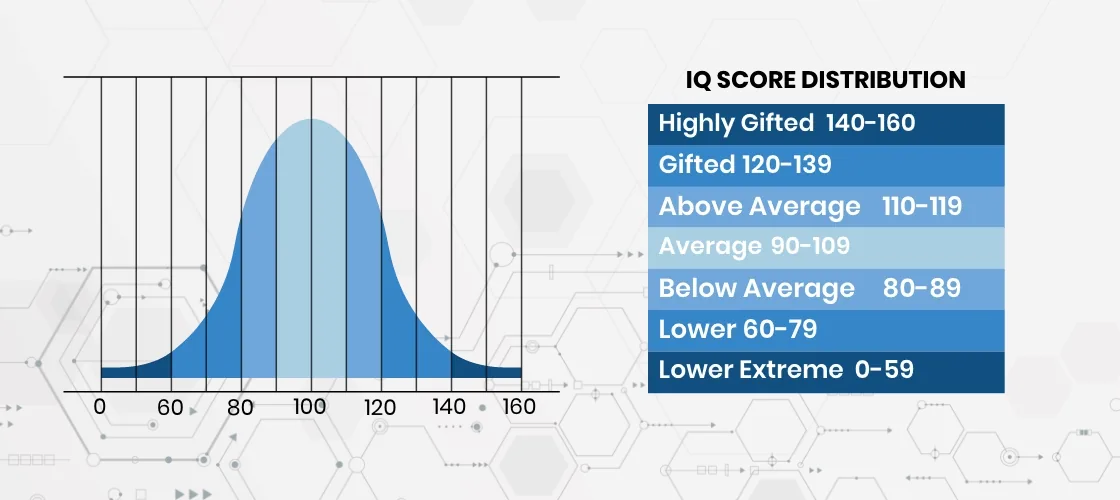
An IQ of 130 on one test could be exactly identical to an IQ of 148 on another. Understanding standard deviation is the absolute foundation of accurate cognitive interpretation.
1 Quick Answer
Updated April 24, 2026 by Structural. On modern adult intelligence scales such as WAIS and ACIS, the standard deviation is typically 15 points (SD 15). That number defines how far scores spread from the mean of 100 and how ACIS bands scores from Average through High Average, Superior, and the gifted classifications. The clearest illustration of that spacing is IQ 115, one deviation above the mean, which lands at the 84.13th percentile inside the 110-119 High Average band.
The key point is simple: raw IQ numbers are not universal units. A score only becomes comparable when you know the scale behind it. For example, 130 on an SD 15 test represents roughly the same rarity as 148 on an SD 24 scale, even though the printed numbers look very different.
Scale literacy pays off most when choosing an instrument. A full scale IQ test that states its SD 15 metric openly lets you convert any score to a percentile without guesswork, something a quiz that hides its scaling never allows.
SD = 15WAIS / ACIS
A common modern reference scale for adult intelligence batteries.
SD = 16Stanford-Binet
A closely related scale that spreads scores slightly wider.
SD = 24Cattell
A wider-number scale where equivalent rarity appears as a higher raw score.
Mean Score100
The center of the scale, regardless of whether the SD is 15, 16, or 24.
IQ scores are usually interpreted against a bell curve. Standard deviation provides the spacing for that curve, telling you how quickly rarity increases as you move away from the mean of 100. That spacing is what makes a historical claim checkable: a reported 125 sits 1.67 deviations above the mean, near the 95th percentile, which is where the score reported for Richard Feynman lands once you assume an SD 15 scale the original test may never have used. The same arithmetic is what exposes the figures written into television scripts, where a stated 187 sits 5.80 deviations above the mean, or roughly one person in 302 million.
On an SD 15 scale, about 68.2% of people fall between 85 and 115, and about 95.4% fall between 70 and 130. That is why 130 is commonly treated as an important threshold: it is roughly two standard deviations above the mean and lands near the top 2.3%.
Once you understand the deviation width, the rest becomes easier: percentiles tell the real story, while raw numbers are just labels attached to a specific scoring scale.
3 The Direct Conversion Table
When you compare scores across different instruments, convert them back to percentile rarity or z-score. That is the cleanest way to see whether two different numbers really mean the same level of performance. That conversion is also what makes a fair comparison between products possible: a ranked comparison of the top online IQ tests treats score range and precision as separate criteria, because two tests can print the same number while one stops discriminating well before the other.
Percentile
WAIS / ACIS (SD 15)
Stanford-Binet (SD 16)
Cattell (SD 24)
84.1st (+1 Deviation)
115
116
124
97.7th (+2 Deviations)
130
132
148
99.9th (+3 Deviations)
145
148
172
99.99th (+4 Deviations)
160
164
196
The scale illusion: raw numbers can look dramatically different even when rarity is the same. A wider SD produces larger-looking IQ values without necessarily implying rarer performance.
Quick rule: first compare percentiles, then compare the test, and only then compare the printed IQ numbers.
Mensa requires applicants to perform in the top 2% of the general population to secure membership. Because of the differing standard deviations, Mensa maintains multiple score cutoffs depending entirely on which test was administered. The same hazard has an older version. Feeding a modern deviation score into the historical ratio IQ formula yields a tidy number by combining two scoring systems that were never on the same scale. The cutoff itself is applied to a supervised score, which is why a proctored Mensa session sits beside a psychologist's office and a university clinic among the four places to take an IQ test, with the self-administered online route reserved for personal insight rather than membership. The deviation convention itself dates from Wechsler's 1939 Bellevue scale, and a German adaptation of that instrument produced the intelligence figures recorded for the Nuremberg defendants in 1945, an administration with a named examiner, a named instrument and a printed table of results.
130 on WAIS/ACIS
On an SD 15 scale, 130 lands at roughly the 97.7th percentile, which satisfies the usual top 2% cutoff.
148 on Cattell
On an SD 24 scale, a higher raw number is needed to represent the same percentile position.
If you score 140, the scale matters. On SD 15, that clears the threshold comfortably. On SD 24, it corresponds to a lower percentile and does not represent the same rarity. The admission decision follows percentile equivalence, not the size of the raw number.
5 Frequently Asked Questions
What is the standard deviation of the WAIS test? The Wechsler Adult Intelligence Scale utilizes a standard deviation of exactly 15 points.
Why don't all tests use the same deviation scale? Because different test families were developed with different scoring conventions. To compare them properly, use percentile rank or z-score rather than the raw IQ number alone.
Is an SD 24 test less accurate than an SD 15 test? Not automatically. Accuracy depends on the instrument's design, calibration, reliability, and norms, not just on whether the scale is narrower or wider.
6 Related Guides
Expand your understanding of advanced psychometric interpretations:
The 15 point standard deviation is a convention rather than a fact of nature, and everything on this page follows from it. The sources below document where the convention comes from, how it turns into percentiles inside an actual score report, and how much uncertainty surrounds any number produced that way.
Voncken, L., Albers, C.J. & Timmerman, M.E. (2019). Improving confidence intervals for normed test scores. Behavior Research Methods. Open access. States that normed intelligence scores carry a population mean of 100 and a standard deviation of 15, and explains why norms drawn from a sample add uncertainty beyond measurement error alone.
Crawford, J.R., Garthwaite, P.H. & Slick, D.J. (2009). On percentile norms in neuropsychology: proposed reporting standards and methods for quantifying the uncertainty over the percentile ranks of test scores. The Clinical Neuropsychologist, 23(7), 1173-1195. Documents that three different definitions of a percentile coexist in practice and can return substantially different results for the same score.
Pearson (2008). WAIS-IV Score Report sample. Shows what a real report contains: every composite paired with a percentile rank, a 95% confidence interval and a qualitative description, never a bare number.
Pearson Clinical Assessment Scientific Council (2023). Standardized Clinical Assessment for Practitioners: A Primer. Covers how standard scores, percentile ranks and the standard error of measurement are meant to be read together, and why a gap between two scores can be smaller than the error around them.
Pearson (2024). WAIS-5, Wechsler Adult Intelligence Scale, Fifth Edition. The current adult battery, covering ages 16:0 to 90:11 across five cognitive domains with a Full Scale IQ built from seven subtests.
Riverside Insights. Stanford-Binet Intelligence Scales, Fifth Edition. A second current publisher with a different structure and a different age span, from 2 to 85 and above. The clearest illustration of why ranges and labels are not interchangeable between tests.
National Association for Gifted Children. What is Giftedness. The field's definitional body sets no fixed IQ threshold and holds that a single test at one point in time should not decide identification.
Lubinski, D. & Benbow, C.P. (2006). Study of Mathematically Precocious Youth after 35 years. Perspectives on Psychological Science. What long term follow up of verified high scorers actually shows.
ACIS measures six CHC domains across 20 subtests and reports each one with its own normed score and confidence interval, so you can see where you are strong and where you are not.