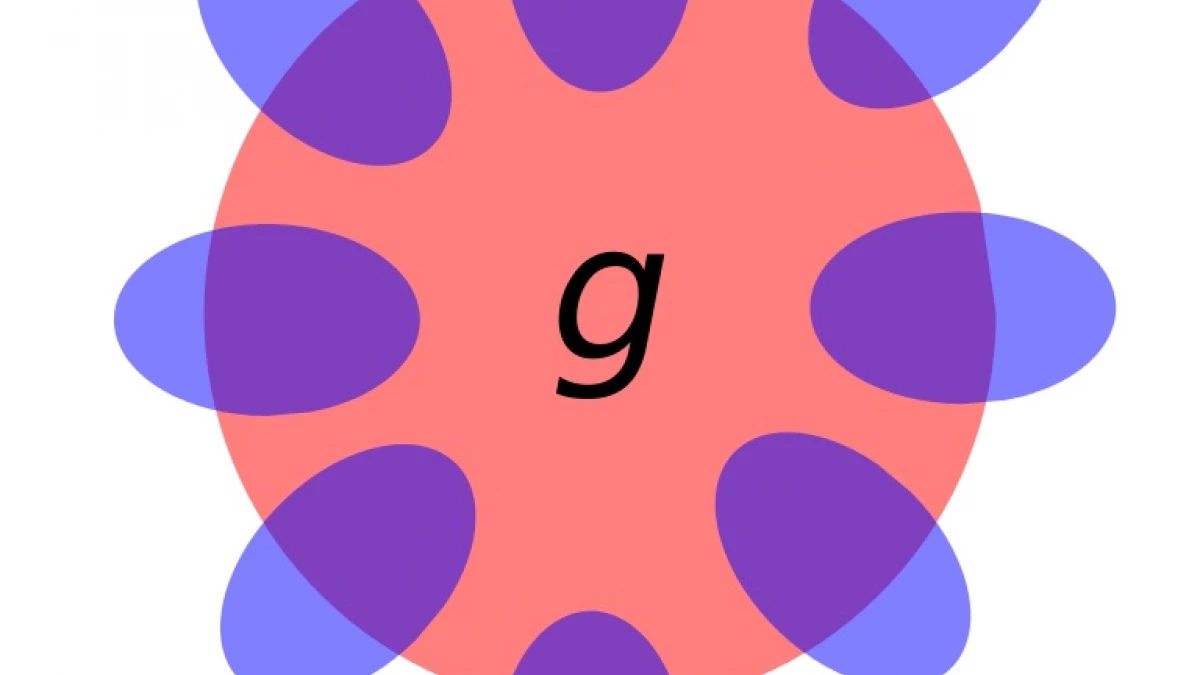
The g factor is the hidden statistical thread behind broad cognitive performance. This guide explains what general intelligence means, how it is estimated, why g-loading matters, and what a single IQ score can and cannot say.
0 Quick Answer
Updated April 21, 2026 by Structural. The g factor, short for general intelligence factor, is the broad mental ability factor that helps explain why people who do well on one kind of cognitive task tend to do well on many other kinds of cognitive tasks. It is not a single test item, not a personality trait, and not a complete ranking of human worth. It is a statistical construct inferred from patterns across many mental tests.
Brain imaging has not replaced the test as the way g is estimated. In an 884 person Human Connectome Project study, resting-state connectivity predicted 20 percent of the variance in a general intelligence estimate drawn from many cognitive tasks, and a systematic review found much weaker prediction for fluid intelligence alone. The page on intelligence and the brain covers that result and the replication limits.
Direct answer: g is the common cognitive factor shared by reasoning, learning, memory, knowledge, speed, and problem-solving tasks. A good Full Scale IQ score is usually a practical estimate of g, but IQ and g are not identical. IQ is an observed standardized score. g is the latent factor that broad batteries try to estimate.
The estimation detail matters when picking a test: g emerges from the shared variance of many distinct tasks, so a full scale IQ test built on a broad battery approximates it far better than any single-task score can.
The g factor is the broad factor that emerges when many different cognitive tests are analyzed together. Vocabulary, matrix reasoning, arithmetic, spatial rotation, working memory, and processing speed are not the same task. They have different content, rules, timing demands, and strategies. Yet performance on these tasks tends to be positively related. A person who scores high on one cognitive task is more likely than average to score high on others.
That shared tendency is what psychometricians call general intelligence, usually written as g. The idea is not that every mental task is identical. The idea is that different mental tasks share some common source of variance. In practical language, g captures the general efficiency of learning, abstraction, reasoning, and complex mental control that supports performance across many domains.
Charles Spearman introduced the idea in the early 20th century after observing that school and mental-test performances were positively correlated. His famous 1904 paper, "General Intelligence," Objectively Determined and Measured, argued that test performance could be understood as a combination of a general factor and task-specific factors. Modern models are more complex, but the basic observation still matters.
The same positive manifold logic has been applied to groups, not only people. In 2010, Woolley and colleagues gave groups of two to five people a battery of tasks and found a first factor that carried more than 43 percent of the variance in group scores. Whether that factor is more than the members' own ability is disputed, and the evidence review on collective intelligence and the c factor sets out the figures on each side.
A factor and a single test are different things. Kvist and Gustafsson fitted a model to 17 tests covering four broad abilities and found a g to fluid reasoning relationship of 0.83 in the total group and close to unity in each of three subgroups. One matrix test sits well below that, as the page on how one abstract reasoning test differs from the fluid factor explains.
Plain-English definition
G is the general cognitive factor behind broad mental performance. It is what many different cognitive tasks tend to have in common after their specific content is separated out.
2 Positive Manifold: Why g Exists at All
The core empirical reason for g is called the positive manifold. This means that cognitive test scores tend to correlate positively with one another. The correlations are not perfect, and they vary by task type, but the pattern is broad enough that a general factor appears when large batteries are analyzed. This is the pattern Gardner's eight or nine independent intelligences cannot absorb, since genuine independence predicts correlations near zero and the measured abilities keep returning positive ones.
If mental abilities were completely independent, a person could be excellent at abstract reasoning and no more likely than anyone else to be good at vocabulary, memory, quantitative reasoning, or visual problem solving. Real data do not usually look like that. The average pattern is more connected. People differ in domain-specific ways, but they also differ in general cognitive capacity.
This is why serious IQ batteries use multiple subtests. A single task can be too narrow. It may depend too much on a trick, a learned method, a speed demand, a language background, or a specific content area. A broad battery can look for the shared signal across tasks, which is closer to g than any one isolated subtest.
General factor
The broad signal common across many cognitive tasks.
Broad abilities
Domain-level factors such as reasoning, knowledge, memory, speed, and visual processing.
Narrow skills
Specific task abilities, strategies, content knowledge, and item formats.
3 What Does G-Loading Mean?
G-loading refers to how strongly a task, subtest, or score relates to the general intelligence factor. A highly g-loaded subtest tends to draw on broad reasoning, abstraction, working memory, learning efficiency, and mental control. A less g-loaded task may still be useful, but it may depend more on a narrow skill or a specific learned routine.
Matrix reasoning is often considered highly g-loaded because it requires the test taker to infer abstract rules from unfamiliar visual patterns. Vocabulary can also be strongly related to g because word knowledge reflects long-term learning, language exposure, conceptual precision, and accumulated reasoning about meanings. Processing speed tasks may be related to g too, but they often carry more task-specific motor, attention, and timing demands.
G-loading is not a moral label. A low or moderate g-loaded task is not "bad." Some narrower tasks are valuable because they reveal specific strengths and weaknesses. The point is interpretation. If a test claims to estimate overall intelligence, it should include enough tasks with meaningful g-loadings and enough breadth to avoid mistaking one narrow skill for the whole construct.
Useful domain tasks that combine general ability with specific knowledge, speed, or format effects.
Low g-loading
Narrow tasks dominated by learned routines, sensory-motor execution, or a specific item style.
4 Is g the Same as IQ?
No. IQ and g are related, but they are not the same thing. IQ is a standardized score reported by a test. It is usually scaled with a mean of 100 and a standard deviation of 15. The g factor is a latent construct inferred from correlations among cognitive tasks. A Full Scale IQ can be a good estimate of g when the battery is broad, reliable, and appropriately normed.
This distinction matters because an IQ score is always affected by the test design. Two tests can both estimate general intelligence while using different item types, time limits, norms, and domain weights. A very short test may produce a number that looks like an IQ score while offering a weaker estimate of g. A broad battery can usually estimate g better because it samples more than one cognitive route.
A Full Scale IQ from a broad battery is best understood as an estimate of general cognitive ability, not as direct access to g itself and not as a complete description of the person.
5 Where g Fits in CHC Theory
Modern cognitive theory usually treats intelligence as hierarchical. The CHC model places general intelligence at the top, broad abilities in the middle, and narrow abilities underneath. This structure helps avoid two common mistakes: pretending intelligence is only one thing, or pretending every ability is completely separate.
At the top is g, the general factor. Under it are broad domains such as fluid reasoning, crystallized knowledge, working memory, visual processing, processing speed, and quantitative reasoning. Under those broad domains are narrower abilities and task skills. This is why a good report can show both an overall score and a profile. The overall score summarizes the common signal; the profile shows how that signal is expressed across domains.
Spearman's task-specific factors have a modern counterpart in mathematics. A nested-factor analysis of German school assessments found mathematical ability beyond g (Saß and colleagues, 2017), and a twin study at age 7 found a genetic correlation of .67 between mathematics and general intelligence, with about a third of the genetic variance in mathematics independent of reading and g. The page on math ability and general intelligence reviews both.
A g loading is not a fixed property of a subtest, because it is estimated within a group of people. In a meta-analysis of 106 articles and 408 studies, Blum and Holling found that the mean correlations and g loadings of ability tests decrease with increasing ability. Whether that reflects real structure or a statistical artifact is disputed, as the evidence review of Spearman's law of diminishing returns explains.
John Carroll's Human Cognitive Abilities was one of the most important factor-analytic works behind this structure. CHC theory integrated that work with earlier fluid-crystallized theory, giving modern tests a language for both g and domain-level interpretation.
Stratum III
General intelligence, or g.
Stratum II
Broad abilities such as Gf, Gc, Gwm, Gv, Gs, and Gq.
Stratum I
Narrow abilities and specific task skills.
6 Why g Predicts Some Real-World Outcomes
G is useful because complex environments often require learning, abstraction, memory control, error detection, and transfer of knowledge to new problems. Those demands are common in education, technical training, complex work, and many forms of independent problem solving. This is why general cognitive ability tends to predict some academic and occupational outcomes better than chance. Far weaker associations attract far more attention: the most cited work on intelligence and religiosity, a 2013 meta-analysis by Zuckerman, Silberman and Hall pooling 63 studies, reports an inverse correlation of about .20, and what that meta-analysis actually supports is roughly 4 percent of the variation, in mostly Western samples, with the causal direction unestablished.
The key phrase is some outcomes. G is not destiny. It does not guarantee achievement, social competence, creativity, happiness, moral judgment, wealth, or health. It is one important variable among many. Motivation, personality, conscientiousness, mental health, physical health, family background, opportunity, instruction quality, interests, and values all influence life outcomes.
The g factor is often misunderstood because it is powerful enough to matter but abstract enough to invite exaggeration. A responsible interpretation has to keep several limits in view.
G is not human value. It is a cognitive factor, not a moral ranking or a measure of dignity.
G is not every form of intelligence. It does not fully capture creativity, wisdom, personality, motivation, expertise, taste, leadership, or social judgment.
G is not a single brain switch. It is a statistical factor related to distributed cognitive efficiency, learning, and problem solving.
G is not error-free. Any score estimating it has measurement error, confidence intervals, and norm limitations.
G is not a replacement for profile interpretation. Domain scores and subtests can still matter, especially when the profile is uneven.
The point is not to shrink g until it means nothing. The point is to keep the construct precise. G is one of the most important findings in intelligence research, but it is still a scientific construct with boundaries. Keeping the construct precise is exactly where popular coverage fails, and the claim that AI use is lowering IQ is the live example: the three studies carrying that coverage measured brain connectivity during essay writing, a critical thinking questionnaire and self reported effort, and not one of them administered an intelligence test.
8 Can Someone Have High g and Weak Areas?
Yes. A person can have high general ability and still show relative weaknesses in processing speed, working memory, verbal knowledge, quantitative reasoning, or visual-spatial tasks. The reverse is also possible: a person can have one strong domain without having a high overall score. This is why profile interpretation matters.
Suppose a person performs very well on matrix reasoning, visual puzzles, and quantitative reasoning, but only average on speeded symbol tasks. The general score may still be high, but the profile says something useful about how that person solves problems. Another person may have strong vocabulary and information scores but weaker novel visual reasoning. Both profiles can produce meaningful interpretation beyond the single number.
ACIS is built around this distinction. Full Scale IQ gives a broad estimate. Index and subtest results show the pattern underneath. That does not mean every small difference is meaningful. It means that large, reliable, theory-consistent differences can help explain how the overall score was produced.
9 Why Single-Task IQ Claims Are Weak
A single task can be interesting, but it is a fragile way to estimate g. A matrices-only test may overemphasize visual abstraction. A vocabulary-only test may overemphasize language exposure and education. A speed-only test may overemphasize timing, motor fluency, or attention. A number-series-only test may overemphasize learned numerical strategies. A single narrow task type is also one of the red flags that disqualify an IQ test, together with missing norm information, extreme score promises and no discussion of limits.
That is why the strongest interpretation usually comes from breadth. A broad battery can let different subtests cancel out some of each other's task-specific noise. It can also detect whether a score is coherent or uneven. If all domains point in a similar direction, the general estimate is easier to interpret. If domains diverge sharply, the overall score needs more caution.
Practice can improve performance on familiar item formats. Learning how matrices work, how number series are commonly constructed, or how speed tasks are scored can raise performance on those tasks. That does not necessarily mean the person's underlying g changed. It may mean the task became less novel, less confusing, or less dependent on strategy discovery.
This is one reason broad batteries are useful. If practice affects one narrow format, the entire assessment is less vulnerable when other domains are also measured. It is also why retesting should be interpreted carefully. A repeated score can reflect true ability, measurement error, fatigue differences, motivation differences, and practice effects all at once.
In a serious report, the right question is not simply "what was the number?" The right question is "how was the number produced, what tasks contributed to it, how reliable is it, how broad is the battery, and what conditions could have affected performance?"
11 G and the Flynn Effect
The Flynn effect refers to generational changes in IQ test performance. In many countries during much of the 20th century, average test scores rose over time, which forced tests to be renormed. This matters for g because score meaning depends on current norms. A score of 130 on an old norm set is not automatically equivalent to a score of 130 on a modern norm set. Renorming is therefore a maintenance requirement rather than a marketing detail, and an outdated norm table is one of the failure modes covered in what makes an IQ score accurate.
The Flynn effect does not mean g is fake. It means test performance is shaped by both cognitive ability and historical environment. Education, nutrition, test familiarity, abstract problem-solving demands, health, technology, and other social changes can affect average performance. The fact that norms move over time is exactly why serious tests have to update their reference samples.
ACIS estimates general intelligence through a multi-subtest structure rather than a single puzzle type. The goal is to sample several cognitive routes into g: reasoning, knowledge, working memory, quantitative thinking, visual-spatial processing, and speeded cognitive efficiency. This produces both a Full Scale IQ estimate and a domain profile.
The Full Scale IQ is the broad summary. It is closest to a practical estimate of g. The composite and subtest results explain the pattern underneath. This matters because two people can receive similar overall scores through different cognitive profiles. One may be strongest in verbal knowledge and reasoning; another may be strongest in visual and quantitative tasks.
ACIS also separates the public explanation pages from the test itself. Pages like What IQ Measures, Reliability vs. Validity, and The CHC Model exist so users can understand the construct before treating any score as self-explanatory.
13 How to Interpret g Without Overclaiming
A strong interpretation of g is specific, statistical, and cautious. It does not say "this person is smart in every possible way." It says something closer to this: "Across a broad set of cognitive tasks, this person showed a level of general cognitive performance that is above, below, or near the average of the relevant norm group."
Good interpretation also distinguishes absolute score level from profile shape. A person with a high overall score may still need slow, careful work on speeded tasks. A person with an average overall score may have one unusually strong domain. A person with a very uneven profile may need more explanation than the Full Scale IQ alone can provide.
That is the practical value of g when used correctly. It gives a strong summary of broad cognitive performance without pretending that the summary is the whole story.
14 G vs Gf, Gc, and Other Cognitive Abilities
One of the most common questions around this topic is whether the g factor is the same thing as fluid intelligence. It is not. Gf, or fluid reasoning, is a broad ability that reflects solving novel problems, detecting patterns, and reasoning without relying heavily on learned facts. Gf is often highly related to g, but it is still a domain-level ability rather than the entire general factor.
Gc, or crystallized knowledge, is also related to g, but in a different way. It reflects vocabulary, factual knowledge, language development, and the ability to use accumulated learning. A person with high general ability usually learns efficiently over time, which can support strong Gc. But Gc is also shaped by education, reading, language exposure, culture, and opportunity.
The bar exam shows how hard it can be to connect a licensing outcome to g. In the LSAC national longitudinal study of bar passage, law school grades and LSAT scores together correlated .52 with pass or fail, and neither measure is a cognitive battery. No bar exam study reviewed for the page on how the bar exam relates to IQ paired a named battery with bar results, so what g contributes there remains untested.
This is why the CHC model is useful. It does not force a choice between "there is only g" and "there are only separate abilities." It allows both. General intelligence explains the shared signal across domains, while broad abilities explain meaningful differences in how that signal appears across reasoning, knowledge, memory, speed, quantitative thinking, and visual processing.
Term
What it means
How to interpret it
g
General intelligence factor shared across cognitive tasks.
Best estimated by broad batteries, not one narrow task.
Gf
Fluid reasoning and novel problem solving.
Usually highly g-loaded, but not identical to g.
Gc
Crystallized knowledge and language-based learning.
Reflects both ability and accumulated exposure.
Gwm
Working memory capacity and controlled mental manipulation.
Important for reasoning, learning, and complex problem solving.
Gs
Processing speed and rapid cognitive efficiency.
Useful, but often more sensitive to timing, attention, and motor demands.
15 How g Is Estimated in Practice
G is not measured by opening a test booklet and finding a single "g item." It is estimated from the relationships among many tasks. In a simplified explanation, a battery gives several cognitive scores, the scores correlate with one another, and factor analysis identifies the common dimension that accounts for the shared variance. That common dimension is interpreted as general intelligence.
The quality of the estimate depends on the quality of the battery. A test with too few subtests may be overly dependent on format. A test with weak reliability may add too much noise. A test with poor norms may give a standardized score that looks precise but does not have a defensible reference group. A test with a narrow ceiling may underestimate high scorers because the items stop discriminating in the upper range.
That is why serious g interpretation depends on psychometrics, not vibes. You need reliable scores, an appropriate norm sample, enough item difficulty, enough breadth, and a transparent scoring model. A number alone is not the evidence. The evidence is the measurement system behind the number.
Breadth
The battery should sample more than one cognitive domain.
Reliability
Scores should be stable enough to interpret beyond random error.
Norms
The score should be compared with a clear, relevant reference group.
16 What Makes a Test More g-Loaded?
A test tends to be more g-loaded when success requires discovering structure, holding information in mind, resisting distraction, transferring rules, and solving problems that cannot be handled by one memorized routine. Novel matrix items, complex analogies, multi-step quantitative reasoning, and demanding working memory tasks often tap this kind of general control. In Figure Weights, balance scale problems show two of those demands in quantitative form: the examinee must infer how visual quantities relate and apply a hidden rule to a new arrangement.
A task tends to become less pure as an estimate of g when it depends heavily on a narrow trick, a repeated item family, a specific school curriculum, speeded motor execution, or item familiarity. This does not make the task useless. It means the interpreter should know what else the task is measuring. A processing speed task can be useful for cognitive efficiency. A vocabulary task can be useful for accumulated learning. A visual puzzle can be useful for spatial reasoning. But none of them alone should be treated as the entire construct.
In plain terms, this is the practical meaning of highly g-loaded IQ test: it is not a magic test immune to bias or error. It is a test or subtest that shares a large amount of variance with the general factor in a psychometric model. The strongest public interpretation still comes from a broad battery rather than one impressive-looking item format.
17 Practical Checklist for Any g Claim
When a site, report, or social media post claims to measure "pure g" or "real intelligence," use a checklist instead of reacting to the score label. The best questions are measurement questions. Those measurement questions are the same ones that separate a viral quiz from taking a normed IQ test from home, where the norms, the breadth of sampling and the reliability are all stated.
How many subtests were used? One-format claims are weaker than broad batteries.
Which domains were sampled? Reasoning alone is not the same as a full cognitive profile.
Were there real norms? A score needs a reference group, not just a percent-correct conversion.
Is the ceiling high enough? High scorers need items difficult enough to separate upper-range performance.
Is reliability reported? A score that cannot be stable cannot carry strong interpretation.
Are limits stated? A credible test explains what it does not measure.
This checklist is also why ACIS separates the dashboard, score interpretation pages, and technical notes. The product should not ask the user to trust a number without explaining how the number should be read.
18 FAQ: G Factor Explained
Is g real?
G is real as a statistical factor in cognitive-test data. The interpretation of that factor requires care.
Can g be measured directly?
No. It is inferred from performance across tasks. Scores estimate it; they do not observe it directly.
Is g the same as reasoning?
No. Reasoning is usually highly related to g, but g also reflects shared variance across memory, knowledge, speed, and other domains.
Are matrix tests pure g?
No. Matrix tests can be highly g-loaded, but they still include visual format, strategy, attention, and item-specific effects.
Does g change with age?
Measured cognitive performance changes with development and aging, and different domains change at different rates.
Is g enough for diagnosis?
No. Clinical and educational decisions require context, history, professional judgment, and often multiple measures.
What is the positive manifold?
It is the finding that cognitive test scores tend to correlate positively, which makes a general factor statistically possible.
Is g the same as IQ?
No. IQ is an observed standardized score. G is the latent general factor that broad IQ batteries try to estimate.
What does g-loading mean?
It means how strongly a task or subtest relates to the general intelligence factor.
Is g the same as fluid intelligence?
No. Fluid reasoning is usually highly related to g, but it is one broad ability under the general factor.
Can practice change g?
Practice can improve familiar formats. That does not automatically mean the underlying general factor changed.
Why use multiple subtests?
Multiple subtests reduce narrow format effects and produce a stronger estimate of general cognitive ability.
Are nonverbal tests pure g?
No. Nonverbal tests can reduce language demands, but they still include format, instruction, strategy, and norm effects.
Can someone have high g and low speed?
Yes. General ability can be high while processing speed is only average or relatively weak.
Does g determine success?
No. It helps with learning and complex problem solving, but outcomes also depend on motivation, health, personality, opportunity, and fit.
The claims on this page follow the published literature rather than our own assertions. These are the primary papers and reference bodies worth reading directly, with what each contributes.
Spearman, C. (1904). General intelligence, objectively determined and measured. American Journal of Psychology, full text at Classics in the History of Psychology. The paper where the g factor entered psychology.
Gottfredson, L.S. (1997). Why g matters: the complexity of everyday life. Intelligence, 24(1), 79-132.
Nisbett, R.E. et al. (2012). Intelligence: new findings and theoretical developments. American Psychologist, 67(2). The broad APA review of what moves measured intelligence and what does not.
Plomin, R. & Deary, I.J. (2015). Genetics and intelligence differences: five special findings. Molecular Psychiatry. Open access. The standard modern review of what twin and DNA evidence does and does not show.
Gottfredson, L.S. (1997). Mainstream Science on Intelligence, the editorial signed by 52 researchers. Intelligence, 24(1), hosted by the University of Delaware. A consensus statement on what IQ tests measure.
Voncken, L., Albers, C.J. & Timmerman, M.E. (2019). Improving confidence intervals for normed test scores. Behavior Research Methods. Open access. Documents the mean 100, SD 15 metric and the uncertainty that norming from samples adds to any score.
Pearson Clinical Assessment Scientific Council (2023). Standardized Clinical Assessment for Practitioners: A Primer. How standard scores, percentile ranks and the standard error of measurement are meant to be read together.
Pearson (2008). WAIS-IV Score Report sample. What a real report contains: every composite paired with a percentile rank, a 95% confidence interval and a qualitative description, never a bare number.
Pearson (2024). WAIS-5, Wechsler Adult Intelligence Scale, Fifth Edition. The current adult battery, covering ages 16:0 to 90:11 across five cognitive domains.
Take the assessment
You get a profile, not a number
ACIS measures six CHC domains across 20 subtests and reports each one with its own normed score and confidence interval, so you can see where you are strong and where you are not.
Free trial, no card required. Full report from $15.
Six-domain profileillustrative
VCI
FRI
VSI
WMI
PSI
QRI
Apply general ability carefully
The g factor helps explain the correlation in IQ vs SAT, but it is not a percentage of brain use and does not define personality. Review the 10 percent brain myth for the neuroscience boundary.