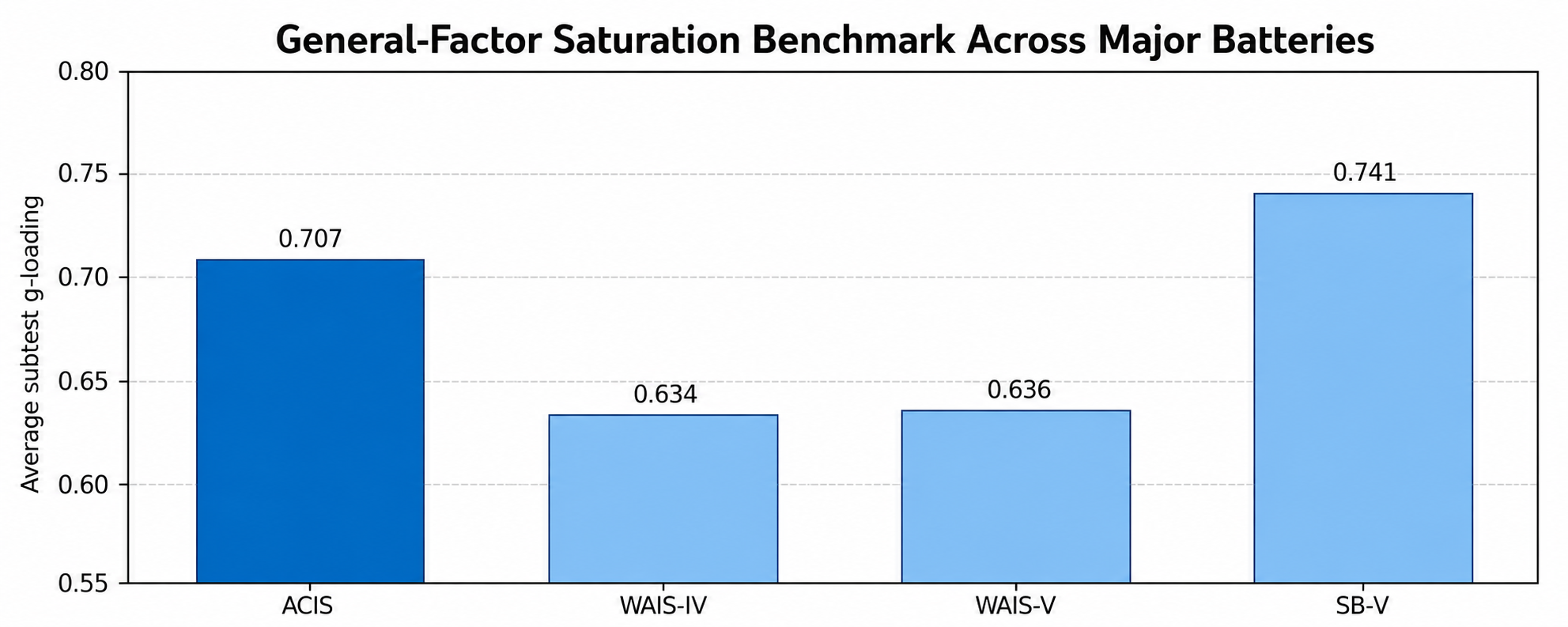
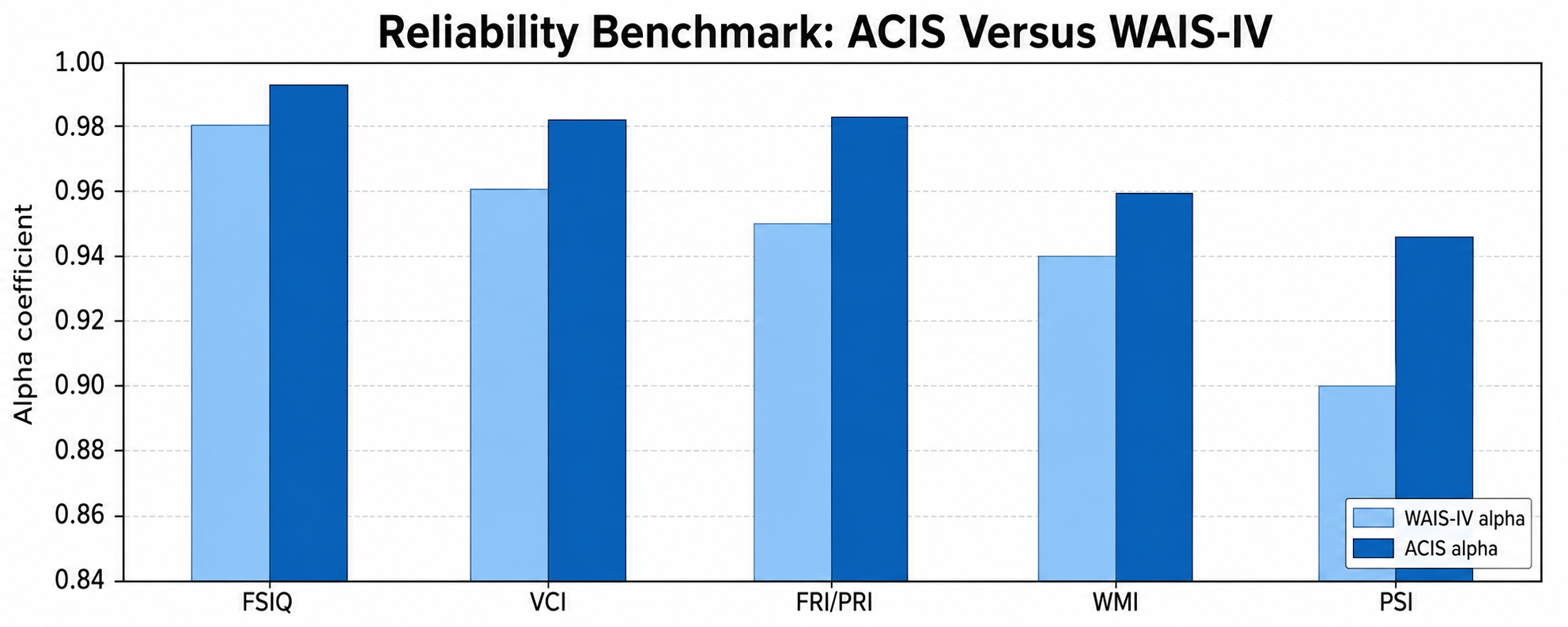
A professional technical report for ACIS: CHC construct architecture, adult score interpretation, reliability and SEM estimates, higher order g CFA, g loadings, professional comparisons, and interpretation rules.
Version 1.4, updated August 3, 2026. The Advanced Comprehensive Intelligence Scale (ACIS) is a multidomain cognitive assessment built around the Cattell Horn Carroll (CHC) model. It measures broad cognitive ability through verbal, fluid, quantitative, visual spatial, working memory, and processing speed tasks. The Full Scale form contains 20 subtests and supports FSIQ, six primary indices, broad composites, and advanced composites.
This report integrates the ACIS construct framework with norming information, reliability estimates, standard errors of measurement, confirmatory factor analysis, higher order g evidence, subtest g loadings, composite g loadings, professional comparisons, and interpretation rules.
ACIS is not a casual online quiz. The evidence summarized in this manual supports ACIS as a professional grade online cognitive assessment: broad CHC aligned cognitive domain coverage, a defined adult English speaking reference frame, strong reliability estimates for broad scores, and a higher order g model with excellent fit.
Full Scale Form20
Subtests across six primary cognitive domains.
Adult Reference Frame3,243
English speaking age bands from 16 to 90.
Technical Analysis Set2,750
Complete records used for CFA and reliability tables.
Primary CFAHigher order g
General intelligence modeled above six CHC aligned domains.
3 Methods: Analysis Basis, Data Preparation, and Primary Model
The current ACIS adult reference frame contains 3,243 English speaking records across ages 16 to 90. The technical tables use N = 2,750 complete records. The broader frame defines the adult score context, while the technical N defines the records used for CFA, reliability, SEM, and composite g loading estimates.
Element
Value
Technical definition
Interpretive reason
Adult reference frame
3,243
English speaking age bands in the supported adult range.
Defines the current ACIS adult score frame.
Technical analysis set
2,750
Complete records used for reliability and CFA.
Keeps technical coefficients tied to the reported analysis basis.
Age range
16 to 90
Strict supported adult and late adolescent range.
No out of range cases are interpreted in the adult norm frame.
Primary CFA model
Higher order g
g loading on VCI, FRI, QRI, VSI, WMI, and PSI.
Matches the professional interpretation: broad domains plus an overall general factor.
Estimator
MLR
Robust maximum likelihood reporting in lavaan.
Used for model fit, loadings, and robust fit indices.
Security basis
Protected administration
Completion, retake control, and integrity requirements are part of the intended operating model.
Online scores require security controls to preserve measurement meaning.
The higher order g model is the primary structural model because it matches how ACIS is interpreted: users receive broad domain scores, and those domains are positively correlated enough to support a strong general cognitive factor. This is the central validity model used throughout the manual.
4 Norming Frame, Age Bands, and Analytic Inclusion
The current ACIS documentation distinguishes between the adult reference frame and the technical analysis set used for the psychometric tables in this manual. The adult frame contains 3,243 English speaking records across ages 16 to 90. The CFA and reliability tables use N = 2,750 complete records.
The adult reference frame identifies the age and language context represented in ACIS adult score interpretation. The technical N identifies the records used to estimate internal structure, factor loadings, reliability coefficients, SEM, and composite g saturation. Together, these values define the current ACIS adult measurement frame.
The supported age range is strictly adult and late adolescent: 16 to 90. ACIS does not interpret scores for people outside that range. If a person is younger than 16 or older than 90, ACIS does not currently provide a supported adult norm reference for that person.
Quantity
Value
Interpretive meaning
Use in this manual
English speaking adult reference frame
3,243
Current adult age band frame from ages 16 to 90 available for score context.
Used to describe the breadth of the current ACIS adult reference frame.
Technical analysis set
2,750
Complete records used for the CFA and reliability statistics reported here.
Used for loadings, model fit, internal consistency, SEM, and composite statistics.
Age range
16 to 90
Strict configured adult age range for ACIS interpretation.
Used to define supported score interpretation and age band reporting.
Language basis
English speaking
Language context for verbal, reading, knowledge, and instruction dependent tasks.
Used when interpreting VCI, SAI, VKI, and other language sensitive scores.
The working age band distribution used for the N = 2,750 technical analysis set is documented as follows: ages 16 to 17, 234 records; 18 to 19, 341 records; 20 to 24, 508 records; 25 to 29, 364 records; 30 to 34, 305 records; 35 to 44, 385 records; 45 to 54, 231 records; 55 to 64, 154 records; 65 to 69, 81 records; 70 to 74, 77 records; 75 to 79, 39 records; 80 to 84, 22 records; and 85 to 90, 9 records. The mean age is 33.91 and the standard deviation is 16.72. This is a full range adult distribution with strong young adult coverage and an upper age tail for age aware interpretation.
ACIS is an online, self administered assessment with a defined adult English speaking score frame. The manual therefore reports age range, language status, technical N, score reliability estimates, CFA structure, and standard errors so the measurement basis is clear.
Security filtering is part of the intended psychometric operating model. ACIS is not designed to treat repeated practice attempts, obviously invalid attempts, incomplete records, or flagged behavior as equivalent to first valid completions. This requirement is stated at the score interpretation level while operational security details remain protected.
Age norming is also more than a demographic label. Processing speed, working memory, knowledge acquisition, and some visual spatial operations do not age in exactly the same way. ACIS therefore interprets performance within age aware context and keeps the public age gate explicit. The score means interpreted within the ACIS adult norming framework for the supported age range.
5 CHC Crosswalk and Construct Architecture
ACIS is organized around the Cattell Horn Carroll model because the battery is intended to measure more than a single undifferentiated ability. CHC gives the test a hierarchy: a broad general factor at the top, major broad abilities beneath it, and narrower task relevant abilities under those broad domains. In ACIS, this hierarchy is used as a design map rather than as a set of decorative labels. Subtests are placed where their main cognitive operations belong, composites are defined from preselected groups of subtests, and validity evidence is evaluated against the structure the test claims to measure.
The central broad abilities represented by ACIS are Comprehension Knowledge, Fluid Reasoning, Quantitative Knowledge and reasoning, Visual Processing, Working Memory, and Processing Speed. In reported score language these correspond to VCI, FRI, QRI, VSI, WMI, and PSI. ACIS also reports broader composite scores when the required subtests are available, including Full Scale IQ, CFI, GAI, IRI, VRI, VWMI, AWMI, CVSI, CFRI, CQRI, NVI, GRI, CPI, SAI, and VKI. These composites answer different psychometric questions using predefined subtest sets.
A CHC crosswalk matters because the same item format can involve more than one process. A semantic relation item may involve both lexical knowledge and induction. A quantitative reasoning item may involve both learned numerical knowledge and quantitative reasoning under constraints. A visual sequence item may use visual information but still belong primarily to working memory because the essential demand is maintaining and reproducing ordered visual positions. ACIS therefore separates broad score placement from secondary method notes.
The broad score placement used by ACIS is intentionally pragmatic. VCI captures acquired verbal knowledge, lexical access, verbal concept reasoning, and reading comprehension. FRI captures induction, hypothesis generation, relation reasoning, and general sequential reasoning. QRI captures quantitative reasoning and mathematical achievement, with explicit recognition that the construct bridges Gq and Gf. VSI captures visualization, speeded rotation, spatial scanning, imagery, and visual memory when those operations serve visual processing. WMI captures auditory and visual working memory under attentional control. PSI captures perceptual speed search, perceptual speed compare, and speeded response execution.
Construct language is controlled for that reason. ACIS should not rename CHC abilities with loose labels just because a task feels fluid, spatial, or speeded. The manual uses CHC broad abilities for score families and CHC narrow abilities for subtest targets. When a task contains a secondary process, that process is described as a method note rather than promoted to a new construct. This keeps score interpretation stable across pages, reports, and future technical updates.
The CHC model also protects against a common error in online test design: building many tasks that look different but measure the same narrow skill. ACIS aims for breadth. The battery includes verbal, fluid, quantitative, visual spatial, working memory, and processing speed tasks so the Full Scale score is not a disguised single format score. The higher order g evidence supports this design by showing a strong general factor above meaningful broad domains.
Construct rule: a subtest is assigned by its dominant cognitive demand, not merely by surface content. Visual content does not automatically mean VSI, numeric content does not automatically mean QRI, and verbal output does not automatically mean VCI if the main demand is induction.
6 Subtest Level Technical Reference
The subtest reference sheet expands into professional interpretive language below. Each subtest is described by index placement, CHC narrow ability, primary demand, secondary demand, and interpretive note. These descriptions are not item keys and do not reveal operational content. They define why each task contributes to the reported score structure.
Verbal Comprehension
Antonyms
Lexical KnowledgeGc
The examinee is shown a single stimulus word and selects, from the response options, the word most nearly opposite in meaning. Because the answer is chosen rather than produced, the demand is recognition of an opposing sense rather than the ability to define the word. The section runs under one continuous limit rather than per-item timing, so distributing effort across items is part of the task.
31 words · 10:00 total · Multiple choice (select the opposite meaning)
CFA
.860
g
.743
Rxx
.900
SEM
0.95
Antonyms primarily reflects lexical knowledge. The task requires efficient access to stored word meanings, discrimination between related and opposite meanings, and retrieval from long term semantic networks. Its main contribution is to the verbal knowledge side of ACIS rather than to open ended reasoning. A high score suggests strong lexical access and semantic differentiation; a low score may reflect weaker vocabulary, slower lexical retrieval, unfamiliarity with the language register, or reduced exposure to the specific word forms sampled.
Antonyms should not be interpreted as a complete measure of verbal intelligence by itself. It becomes more meaningful when read alongside Vocabulary, Information, Synonyms, and Similarities. If Antonyms is high but Similarities is lower, the profile may show strong word knowledge with less semantic relation reasoning. If Antonyms is low but Synonyms is adequate, the gap may reflect difficulty with opposite meaning contrasts specifically rather than a broad lexical limitation.
Vocabulary
Lexical KnowledgeGc
The examinee is shown a word and types its definition in their own words. Responses are open ended, so credit depends on the precision and completeness of the definition given: the opening items admit a single correct response, while later items are scored on a graded scale that separates a fully adequate definition from a partially adequate one. Each item carries its own allowance and advances automatically.
45 words · 1:30 per item · Items 1-3 = 1 pt; items 4-45 = 0-2 pts
CFA
.848
g
.732
Rxx
.950
SEM
0.67
Vocabulary reflects lexical knowledge, verbal concept formation, and semantic organization. The construct is not simply whether the user has memorized isolated words. A strong vocabulary response shows definition precision, concept scope, category awareness, and the ability to communicate meaning efficiently. Vocabulary is usually one of the strongest crystallized indicators in intelligence batteries because it accumulates over development and correlates with general knowledge, education, reading, and verbal reasoning.
Vocabulary is language and culture sensitive. That does not make it invalid, but it means interpretation must respect the English speaking norm frame. In ACIS, Vocabulary gains interpretive strength when it agrees with Antonyms, Information, and Similarities; disagreement among those scores is a clue that the verbal domain should be interpreted by pattern rather than by a single task.
Information
General InformationGc
The examinee answers general knowledge questions and types the response rather than choosing it. The questions draw on knowledge ordinarily acquired through schooling and everyday exposure rather than specialised study. Items advance automatically after a short fixed interval, which keeps the subtest a measure of general information already held rather than of reasoning time.
Information reflects acquired factual knowledge and retrieval from long term knowledge stores. This subtest samples the breadth of knowledge that an adult has accumulated and can access under test conditions. It is not intended to measure pure reasoning speed or abstract induction. Instead, it represents the knowledge component of VCI and contributes to the broader crystallized side of ACIS.
Because Information depends on exposure, education, curiosity, reading, and cultural context, it must be interpreted with caution when used in isolation. If Information is high with Vocabulary and Synonyms, the profile supports broad verbal knowledge strength. If Information is lower than Vocabulary, the user may have strong word meaning but narrower factual exposure.
Synonyms
Lexical KnowledgeGc
The examinee is shown a stimulus word and selects the option closest to it in meaning. Because both the stimulus and the options are single words, the task isolates the precision of stored lexical meaning from any support that sentence context would give. The section is timed as a whole rather than item by item.
31 questions · 10:00 total · Select the best synonym
CFA
.828
g
.715
Rxx
.880
SEM
1.04
Synonyms maps to lexical knowledge. It requires efficient access to stored word meanings, discrimination between near synonyms, and selection of the option closest in meaning to the target among plausible alternatives. The task is verbal, and like Antonyms it samples word level semantic precision rather than discourse level comprehension. It adds a second crystallized lexical indicator to the verbal domain, which supports a more stable estimate of vocabulary based ability.
Synonyms can be influenced by reading experience, language proficiency, and exposure to the English register sampled. For that reason, it should be read alongside Vocabulary and Antonyms. A weakness in Synonyms with adequate Vocabulary may point to fine grained meaning discrimination or unfamiliarity with the specific word forms rather than a broad verbal knowledge limitation.
Similarities
InductionLexical Knowledge
The examinee is presented with two words naming objects or concepts and explains how the two are alike. The response is produced rather than selected, and credit is graded: a superordinate category that captures both members earns full credit, while a concrete or functional resemblance earns partial credit. The scoring distinction is what separates induction from lexical knowledge alone.
31 pairs · 1:30 per item · 0-2 points per item
CFA
.865
g
.747
Rxx
.860
SEM
1.12
Similarities belongs to VCI but has an explicit bridge to induction. The task asks the user to identify shared properties, abstract relations, or higher order categories among concepts. It therefore combines lexical knowledge with conceptual reasoning. In many cognitive batteries, Similarities is one of the most g loaded verbal tasks because it requires both knowledge and abstraction rather than simple recall.
In ACIS, Similarities prevents VCI from becoming merely a vocabulary and information score. If Similarities is higher than the other verbal tasks, the profile may show strong abstraction despite ordinary lexical breadth. If Similarities is lower than Vocabulary and Information, the user may know words and facts but have more difficulty organizing them into shared conceptual relations.
Fluid Reasoning
Matrix Reasoning
InductionGf
The examinee is shown an incomplete visual matrix and selects the option that completes it. The material is non-verbal and the rules governing each matrix are never stated, so they must be induced from the arrangement itself. Difficulty rises as items combine more rules operating simultaneously across rows and columns.
32 matrices · 30 sec/item + shared 120 sec bank · Choose 1 of 5 image options
CFA
.840
g
.774
Rxx
.930
SEM
0.79
Matrix Reasoning primarily reflects induction. The user must infer rules from abstract visual patterns, generate hypotheses, test them against the options, and select the completion that preserves the underlying structure. The subtest is designed to reduce reliance on acquired verbal knowledge while still requiring controlled attention, pattern detection, and flexible rule use.
Matrix Reasoning is a central fluid reasoning task, but it is not the whole of Gf. ACIS strengthens FRI by combining Matrix Reasoning with Figure Weights, Visual Number Series, Logic Grid, and Complex Relations. Agreement across those tasks supports broad fluid reasoning. Disagreement suggests that format, quantitative content, general sequential reasoning, or relation abstraction may be influencing the profile.
Figure Weights
Quantitative ReasoningGf
The examinee is shown balance scales with one side incomplete and selects the option that would bring the scale into balance. Colour, shape and size distinguish the elements, and the equivalences between them are never given; they must be inferred from the scales already shown. The task expresses quantitative relations without using numbers or language.
27 balance problems · 45 sec per item · Choose 1 of 5 image options
CFA
.872
g
.803
Rxx
.910
SEM
0.90
Figure Weights maps to Quantitative Reasoning within Gf. It requires reasoning with quantities, balance constraints, and proportional transformations. Although the task often appears visual, its deeper demand is quantitative reasoning under abstract constraints: the user must identify how elements relate, preserve constraints, and infer a missing quantity or relation without relying on explicit school mathematics alone.
Figure Weights is an important bridge between FRI and QRI. It is not purely mathematical achievement because it does not mainly ask for learned formulas. It is also not purely visual spatial because the critical demand is the relation among quantities. A high Figure Weights score with high Arithmetic and Mathematical Achievement strengthens the interpretation of quantitative reasoning.
Visual Number Series
InductionGf
The examinee is shown a sequence of numbers with one value missing and types the value that continues the rule. Because the answer is produced rather than chosen, the examinee cannot work backwards from options and must state the rule precisely enough to apply it. Series range from single step arithmetic progressions to alternating and compound patterns.
20 series · 45 sec per item · Type the missing number
CFA
.837
g
.772
Rxx
.850
SEM
1.16
Visual Number Series primarily reflects Induction applied to numerical sequences. The user must detect transformations, infer a rule, and extrapolate the next or missing element. The content is numeric, but the intended construct is not simple arithmetic calculation. Numerical material is the vehicle for induction and hypothesis testing.
This subtest adds a different fluid reasoning format from matrices and semantic relations. If Visual Number Series is high while Arithmetic is lower, the profile may show induction stronger than quantitative manipulation under working memory load. If Visual Number Series is low while other FRI tasks are adequate, the issue may be symbolic sequence tracking, quantitative notation, or difficulty inferring transformations from ordered symbols.
Logic Grid
General Sequential ReasoningGf
The examinee is shown a partially filled grid and determines which shape belongs in a highlighted cell. Every row, every column and every outlined region must contain each shape exactly once, so the answer follows by elimination from those constraints rather than by recognising a pattern. The task rewards sequential reasoning held across several constraints at the same time.
26 grids · 20 min total; no visible countdown · Choose the missing shape
CFA
.884
g
.814
Rxx
.880
SEM
1.04
Logic Grid reflects explicit constraints, systematic elimination, ordered reasoning, and the maintenance of multiple conditions. It differs from Matrix Reasoning because it is not primarily about visual pattern completion. It differs from Arithmetic because the rules are logical and relational rather than numerical operations.
Logic Grid is especially useful for detecting controlled reasoning under constraint. A user may be strong at pattern induction but weaker at stepwise deductive tracking, or the reverse. In profile interpretation, Logic Grid should be read with Complex Relations, Matrix Reasoning, and WMI. A low Logic Grid score with weak working memory may reflect difficulty maintaining rules, while a low score with adequate WMI may reflect difficulty using constraints strategically.
Complex Relations
InductionGf
The examinee completes an abstract analogy by supplying both missing terms in the frame __ is to A as B is to __. With two open slots rather than one, the rule linking the given pair must first be induced and then applied twice, so the item cannot be answered from how readily the words associate.
30 analogies · 45 sec per item · Type two words in ALL CAPS
CFA
.856
g
.789
Rxx
.900
SEM
0.95
Complex Relations maps primarily to Induction. The task requires the user to infer transformation rules, identify multi step relations, and integrate several constraints into a coherent rule set. It is one of the ACIS subtests most directly aimed at abstract relation induction beyond simple pattern matching.
Complex Relations can overlap with Similarities because both involve relations and abstraction, but the modalities differ. Similarities is verbal conceptual; Complex Relations is broader induction over relations. A profile with high Similarities and high Complex Relations supports strong abstraction across verbal and nonverbal formats.
Quantitative Reasoning
Mathematical Achievement
Mathematical AchievementGq
The examinee answers quantitative problems drawn from curricular mathematics. A reference table of formulas remains available throughout, so the subtest measures the application of mathematical procedure rather than formula recall; scratch paper is permitted and calculators are not. An explicit I don't know response is offered so that omissions remain distinguishable from errors.
25 problems · 35:00 total · Multiple choice (6 options)
CFA
.908
g
.801
Rxx
.910
SEM
0.90
Mathematical Achievement reflects acquired mathematical knowledge and the ability to apply learned procedures to structured problems. It is the most achievement oriented quantitative subtest in ACIS. The construct includes retrieval of learned rules, procedural accuracy, and the ability to select appropriate operations under problem constraints.
This subtest must be interpreted as a mixture of cognitive ability and learned academic exposure. A high score supports quantitative achievement and educationally developed math skill. A low score does not necessarily prove weak fluid reasoning if Figure Weights, Visual Number Series, or Matrix Reasoning are strong. The QRI interpretation is strongest when Mathematical Achievement and Arithmetic converge.
Arithmetic
Quantitative ReasoningGq
The examinee hears a word problem delivered in the listening area and computes the answer mentally. Because the problem is presented aurally and no written copy remains on screen, the terms must be held while the solution is computed, so the format adds a retention demand to the arithmetic itself.
26 audio problems (items 1-5 include images) · 30 sec response per item · Ends after 3 consecutive errors
CFA
.897
g
.791
Rxx
.830
SEM
1.24
Arithmetic maps to Quantitative Reasoning with working memory control. It requires quantitative manipulation, maintenance of numerical information, operation selection, and accurate step execution. It is less purely achievement based than Mathematical Achievement because it emphasizes active manipulation and efficient problem solving, but it still depends on learned number concepts.
Arithmetic is sensitive to attention, anxiety, working memory, and calculation fluency. A low Arithmetic score with adequate Mathematical Achievement may indicate that the person understands math but performs less efficiently under working memory demands. A high Arithmetic score with lower Mathematical Achievement may indicate strong quantitative manipulation but narrower formal math exposure.
Visual Spatial
Visual Puzzles
VisualizationSpeeded RotationGv
The examinee is shown a completed figure and selects the three pieces that would reconstruct it. Pieces may be mentally rotated but not reflected, so the item requires manipulation of part to whole relations without any physical manipulation of the material. Because exactly three pieces must be chosen, partial solutions cannot be submitted.
Visual Puzzles reflects visualization plus speeded rotation. The user must mentally synthesize parts, rotate visual representations, and determine how components form a whole. The task samples spatial reasoning with decomposed forms and is intended to represent visual transformation rather than acquired knowledge.
Visual Puzzles can be affected by speed, visual scanning, and strategy. For interpretation, Visual Puzzles should be read with Layer Rotation and Spatial Comprehension. Agreement across these tasks supports broad visual spatial strength. Divergence can distinguish mental rotation, scanning, imagery, and visual memory contributions.
Layer Rotation
VisualizationSpeeded RotationGv
The examinee is shown several transparent layers of a square grid, each carrying a tab on one edge, and selects from eight options the figure that results from turning every layer until its tab is at the top and then superimposing them. All layers stay visible for the whole item. Early items use two layers of two cells on a three by three grid; difficulty grows with the size of each shape, the number of cells in the combined figure, the number of layers and the variety of turns, up to four layers on a six by six grid.
30 items, eight options each · 45 s per item; no shared time bank · Discontinue after 3 consecutive errors
Layer Rotation reflects visualization and speeded rotation: establishing the orientation of each part from a visual marker, simulating the turn, and combining the turned parts into one figure. Because the layers are always visible, the demand falls on transformation and integration rather than on remembering them, and the per item limit means the speed of the transformation contributes to the score.
Layer Rotation is not a PSI task. The per item limit controls pacing, but the dominant demand is figural transformation, not speed of response. The task carries no words at all: the instruction to turn is given by the tab on each layer, which is why the subtest also contributes to the Nonverbal Index. It replaced Spatial Navigation, a map based task with written stems, on September 7, 2026. Strong Layer Rotation with weaker Visual Puzzles suggests efficient rotation with less efficient mental assembly; the reverse pattern suggests the opposite.
Spatial Comprehension
ImageryVisualizationGv
The examinee answers directional and geometric items using standard compass convention. A knowledge sheet defining the required terms is available before the subtest begins, so performance reflects visualization conducted with those terms rather than familiarity with the vocabulary itself.
28 · 25:00 total · Multiple choice and typed answers (numbers)
CFA
.871
g
.789
Rxx
.870
SEM
1.08
Spatial Comprehension reflects imagery, visualization, and visual memory. It requires generating mental images, transforming viewpoints, maintaining internal spatial relations, and using those representations to answer a problem. It is not simply a memory task, because spatial transformation and comprehension are central to the construct.
This subtest broadens VSI beyond rotation and scanning. It helps identify users whose visual spatial performance depends on mental imagery and spatial relation maintenance. If Spatial Comprehension is high while Visual Puzzles is lower, the user may show stronger imagery than speeded manipulation of decomposed forms.
Working Memory
Digit Span
Working Memory CapacityAuditory Short Term StorageGwm
The examinee reproduces sequences of digits under three conditions: in the order presented, in reverse order, and re-ordered into ascending sequence. Holding the material is common to all three, but reversal and re-ordering add manipulation on top of storage, so the conditions differ in how much working memory capacity they demand beyond short term storage, rather than in the material itself.
Forward, Backward, Sequencing · Forward 2-12, Backward 2-10, Sequencing 2-11 · Ends a part after 2 consecutive errors
CFA
.791
g
.623
Rxx
.890
SEM
0.99
Digit Span reflects working memory capacity plus auditory short term storage. The task depends on attention, phonological encoding, serial maintenance, and, when required, manipulation of ordered information. It is a foundational auditory verbal working memory indicator because it samples the ability to hold and reproduce sequences under controlled conditions.
Digit Span should be interpreted as a working memory measure, not as a measure of reasoning. It can influence performance on more complex tasks because many tasks require temporary storage, but it is not identical to fluid reasoning. A low Digit Span with strong reasoning may show a profile where reasoning is better than raw serial storage.
Alphanumeric Sequencing
Working Memory CapacityAuditory Short Term StorageGwm
The examinee is presented with an intermixed series of numbers and letters and reproduces it re-ordered, numbers in ascending order followed by letters in alphabetical order. The series must be held while two ordering rules are applied to it, which is why the subtest is read beside Digit Span: it separates adequate retention from efficiency once sorting and dual rule control are added.
30 sequences (lengths 2-8) · Digits ascending, then letters alphabetically · Ends after 3 consecutive errors
CFA
.769
g
.606
Rxx
.800
SEM
1.34
Alphanumeric Sequencing reflects Working Memory Capacity and Auditory Short Term Storage. The task is more demanding than simple serial recall because the user must maintain mixed information and reorganize it according to rules. It therefore represents active auditory verbal working memory rather than passive storage alone.
This subtest distinguishes passive storage from active manipulation. If Digit Span is adequate but Alphanumeric Sequencing is weaker, the user may maintain information but have difficulty reorganizing it under rules. If both are strong, the auditory working memory profile is more robust.
Visual Sequence
Visual Spatial Short Term StorageWorking Memory CapacityGwm
The examinee watches a sequence of tiles flash and reproduces it by clicking the tiles, first in the order shown and then in reverse. The material is spatial rather than verbal, which makes this the visual counterpart to Digit Span and lets visual spatial short term storage be read beside its auditory equivalent.
Forward and Backward · Forward 2-11, Backward 2-10 · Ends a part after 2 consecutive errors
CFA
.738
g
.581
Rxx
.820
SEM
1.27
Visual Sequence belongs to WMI, not to VSI as a primary score. Its core demand is visual working memory: registration, maintenance, ordered recall, and manipulation of visual spatial sequence information. The task uses visual material, but the defining operation is temporary storage and controlled sequence reproduction.
Visual Sequence supports the VWMI advanced composite and contributes to WMI and CPI style interpretation. A high Visual Sequence score with lower Digit Span may suggest stronger visual than auditory working memory. A low Visual Sequence score with adequate visual spatial reasoning may suggest that the weakness is not visual processing itself but visual sequence maintenance.
Processing Speed
Symbol Search
Perceptual Speed SearchGs
The examinee is shown two target symbols and scans a search array to decide whether either target appears in it, responding NO when neither does. At most one match is present in any item. Incorrect responses are penalised, so the subtest measures speed of search under an accuracy constraint rather than raw speed.
80 trials · 120 seconds · Click a matching symbol or NO
CFA
.752
g
.487
Rxx
.780
SEM
1.41
Symbol Search reflects perceptual speed search. The task requires rapid visual scanning, target detection, discrimination among distractors, and time pressured decision making. It is intended to measure efficient visual search and comparison under simple stimulus conditions rather than deep reasoning. The cognitive demand is simple but speeded, which is why reliability and administration quality matter for interpretation.
Symbol Search can be affected by visual acuity, response style, device conditions, attention, and willingness to work quickly. Its interpretation should therefore be anchored in PSI rather than treated as a standalone intelligence measure. When Symbol Search and Coding agree, PSI interpretation is stronger.
Coding
Perceptual Speed CompareGs
Working from a key that pairs symbols with letters, the examinee matches as many symbols as possible against a fixed limit, responding with on-screen buttons. Items arrive in a continuous stream and are not graded in difficulty, so the score reflects the rate at which symbol and key are compared: each correct match earns a point and errors are recorded without penalty.
120 seconds · Up to 135 symbols
CFA
.762
g
.493
Rxx
.840
SEM
1.20
Coding reflects perceptual speed compare with a speeded output component. It involves rapid symbol comparison, response mapping, attention to a simple rule, and efficient execution under time constraints. Coding is often sensitive to motor fluency and automaticity, so it is not a pure cognitive reasoning task.
Coding is useful because processing speed is a legitimate part of broad cognitive profiles, but it should not dominate interpretation of reasoning ability. A low Coding score with strong FRI and VCI may indicate weaker speeded response execution rather than weak reasoning. PSI is best interpreted as cognitive efficiency under simple visual symbol demands.
7 Assessment Forms and Structural Composition
ACIS supports three assessment forms: Quick, Optimized, and Full Scale. The forms are not interchangeable versions of the same evidence base. They differ in breadth, number of subtests, domains represented, and interpretive confidence. A professional report must identify which form was completed because the form determines which scores can be interpreted and how broad the resulting profile is.
The Quick form is designed as a shorter estimate. It samples core verbal, fluid, and working memory indicators: Similarities, Vocabulary, Matrix Reasoning, Figure Weights, Digit Span, and Alphanumeric Sequencing. It can support a useful screening level profile, but it is not the same as a 20 subtest Full Scale interpretation. It emphasizes efficiency and broad signal rather than complete cognitive coverage.
The Optimized form is a wider balance between testing time and construct coverage. It includes 13 subtests: Vocabulary, Antonyms, Similarities, Synonyms, Matrix Reasoning, Figure Weights, Logic Grid, Spatial Comprehension, Layer Rotation, Digit Span, Alphanumeric Sequencing, Coding, and Symbol Search. It adds speed, visual spatial content, a second lexical knowledge measure, and more fluid reasoning coverage while still remaining shorter than the Full Scale form.
The Full Scale form is the professional technical reference form. It includes all 20 subtests: Antonyms, Vocabulary, Information, Synonyms, Similarities, Matrix Reasoning, Figure Weights, Visual Number Series, Logic Grid, Complex Relations, Mathematical Achievement, Arithmetic, Visual Puzzles, Layer Rotation, Spatial Comprehension, Digit Span, Alphanumeric Sequencing, Visual Sequence, Symbol Search, and Coding. It is the required form for the broadest interpretation of FSIQ, all primary domains, and the advanced composite structure.
Form
Subtests
Primary use
Interpretive caution
Quick
6
Efficient estimate of selected verbal, fluid, and working memory abilities.
Does not cover every ACIS domain and should not be interpreted as equivalent to Full Scale.
Optimized
13
Balanced profile with stronger coverage of verbal, fluid, visual spatial, working memory, and speed domains.
Broader than Quick but still omits several Full Scale subtests and some advanced composites.
Full Scale
20
Maximum ACIS coverage for FSIQ, primary indices, and advanced composites.
Best technical basis for broad interpretation, but still subject to SEM and online administration limits.
The distinction between forms is also a validity distinction. A score from a shorter form can be reliable enough for a narrow purpose while still lacking the breadth required for a complete profile. Conversely, a longer form can reveal unevenness that a short form would hide. ACIS therefore treats form identity as part of score meaning. The same numerical IQ value carries different interpretive richness depending on the amount and diversity of evidence behind it.
8 Score Scaling, SEM, and Confidence Language
ACIS uses IQ style standard scores for broad reporting. The standard metric has a mean of 100 and standard deviation of 15. Subtest level scaled scores use a mean of 10 and standard deviation of 3 where scaled score interpretation is appropriate. These metrics are familiar because they make scores comparable across domains and align with common cognitive assessment conventions.
The score metric is not the same thing as score certainty. A score of 130 does not mean the person's true standing is exactly 130. It means that the observed performance maps to that point on the ACIS scale, with uncertainty determined by the reliability of the score and the standard error of measurement. SEM is therefore mandatory for serious interpretation. ACIS computes SEM from the reliability coefficient used for the score: Mosier composite reliability for multi indicator composites, omega subtest estimates for non speeded subtests, and test retest reliability for WMI and speeded PSI subtests.
The formula is conceptually simple: SEM equals the standard deviation of the scale multiplied by the square root of one minus the reliability coefficient. On the IQ scale, the SD is 15. A reliability of .960 produces an SEM of about 3 IQ points. A reliability of .860 produces an SEM of about 5.6 IQ points. That difference matters because it determines whether a small difference between two scores should be treated as meaningful or as expected measurement noise.
Confidence language should be proportional to SEM. Broad composites with high composite reliability can support narrower interpretation. Single subtests and one indicator composites use subtest level omega or test retest reliability, so their wording should stay attached to the construct sampled by that task. A professional ACIS report should avoid language like "exact IQ" or "precise rank" when the score is based on a narrow indicator. The correct language is that the observed score estimates a range of likely standing within the ACIS norming frame.
Percentile and rarity language also require caution. Percentiles are nonlinear. A small score change near the mean moves fewer percentile points than a similar score change in some other regions, and in the very high range public rarity language becomes compressed. For this reason, ACIS should report score, percentile, confidence context, and profile interpretation together rather than treating a single percentile as a complete psychological conclusion.
9 Reliability Model and Score Precision
Reliability in ACIS is reported at the score level. The question is not whether the website is generally "reliable" in a vague sense. The question is whether a particular score has enough internal consistency and precision to support the interpretation being made. ACIS reports stratified alpha, composite omega total, subtest level alpha/omega diagnostics, omega h, SEM, and classification labels for primary indices, broad composites, advanced composites, and individual subtests; the companion article on reliability and validity explains the conceptual distinction for nontechnical readers.
For multi indicator scores, ACIS uses Mosier composite reliability as the operational score reliability coefficient for SEM. It is reported as the ACIS stratified alpha and composite omega total analogue because it combines the observed subtest covariance matrix with current subtest score reliabilities. Classical Cronbach alpha and McDonald's omega over aggregated subtest scores are retained as secondary diagnostics, but they are not the professional composite reliability coefficient used for SEM.
The Full Scale score has stratified alpha .9886, composite omega total .9886, subtest level alpha .9581, subtest level omega .9591, omega h .9164, and SEM 1.6029. This is the strongest broad score in ACIS because it combines 20 indicators across the full construct range. The high composite reliability indicates strong score consistency, and the high omega h indicates that much of the broad composite is saturated by general cognitive ability. That supports FSIQ as the primary broad summary when the Full Scale form is completed.
Among primary indices, FRI shows composite omega .9727 and omega h .7906, indicating excellent consistency and strong general factor saturation. VCI has composite omega .9745 and omega h .6859, indicating excellent reliability with a larger verbal knowledge component. QRI has composite omega .9283 and omega h .6979, indicating strong reliability for a two subtest quantitative index. VSI has composite omega .9488 and omega h .7323, showing strong score reliability with substantial visual spatial specificity. WMI has composite omega .9247 and omega h .5096, consistent with a reliable working memory index that includes domain specific sequence and storage variance. PSI has composite omega .879 and omega h .3055, meaning it is reliable as a processing speed score but less saturated by g than reasoning composites.
The reliability pattern is theoretically coherent. Reasoning and broad knowledge composites tend to show stronger g saturation. Processing speed is reliable but more method specific. Working memory is a genuine cognitive domain but includes storage, manipulation, modality, and sequence demands that do not reduce to g. Visual spatial tasks share a coherent broad domain while retaining substantial visual specific variance. This is exactly why ACIS reports both Full Scale and domain indices.
Advanced composites vary by construct breadth. GAI has composite omega .9885, omega h .9079, and SEM 1.61; it is one of the strongest broad composites because it emphasizes higher order reasoning and knowledge across verbal, fluid, visual spatial, and quantitative domains. CFI has composite omega .9837 and omega h .9003, supporting a broad reduced verbal composite. GRI has composite omega .9840 and omega h .9075, supporting general reasoning interpretation. CPI has composite omega .9352 and SEM 3.82, showing strong precision for cognitive proficiency even though its g saturation is lower than broad reasoning composites.
Subtest reliability is interpreted differently. A single subtest cannot have Cronbach alpha in the same sense as a multi subtest index. ACIS therefore reports non speeded subtests with McDonald's omega subtest estimates, while WMI and speeded PSI subtests are reported with test retest reliability. Subtest SEM is reported on the scaled score metric, and one indicator IQ style scores such as VWMI use the same single subtest reliability source on the IQ metric.
Subtest reliability method
Applied to
SEM formula
Interpretation
McDonalds_Omega_Subtest
Non speeded VCI, FRI, QRI, and VSI subtests.
SEM SS = 3 x sqrt(1 - omega subtest).
Best approximation to subtest total reliability when the task is not primarily speeded or memory span based.
Test_Retest_Rxx
Digit Span, Alphanumeric Sequencing, Visual Sequence, Symbol Search, and Coding.
SEM SS = 3 x sqrt(1 - test retest Rxx).
Preferred reliability model for working memory, sequencing, and speeded efficiency tasks where temporal stability is the cleaner score quality estimate.
Mosier_Composite_Rxx
All multi indicator indices and composites.
SEM IQ = 15 x sqrt(1 - Mosier composite Rxx).
Composite score reliability used for professional score precision and confidence language.
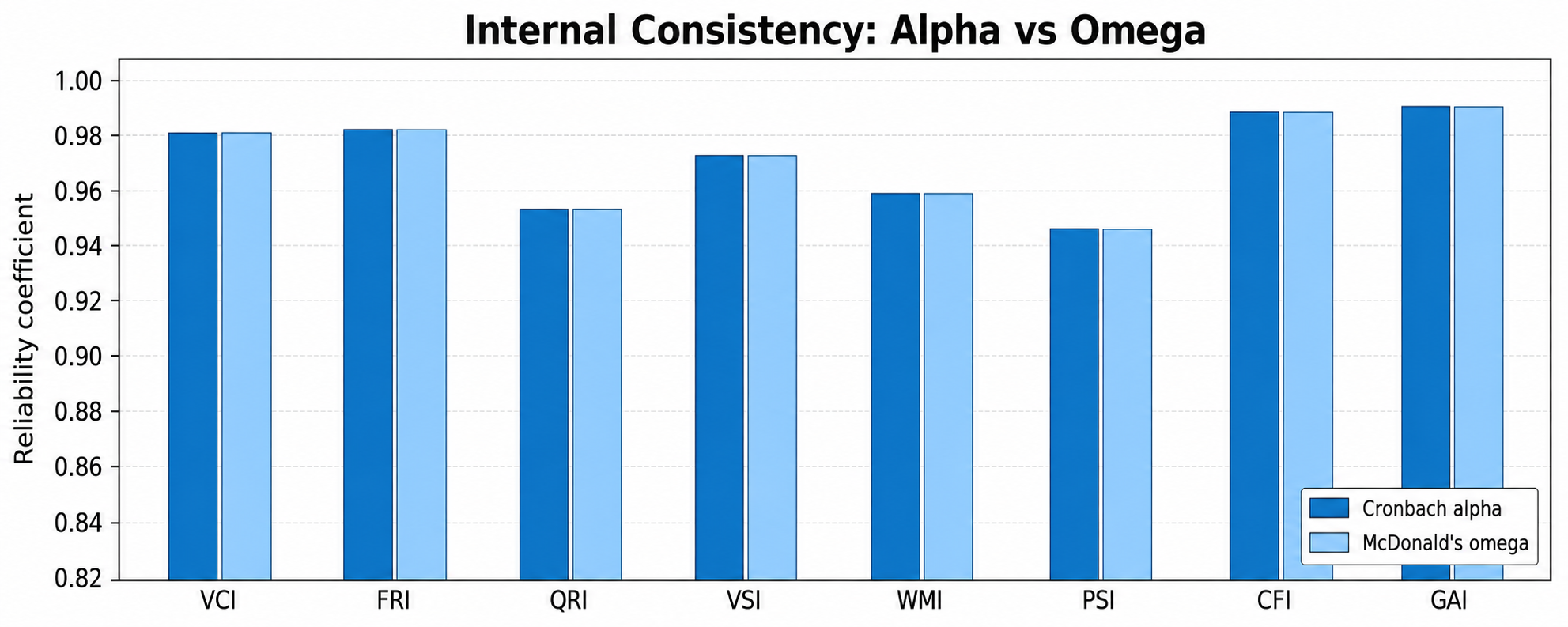
Figure 1. Internal consistency diagnostics. Subtest level alpha and omega for each index and broad composite, as listed in section 19. These are the secondary diagnostics rather than the Mosier composite reliability used for SEM, which is why they sit below the composite omega values in the tables.
10 Confirmatory Factor Analysis and Structural Validity
The CFA evidence evaluates whether the score structure behaves like the construct map says it should. The primary public interpretation model is the higher order g model: six broad domains are retained for profile interpretation, and those domains load on a general cognitive factor. That is the model that best matches ACIS reporting because users receive both FSIQ and differentiated domain scores.
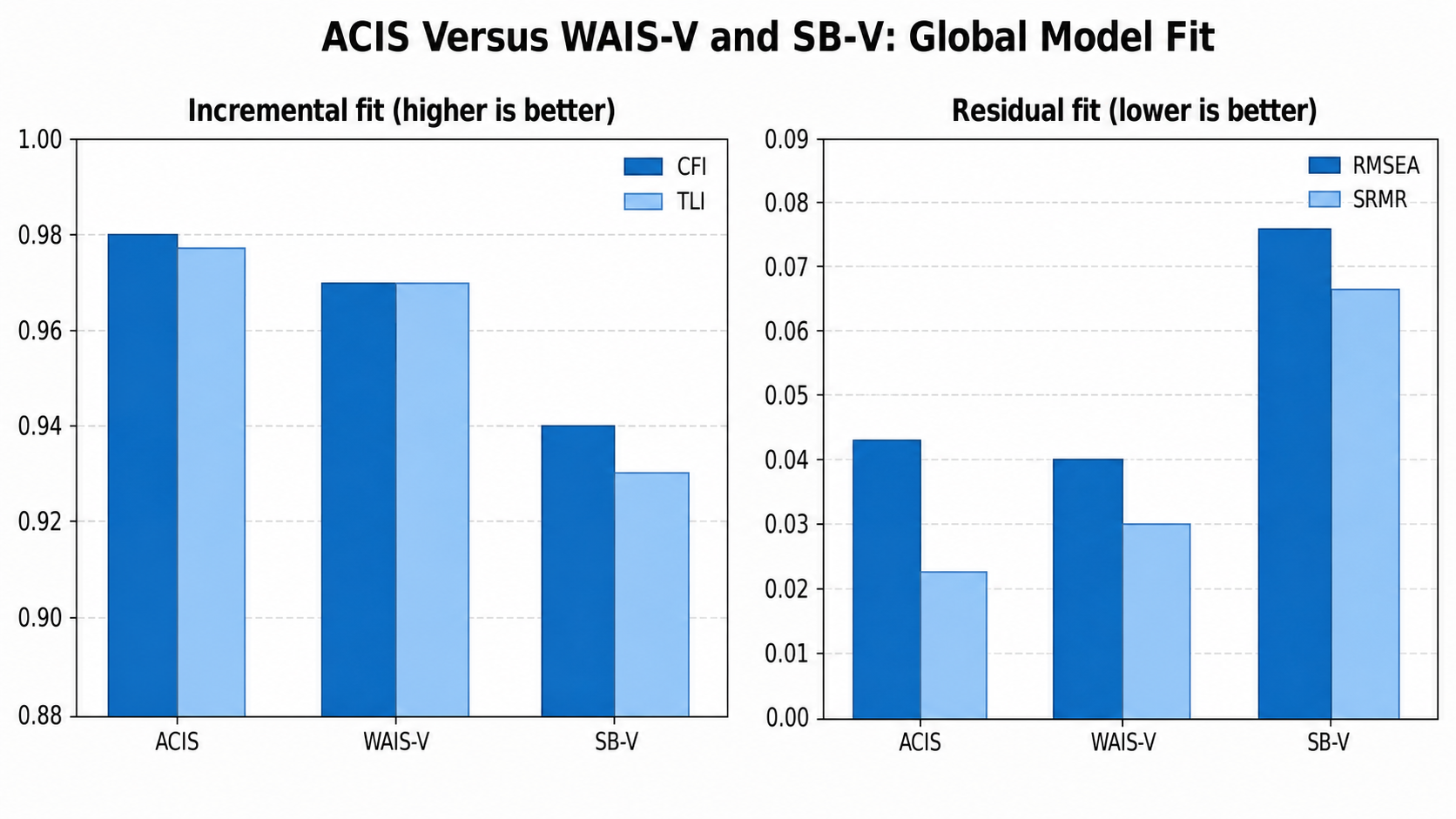
The higher order g model fits very well: CFI .9761, TLI .9726, RMSEA .0406, and SRMR .0217. This supports the interpretation that VCI, FRI, QRI, VSI, WMI, and PSI are positively correlated broad domains that can be summarized by a higher order general factor without erasing the domain profile. In plain terms, ACIS has both broad g and meaningful cognitive domains.
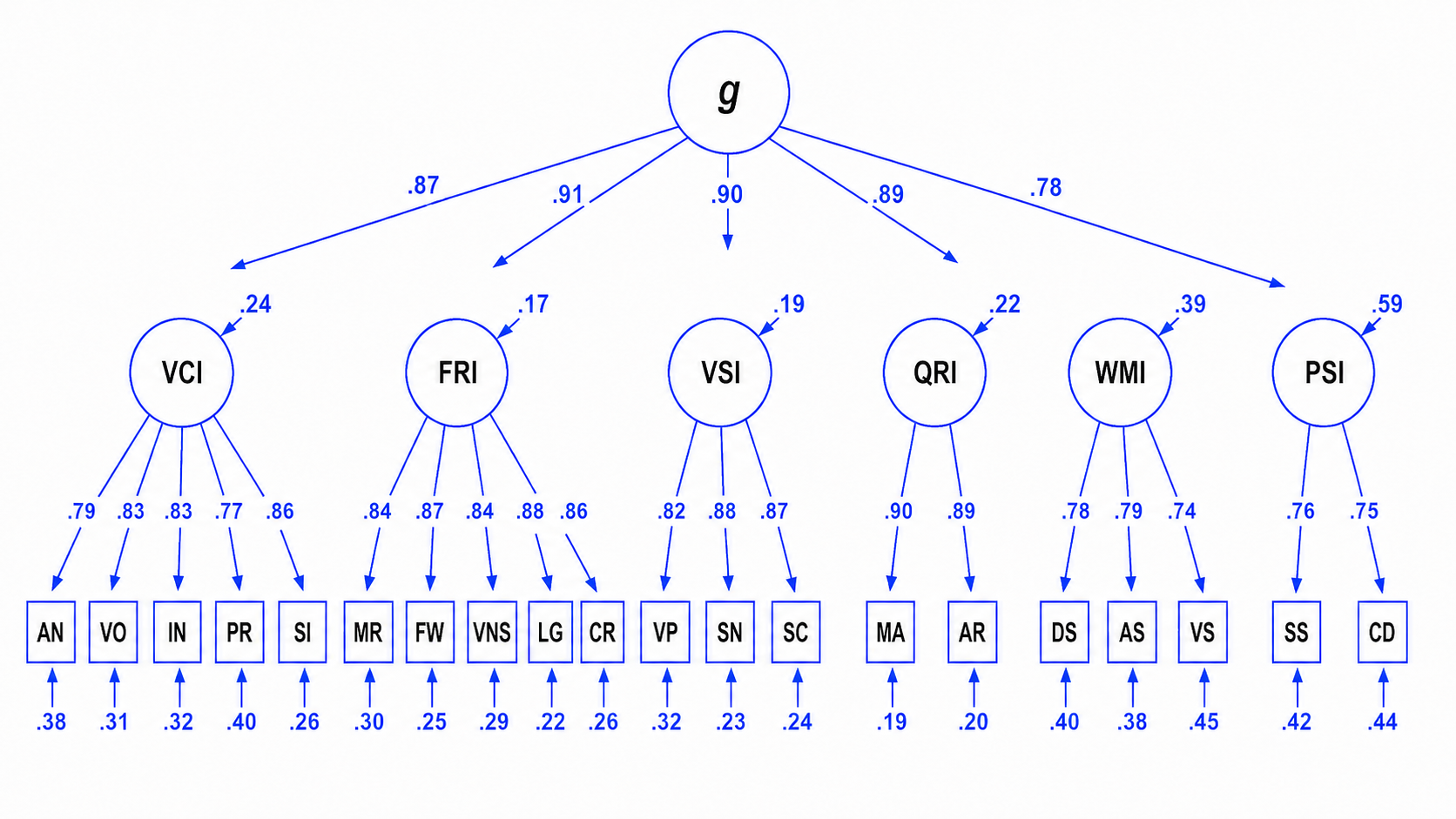
Standardized loadings in the higher order model are strong across the battery. VCI loadings range from .814 for Information to .865 for Similarities. FRI loadings range from .837 for Visual Number Series to .884 for Logic Grid. QRI loadings are .908 for Mathematical Achievement and .897 for Arithmetic. VSI loadings are .821 for Visual Puzzles, .886 for Spatial Navigation, and .871 for Spatial Comprehension. WMI loadings are .791 for Digit Span, .769 for Alphanumeric Sequencing, and .738 for Visual Sequence. PSI loadings are .752 for Symbol Search and .762 for Coding.
Factor correlations also support the general factor. VCI correlates .801 with FRI, .764 with QRI, .783 with VSI, .670 with WMI, and .577 with PSI. FRI correlates .812 with QRI, .813 with VSI, .699 with WMI, and .590 with PSI. QRI correlates .795 with VSI, .704 with WMI, and .542 with PSI. VSI correlates .715 with WMI and .587 with PSI, while WMI correlates .475 with PSI. The average scoring domain correlation is .688, which is high enough to support g but not so high that differentiated domains are meaningless.
The higher order g loadings on domains are also coherent: VCI .864, FRI .922, QRI .882, VSI .906, WMI .788, and PSI .648. This pattern matches the theoretical expectation that reasoning and knowledge domains carry stronger g saturation than speeded efficiency scores. PSI still contributes to the battery, but it is not expected to load on g as strongly as FRI, QRI, or VSI. This is why PSI should be interpreted as processing speed and cognitive efficiency rather than as a direct proxy for general reasoning.
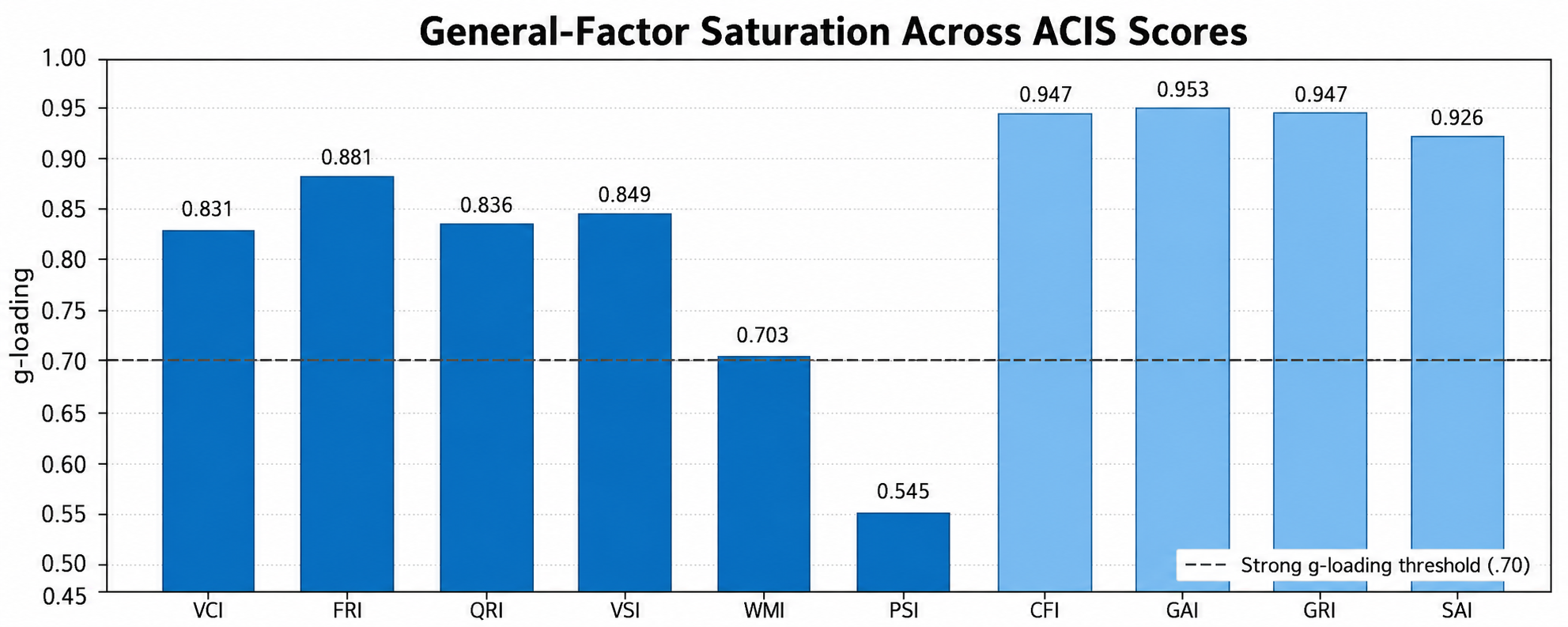
Figure 2. ACIS higher order g model. The primary public structural model places g above six CHC aligned broad domains while preserving domain level score interpretation.Figure 3. Composite g loading profile. General factor saturation for each index and broad composite, matching section 21. Reasoning composites carry the highest loadings, while PSI remains meaningful but more speed specific.
Composite g loadings further support the scoring system. FSIQ has g loading .958 and omega h .917. GAI has g loading .954 and omega h .910. CFI has g loading .949 and omega h .900. GRI has g loading .949 and omega h .900. CFRI has g loading .924 and omega h .853. CQRI has g loading .902 and omega h .814. These values show that broad ACIS composites are strongly related to general cognitive ability while still preserving construct specific interpretation.
Residual and modification index evidence remains consistent with the higher order g interpretation. Some local relationships are expected: Symbol Search and Coding share speeded visual method variance; Digit Span and Alphanumeric Sequencing share auditory serial order demands; Visual Puzzles and Spatial Navigation share visual spatial transformation demands; Similarities and Complex Relations share induction and abstraction demands. The key result is that the higher order g model fits strongly while preserving meaningful domain level interpretation.
11 Validity Evidence and Interpretive Argument
Validity is not a single coefficient. The validity argument for ACIS combines construct definition, CHC alignment, score reliability, higher order g structure, composite coherence, norming context, and administration security controls. Those sources converge on the same conclusion: ACIS supports professional interpretation of broad cognitive ability and differentiated cognitive domains.
Content based evidence begins with the subtest map. ACIS samples lexical knowledge, general information, reading comprehension, induction, general sequential reasoning, quantitative reasoning, mathematical achievement, visualization, spatial scanning, imagery, auditory working memory, visual working memory, and perceptual speed. The breadth of the Full Scale form supports a broad cognitive interpretation. The subtest level descriptions also show that each task has a defined construct role rather than being included solely because it resembles an IQ item.
Internal structure evidence comes from the higher order g CFA results. The model supports a multidomain structure with a strong general factor above VCI, FRI, QRI, VSI, WMI, and PSI. That is exactly the structure needed for an assessment that reports both FSIQ and differentiated indices.
Reliability evidence supports score precision. The strongest claims should be attached to the strongest scores: FSIQ, GAI, CFI, GRI, CFRI, and other broad composites with high omega and reasonable SEM. More cautious claims should be attached to narrower or one indicator scores. This is not a weakness of ACIS; it is normal psychometric discipline. Narrower scores are useful for profile interpretation, but they should not be described with the certainty of a 20 subtest composite.
Response process evidence is addressed at the construct level. The task descriptions specify the mental operations expected for each subtest: lexical retrieval, semantic abstraction, induction, general sequential reasoning, quantitative reasoning, visualization, sequence maintenance, visual scanning, and speeded comparison. ACIS does not disclose item content or scoring keys, but it specifies enough about intended processes for users to understand what each score represents.
The validity conclusion is direct: ACIS provides a coherent, CHC aligned, internally structured, reliability supported online cognitive assessment for adult English speaking users in the supported age range. The Full Scale form and broad composites carry the strongest interpretive weight because they combine broad domain coverage, high reliability, tight SEM, and strong g saturation.
12 Composite Index Reference and Use Cases
Composite scores are predefined groupings of subtests. They should not be created after the fact simply because a pattern looks interesting. ACIS composites have explicit construct definitions. Their value comes from combining related evidence in a way that increases reliability, clarifies the question being asked, and reduces overdependence on a single task.
FSIQ is the broadest ACIS composite. It is the best single summary of overall performance when all 20 subtests are completed. It should be interpreted with domain profile information because two users can have the same FSIQ with different strengths. FSIQ is strongest as a general cognitive estimate, not as a replacement for the entire report.
GAI is a broad general ability composite emphasizing higher order reasoning and knowledge while reducing dependence on working memory and processing speed. It is useful when the interpretive question concerns reasoning and knowledge more than cognitive efficiency. CFI is a broad composite emphasizing reasoning, working memory, and speed with reduced reliance on acquired verbal content. It is not culture free, because no cognitive test is culture free, but it reduces verbal knowledge dependence relative to FSIQ or GAI.
IRI focuses on Induction through Visual Number Series, Matrix Reasoning, and Complex Relations. It is useful when the interpretive question concerns rule inference and abstraction across novel stimuli. VRI focuses on verbal reasoning through Similarities and Complex Relations, identifying relations among concepts and abstracting shared meaning. VWMI focuses on visual working memory through Visual Sequence and therefore requires careful single indicator caution. AWMI focuses on auditory working memory through Digit Span and Alphanumeric Sequencing.
CVSI expands visual spatial coverage beyond the primary VSI by including Layer Rotation, Visual Puzzles, Spatial Comprehension, and Visual Sequence. CFRI expands fluid reasoning by adding quantitative components to the core reasoning set. CQRI expands quantitative reasoning beyond QRI by combining Mathematical Achievement, Figure Weights, Arithmetic, and Visual Number Series. NVI emphasizes nonverbal reasoning, visual spatial ability, working memory, and speed with minimal reliance on verbal content. GRI samples multiple reasoning modalities, including fluid, quantitative, and visual spatial reasoning. CPI combines working memory and processing speed as cognitive proficiency. SAI emphasizes academic, achievement, and knowledge related constructs. VKI combines Antonyms, Synonyms, Vocabulary, and Information as a verbal knowledge composite. Antonyms and Synonyms are parallel lexical-relation tasks and share an identical raw-to-scaled table, so both are included.
The key composite rule is match to question. If the question is broad cognitive standing, use FSIQ. If the question is reasoning and knowledge without emphasizing speed or working memory, use GAI. If the question is reduced verbal reliance, use CFI or NVI depending on the exact purpose. If the question is cognitive efficiency, use CPI. If the question is educationally loaded knowledge and achievement, use SAI. If the question is a narrow ability, use the relevant advanced composite but report its reliability and SEM.
13 Security, Retake Control Policy, and Data Quality
ACIS score interpretation assumes that the record represents a valid attempt. Security controls are not separate from psychometrics; they protect the meaning of the score. In an online assessment, repeated exposure, shared answers, low effort responding, device interference, and unusual response patterns can all weaken the relationship between observed score and intended ability. ACIS therefore treats security as part of score validity.
The technical analysis sample is built around completed and security qualified records. Retake controls help reduce practice contamination. Integrity screening helps remove attempts that no longer represent ordinary self administered performance. Completion requirements prevent partial profiles from being treated as full profiles. Age and language restrictions keep the score tied to the intended norm frame. These rules are not punitive; they are measurement rules.
Operational thresholds are withheld because exact detection rules would make the test easier to manipulate and would degrade future validity. ACIS states the existence and purpose of security controls while keeping implementation details confidential, which protects score meaning in online administration.
Data quality also includes device and context issues. Speeded tasks can be affected by input latency, screen size, visual clarity, distraction, fatigue, and motivation. Working memory tasks can be affected by audio conditions, attention, and rehearsal strategy. Verbal and knowledge tasks can be affected by English proficiency and educational exposure. ACIS cannot eliminate every environmental influence, but the report should acknowledge that online administration requires careful interpretation.
The correct conclusion is not that online testing is unusable. The correct conclusion is that online testing requires transparent limits, robust security, broad task sampling, careful score reporting, and conservative interpretation. ACIS is designed around those requirements. The Full Scale score, broad indices, reliability estimates, SEM, and profile interpretation together provide a more defensible result than a short unverified quiz.
14 Score Architecture and Reporting Hierarchy
ACIS scores are organized as a hierarchy rather than a flat list. The broadest score is FSIQ, followed by primary indices, composite indices, advanced composites, and individual subtests. The hierarchy is important because reliability, construct breadth, and interpretive certainty are not equal at every level. A score derived from 20 subtests can support broader language than a score derived from one task. A one subtest advanced composite can still be useful, but it must be reported with its reliability, SEM, and construct scope.
Variable; some are broad and excellent, while one indicator composites use the relevant subtest reliability source.
Target narrower interpretive questions with predefined subtest sets.
Creating new composites after seeing the profile.
Subtests
All 20 ACIS tasks
Most task specific; subtest omega or test retest reliability and scaled score SEM should be used.
Describe the cognitive operations behind index strengths and weaknesses.
Calling one subtest a complete measure of intelligence.
ACIS uses two main score metrics. Broad scores are interpreted on the IQ style metric with mean 100 and SD 15. Subtests are interpreted on a scaled score metric with mean 10 and SD 3 where subtest interpretation is appropriate. This separation prevents a subtest score from being confused with an IQ score and keeps uncertainty attached to the correct scale.
Use observed score plus SEM based uncertainty; avoid exact score language.
Composite and advanced composite indices
IQ style standard score
100
15
Mosier composite reliability when k >= 2; subtest omega or test retest Rxx when k = 1.
Broader composites can be described more confidently than one indicator scores.
Subtests
Scaled score
10
3
McDonalds_Omega_Subtest for non speeded subtests; Test_Retest_Rxx for WMI and PSI.
Use as supporting profile evidence, not a broad conclusion.
Percentiles
Norm referenced percentile rank
50th at standard score mean
Nonlinear
Derived from the score and norm scale, not a reliability coefficient.
Report with score and confidence context, especially in the tails.
SEM(IQ scale) = 15 x sqrt(1 - reliability)
SEM(scaled score scale) = 3 x sqrt(1 - reliability)
Example:
FSIQ composite omega total = .9886
SEM = 15 x sqrt(1 - .9886) = 1.6029 IQ points
ACIS uses Mosier composite reliability for multi indicator composite SEM because it combines observed subtest covariance with subtest score reliability. Cronbach alpha and omega over aggregated subtests remain useful diagnostics, but they are not the operational SEM coefficient for ACIS composite scores.
15 Technical Abbreviations
This section standardizes the abbreviations used throughout ACIS reports. It is limited to score and construct abbreviations; live items, scoring keys, timing thresholds, security rules, and operational scoring code remain protected.
Technical abbreviation
Meaning
Use in ACIS
Interpretive level
ACIS
Advanced Comprehensive Intelligence Scale
Name of the assessment battery.
Whole instrument.
CHC
Cattell Horn Carroll model
The construct framework used to map domains and narrow abilities.
Theoretical model.
g
General cognitive ability factor
Common variance across broad domains and subtests.
Higher order construct.
FSIQ
Full Scale IQ
Broadest ACIS summary score when all required subtests are complete.
Global composite.
Gc
Comprehension Knowledge
Verbal knowledge, acquired knowledge, language based reasoning.
CHC broad ability.
Gf
Fluid Reasoning
Novel problem solving, induction, general sequential reasoning, quantitative reasoning, and flexible adaptation.
CHC broad ability.
Gv
Visual Processing
Visualization, speeded rotation, spatial scanning, imagery, and visual memory when the dominant demand is visual processing.
Expanded fluid reasoning with quantitative components.
Advanced composite.
CQRI
Complete Quantitative Reasoning Index
Expanded quantitative reasoning and quantitative pattern discovery.
Advanced composite.
NVI
Nonverbal Index
Nonverbal reasoning, visual spatial ability, working memory, and speed.
Advanced composite.
GRI
General Reasoning Index
Reasoning across fluid, quantitative, and visual spatial modalities.
Advanced composite.
CPI
Cognitive Proficiency Index
Working memory and processing speed efficiency.
Advanced composite.
SAI
Scholastic Ability Index
Achievement, academic performance, and knowledge related constructs.
Advanced composite.
VKI
Verbal Knowledge Index
Lexical retrieval, verbal concept formation, and general information.
Advanced composite.
16 Assessment Forms and Score Availability Matrix
The Quick, Optimized, and Full Scale forms are not merely shorter or longer versions of the same score. They answer different measurement questions. Quick is a focused estimate of selected verbal, fluid, and working memory ability. Optimized is a broader profile with stronger breadth to time balance. Full Scale is the complete technical form and is the basis for the widest set of primary and advanced composites.
Complete technical profile and strongest basis for broad interpretation.
The form matrix defines score availability by assessment form. A score is reported only when its required subtests are available, which keeps Quick, Optimized, and Full Scale interpretations technically distinct.
Score
Quick
Optimized
Full Scale
Required subtests
FSIQ
Short form
Short form
Yes
Full Scale uses all 20 subtests. Quick and Optimized report a short-form FSIQ from their own 6 and 13 subtests, with a composite conversion specific to each set; it is not equivalent to the Full Scale FSIQ.
VCI
Partial
Partial
Yes
Full VCI requires Antonyms, Vocabulary, Information, Synonyms, Similarities. Optimized covers four of the five and omits Information.
FRI
Partial
Partial
Yes
Full FRI requires Matrix Reasoning, Figure Weights, Visual Number Series, Logic Grid, Complex Relations.
The glossary below is included so that the construct names in ACIS are not treated as loose labels. Each broad and narrow ability has a functional meaning. ACIS uses those meanings to decide where a subtest belongs, how an index should be named, and what a score can reasonably be said to represent.
Broad ability
Functional definition
ACIS index relationship
Interpretive scope
Gc: Comprehension Knowledge
Depth and breadth of acquired knowledge, verbal concepts, and language based reasoning.
Primary foundation of VCI and part of GAI, SAI, and VKI.
Strongly affected by English proficiency, educational exposure, and cultural knowledge.
Gf: Fluid Reasoning
Reasoning and problem solving in novel situations through induction, general sequential reasoning, and flexible adaptation without relying mainly on learned knowledge.
Primary foundation of FRI and a major contributor to GAI, CFI, IRI, CFRI, CQRI, NVI, and GRI.
Can still be influenced by task format, visual clarity, quantitative notation, and working memory demands.
Gv: Visual Processing
Perception and mental manipulation of visual spatial information, including visualization, speeded rotation, spatial scanning, imagery, and visual memory.
Primary foundation of VSI and CVSI; contributes to CFI, GAI, NVI, and GRI.
Should not be confused with visual working memory unless the task requires temporary sequence maintenance.
Gq: Quantitative Knowledge
Acquired mathematical knowledge and procedural skill, including learned numerical concepts and operations.
Primary foundation of QRI and part of CQRI, CFRI, GAI, GRI, and SAI.
Blends reasoning with schooling and procedural knowledge; interpretation should acknowledge both.
Gwm: Working Memory
Capacity to maintain and manipulate information over short intervals under attentional control.
Primary foundation of WMI, AWMI, VWMI, CPI, CFI, and NVI.
Modality matters: auditory and visual working memory are related but not identical.
Gs: Processing Speed
Speed and efficiency of performing simple cognitive operations, especially visual scanning and rapid decision making.
Primary foundation of PSI and part of CPI, CFI, and NVI.
Reliable speeded performance can still be affected by device conditions, visual acuity, motor output, and fatigue.
Narrow ability
Functional definition
ACIS subtest examples
Technical note
Lexical Knowledge
Breadth and depth of word meanings, vocabulary, and semantic network organization.
Antonyms, Vocabulary, Synonyms, Similarities
Supports verbal concept access and semantic relation reasoning.
General Information
Acquired factual knowledge and culturally mediated information stored in long term memory.
Information
Useful for Gc and SAI, but education and exposure should be considered.
Induction
Deriving rules from specific instances; detecting regularities and generating hypotheses about underlying structure.
Matrix Reasoning, Visual Number Series, Complex Relations, Similarities
Central to fluid reasoning and broad g saturation.
General Sequential Reasoning
Stepwise use of constraints and rules to reach a logically necessary conclusion.
Logic Grid
Combines rule following, controlled attention, and systematic elimination.
Quantitative Reasoning
Reasoning with quantities, relations, numerical constraints, and abstract quantitative relationships.
Figure Weights, Arithmetic
Functions as a bridge between Gf and Gq depending on item format.
Mathematical Achievement
Acquired mathematical knowledge and skill in applying learned procedures.
Mathematical Achievement
Achievement loaded and therefore interpreted with schooling context.
Visualization
Formation and manipulation of internal visual representations and spatial relations.
Temporary storage of phonological or auditory sequences.
Digit Span, Alphanumeric Sequencing
Auditory modality is important for AWMI interpretation.
Perceptual Speed Search
Rapid visual search, target detection, and discrimination among distractors under time pressure.
Symbol Search
Primary PSI narrow ability for visual search efficiency.
Perceptual Speed Compare
Rapid comparison and symbol response mapping under simple rule constraints.
Coding
Primary PSI narrow ability for speeded comparison and response mapping.
Writing Speed
Speeded output and symbol transcription coordinated with cognitive demands.
Coding
Secondary method component that explains output variance in Coding.
18 Subtest Technical Table: Construct, Loading, Reliability, and Risk
This table is the subtest level core of the manual. It combines the construct map with the CFA loading, indirect g loading, subtest reliability method, scaled score SEM, and the main interpretation risk. Each subtest is shown with enough technical detail to support professional score interpretation directly from the table.
Subtest
Factor
CHC narrow ability
CFA loading
g loading
Reliability method
Rxx
SEM SS
Primary interpretation risk
Antonyms
VCI
Lexical Knowledge
.860
.743
Omega subtest
.900
0.95
Lexical familiarity and English vocabulary exposure.
Vocabulary
VCI
Lexical Knowledge
.848
.732
Omega subtest
.950
0.67
Language production, precision of definitions, and scoring consistency.
Information
VCI
General Information
.814
.703
Omega subtest
.920
0.85
Educational and cultural exposure to factual knowledge.
Synonyms
VCI
Lexical Knowledge
.828
.715
Omega subtest
.880
1.04
Lexical familiarity and fine grained meaning discrimination.
Similarities
VCI
Induction + Lexical Knowledge
.865
.747
Omega subtest
.860
1.12
Blend of semantic relation reasoning and lexical knowledge.
Matrix Reasoning
FRI
Induction
.840
.774
Omega subtest
.930
0.79
Visual pattern format and hypothesis testing under item constraints.
Figure Weights
FRI
Quantitative Reasoning
.872
.803
Omega subtest
.910
0.90
Quantitative relation handling and proportional reasoning.
Visual Number Series
FRI
Induction
.837
.772
Omega subtest
.850
1.16
Symbolic pattern content can add quantitative familiarity.
Logic Grid
FRI
General Sequential Reasoning
.884
.814
Omega subtest
.880
1.04
Constraint tracking and controlled attention demands.
Complex Relations
FRI
Induction
.856
.789
Omega subtest
.900
0.95
Relation induction and rule integration.
Mathematical Achievement
QRI
Mathematical Achievement
.908
.801
Omega subtest
.910
0.90
Learned mathematics and procedural knowledge.
Arithmetic
QRI
Quantitative Reasoning
.897
.791
Omega subtest
.830
1.24
Quantitative manipulation plus working memory control.
Retired on September 7, 2026 and replaced by Layer Rotation. These values belong to the current edition, which was modelled with Spatial Navigation in the battery. Layer Rotation has no values yet.
Spatial Comprehension
VSI
Imagery + Visualization + Visual Memory
.871
.789
Omega subtest
.870
1.08
Mental imagery, visual memory, and open response clarity.
Digit Span
WMI
Working Memory Capacity + Auditory Short Term Storage
.791
.623
Test retest
.890
0.99
Attention, auditory encoding, and serial recall strategy.
Alphanumeric Sequencing
WMI
Working Memory Capacity + Auditory Short Term Storage
.769
.606
Test retest
.800
1.34
Active reordering, sequencing rules, and auditory verbal storage.
Visual Sequence
WMI
Visual Memory + Visual Spatial Short Term Storage
.738
.581
Test retest
.820
1.27
Visual working memory; should not be reclassified as visual reasoning.
Symbol Search
PSI
Perceptual Speed Search
.752
.487
Test retest
.780
1.41
Device latency, visual scanning, response speed, and attention.
Coding
PSI
Perceptual Speed Compare + Writing Speed
.762
.493
Test retest
.840
1.20
Speeded output, motor fluency, response mapping, and device conditions.
The pattern is coherent. Fluid, quantitative, and visual spatial reasoning subtests occupy the highest indirect g loading range, with Logic Grid, Spatial Comprehension, Complex Relations, Mathematical Achievement, Figure Weights, Spatial Navigation, and Arithmetic all near the top. PSI has lower g loadings but still strong factor loadings on PSI, which is the expected pattern for a processing speed domain: reliable and meaningful, but not a direct substitute for reasoning.
19 Reliability Tables and SEM Interpretation
ACIS reports stratified alpha, composite omega total, subtest level alpha/omega diagnostics, omega h, and SEM because each answers a different question. Stratified alpha and composite omega total are the professional ACIS score reliability coefficients used for SEM. Subtest level alpha and omega describe the covariance among aggregated subtests and remain useful diagnostics, but they should not be confused with the operational composite reliability.
Score
k
Stratified alpha
Composite omega
Subtest level omega
Omega h
SEM IQ
Interpretive classification
Technical reading
VCI
5
.9745
.9745
.9250
.6859
2.40
Excellent+
Reliable verbal index with a meaningful verbal specific component.
FRI
5
.9727
.9727
.9330
.7906
2.48
Excellent+
Strong reasoning index with high general factor saturation.
QRI
2
.9283
.9283
.8977
.6979
4.02
Very good
Strong two indicator quantitative score; interpret with Gq/Gf bridge in mind.
VSI
3
.9488
.9488
.8953
.7323
3.39
Excellent
Reliable visual spatial index with substantial domain specific variance.
WMI
3
.9247
.9247
.8099
.5096
4.12
Very good
Reliable working memory index; modality and sequence variance are important.
PSI
2
.8790
.8790
.7281
.3055
5.22
Good
Reliable speed index with lower g saturation and higher method specificity.
FSIQ
20
.9886
.9886
.9591
.9164
1.60
Excellent+
Strongest broad ACIS score and best single global summary.
CFI
15
.9837
.9837
.9453
.9003
1.92
Excellent+
High reliability reduced verbal broad composite.
GAI
15
.9885
.9885
.9612
.9079
1.61
Excellent+
Very strong broad reasoning and knowledge composite.
Advanced composite
k
Stratified alpha
Composite omega
Subtest level omega
Omega h
SEM IQ
Classification
Interpretive note
IRI
3
.9556
.9556
.8780
.7531
3.16
Excellent
Strong inductive reasoning composite.
VKI
4
.9800
.9800
.8801
.6275
2.12
Excellent+
Verbal knowledge composite with meaningful Gc specificity. Four-indicator values from 2026-08-31; Synonyms addition raises composite reliability and lowers subtest level omega because Synonyms is the least reliable of the four.
VRI
2
.9265
.9265
.7765
.7596
4.07
Very good
Narrow verbal reasoning composite; use with SEM rather than exact score language.
VWMI
1
NA
.8200
NA
.3932
6.36
Good
Single indicator visual working memory score; SEM is based on Visual Sequence test retest Rxx .82.
AWMI
2
.9054
.9054
.7792
.4348
4.61
Very good
Auditory working memory composite.
CVSI
4
.9508
.9508
.8732
.7675
3.33
Excellent
Expanded visual spatial score with working memory contribution.
CFRI
7
.9777
.9777
.9399
.8518
2.24
Excellent+
Very strong expanded fluid reasoning composite.
CQRI
4
.9582
.9582
.8988
.8235
3.06
Excellent
Strong expanded quantitative reasoning composite.
NVI
7
.9629
.9629
.8670
.8131
2.89
Excellent
Nonverbal composite with broad reasoning and efficiency coverage.
GRI
11
.9840
.9840
.9536
.9075
1.90
Excellent+
Excellent broad reasoning composite.
CPI
5
.9352
.9352
.7811
.5855
3.82
Very good
Cognitive efficiency score; more method sensitive than broad reasoning.
SAI
9
.9823
.9823
.9399
.8537
1.99
Excellent+
Strong scholastic and knowledge related composite.
SEM should be read as a score level uncertainty metric. FSIQ, GAI, CFI, CFRI, GRI, SAI, CPI, and NVI have small SEMs because they combine several indicators and have strong composite reliability. VWMI is the special case in this table because it is a one indicator score: its SEM is calculated from Visual Sequence test retest reliability rather than from a multi indicator composite coefficient. SEM does not "limit" ACIS when the coefficient is excellent; it simply states the precision of each reported score on its own scale.
Observed score
SEM 3.0
SEM 4.5
SEM 6.0
Professional wording
100
Approx. 95 to 105 at 90% confidence
Approx. 93 to 107 at 90% confidence
Approx. 90 to 110 at 90% confidence
Average range estimate; precision depends on score reliability.
115
Approx. 110 to 120 at 90% confidence
Approx. 108 to 122 at 90% confidence
Approx. 105 to 125 at 90% confidence
High average estimate; avoid treating small adjacent differences as fixed.
130
Approx. 125 to 135 at 90% confidence
Approx. 123 to 137 at 90% confidence
Approx. 120 to 140 at 90% confidence
Very high estimate; percentile language should stay tied to uncertainty.
145
Approx. 140 to 150 at 90% confidence
Approx. 138 to 152 at 90% confidence
Approx. 135 to 155 at 90% confidence
Extremely high estimate; subtest scatter and ceiling behavior matter more.
The CFA section evaluates whether the ACIS score architecture behaves like the manual says it should. The intended structure is a higher order g model: VCI, FRI, QRI, VSI, WMI, and PSI remain interpretable domains, and those domains support a strong general cognitive factor.
lavaan 0.6-21
Estimator: MLR
Number of observations: 2750
Primary model: higher order g
Domains: VCI, FRI, QRI, VSI, WMI, PSI
Higher order g model:
Chi-square = 916.703
df = 166
CFI = .9761
TLI = .9726
RMSEA = .0406 [.0380, .0431]
SRMR = .0217
The compact output block mirrors professional technical report style without exposing scoring keys or item content.
Model
Estimator
df
CFI
TLI
RMSEA
SRMR
Technical conclusion
Higher order g
MLR
166
.9761
.9726
.0406
.0217
Excellent fit for a general factor above six broad ACIS domains.
The higher order g model supports ACIS as a broad cognitive battery with both a strong general factor and meaningful domain scores. The model is not dependent on a single favorable index: CFI, TLI, RMSEA, and SRMR all support the same professional reading.
Domain
Higher order g loading
Domain interpretation
Implication for reporting
FRI
.922
Highest domain g loading; fluid reasoning is central to the ACIS general factor.
FRI differences are highly relevant to broad ability interpretation.
VSI
.906
Visual spatial processing strongly contributes to g while retaining visual specific variance.
VSI should be interpreted as broad Gv, not as a single visual puzzle score.
QRI
.882
Quantitative reasoning/knowledge strongly reflects g in ACIS.
QRI should be read as a high g quantitative domain, not merely arithmetic skill.
VCI
.864
Verbal knowledge and reasoning strongly reflect g with additional Gc specificity.
VCI supports broad interpretation but remains language/knowledge sensitive.
WMI
.788
Working memory contributes to g and cognitive proficiency.
WMI is important but should be separated from reasoning when profiles diverge.
PSI
.648
Processing speed contributes to general performance but is more method specific.
PSI should be interpreted as cognitive efficiency rather than reasoning power.
Factor pair
Correlation
Technical reading
VCI to FRI
.801
Strong relation between verbal knowledge, semantic relation reasoning, and fluid reasoning.
VCI to QRI
.764
Strong relation between verbal knowledge and quantitative reasoning/knowledge.
VCI to VSI
.783
Strong relation between verbal and visual spatial domains.
VCI to WMI
.670
Working memory relates to verbal performance but remains separable.
VCI to PSI
.577
Processing speed is related but more distinct from verbal knowledge.
FRI to QRI
.812
High domain correlation; quantitative reasoning is strongly fluid loaded.
FRI to VSI
.813
Strong relation between fluid and visual spatial reasoning.
FRI to WMI
.699
Working memory supports fluid reasoning but is not redundant with it.
FRI to PSI
.590
Speed contributes less to fluid reasoning than WMI or VSI.
QRI to VSI
.795
Quantitative and visual spatial reasoning share substantial problem solving variance.
QRI to WMI
.704
Quantitative work strongly involves working memory control.
QRI to PSI
.542
Quantitative scores are related to speed but not reducible to speed.
VSI to WMI
.715
Visual spatial tasks share memory and controlled attention demands.
WMI and PSI form a cognitive proficiency cluster but remain clearly distinct.
The average domain correlation is .688. That is high enough to justify a general factor and low enough to justify differentiated domain reporting. In practical terms, ACIS should report FSIQ, but it should not collapse the profile into FSIQ only.
21 Composite g Loadings and Construct Validity Coefficients
Composite g loadings estimate the correlation between a unit weighted composite and the latent general factor. Omega h estimates how much of the reliable composite variance is attributable to that general factor. These coefficients are not the same as total reliability. A composite can be reliable because it consistently measures a specific domain, even if its g saturation is moderate. This is why PSI can be a reliable processing speed score while still having lower omega h than FRI or GAI.
Score
k
g loading
Omega h
Construct validity reading
FSIQ
20
.958
.917
Excellent general cognitive composite; strongest ACIS global score.
VCI
5
.830
.689
High general ability plus strong verbal knowledge specificity.
FRI
5
.890
.792
Very high general reasoning saturation.
QRI
2
.835
.698
High quantitative reasoning saturation with Gq/Gf blend.
VSI
3
.857
.734
Strong visual spatial domain with meaningful specific variance.
WMI
3
.710
.504
Moderately high g relation plus working memory specificity.
PSI
2
.553
.305
Processing speed construct is reliable but less g saturated.
CFI
15
.949
.900
Excellent reduced verbal broad composite.
GAI
15
.954
.910
Excellent reasoning/knowledge composite.
IRI
3
.868
.753
Strong inductive reasoning composite.
VKI
4
.815
.665
Verbal knowledge score with strong Gc specificity.
VRI
2
.849
.721
High g verbal reasoning composite but narrower than VCI.
VWMI
1
.581
.337
Useful visual working memory indicator with single score caution.
AWMI
2
.679
.461
Auditory working memory with moderate g relation.
CVSI
4
.863
.745
Expanded visual spatial composite with broad cognitive relevance.
CFRI
7
.924
.853
Excellent expanded fluid reasoning composite.
CQRI
4
.902
.814
Very strong quantitative reasoning composite.
NVI
7
.899
.808
Strong nonverbal composite with broad reasoning content.
GRI
11
.949
.900
Excellent general reasoning composite.
CPI
5
.762
.581
Cognitive proficiency composite with efficiency specific variance.
SAI
9
.926
.857
Strong scholastic/knowledge composite.
The composite table supports a clean reporting rule. Use FSIQ when the question is broad cognitive standing. Use GAI when the question emphasizes reasoning and knowledge while reducing the impact of working memory and processing speed. Use CFI or NVI when the question requires reduced verbal dependence. Use CPI when the question is cognitive efficiency. Use advanced composites only when their construct definition matches the interpretive question.
22 Professional Comparisons
ACIS should be evaluated against professional cognitive batteries, not against short online quizzes. The values below compare ACIS structural fit and g loading evidence with public technical summaries for established batteries and the CORE reference page. Cross test comparisons are not perfect equivalence tests because samples, subtest sets, estimators, and reporting conventions differ. They are still useful because ACIS lands in the professional psychometric range.
Figure 4. Fit index comparison. ACIS higher order g fit is in the professional range and is competitive with published professional test values.
Fit index
ACIS higher order g
CORE
WAIS-V
SB-V
WJ-V
RIOT
Technical reading
CFI
.9761
.976
.97
.94
.70
.950
ACIS is in the excellent range and competitive with the comparison values shown here.
TLI
.9726
.970
.97
.93
.68
Not reported
ACIS shows strong parsimony adjusted fit.
RMSEA
.0406
.018
.04
.076
.110
.058
ACIS is comfortably inside conventional close fit territory.
SRMR
.0217
.036
Not reported
.067
Not reported
.045
ACIS has low standardized residual misfit.
The fit table does not imply that every test was studied in identical conditions. It shows that ACIS does not look psychometrically weak when placed beside professional structural reference values. Its higher order model fit is strong enough to support serious technical interpretation.
Figure 5. Average subtest g loading comparison. ACIS shows strong broad cognitive saturation while retaining differentiated domain structure.Figure 6. Reliability comparison. ACIS broad composites fall in the high reliability range expected of serious cognitive batteries.
Comparison area
ACIS
CORE reference
WAIS-V reference
SB-V reference
RIOT reference
Interpretation
Average subtest g loading
.715
Approx. .677
Approx. .636
Approx. .741
Approx. .58
ACIS is in the professional range while retaining a differentiated multidomain profile. Figure 5 plots the same averages and adds WAIS-IV at approximately .634.
Subtest g loading range
.487 to .814
.53 to .78
.39 to .78
.47 to .81
.33 to .83
ACIS has a coherent range: reasoning indicators high, processing speed lower but still meaningful.
Broad composite reliability
FSIQ composite omega .9886
Professional range expectation
Professional range expectation
Professional range expectation
Professional range expectation
ACIS broad score reliability is consistent with professional assessment standards.
Measurement breadth
20 subtests, six domains
Multidomain
Multidomain
Multidomain
Multidomain
ACIS is broad enough to support more than a single narrow online test interpretation.
Subtest g loading comparison detail
The table below places ACIS subtest g loadings beside broadly similar indicators from professional style technical summaries. Similar names do not imply identical tasks; the comparison shows whether ACIS indicators sit in the professional g loading range expected from serious cognitive batteries.
ACIS
CORE
WAIS-V
SB-V
RIOT
Subtest
g-loading
Subtest
g-loading
Subtest
g-loading
Subtest
g-loading
Subtest
g-loading
AN
.74
AG
.70
VC
.69
VKN
.70
AG
.55
VC
.73
AN
.69
SI
.65
NVKN
.77
IN
.59
IN
.70
IN
.62
IN
.65
VFR
.74
VC
.60
SY
.72
MR
.73
CO
.66
NVFR
.66
FW
.72
SI
.75
GM
.76
MR
.73
VVS
.81
MR
.70
MR
.77
FW
.78
FW
.78
NVVS
.71
VP
.66
FW
.80
FS
.73
AR
.74
VQR
.81
OR
.69
VNS
.77
VP
.74
SR
.70
NVQR
.79
SO
.83
LG
.81
SA
.76
BD
.73
VWM
.72
SV
.71
CR
.79
BC
.61
VP
.74
NVWM
.70
CS
.46
MA
.80
QK
.76
SSp
.65
EM
.40
AR
.79
AR
.70
SAd
.68
VR
.54
VP
.74
DLS
.53
DSq
.61
AM
.33
SN
.80
DS
.58
DF
.53
SS
.49
SC
.79
CP
.59
DB
.61
sRT
.44
DS
.62
SS
.55
RD
.42
cRT
.43
AS
.61
LNS
.63
VS
.58
CD
.57
SS
.49
SS
.56
CD
.49
NSO
.39
The comparison explains why ACIS should not be evaluated as if it were a narrow online matrix test. The ACIS g loading profile has the shape expected of a broad battery: fluid and quantitative reasoning tasks are high, semantic relation and visual spatial tasks are strong, working memory tasks are moderate to strong, and processing speed tasks are lower but coherent. That is the same broad pattern seen in professional batteries, where not every subtest is supposed to load equally on g.
The ACIS advantage is breadth. A short online IQ test can sometimes produce one impressive loading for one task family, but it cannot provide a professional profile if it does not sample the major cognitive domains. ACIS samples verbal knowledge, verbal reasoning, reading comprehension, matrix reasoning, quantitative reasoning, sequential reasoning, visual spatial processing, visual working memory, auditory working memory, and processing speed. That breadth is what makes the Full Scale score and broad composites technically meaningful.
On the evidence summarized here, ACIS is technically comparable to professional intelligence assessments in structural breadth, broad score reliability, and higher order g modeling. In several structural fit comparisons, ACIS is stronger than the public reference values shown here. The overall conclusion is that ACIS is psychometrically and structurally professional grade, and not comparable to casual online IQ tests.
23 Security, Retake Control, and Online Administration Quality
Security is part of validity, especially for an online cognitive assessment. A score is not meaningful if it is based on repeated exposure, answer sharing, automation, external assistance, or low effort behavior. ACIS therefore treats secure record qualification as a psychometric requirement rather than a cosmetic platform feature.
Threat to score meaning
Expected psychometric effect
ACIS public position
Why details remain protected
Retake practice
Inflates performance through item familiarity and strategy learning.
Technical records assume retake control before score interpretation.
Exact matching logic would help users bypass controls.
External assistance
Weakens the relationship between observed score and individual ability.
Flagged records should be excluded from technical estimation and valid reporting.
Publishing detection thresholds would degrade future validity.
Low effort
Deflates scores and distorts covariance, especially on timed or memory tasks.
Quality rules protect the analysis sample from clearly invalid attempts.
Specific cutoffs should remain confidential.
Device latency
Can affect PSI, visual spatial timing, and response speed.
PSI is interpreted with device/context awareness.
Device control is handled separately from score interpretation.
Screen size and visibility
Can affect visual scanning, rotation, and spatial tasks.
Visual spatial and processing speed scores are interpreted with online administration caution.
Public page should not expose live rendering validation logic.
Language mismatch
Can depress verbal, reading, information, and instruction dependent tasks.
The current norming frame is English speaking adults.
Language specific norms would require separate documentation.
Partial completion
Can make unavailable composites appear deceptively precise.
Scores should appear only when required subtests are complete.
Score availability logic should be consistent across report and backend.
Score validity depends on administration integrity without exposing live detection rules. ACIS reports the existence and purpose of controls while keeping operational thresholds confidential.
24 Professional Interpretation Rules
ACIS score interpretation starts from the strongest evidence: completed form, validity status, FSIQ, primary indices, broad composites, and then subtest detail. The rules below keep report language aligned with reliability, SEM, construct breadth, and higher order g evidence.
Rule
Required reporting behavior
Reason
Example of correct wording
State the completed form
Name whether the result is Quick, Optimized, or Full Scale.
Form breadth determines score availability and interpretive strength.
"The Full Scale form was completed, allowing interpretation of FSIQ, all primary indices, and advanced composites."
Attach SEM to serious score claims
Report score uncertainty using the reliability coefficient selected for SEM.
No observed score is exact.
"The observed FSIQ is best read with an SEM of approximately 3.0 points."
Use broad scores first
Begin with FSIQ and broad indices before subtests.
Broad scores have stronger reliability and less task specific variance.
"The broad profile indicates stronger reasoning than processing speed efficiency."
Respect construct names
Use the manual defined construct for each score.
Prevents labeling a score as something it does not measure.
"Visual Sequence is interpreted as visual working memory, not as primary visual spatial reasoning."
Do not overread small differences
Interpret differences only when they exceed expected measurement error and make construct sense.
Small score gaps can be noise.
"The VCI to FRI difference is noted only if it is larger than the uncertainty around both scores."
Use subtests as explanatory evidence
Subtests support profile interpretation but do not replace broad domains.
Subtests have more method variance and higher SEM.
"Coding suggests processing output efficiency, but PSI is the stronger speed domain score."
Profile interpretation should follow a fixed sequence: verify form and validity status, read FSIQ, review primary indices, check whether broad composites answer a specific question, inspect advanced composites only when relevant, then use subtests as explanatory detail. This order prevents an unusual single score from driving the entire interpretation.
25 CFA Appendix: Loadings, Residuals, and Model Diagnostics
This appendix provides the higher order g loading details behind the ACIS score structure. The key technical question is whether the broad domains and subtests behave coherently inside the model used for score interpretation.
Domain
Indicator
Standardized loading
SE
Interpretation
VCI
Antonyms
.860
.009
Strong lexical knowledge indicator with substantial verbal domain signal.
VCI
Vocabulary
.848
.007
Very strong VCI indicator; central to verbal concept formation.
VCI
Information
.814
.008
Strong acquired knowledge indicator; more exposure sensitive than Vocabulary.
VCI
Synonyms
.828
.009
Strong lexical knowledge indicator with fine grained meaning discrimination.
VCI
Similarities
.865
.006
Highest VCI loading; strong abstraction and lexical reasoning signal.
FRI
Matrix Reasoning
.840
.006
Strong figural induction indicator.
FRI
Figure Weights
.872
.006
Very strong fluid quantitative bridge indicator.
FRI
Visual Number Series
.837
.006
Strong numerical induction indicator.
FRI
Logic Grid
.884
.005
Very strong sequential reasoning indicator.
FRI
Complex Relations
.856
.006
Strong Induction indicator over multi step relations.
QRI
Mathematical Achievement
.908
.005
Very strong quantitative/achievement indicator.
QRI
Arithmetic
.897
.005
Very strong Quantitative Reasoning indicator with working memory demand.
VSI
Visual Puzzles
.821
.008
Strong visualization and speeded rotation indicator.
VSI
Spatial Navigation (retired)
.886
.006
Indicator of the current edition. The subtest was retired on September 7, 2026; Layer Rotation replaces it and enters the model in the next edition.
VSI
Spatial Comprehension
.871
.006
Very strong imagery, visualization, and visual memory indicator.
WMI
Digit Span
.791
.011
Strong auditory serial storage indicator.
WMI
Alphanumeric Sequencing
.769
.011
Strong executive auditory sequencing indicator.
WMI
Visual Sequence
.738
.012
Strong visual working memory indicator.
PSI
Symbol Search
.752
.010
Strong visual search speed indicator.
PSI
Coding
.762
.010
Strong speeded symbol association and output indicator.
The lowest primary domain loading in the higher order model is Visual Sequence at .738, which is still strong. No indicator shows a weak loading that would justify removing it from the reported construct structure. The pattern is also theoretically ordered: Mathematical Achievement, Arithmetic, Logic Grid, Spatial Navigation, Spatial Comprehension, Figure Weights, and Similarities sit among the strongest indicators because they combine clear task demands with strong domain saturation. Processing speed indicators load strongly on PSI even though PSI's higher order g loading is lower.
Higher order g result
Value
Technical meaning
Reporting implication
CFI
.9761
Excellent comparative fit.
Supports the primary ACIS score structure.
TLI
.9726
Excellent parsimony adjusted fit.
Shows strong fit without relying on unnecessary complexity.
RMSEA
.0406
Low approximate error.
Consistent with a well specified higher order structure.
SRMR
.0217
Very low standardized residual mismatch.
Supports local fit of the covariance structure.
Average subtest g loading
.715
Subtests are broadly saturated with general ability, but not equally.
Broad scores are justified; domain differences remain meaningful.
Subtest g loading range
.487 to .814
Processing speed tasks sit lower; reasoning and quantitative tasks sit higher.
Do not interpret all subtests as equally g loaded.
Residual diagnostics are a quality control check. Some residual relations are cognitively expected. Symbol Search and Coding share speeded visual output variance. Digit Span and Alphanumeric Sequencing share auditory serial order. Similarities and Complex Relations share abstraction and induction. Visual Puzzles and Spatial Navigation share visual spatial transformation. In the higher order g model, these relationships remain small enough to preserve the intended interpretation.
Higher order residual area
Largest residual examples
Magnitude range
Interpretive decision
Visual speed overlap
Spatial Navigation and Symbol Search; Spatial Navigation and Coding. Both pairs involve the retired subtest.
Mostly around .04 to .07
Expected visual speed overlap; does not weaken domain interpretation.
Abstract relation overlap
Similarities and Complex Relations.
Mostly around .04 to .07
Expected overlap between verbal abstraction and relational induction.
Quantitative memory overlap
Arithmetic and Visual Sequence.
Mostly around .04 to .07
Small local relation consistent with working memory demand in quantitative tasks.
The higher order g model is therefore supported both globally and locally: fit indices are strong, loadings are coherent, and residual relationships are small and theoretically interpretable.
26 Composite Composition Appendix
This appendix lists each broad and advanced composite as a predefined score. It is included to prevent undocumented composites from entering reports. A composite should exist because it has a construct definition and a stable subtest set, not because a user or developer notices a convenient cluster after seeing results. This is the same logic used in professional test manuals: score meaning comes before score calculation.
Composite
Included subtests
Construct definition
Reliability / SEM
Best use
FSIQ
All 20 ACIS subtests.
Global estimate of broad cognitive ability across verbal, fluid, quantitative, visual spatial, working memory, and processing speed domains.
Scholastic ability composite emphasizing achievement, knowledge, and academically relevant reasoning.
Composite omega .9823; SEM 1.99.
Academic and knowledge related cognitive estimate.
VKI
Antonyms, Synonyms, Vocabulary, Information.
Verbal knowledge: lexical retrieval, verbal concept formation, and general information.
Composite omega .9800; SEM 2.12.
Gc heavy verbal knowledge score.
The composition table also clarifies why several advanced composites can have high g loadings. CFRI, GRI, GAI, and CFI combine multiple high g reasoning indicators across domains, so their broad cognitive saturation is high. VWMI is different: it is constructually useful, but it is one subtest. VWMI is therefore treated as a targeted visual working memory indicator with a wider SEM rather than as a broad replacement for WMI or VSI.
27 Conclusions
Taken together, the evidence in this manual indicates that ACIS is not merely a strong online IQ test, but a professional grade cognitive assessment for online administration. Across reliability, SEM, higher order g model fit, domain structure, and subtest g loadings, ACIS shows the psychometric pattern expected from a serious multidomain intelligence battery.
The Full Scale score is supported by 20 subtests, six CHC aligned domains, composite omega .9886, SEM 1.60, and FSIQ g loading .96. The higher order g model fits strongly, with CFI .9761, TLI .9726, RMSEA .0406, and SRMR .0217. This combination supports a highly accurate and theoretically grounded estimate of general cognitive ability while preserving meaningful domain level interpretation.
28 References
The analytic conventions, scaling choices, and comparison points used throughout this manual draw on the following instruments, standards, and literature.
American Psychological Association. (2013). Guidelines for the practice of telepsychology. American Psychologist, 68(9), 791-800.
Binet, A., & Simon, T. (1905). New methods for the diagnosis of the intellectual level of subnormals. L'Année Psychologique, 12, 191-244. Full text at Classics in the History of Psychology.
Brown, T. A. (2015). Confirmatory Factor Analysis for Applied Research (2nd ed.). New York: Guilford Press.
Carroll, J. B. (1993). Human Cognitive Abilities: A Survey of Factor-Analytic Studies. Cambridge: Cambridge University Press.
Cattell, R. B. (1963). Theory of fluid and crystallized intelligence: A critical experiment. Journal of Educational Psychology, 54(1), 1-22.
Crawford, J. R., Garthwaite, P. H., & Slick, D. J. (2009). On percentile norms in neuropsychology: Proposed reporting standards and methods for quantifying the uncertainty over the percentile ranks of test scores. The Clinical Neuropsychologist, 23(7), 1173-1195.
Cronbach, L. J. (1951). Coefficient alpha and the internal structure of tests. Psychometrika, 16(3), 297-334.
Flynn, J. R. (1987). Massive IQ gains in 14 nations: What IQ tests really measure. Psychological Bulletin, 101(2), 171-191.
Gottfredson, L. S. (1997). Mainstream science on intelligence: An editorial with 52 signatories, history, and bibliography. Intelligence, 24(1), 13-23.
Horn, J. L., & Cattell, R. B. (1966). Refinement and test of the theory of fluid and crystallized general intelligences. Journal of Educational Psychology, 57(5), 253-270.
Hu, L., & Bentler, P. M. (1999). Cutoff criteria for fit indexes in covariance structure analysis: Conventional criteria versus new alternatives. Structural Equation Modeling, 6(1), 1-55.
Jensen, A. R. (1998). The g Factor: The Science of Mental Ability. Westport, CT: Praeger.
Kaufman, A. S., Raiford, S. E., & Coalson, D. L. (2016). Intelligent Testing with the WISC-V. Hoboken, NJ: Wiley.
Lubinski, D., & Benbow, C. P. (2006). Study of Mathematically Precocious Youth after 35 years: Uncovering antecedents for the development of math-science expertise. Perspectives on Psychological Science, 1(4), 316-345.
McDonald, R. P. (1999). Test Theory: A Unified Treatment. Mahwah, NJ: Lawrence Erlbaum Associates.
McGrew, K. S. (2009). CHC theory and the human cognitive abilities project: Standing on the shoulders of the giants of psychometric intelligence research. Intelligence, 37(1), 1-10.
Rosseel, Y. (2012). lavaan: An R package for structural equation modeling. Journal of Statistical Software, 48(2), 1-36.
Salthouse, T. A. (2012). Consequences of age-related cognitive declines. Annual Review of Psychology, 63, 201-226.
Schmidt, F. L., & Hunter, J. E. (1998). The validity and utility of selection methods in personnel psychology: Practical and theoretical implications of 85 years of research findings. Psychological Bulletin, 124(2), 262-274.
Schneider, W. J., & McGrew, K. S. (2018). The Cattell-Horn-Carroll theory of cognitive abilities. In D. P. Flanagan & E. M. McDonough (Eds.), Contemporary Intellectual Assessment: Theories, Tests, and Issues (4th ed., pp. 73-163). New York: Guilford Press.
Spearman, C. (1904). General intelligence, objectively determined and measured. American Journal of Psychology, 15, 201-292. Full text at Classics in the History of Psychology.
Warne, R. T. (2025). Informational Bulletin for the Reasoning and Intelligence Online Test (RIOT Technical Report No. 2025-01). RIOT IQ.
Wechsler, D. (2008). Wechsler Adult Intelligence Scale, Fourth Edition: Technical and Interpretive Manual. San Antonio, TX: Psychological Corporation.
Wechsler, D., Raiford, S. E., & Presnell, K. (2024). Wechsler Adult Intelligence Scale (5th ed.): Technical and interpretive manual. NCS Pearson.
Take the assessment
You get a profile, not a number
ACIS measures six CHC domains across 20 subtests and reports each one with its own normed score and confidence interval, so you can see where you are strong and where you are not.