Cognitive Ability Test Measure How Your Mind Works
A cognitive ability test measures general mental ability, the same construct an IQ test captures. Here's what it measures, how it differs from aptitude tests, and how to take a real, normed one. Start free.
0 Quick Answer
A cognitive ability test measures your general mental ability, how well you reason, learn, solve problems, and process information. It is the same underlying construct an IQ test measures: both estimate the general factor of intelligence (g) by sampling several distinct cognitive abilities and combining them into an overall score. "Cognitive ability test," "general mental ability test," and "IQ test" are, for practical purposes, three names for the same thing.
Direct answer: if you want to measure your own cognitive ability accurately, take a broad, properly normed battery that samples multiple abilities and reports a real score with a margin of error. ACIS is exactly that, a cognitive ability test with 20 subtests across six domains, adult norms (3,243 records, ages 16–90), published reliability and validity, and a detailed report. It is built for personal insight and self-assessment, not as an employer's proctored screening tool or a clinical diagnosis. This guide explains what a cognitive ability test measures, how it differs from aptitude tests, how employers use them, and how to take one and read your result. Whether you're testing for self-knowledge, curiosity, or to understand an employer's screening, the same underlying principles apply. In every case the goal is the same: a real measurement of general cognitive ability, reported with the percentile and confidence interval that let you read it honestly. A cognitive ability score is most useful treated as a starting map of your strengths rather than a single label, and that is exactly how this guide helps you read yours.
A cognitive ability test is a standardized assessment of your mental capabilities, the mix of reasoning, memory, knowledge, and processing speed that lets you think, learn, and solve problems. Rather than testing what you happen to know about one subject, it measures how well your mind works across several distinct kinds of thinking, and expresses the result as a standardized score relative to a comparison group.
The key idea behind every serious cognitive ability test is that these different abilities are correlated: people who are strong in one tend to be above average in others. That shared core is the general cognitive ability factor, usually called g, and it is what an overall cognitive ability score (or IQ) estimates. A good test samples widely precisely so that the overall number reflects this general ability rather than one narrow skill.
Like any measurement, a cognitive ability score is only meaningful relative to a defined reference group and only as precise as the test's reliability allows, which is why a real test reports a confidence interval, not a bare exact number. ACIS interprets your results within an adult reference frame of 3,243 records (ages 16–90) and reports the precision of every score. For the score side of it, start with What IQ Scores Mean.
2 Cognitive ability vs IQ vs aptitude, the terms cleared up
These words get used interchangeably and it causes real confusion, so here is the honest distinction:
Cognitive ability / general mental ability (GMA). The broad capacity to reason, learn, and solve problems. This is the construct. In research and hiring, "general cognitive ability" and "general mental ability" are the standard terms.
IQ. A score on the standardized scale (mean 100, SD 15) used to express general cognitive ability. "IQ" is the number; "cognitive ability" is the thing the number measures. A cognitive ability test and an IQ test estimate the same underlying g.
Aptitude test. Usually narrower and job- or domain-specific, measuring a particular ability (numerical, verbal, mechanical) often to predict performance in a specific role or course. Aptitude tests overlap heavily with cognitive ability because they tap the same abilities, but a single aptitude test measures one slice, while a full cognitive ability battery measures the whole picture.
So when people search for a "cognitive ability test," some want a personal measure of their intelligence and others are preparing for a job-screening aptitude test. ACIS serves the first group directly and helps the second understand what those abilities are and where they stand. The deeper construct map is in What an IQ Test Measures and Cognitive Domains.
The practical reason the terminology matters is that the label you search for shapes the test you find: search "cognitive ability test" and you surface employer-style aptitude tools, search "IQ test" and you surface personal-assessment sites, search "aptitude test" and you surface job-prep practice. Yet all three tap the same underlying general ability, which is why a single broad, normed battery serves every one of those intents at once: it gives you a real measure of your general cognitive ability, reveals the specific abilities that narrow aptitude tests probe one at a time, and reports the result on the IQ scale people already recognize. That convergence is the genuine reason ACIS describes itself as both a cognitive ability test and an IQ test: not a marketing flourish, but the simple fact that they measure the same construct. So whichever term brought you here, the thing you actually want, an accurate read of how your mind works, is the same.
3 The g factor: what a cognitive ability test really captures
Over a century of research has found that performance on diverse mental tasks is positively correlated, the "positive manifold." The statistical core of that correlation is general cognitive ability, g, and it is the single most important thing a cognitive ability test measures. A test is considered strong when its overall score is heavily "g-loaded", that is, when it reflects this general factor rather than a single trick.
ACIS is organized around the Cattell–Horn–Carroll (CHC) model, the dominant scientific framework for the structure of cognitive abilities, and it supports its structure with confirmatory factor analysis and reported g-loading estimates (based on N = 2,750 complete records). That means the overall score isn't an arbitrary sum; it's a defensible estimate of general cognitive ability, with the six domains feeding into it. For the science of the general factor, read The g Factor Explained.
4 The six cognitive abilities ACIS measures
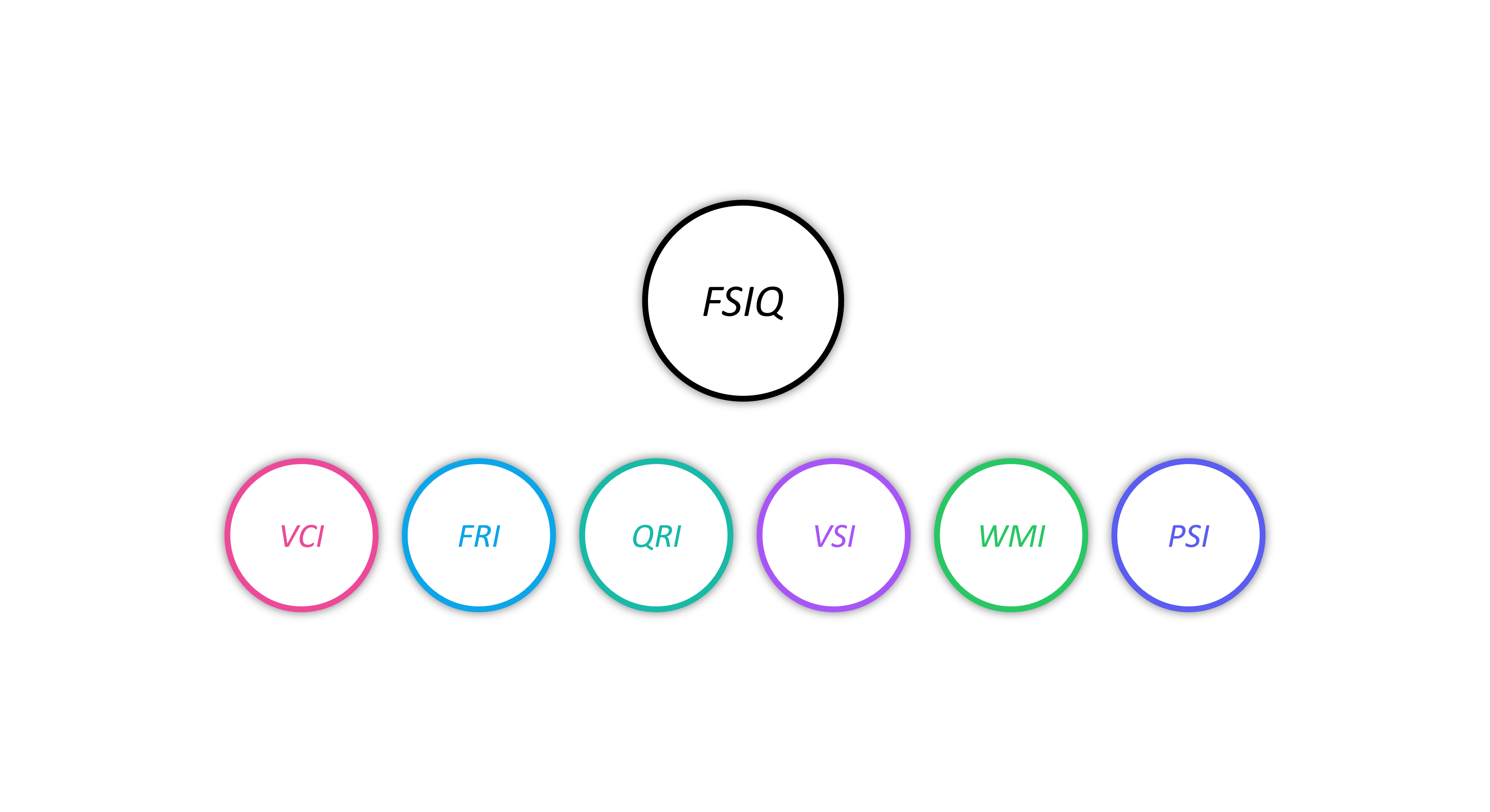
Because general ability shows up across distinct domains, an accurate cognitive ability test samples several of them. ACIS measures six broad domains with 20 subtests, producing a Full Scale IQ plus a domain profile:
This breadth is what separates a real cognitive ability test from a single-task quiz: the Full Scale IQ reflects general ability, and the six domain scores reveal your cognitive shape, your relative strengths and weaknesses. Each domain is explained in depth in Cognitive Domains.
5 Cognitive ability tests in hiring
One of the biggest reasons people search for cognitive ability tests is employment: companies use them to screen candidates, because general mental ability is among the strongest single predictors of job performance and trainability, especially in complex roles. The classic meta-analytic evidence comes from Schmidt & Hunter on the validity of selection methods, and the broader case is laid out by Gottfredson (1997). Employer tools you may have encountered, Wonderlic, SHL, Korn Ferry, Criteria CCAT, are all cognitive ability or aptitude tests built on this research.
Where ACIS fits, honestly: ACIS is not an employer's proctored pre-employment test, and it should not be submitted as one. But it measures the same general cognitive ability those tests measure, so it is genuinely useful if you want to (a) understand what employers are actually assessing, (b) learn your own cognitive profile and relative strengths, or (c) get a baseline before a real assessment. For the relationship between ability and work outcomes, and its limits, see IQ and Job Performance.
If you're facing an employer's cognitive ability test, it helps to know what to expect. Most pre-employment tools are short, strictly timed, and focus on a few abilities, typically verbal, numerical, and abstract/logical reasoning, because they're predicting on-the-job learning, not producing a full cognitive profile. Names you may encounter include the Wonderlic, the Criteria Cognitive Aptitude Test (CCAT), and SHL or Korn Ferry assessments. They differ in format and length, but all rest on the same finding that general mental ability predicts performance. Taking a broad, self-paced cognitive ability test like ACIS beforehand won't raise your underlying ability (nothing crams that), but it does two useful things: it tells you your real cognitive profile, so you know your genuine strengths going in, and it reduces unfamiliarity with the kinds of reasoning these tests use, so nerves and format confusion don't drag your performance below your true level. Just keep the boundary clear: ACIS is for self-knowledge and preparation insight, not a result to submit in place of the employer's own assessment. Those screening products are also a different category of thing from a normed battery, and the phrase cognitive assessment platform covers four unrelated product categories, only one of which returns a composite referenced to a general adult sample.
Beyond hiring, most people take a cognitive ability test for the same reason they would take an IQ test: to understand themselves. A good test answers questions like "where do I stand relative to other adults?", "which kinds of thinking are my strengths?", and "is my profile balanced or spiky?", questions a single number can't fully answer but a domain profile can.
This is exactly what ACIS is built for. After you complete the Full form, its report gives a Full Scale IQ plus six domain scores, percentiles, and a confidence interval, so the result is a map of your cognitive abilities rather than a bare figure. That makes it useful for lifelong learners, the cognitively curious, people exploring study or career fit, and anyone who wants a defensible self-assessment instead of a flattering quiz. Related entry points by audience: IQ Test for Adults and Online IQ Test.
7 What the ACIS cognitive ability test includes, start free
You can experience the actual cognitive tasks in your browser before buying an assessment. The free trial includes 2 subtests for Quick, 4 for Optimized, or 5 for Full. It shows scaled scores and percentiles for completed subtests, plus composites whose required subtests are complete. Quick covers working memory; the Optimized and Full trials also include processing speed. The trial does not provide a Full Scale IQ. A paid assessment adds the remaining subtests for the chosen form, and its Full Scale IQ and report require that work to be completed. All six domain indices are available with the completed Full form. Completed trial subtests carry over where they are included in the assessment you buy. Choose the coverage that fits your question:
Tier
Best for
Subtests
Time
Price
Quick
A fast, reliable baseline
6
~45 min
$15
Optimized
Most people, best breadth-to-time balance
13
~110 min
$30
Full Scale
The complete six-domain profile
20
Full battery
$50
More subtests means a more reliable, more detailed measurement of your cognitive ability. Every tier is self-paced (breaks allowed, resume within 30 days) and every paid tier includes the detailed report and a 5-day quality guarantee: if the report doesn't deliver what's described, or a technical issue blocks access, you can request a full refund within 5 days (see Terms). Full pricing is on the ACIS home page.
A cognitive ability test is only as good as its reliability, validity, and norms. ACIS publishes the work behind its scores rather than asking you to trust a claim:
Confirmatory factor analysis (CFA) supporting the six-domain structure and the general factor, with g-loading estimates, based on N = 2,750 complete records.
Reliability and standard error of measurement reported per score, so every result carries a confidence interval rather than a false point value.
A defined, age-aware norm group of 3,243 eligible records (ages 16–90).
Breadth, 20 subtests across six domains, so the overall score reflects general ability.
What an online cognitive ability test cannot do is replace a professionally administered, supervised assessment for diagnosis or official decisions, and ACIS is transparent about that ceiling. The methodology is in the Technical Manual and Reliability & Validity; for the honest limits of online testing, see Are Online IQ Tests Accurate? and Accurate IQ Test.
9 Types of cognitive ability questions
A cognitive ability test isn't one question type; it's a mix designed to tap each domain. Knowing the categories helps you understand what's being measured (and why you can't "cram" for the whole thing):
Numerical / quantitative reasoning, arithmetic, number series, quantitative word problems. Taps mathematical reasoning.
Abstract / logical reasoning, matrices, figure weights, logic grids, pattern completion with no words or numbers. Taps fluid reasoning, the purest measure of g.
Working memory, digit span, sequencing tasks. Taps the mental workspace.
Processing speed, fast, simple matching tasks under time pressure (coding, symbol search).
ACIS draws on all of these across its 20 subtests, which is why the overall result generalizes. People searching for a single category, a matrix reasoning, figure weights, or arithmetic test, will find each one is a component of the full cognitive ability picture, not the whole of it. Matrix reasoning and figure weights belong to the same broad ability, and the index those two task families feed is the one whose items are written so that the rule sits inside the problem rather than in anything you were taught.
10 How to take a cognitive ability test properly
Because you control the conditions of an online test, a little care meaningfully improves how representative your score is:
Test when rested and alert. Fatigue, alcohol, illness, and stress depress performance, especially on timed and working-memory tasks.
Remove distractions. Silence notifications and find a quiet space; interruptions hit working-memory and processing-speed scores most.
Use a laptop or desktop. A real keyboard and larger screen matter for spatial and timed subtests, so the result reflects your ability rather than your device.
Don't pre-study item types. Practicing matrices or figure-weight puzzles beforehand inflates that score without raising real ability; it makes the result less accurate, not more.
Take it once, in good faith. Your first careful attempt is the most accurate; repeated retakes introduce practice effects.
This isn't about gaming a higher number; it's about giving the test a fair chance to measure you, so the profile you get back is one you can trust.
11 Reading your cognitive ability results
A good cognitive ability report gives you more than a number; reading it well is part of the value:
Full Scale IQ with its interval. Your overall standardized cognitive ability (mean 100, SD 15), treat the confidence band as the real answer, not the exact midpoint. See Full Scale IQ.
Cognitive ability uses the standardized IQ scale (mean 100, SD 15), so every 15 points is one standard deviation from average. Here's how the bands map to the adult population:
Score range
Classification
Approx. percentile
Roughly how rare
130 and above
Gifted / very superior
~98th+
~1 in 44 (top 2%)
120–129
Superior
~91st–97th
~1 in 11
110–119
High average
~75th–90th
~1 in 4
90–109
Average
~25th–73rd
~1 in 2 (the bulk)
80–89
Low average
~9th–23rd
~1 in 6
Below 80
Below average
under 9th
~1 in 11
A real test places most people near the middle, roughly half of adults score 90–109, which is a useful sanity check against inflated quizzes. Rarity climbs steeply at the top: 130 is about 1 in 44, while 145 is near 1 in 740. For context, see Gifted IQ Range, High Average IQ, and Standard Deviation 15 Explained.
13 What cognitive ability predicts, and what it doesn't
Cognitive ability is one of the most studied measures in psychology, and it is genuinely informative, but it is a population-level probability, not an individual verdict. Across large samples it shows meaningful average relationships with learning speed, academic achievement, job performance, and income (Schmidt & Hunter; Gottfredson, 1997). ACIS covers this evidence and its limits in IQ and Academic Achievement, IQ and Job Performance, IQ and Income, and IQ and Success.
What it does not capture is just as important: creativity, conscientiousness, emotional intelligence, motivation, and character, traits that strongly shape real outcomes and that no cognitive battery measures. Plenty of high scorers underachieve and plenty of average scorers thrive. So treat even an accurate cognitive ability score as one informative input about one set of abilities, a map of strengths to use, not a label that fixes your future.
There's also an important point about direction that's easy to miss. Cognitive ability makes certain outcomes more likely on average across thousands of people; it does not determine any single individual's result. Two people with identical scores can lead very different lives depending on the choices they make, the opportunities they encounter, and the effort they sustain over years. This is why the healthiest way to use a cognitive ability score is forward-looking and personal: lean into the domains that are relative strengths, compensate deliberately where a domain is weaker, and choose the learning or work that fits your profile, rather than treating the number as a verdict on your worth or a ceiling on what you can achieve. Plenty of high scorers underachieve and plenty of average scorers build remarkable lives, precisely because ability is one ingredient among many. Read your result as a useful map, not a prophecy.
14 Common myths about cognitive ability tests
"You can train your cognitive ability up before the test." Underlying general ability is fairly stable in adulthood, and brain-training mostly improves the trained task, not general intelligence. Practicing item types inflates a specific score without raising real ability.
"A cognitive ability test is different from an IQ test." They estimate the same construct (general cognitive ability / g). The label differs by context, hiring and research favor "cognitive ability," everyday use favors "IQ."
"One online number is my exact ability." No instrument gives an exact point value; your true ability sits within a confidence band, which a serious test reports.
"A high score guarantees success." Ability correlates with outcomes but does not determine them; motivation, personality, and circumstance matter enormously.
The practical takeaway: don't cram, don't chase a flattering number, and judge a test by its norms, breadth, reliability, and transparency, not by whether it's free, fast, or flattering. More are cleared up in Common Myths About IQ Tests, Debunked.
15 Cognitive ability test vs IQ test vs aptitude test
Three labels, matched to purpose:
Type
What it measures
Typical use
Breadth
Cognitive ability test
General mental ability (g) across domains
Hiring, research, self-assessment
Broad (multiple abilities)
IQ test
The same g, expressed as an IQ score
Personal insight, clinical (when supervised)
Broad
Aptitude test
One specific ability (numerical, verbal, mechanical…)
Predicting role/course fit
Narrow (single ability)
ACIS is a broad cognitive ability test that produces an IQ-scale score and a full domain profile, which is why it works for self-assessment and for understanding the abilities aptitude tests probe one at a time. To compare ACIS with other options, see Best Online IQ Tests and the selection guide Best IQ Test.
Adult cognitive ability is not static, which is why an accurate test compares you to peers your own age. Fluid reasoning and processing speed tend to peak in the mid-20s and decline gradually; crystallized ability, vocabulary and knowledge, often keeps growing well into later life, partially offsetting fluid decline; and processing speed is the most age-sensitive of all.
Because of this, your overall score is most useful read alongside your domain profile and an appropriate age reference. ACIS interprets results within an adult reference frame covering ages 16 to 90, so the question it answers is "how do I compare to people like me?" rather than against a single fixed standard, something a generic quiz with one undisclosed norm group cannot do. For the population pattern, see Average IQ by Age, and for why average scores have shifted across generations, The Flynn Effect Explained. Absolute performance and relative position also move on different clocks, and the Lothian Birth Cohort retested the same people at 11 and again in their seventies, finding rank order largely preserved even where the underlying speed had fallen away.
17 Can you prepare for a cognitive ability test?
This is the most common question, especially from people facing an employer's test, and the honest answer has two parts. You cannot meaningfully raise your underlying general cognitive ability by cramming; it's a stable trait in adulthood. What practice can do is two things: reduce unfamiliarity (so nerves and confusion don't drag your score below your true ability), and inflate a specific score through practice effects (which makes the result less accurate as a measure of you).
So if your goal is an accurate measurement, which is the point of testing yourself, the best preparation is simply to test under good conditions, rested and undistracted, without drilling item types. If your goal is to perform on an employer's specific test, light familiarization with the format is reasonable, but understand it's reducing friction, not raising ability. Either way, knowing your real profile first (which ACIS gives you) is more useful than chasing a number. The myth that you can train your way to a higher real score is addressed in Common Myths About IQ Tests.
18 After your result: using your cognitive ability score
A score is a starting point, not an endpoint. Once you have your ACIS report, here's how to turn it into usable self-knowledge:
Anchor on the interval, not the midpoint. A point or two of difference is measurement noise, not meaning.
Study your profile. Your six domain scores show where you learn fastest and where strategy or tools help more than effort.
Connect to goals carefully. Use the outcome research as context, never as a personal guarantee.
Don't immediately retest. Practice effects inflate quick retakes; wait, and expect a result within the same confidence band.
Used this way, your cognitive ability result becomes a durable map of your strengths rather than a one-time figure. The full interpretation workflow lives in What IQ Scores Mean.
Understanding how the score is produced makes it much easier to judge whether a cognitive ability test is real, because every layer is where a quiz cuts corners. A serious test doesn't just count right answers, it runs your performance through several steps:
First, your raw score on each subtest (how many items you got right, sometimes weighted by difficulty) is converted into a scaled score by comparing it to the norm group; this is where the reference sample does its work, turning "you got 18 right" into a standing relative to other adults. Scaled subtest scores are then combined into domain index scores (your standing in Verbal Comprehension, Working Memory, and so on), and the domains roll up into the Full Scale IQ, the best single estimate of general cognitive ability. Finally, the result is expressed on the standardized scale (mean 100, SD 15), translated into a percentile, and wrapped in a confidence interval reflecting measurement error. Two rules hide inside that first conversion and rarely get stated, that items a discontinue rule cuts off are counted as failures rather than skipped, and that the comparison group is your own age band rather than the whole adult sample, both of which are worked through in the nine conversions between an answer and an index.
Every one of those steps depends on real norms and reliability analysis. A quiz that jumps straight from "18 correct" to "your IQ is 134" has done none of it: there's no norm group converting raw to scaled, no composite structure, and no error band. ACIS performs all of these steps and documents the methodology in the Technical Manual. To see how raw performance becomes a standardized score, read How IQ Scores Are Normed, and for the overall metric, Full Scale IQ. This pipeline is also why you can't simply "add up" subtest scores yourself, the conversion to a meaningful score is the whole product.
20 Group vs individual cognitive ability tests
Cognitive ability tests come in two broad formats, and knowing the difference clarifies where an online test like ACIS sits and what it can and cannot do. Individually administered tests are the in-person route, and the in-person and online options for taking a test split along the same line: a licensed psychologist, a hospital neuropsychology department or a supervised clinic for diagnosis, accommodations or legal reports, and a browser for a self-administered normed score.
Individually administered tests, such as the WAIS or Stanford-Binet, are given one-on-one by a trained psychologist who controls the conditions, observes effort and behavior, and interprets the results clinically. This is the gold standard for accuracy and the only appropriate tool for diagnosis, accommodations, or legal decisions. It is also costly, requires an appointment, and often involves a waitlist. See What Is the WAIS-5? and Professional vs Online IQ Test.
Group or self-administered tests, including online batteries like ACIS and most employer screening tools, are taken without a proctor present, which trades some examiner control for accessibility: immediate, affordable, self-paced, and private. For the many people who want self-insight rather than a clinical diagnosis, a well-built group-format test is the appropriate level of rigor. The key is that the test still applies real norms, breadth, and reliability, which is exactly what separates ACIS from a quiz. So ACIS is a self-administered, online cognitive ability test built for personal insight: it measures the same general ability an individually administered test does, while being transparent that it is not a supervised clinical instrument. For an honest treatment of where online testing is and isn't appropriate, read Are Online IQ Tests Accurate?
21 A short history of cognitive ability testing
Modern cognitive ability testing has roots over a century deep, and the science behind it is why a serious test today is so much more than a quiz. In the early 1900s, Charles Spearman observed that performance across very different mental tasks was positively correlated and proposed a general factor, g, underlying them all. Around the same time, Alfred Binet built the first practical intelligence scale to identify children needing extra help, introducing the idea of comparing an individual against age norms.
David Wechsler then advanced the field by measuring intelligence as a profile of distinct abilities (verbal, performance, working memory, processing speed) combined into a Full Scale score, the structure most modern tests, including ACIS, still follow. Decades of factor-analytic research by Raymond Cattell, John Horn, and John Carroll culminated in the Cattell–Horn–Carroll (CHC) model, the integrated framework of broad and narrow abilities that organizes serious cognitive testing today.
What changed recently is delivery: the same psychometric principles, calibrated items, precise timing, norm-based scoring, and reliability analysis, can now run in a browser, making a real cognitive ability test accessible without an appointment. ACIS carries that century of science forward into an online format, with its structure (six CHC domains, 20 subtests) and evidence published in the Technical Manual. For more on the field's development, see The History of IQ and The g Factor Explained.
No. It's for self-insight. It measures the same abilities but isn't a proctored hiring tool.
Can you prepare for it?
You can't cram general ability; practicing item types just inflates and distorts the score.
How accurate is it?
Built on 20 subtests, norms of 3,243, CFA and reliability, accurate for self-assessment.
Is there a free cognitive ability test?
Yes. The trial shows scaled scores and percentiles for completed subtests, plus composites whose required subtests are complete. Quick includes 2 trial subtests, Optimized 4, and Full 5. It does not provide a Full Scale IQ; paid reports require the remaining work for the selected form.
How long does it take?
~45 min (Quick) to the full battery, self-paced with breaks within 30 days.
How many questions?
20 subtests across six domains (6 in Quick, 13 in Optimized, 20 in Full Scale).
What question types?
Verbal, numerical, abstract/logical, spatial, working memory, and processing speed.
What is the g factor?
The general ability shared across mental tasks, what the overall score estimates. See g Factor Explained.
Does it change with age?
Yes, fluid and speed decline gradually, knowledge grows; adult norms account for it.
Use it for a job/diagnosis?
No. Submit the employer's required test; diagnosis needs a supervised assessment.
It works on mobile, but a laptop/desktop is best for spatial and timed subtests.
Will I get a detailed report?
After you complete the required subtests of a paid form, the report includes that form's Full Scale IQ, supported domain scores, percentiles and confidence intervals. Coverage differs by tier; all six domain indices require the Full form. Payment provides access to the remaining assessment, not scores for work you have not completed.
Can I retake it?
Practice effects inflate retakes; your first careful attempt is most accurate.
Is it like the WAIS?
Same CHC abilities for self-insight, online, not a clinical instrument. See What Is the WAIS-5?
The claims on this page follow the published literature rather than our own assertions. These are the primary papers and reference bodies worth reading directly, with what each contributes.
American Psychological Association. Understanding psychological testing and assessment. What professionally administered testing involves and how it differs from informal quizzes.
American Psychological Association. The Standards for Educational and Psychological Testing, the joint AERA, APA and NCME framework that legitimate tests are built and evaluated against.
Buros Center for Testing. The independent center whose Mental Measurements Yearbook has reviewed commercial tests since 1938. The reference point for claims about test quality.
Pearson (2008). WAIS-IV Score Report sample. What a real report contains: every composite paired with a percentile rank, a 95% confidence interval and a qualitative description, never a bare number.
Pearson Clinical Assessment Scientific Council (2023). Standardized Clinical Assessment for Practitioners: A Primer. How standard scores, percentile ranks and the standard error of measurement are meant to be read together.
Nisbett, R.E. et al. (2012). Intelligence: new findings and theoretical developments. American Psychologist, 67(2). The broad APA review of what moves measured intelligence and what does not.
Plomin, R. & Deary, I.J. (2015). Genetics and intelligence differences: five special findings. Molecular Psychiatry. Open access. The standard modern review of what twin and DNA evidence does and does not show.
Gottfredson, L.S. (1997). Mainstream Science on Intelligence, the editorial signed by 52 researchers. Intelligence, 24(1), hosted by the University of Delaware. A consensus statement on what IQ tests measure.
Spearman, C. (1904). General intelligence, objectively determined and measured. American Journal of Psychology, full text at Classics in the History of Psychology. The paper where the g factor entered psychology.
Voncken, L., Albers, C.J. & Timmerman, M.E. (2019). Improving confidence intervals for normed test scores. Behavior Research Methods. Open access. Documents the mean 100, SD 15 metric and the uncertainty that norming from samples adds to any score.
Take the assessment
You get a profile, not a number
ACIS measures six CHC domains across 20 subtests and reports each one with its own normed score and confidence interval, so you can see where you are strong and where you are not.