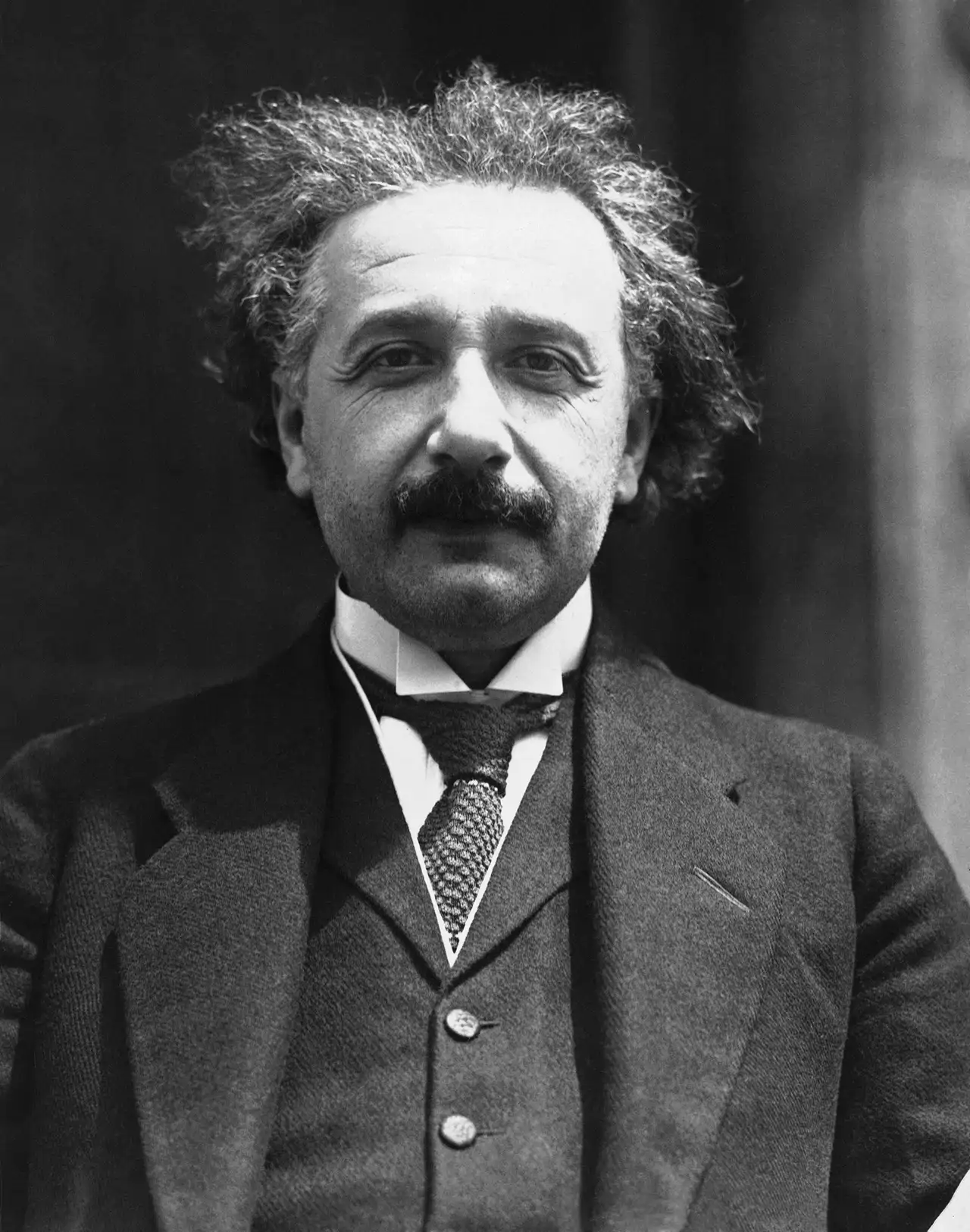
Albert Einstein's IQ is not publicly verified. This article separates the famous 160 estimate from the documented record and explains why achievement is not the same as a score report.
1 What Was Albert Einstein's IQ?
Updated May 2, 2026 by Structural. Albert Einstein's IQ is not known. There is no verified evidence that he ever took a standardized IQ test, and the popular number 160 should be read as a retrospective estimate rather than a documented score.
Einstein's memory for facts was tested in public once. On May 20, 1921, reporters in Boston asked him the speed of sound, and when he did not know it, headlines said he had failed the Edison test. He answered that he did not carry such facts in his head when a book could supply them. The page on the Edison questionnaire behind that headline explains what it measured.
This is the most important sentence on the page because a lot of internet content skips it. Search results, quote cards, and listicles often present Einstein's IQ as if it were recorded somewhere in a score report. That is not what the reliable record shows. Britannica explicitly notes that Einstein's IQ is unknown and that there is no evidence he ever took an IQ test. The number that circulates online is usually attached after the fact because of his scientific achievements, not because a test administrator published a result.
A different scientist illustrates the same evidence question: Christopher Hirata's reported IQ has a traceable newspaper attribution without a verified score report.
The irony of the 160 meme is that measuring anyone at that level takes deliberate engineering. A serious high range IQ test needs ceiling items and extended norms precisely because standard batteries lose precision near their upper limits, a detail the quote cards always omit.
Best short answer
Einstein's IQ is unknown, not verified, and not something historians can recover with certainty.
What 160 means here
A common estimate attached to Einstein later, not a score with a known test form, norm table, or administration record.
What actually matters
The documented record of Einstein's work is stronger evidence of exceptional ability than any recycled internet IQ number.
If you want to judge the Einstein IQ claim carefully, start from what is not disputed. The official Nobel material, the Institute for Advanced Study, and the Einstein Papers Project give us a much firmer base than viral IQ lists do. They show a life with extraordinary scientific output, a clear career timeline, and a documentary archive large enough that the absence of a real IQ score becomes meaningful.
Nobel's official facts page identifies Albert Einstein as born on March 14, 1879 in Ulm, Germany, and records that he received the 1921 Nobel Prize in Physics, presented in 1922, especially for the law of the photoelectric effect. Nobel also notes the broad path of his career: education in Zurich, work in the Swiss patent office, later university appointments, Berlin, and then the Institute for Advanced Study in Princeton after emigrating to the United States.
1879
Born in Ulm, Germany
That is the clean starting point in the official Nobel record. It matters because public IQ mythology often strips away actual chronology and replaces it with a flat genius label.
1896-1901
Studies in Zurich
Einstein studied at the Swiss Federal Polytechnic in Zurich, the institution now known as ETH Zurich. This part of the record matters far more than casual internet numerology because it shows formal scientific training, not mystique.
1905
The patent office years and the breakthrough papers
While working at the patent office in Bern, Einstein produced several epoch-shaping papers. Britannica's IQ explainer directly ties the later 160 estimate to this achievement profile rather than to any known IQ assessment.
1921-1922
Nobel recognition
The Nobel Prize page states that Einstein's 1921 Physics Prize was awarded especially for the law of the photoelectric effect and that he received it one year later, in 1922.
1933
Institute for Advanced Study, Princeton
The IAS biography notes that Einstein joined the Institute for Advanced Study in Princeton in 1933 after leaving Germany under the Nazi regime.
The Einstein Papers Project adds another useful layer. It describes The Collected Papers of Albert Einstein as part of a major scholarly publishing effort that documents his writings and correspondence in depth. That matters because it reminds readers that Einstein's life is unusually well archived. When no verified IQ record appears in the standard biography, the safe conclusion is not "the score was probably 160," but "the score is undocumented."
3 Did Albert Einstein Ever Take an IQ Test?
The reliable answer is not that anyone can prove. That sounds modest, but it is the correct standard. Public history does not give us a named test, a testing date, a publisher report, a memoir with administration details, or a trustworthy archival source showing Einstein sat for a modern IQ assessment and obtained a reported score. The silence covers his contemporaries too: Marie Curie died in 1934 with no recorded assessment of any kind, which leaves the numbers circulating for Marie Curie resting on popular lists while her first place physics degree at the Sorbonne does the actual evidentiary work. A documented score would need what neither biography supplies, a named instrument and a defined reference group, which is precisely what an IQ test normed for adults provides through adult norms with a stated age range.
That absence matters even more once you place it in testing history. Early intelligence testing was built for specific educational and institutional purposes, not for posthumous celebrity ranking. The first practical Binet-Simon scale appeared in 1905 for school screening, and adult-style normed intelligence testing developed later. So when people talk as if Einstein must have had an IQ score hidden somewhere, they are projecting a modern internet habit backward onto a very different historical context.
It is completely reasonable to say Einstein was extraordinarily able. It is not reasonable to pretend that this automatically produces a documented IQ number. A biography, even an extraordinary one, is not the same thing as a psychometric record. That distinction is central to reliability and validity. If the score source itself is missing, the number cannot be treated as secure no matter how impressive the person was.
What a documented score would include
A named test, known age at administration, score report, or a source traceable to a real assessment context.
None of that is available for Einstein.
What the internet usually offers instead
A number, a confidence tone, and no psychometric chain of custody behind it.
That is weak evidence, not strong evidence.
Best category for the Einstein number
Retrospective estimate based on reputation and achievement.
Useful as folklore, not as a verified measurement.
4 Where the "160" Estimate Comes From
The simplest answer is that the 160 figure comes from backward inference. Britannica's entry says Einstein's IQ is unknown, then notes that some sources place him at about 160 and that this number is largely derived from his achievements in physics. In other words, the number is being inferred from the historical reputation, not recovered from a known testing event. Reputation cannot substitute for the reliability, validity and norms behind an accurate score, because each of those is a property of a specific test given under specific conditions, and a backward inference has none of them.
That is why the claim is so sticky. A round number like 160 sounds precise, feels prestigious, and fits the public image of Einstein as the symbolic genius of the modern era. It travels well in headlines and social posts. But once you ask the basic psychometric questions, the neatness collapses. Which test? Which norm year? Which standard deviation? Which ceiling? Which age? Which examiner? Which source first published the result? Usually those questions have no satisfying answer. The same checklist collapses the 178 attached to Rowan Atkinson, a figure that circulates with no test, no date and no examiner behind it while the verifiable part of his record is an electrical engineering degree from Newcastle and a masters from Oxford.
ACIS read: The number 160 is best treated as a cultural shorthand for "exceptionally high ability," not as a documented Einstein score. That lets readers acknowledge why the number became popular without mistaking popularity for evidence.
This is also where pages like Standard Deviation 15 Explained and How IQ Scores Are Normed become relevant. Even if you did have a quoted number, you would still need the scale context before concluding what it means. Without that context, 160 is more of a narrative badge than a scientific statement.
5 What Einstein's Record Actually Shows
Once you stop trying to force Einstein into a neat IQ box, the real record becomes much more interesting. Nobel's material emphasizes the path from Zurich to the patent office to university appointments and eventually Princeton. The Einstein Papers Project frames his archive as a massive documentary legacy. Britannica points readers back to the 1905 papers that helped reshape twentieth-century physics. Taken together, those sources show why Einstein became a symbol of intellectual achievement even without a documented IQ score.
That distinction matters because history is not psychometrics. Achievement, originality, persistence, timing, collaborators, institutions, and luck all shape public impact. Einstein's place in scientific history reflects a rare combination of theoretical vision and lasting influence. It does not give us permission to flatten the whole picture into one floating internet number.
The practical takeaway is this: the absence of a verified IQ score does not weaken Einstein's stature. It only weakens the specific claim that "Einstein had an IQ of 160" should be read as factual measurement. Those are two very different propositions, and no article should blur them just to chase a cleaner headline.
Better framing than fake certainty: Einstein is one of the strongest examples of why public achievement should be described directly. If the evidence supports "transformational physicist with extraordinary intellectual impact," say that. Do not pretend an undocumented number is stronger than the historical record itself.
6 Did Einstein Fail Math? No.
The viral story that Einstein failed math is false. Britannica's short fact page on the rumor says the story was already circulating in 1935 and reports Einstein's own rebuttal that he had mastered differential and integral calculus before age fifteen. That is the cleanest way to dispose of the myth.
The reason this myth survives is the same reason fake IQ certainty survives: it makes Einstein look more narratively satisfying. Either he becomes the misunderstood failure who later conquered science, or he becomes the magical 160 genius whose score explains everything. Both versions are better storytelling than serious reading. Neither should substitute for the documented record.
For this page, the math myth matters because it shows how quickly repetition can outrun evidence. Once a catchy claim enters popular culture, it can live for decades even when authoritative sources say otherwise. That is exactly why public IQ claims about famous people need a stricter editorial standard than anonymous ranking lists.
7 Why Retrospective IQ Estimates Are Weak
Retrospective estimates are tempting because they feel like a bridge between biography and measurement. But they are weak for a simple reason: they usually lack the test conditions that make an IQ score interpretable in the first place. No identified form, no controlled administration, no clear age, no norm table, no scoring method, no ceiling documentation, and no direct source chain means there is no proper psychometric object to inspect. The same failure repeats across the genre, from J. Robert Oppenheimer, who was never tested, to Neil deGrasse Tyson, who has simply declined to publish a number. The counterexample from the same period is narrow and well recorded, because an adaptation of the Wechsler-Bellevue was administered under controlled conditions at the Nuremberg jail in the autumn of 1945, which is why the defendants who actually sat that test have a named instrument, a named examiner and a printed table behind their figures.
No test form
Without knowing the actual assessment, nobody can say what construct mix or ceiling behavior a quoted number reflects.
No norm context
Scores change meaning across norm vintages and scale conventions. A floating number without those anchors is incomplete.
Achievement is not score identity
Scientific output can signal unusual ability without mapping cleanly onto one psychometric value.
Stories compress complexity
Internet culture rewards a clean number more than it rewards nuance, source quality, or uncertainty.
This is why ACIS treats famous-person IQ claims through an evidence ladder rather than a fame ladder. A high-profile name does not upgrade weak sourcing into strong sourcing. If anything, fame increases the chance that a number will be repeated simply because it is memorable.
8 How ACIS Reads the Einstein Claim
The best way to read the Einstein IQ claim is to place it in the right evidence bucket. It is not on the same level as a documented assessment report. It is not on the same level as a named primary source with administration details. It belongs lower down, in the zone of retrospective estimate built from reputation and historical achievement. The same sorting applies when a reader picks an instrument for personal use: the red flags that disqualify an IQ test, no norm information, one narrow task type, extreme score promises and no discussion of limits, mark a number that belongs in the lowest bucket. Applied across the whole genre, the sorting is brutal, because the ranked celebrity IQ claims land overwhelmingly in the unsourced folklore tier and only a handful rest on a documented administration or a documented proxy such as a military entrance test.
Level 1: documented score
Strongest category. Named test, attributable source, and enough detail to interpret the number psychometrically.
Einstein does not belong here.
Level 2: attributable self-report
Still limited, but at least traceable to a person and context rather than a copy-paste list.
No known strong Einstein case here either.
Level 3: retrospective estimate
Useful as cultural shorthand if clearly labeled, but not equivalent to a measured score.
This is the right Einstein bucket.
Level 4: recycled unsourced claim
The common internet failure mode: big number, zero chain of evidence, infinite repetition.
Many Einstein score graphics stop here.
If your real question is not "What was Einstein's IQ?" but "How rare would a score like 160 be on a modern scale?", use the IQ Rarity Calculator. If your question is "What actually counts as a high score?", use What Is a Good IQ? or Gifted IQ Range Explained. Those pages give you scale context without pretending to solve an undocumented historical measurement problem.
9 Common Questions About Albert Einstein's IQ
What was Albert Einstein's IQ?
Albert Einstein's IQ is unknown. There is no verified record that he ever sat a standardized IQ test, so the 160 claim should not be treated as a confirmed score.
Did Einstein ever take an IQ test?
There is no credible public evidence showing that he did. What survives is a large historical record of his work, not a documented IQ report.
Is the 160 number confirmed?
No. It is a common retrospective estimate attached to Einstein after the fact, not a traceable measured result.
Did Einstein fail math?
No. Britannica says the famous story is false and reports Einstein's own statement that he had mastered differential and integral calculus before age fifteen.
Why was Einstein's Nobel Prize not for relativity?
The official Nobel motivation for the 1921 prize highlights the law of the photoelectric effect. That is a useful reminder that public fame and official recognition are not always identical.
Was Einstein still a genius if his IQ is unknown?
Yes. Einstein's status comes from documented scientific achievement and historical influence, not from a verified score report. The unknown score only limits the specific IQ claim, not his intellectual stature.
Why do so many websites give Einstein a precise IQ number?
Because a precise number is easy to repeat and fits the public myth of Einstein as the archetypal genius. That kind of precision often outruns the source quality behind it.
Could Einstein have scored above 160 on a modern test?
No one can know with confidence. A modern high-end score would depend on the exact test, age, norms, and ceiling behavior, so projecting a precise number backward is speculative.
Why is Einstein's IQ usually listed as 160?
The 160 figure fits Einstein's public image, but it is a retrospective estimate rather than a verified score report.
Did Einstein ever publish an IQ result?
No credible public source shows Einstein publishing or confirming a standardized IQ score.
Can Einstein's Nobel Prize prove his IQ?
No. The Nobel Prize documents scientific impact, not a standardized intelligence-test result.
Is Einstein's IQ unknowable?
His exact psychometric IQ is unknowable from public evidence because no verified test record is available.
Does the unknown score reduce Einstein's genius?
No. It only limits the score claim. Einstein's documented scientific work remains historically extraordinary.
Why do websites use exact Einstein IQ numbers?
Exact numbers attract clicks and are easy to repeat, even when the source chain is weak.
Could a modern IQ test measure Einstein fairly?
A modern test could measure a living person under modern norms, but it cannot be administered retrospectively to Einstein.
Was Einstein gifted as a child?
Historical accounts support strong early mathematical ability, but childhood talent is still not a verified IQ score.
Does being a physicist imply a genius IQ?
Advanced physics requires strong reasoning and mathematical ability, but profession alone does not determine an exact IQ.
Why is the math-failure myth relevant?
It shows how easily public stories about Einstein become distorted, which is the same problem found in exact IQ claims.
Should Einstein be removed from IQ lists?
He should not be listed with a confirmed score. If included, the number should be clearly labeled as unverified or speculative.
What is the strongest claim about Einstein's intelligence?
The strongest claim is that his documented scientific output shows exceptional ability, while his exact IQ remains unverified.
What should readers compare Einstein with?
Compare documented achievements and source quality, not unsupported ranking numbers.
10 Sources Behind This Page
This page is written to be searchable and defensible. That means the argument is built around attributable sources instead of recycled score lists. If you want to verify the core claims yourself, start with these.
Cox, C.M. (1926). The Early Mental Traits of Three Hundred Geniuses, full text at the Internet Archive. The historiometric study behind most IQ figures still attached to historical figures.
Frey, M.C. & Detterman, D.K. (2004). Scholastic Assessment or g? Psychological Science, 15(6). The study linking SAT scores to measured cognitive ability, and the reason SAT conversions are estimates rather than measurements.
ACIS measures six CHC domains across 20 subtests and reports each one with its own normed score and confidence interval, so you can see where you are strong and where you are not.