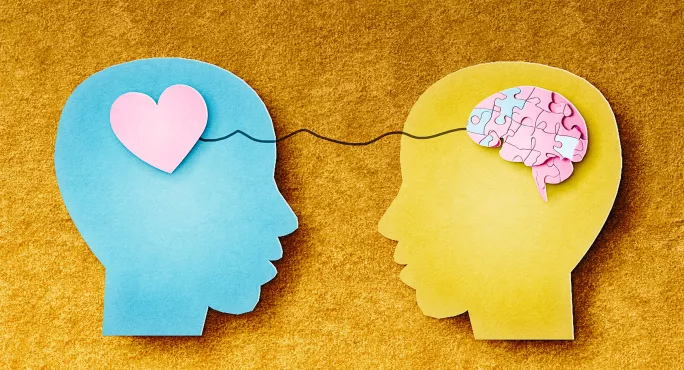
Emotional intelligence is real and useful, but it has been badly oversold. The popular claim that "EQ matters more than IQ" is not what the evidence shows, and most online "EQ tests" are measuring personality, not a distinct ability. Here is the honest version: what each one is, what each one predicts, and why they are partners rather than rivals.
1 EQ vs IQ: The Short Answer
Updated July 9, 2026 by Structural.IQ and EQ are different things, and neither one cancels the other. IQ measures general cognitive ability, the reasoning and learning power that psychologists call the g factor. EQ, or emotional intelligence, refers to how well you perceive, understand, use, and manage emotions in yourself and others. They overlap only a little, so a person can be high in one and average in the other.
Social perceptiveness has also been studied in groups. In a 2010 study, groups whose members scored higher on a test of reading mental states from the eyes performed better across tasks, with a correlation of 0.26, yet Bates and Gupta later found the same test related to individual IQ. The evidence on collective intelligence in groups shows how far perceptiveness predicts team results beyond ability.
The famous headline that "emotional intelligence matters more than IQ for success" comes from a 1995 bestseller, not from the research the book was based on. When independent psychologists actually measured it, IQ remained one of the strongest single predictors of learning, job performance, and complex problem solving, while EQ added a smaller, real, but often overstated boost, mostly in roles that lean heavily on people skills. Just as important: the everyday "EQ tests" you find online are usually self-report personality questionnaires, not validated ability tests.
Practitioners often reach for a word other than emotional intelligence. At the 2009 Berkshire Hathaway annual meeting Warren Buffett said an investor needs emotional stability, inner peace about decisions and the ability to think for yourself, but does not need to be a genius. His own word for this is temperament, and the page on his dated remarks about IQ shows how he separates it from intelligence.
1990
Year the term "emotional intelligence" was coined in academia
~0.5
IQ's correlation with job performance in complex roles
Small
Extra prediction EQ adds once IQ and personality are accounted for
So the honest answer to "which is better" is that it depends on the outcome. For learning something hard, reasoning through a novel problem, or predicting performance across most jobs, IQ carries more weight. For navigating relationships, managing your own reactions, and leading people, emotional skill matters a great deal. For where these scores sit on the scale, see What Is the Average IQ?, and for how ability tests are validated, see Reliability and Validity.
Intelligence also appears in what people say they want in a partner. In a 2002 study in which participants designed ideal long-term mates under different budgets, kindness and intelligence were necessities for both sexes, yet stated priorities predicted real choices poorly in speed dating studies. The page on what dating and couple studies measured about intelligence reviews both findings.
IQ, short for intelligence quotient, is a standardized score for general cognitive ability. Modern tests do not literally divide a mental age by a chronological age anymore. Instead they compare your performance to a large, representative sample of people your age, then place you on a bell curve where the average is set to 100 and about two thirds of people fall between 85 and 115. If you want the full picture of how those numbers are built and spaced, our guide to the average IQ walks through it.
What a good IQ test is really estimating is the g factor, a general capacity that shows up across almost every mental task. When people are quick at verbal reasoning, they also tend to be quick at spatial and numerical reasoning. That shared thread is g, and it is the single most researched and most predictive construct in all of psychology. A strong test samples several distinct abilities, verbal comprehension, fluid reasoning, working memory, spatial ability, and processing speed, then combines them, which is exactly the structure our page on cognitive domains lays out.
The reason IQ gets taken seriously by scientists, even by those who dislike how it is used, is its track record. Cognitive ability is stable across adulthood, highly reliable, and consistently predictive. It correlates with academic achievement, the complexity of jobs people end up in, on-the-job performance, income, and even health and longevity. None of those links is perfect, and none says anything about a person's worth. But as a measurement, IQ is one of the best-validated tools psychology has, which is a large part of why the "EQ beats IQ" claim was always going to be a hard sell against the data.
Emotional intelligence is the ability to recognize emotions, understand what they mean, use them to guide thinking, and manage them well, both your own and other people's. The idea has real academic roots. Psychologists Peter Salovey and John Mayer coined the term in 1990 and framed it as a genuine mental ability, a kind of intelligence about the emotional world that could in principle be measured the way reasoning is measured. Gardner had made a broadly similar move seven years earlier in Frames of Mind, where interpersonal ability appears as one of eight or nine proposed intelligences, and why that list does not survive measurement is a separate question from whether the abilities are worth naming at all.
Then, in 1995, science journalist Daniel Goleman published a bestseller titled Emotional Intelligence: Why It Can Matter More Than IQ. The book was enormously influential, and it deserves credit for putting emotional skills on the map for managers, teachers, and parents. But it also broadened the concept far beyond the original definition, folding in motivation, self-control, optimism, and social skills, and it attached the memorable claim that this bundle could matter more than IQ for a successful life. That claim is where the popular understanding of EQ parted ways with the careful science.
In the original ability framework, Salovey and Mayer described emotional intelligence as four related skills that build on each other. The first is perceiving emotions accurately, in faces, voices, and situations. The second is using emotions to help thinking, letting the right mood support the task at hand. The third is understanding emotions, knowing how they blend, shift, and escalate over time. The fourth, and the one most people mean by the term, is managing emotions, regulating your own and influencing others constructively. Laid out this way, emotional intelligence looks less like a personality glow and more like a stack of learnable competencies. It is a genuinely useful map. The trouble began only when the popular version swapped this careful four-part ability for a vague bundle of good qualities and then promised it would out-predict a century of intelligence research.
Stripped back to its useful core, emotional intelligence covers a handful of real and valuable skills: reading a room, naming what you feel instead of being driven by it, staying composed under pressure, empathizing accurately, and adjusting how you communicate to the person in front of you. Nobody serious disputes that these matter. The disputes are about two narrower questions: is this a single "intelligence" that can be measured like IQ, and does it really outrank cognitive ability for predicting success. The answers are "partly" and "no," and the reason comes down to a distinction most articles skip.
4 The Distinction That Changes Everything: Ability EQ vs Trait EQ
Here is the single most important thing to understand about emotional intelligence, and the part that most "IQ vs EQ" articles leave out. There is not one emotional intelligence. There are two very different things wearing the same name, and they behave completely differently.
Ability EQ. This is emotional intelligence treated as a real mental ability, tested the way an IQ test works: with problems that have better and worse answers. The best-known instrument is the MSCEIT, developed by Mayer, Salovey, and Caruso, which asks you to solve emotion-based problems rather than rate yourself. Ability EQ is modest but genuine. It correlates a little with IQ, especially verbal ability, and it adds only a small amount of prediction beyond cognitive ability and personality.
Trait EQ, or mixed EQ. This is emotional intelligence measured by self-report, where you rate how empathetic, calm, or socially skilled you believe you are. Almost every popular "EQ test," workplace assessment, and viral online quiz is this kind. The problem is that when researchers examine what these questionnaires actually capture, the answer is mostly personality, especially the Big Five traits of emotional stability, extraversion, conscientiousness, and agreeableness, repackaged with an emotional label.
This distinction dissolves a lot of confusion. When someone says "studies show EQ predicts success better than IQ," they are almost always citing trait or mixed measures. And those measures predict things partly because they are quietly measuring long-established personality traits that psychologists already knew predicted job outcomes. In other words, part of EQ's apparent power is borrowed from personality science that predates the term by decades. Ability EQ, the version that is actually a distinct intelligence, is real but has a much more modest effect. Keep this split in mind and every confusing headline about EQ suddenly makes sense.
Quick test: if an "emotional intelligence" assessment asks you to rate yourself ("I stay calm under pressure: strongly agree to strongly disagree"), it is a trait measure and is largely reading your personality. If it gives you a scenario and asks for the most effective response, it is closer to an ability measure. Most of what is sold as EQ testing is the former.
5 "Does EQ Matter More Than IQ?" The Claim vs The Evidence
The phrase that launched a thousand headlines is Goleman's subtitle: "why it can matter more than IQ." Over the years this hardened into confident-sounding statistics that circulate to this day: that emotional intelligence accounts for most of career success, or that a large majority of top performers are high in EQ. These numbers are repeated so often they feel established. They are not.
It is worth asking why the claim spread so far when the evidence was thin. Part of it is that the message is genuinely appealing. IQ can feel fixed and exclusionary, a number you are stuck with, while emotional intelligence promises that anyone willing to work on themselves can get ahead. Part of it is timing: the idea arrived when businesses were hungry for a people-centered story about performance, and a whole industry of training and certification grew up to supply it. And part of it is that the claim is hard to check casually, because most people never see the difference between a self-report questionnaire and a validated ability test. A hopeful message, a ready market, and a measurement most readers cannot audit is exactly the recipe for a statistic that outruns its evidence.
The strongest versions of those claims trace back to popular books and to companies that sell emotional intelligence training and assessments, not to independent peer-reviewed research. A figure like "90% of top performers have high EQ" is a marketing statistic from an EQ vendor, not a finding you will find replicated in the job-performance literature. Goleman himself, to his credit, has walked back the strongest interpretation over the years, clarifying that he never meant EQ literally outweighs cognitive ability for every outcome.
When independent researchers put the two head to head with proper measures, the pattern is consistent. Cognitive ability remains the stronger single predictor of performance in most jobs, and its edge grows as jobs get more complex. Emotional intelligence adds something real on top, but the increment is small once you account for IQ and personality, and it is largest in roles built around managing emotions, such as sales, nursing, customer service, and leadership. That is a meaningful finding. It is just a much quieter one than "EQ matters more."
6 What the Research Actually Shows
Let us be concrete about the evidence, because the honest picture is more interesting than either cheerleading or dismissal.
IQ predicts performance broadly. Across a century of validity studies, general cognitive ability is among the best predictors of job performance, training success, and academic achievement. In cognitively demanding work its correlation with performance is around 0.5, which is very high for a single trait. This is why our page on IQ and job performance exists as its own topic.
Ability EQ adds a little. Meta-analyses find that performance-based emotional intelligence has incremental validity over IQ and personality, but the added prediction is small. It is a genuine effect, not zero, and not the headline.
Mixed and trait EQ add more, but partly by proxy. Self-report emotional intelligence often predicts outcomes better than ability EQ, which sounds impressive until you notice it overlaps heavily with personality. Control for the Big Five and much of the predictive power shrinks, because the questionnaire was measuring conscientiousness and emotional stability under a new name.
Context decides the weight. The clearest finding is that emotional intelligence matters most in jobs high in "emotional labor," where reading and managing feelings is the work. In highly technical or analytical roles, cognitive ability dominates. Neither wins everywhere.
One phrase is worth translating, because it is doing a lot of quiet work: incremental validity. It means the extra predictive power a new measure adds after you already know the old ones. Emotional intelligence can look impressive on its own, but the honest question is what it adds once you already know a person's cognitive ability and personality, since those are cheaper and better established. The answer from the meta-analyses is: a little, sometimes a useful little, rarely a lot. That is not a dismissal. A measure that adds a genuine sliver of prediction in the right role is worth having. It is simply a very different statement from the headline that emotional intelligence is the master key to success, and keeping the two apart is most of what it takes to think clearly about EQ.
The takeaway is not that EQ is fake. It is that EQ is a modest, context-dependent contributor that was marketed as a revolution, while IQ is a strong, general predictor that was marketed as obsolete. Reality sits in between, and it favors treating both as useful rather than crowning one.
7 Where Emotional Intelligence Genuinely Helps
It would be just as dishonest to dismiss emotional intelligence as to inflate it. Once you separate the useful core from the marketing, emotional skill earns real credit in specific places.
Leadership and teamwork. The ability to read morale, defuse conflict, and communicate in a way people can actually hear is central to leading. Two managers with identical technical skill can get very different results depending on how they handle people.
Emotionally demanding jobs. Nursing, teaching, sales, therapy, customer service, and negotiation all involve managing your own state and other people's. In these fields emotional skill is close to a core competency, not a nice-to-have.
Relationships and wellbeing. Recognizing your feelings before they drive your behavior, and empathizing accurately with a partner or friend, is associated with better relationships and mental health. This is arguably where emotional intelligence matters most, and it has little to do with a paycheck.
Turning ability into results. Cognitive horsepower does not help much if you cannot stay composed in a meeting, take feedback, or collaborate. Emotional skill is often the channel through which raw ability gets expressed in the real world.
None of this requires the "more important than IQ" framing. Emotional intelligence can be deeply valuable and still not be a substitute for reasoning ability. The two do different jobs.
8 Where IQ Does the Heavy Lifting
On the other side, there are domains where cognitive ability simply carries more weight, and no amount of emotional skill substitutes for it.
Learning something hard and fast. Acquiring complex knowledge, from advanced mathematics to medicine to programming, leans directly on reasoning and working memory. Higher cognitive ability means learning more, in less time, with less support.
Novel problem solving. When a problem has no template and cannot be handled by rehearsed social skills, fluid reasoning is what gets you through. This is the heart of what an IQ test samples.
Complex, high-information work. The more a job requires juggling abstract variables, the more cognitive ability predicts who thrives. That is precisely why IQ's link to performance strengthens as jobs get more complex.
Long-run life outcomes. Educational attainment, occupational level, and income all show meaningful correlations with measured ability, as our pages on IQ and success and IQ and income document. These are averages across populations, not verdicts on individuals, but they are real.
A useful way to picture the difference is to imagine two candidates for a demanding analytical role who are equally warm, likeable, and composed. Their emotional skills cancel out, and what separates their output is how quickly they absorb new material and how well they reason through problems they have never seen. Now imagine the same two people co-leading a fractious team. Their reasoning may cancel out, and what separates them is who reads the room and defuses the tension. Same two people, opposite deciding factor. That is the whole argument in miniature: the trait that matters most is set by the demands of the situation, not by a universal ranking of EQ over IQ or the reverse. Sensible selection and self-knowledge start from the task, then ask which abilities it actually taxes.
The fair summary is that IQ sets a lot of the ceiling for what you can learn and reason through, while emotional intelligence shapes how effectively you deploy what you have among other people. A ceiling and a channel are both necessary. Neither is the whole house.
9 The "Smart but Socially Awkward" Myth
One of the stickiest ideas in pop culture is that intelligence and emotional intelligence trade off, that the brilliant analyst must be cold or clueless with people, and the warm, socially gifted person cannot be the sharpest reasoner. It is a satisfying story. It is also not what the data shows. The athletic mirror image of that story, the old assumption that physical gifts and intelligence are opposites, fails in the same way, and our page on LeBron James shows why: a documented memory for entire possessions and decades of articulate judgment under pressure leave a below average estimate with nothing to stand on.
When ability-based emotional intelligence is measured properly, its correlation with IQ is small and positive, not negative. On average, people who reason well about the physical and abstract world tend to reason at least slightly better about emotions too, not worse. The stereotype of the high-IQ, low-EQ genius is built from memorable individual cases and fiction, not from the central tendency.
Where does the stereotype come from, then? Partly from visibility: a socially awkward specialist is memorable precisely because the mismatch is striking, so those cases stick in memory while the many bright, socially fluent people go unnoticed. Partly from selection: certain fields concentrate people who prefer working with systems over people, which is a preference and a personality difference, not a deficit in emotional ability. And partly from fiction, which loves the trope of the brilliant misfit because it makes for good drama. None of these is evidence about the underlying correlation. When you set aside the vivid anecdotes and look at measured averages, the tidy trade-off between brains and emotional skill simply is not there.
What is true is that the two are largely independent, so you cannot read one off the other. Plenty of very bright people have excellent social instincts, and plenty have poor ones, just as in the general population. The same holds in reverse. So the useful conclusion is not "smart people are awkward," it is "intelligence tells you little about someone's emotional skill in either direction." If you want to know both, you have to measure both, which is exactly why conflating them, as the "EQ vs IQ" framing tempts people to do, leads to bad predictions about real people.
10 Can You Raise Your EQ or Your IQ?
This is where the two constructs genuinely differ in a way that matters for your life, and it may be the strongest practical argument for caring about emotional intelligence at all.
IQ is relatively stable. By adulthood, general cognitive ability is quite consistent over time and substantially heritable. You can lose measured points to poor sleep, stress, or ill health, and reclaim them by fixing those, and education has real effects, especially early. But there is no reliable method to durably add many IQ points to a healthy adult. Brain-training apps mostly improve the specific task you practice, not general ability, a point our guide to common IQ myths covers.
Emotional skills are more trainable. The behaviors under the emotional intelligence umbrella, noticing your feelings, pausing before reacting, listening actively, reading nonverbal cues, giving feedback without triggering defensiveness, are all learnable. Therapy, coaching, deliberate practice, and simple habits move them. This is the honest, useful version of Goleman's message: even if emotional intelligence is not a magic predictor of success, the underlying skills are among the more improvable things about you, and improving them pays off in relationships and work.
The concrete moves are unglamorous and effective. Naming an emotion as you feel it, silently and specifically, reliably lowers its grip, a habit sometimes called affect labeling. Building a short pause between a trigger and your response, even a single breath, is most of emotion regulation in practice. Asking a genuine question and reflecting back what you heard before you argue turns a standoff into a conversation. Watching faces and tone rather than only words sharpens accurate empathy. And soliciting blunt feedback about how you come across, then acting on it, closes the gap between how skilled you feel and how skilled you actually are. None of these needs a course or a certificate. They are ordinary practices that, repeated, move the very skills the emotional intelligence label points at, which is the part of the idea genuinely worth keeping.
So a balanced strategy is clear. Treat your cognitive ability as a strength to understand and work with rather than a number to grind upward, and treat your emotional skills as an area where deliberate effort actually compounds.
11 How Each One Is Measured
The measurement gap between IQ and EQ is larger than most people realize, and it explains why you should trust an IQ score more than a typical EQ score. That trust is conditional, since an IQ score earns it only through reliability, validity and a defined norm group, and most free online quizzes fail at least one of the three.
IQ testing is mature. Professional intelligence tests are built on large, representative norm samples, checked for reliability, and validated against real outcomes. They use performance items with objectively better and worse answers, so your result does not depend on how you see yourself. This is the machinery described in reliability and validity, and it is why a well-constructed IQ estimate is stable and meaningful.
EQ testing is a mixed bag. Ability-based emotional intelligence tests like the MSCEIT do exist and are the closest thing to a real emotional-intelligence measure, but they are less widely used and even their scoring is debated, because "the right answer" to an emotional problem is fuzzier than the right answer to a matrix puzzle. Meanwhile, the vast majority of EQ assessments people actually take, corporate questionnaires and online quizzes alike, are self-report. They measure how emotionally skilled you believe you are, which is influenced by your personality and your self-image as much as by any ability. That is why two EQ tests can give very different results, and why an "EQ score" should be read with far more caution than an IQ score. Self-report fails the same way wherever the performance can actually be scored, and how funny people judge their own attempts correlates about .13 with how funny other people judge them.
The practical upshot: if you want a trustworthy number about your reasoning ability, a validated cognitive test delivers it. If you want to grow your emotional skills, skip the score-chasing and work on the behaviors directly, because the "score" is the least reliable part of the whole enterprise.
12 EQ vs IQ at a Glance
Pulling the pieces together, here is how the two constructs compare on the dimensions that actually matter:
What it is. IQ is general cognitive ability, the reasoning and learning power behind the g factor. EQ is the skill of perceiving, understanding, and managing emotions.
How well it is measured. IQ is measured with mature, validated, norm-referenced performance tests. EQ is measured either by rare ability tests or, far more often, by self-report questionnaires that overlap with personality.
What it predicts best. IQ predicts learning, complex problem solving, and performance across most jobs. EQ predicts interpersonal effectiveness, leadership perception, teamwork, and wellbeing, especially in emotionally demanding roles.
How stable it is. IQ is stable and substantially heritable in adults. Emotional skills are more malleable and respond to deliberate practice.
How they relate. They are largely independent, with a small positive correlation. High in one says little about the other.
The honest verdict. Not rivals. IQ sets much of the cognitive ceiling; EQ shapes how well you use your abilities among people. A full picture of a person needs both, plus personality.
13 Common EQ vs IQ Myths, Corrected
Myth: EQ matters more than IQ. For most outcomes, cognitive ability is the stronger single predictor. EQ adds a smaller, context-dependent boost. The "more important" claim came from a book title, not the data.
Myth: EQ accounts for most of career success. The big percentages are marketing statistics from EQ vendors, not replicated independent findings.
Myth: smart people have low emotional intelligence. Measured properly, the correlation is small and positive. The genius-with-no-social-skills is a stereotype, not an average.
Myth: an online EQ test measures your emotional intelligence. Almost all of them are self-report personality questionnaires wearing an emotional label.
Myth: IQ is fixed and EQ is fully learnable. IQ is stable but not immovable, and emotional skills are trainable but not infinitely so. The difference is real but a matter of degree.
Myth: you have to choose which one to develop. They are largely independent, so investing in emotional skills costs you nothing on the cognitive side, and vice versa.
14 What This Means for You, and Where ACIS Fits
If you came here trying to decide which one to care about, the practical answer is both, for different reasons. Understand your cognitive ability so you can play to your strengths and choose work that fits, and build your emotional skills because they are learnable and they change how your abilities land with other people. Ignore the horse race. It was never a fair fight because the two were never competing for the same job. The cognitive half of that advice no longer requires an appointment, because a normed IQ test taken from home can report a domain profile, provided it publishes its norms, samples ability broadly and states its reliability.
A word on where our own test sits, because honesty is the whole point of this page. ACIS measures cognitive ability, not emotional intelligence. It is a validated, norm-referenced assessment that estimates your reasoning across the CHC cognitive domains and returns a full-scale score plus a domain profile, the kind of trustworthy cognitive number this article argues you can actually rely on. It does not, and does not claim to, measure your EQ. Anyone selling you a single test that scores both your intelligence and your emotional intelligence with equal rigor is overpromising, for exactly the measurement reasons covered above. If what you want is a solid read on how you reason, that is what ACIS is built for.
Joseph, D. L., & Newman, D. A. (2010). Emotional intelligence: An integrative meta-analysis. Journal of Applied Psychology, on the incremental validity of EQ over cognitive ability and personality.
Nisbett, R.E. et al. (2012). Intelligence: new findings and theoretical developments. American Psychologist, 67(2). The broad APA review of what moves measured intelligence and what does not.
Schmidt, F.L. & Hunter, J.E. (1998). The validity and utility of selection methods in personnel psychology. Psychological Bulletin, 124(2). The meta-analysis behind general ability as the strongest single predictor of job performance.
Plomin, R. & Deary, I.J. (2015). Genetics and intelligence differences: five special findings. Molecular Psychiatry. Open access. The standard modern review of what twin and DNA evidence does and does not show.
Gottfredson, L.S. (1997). Mainstream Science on Intelligence, the editorial signed by 52 researchers. Intelligence, 24(1), hosted by the University of Delaware. A consensus statement on what IQ tests measure.
Spearman, C. (1904). General intelligence, objectively determined and measured. American Journal of Psychology, full text at Classics in the History of Psychology. The paper where the g factor entered psychology.
Voncken, L., Albers, C.J. & Timmerman, M.E. (2019). Improving confidence intervals for normed test scores. Behavior Research Methods. Open access. Documents the mean 100, SD 15 metric and the uncertainty that norming from samples adds to any score.
Pearson Clinical Assessment Scientific Council (2023). Standardized Clinical Assessment for Practitioners: A Primer. How standard scores, percentile ranks and the standard error of measurement are meant to be read together.
15 FAQ: EQ, IQ, and What Predicts Success
What is the difference between EQ and IQ?
IQ measures general cognitive ability, the g factor. EQ is the skill of perceiving, understanding, and managing emotions. They are largely independent, so you can be high in one and average in the other.
Is EQ more important than IQ?
Not in general. That claim came from a 1995 book title. For most outcomes, cognitive ability is the stronger single predictor, with EQ adding a smaller, context-dependent boost.
Does a high IQ mean low EQ?
No. Measured properly, the correlation between IQ and ability-based EQ is small and positive, not negative. The awkward-genius stereotype is not the average.
Can you have both high IQ and high EQ?
Yes, and it is common. The two are largely independent, so any combination is possible, and high ability slightly raises the odds of good emotional reasoning.
Which predicts job success better?
For most jobs, cognitive ability, and its edge grows with complexity. EQ adds modest prediction and matters most in emotionally demanding, people-facing roles.
Is emotional intelligence real or pseudoscience?
Real but oversold. Ability EQ is a genuine, modest ability, but most popular EQ tests are self-report questionnaires that largely measure personality.
Can you increase your IQ?
Only modestly in a healthy adult. You can recover points by fixing sleep, stress, or health, but brain-training apps mostly improve the practiced task, not general ability.
Can you improve your EQ?
Yes, more readily than IQ. Noticing feelings, pausing before reacting, listening, and reading cues all respond to coaching and deliberate practice.
What is a good EQ score?
There is no single agreed scale. Different EQ tests use different norms, and most are self-report, so scores are heavily shaped by personality and self-image.
Do online EQ tests really work?
Usually not rigorously. Almost all are self-report questionnaires that overlap heavily with personality, so they measure personality with an emotional label.
Who invented the term?
Salovey and Mayer coined "emotional intelligence" in 1990. Daniel Goleman popularized and broadened it in his 1995 bestseller.
Did Goleman prove EQ beats IQ?
No. It was a broad claim, not a proven finding, and he has since moderated it. Independent research finds cognitive ability is the stronger general predictor.
What is the average IQ?
By design, 100. About two thirds of people score between 85 and 115. See our average IQ guide for how the scale is built.
Is EQ inherited or learned?
Both. Temperament has a heritable component, but the specific skills are substantially learnable, and EQ is more trainable in adulthood than IQ.
IQ or EQ for leadership?
Leadership rewards emotional skill through managing people and conflict, but cognitive ability still drives the strategic side. Good leaders use both.
Why do some smart people struggle socially?
Because IQ and emotional skill are largely independent. High reasoning ability neither guarantees nor rules out strong social instincts.
Does EQ grow with age?
On average, emotional skills tend to improve with experience into middle age, since they are learnable and practiced over time.
Is EQ the same as being nice?
No. Self-report EQ overlaps with agreeableness, but genuine emotional skill can mean being direct. Niceness is a personality trait, not an ability.
Can an IQ test measure EQ?
No. IQ tests sample reasoning, memory, spatial ability, and speed, not emotional skill. The two are largely independent constructs.
Should employers hire for IQ or EQ?
It depends on the role. Consider cognitive ability, relevant emotional skills, and personality together rather than betting on one number.
Does ACIS measure EQ?
No. ACIS measures cognitive ability across the CHC domains and returns a validated score plus a domain profile. It does not measure emotional intelligence.
ACIS measures six CHC domains across 20 subtests and reports each one with its own normed score and confidence interval, so you can see where you are strong and where you are not.
Free trial, no card required. Full report from $15.
Six-domain profileillustrative
VCI
FRI
VSI
WMI
PSI
QRI
Related outcome distinctions
Keep emotion constructs separate from the evidence on IQ and personality, then examine why IQ and happiness do not form a simple individual prediction.