Full Scale IQ Test What It Is and How to Take a Real One
A Full Scale IQ test measures your overall intelligence by combining many subtests across several cognitive domains into one score, not by asking a single kind of puzzle. Here is what that really means, why most online quizzes are not full scale, and how to take a real one. Start free.
0 Quick Answer
A Full Scale IQ (FSIQ) test measures your overall cognitive ability by sampling many different abilities, verbal reasoning, fluid reasoning, working memory, and more, across a broad set of subtests, then combining them into a single composite score. That breadth is the whole point: your Full Scale IQ is the best single estimate of general intelligence precisely because it does not rely on any one kind of task. It is the headline number produced by serious batteries such as the WAIS-V and the Stanford-Binet 5.
Direct answer: most "IQ tests" you find online are not full scale at all. They are single-task quizzes, usually one page of matrix puzzles, that measure one narrow ability and then label it as your IQ. A real Full Scale IQ requires sampling across domains, which is exactly what ACIS does: 20 subtests across six cognitive domains, combined into a Full Scale IQ, interpreted against a defined adult reference frame (ages 16 to 90), and reported with a confidence interval rather than a single exact number. This guide explains what a Full Scale IQ test actually is, why breadth makes it accurate, and how to take a real one. For the underlying concept in depth, see Full Scale IQ.
A Full Scale IQ test is a comprehensive assessment that measures several distinct cognitive abilities and combines them into one overall score, the Full Scale IQ. The word "full scale" is the key: instead of testing a single skill, it samples the full range of reasoning that intelligence tests are designed to capture, then reports a composite that represents your general cognitive ability as a whole.
This is how the gold-standard clinical tests are built. The Wechsler Adult Intelligence Scale and the Stanford-Binet do not give you one type of problem; they give you a battery of different tasks, verbal, visual, quantitative, memory, and speed, and derive the Full Scale IQ from all of them together. The Full Scale IQ is treated as the single best summary of intelligence because it draws on that breadth rather than on any one narrow strength or weakness.
So the defining feature of a Full Scale IQ test is not its length or its difficulty, but its coverage. It is the difference between measuring how well you solve one kind of puzzle and measuring how well you reason across many kinds. That distinction, breadth versus a single task, is what separates a real Full Scale IQ from the quizzes that borrow the name, and it is the theme of everything that follows.
2 Why most online "IQ tests" are not full scale
Here is the thing most people never realize. The typical free "IQ test" online is a single-domain quiz. Almost always it is a page of matrix puzzles, abstract patterns with a missing piece, and nothing else. Matrix reasoning is a genuine and important task, but it measures one ability: fluid reasoning. Scoring it and calling the result your IQ is like measuring your height and calling it your fitness. The gap is not online delivery itself, since a real online IQ test can sample every domain in a browser; the gap is how many domains the quiz bothers to sample.
A Full Scale IQ cannot come from one kind of question, because intelligence is not one thing. A person can be strong in nonverbal reasoning and average in verbal ability, or fast at processing but weaker in working memory. A single-task quiz sees only one of those and misses the rest, so its "IQ" can be off by a wide margin for anyone whose profile is uneven, which is most people. It is not that these quizzes are worthless; it is that they measure a slice and present it as the whole.
This matters commercially and personally, because a number that samples only one ability carries far more error than a composite drawn from many. When you see a slick score from a one-page test, what you are really seeing is a fluid-reasoning estimate dressed up as a Full Scale IQ. Knowing that difference is the single most useful thing to understand before trusting any online IQ result, a point that connects directly to what a test actually measures in What an IQ Test Measures.
3 What goes into a Full Scale IQ
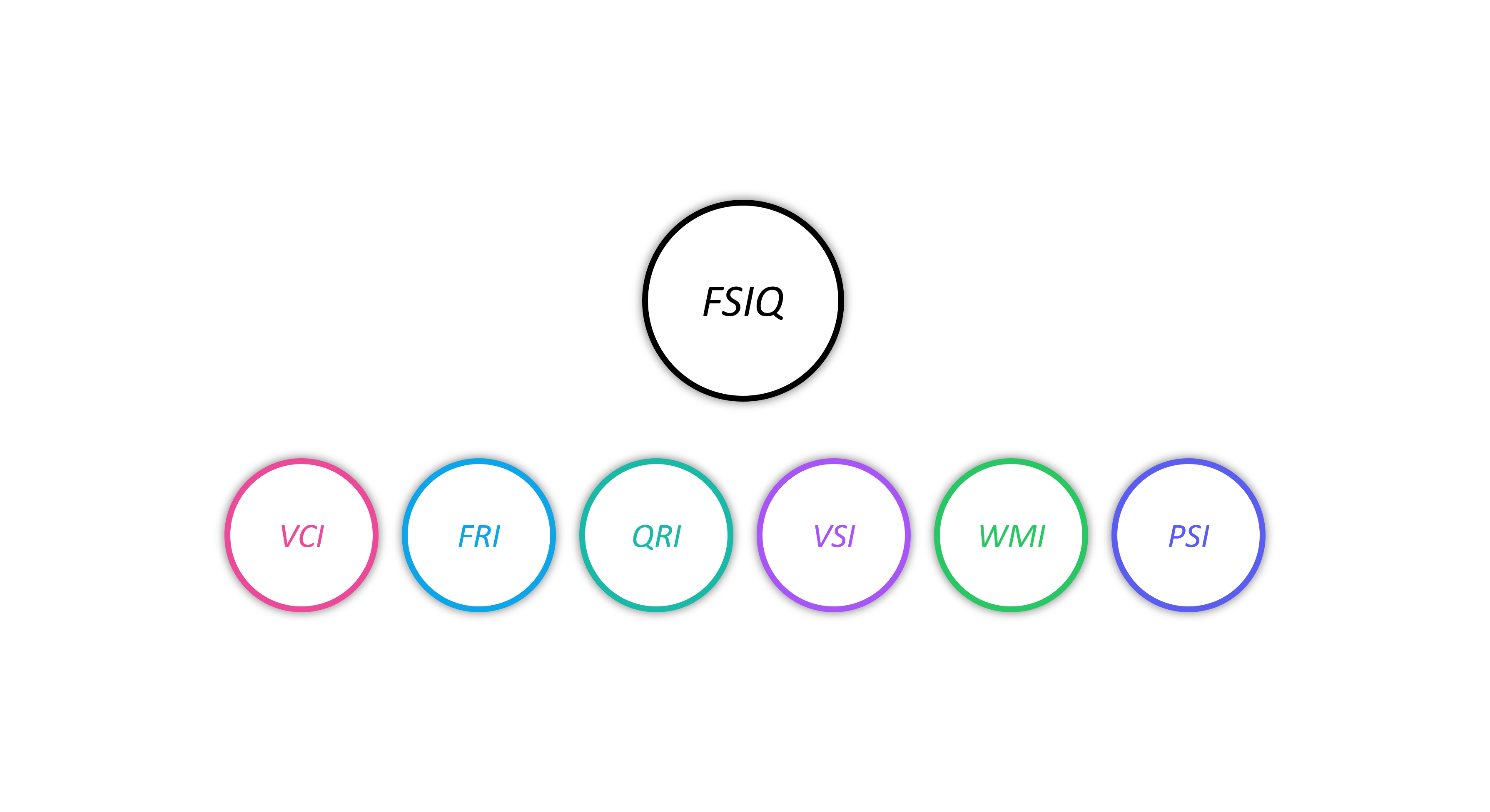
A real Full Scale IQ is built from several broad domains of ability, each measured by its own subtests. The modern framework for this is the Cattell-Horn-Carroll (CHC) model, and a complete battery like ACIS samples six broad domains:
Domain
What it captures
Verbal Comprehension
Knowledge, word meaning, and verbal reasoning
Fluid Reasoning
Novel problem solving and pattern detection
Quantitative Reasoning
Numerical reasoning and knowledge
Visual-Spatial
Mental rotation and spatial logic
Working Memory
Holding and manipulating information
Processing Speed
Fast, accurate cognitive throughput
Each domain is measured by more than one subtest, because a single subtest is a noisy measure of a broad ability. The Full Scale IQ then combines the domains into one number. This layered design, subtests feeding domains feeding the Full Scale IQ, is exactly why the composite is trustworthy: an unusually good or bad performance on any one task gets averaged into a stable overall estimate rather than distorting the whole result. The domains are described further in Cognitive Domains.
4 How the Full Scale IQ is calculated
The Full Scale IQ is a composite, not an average of raw answers. Each subtest is first scored and converted to a standardized scaled score by comparing your performance to a reference population of your age. Those subtest scores combine into domain index scores, and the domain indexes combine into the Full Scale IQ, all placed on the familiar scale where the population average is 100 and the standard deviation is 15.
What makes the Full Scale IQ the best single measure of intelligence is that it captures the most general part of cognitive ability, often called the g factor. Every cognitive task draws partly on abilities specific to that task and partly on a general reasoning capacity that runs through all of them. By combining many diverse tasks, the Full Scale IQ cancels out much of the task-specific noise and isolates that shared general factor, which is why it predicts real-world outcomes better than any single subtest does.
This is also why a Full Scale IQ from a broad battery is statistically more reliable than a score from a short quiz. Reliability rises as you add good, diverse subtests, because errors in different directions partly cancel out. A well-built Full Scale IQ reaches a reliability most single-task tests cannot approach, which is one of the concrete reasons breadth matters, explained further in Reliability and Validity.
5 Full Scale IQ, index scores, and subtest scores
A complete result is a hierarchy, and understanding the three levels helps you read any Full Scale IQ report. At the bottom are subtest scores, your performance on each individual task. In the middle are index or domain scores, which summarize each broad ability, such as your verbal comprehension or processing speed. At the top is the Full Scale IQ, the single composite drawn from all of them.
Each level answers a different question. The Full Scale IQ answers "what is my overall cognitive standing?" The index scores answer "where am I strong and where am I weaker?" The subtests answer "how did I do on this specific task?" A good report gives you all three, because the profile of index scores is often more useful than the single top number: two people with the same Full Scale IQ can have completely different strengths, and only the index level reveals that.
This layered reporting is also what separates a serious assessment from a quiz. A one-page test can only ever give you the equivalent of one subtest, so it cannot show a profile at all. A Full Scale IQ test gives you the overall number and the shape beneath it, which is the difference between knowing a single figure and actually understanding how your mind works, as laid out in Full Scale IQ.
6 Why breadth means accuracy
The central argument for a Full Scale IQ test over a quick quiz comes down to accuracy, and it is not a matter of opinion but of measurement. A single subtest is a small, noisy sample of a broad ability. Any one task is affected by chance, by momentary focus, by whether the format happens to suit you, so a score from one task carries a large margin of error. Add more diverse subtests, and those random errors increasingly cancel, so the composite closes in on your true ability.
Breadth also protects against a subtler problem: format dependence. If your whole IQ comes from matrix puzzles, then being unusually good or bad at that specific format distorts the entire result. A person who has simply seen a lot of matrix puzzles scores high; a strong reasoner who finds that format awkward scores low. A Full Scale IQ, drawn from many formats, does not let any single task type dominate, so it measures reasoning rather than familiarity with one puzzle.
Finally, breadth is what makes the score meaningful across different kinds of people. Someone with strong verbal ability and weaker spatial skill, or the reverse, is captured fairly by a Full Scale IQ because both are sampled and weighed. A narrow test would favor whoever happens to match its single format. This is the concrete reason clinicians rely on Full Scale IQ from full batteries rather than on any one clever task, and why an honest online test should do the same.
7 What a Full Scale IQ score means
A Full Scale IQ is expressed on a standard scale where 100 is the exact average and the standard deviation is 15. About two thirds of people score between 85 and 115, roughly 95 percent between 70 and 130, and scores above 130 or below 70 are genuinely rare. Your Full Scale IQ tells you where you stand relative to other adults, not an absolute quantity of intelligence, a distinction covered in What Is the Average IQ? and the IQ Score Chart.
The most useful way to read the number is as a percentile and as a band. A Full Scale IQ of 100 is the 50th percentile; 115 is about the 84th; 130 is about the 98th. And because every real score carries measurement error, a good report gives a confidence interval, a range in which your true score very likely falls, rather than pretending the point estimate is exact. A Full Scale IQ of 120 is better understood as "very likely somewhere around 115 to 125" than as a precise 120.
What a Full Scale IQ does not do is capture everything about you. It measures cognitive ability, not creativity, character, motivation, or emotional intelligence, and it predicts outcomes strongly but never completely. Read correctly, as a well-measured, percentile-anchored estimate of general reasoning with an honest margin of error, it is one of the most informative single numbers in psychology, and far more meaningful than a figure from a one-task quiz.
8 Full battery or quick screener: which do you need?
Not everyone needs the longest possible test, and it is worth being honest about that. A short screener can give you a rough sense of where you stand in a few minutes, which is fine if all you want is a ballpark. The trade-off is precision: fewer subtests mean a wider margin of error and no meaningful profile of strengths and weaknesses. A screener answers "roughly, am I above or below average?" and little more. The trade has a size as well as a direction, because reliability lost to shortening converts straight into a wider standard error of measurement, which is what a shorter form actually costs in precision. Employers buy that trade on purpose. The Wonderlic and its competitors put around fifty questions into twelve to fifteen minutes and are built to be unfinishable, because how fast you work is part of what they score.
A Full Scale IQ test answers the question most people actually have: "what is my real overall score, and what does my cognitive profile look like?" It takes longer because breadth requires more tasks, but that is exactly what buys the accuracy and the detail. If you want a number you can trust and a picture of how your abilities fit together, the full battery is the right choice; if you only want a quick gut-check, a screener will do. The time that breadth costs is smaller than most people assume, and the administration times publishers state show it: 45 minutes for the seven subtest Full Scale on the WAIS-5 and 50 minutes for the ten subtest Stanford-Binet 5, because item count is what sets the width of the confidence interval around your score.
ACIS is built around this choice rather than forcing one answer. Its tiers range from a shorter assessment to the complete Full Scale battery, so you can match the depth to what you need. If your goal is a genuine Full Scale IQ with a full domain profile, the complete assessment is what delivers it, while a lighter tier exists for a faster, rougher read. The point is that a real Full Scale IQ is a deliberate choice for breadth, not an accident of a longer quiz.
9 Full Scale IQ and the General Ability Index
One nuance worth knowing is that the Full Scale IQ is not the only composite a full battery can produce. Because the Full Scale IQ includes working memory and processing speed alongside reasoning, it can be pulled down for people whose reasoning is strong but whose attention-sensitive abilities lag, which is common in conditions like ADHD. For those cases, clinicians often also look at the General Ability Index (GAI), a composite built from verbal and reasoning tasks that leaves out working memory and processing speed.
The point is not that one number is right and the other wrong, but that a broad battery gives you the flexibility to see both. The Full Scale IQ captures real-world cognitive performance including the speed and memory demands of everyday tasks, while the General Ability Index gives a cleaner read of reasoning capacity when those two indexes are selectively low. Seeing them together tells you more than either alone, and it is only possible because the battery measured all the domains in the first place.
This is another advantage a single-task quiz cannot offer. It has no domains to separate, so it cannot distinguish a limit on reasoning from a limit on speed or memory. A Full Scale IQ test, by measuring the components, lets you understand not just your overall score but why it landed where it did, which is exactly the kind of insight covered across Cognitive Domains.
10 How ACIS gives you a real Full Scale IQ online
ACIS is a genuine Full Scale IQ test built for online, self-administered use. Its complete assessment runs 20 subtests across the six cognitive domains above, scores each against a defined adult reference frame, and combines them into a Full Scale IQ reported with a confidence interval. It is not a matrix quiz with a composite label; it is a real multi-domain battery that produces the same kind of layered result, subtests, domain indexes, and an overall Full Scale IQ, that a serious test is supposed to. That reference frame is an adult one, drawn from 3,243 eligible records between ages 16 and 90, which is the concrete version of how an adult IQ test differs from a quiz.
Just as important, it is built to be trustworthy rather than merely impressive. ACIS interprets your result within a reference frame of thousands of records spanning ages 16 to 90, publishes its reliability and validity evidence and its norming, and reports your Full Scale IQ with a margin of error instead of a false-precise single figure. That is what turns a set of subtests into a score that actually means something, and it is the standard a Full Scale IQ deserves.
What it does not do is claim to be a supervised clinical evaluation. A Full Scale IQ from ACIS is a rigorous self-administered measurement of your cognitive ability and profile; it is not a substitute for an in-person assessment by a licensed psychologist for diagnosis, accommodations, or legal use, a boundary explained in Professional IQ Test. Within that honest scope, it is about as close to a real Full Scale IQ as an online test gets.
Even setting breadth aside, there is a second reason a real Full Scale IQ test is worth more than a free quiz: the score has to be anchored to something. A number only means "your IQ" if it is compared against a real, representative sample of people, placed on a fixed scale, and reported with a known margin of error. A quiz that invents a scale can hand you an impressive figure that corresponds to nothing. Published norms are one of the criteria used in a ranked comparison of the top online IQ tests, alongside technical evidence, report utility, score range and anti-cheat controls.
This is why norms and documentation matter as much as the tasks. Two tests could use identical subtests and still produce completely different, incomparable Full Scale IQs if one is normed on a proper reference population and the other simply makes up its numbers. A trustworthy result tells you where you stand relative to a defined group, backs it with published reliability and validity, and reports a confidence interval, the standard drawn out in Accurate IQ Test and Free vs. Validated IQ Tests.
Put breadth and norming together and the gap becomes clear. A free quiz gives you one task, no real norms, and a single exact-looking number. A proper Full Scale IQ test gives you many tasks across domains, a defined reference population, a confidence interval, and a profile. The first is entertainment; the second is measurement, and only the second deserves to be called your Full Scale IQ.
12 Quick quiz vs a real Full Scale IQ test
To make the difference concrete, here is how a typical one-page IQ quiz compares with a real Full Scale IQ test:
What matters
Typical free IQ quiz
Full Scale IQ test (ACIS)
Coverage
One task, usually matrices
20 subtests across six domains
What it measures
Mainly fluid reasoning
General ability plus a full profile
Reliability
Low (single task)
High (broad composite)
Norms
Often none or undisclosed
Defined adult reference frame, ages 16 to 90
Reporting
One exact number
Full Scale IQ with a confidence interval, plus index scores
The tasks are the easy, copyable part; the breadth, the norms, the reliability, and the confidence interval are what make a Full Scale IQ real. That is the same line that separates a serious assessment from a viral quiz in every format, and it is why the word "full scale" is worth taking literally.
13 Common myths about Full Scale IQ tests
"Any online IQ test gives a Full Scale IQ." No. Most are single-task quizzes measuring one ability. A Full Scale IQ requires sampling across multiple domains.
"A longer test is automatically a Full Scale IQ." No. Length is not the point; breadth is. A hundred matrix items is still one domain. Coverage across abilities is what makes it full scale.
"The Full Scale IQ is the only number that matters." No. The index profile beneath it is often more useful, because two people with the same Full Scale IQ can have very different strengths.
"A Full Scale IQ is an exact, fixed number." No. It carries a margin of error and is best read as a confidence interval, and it can shift with conditions and over time.
"A high Full Scale IQ explains success." It predicts outcomes meaningfully but never completely; motivation, character, and circumstance matter too.
When you get a Full Scale IQ, read it the way a professional would. Start with the confidence interval, not the point: your result is a range in which your true score very likely falls, so treat a Full Scale IQ of 118 as "around 113 to 123" rather than an exact figure. Then convert to a percentile, the share of people you scored at or above, which is far more intuitive than the raw number and ties directly to the IQ Score Chart.
Next, look beneath the composite at your index scores. The shape of your profile, where you are strong and where you are weaker, is often the most useful part of the whole result, and it is the part a one-task quiz can never give you. A high overall score built on even abilities means something different from the same score built on a towering verbal strength and a weak processing speed, and only a full battery reveals which you have.
Finally, hold the number in perspective. A Full Scale IQ is a strong, well-measured estimate of your general cognitive ability, and that is genuinely valuable, but it is one dimension of a person, not a verdict. Used well, it is information for understanding yourself and making decisions, not a label. That is the spirit in which a real Full Scale IQ is worth taking, and worth taking seriously.
15 Bottom line
A Full Scale IQ test measures your overall intelligence by sampling many abilities across several domains and combining them into one composite, which is what makes it the best single estimate of general cognitive ability. Most online "IQ tests" are not full scale; they are single-task quizzes that measure one ability and borrow the name. The difference is not marketing but measurement: breadth is what buys accuracy, reliability, and a real profile.
If you want a genuine Full Scale IQ rather than a matrix quiz with a composite label, take a properly normed battery that reports your overall score with a confidence interval and shows the domain profile beneath it. ACIS measures 20 subtests across six cognitive domains, interprets your Full Scale IQ against a defined adult reference frame, and gives you both the number and the shape of your abilities. You can start free and see your real Full Scale IQ, done the way it is supposed to be done.
The claims on this page follow the published literature rather than our own assertions. These are the primary papers and reference bodies worth reading directly, with what each contributes.
Pearson (2008). WAIS-IV Score Report sample. What a real report contains: every composite paired with a percentile rank, a 95% confidence interval and a qualitative description, never a bare number.
Pearson Clinical Assessment Scientific Council (2023). Standardized Clinical Assessment for Practitioners: A Primer. How standard scores, percentile ranks and the standard error of measurement are meant to be read together.
Pearson (2024). WAIS-5, Wechsler Adult Intelligence Scale, Fifth Edition. The current adult battery, covering ages 16:0 to 90:11 across five cognitive domains.
American Psychological Association. Understanding psychological testing and assessment. What professionally administered testing involves and how it differs from informal quizzes.
Nisbett, R.E. et al. (2012). Intelligence: new findings and theoretical developments. American Psychologist, 67(2). The broad APA review of what moves measured intelligence and what does not.
Plomin, R. & Deary, I.J. (2015). Genetics and intelligence differences: five special findings. Molecular Psychiatry. Open access. The standard modern review of what twin and DNA evidence does and does not show.
Gottfredson, L.S. (1997). Mainstream Science on Intelligence, the editorial signed by 52 researchers. Intelligence, 24(1), hosted by the University of Delaware. A consensus statement on what IQ tests measure.
Spearman, C. (1904). General intelligence, objectively determined and measured. American Journal of Psychology, full text at Classics in the History of Psychology. The paper where the g factor entered psychology.
Voncken, L., Albers, C.J. & Timmerman, M.E. (2019). Improving confidence intervals for normed test scores. Behavior Research Methods. Open access. Documents the mean 100, SD 15 metric and the uncertainty that norming from samples adds to any score.
ACIS measures six CHC domains across 20 subtests and reports each one with its own normed score and confidence interval, so you can see where you are strong and where you are not.