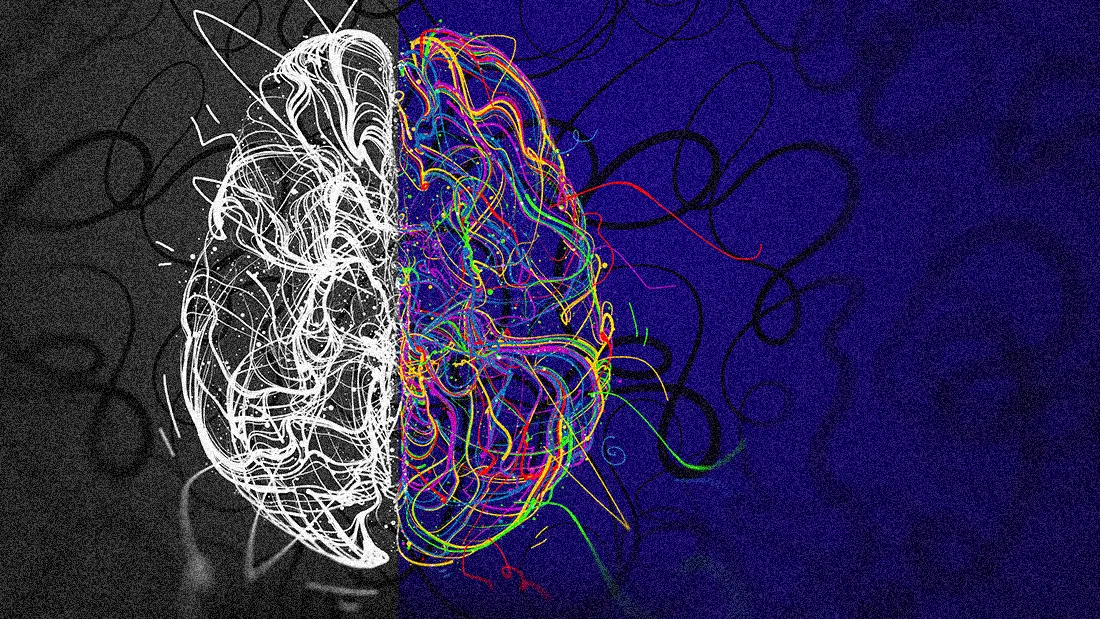
Are you a logical "left-brained" person or a creative "right-brained" one? The honest answer is neither, because that idea is a myth. Nobody is dominated by one hemisphere. But the myth grew out of real, fascinating science, and there is a genuine truth hiding underneath it. Here is what your two hemispheres actually do, and what they do not.
1 Left Brain vs Right Brain: The Short Answer
Updated July 9, 2026 by Structural.The popular idea that people are either logical "left-brained" types or creative "right-brained" types is a myth. There is no good evidence that any individual has a dominant hemisphere that shapes their personality, and complex traits like logic and creativity are not confined to one side of the brain. Both hemispheres are involved in almost everything you do, constantly and cooperatively.
Hemisphere dominance is not the pattern that imaging finds for intelligence. Jung and Haier's P-FIT review described a distributed network linking parietal and frontal cortex, with white matter such as the arcuate fasciculus, and a lesion study of 241 patients found a distributed frontal and parietal system. The page on where intelligence sits in the brain reports the effect sizes and what has replicated.
It is worth being precise about the two different claims tangled up in this topic, because keeping them apart is the whole key. One claim is that the two hemispheres are not identical and that certain functions favor one side, which is true and well established. The other is that a given person is ruled by a dominant hemisphere that fixes their personality as logical or creative, which is false. Almost all the confusion here comes from sliding between these two, treating the real fact about functions as if it proved the false story about people.
What is true, and what the myth is a distortion of, is lateralization: the fact that some specific functions do lean more heavily on one hemisphere than the other. Language, for example, is mostly handled on the left in the great majority of people. But lateralization of narrow functions is a completely different claim from the idea that your whole thinking style, or your identity, is governed by a stronger side. The first is real neuroscience; the second is pop psychology that the research does not support.
A myth
Being "left-brained" or "right-brained" by personality
1,000+ brains
Imaging study that found no dominant hemisphere in people
Real
Lateralization: some functions do lean to one side
So this page separates the real science from the self-help version, explains where the myth came from, and shows what your hemispheres genuinely do. For a related debunking about teaching and thinking styles, see our page on types of intelligence, and for how cognitive abilities are really organized, see cognitive domains.
Note: "Left-brained" and "right-brained" are useful as loose metaphors for analytical versus intuitive styles, and there is nothing wrong with using them that way. The problem is only when they are taken literally, as a claim about brain biology or a fixed personality type. This page is about that literal claim.
The left-brain versus right-brain idea, in its popular form, sorts people into two cognitive tribes. The "left-brained" person is supposed to be logical, analytical, verbal, mathematical, detail-oriented, and orderly. The "right-brained" person is supposed to be creative, artistic, intuitive, emotional, holistic, and free-spirited. In this picture, everyone has a dominant hemisphere that determines which cluster of traits they have, the way handedness determines which hand you write with.
It is a strangely rigid picture when you spell it out. It implies that your capacity for logic and your capacity for creativity are locked in a kind of seesaw, so that being strong at one means being weak at the other. Real people do not work that way. Plenty of scientists are highly creative and plenty of artists are rigorously analytical, and the same person can move fluidly between careful reasoning and imaginative leaps depending on the task. A theory that forces those into opposing camps is already at odds with everyday experience before any brain scan is involved.
From that core claim, a whole industry grew. There are quizzes to discover which side you are, books on unlocking your neglected hemisphere, and educational programs promising to teach to a child's "right-brained" or "left-brained" style. The framework is attractive because it is simple, it flatters, and it seems to explain real differences: some people really do gravitate toward art and others toward analysis, and the myth offers a tidy brain-based reason why.
The trouble is that the tidy reason is wrong. The observation it starts from, that people have different aptitudes and temperaments, is perfectly real. But the explanation it attaches, that these differences come from one hemisphere dominating the other, is not how brains work. The rest of this page is about the gap between the real observation and the false explanation, because untangling them is the whole point.
There is a useful test you can apply to any claim like this. Ask whether it is describing a tendency people notice, or asserting a mechanism about how the body produces it. The left-brain, right-brain idea quietly swaps a real description, that some people lean analytical and others intuitive, for a false mechanism, that one hemisphere runs the show. The description is worth keeping and the mechanism is worth discarding, and most pop-neuroscience myths follow exactly this shape, which is why learning to separate the two is a skill that pays off well beyond this one topic.
3 Where It Came From: Split-Brain Science
The myth is unusual in that it grew out of genuinely great science. In the 1960s and 1970s, the neuroscientist Roger Sperry and colleagues studied patients who, to treat severe epilepsy, had undergone surgery to cut the corpus callosum, the thick bundle of fibers connecting the two hemispheres. With the connection severed, researchers could present information to one hemisphere at a time and see how each side handled it on its own. The work was so important that Sperry shared a Nobel Prize for it.
It is worth pausing on how good the original science actually was, because the myth is not a case of bad research misleading people. Sperry's split-brain studies were rigorous, careful, and genuinely revolutionary; they reshaped how neuroscientists think about the organization of the brain. The failure happened downstream, in the translation from laboratory to bookstore, where nuanced findings about disconnected hemispheres were flattened into a catchy personality framework. It is a cautionary tale about science communication more than about science: the same result can be reported accurately or distorted, and the distortion often travels faster.
These "split-brain" experiments revealed that the hemispheres do have some different specializations. In these patients, the left hemisphere, which usually controls language, could name an object shown to it, while the right hemisphere often could not name the same object but could still recognize it or point to it. The findings were a landmark demonstration that the two halves are not identical and can, when disconnected, work in strikingly different ways.
But notice the crucial condition: these were people whose hemispheres had been surgically disconnected. The dramatic differences appeared precisely because the normal cooperation between the sides had been cut. In the 1970s and 1980s, popular writers stripped away that condition and turned a finding about surgically separated brains into a sweeping claim about the personalities of ordinary, intact-brained people. The science was real; the pop extrapolation from it was not, and that leap is the origin of the whole myth.
It is a pattern worth recognizing, because it recurs across popular science: a real, careful finding obtained under very specific conditions gets stretched into a sweeping everyday claim it was never meant to bear. The antidote is simple and general. Ask what conditions the original study actually held, and here that single question, were the brains connected or surgically disconnected, dissolves most of the myth on its own, because everything dramatic in the split-brain work depended on a disconnection that ordinary brains do not have.
4 What Lateralization Actually Is
To be fair to the science, hemispheric specialization is real, and it is worth stating accurately so the myth can be separated from the truth. Some functions genuinely are lateralized, meaning they depend more on one hemisphere than the other. The clearest case is language: in roughly 90 to 95 percent of right-handed people, and a majority of left-handed people, the core machinery of speech and grammar sits mainly in the left hemisphere. Reading shows how specific these stories have to stay, because writing is only a few thousand years old and no dedicated reading organ ever evolved, so learning to read borrows the circuits built for speech and vision and can fail on its own, which is what the reading difficulty in dyslexia amounts to while reasoning runs at full power.
It also helps to appreciate how variable lateralization is from person to person, which the myth ignores entirely. The side that language sits on is a strong tendency, not a universal law, and it differs across individuals, especially left-handers. Other functions are only weakly lateralized, and the degree of lateralization for any given function varies too. This messy, graded, individual reality is nothing like the clean binary the myth proposes, in which you are simply one type or the other. Real hemispheric organization is a matter of degree and of specific functions, not of whole-person categories.
Other functions lean the other way. Aspects of spatial attention, face recognition, and the processing of emotional tone in speech tend to involve the right hemisphere more heavily. So it is entirely accurate to say that particular, narrow functions are handled more on one side. This is real, well-established neuroscience, and it is why brain injuries to one hemisphere can affect some abilities while sparing others.
But two things keep this from supporting the myth. First, lateralization is about specific functions, not about broad traits like logic or creativity, which are far too complex to live on one side. Second, lateralization varies and is never total; even a strongly lateralized function like language draws on both hemispheres to some degree. Recognizing that language is left-leaning is a world away from claiming that a person is a "left-brained" logical type, and conflating the two is exactly the error the myth makes. Measured verbal ability is not a hemisphere either, since the index that samples verbal knowledge and reasoning is defined by the task families inside it rather than by where in the brain those tasks run.
5 Why Logic and Creativity Are Not Hemispheres
The heart of the myth is the pairing of logic with the left and creativity with the right, and this is where it most clearly breaks down. Neither logic nor creativity is a single, simple function that could sit in one hemisphere. Both are complex, high-level activities that recruit large, distributed networks spanning both sides of the brain, along with regions front and back.
The reason complex abilities cannot be one-sided is worth making explicit. A capacity like creativity or logical reasoning is not a single operation but a coordinated sequence of many, holding information in mind, retrieving knowledge, generating possibilities, evaluating them, and controlling attention throughout. Those sub-processes are handled by different regions distributed across the whole brain, so the finished ability necessarily spans both hemispheres. Expecting creativity to live in the right hemisphere is a bit like expecting an orchestra's sound to come from a single instrument; the output is inherently the product of many parts playing together.
Creativity is the clearest example. Far from being a "right-brain" activity, generating and refining original ideas involves widespread networks, including systems associated with imagination and mind-wandering as well as systems for focus and evaluation, drawing on both hemispheres together. Our page on IQ and creativity goes deeper, but the short version is that creativity is a whole-brain phenomenon, not the property of one side. The same is true of logical and mathematical reasoning, which likewise engage bilateral networks rather than a single "logical" hemisphere.
So the neat left-logic, right-creativity split is not a simplification of the truth; it is a misdescription of it. The abilities the myth assigns to separate hemispheres are in fact produced by the two hemispheres working together, which is the opposite of the picture it paints. Once you know that logic and creativity are both whole-brain achievements, the idea of sorting people by which half runs them stops making sense.
6 The Evidence That Debunked It
The myth is not just unsupported in theory; it has been tested directly and failed. The most cited investigation used brain imaging to look for exactly the thing the myth predicts: individuals whose brains are wired to favor one hemisphere overall. Researchers analyzed the resting brain activity of a large sample, more than a thousand people, measuring how strongly each person's left- and right-sided networks were used.
It is worth being clear about what kind of evidence this is, because it directly targets the myth's own prediction. The study did not ask a vague question; it operationalized the exact claim, that some individuals should have generally stronger left-hemisphere networks and others stronger right ones, and then measured precisely that across a large sample. When a theory makes a concrete prediction and a well-designed test looks for it and finds nothing, that is the strongest kind of disconfirmation available, far more telling than a mere absence of supporting evidence.
If the myth were true, some people should show a generally stronger left-hemisphere network and others a stronger right, corresponding to "left-brained" and "right-brained" individuals. That is not what the data showed. While specific functions were lateralized, as expected, there was no evidence that individuals had an overall dominant hemisphere. People did not sort into left-brained and right-brained types; everyone used both hemispheres' networks to a broadly similar extent. The central prediction of the myth simply did not appear.
This is about as clean a debunking as psychology offers. The idea makes a specific, testable claim, that individuals have a dominant side, and when researchers looked for that dominance across a large group, it was not there. Combined with the fact that complex traits are whole-brain functions and that the myth rests on a misreading of split-brain surgery, the conclusion is firm: being "left-brained" or "right-brained" as a personal type is not a real phenomenon.
None of this, importantly, denies that the same research also confirmed real lateralization. The very analysis that found no dominant-hemisphere individuals did find that specific functions were lateralized, exactly as neuroscience expects. That combination is the honest result in a single study: the narrow, real phenomenon is present, and the broad, mythical one is absent. It is a tidy illustration of the theme of this whole page, that the truth and the myth sit right next to each other, and careful measurement is what tells them apart.
7 Your Hemispheres Are a Team
The deepest reason the myth fails is that it imagines the hemispheres as rivals competing for control, when in a healthy brain they are constant collaborators. The corpus callosum, the very structure that was cut in the split-brain patients, is a massive bridge of some 200 million nerve fibers whose entire job is to keep the two sides in continuous communication. In an intact brain, information flows across it ceaselessly, so the hemispheres act far more like one integrated system than like two competitors.
The scale of the connection is easy to underestimate. Those roughly 200 million fibers are firing constantly, shuttling information back and forth faster than conscious awareness, so that what feels like a single seamless stream of thought is actually the product of both hemispheres updating each other moment by moment. The unity of your experience is not evidence that one side is in charge; it is evidence of how thoroughly the two are integrated. A brain that genuinely ran on one dominant hemisphere would not produce the fluid, unified cognition that healthy brains do.
This is why almost every real-world task, holding a conversation, reading a map, playing music, solving a problem, engages both hemispheres in tight coordination. Reading, for instance, uses left-hemisphere language machinery but also right-hemisphere contributions to context and tone. The division of labor that lateralization describes is real, but it operates within a system designed for integration, not separation, and the payoff of that integration is exactly the rich, flexible thinking that the "one dominant side" picture cannot explain.
Seen this way, asking whether you are left-brained or right-brained is a bit like asking whether a bird flies with its left wing or its right wing. Each wing does something, and they are not identical, but flight is what happens when they work together, and singling out one as dominant misunderstands the whole activity. Your thinking is a two-hemisphere accomplishment, moment to moment, all the time.
8 What About Handedness?
People often assume handedness settles the question, that left-handers must be "right-brained" and therefore more creative, while right-handers are "left-brained" and logical. It is a natural guess, since handedness really is a lateralized trait, but it does not support the personality myth either. Left-handedness has still worked its way onto nearly every list of supposed signs of high intelligence, where it sits in the weakly supported column beside being a night owl and keeping a messy desk.
Few everyday habits are read as a sign of a better brain as often as being a night owl, and the data behind it are thin. A 2011 meta-analysis put the correlation between eveningness and cognitive ability at 0.08, and a 2020 comparison of 586 Mensa members with 586 controls found no difference in chronotype at all. The review of night owls and IQ shows how a small association became a popular sign of a better brain.
It is worth adding why the handedness guess is so tempting and yet so misleading. Handedness is visible, seemingly binary, and obviously brain-related, so it feels like it should map onto a deeper binary of thinking styles. But the brain does not honor that neat correspondence. The organization of language by handedness is a genuine, measurable pattern, and it simply does not extend to personality, creativity, or intelligence. Treating a real fact about motor and language organization as a window into someone's character is a category error, however intuitive the leap feels.
In short, the one real thing handedness reveals about the brain is modest and specific, a matter of where language tends to sit, and it stops well short of the sweeping story about character and creativity that the myth tries to build on it.
Handedness does relate to how the brain is organized, mainly for language. In most right-handers, language is strongly left-lateralized. In left-handers the picture is more varied: many still have left-lateralized language, while a larger minority have language more evenly distributed or right-lateralized. So handedness is a real clue to certain aspects of brain organization. What it is not is a predictor of personality or creative talent. The claim that left-handers are more creative or artistic is, at best, a very weak and inconsistent finding, and it does not come close to the tidy story the myth tells.
The lesson is the same as everywhere else on this page. A specific lateralized trait, here the side that language sits on, is real and can be linked to handedness, but it does not scale up into a claim about someone's whole thinking style. Being left-handed tells you something modest about language organization and essentially nothing about whether a person is logical or creative, because those traits were never hemisphere-based to begin with.
9 The "Right-Brained Learner" Myth
One of the most common and most harmful spin-offs of the idea is the "right-brained learner" or "left-brained learner" in education. Teachers are sometimes encouraged to identify a child's dominant hemisphere and tailor instruction to it, treating some students as intuitive right-brained learners and others as analytical left-brained ones. This is a myth built on a myth, and it deserves to be set aside. The classroom profiles that genuinely do get missed are the twice exceptional ones, where a strong reasoner compensates well enough that achievement lands at average and the exhausting gap behind that average never shows up in the grades.
There is a further, subtler harm in the educational version worth naming. When a child is told they are a right-brained learner, the label can become a self-fulfilling limit: they and their teachers may stop expecting progress in supposedly left-brained subjects, and effort gets quietly withdrawn from exactly the areas where it is most needed. A framework meant to celebrate a child's strengths can end up fencing them into them. The kinder and more accurate approach treats every skill as open to growth, rather than assigning children to cognitive lanes on the basis of a myth.
It fails twice over. First, because individuals do not have a dominant hemisphere, there is nothing real to teach to, so the whole premise is empty. Second, it is a close relative of the broader learning-styles myth, the idea that matching teaching to a student's preferred style improves learning, which controlled studies have repeatedly failed to support. We cover that in our page on types of intelligence. Labeling a child "right-brained" can actually do harm, by lowering expectations in areas wrongly assumed to belong to the other hemisphere and by excusing a narrow approach to teaching.
What actually helps learning is matching the method to the material, not to a supposed brain type, and giving every student practice across the full range of skills rather than pigeonholing them. A child is not a hemisphere, and treating them as one trades a fun-sounding label for a real limit on what they are encouraged to try.
10 Why the Myth Persists
Given how thoroughly it has been debunked, it is worth asking why the left-brain, right-brain idea is so stubborn. Part of the answer is that it is genuinely useful as a metaphor. "Analytical" and "intuitive" are real and different modes of thinking, and mapping them onto left and right is a vivid shorthand. The metaphor survives because the underlying distinction it points at, between careful analysis and holistic intuition, is real, even though the brain geography is wrong. Cognitive tests can trade on the same appeal, so an instrument is worth judging on reliability, validity and its norm sample, which is what an accurate IQ score actually requires rather than on how satisfying its labels feel.
There is also a media incentive that keeps ideas like this alive. A striking, brain-based explanation for personality makes for shareable content, appealing quizzes, and confident headlines, in a way that the accurate but less dramatic story, complex distributed networks with partial lateralization, never will. Myths that are simple, flattering, and visual outcompete truths that are nuanced and hard to picture. Recognizing that incentive is part of reading brain claims critically: the more a neuroscience story flatters and simplifies, the more it is worth pausing to check.
Another part is identity. People enjoy having a category that explains and validates their strengths. Calling yourself right-brained affirms a creative self-image, and calling yourself left-brained affirms an analytical one, and a label that flatters and simplifies at the same time is hard to give up. It also offers a comforting excuse: if you are just not a "math person" because you are right-brained, then a weakness becomes a fixed identity rather than something you could work on.
That last point is where the myth quietly does damage. Treating logic or creativity as a hemisphere you either have or lack discourages people from developing the side they have written off, when in reality both are broad, trainable capacities available to everyone. The metaphor is harmless as a figure of speech; the belief becomes limiting the moment it is taken as a fixed fact about who you are and what you can become.
11 What You Can Actually Keep
Debunking the myth does not mean the topic is boring underneath; the real neuroscience is more interesting than the pop version. You can keep, and enjoy, the genuine facts. It is true that your two hemispheres are not identical, that language leans left in most people, that certain spatial and emotional-tone functions lean right, and that surgically separating the hemispheres produces the strange and revealing effects Sperry documented. Lateralization is a real and elegant feature of how brains are organized.
It is genuinely worth savoring how elegant the real arrangement is, because it beats the myth on its own terms. A brain that assigns some functions preferentially to one side while keeping both in constant dialogue gets the best of both: the efficiency of specialization and the power of integration. That design is a more impressive answer to how minds work than a crude split into a logical half and a creative half. Trading the myth for the reality is not a downgrade from a fun idea to a dull fact; it is an upgrade to something both true and more interesting.
What you should drop is the leap from those facts to a theory of personality. The accurate picture is that specific functions are distributed with some bias across two hemispheres that are otherwise in constant, intimate cooperation, producing a single, integrated mind. That is a richer and truer story than "you are ruled by one side," and it does not sort people into creative and logical camps, because the brain does not sort itself that way.
So the honest takeaway is a small, firm swap. Keep lateralization, the real and testable fact that some functions lean one way. Drop hemispheric dominance as a personality type, the untested and now disproven fantasy. With that swap, you lose nothing true and shed a belief that, at its worst, quietly narrows what people think they are capable of.
12 Common Left-Brain, Right-Brain Myths, Corrected
Myth: people are either left-brained or right-brained. A large imaging study found no individuals with an overall dominant hemisphere. Everyone uses both sides extensively.
Myth: logic lives in the left brain and creativity in the right. Both are complex, whole-brain functions that recruit distributed networks across both hemispheres.
Myth: the hemispheres work separately. In a healthy brain they are in constant communication through the corpus callosum and act as one integrated system.
Myth: split-brain research proved the personality theory. It studied surgically disconnected brains and showed specialization, not that intact people have a dominant personality-defining side.
Myth: left-handed people are right-brained and more creative. Handedness relates to language organization, not to personality or creative talent, which are not hemisphere-based.
Myth: children are right-brained or left-brained learners. There is no dominant hemisphere to teach to, and this is a relative of the debunked learning-styles idea.
13 What This Means for You, and Where ACIS Fits
The practical message is freeing rather than deflating. You are not locked into a creative or a logical identity by the side of your brain, because there is no dominant side and these traits are not hemisphere-based in the first place. Both analytical and creative thinking are broad, developable capacities, and treating them as fixed halves of yourself only limits what you are willing to try. Enjoy the metaphor if you like it; just do not let it become a ceiling. For anyone curious about an actual cognitive profile rather than a hemisphere label, measurement is the route, and what separates an online IQ test from a quiz is whether it reports separate domain scores against real norms.
It is also worth extending the point beyond this single myth. The left-brain, right-brain story is one of a family of neuro-myths, alongside the claim that we use only ten percent of our brains and the learning-styles idea, that share a common appeal and a common flaw: they offer simple, brain-based explanations that feel scientific but do not hold up. Getting this one right is good practice for the others. The habit worth building is to enjoy a striking brain claim, then ask what the actual evidence says before making it part of how you see yourself.
A word on where our own test fits, in the same honest spirit as the rest of this page. ACIS measures cognitive abilities, not a brain type. It does not sort you into a left-brained or right-brained category, because that category is not real. Instead, it assesses your reasoning across the cognitive domains, verbal, fluid, spatial, memory, and speed, and returns a full-scale score plus a domain profile of genuine strengths and weaknesses. That profile is the real, evidence-based version of the thing the myth gestures at: an honest map of how you actually think, grounded in measured ability rather than a pop label about which half of your brain is in charge. If you want to understand your real cognitive strengths, that is what ACIS is built to show you.
Sperry, R. W. Nobel Prize-winning split-brain research in the 1960s and 1970s, which revealed hemispheric specialization in patients whose corpus callosum had been surgically cut.
Nielsen, J. A., et al. (2013). An evaluation of the left-brain vs. right-brain hypothesis with resting-state functional connectivity, in over 1,000 brains, finding no evidence that individuals have a dominant hemisphere.
On lateralization of language and other functions, see standard neuroscience treatments of hemispheric specialization.
On the related learning-styles myth, see our page on types of intelligence and reviews finding no benefit to matching instruction to a preferred style.
Nisbett, R.E. et al. (2012). Intelligence: new findings and theoretical developments. American Psychologist, 67(2). The broad APA review of what moves measured intelligence and what does not.
Harada, C.N., Natelson Love, M.C. & Triebel, K. (2013). Normal cognitive aging. Clinics in Geriatric Medicine, 29(4), 737-752. Open access. Fluid abilities peak in the third decade while vocabulary and knowledge hold or improve into the seventies.
Plomin, R. & Deary, I.J. (2015). Genetics and intelligence differences: five special findings. Molecular Psychiatry. Open access. The standard modern review of what twin and DNA evidence does and does not show.
Gottfredson, L.S. (1997). Mainstream Science on Intelligence, the editorial signed by 52 researchers. Intelligence, 24(1), hosted by the University of Delaware. A consensus statement on what IQ tests measure.
Spearman, C. (1904). General intelligence, objectively determined and measured. American Journal of Psychology, full text at Classics in the History of Psychology. The paper where the g factor entered psychology.
Voncken, L., Albers, C.J. & Timmerman, M.E. (2019). Improving confidence intervals for normed test scores. Behavior Research Methods. Open access. Documents the mean 100, SD 15 metric and the uncertainty that norming from samples adds to any score.
Pearson Clinical Assessment Scientific Council (2023). Standardized Clinical Assessment for Practitioners: A Primer. How standard scores, percentile ranks and the standard error of measurement are meant to be read together.
Pearson (2008). WAIS-IV Score Report sample. What a real report contains: every composite paired with a percentile rank, a 95% confidence interval and a qualitative description, never a bare number.
The personality version is a myth. A study of 1,000+ brains found no dominant hemisphere in individuals. Only specific functions, like language, are lateralized.
Are people left- or right-brained?
No. Everyone uses both hemispheres extensively. No one sorts into a dominant-hemisphere personality type.
Where did the myth come from?
From Roger Sperry's real split-brain research, later exaggerated into a personality claim about ordinary, intact-brained people.
What is lateralization?
The real fact that some functions lean to one side, like language on the left. It is about narrow functions, not broad traits, and is never total.
Is creativity a right-brain thing?
No. Creativity is a whole-brain phenomenon using distributed networks across both hemispheres, not the property of one side.
Is logic a left-brain thing?
No. Logical and mathematical reasoning engage bilateral networks, produced by both hemispheres working together.
What did the 1,000-brain study find?
Specific functions were lateralized, but no individual had an overall dominant hemisphere. Left- and right-brained types did not appear.
Do the hemispheres work separately?
No. The corpus callosum keeps them in constant communication, so they act as one integrated system, not rivals.
What is the corpus callosum?
The large fiber bundle connecting the hemispheres so they share information. Cutting it caused the split-brain effects.
Are left-handers more creative?
No. Handedness relates to language organization, not personality or creativity. The "creative left-hander" claim is weak and inconsistent.
Is there a right-brained learner?
No. There is no dominant hemisphere to teach to, and it is a relative of the debunked learning-styles myth.
Do split-brain patients have two minds?
They show striking effects because their hemispheres were surgically disconnected. It does not describe ordinary connected brains.
Why does the myth persist?
It works as a metaphor for analytical vs intuitive styles and flatters identity. Harmless as a figure of speech, false as biology.
Can I train my weaker side?
The framing is off, but the truth is encouraging: logic and creativity are trainable skills, not fixed hemispheres.
Are these traits brain-based?
Everything is, but via distributed networks across both sides, not one dominant hemisphere.
Is saying "left-brained" wrong?
Not as a casual metaphor. It is only wrong taken literally as brain biology or a fixed type.
Do brain injuries show hemisphere differences?
Yes, that is real lateralization: one-sided damage can affect some abilities. But it does not support personality types.
Is emotion a right-brain thing?
Some aspects like emotional tone lean right, but emotion involves central structures and both hemispheres, not one side.
What makes me analytical or creative?
A mix of ability, interest, personality, and practice, produced by the whole brain. Both are real, developable, and not hemisphere-based.
Does ACIS test brain dominance?
No, there is none to test. It measures cognitive abilities and returns a real profile of strengths.
What is the honest takeaway?
Keep lateralization (real); drop hemispheric dominance as a personality type (disproven). You lose nothing true.
ACIS measures six CHC domains across 20 subtests and reports each one with its own normed score and confidence interval, so you can see where you are strong and where you are not.