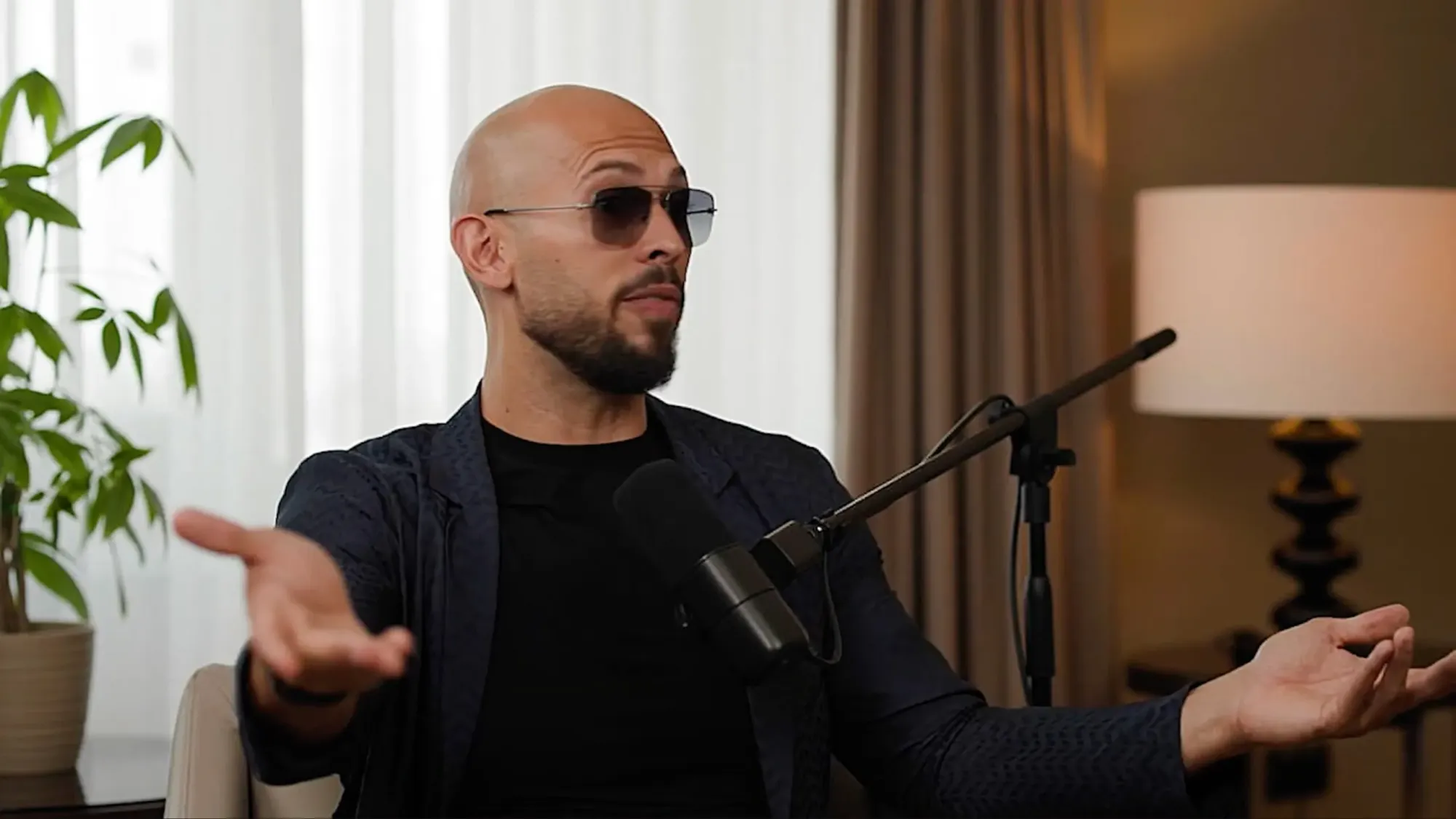
Andrew Tate has publicly claimed an IQ of 148, but no named instrument, score report, examiner, testing date, percentile record, or verified Mensa documentation is available. His public career supports some cognitive inferences, yet the evidence is too weak for an extreme score. This review applies the same standard whether the reader admires or dislikes him.
Self reported scores begin an evidence check. They do not complete one, especially when the original test record is unavailable.
1 The Short Answer
Andrew Tate's IQ is not verified. He has publicly claimed a score of 148, and that self report is the origin of the famous number. No public score document identifies the test, edition, date, examiner, age norms, confidence interval, or qualifying organization. The honest answer must therefore separate the existence of a claim from evidence that the claimed event occurred as described.
148 is self reported
The claim is public, while the psychometric documentation needed to authenticate it is not.
110 to 125
This central estimate gives credit to visible verbal, strategic, business, and sport performance without treating them as tests.
95 to 135
The wide 90 percent uncertainty interval reflects the weakness and confounding of the available evidence.
Neutral evidence ruleAdmiration does not verify 148, and dislike does not prove a low score. The same documentation standard applies in both directions.
A first person claim establishes that the speaker has represented the score as true. It does not establish the instrument, administration, or meaning. People use IQ to refer to professionally administered batteries, school testing, Mensa admissions, short online quizzes, practice tests, and informal conversions. Those results cannot be assumed to share the same scale or technical quality. Unrelated instruments get recruited as proof just as often: the only cognitive test in Donald Trump's documented record is the Montreal Cognitive Assessment, a dementia screen that produces nothing comparable to an IQ.
Verification would begin with the name and edition of the test. It would identify when Tate took it and his age, because adult norms and score interpretation depend on age and instrument. It would show whether 148 was a Full Scale composite, a domain score, an extrapolated result, or a percentile confused with IQ. It would include an authentic report or confirmation that can be responsibly disclosed.
None of those details is available in the public record reviewed here. That absence does not prove the claim false. Tate has privacy rights and no obligation to publish a report. It means the public cannot move from self reported to verified. The appropriate label is unverified, not debunked by mere absence and not confirmed by repetition. The rare counterexample is a figure who released the underlying paperwork, since the class ranks a presidential candidate handed over in 1987 were reported at the time and were still checkable against those documents when a fact checking organization rated them true in 2024.
Celebrity IQ sites often remove the label. One page quotes the claim, the next lists 148 as a fact, and a later page cites the list. Search results then appear to show multiple sources when they share one unsupported origin. This repetition creates confidence without adding information, a pattern explained in Common Myths About IQ Tests. The cure is to sort by evidence rather than by size of number, and once the genre is split into documented administration, documented proxy, published expert estimate and unsourced folklore, the great majority of famous IQ figures land in that last category.
A screenshot or membership assertion would still need provenance. Images can be cropped, scales can differ, and organizations protect member privacy. Responsible verification is not hostility. It is the ordinary standard applied whenever a precise psychological measurement is used as a public status claim.
3 The Public Record We Can Use
Tate built a career in professional kickboxing and later became a highly visible online personality and seller of digital products. Those are real achievements in competitive environments. Combat sport requires long training, tactical adaptation, attention to an opponent, response selection under pressure, and physical execution. Online business requires some combination of positioning, audience knowledge, experimentation, persistence, and risk tolerance.
Public speaking clips show rapid verbal responses, recurring analogies, memorable framing, and confidence. These behaviors are consistent with practiced verbal fluency. They also occur within a narrow and highly rehearsed public persona. A person who discusses the same themes across many interviews can retrieve arguments quickly because the material is overlearned, not because every response samples novel reasoning.
Business success supplies another directional clue but no score. Building an audience and converting attention into purchases can require strategy and social prediction. Revenue claims, valuations, and personal wealth figures circulating around influencers are difficult to verify and are not used here as cognitive data. Even authenticated revenue would reflect marketing, platform dynamics, collaborators, opportunity, brand controversy, and customer behavior.
The public record does not provide a strong conventional academic anchor such as released admission scores, published research, selective academic honors, or a verified cognitive test. That does not imply low intelligence. It removes the kind of evidence that could justify a narrow estimate near an extreme percentile. The proper response is a wider interval.
This distinction prevents social class or educational bias. A person does not need an elite degree to have high cognitive ability. Education can improve the evidence available to an outside analyst because standardized achievements are documented, but lack of that documentation is uncertainty rather than a penalty. The estimate stays broad instead of assigning points for prestige.
Media volume is not independent replication. Hundreds of clips may come from the same interviews, repeated themes, and distribution network. Counting each clip as a new observation would overstate the sample. The more appropriate unit is the underlying behavior across genuinely different contexts. Tate demonstrates consistency in maintaining a persona and message, but the public sees much less of how he handles unfamiliar technical problems, quiet written work, memory tasks, or standardized constraints.
Negative evidence must be treated just as cautiously. A factual error in an interview can reflect weak knowledge, rhetorical incentives, overconfidence, or ordinary error. It cannot be converted into missed test items without knowing the intended construct and conditions. The estimate does not reward popularity or punish controversy. It asks what kind of cognition the public behavior actually samples and how many alternative explanations remain.
4 Verbal Fluency, Persuasion, and Reasoning
Verbal fluency is the easiest apparent strength to infer from Tate's public persona. He speaks readily, compresses claims into memorable phrases, anticipates objections, and maintains a coherent brand vocabulary. Those skills draw on learned verbal knowledge, retrieval, attention, social prediction, and experience. They are relevant qualitative evidence, but they are not the same as a standardized Gc score.
Persuasion and truth are separate. A person can present a weak argument confidently, use selective examples, or design a claim for emotional impact. High ability does not guarantee correct premises, and rhetorical success does not prove logical validity. An IQ test also does not score whether an opinion is socially approved. The argument should be evaluated on evidence while the cognitive estimate remains separate.
Rapid replies can create an illusion of processing speed. Standard Gs tasks usually involve simple, tightly controlled visual or symbolic decisions performed quickly and accurately. Interview speed includes topic familiarity, turn taking, confidence, editing, and the choice to answer before reflecting. It cannot reveal how Tate would perform on coding, symbol search, or another normed speed measure.
Analogies and counterarguments may involve fluid reasoning when they connect relations in a new way. Repeating a favored analogy after many appearances relies more on crystallized material and rehearsal. Public observers cannot reliably distinguish the two from a short clip. A broad battery uses novel items and standardized conditions to make that distinction more defensible.
The central estimate gives verbal performance modest positive weight because it is sustained across contexts. It refuses to assign an extreme value because the behavior is strategically selected and domain specific. Read Fluid Versus Crystallized Intelligence for why practiced knowledge and novel reasoning should not be collapsed.
Vocabulary can also be misleading in both directions. A polished speaker may use specialized language learned within a community without having unusually broad verbal knowledge. A speaker using informal or provocative language may still reason effectively. Standardized verbal tasks select items and scoring rules to compare performance across people. Internet audiences instead respond to identity, entertainment, and persuasion, so word choice carries a different purpose.
Long form conversation is somewhat more informative than a short viral edit because it shows whether arguments remain coherent over time and whether the speaker can update under questioning. It is still not standardized. Interviewers vary in preparation, challenge, and topic. The guest can choose familiar subjects, decline premises, or redirect. The evidence is qualitative and should stay that way.
5 What Kickboxing Can and Cannot Tell Us
Combat sport is cognitively demanding. A fighter learns patterns, reads distance and timing, manages attention, predicts an opponent, updates tactics, and chooses actions in fractions of a second. Expertise turns repeated situations into efficient recognition. Those abilities are genuine and should not be dismissed simply because they are expressed through movement rather than academic work.
Expert sport performance is also highly specific. Physical conditioning, reaction, technique, coaching, pain tolerance, discipline, and thousands of hours of practice contribute. A tactical choice in the ring is embedded in a trained perception action system. It cannot be converted into a Full Scale IQ any more than a vocabulary score can be converted into athletic ability.
Sport expertise may support a lower bound by showing sustained learning and adaptation in a competitive field. It does not establish the upper tail. Elite athletes vary widely in academic background and measured cognitive profiles, just as highly intelligent people vary widely in physical skill. Success in one domain is evidence of skill in that domain first. The one fighter with an actual test record makes the point in reverse, because Muhammad Ali's documented 1964 Armed Forces Qualification Test result is a percentile rather than a standard score and explains nothing about what made him great in the ring.
Combat sports also raise questions about head impacts. It is irresponsible to infer injury, a disorder, or cognitive decline for a specific person without medical evidence. The estimate on this page does not subtract points for a kickboxing career. If an individual has neurological concerns, diagnosis requires history, examination, and qualified assessment rather than internet speculation.
The broader lesson is developed in LeBron James's IQ and IQ and Job Performance: complex expertise can reveal learning and decision skill while remaining multiply determined. The responsible inference is directional and modest.
Sport decision making is often described as game intelligence. That phrase can be useful within the domain because it captures anticipation, tactical knowledge, and efficient choice. It should not be confused with a separate broad intelligence or with Full Scale IQ. CHC constructs are supported by patterns across standardized tasks, while sport expertise is organized around the demands of a practiced environment.
Discipline is another confound worth preserving rather than treating as noise. Training for competition demonstrates persistence, tolerance for repetition, and goal directed behavior. Those traits can produce outstanding outcomes without being IQ, and they remain valuable in their own right. An explanation that credits everything to general ability would understate the work and physical adaptation required.
6 Business Strategy Is Not a Standardized Test
Tate's online visibility demonstrates an ability to attract attention and maintain a distinctive position in crowded media. Turning recurring themes into clips, communities, and paid products can require market testing, message discipline, incentive design, and an understanding of how controversy spreads. Those behaviors are compatible with strategic reasoning.
They do not isolate general cognitive ability. Platform algorithms can amplify provocative content. Affiliates and audiences can distribute material. Timing, capital, collaborators, network effects, and willingness to accept reputational risk influence the result. A strategy can be commercially effective without being intellectually deep, ethically sound, or sustainable.
Public revenue and wealth estimates are omitted because they are not necessary and often lack reliable documentation. Even a perfectly verified amount would not map to IQ. Wealth distributions reflect ownership, market conditions, inherited and accumulated resources, risk, bargaining, and luck. The relation between cognitive ability and income is real on average but far too loose for individual conversion.
Marketing skill may rely heavily on crystallized knowledge of a particular audience. Repeated experimentation can teach which phrases, identities, and conflicts generate engagement. That is learning from feedback, which is cognitively meaningful. It remains different from solving novel matrices, holding information in working memory, or performing timed symbol tasks.
The estimate therefore treats entrepreneurship as supporting evidence against an unusually low value, not evidence for 148. The same method is used on pages about Jeff Bezos, Mark Zuckerberg, and Sam Altman, where business scale alone never becomes a score.
Audience capture can make business evidence particularly hard to interpret. A public figure learns which statements generate attention, and the audience rewards consistency with an established identity. Repeating successful frames is rational marketing even if it does not require novel reasoning. At the same time, adapting products and distribution to platform changes can require experimentation. The record likely contains both rehearsal and adaptation, which supports a moderate rather than extreme inference.
Commercial incentives can also distort self descriptions. Claims of exceptional intelligence may strengthen authority within a brand that sells guidance or status. That incentive does not prove the claim false. It lowers the evidential value of the self report unless external documentation is available. Psychometric verification is especially important when the number itself has marketing value.
7 How the Estimate Was Calibrated
Direct test evidence would dominate the estimate, but none is available. The self reported 148 receives little weight because the instrument and report are missing and because self presentation is central to the public persona. Verified Mensa membership could modestly change the evidence, yet no authenticated public record was identified. Mensa admission is one of the few public routes to a checkable score, since a proctored session is among the standard answers to where to take an IQ test, and a membership record would carry more weight than any interview quote.
The positive evidence includes sustained verbal fluency, strategic branding, entrepreneurship, and high level sport performance. Each is affected by other traits, but their convergence makes an estimate centered far below average difficult to defend. The public record supports competent learning, planning, adaptation, and communication across more than one environment.
The missing evidence prevents an extreme central estimate. There is no released standardized score, no authenticated admission test anchor, no documented academic performance that maps even loosely to population selection, and no body of technical work that independently demonstrates rare abstract performance. This does not disprove high ability. It leaves the upper tail weakly identified.
A central range of 110 to 125 captures above average plausibility without confusing success and confidence with psychometric rarity. The broad 95 to 135 interval acknowledges that public persona data are noisy. The lower end allows for exceptional motivation, practice, physical skill, and marketing to explain much of the achievement. The upper end allows for substantial unmeasured ability.
The 90 percent label is an editorial uncertainty commitment, not a test based confidence interval. It communicates that an exact guess would be irresponsible. Analysts could choose somewhat different boundaries, but anyone centering confidently at 148 needs evidence beyond the same public clips and self report.
The estimate tests several alternative models. In one, broad ability is moderately high and supports rapid learning across sport and business. In another, ordinary ability combines with exceptional drive, practiced rhetoric, risk tolerance, and a strong distribution system. In a third, ability is very high but the public record lacks conventional documentation. All three fit parts of the evidence, which is why the interval spans many points instead of collapsing onto a preferred narrative.
Base rates also matter. Scores near 148 are extremely rare. A rare claim can be true, but indirect evidence must be strong enough to overcome the low prior probability. Many people are verbally fluent, commercially successful, or athletically accomplished without scoring in that range. Treating the combination as automatic proof would assign extreme IQ to far more people than the distribution allows.
8 The Defensible Range Versus 148
Range
Fit with the available evidence
Judgment
Below 95
Difficult to reconcile with sustained strategic, verbal, business, and competitive sport performance
Outside the main interval
95 to 109
Possible if expertise, drive, persona, and opportunity explain most visible success
Plausible lower tail
110 to 125
Balances evidence of learning and strategy with the lack of direct psychometric anchors
Most plausible
126 to 135
Possible if public performance understates broader reasoning ability
Plausible upper tail
136 to 147
Requires stronger evidence of rare general ability than the public record supplies
Weakly supported
148
A self reported extreme score with no public provenance
Unverified
On a mean 100 and standard deviation 15 scale, 110 to 125 spans approximately the upper quarter to upper few percent of the population. That is already a wide cognitive region. Treating everyone who appears quick and commercially successful as top one tenth of one percent would make the score distribution meaningless.
The interval does not accuse Tate of lying. Memory errors, different instruments, childhood testing, online tests, misunderstood scales, and incomplete reporting are all possible. Verification standards exist because an observer cannot choose among those explanations. The page evaluates the claim, not private intent.
Use the IQ Percentile Calculator to understand hypothetical values. It can show what 148 would mean on a selected scale, but no calculator can establish that the input belongs to a person.
The lower interval is not a coded insult. A score near 100 is the population mean, and outcomes overlap widely across the distribution. The central range is not praise. It is a probability judgment about cognitive performance based on incomplete evidence. Separating measurement from approval keeps the analysis from turning IQ into a moral ranking.
The upper interval is not a partial verification either. A value near 135 remains possible because the public may not see the strongest cognitive evidence. It receives less central weight because no direct anchor supports it. An interval includes possibilities that are less likely than its center. Celebrity pages often quote the highest plausible value and silently discard that distinction.
9 What a Real Profile Would Need to Measure
A Full Scale assessment would sample more than public verbal performance. Fluid reasoning tasks would present novel relations rather than recurring interview topics. Crystallized or verbal tasks would examine acquired word and concept knowledge. Visual spatial tasks would require mental transformation. Working memory would involve holding and manipulating information. Processing speed would use simple consistent tasks under standard timing. Each of those domain scores also has to be read against adults of a similar age, which is the defining feature of an adult IQ test with a defined reference group and the piece a self reported number cannot supply.
Quantitative reasoning could be represented through arithmetic or relational problems. Public business activity provides no direct standardized evidence for Gq because financial decision making combines teams, tools, domain knowledge, risk, and incentives. A profitable outcome does not reveal performance on a normed quantitative task.
The biography suggests possible verbal and strategic strengths but says little about the shape of the other domains. It would be tempting to infer high processing speed from fast speech or high visual processing from sport. Those analogies are too loose. Standardized constructs are narrower than everyday labels and are designed to separate speed, reasoning, memory, and knowledge.
A real score report would include confidence intervals and potentially note whether the Full Scale composite adequately summarizes the profile. Public observers cannot determine discrepancies from clips. The most interesting hypothesis, such as verbal skill exceeding another domain, remains unmeasured until a broad test is taken under valid conditions.
The six domain framework is explained in Cognitive Domains and CHC Model. It protects analysis from turning charisma, athletic reaction, and business outcomes into imaginary subtest scores.
A profile could be uneven in ways that a single number hides. Someone can be verbally strong with average processing speed, or spatially strong with ordinary acquired knowledge. Public careers are selected around strengths, so observers mostly see tasks the person chooses and has practiced. Standardized batteries deliberately sample beyond that comfort zone, which is one reason a real profile can surprise even a successful adult.
Validity conditions would matter as much as the tasks. Assistance, retesting, screenshots, interruptions, sleep, medication, language, and motivation can affect a self administered result. A professional examiner adds observation and controlled procedures. Neither route can turn a test into a measure of every public claim, but both produce more direct evidence than biography when used within their limits.
10 Family Chess Achievement Is Not a Score
Emory Tate was a distinguished chess player known for tactical strength. That is a meaningful part of Andrew Tate's family biography. It does not authenticate Andrew's IQ or assign him a genetic score. Parent and child share genes and environments in complex ways, while individual outcomes remain uncertain.
Heritability is often misunderstood as a percentage of one person's intelligence caused by genes. It is a statistic about variation within a population under particular environmental conditions. It does not say that a child inherits a fixed number from a parent. The distinction is explained in Is IQ Genetic?.
Chess expertise itself cannot be converted one to one into IQ. General ability supports learning and calculation, but expert performance depends heavily on stored patterns, opening and endgame knowledge, deliberate practice, competitive experience, and motivation. A strong player can have a varied cognitive profile, and a person with high IQ may never become a strong player.
Claims about Emory Tate's own IQ circulate alongside Andrew's. Unless a verified score report exists, they require the same caution. Using one unverified family score to support another compounds uncertainty. The strongest documented fact is chess achievement, and it should remain exactly that.
Family anecdotes can still shape interests and opportunities. Growing up around competitive chess may expose a child to strategy, calculation, and a culture of intellectual confidence. That environmental influence is plausible and meaningful without being translated into inherited IQ points.
11 Measurement Caveats at the Extreme
A claimed score of 148 sits near the upper tail of the standard distribution, where details matter more. Test editions have different ceilings and norm samples. A short online quiz may estimate high values with far less precision than a professional battery. A domain score can be mistaken for Full Scale IQ, and a percentile can be misremembered as an IQ number. A product that promises scores deep in that tail without publishing norm information fails a basic item in what to check before paying for an IQ test, and its numbers should not be read on the same scale as a professional battery.
Modern deviation IQ compares performance with an age based reference distribution. Older ratio IQ divided mental age by chronological age. The scales are not interchangeable, particularly at extreme childhood values. If a self report came from school testing, the instrument and scoring method would be necessary before comparing it with a modern adult IQ.
Historiometric estimates such as Catharine Cox's 1926 work inferred intellectual level from biographies of eminent historical figures. Those values are achievement based reconstructions, not test administrations. Tate is living and his claim is a self report, so historiometry is not the source, but celebrity lists often mix all of these evidence types without labels.
Most validated IQ tests have limited precision near a ceiling around 160. Scores close to that limit require enough difficult items and high ability norm cases. A reported 148 is within the nominal range of several instruments, but its confidence interval could still be meaningful. Publishing only the point value strips away the uncertainty a real report would include.
These caveats do not prove a lower number. They show why an extreme value needs more documentation, not less. The rarer the claim, the more damaging it is to treat a self report as a settled psychometric fact.
12 Myths, Fan Bias, and Critic Bias
Myth: confidence proves 148. Confidence can support persuasion and performance. It is not standardized accuracy, metacognition, or general ability.
Myth: controversial beliefs prove a low IQ. A claim can be false, harmful, or poorly reasoned without revealing a Full Scale score. Evaluate ideas directly and keep psychometric inference separate.
Myth: money proves genius. Financial outcomes are influenced by ownership, marketing, risk, audience, opportunity, collaborators, and luck. They do not generate an IQ conversion.
Myth: combat sport means someone is only physically intelligent. Sport includes real tactical and learning demands. It still does not measure every CHC domain or provide an IQ.
Myth: a smart parent guarantees a smart child. Population heritability does not transmit an exact score. Family achievement is context, not verification.
Myth: because 148 is unverified, the opposite claim is true. Rejecting unsupported precision does not authorize an insulting low estimate. Unknown remains unknown, and the broad interval reflects that.
Fans often treat doubt as hostility, while critics treat an unfavorable estimate as moral judgment. Both pressures distort analysis. A neutral method gives credit for documented achievement, discounts confounded outcomes, labels self reports, and leaves space for uncertainty. That is the same framework used throughout Famous People and IQ.
13 Sources and Further Reading
The sources below establish that 148 is reported as Tate's own claim and provide an independently produced account of his public profile and kickboxing background. Neither supplies the test documentation required to authenticate the score. They support the evidence classification, not the number.
BBC Radio 4 File on 4 transcript. Provides independently produced background on Tate's public persona and former kickboxing career.
Cox, C.M. (1926). The Early Mental Traits of Three Hundred Geniuses, full text at the Internet Archive. The historiometric study behind most IQ figures still attached to historical figures.
Frey, M.C. & Detterman, D.K. (2004). Scholastic Assessment or g? Psychological Science, 15(6). The study linking SAT scores to measured cognitive ability, and the reason SAT conversions are estimates rather than measurements.
Lubinski, D. & Benbow, C.P. (2006). Study of Mathematically Precocious Youth after 35 years. Perspectives on Psychological Science. What long term follow up of verified high scorers actually shows.
Voncken, L., Albers, C.J. & Timmerman, M.E. (2019). Improving confidence intervals for normed test scores. Behavior Research Methods. Open access. Documents the mean 100, SD 15 metric and the uncertainty that norming from samples adds to any score.
Pearson (2008). WAIS-IV Score Report sample. What a real report contains: every composite paired with a percentile rank, a 95% confidence interval and a qualitative description, never a bare number.
Pearson Clinical Assessment Scientific Council (2023). Standardized Clinical Assessment for Practitioners: A Primer. How standard scores, percentile ranks and the standard error of measurement are meant to be read together.
The Andrew Tate IQ question has a cleaner answer than search results suggest. The public knows that he claims 148. The public does not have the evidence needed to know whether the score is accurate, what it measured, or how precise it was. The career record supports a broad inference of at least ordinary to above average cognitive competence, while remaining too confounded for an extreme point estimate. Self-claimed numbers sit at the weak end of an evidence spectrum; Joe Rogan's certificate screenshot is one step stronger, and Jordan Peterson's recollected 150 sits in the same tier as the 148 discussed here.
ACIS replaces biography with direct task performance. It uses 20 subtests across six broad CHC domains: fluid reasoning, crystallized intelligence or verbal comprehension, quantitative reasoning, visual spatial processing, working memory, and processing speed. It reports Full Scale context, domains, subtests, percentiles, rarity, and confidence intervals.
ACIS is an independent online cognitive self assessment for adults using an English speaking reference frame. It is not a clinical diagnosis, medical service, legal report, accommodations document, employment selection test, or membership guarantee. It does not measure beliefs, morality, masculinity, combat ability, entrepreneurship, personality, or emotional intelligence.
A current ACIS result would not authenticate Tate's historical claim even if he took it. Different instruments, times, ages, and conditions produce different evidence. Verification of 148 requires the original record. For ordinary readers, the practical alternative to arguing about a public persona is to measure their own broad profile honestly and interpret the result with uncertainty.
A trustworthy report should make an average or moderately above average result as useful as an extreme one. Inflated scores create excitement but undermine the reference distribution and encourage identity claims the measurement cannot support. ACIS publishes its scale, confidence intervals, and technical limits so users can evaluate the result rather than accept a prestige label. The goal is self knowledge, not winning a comparison with an influencer.
The same evidence discipline applies after testing. A strong result does not make every opinion correct, and a disappointing result does not invalidate a person's achievements. Cognitive scores describe performance on selected tasks relative to a reference frame. They do not measure dignity, character, ethics, athletic courage, or business legitimacy. Keeping those boundaries visible is the most important correction to the culture surrounding celebrity IQ claims.
Readers evaluating any influencer claim can use a simple verification sequence. Ask for the instrument, administration date, age based norms, testing conditions, composite name, confidence interval, and a record that can be authenticated without exposing protected items. Then check whether the quoted value uses the modern deviation scale being discussed. A screenshot without identifiers, a recollection from childhood, or a result from an entertainment quiz cannot carry the same weight as a complete professional report. This sequence does not assume dishonesty. It prevents uncertainty from being converted into prestige. The same standard should apply to a flattering claim about a favored figure and an insulting claim about someone the reader dislikes.
His actual IQ is unknown. This review places the most plausible estimate around 110 to 125, with a wide 90 percent uncertainty interval of roughly 95 to 135.
Did Andrew Tate score 148 on an IQ test?
He has made that claim, but the public cannot verify it because the original test details and score documentation are missing.
Is Andrew Tate in Mensa?
No authenticated public Mensa membership documentation was identified. Online repetition of membership claims is not the same as confirmation from the organization or member record.
Is an IQ of 148 possible?
Yes. On a mean 100, standard deviation 15 scale, it is an extremely high score. Possibility does not verify Tate's claim.
What percentile would 148 represent?
On a standard deviation 15 scale it is around the top one tenth of one percent, depending on rounding. That describes the claim, not a verified result.
Does speaking quickly show a high IQ?
No. Verbal speed can reflect fluency, rehearsal, confidence, editing, domain familiarity, and performance style as well as cognitive ability.
Does business success prove a 148 IQ?
No. Business outcomes reflect strategy, marketing, risk, capital, audience, timing, teams, persistence, and ethics, not one cognitive score.
Does kickboxing success indicate intelligence?
Elite sport involves learning, prediction, attention, timing, and decision making, but athletic expertise is not a standardized Full Scale IQ test.
Does his father's chess skill prove Andrew's IQ?
No. Family background can inform biography, but intelligence is not inherited as an exact score and a parent's achievement cannot be assigned to a child.
Can chess ability be converted to IQ?
No reliable one to one conversion exists. Chess performance combines cognitive ability with training, knowledge, pattern memory, motivation, and competition experience.
Why is the estimate lower than 148?
The public record lacks direct academic or psychometric anchors strong enough to justify an extreme score. Public performance supports ability, but not that precision.
What does the 90 percent interval mean?
It is an editorial uncertainty band, not a test based confidence interval. The unusually wide range reflects weak and highly confounded public evidence.
Do controversial opinions indicate low IQ?
No. Agreement, morality, factual accuracy, and intelligence are different questions. People at every ability level can hold false, harmful, or disputed beliefs.
Does confidence indicate intelligence?
No. Confidence can improve persuasion while being weakly related to accuracy. Public personas are designed performances, not standardized assessments.
Could head impacts affect cognitive testing?
Repeated head impacts can be clinically relevant, but no diagnosis or score change should be inferred for an individual without medical evidence and assessment.
Can an online IQ test verify the 148 claim?
Not retrospectively. A new self administered result would be a different score under different conditions and would not authenticate an earlier claim.
Is a self reported IQ reliable?
Self reports can be accurate, mistaken, based on online quizzes, use different scales, or be strategically exaggerated. Documentation is needed for verification.
Are celebrity IQ websites reliable?
Many recycle numbers without primary sources. A credible page distinguishes verified scores, self reports, indirect estimates, and pure rumor.
Is childhood ratio IQ comparable to modern IQ?
No. Old mental age ratios and modern age normed deviation IQ scores are constructed differently, especially at the extremes.
What is the ceiling of validated IQ tests?
Most validated instruments provide limited precision around the extreme upper range, commonly near 160. Exact values beyond the ceiling require skepticism.
How does ACIS differ from a celebrity estimate?
ACIS measures the user's own performance across 20 subtests and six domains. A celebrity estimate infers indirectly from public behavior and achievements.
Take the assessment
You get a profile, not a number
ACIS measures six CHC domains across 20 subtests and reports each one with its own normed score and confidence interval, so you can see where you are strong and where you are not.