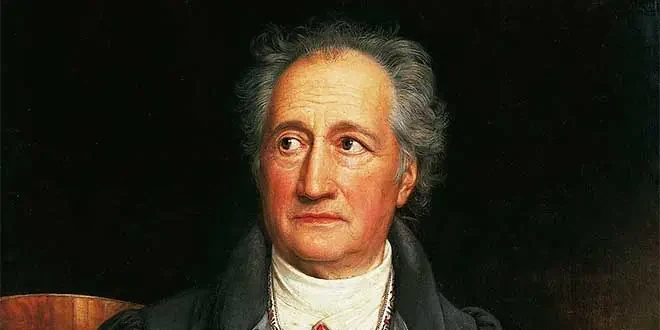
Goethe's IQ: the 210 that circulates and what the 1926 ratings show
ACIS has never assessed Johann Wolfgang von Goethe, holds no record belonging to him, and no retrospective assessment of anyone is possible. The 210 that lists attach to his name is not a figure we found in the 1926 volume they cite, which prints 185 and 200. This page traces each number, including a single judge's 225, and sets them beside what Goethe's own childhood account and his scientific work document.
Goethe lived from 1749 to 1832, and Catharine Cox's 1926 entry for him begins on page 693 of the second volume of Genetic Studies of Genius.
0 The short answer
Goethe has no documented IQ: no intelligence test ever measured him, and the 210 on lists is not a figure we found in the 1926 study those lists cite. That study, by Catharine Cox, prints two ratings of his recorded life, 185 for the years to age 17 and 200 for the years to 26, each with a data reliability of .82. One of her raters scored his youth at 225, and a formula she describes for correcting groups, applied to his 200 by our own arithmetic, gives about 208 to 209. What the record does document is an unusually thorough education, early writing in several languages and later scientific work, none of which reduces to a single number.
185 and 200
The two ratings printed for Goethe in 1926, for the record to age 17 and to age 26.
.82
The reliability Cox printed for the data behind both ratings, the highest in his group of three.
225
The score one rater gave his youth, which Cox reports as a single judge's impression.
No one did: Goethe died in 1832, decades before the first intelligence scale existed, so every figure attached to his name is a later estimate. Cox's volume gives his dates as 1749 to 1832. Lewis Terman's Stanford revision of the Binet tests, published in 1916, is the book Cox cites for the definition of the IQ she uses. A reader who sees "Goethe IQ 210" is therefore reading a retrospective number, and the useful question is which document produced it.
Four numbers circulate for him, and they have different standing. The table sets each against what we could open. Pages were read on October 6, 2026.
Figure
Where it appears
What it is
What is missing
185
Cox 1926, case heading and Table 38
Rating of the record to age 17, with a plus or minus of 4 and reliability .82
A test. It is an estimate from biography
200
Cox 1926, case heading and Table 38
Rating of the record to age 26, with a plus or minus of 4 and reliability .82
A test, and a statement of how the three raters differed
195
Cox 1926, page 153
A single rater's estimate for the first period, which she reports without naming the rater
Who gave it
225
Cox 1926, analysis chapter and page 163
The score one rater, coded M, gave "on the basis of the record of Goethe's youth"
The rater's reasoning, and any other rater agreeing
Listed as an estimate "Cox 1926" by the first page, and as the highest estimated IQ in her study by the second
A printed source for 210 in the pages of Cox we searched
The first two rows are what the 1926 volume prints under his name in Catharine Cox's volume. The fifth row is the figure that travels. Both pages that print it say, correctly, that it is a retrospective estimate and that it comes from Cox, and the IQ Metrics page adds that her scores rise with the amount of surviving childhood documentation and that his is the fullest in the study. That last observation is sound, and a later section shows where Cox herself makes it.
ACIS has not tested GoetheACIS has never assessed Goethe, holds no record belonging to him, and no retrospective assessment of anyone is possible. Nothing on this page is an estimate of his IQ, and no figure here should be read as one. Numbers come from named sources or are labeled as our own arithmetic.
The 210 deserves its own section, because it is the number most readers arrive with. Before that, the two numbers Cox actually printed need their context. The wider pattern, in which a famous name collects a figure that nobody can source, is the subject of the page on the highest IQ ever recorded and of the survey of celebrity IQ numbers.
2 What did Cox print for Goethe, AI 185 and AII 200?
Cox printed two ratings for Goethe, an AI of 185 and an AII of 200, each with a plus or minus of 4 and a data reliability of .82. The case heading reads "AI IQ 185, AII IQ 200", with the reliability repeated under the account of each period. Table 38 of her analysis chapter, titled the group of cases rated AI IQ 185, then lists Goethe beside Hugo Grotius and Gottfried Wilhelm Leibnitz, spelled as she printed it.
Case
AI IQ
Reliability of data
AII IQ
Reliability of data
Grotius
185 plus or minus 5
.75
190 plus or minus 5
.75
Goethe
185 plus or minus 4
.82
200 plus or minus 4
.82
Leibnitz
185 plus or minus 5
.75
190 plus or minus 5
.75
Average for 3 cases
185 plus or minus 5
.77
195 plus or minus 5
.77
Three readings of the table follow from what it prints. First, on the first period the three men tie at 185, and Goethe separates from the others only in the second period, where his 200 is ten points above each of theirs. Second, his data carry the highest reliability of the three, and Cox states the connection between records and ratings in her conclusions: the IQ rises with the reliability of the data. Third, she writes in the text beside the table that the three cases average 185 on the basis of the records, that a single estimate for Grotius is 190, that two for Leibnitz reach that figure, and that "one for Goethe reaches 195". No single rating for any of the three falls below 180.
The 200 is also the only rating at that level in her book. Her chapter on the second period lists one case at AII 200, with a reliability of .82, and none at AI 200. In the first period the single highest case is John Stuart Mill, whose three ratings average 190. So the claim that Goethe tops her table needs the second period to be true: he holds the highest AII rating, and Mill holds the highest AI rating. Cox also explains why Mill sits above Goethe at the first rating: she writes that Mill is rated above Voltaire and Goethe because the IQ estimated from incomplete records is not an adequate measure of spontaneity and intellect, and that Mill's AII of 170 shows his place among the more brilliant geniuses better than his AI does. Fifteen cases are rated above Mill on the second rating, and she names Goethe among them.
The plus or minus and the reliability are different quantities and should not be merged. The plus or minus is an error term Cox prints beside each rating. The reliability coefficient is, in her words, "a measure of the reliability, for estimating an IQ, of the data upon which the estimate is based". Her wording points to the biography, not to the rater. A coefficient of .82 says that the record for Goethe was judged a fairly sound basis for an IQ estimate, and it says nothing about whether the rating is close to what a test would have shown. The wider treatment of what a reliability number does and does not say is in the page on reliability and validity.
3 What kind of number is a Cox IQ?
A Cox IQ is a rater's judgment of how a documented childhood compares with the achievements of ordinary children, expressed on a scale that was meant to behave like a test score. The longer account of the method, with the three raters, the two periods and the reliability scale, is on the page about Mozart's three raters, and the same method gives the numbers on the pages about Napoleon and Isaac Newton. Here only the points that decide how to read Goethe's numbers are needed. Each rating is an average of three independent estimates, one set to the 17th birthday for the AI and one to the 26th for the AII, and every rating comes with a reliability coefficient for its records.
Two properties of the scale matter for a figure as high as 200. The first is its definition. Cox calls the IQ "the Intelligence Quotient or Mental ratio, the ratio of mental age to chronological age", and sends the reader to Terman's 1916 book, where a footnote defines the quotient in the same words. Read literally, a ratio of 210 would mean a mental age 2.1 times the chronological age: a child of 10 performing like an adult of 21. That is our arithmetic. Cox does not read it that way. She writes that she uses the IQ "without the limitation which, in testing practice, impairs its usefulness in the upper mental ages", as a constant measure of relative "brightness" compared with a large unselected group "in the same way that a sigma index would do".
The second property follows: the number is a relative standing. In a modern deviation score, a standing is read against a normal distribution with a stated standard deviation, which the page on standard deviation 15 explains. In the passages we read, Cox does not state a standard deviation for her scale. If a score of 210 were placed on a scale with a standard deviation of 15, it would lie 7.3 standard deviations above the mean, which is our arithmetic and a distance no norming sample could calibrate. The page on how IQ scores are normed explains why scores that far out cannot be anchored, and the rarity calculator shows how fast the proportion shrinks in that region.
Cox also warns against reading the numbers as measurements of change or of rank. In her discussion of the method she contrasts Mill and Milton, with ratings of 190 and 145 for the first period, and says this must not be read to mean that Mill's true score was 45 points higher. Each score, she writes, registers the average IQ rating of all individuals who do the things that are recorded of the subject at a particular age. A Goethe rating of 200 is that kind of statement: raters judged that people who wrote and studied as the record says he did between the ages of 17 and 26 would rate about 200 on a scale that cannot be checked at that level.
4 Where does the 210 come from?
We did not find 210 anywhere in the pages of Cox that discuss Goethe, so the number is a downstream figure whose route from her tables we cannot document. We searched the text of the second volume for his case entry, Table 38, the analysis chapter and the concluding chapter. The values printed for him are 185, 200, one rater's 195 and one rater's 225, plus a list of cases that Cox says probably rated at 200 or higher. The text we searched is an OCR of the scan, which is noisy, so this statement is about that text and not about every page of the book.
Two pages that print 210 were opened on October 6, 2026. The page at whats-your-iq.com lists 210 and labels it "Estimated (Cox 1926)", describing him as one of her top rated figures because his childhood is unusually well documented. The IQ Metrics page calls 210 the highest estimated IQ in the best known study, gives 185 as Cox's lower figure for him, and warns that the 210 travels as a measurement without the study attached. Neither page says which table or page of Cox holds the 210. The page on the highest IQ ever recorded on this site also mentions figures like 210 for Goethe in a paragraph on historical geniuses, and this page is the dedicated trace behind that sentence.
What can be said without guessing is a list of what 210 is not. It is not a test result, because no test existed. It is not the AI rating, which is 185. It is not the AII rating, which is 200. It is not the 225 of a single rater. It is not a group average, since the group averages in this region are the 185 and 195 of Table 38 and the corrected group figures of her method chapter, and none is 210. A route that does land near it exists, and the next section works it through, but the pages that print 210 do not say that they used it, so it remains an arithmetic coincidence and not a documented origin.
The other lesson is about rounding and copying. A rating of 200 for the older Goethe, plus the knowledge that Cox corrected her averages upward, invites the assumption that a corrected individual figure was published somewhere. Her tables are titled for groups, and no corrected value is printed for Goethe himself. That is the same situation the page on Mozart documents for his 165: a number that sounds precise, a source that holds a different and more qualified statement.
5 Does Cox's correction turn 200 into 210?
Her correction formula, applied to Goethe by our arithmetic, moves 200 to about 208 or 209, which is near 210 but is not a figure she printed and is not what she says the correction is for. Cox argued that her raters pulled uncertain records toward the average of 100, so that obtained ratings understate the true level. Her chapter on method sets out a formula for regressing a rating toward a chosen mean: the corrected IQ equals the obtained IQ plus the difference between that mean and 100, multiplied by one minus the reliability of the data. In her notation the correction is the obtained score plus D times (1 minus r). She credits the method to Dr. Kelley and presents it for groups, warning that even the corrected values are probably too low.
She also says what the correction is not meant to do. The corrected estimates, she writes, are not meant to furnish exact values for the score of an individual or even of a group, but to indicate the region of the scale in which the true scores are likely to lie. She applies the formula to named groups in Tables 20A and 20B, and she says that each individual score is corrected by regression to the mean of the professional group it belongs to. Those individual corrections are not printed in the pages we read.
The calculation below is ours. It applies her formula, as printed, to Goethe's two ratings and to the reliability of .82, using the means she prints for the whole of Group A and for the writers who were poets, novelists or dramatists, the closest fit to her heading for him as "One of the Greatest Poets of Any Age or Country". We did not find a place where she assigns him to that group, so the second row of each pair rests on our reading of her heading.
Rating
Mean regressed toward
D (mean minus 100)
D times (1 minus .82)
Result, rounded
AI 185
Group A AI mean, 135
35
6.3
191
AI 185
Writers (PND) AI mean, 141
41
7.4
192
AII 200
Group A AII mean, 145
45
8.1
208
AII 200
Writers (PND) AII mean, 149
49
8.8
209
Our arithmetic, labeledThe four results in the table are our calculation with Cox's printed formula and printed group means. Cox does not print a corrected rating for Goethe, and no author or page we read attributes 208, 209 or 210 to her formula. The table shows how far her own correction would move his ratings, nothing more.
Two conclusions follow. The first is that the formula does produce a number close to 210 when it starts from the second rating, which is a reason the 210 is plausible as a rounded or approximate figure for the AII corrected upward. The second is the reverse: the same formula starts from the first rating and gives 191 or 192. A reader who quotes 210 as "Cox's score for Goethe" is picking one of her two periods, applying a correction she did not publish for him, and dropping her statement that corrected values mark a region and not an individual score.
The logic of the correction also limits it. Her raters judged each record as if its subject belonged to an unselected group with a mean of 100. The correction moves the rating toward the means of groups that were chosen because their members became eminent. That is a reasonable way to estimate how much a thin record understates a true level, and it is also the reason the result cannot be treated as a measurement: it combines a rating of a biography with an assumption about the group the person belongs to.
6 Who gave Goethe 225, and what did Cox say about it?
The 225 is the score of one rater, coded M, who scored the record of Goethe's youth, and Cox reports it as an impression and not as a finding. In her discussion of the second period she writes that, on the basis of intelligence norms alone, the estimated rating is probably too low, and then adds that "one rater (M.) has scored on the basis of the record of Goethe's youth an IQ of 225". Her list of raters gives the codes T, M, KG, St and G, and the code M matches the initial of only one name in it, Maud A. Merrill of Stanford, so that is the likely identity, although the pages we read do not spell it out.
The two passages differ in what they say the 225 rests on: the first names the record of his youth, the second his later record, and we report both as Cox wrote them. Her analysis chapter repeats the figure with a qualification. Goethe's early development, his scholastic progress, his interests and his reading, she writes, warrant a rating for phenomenal ability, and his literary performance before the age of 8 "entitles him to a composition IQ rating far above 200". A rating of 225, she continues, "indicates the impression in terms of intelligence made upon one rater by Goethe's later record". The words matter. She describes the 225 as the effect of the later record on one reader, and a composition rating of "far above 200" as a statement about one kind of performance in childhood, not about general ability.
Her most quoted sentence about him is in the second passage: his true IQ "may in the history of mankind have been equalled in a few instances", and one may "well wonder whether it has ever been exceeded". That is a hedged literary judgment from an author who was also reporting an averaged 185 and 200. In her concluding chapter she lists fourteen names that "probably rated at 200 IQ or even higher", and Goethe is among them, with Grotius, Newton, Pascal, Michelangelo and others.
Three cautions apply to the 225. It has a single source, and Cox's method took the average of three independent raters as the rating, so the 225 is a component and not a result. The same code M gave the highest of the three scores for Mozart on the page on Mozart, a reminder that one rater can sit far from the others. And a 225 on a ratio scale applied to a poet's record cannot be checked by anything outside the biography. The rater's reasoning is not printed in what we read, which is why the table in the first section lists the missing information in its final column.
7 What do the Dichtung und Wahrheit childhood accounts document?
Goethe's own account of his childhood, Dichtung und Wahrheit, documents a boy taught by tutors, reading widely and learning languages early, and it is also a self portrait written afterward. The book is a main source behind Cox's pages on his early years. Her reference list includes "Goethe's Autobiography and Annals" in the Oxenford translation, together with biographies by Bielschowsky, Lewes, Duntzer and others. The German title pairs Dichtung, which can mean poetry or fiction, with Wahrheit, truth, so its details are evidence about what Goethe remembered and chose to tell, not an independent register. The English text read here is John Oxenford's translation, published as Truth and Fiction Relating to My Life.
Five episodes in the first four books can be checked against that translation.
The puppet theater. One Christmas evening his grandmother gave the children a puppet show, which Goethe says made a very strong impression on the boy. Cox dates the gift to his fourth year and says it stimulated his sense of drama, and the book later has the puppets brought out again and the performance staged in his own room.
The Lisbon earthquake. Goethe writes that the earthquake of November 1, 1755 "deeply disturbed the boy's peace of mind for the first time", and later says that in his sixth year the goodness of God had become to him in some measure suspicious. Cox also reports a remark by the six year old on the disaster, which this page did not check against the translation.
Italian by overhearing. His father taught his sister Italian in the room where the boy had to memorize Latin vocabulary, and having finished his own task he listened and "very readily caught the Italian". Cox gives age 8 for the same episode.
The altar. The boy kept to the first article of belief, sought God through nature and built an altar of natural specimens with a flame, an invention Cox dates to age 9.
The polyglot romance. To save effort on his language studies he invented a novel of six or seven brothers and sisters writing to each other, the eldest in good German, one in formal Latin with a Greek postscript, one in English, one in French, one in Italian and the youngest in Jew-German, which led him to the need to learn Hebrew.
None of the five is a test performance. Each is a behavior that a rater could compare with the typical age at which children do such things, and that is how Cox's raters used them. The Lisbon passage also shows why a score based on the autobiography cannot be separated from Goethe's own storytelling: it is a reflective adult describing what troubled the child.
8 What does the record of his schooling and youth add?
Cox's case entry documents a boy educated by about ten tutors under a broad plan, a student who wrote constantly, and a young man famous before 26, and she supplies ages for each step. The ages below are hers. The entry names Dichtung und Wahrheit among its references but also draws on biographies, so some details come from later authors, and her pages are not always consistent with one another, as the Leipzig dates show.
On schooling, she writes that from the age of 7 to 17 Goethe and his sister were trained by private tutors under a liberal plan, and that at least ten teachers took part, covering Latin, Greek, Hebrew, French, English, Italian, history, geography, religion, natural science, mathematics, composition, rhetoric, drawing, music, dancing, fencing and riding. His Latin training began at 7, and within a few months he was writing free compositions. One tutor arranged prize literary competitions in which he competed successfully with boys in the regular school. At 8, she writes, he translated exercises into Latin of the kind designed for the senior class of the Gymnasium, so that in his ninth year he was competing with boys of 16 to 22.
The entry is not uniformly flattering, and that is part of why it reads as a record and not as a legend. Grammar, which seemed to him a matter of arbitrary rules, he despised and learned with some difficulty. His penmanship, rated against other children in the town, stood on average ninth in a group of 30. A playmate two years older wrote that "we were all his lackeys". Cox also reports that, praised by his father's friends, he became self conscious and somewhat vain.
For the years from 17 to 26 her account runs as follows. At the University of Leipzig he was a recognized leader among his fellows. At 19 he suffered a serious illness, which she marks with a question mark as possibly pulmonary tuberculosis, and returned to Frankfort to recover. At 20 his first volume of poems was printed. From about 20 and a half to 22 he lived in Strasbourg, studied for his legal examination and, in his spare time, medicine, and met Herder, five years his senior, "the man who influenced him more than any other". Before he was 22 he prepared a dissertation for the doctorate, was advised to apply for the licentiate instead because the freedom with which he discussed a question of state policy was thought unseemly, and defended 65 theses. He began legal practice at 22, wrote Götz von Berlichingen before he was 23, and published Werther at 25. Before 26 he was world famous, and the friendship with the Duke of Saxe-Weimar began a career as a statesman that she says continued until his death 57 years later.
Her pages give the age of entry to Leipzig as 16 in one place and describe him as enrolled from his 17th to his 23rd year in another. The discrepancy is small, and it is worth stating because the rating rests on such ages. A rater who compares a boy's accomplishments with the age at which children ordinarily reach them is sensitive to a year in either direction, and the page on mental age covers the formula behind those comparisons and its modern limits.
Two details from the Dichtung und Wahrheit text add to this. In the sixth book Goethe describes the wish, on arriving at Leipzig, to test his early work, and the contempt for his own early labors that led him to burn "poetry and prose, plans, sketches, and projects" on the kitchen hearth. Cox lists a similar episode at about 16 and a second at 20. A rater reading about the burning receives a lesson that is easy to miss: the archive of a young author's early work is smaller than he produced, because he destroyed it. What survives is whatever escaped him, and what the biographers repeat.
9 What do the colour theory and the intermaxillary bone show about his science?
Goethe's scientific work is documented in his own texts and in historians' accounts, and both episodes show an observer who was partly right, partly contested and partly preceded. Neither episode is evidence of an IQ. Each is evidence about what he did, and the published record lets a reader check how it was received.
The colour theory is the better documented. It was first published in 1810, and the English translator, Charles Lock Eastlake, wrote in 1840 that the work consisted of two volumes and sixteen plates in three parts, a didactic, a controversial and a historical one, of which his translation gave the first. In the preface Goethe writes that the second part examines the Newtonian theory, "a theory which by its ascendancy and consideration has hitherto impeded a free inquiry into the phenomena of colours", and he later compares that theory to an old castle built in haste and then fortified. The tone is combative, and the translator saw it that way. Eastlake wrote that "much of the opposition Goethe met with was to be attributed to the manner as well as to the substance of his statements", and called him, in the translator's words, "it is believed, so mistaken an opponent of Newton", while crediting the observations and the account of colour harmony as useful. He also reports that Goethe admitted he was very imperfectly acquainted with mathematics. That is the translator's report of Goethe's own admission, not a measurement of any ability, but it limits any claim that his record shows strength in every domain. The Theory of Colours is available in that translation, and the page on Isaac Newton takes up the figure on the other side of the dispute.
The intermaxillary bone is a priority question. George A. Wells, in a 1967 article in the British Journal for the History of Science, states that Goethe believed that in 1784 he demonstrated the presence of the intermaxillary bone in man, and he sets that claim among earlier descriptions, naming Vicq d'Azyr, who wrote about traces of the bone in human fetuses between 1780 and 1786, and Camper, who denied the bone in humans in 1782. Wells questions how original Goethe's contribution was, and the summary we read described it as closer to a rediscovery supported by systematic comparison than to a first. We read the article through an automated summary of the PDF, so its exact wording should be checked in the published article before it is quoted.
What the two episodes support, together, is a narrower statement than a high IQ. They document a researcher who observed carefully, argued forcefully, and worked in fields where others had already made progress. Cox's raters did not see these episodes, because her rating covers the years to 26 and his colour work and his osteology came later. They are useful here as evidence of what the later record contains, which is the record that shaped the 225 of the single rater who scored "Goethe's later record".
10 How many languages did Goethe learn, and what does that say?
Goethe's record shows study of at least six languages besides German before he was 17, and that breadth reflects a tutored environment as much as any ability. From the sources already cited, Cox lists Latin, Greek, Hebrew, French, English and Italian among the subjects taught by his tutors, and her account has him writing "morning salutations" in German, Latin and Greek before he was 9, studying French with the French commandant quartered in his father's house between 9 and 12, and composing at 12 a story in the form of letters in Latin with a sprinkling of Greek, English, French, Italian, Yiddish and German. At about 16, she writes, he wrote verses in German, French, English and Italian. Dichtung und Wahrheit confirms the Italian overheard at his sister's lessons, the English added by his father's anxiety about his studies, and the Hebrew he asked to learn so as to understand Jew-German. Between 17 and 26, Cox adds, he translated Ossian and Pindar.
In the vocabulary of the CHC model, languages learned and used belong to comprehension-knowledge (Gc), the store of acquired knowledge and its use, which the page on fluid and crystallized intelligence distinguishes from reasoning with new material (Gf). Cox's raters scored many of these performances against children's norms for language and composition, which is why her text speaks of a "composition IQ". A rating built mostly on linguistic output is a rating of Gc-type evidence. It says little about working memory, speed, visual spatial ability or novel problem solving, because a biography rarely records them.
The distinction matters for Goethe because the record is lopsided. It is rich in languages, reading, composition and drama, and thinner on quantitative work, where, according to the translator, Goethe himself conceded limited acquaintance. A person with a high Gc and an average Gq would show an uneven profile on a modern battery, and that unevenness is ordinary. The page on what IQ measures explains how a single total can hide it, and the page on verbal IQ tests describes what a score on a verbal index covers. ACIS reports a verbal comprehension index with Antonyms, Vocabulary, Information, Synonyms and Similarities, and it is online and in English only.
The tutors also matter. Cox describes a plan "devised to develop wide interests and cultivated tastes", directed by a father who had arranged his own expectations for the boy, and a household with a collection of maps, specimens and engravings. A modern reader should ask how many children of the time received ten teachers, the commandant's household and a library, and how many would have done what he did with the same exposure. The record cannot answer either question, because it covers one child. The page on IQ and creativity takes up the related question of how much general ability explains in creative careers.
11 Why do the best documented lives get the highest ratings?
In Cox's own tables the rating and the reliability of the records rise together, so Goethe's 200 partly reflects how much of his life was written down. She states the pattern in her conclusions: there is a constant relation between the sufficiency of the account and the estimated IQ, with the IQ increasing with the reliability of the data. She draws the inference that the true IQs of her subjects are higher than the obtained estimates, and she says elsewhere that low ratings in such cases indicate only that raters regressed toward the mean because the information was indefinite, not because the evidence limited the rating.
The group tables show the pattern directly. The obtained average for her whole group of 301 was an AI of 135 with a reliability of .46. The group she labels the highest IQs averaged 175 with a reliability of .75, and the group of the lowest IQs averaged 113 with a reliability of .20. Goethe's .82 sits above all three, and the difference between his reliability and the group average is .36, which is our arithmetic.
Group in Cox's Table 20A
Obtained AI IQ
Reliability of data
Corrected AI IQ, as printed
Highest IQs
175
.75
185
Whole of Group A
135
.46
155
Lowest IQs
113
.20
140
Reading the table, a reader should resist two opposite conclusions. One is that the ratings are worthless because they track the records. The other is that the correction repairs the problem, since her correction still leaves 185 and 140 as the corrected values of the two extreme groups, and she says the corrected values are probably too low. What the table supports is a narrower statement: a rating built from a thin record carries little information about the person, and a rating built from a thick record carries more, but the thick record is also the one that was kept for a reason. People whose childhood was documented in volumes were plausibly people whose families, tutors and later biographers thought them remarkable.
Goethe is the extreme case of a documented life. She says in her description of method that for a few individuals, naming Goethe and Mill, including every statement about the first sixteen years would have required transcribing whole volumes, so she selected portions. The IQ Metrics page mentioned earlier makes the same point about the study, and Cox's own pages support it.
None of this makes historiometry empty. Dean Keith Simonton's 2009 review, "The Other IQ", in the Review of General Psychology, describes historiometric assessment as running parallel to psychometric research and reports that historiometric studies of the relation between broadly defined intelligence and adult achievement obtain about the same effect size as psychometric research, reported as rs or betas of .25 plus or minus .10. That is a result about groups. It supports the use of retrospective ratings in aggregate studies of eminence, and it does not make any single number reliable enough to rank Goethe against Newton. The pages on Napoleon, William Shakespeare and Srinivasa Ramanujan apply the same source first approach to other names, and the page on the history of IQ testing places Terman's 1916 work in the longer sequence from Binet to the modern batteries.
12 How should any retrospective IQ figure be read under the testing standards?
A figure like 210 should be read as a claim that needs the evidence the Standards for Educational and Psychological Testing (AERA, APA and NCME, 2014) require of any score interpretation, and the 1926 ratings meet only part of it. Standard 1.0 asks for a clear articulation of each intended score interpretation and for validity evidence supporting each one. Standard 1.4 adds that if a score is interpreted for a use that has not been validated, the user must justify the new interpretation, providing a rationale and collecting new evidence if necessary. Cox's AI and AII were built to describe documented precocity in her sample. Using the 200 as "Goethe's IQ" to rank him against living people, or against Einstein, is a new interpretation, and no one has supplied the evidence for it.
Standard 1.9 bears on the way her ratings were produced, since they rest on judges. It asks that the procedures for selecting experts and eliciting ratings be fully described, that the qualifications and experience of the judges be presented, that it be indicated whether they decided independently, and that the level of agreement be reported. Cox does well on several points: she names the raters, describes their prior experience with children, says that each rating is an average of three independent estimates, and reports a reliability coefficient for each set of records. For Goethe, the pages we read do not report how closely the three raters agreed, and the 195 and 225 she mentions show that they did not all agree. Standard 1.2 asks for a rationale for each interpretation with a summary of the evidence, and her method chapter serves as that rationale for the group results. It does not serve as one for individual ranking.
The American Psychological Association's 2020 Guidelines for Psychological Assessment and Evaluation point the same way. Guideline 6 asks psychologists to select tools with sufficient validity evidence for their uses and sufficient score reliability. Guideline 7 asks for multiple sources of relevant and reliable information, and its rationale states that individual performance on tests is only one piece of an assessment. Guideline 8 asks for attention to the appropriate normative comparison. A retrospective rating has no norm group in the ordinary sense, since the comparison was a rater's idea of what typical children do. Group statistics, finally, are never individual diagnoses, and nothing here is a statement about the reader.
What this means for you is practical. A number with a named test, a stated norm group, a percentile and a confidence interval is a different kind of object from a number with a biography behind it, and it should be read differently. ACIS is a self administered online assessment with 20 subtests in six CHC domains, reported as a Full Scale IQ and six indices on a scale with a mean of 100 and a standard deviation of 15, with percentiles and a 95 percent confidence interval. As read on October 6, 2026, the Quick form is 15 dollars with 6 subtests in 3 domains, the Optimized form is 30 dollars with 13 subtests in 5 domains and the Full Scale form is 50 dollars with all 20 subtests, each a one time payment, with a free trial that needs no card and a 5 day quality guarantee. It is not a clinical or diagnostic instrument, not for hiring, school accommodations or admission to high IQ societies, and available in English only. Documentation is in the technical manual, and the page on where to take an IQ test compares the options, including supervised ones.
Every figure above is traceable to one of the following, and each is linked at the point where it is used. Web pages were read on October 6, 2026. Figures marked as our arithmetic are calculations on published numbers and are not attributed to any author. The text of Cox's volume was read in an OCR transcription of the scan, which is noisy, and the scan itself was not viewed.
Cox C M. The Early Mental Traits of Three Hundred Geniuses. Genetic Studies of Genius, volume 2, edited by L M Terman, Stanford University Press, 1926. Pages used: case entry for Goethe from page 693, Table 38 and the surrounding text on page 153, pages 159 and 162 to 163, pages 81 to 84 with Tables 20A and 20B, and page 217, with the method chapters.
Terman L M. The Measurement of Intelligence. Houghton Mifflin, Boston, 1916. A footnote defines the intelligence quotient as the ratio of mental age to chronological age.
Goethe J W. Goethe's Theory of Colours (Zur Farbenlehre, 1810). Translated with notes by Charles Lock Eastlake, John Murray, London, 1840. Project Gutenberg ebook 50572. The translator's preface and Goethe's preface to the first edition were read.
Wells G A. Goethe and the intermaxillary bone. The British Journal for the History of Science, volume 3, issue 4, 1967, pages 348 to 361. The publisher PDF was read through an automated summary, so its wording should be checked before it is quoted.
American Educational Research Association, American Psychological Association and National Council on Measurement in Education. Standards for Educational and Psychological Testing. AERA, 2014. Standards 1.0, 1.2, 1.4 and 1.9 were read in the open access PDF.
Pages that print a figure for Goethe, read on October 6, 2026: whats-your-iq.com (210, labeled Cox 1926) and IQ Metrics (210 and 185, with a historiometric estimate of its own that this page does not use).
14 Frequently Asked Questions
What was Goethe's IQ?
Goethe has no measured IQ, because he died in 1832, long before intelligence tests existed. The figures attached to his name are retrospective estimates. The 1926 study by Catharine Cox printed 185 for his record to age 17 and 200 for his record to age 26, both estimates from biography.
Did Goethe ever take an IQ test?
No. Goethe lived from 1749 to 1832, and the Stanford revision of the Binet scale that Cox cites for the IQ was published in 1916. No examiner, date or score sheet exists for him, so any figure published under his name is an estimate made later from his recorded childhood and youth.
Was Goethe's IQ 210?
Not by any source we could open. Pages that print 210 name Cox's 1926 study, but her pages for him print 185, 200, a single rater's 195 and a single rater's 225. Applying her correction formula to his 200 gives about 208 to 209 by our arithmetic.
Was Goethe's IQ 225?
225 was the score one rater, coded M, gave to the record of his youth, according to Cox. She reports it as an impression, not a result, and her method averaged three raters. His printed ratings are 185 and 200, so 225 is a single component, not his rating.
Was Goethe a genius?
By achievement, the record supports the word: Cox's raters scored his childhood far above average, he wrote and studied intensively as a young man, and he was famous before 26. Genius is a judgment about achievement and influence, though, not an IQ band, and no test result is needed or available to make it.
How smart was Goethe?
The documents show exceptional education and output: ten tutors, several languages before 17, a published volume of poems at 20, and later scientific work. How that compares with a modern score cannot be said. The record covers one boy in one household, and it does not isolate ability from opportunity.
Is Goethe's IQ the highest in history?
Only in one sense: Cox's table gives him the highest second period rating, an AII of 200, and John Stuart Mill the highest first period rating, an AI of 190. Those are ratings of documented lives in one 1926 study, not a ranking of measured intelligence across history.
Who calculated Goethe's IQ?
Catharine Cox, in volume 2 of Genetic Studies of Genius, published by Stanford University Press in 1926. Three raters estimated his IQ from his documented life, and she averaged their estimates. Terman, Merrill and Goodenough are among the raters she names, though the page we read codes the 225 only as M.
What do AI and AII mean in Cox's ratings?
AI is the average of three raters' estimates of intelligence as shown by the record to the 17th birthday, and AII is the same for the record to the 26th birthday. AII usually runs higher, because the later record adds more information. Both express a rating as a quotient, a relative standing.
What does the reliability of .82 mean for Goethe?
It is Cox's coefficient for how reliable the records were as a basis for estimating an IQ, not a statement about how close the rating is to a true test score. Goethe's .82 was the highest of the three men in Table 38, whose records scored .75 each.
What does the plus or minus 4 beside Goethe's ratings mean?
Cox prints a plus or minus figure beside each rating as an error term, 4 for Goethe and 5 for Grotius and Leibnitz. The pages we read do not define it beyond that, so it should not be converted into a modern confidence interval or compared with one.
Why is Goethe's second rating higher than his first?
The second rating covers the record to age 26 and so uses more information than the first, which stops at 17. Cox says the AII ratings often approach the true IQ more closely than the AI, because raters regress toward the mean when evidence is thin. Goethe went from 185 to 200.
What did Goethe do as a child?
According to Cox and Goethe's own account, he studied under private tutors from 7, wrote Latin exercises early, overheard Italian lessons, built an altar of natural specimens, staged puppet plays, and invented a novel of letters in several languages. These are documented behaviors from biography and autobiography, not test performances.
What is Dichtung und Wahrheit?
It is Goethe's autobiography, whose title pairs poetry or fiction with truth. It is the main source for his childhood, and Oxenford's English translation is published as Truth and Fiction Relating to My Life. Because he wrote it as an adult, it reflects what he remembered and chose to tell.
Can you estimate someone's IQ from a biography?
Only roughly, and only as a relative statement about documented behavior. Cox's method rates what was recorded against typical development, so thin records give low ratings and thick ones give high ratings. Group studies of such ratings show modest links with achievement, but a single person's number is not a test result.
Why do well documented people get higher estimated IQs?
Because raters can only credit what is written down. Cox found the estimated IQ rose with the reliability of the data, and Goethe's record was among the fullest. A person with an extraordinary mind and a sparse record would score lower, so the number mixes ability with documentation.
How many languages did Goethe know?
Cox's account lists Latin, Greek, Hebrew, French, English and Italian among the subjects taught by his tutors, in addition to German, with Yiddish in a story he wrote at 12. That is what the record documents as studied. It does not establish fluency in each, and it is not a test score.
Does high verbal ability mean a high IQ?
Not by itself. Verbal and language performance mainly reflects comprehension-knowledge, one broad ability in the CHC model, and a full IQ combines several. A person can be exceptional in language and ordinary in other areas, so a record dominated by writing cannot support a single total.
Can an online test give an IQ of 210?
No test with a normed sample supports a figure that far from the mean, because almost no one in any sample scores there. A reported score that high is an extrapolation with wide uncertainty. A responsible report gives a percentile and a confidence interval, which a retrospective number does not have.
How can I measure my own IQ?
Take a standardized test that reports a score, a percentile and a confidence interval, and read the limits. ACIS is online and unsupervised, offers a free trial with no card, and is not a clinical instrument or suitable for hiring or admission to high IQ societies.
Should I compare my score with Goethe's?
No. His figures are estimates of a documented childhood, built on a different scale and a different kind of evidence, so they cannot be placed beside a score from a test. Compare yourself with the norm group a test reports, and treat the confidence interval as part of the result.
Take the assessment
You get a profile, not a number
ACIS measures six CHC domains across 20 subtests and reports each one with its own normed score and confidence interval, so you can see where you are strong and where you are not.