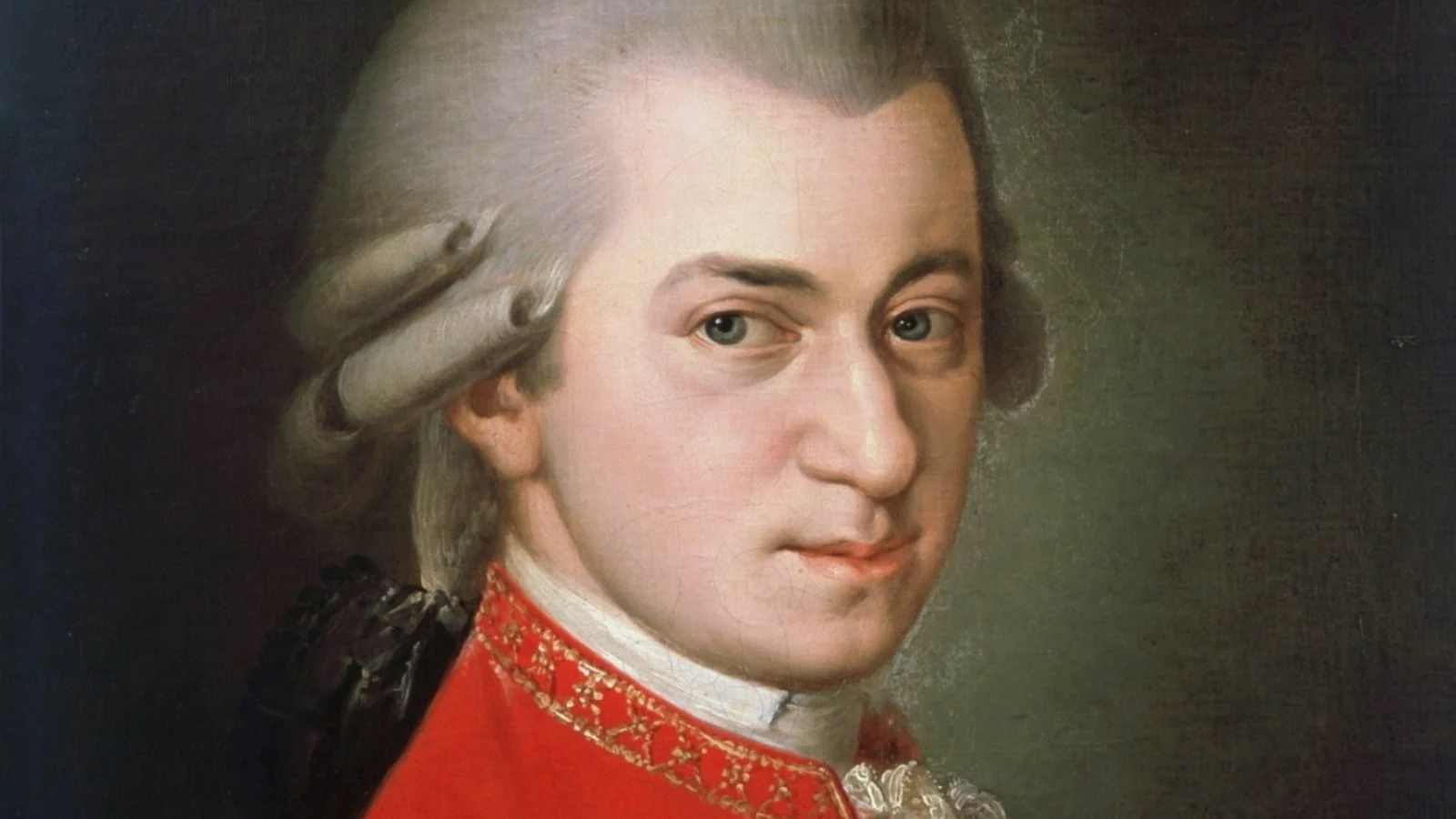
Mozart's IQ: the 150 that circulates and what the childhood record shows
ACIS has never assessed Mozart, holds no record belonging to him, and no retrospective assessment of anyone is possible. The figures of 150, 155 and 165 attached to his name come from a 1926 study of biographical records and from pages that name no source. This page separates them from what the documents hold: Daines Barrington's 1770 report on the boy, Leopold Mozart's letters and his sister's 1792 notes.
Mozart was born in Salzburg on January 27, 1756, according to notes his sister Maria Anna prepared around April 1792 for the biographer Friedrich Schlichtegroll.
0 The short answer
Mozart has no documented IQ: no intelligence test ever measured him, and the figures of 150 and 155 are retrospective ratings that Catharine Cox printed in 1926. Three raters, Terman, Merrill and Cox herself, scored his recorded childhood at 125, 190 and 140, and her table prints the average as 150, with 155 for the years from 17 to 26 and a reliability of .75 for the data behind each. The 165 that some pages print has no source that can be checked. What the record does document, in Barrington's 1770 report and in letters, is exceptional musical performance and memory, which no single IQ number summarizes.
150 and 155
The two ratings printed for Mozart in 1926, for the record to age 17 and for ages 17 to 26.
125 to 190
The spread among the three raters who scored his childhood record, before Cox averaged them.
1770
The year Barrington's report on the boy Mozart appeared in the Philosophical Transactions.
1 Where do the figures 150, 155 and 165 come from?
Every figure for Mozart traces either to one 1926 book or to a page that names no source at all, and none traces to a test. The pages below were read on October 6, 2026. They agree on one point: the pages that give a source name the same book, Catharine Cox's volume on the early mental traits of three hundred geniuses, and the pages that give no source give the largest numbers.
The page text read printed no figure and warned that most celebrity numbers are not authenticated test results
Two things follow from the table. The first is that 150 and 155 are not two competing claims. They are the two numbers Cox printed for the same man, one for each of two life periods, and pages that quote one or the other, or the range, are quoting her. The second is that 165 is the figure that cannot be traced. One page ties it to Cox, and her case entry for Mozart does not print it. Another prints it with nothing behind it.
One 155 to 165 range does appear in Cox's chapter on the IQ estimate, on page 49, and it describes something else. She writes that correcting for the incompleteness of the records gives a true average for the whole group of 301 subjects at a point not lower than 155 to 165. That is a group average, not a rating of Mozart. This review does not claim it is the origin of the 165 for Mozart, and it did not find an earlier source. It notes only that a reader skimming her chapter could meet those numbers and attach them to a famous name.
The 152 on check-iq.org also deserves a plain remark. The mean of the three raters' scores that Cox prints for Mozart's childhood is 151.7, which is our arithmetic, and the page does not say how it reached 152. The coincidence is not evidence of where the figure came from. The general lesson of the table is the one the audit of the highest IQ claims and the guide to celebrity IQ numbers apply to every name: a number that circulates is a claim about a source, and the source has to be opened.
ACIS has not tested MozartACIS has never assessed Mozart, holds no record belonging to him, and no retrospective assessment of anyone is possible. Nothing on this page is an estimate of his IQ, and no figure here should be read as one. Numbers come from named sources or are labeled as our own arithmetic.
2 What did Catharine Cox print for Mozart, exactly?
Cox printed two ratings for Mozart, an AI of 150 and an AII of 155, each with a plus or minus of 5 and a reliability coefficient of .75 for the data. Her volume is The Early Mental Traits of Three Hundred Geniuses, the second volume of Genetic Studies of Genius, edited by Lewis Terman and published by Stanford University Press in 1926. Mozart's case study runs from page 592 to page 594, and the heading reads "AI IQ 150, AII IQ 155." Her Table 31, which groups the cases rated 150 for the first period, prints his row as 150 ±5 with .75, then 155 ±5 with .75.
AI and AII, sometimes typed A1 and A2, are the two periods Cox rated. She defines the AI IQ as an average of three independent estimates of a person's intelligence as reported to the 17th birthday, and the AII IQ as the same for the record to the 26th birthday. Each rating is accompanied by a reliability coefficient, which she describes as a measure of the reliability, for estimating an IQ, of the data on which the estimate rests. The coefficient belongs to the paper record. It is not the reliability of a test that Mozart took.
The plus or minus figure also has a defined origin. In her chapter on the treatment of the IQ, Cox says she devised a method for computing the reliability coefficients of the data and the probable errors of the IQ estimates from the reliability grades the raters assigned. So the printed 150 ±5 is a rating and a probable error computed from the quality of the record, which is a different object from a score and a confidence interval on an administered test.
The two numbers should not be read as growth. Cox warns about exactly this in the same chapter. Discussing two other subjects whose two ratings differ by large amounts, she writes that the differences should not be read as changes in true IQ, and that each score registers the average rating of all individuals who do the things recorded of the subject at a particular age. For Mozart, 150 and 155 are two ratings of two stretches of the record, and the five points between them say little.
Cox used the word IQ in a particular way, and the way matters for the figure. She calls it the ratio of mental age to chronological age and credits the ratio to Terman's 1916 volume, The Measurement of Intelligence, where a footnote defines the intelligence quotient in just those words. Her own use departs from that practice. She says the IQ is thought of as a constant measure expressing the relative degree of brightness of an individual compared with a large unselected group, in the way a sigma index would. In effect, a rating of 150 means that the recorded behavior resembles that of the group who would score 150 on the Stanford-Binet, which makes it a statement about relative standing. Nobody divided a mental age by Mozart's actual age. The guide to mental age explains why that ratio fails at the top of the range, and the history of IQ testing places Terman's volume in sequence.
The method that produced these ratings is the same one that produced the figures on the pages for Napoleon and Isaac Newton, and this page does not re-explain it. What is specific to Mozart is the record the raters had in front of them and the way the three of them read it.
3 Why did Terman, Merrill and Cox rate the young Mozart at 125, 190 and 140?
The three raters disagreed by 65 points on the same record because that record shows extraordinary musical performance and little else, and Cox said as much. In her analysis of the ratings she names the three scores for the childhood period, writing T 125, M 190 and C 140. In her scheme the letters stand for the raters who scored all 301 cases: Dr. Lewis M. Terman of Stanford University, Dr. Maud A. Merrill, also of Stanford, and the writer herself. All of her raters, she says, had examined many children of every degree of intelligence and were thoroughly familiar with mental age standards.
Rater
Who, as Cox names them
Rating for the record to age 17
Distance from the printed 150 (our arithmetic)
T
Lewis M. Terman, Professor of Psychology, Stanford University
125
25 below
C
Catharine Cox, the author of the volume
140
10 below
M
Maud A. Merrill, Assistant Professor of Psychology, Stanford University
190
40 above
The passage that discusses these ratings is short, and it is candid. Cox writes that they emphasize the difficulty of estimating the intelligence of a musical prodigy. She then walks through what the record offers. The family standing of the Mozarts, in her scheme, entitles him to a guessed IQ of 115 to 120. His reported interests are almost wholly musical, which she says would not alter the IQ without additional evidence of their intensity or intellectual quality. At age 10 he constructed an imaginary kingdom, and she calls that no more than corroborative of the figure already established. His skill at cards and in fencing adds nothing diagnostic. His general education, reading and correspondence show, in her words, no striking capacity. She concludes that his ability and mental development are disclosed only in his musical performance and achievement.
That list explains the spread better than any hidden disagreement could. Strip away the music, and the record points to a boy of good family and ordinary schooling, which is the reading that would support a low rating. Add the music, and the record points to one of the most precocious performers in the sample. A rater who weights the music heavily lands near 190, and a rater who treats it as a narrow gift lands near 125. The passage does not assign reasons to individual raters, and this page does not guess at them. The printed ratings are all that survives.
The disagreement has a measurement lesson that does not depend on Mozart. In her trial with forty abbreviated test records, Cox reports that the raters agreed closely: the correlations among their reliability grades were .86, .87 and .92. When the evidence resembles a test record, trained judges converge. When the evidence is a biography of a prodigy, they do not. The agreement among raters is therefore a property of the material as much as of the judges, which is why modern guidance on rater-based evidence asks for the procedures and the level of agreement to be reported alongside the rating. The final section returns to that guidance.
Cox then states her own conclusion, and it is more qualified than the circulating number. In the analysis she writes that an IQ of 150 is probably not too high for a youth who combines superior general ability and sustained effort with remarkable, though auditory, memory, and with the ability to analyze, synthesize and create harmony. That is a statement about the way she defined her scale. It is not a measurement, and it is not an upper bound.
4 How reliable was the record behind the 150 and the 155?
The .75 beside each of Mozart's ratings describes how complete and diagnostic the paper record was, it was higher for him than for most of the 282 subjects, and it is not the reliability of a test. Cox asked her raters to grade each case on a seven-point scale for the adequacy of its data as a basis for rating an IQ, from grade 1, evidence equal to a Stanford-Binet test, to grade 7, a guess based on no data. She then translated the grades into coefficients through a trial on forty Stanford-Binet blanks scored with parts missing. In her Table 18 a coefficient of .75 corresponds to grade 4 and to a Stanford-Binet given with two tests for each year group, and .90 is the value for a complete one.
Two features of that scale are worth keeping in view. The first is that the top of her scale, a complete Stanford-Binet, carries a coefficient of .90, while a footnote remarks that recent studies put the reliability of that test at .95 or better. Her scale therefore tops out below the reliability she herself attributes to the test, and even a perfect record would not have reached it. The second is that Mozart's .75 is far above the average for her group. For the 282 subjects in her Group A she reports a mean AI of 134.9 with a standard deviation of 19.0 and an average data reliability of .46, and a mean AII of 144.7 with a standard deviation of 18.6 and an average reliability of .53. Mozart is among the 13 youths she lists as rated on data of .75.
Cox also reports a pattern that bears directly on how to read any single figure. She found, to her own surprise, that the more reliable the data, the higher the IQ estimate, and she reads it as the signature of incomplete records pulling ratings toward the mean of 100. For her group of 24 subjects with an AI of 150, the records average .68 in reliability, and 14 of them, or 58 percent, have coefficients of .75 or above. Mozart's rating comes from a well documented childhood, and in her scheme a well documented childhood is where the estimate stays closest to what the facts support.
Our arithmetic, labeledAgainst Cox's own sample, Mozart's AI of 150 sits 0.8 standard deviations above her group mean of 134.9, and his AII of 155 sits 0.55 standard deviations above 144.7, both computed with her printed standard deviations of 19.0 and 18.6. If the figure 150 were read on a scale with a mean of 100 and a standard deviation of 15, it would lie 3.33 standard deviations above the mean, roughly 1 in 2,300 people, but Cox does not state that scale for her ratings, so the reading is an illustration and not a result. The calculator for score rarity and the page on the 15 point standard deviation show how that conversion works.
What the coefficient does not do is turn the rating into a test score. The .75 says how much to trust the paper record as a basis for a rating. It says nothing about whether Mozart, examined with a modern battery, would have produced a Full Scale IQ near 150. The guide to reliability and validity explains why these are separate questions, and the page on what IQ scores mean shows what a score from a defined test and norm group does tell you.
5 How do Mozart's ratings compare with other composers in Cox's volume?
Among eight composers whose case studies were read for this page, the AI ratings run from 110 to 150 and rise with the reliability of the data, so a rating partly records how much was written down about a childhood. The table lists them with the ratings and coefficients printed in each case study.
Composer, with life dates as Cox prints them
AI rating
Reliability, AI
AII rating
Reliability, AII
Gluck (1714 to 1787)
110
.20
115
.20
Haydn (1732 to 1809)
120
.43
140
.53
Rossini (1792 to 1868)
120
.43
130
.60
Bach (1685 to 1750)
125
.43
140
.43
Beethoven (1770 to 1827)
135
.43
140
.43
Handel (1685 to 1759)
145
.53
155
.60
Mendelssohn (1809 to 1847)
150
.60
155
.75
Mozart (1756 to 1791)
150
.75
155
.75
Read the table for what it is. The ordering of the AI ratings follows the ordering of the reliabilities almost exactly, from Gluck at .20 to Mozart at .75. That is what Cox's own finding predicts. A composer whose childhood was documented in detail, with concerts, tours and compositions recorded by a watchful father, offers a rater more diagnostic items than a composer whose early years left a few lines. The table does not show that Mozart was more intelligent than Haydn or Bach. It shows that a rater had more to work with for the boy who was exhibited across Europe.
The comparison also carries a warning about the number as a ranking. Cox's composers were selected for eminence, were rated from biographies and published letters, and were scored by three people who had to decide how much a musical performance says about general ability. Mendelssohn, rated 150 and 155 on lower reliabilities, shares Mozart's ratings, and Handel sits at 145 and 155. Differences of five points in this table are inside the printed plus or minus and say nothing about who was cleverer. For how the same volume treats other eminent names, the pages on Newton and Napoleon apply the same reading, and the broader discussion of genius and IQ shows where the common 140 threshold came from.
6 What does Daines Barrington's 1770 report on the boy Mozart document?
Barrington's report is the one outside examination of the child Mozart that was written down by a stranger and published in a learned journal, and it documents performances, not an intelligence. The text is Account of a very remarkable young musician, a letter from the Honourable Daines Barrington, a fellow of the Royal Society, to the society's secretary Mathew Maty. It appeared in volume 60 of the Philosophical Transactions, pages 54 to 64, and the transcription read for this page gives the reading date as February 15, 1770. Cox calls the author a London lawyer and says his investigation established the truth of the reports of the boy's achievements.
What did Barrington actually do? He did not give a battery of tasks. He met the child, set him problems of the kind a musician would recognize, and reported the results. He brought a manuscript duet that the boy could not have seen, and the boy played the opening symphony, sang, and supplied the violin parts where they were needed. He asked for an improvised love song of the kind an opera singer might choose, and the child produced a few lines of recitative in nonsense words and played a fitting symphony. He then asked for a song of rage, and the child used the word "Perfido" and, in Barrington's description, beat the harpsichord like a person possessed. Barrington also repeats what musicians told him: that when a famous composer began a fugue and broke off, the boy took it up and carried it forward in a masterly way. That last item is reported at second hand, and a reader should weigh it as such.
Two details in the account matter for a page about intelligence. The first is the age. Barrington says he was a witness to what he describes in June 1765, when the boy was only eight years and five months old. He also says he doubted the age and obtained a confirmation from Salzburg, dated January 3, 1769. The two figures do not fit together. Nannerl's 1792 notes, which the next section uses, give the birth date as January 27, 1756, and from January 1756 to June 1765 is more than nine years, which is the age Cox gives when she summarizes the investigation. The mismatch is small, it is Barrington's own, and this page does not try to settle it. It shows how much care a retrospective rating has to take even with a primary source.
The second detail is the childhood in the record. Barrington notes that a favorite cat came in while the boy was playing and he immediately left his harpsichord, and that he would also run around the room with a stick between his legs by way of a horse. A reader who wants a developmental picture gets one. This was a child with a prodigious musical ability and an ordinary child's interests, which is a more useful observation than any adjective.
What the report cannot supply is what an IQ requires. There is no standard procedure, no comparison group of other eight year olds given the same tasks, no scoring rule and no second examiner. The tasks were musical, and they depended on the instrument, the room and the boy's mood. Barrington was documenting a wonder for a scientific society, and he did it well. The question of how a child's performance relates to a mental age belongs to a later invention, described in the history of IQ testing. In 1765 there was no scale on which the boy could have been placed.
7 What do Leopold Mozart's letters and Nannerl's notes add?
Leopold's letters are contemporary, and they are also the letters of the man who managed his son's career. In the Paris letter of 1764 he worries about the smallpox inoculation that people kept urging on him, and he writes that everything depends on divine grace, whether God will keep this wonder of Nature in the world or take him to himself. The phrase shows a father's wonder and a promoter's stake at once, and a historian has to hold both. It does not describe an ability in measurable terms.
The Rome letter is the first-hand record of the Miserere. Leopold writes that the famous piece is so highly regarded that the chapel musicians are forbidden, under pain of excommunication, to take any of the parts out of the chapel, and he adds that the family already has it: Wolfgang has already written it down. He also says that they went to the Sistine Chapel on the Wednesday and the Thursday to hear the Miserere. In the same letter a postscript in the boy's own hand calls himself a clown. The editors of the edition add a note that the work had in fact already circulated in manuscript copies, and that Charles Burney first published it in 1771.
Maria Anna's notes, written in 1792 at the request of a biographer, tell the same episode with more steps. She says the family went to the Sistine Chapel on Wednesday afternoon, that the son resolved to listen carefully and then write it down, and that he did so when he came home. The next day he went back and kept his notation in his hat to check whether he had it right. On Good Friday the same piece was performed, and afterward he made an improvement here and there, and then it was finished. She adds that he sang it with the keyboard at a concert in Rome.
Set beside Cox, the three texts sharpen the story. Cox's analysis calls the transcription a feat achieved after a single hearing. The letter and the notes describe a first draft after the Wednesday service, a check at the next service, and a revision after the Good Friday performance. That is still a remarkable act of auditory memory for a boy of 14, and it is still what a musician would call extraordinary. It is a more precise account than the legend, and a page about evidence should prefer it. The same notes carry an observation that cuts against the idea of music as his only strength. Maria Anna writes that as a child he already had a desire to learn everything and that he showed great aptitude for whatever he had seen in drawing and in counting, but that he was too busy with music to show his talents in any other subject. She also reports that he noticed the smallest wrong note in music with the largest ensembles and could say which instrument had made it.
Every one of these sources has a limit. The notes were written 22 years after the Rome visit, by a sister who loved him, for a biographer collecting anecdotes. Leopold had every reason to present his son at his best. Barrington is the only outside witness among the three. The honest conclusion is the one a historian would reach: the documents agree on a boy of exceptional hearing, memory and speed in music, and they do not allow a number for general ability.
8 What did the record of his childhood look like, year by year?
The documented childhood is a sequence of early starts and public performances that began at three or four, and every row in it describes music. The table sets out the dated items found in the sources read for this page.
Date or age
What the source records
Source
January 27, 1756
Born in Salzburg
Maria Anna Mozart's 1792 notes
Age 3 to 4
Searched out thirds at the keyboard and copied them with his voice, while his father taught his seven year old sister
Maria Anna's notes
Age 4
His father began teaching him minuets and pieces as a game, and he learned a piece in an hour and a minuet in half an hour
Maria Anna's notes
Age 5
Already composing little pieces, which he played to his father, who wrote them down
Maria Anna's notes
Sixth year
A first journey, to Munich, where both children played before the Elector
Maria Anna's notes
September 18, 1762 to January 1763
Journey to Vienna, with a performance at the Imperial court
Maria Anna's notes
February 22, 1764
Leopold calls him a wonder of Nature in a letter from Paris
Leopold's letter to Hagenauer
April 22, 1764
The family arrives in London after leaving for England on April 10
Maria Anna's notes
June 1765
The examination Barrington describes, with the age given as eight years and five months
Barrington, 1770
July 24, 1765
The family leaves London
Maria Anna's notes
April 1770
Writes down the Miserere in Rome, at 14
Leopold's letter and Maria Anna's notes
Cox's case study draws on the nineteenth century biographies and the published letters rather than on these digital editions, and it adds items the table leaves out, such as absolute pitch discovered at seven and works published by seven. Her verdict on the correspondence is blunt. She writes that Mozart's letters show the characteristics of an average pre-college student, and on page 797 she prints, as a specimen, a letter written at 14 to his sister, a playful note that mentions in passing an air from Metastasio's Demetrio that he had just composed. The raters therefore read a record in which the extraordinary material is musical and the ordinary material is everything else. The disagreement among the three judges follows from that division, and no revision of the arithmetic can remove it.
9 Is exceptional musical talent the same as general intelligence?
Musical talent and general intelligence overlap, but a musical prodigy is evidence of a specific cluster of abilities, and a single IQ figure cannot be read back from it. The CHC model that ACIS uses lists auditory processing (Ga) as its own broad ability, described on the CHC model page as perceiving, analyzing and synthesizing patterns among auditory stimuli and as important for language acquisition and music. The six ACIS indices cover verbal comprehension, fluid reasoning, quantitative reasoning, visual spatial ability, working memory and processing speed. None of them is a measure of musical aptitude, so a profile from this or any general battery would leave much of what made Mozart exceptional unmeasured.
What do studies of living prodigies say? Ruthsatz and Urbach examined eight child prodigies with their developmental histories and the Stanford-Binet Fifth Edition. They report that the prodigies' full scale IQ scores were moderately elevated and not consistently at the extreme end, and that every one of the eight tested in the 99th percentile for working memory. That is a group finding about eight children, published in Intelligence in 2012. It does not tell us Mozart's working memory, and this page does not infer it. It does show why the common assumption fails that a musical prodigy must have the highest possible overall IQ: in that small sample the consistent signal was one specific ability, not the composite.
Cox points the same way in her own language. She calls Mozart's repertoire that of an auditory eidetiker and, in a footnote, defines the term as someone whose imagery in whatever modality is peculiarly vivid, with persistence and completeness approaching an after-image. She adds that his memory was remarkable, though auditory. The guides to photographic memory, to IQ and memory and to the working memory test explain what the evidence supports about exceptional memory and why it is not one thing. The page on savant syndrome covers a different pattern, in which a narrow skill coexists with a different cognitive profile, and nothing in Mozart's record places him there.
Does music make people smarter, which would make a musical childhood a cause of high scores? The strongest design in this literature is a randomized trial. Schellenberg assigned 144 children to keyboard lessons, voice lessons, drama lessons or no lessons, and measured IQ before and after. The music groups showed greater increases in full scale IQ than the control groups, and the author describes the effect as relatively small. A small average gain in children after lessons does not make Mozart's childhood training an explanation of a score, and it does not run the other way either. The page on IQ and musical ability covers the training and aptitude literature in full, and the page on IQ and creativity takes up the related question of composition.
10 Does the Mozart effect say anything about Mozart's own intelligence?
The Mozart effect concerns what a sonata did to other people's scores on a spatial task, so it says nothing about Mozart's own ability, and its replication record is weak. This is the only section of the page devoted to it, because the effect has its own page.
The original report is Rauscher, Shaw and Ky in Nature in 1993. A later paper describes it as showing that 36 undergraduates raised their mean spatial reasoning scores by the equivalent of 8 to 9 IQ points on portions of the Stanford-Binet after listening to 10 minutes of Mozart's Sonata for Two Pianos in D major, K. 448, and that the effect disappeared within 10 to 15 minutes. That later paper is Steele, Bass and Crook, 1999, which followed the original laboratory's own list of procedural requirements and failed to produce either a statistically significant effect or an effect size suggesting practical significance. A meta-analysis by Pietschnig, Voracek and Formann in 2010 covered about 40 independent studies and more than 3,000 participants, as summarized by ScienceDaily, which reports that there is no support for gains in spatial ability specifically due to listening to Mozart.
None of that bears on the composer. The effect is a claim about listeners and a 10 minute window, and it uses his music as a stimulus. It does not make the man a measured quantity. The page on whether you can improve your IQ takes up the practical question, and the one on IQ and musical ability has the fuller account of the finding and its reception.
11 Why can no one assign Mozart an IQ today?
An IQ needs an instrument, an administration and a norm group, and none of the three exists for a man who died in 1791, so every number attached to him is an opinion about a record. The pieces that make a score interpretable are set out in the page on how IQ scores are normed: a defined test, a standard procedure and a reference population for the person's age. Mozart lived and died, by Cox's dates, between 1756 and 1791, and the intelligence quotient he is asked to fit is the one set out in Terman's volume of 1916. Nothing in the Barrington report, the letters or the notes was produced under standard conditions or scored against a comparison group.
The record also changes the question. The documents are rich on exactly the abilities that a general intelligence battery would not sample, namely hearing, musical memory, improvisation and composition, and thin on the abilities such a battery does sample. We do not know how he would have done on fluid reasoning, vocabulary or arithmetic tasks, because nobody recorded him doing anything comparable. Maria Anna's remark that he showed aptitude for drawing and counting is a sentence, and a sentence is not a score. The page on aptitude versus intelligence explains why a talent in one domain does not map onto a composite.
What can be said without overreaching? Mozart is one of the best documented child performers in history, and three independent kinds of record, an outside examiner, a father's letters and a sister's later notes, agree on exceptional musical hearing, memory and speed. Cox's ratings of 150 and 155 are the 1926 judgments of three trained raters who disagreed widely, and they are accurate as a description of that study and not as a description of a man. Anyone who states Mozart's IQ as a fact, including the pages in the first table, has gone past the record. The reasons the same problem recurs across the whole genre appear in the review of highest IQ claims.
A score is only as meaningful as the instrument, the norm group and the documentation behind it, and the standards for testing say the same about every score, including yours. The Standards for Educational and Psychological Testing, published by AERA, APA and NCME in 2014, ask for a clear statement of each intended interpretation of a test score and for validity evidence to support it (Standard 1.0). When a judgment rests on expert raters, they ask that the procedures for selecting the experts and eliciting their ratings be fully described, that it be reported whether the raters decided independently, and that the level of agreement be given (Standard 1.9). They also ask that test users be given clear explanations of what scale scores mean and what their limits are (Standard 5.1). Cox's study met some of these in her own way, with named raters and a stated procedure. It could not meet the others, because the object being rated was a paper record.
The American Psychological Association's Guidelines for Psychological Assessment and Evaluation, approved in March 2020, point the same way. Guideline 6 asks psychologists to select tools with sufficient validity evidence and score reliability. Guideline 7 asks for multiple sources of relevant and reliable information, and Guideline 8 asks for the appropriate normative comparison and standardized administration. A rating built from a family's social standing, a boy's concerts and a handful of letters could not satisfy any of those tests, and Cox acknowledges as much when she calls her scores estimates of paper records only.
What follows for a reader who wants a score of their own? Take a standardized instrument with a defined norm group, and read the number with its interval and its percentile rather than as a rank among the famous. ACIS is one such option, and the page on where to take an IQ test compares it with others, including in-person assessment. As of October 6, 2026, ACIS sells one time forms with no subscription: Quick at 15 dollars with 6 subtests in 3 domains and about 45 minutes, Optimized at 30 dollars with 13 subtests in 5 domains and about 110 minutes, and Full Scale at 50 dollars with all 20 subtests in six domains and about 175 minutes. Prices can change. The report gives a Full Scale IQ and six indices on the standard scale with a mean of 100 and a standard deviation of 15, with percentiles and a 95 percent confidence interval, and the adult norms cover ages 16 to 90.
The limits matter as much as the strengths. ACIS is online and unsupervised, it is not a clinical or diagnostic instrument, it is not for hiring, school accommodations or admission to high IQ societies, and it is in English only. The technical manual holds the documentation, and the guide to IQ tests for adults explains what to look for before choosing one. If you want a sense of how the score scale is laid out, the IQ score chart maps scores to percentiles. Whatever the instrument, the reading that Mozart's case teaches is the same: ask who measured what, on which scale, against which group, and with what precision.
Every figure above is traceable to one of the following, and each is linked at the point where it is used. Web pages were read on October 6, 2026. Figures marked as our arithmetic are calculations on published numbers and are not attributed to any author. Mozart's figures in the text of Cox's volume were cross-checked among the case heading, Table 31 and the analysis chapter.
Cox C M. The Early Mental Traits of Three Hundred Geniuses. Genetic Studies of Genius, volume 2, edited by L M Terman, Stanford University Press, 1926. Pages used: 47 to 52, 63, 66, 67, 75, 76, 126 to 130, 592 to 594 and 797, with Tables 18 and 31. The footnote to the introduction cites Terman's 1916 book for the IQ.
Terman L M. The Measurement of Intelligence. Houghton Mifflin, Boston, 1916. A footnote defines the intelligence quotient as the ratio of mental age to chronological age.
Rauscher F H, Shaw G L and Ky K N. Music and spatial task performance. Nature, volume 365, issue 6447, 1993, page 611. The study design and results are reported as described by Steele, Bass and Crook (1999), because the Nature page could not be read.
American Educational Research Association, American Psychological Association and National Council on Measurement in Education. Standards for Educational and Psychological Testing. AERA, 2014. Standards 1.0, 1.9 and 5.1 were read in the open access PDF.
Mozart has no known IQ, because no intelligence test result belongs to him. The numbers that circulate, mostly 150 and 155, come from a 1926 study in which raters scored his recorded childhood from biographies. They describe a paper record, and they were never a measurement of the man.
Did Mozart ever take an IQ test?
No. Mozart died in 1791, and tests that yield an IQ belong to the twentieth century, so nothing of that kind existed in his lifetime. What he did undergo was a musical examination in London, written up by Daines Barrington, which tested performance and not intelligence.
Is Mozart's IQ really 150?
Not in the sense the question implies. The figure 150 is a rating that Catharine Cox printed for his record up to age 17, averaged from three raters who scored him 125, 190 and 140. It carries a plus or minus of 5, and it was never obtained from an administered test.
Was Mozart's IQ 165?
The figure of 165 has no verified source. One website attributes it to Cox, but her entry for Mozart prints 150 and 155, and another site gives 165 with no source at all. Treat it as an unsupported number repeated across lists, not as a finding.
Was Mozart a genius?
By the record, Mozart was an extraordinary musical prodigy: composing at five, examined by an outside observer, and writing down a protected choral work at 14. Genius in the sense of achievement is well documented. Genius as an IQ threshold is a separate claim, and the record does not settle it.
Was Mozart smarter than other composers?
The record cannot say. In Cox's volume Mozart shares ratings of 150 and 155 with Mendelssohn, and Gluck, Haydn and Bach received lower ones. Those differences track how much was documented about each childhood, so they are not a ranking of intelligence among the composers.
Who first put an IQ number on Mozart?
Among the sources read for this page, the earliest is Catharine Cox's 1926 volume, which printed ratings for Mozart along with hundreds of other eminent people. This review did not find an earlier numerical estimate, but it cannot exclude one. Later web pages repeat her figures or add larger ones without sources.
What do AI and AII mean in Mozart's ratings?
AI is Cox's rating of the evidence on a person's development to age 17, and AII is her rating for the years from 17 to 26. Each is an average of three raters. For Mozart the printed values are 150 and 155, and the gap should not be read as growth.
Why did the three raters score Mozart so differently?
Terman gave 125, Cox 140 and Merrill 190 for his childhood. Cox wrote that the spread shows how hard it is to estimate the intelligence of a musical prodigy. The record was almost wholly musical, and the raters weighed that music differently when they converted it into a general score.
What does the reliability of .75 for Mozart's ratings mean?
The coefficient of .75 describes the adequacy of the historical record as a basis for rating an IQ, on a scale Cox built from abbreviated test forms. It does not describe the consistency of any test taken by Mozart. A complete Stanford-Binet corresponds to .90 on the same scale.
What did Daines Barrington find when he examined young Mozart?
Barrington reported that the boy sight read an unseen manuscript duet, improvised a love song and a song of rage on request, and handled a fugue. He also noted childlike play with a cat and a stick. The report documents performance under informal conditions and gives no score.
Did Mozart write down the Miserere after hearing it once?
The documents describe more than one hearing. Leopold's letter of April 14, 1770 says the family attended on Wednesday and Thursday and that Wolfgang had already written it down. His sister later recalled a first draft, a check the next day and a revision after Good Friday.
What do Mozart's letters show about his intelligence?
They show a playful, fluent writer and a father who admired and promoted him, but no test of reasoning. Cox judged the letters to resemble those of an average pre-college student. The extraordinary material in the record is musical, so the correspondence adds little to an ability estimate.
Is the Mozart effect real?
The effect, as originally reported, was a temporary gain on a spatial task after listening to a Mozart sonata. A replication that followed the original laboratory's own procedure failed to find it, and a 2010 meta-analysis of about 40 studies reported no support for gains specific to Mozart's music. It describes listeners, not the composer.
Can an IQ test measure a musical prodigy?
An IQ test can measure the broad abilities it samples, such as vocabulary, reasoning and working memory, in a musical prodigy as in anyone. It does not sample musical hearing or composition, so the score would leave out most of what makes the prodigy exceptional. The result would be partial.
Does musical talent mean a high IQ?
Not reliably. Musical ability and general ability are related, but a study of eight child prodigies found full scale IQs that were moderately elevated and not consistently extreme, alongside exceptional working memory in all eight. A gift in one domain does not fix a composite score.
Does learning music raise IQ?
A randomized trial found a small average increase in full scale IQ for children given music lessons compared with controls. The effect was small and the sample modest. The finding concerns lessons over time in children, which is a different matter from a childhood prodigy or from listening.
Can anyone estimate the IQ of someone who died centuries ago?
A rating of a record is possible, and Cox's study is the best known attempt, but the result is an opinion about documents. It lacks a defined test, a standard administration and a norm group. Testing standards ask that each interpretation be backed by validity evidence, which such a number lacks.
Should I trust celebrity IQ lists?
Trust them only to the extent that each number names a test, a date, an examiner and a norm group, which almost none do. The lists mostly repeat one another or a single early source. Check whether the figure traces to a primary document before you quote it.
How can I get a reliable IQ score of my own?
Use a standardized instrument with a defined norm group for your age, and read the result with its percentile and confidence interval. In person assessment by a psychologist is the benchmark, and a well built online test can serve as a screen. Then compare the score with a scale, not with famous names.
Does an ACIS score measure musical ability?
No. ACIS reports a Full Scale IQ and six indices covering verbal comprehension, fluid reasoning, quantitative reasoning, visual spatial ability, working memory and processing speed. None is a music aptitude measure. It is online, unsupervised and not a clinical instrument, and it does not rank anyone against historical figures.
Take the assessment
You get a profile, not a number
ACIS measures six CHC domains across 20 subtests and reports each one with its own normed score and confidence interval, so you can see where you are strong and where you are not.