Sherlock Holmes's IQ: the 190 that Doyle never wrote
ACIS has never assessed Sherlock Holmes, holds no record belonging to him, and no retrospective assessment of anyone is possible. A fictional character cannot sit any test either. The 190 attached to his name traces to an estimate attributed to a psychology professor, not to any Doyle story. This page follows the number back, reads what the stories document, and shows why 190 could not be a measured score.
Holmes first appeared in print in A Study in Scarlet, published in Beeton's Christmas Annual in 1887.
0 The short answer
Sherlock Holmes has no IQ in any of the Arthur Conan Doyle texts searched for this review, and the 190 that circulates is a later estimate attributed to the psychology professor John Radford, not a score and not something Doyle wrote. A fictional character cannot sit a test, and the first story appeared in 1887, before the Binet-Simon scale or the ratio quotient gave anyone a way to write intelligence as a number. A 190 would also sit 6.0 standard deviations above the mean, about one person in a billion on our arithmetic, a level no norm group can anchor. Read the 190 as a number in circulation, not as a measurement.
190
The figure attributed to Holmes, reported in 1999 as an estimate by psychology professor John Radford and absent from every Doyle text searched.
6.0
Standard deviations above the mean that 190 would sit on a scale with mean 100 and standard deviation 15, our arithmetic.
1887
The year Holmes first appeared in print, in A Study in Scarlet, before any IQ scale existed.
An IQ is a measurement of a real person who answered standardized tasks and was compared with a norm group, so a fictional detective has an author's portrait of intelligence and no IQ. The standard scale has a mean of 100 and a standard deviation of 15, as the page on why standard deviation 15 matters explains, and the page on how IQ scores are normed shows how a raw performance becomes a score relative to people of the same age. Every step in that chain needs someone to respond.
A real report shows the ingredients. Pearson's WAIS-5 sample score report, which this review opened on October 20, 2026, prints an examiner name, a date of birth and a date of testing, September 16, 2024. Its scaled scores are tied to a stated reference group, examinees aged 20 years 0 months to 34 years 11 months, and its composite scores carry a percentile and a confidence interval. A character in a story has none of these. Nobody sits with an examiner, nobody has a testing date, and no reference group answered the same tasks.
The table sets a real report beside a fictional character, row by row. The right column is not a criticism of fiction. It describes what fiction is for.
Feature
A real test report
A fictional character
Who responds
A person, in a recorded session
Nobody; a writer decides what happens
Tasks
Standardized tasks, the same for everyone
Scenes written to suit the plot
Result
Not controlled by the examinee or the examiner
Controlled by the author
Reference group
A described norm sample
None
Date and examiner
Printed on the report
Not applicable
Precision
A confidence interval around the score
Not applicable
Where a number comes from
The scoring tables of the test
A sentence in an article, a listicle or a guess
Three different things get mixed under the phrase "Holmes's IQ." The first is what the stories depict: a consulting detective who reads strangers from small details. The second is what the author states, which this page checks against the stories themselves in the next section, and which contains no number. The third is what later writers estimate, and that is where the 190 lives. The page on what IQ measures separates a construct from a number in the same way, and the page on the highest IQ claims shows how figures of the third kind spread for real people too.
ACIS has not tested Sherlock HolmesACIS has never assessed Sherlock Holmes, holds no record belonging to him, and no retrospective assessment of anyone is possible. A fictional character cannot sit any test. Nothing on this page is an estimate of his IQ, and no figure here should be read as one. Numbers come from named sources or are labeled as our own arithmetic.
2 What does the Doyle canon say about Holmes's mind?
The canon shows Holmes's mind through what he does and what Watson records, and it never prints a score: it credits him with sharp observation and deep knowledge in a few fields, and it records his deliberate ignorance of others. This review read the four novels and the five story collections on Project Gutenberg, nine files in all, and searched them for the terms an IQ would need. The search covered the abbreviation IQ, the word quotient, the phrase intelligence test and the phrase mental age. It found none of them in any file. A text search of those files says nothing about any other text, but they hold the novels and collections as Project Gutenberg publishes them, and the pattern is the one the dates predict.
What the stories do contain is a portrait. The first one, A Study in Scarlet, was first published in Beeton's Christmas Annual in 1887, according to the Arthur Conan Doyle Encyclopedia. In its second chapter, "The Science of Deduction," Watson draws up a list headed with Holmes's limits and rates him subject by subject. The ratings are one or two words each, and the table reproduces them as a quick view of a lopsided profile.
Subject on Watson's list
Watson's rating
Knowledge of literature
Nil
Philosophy
Nil
Astronomy
Nil
Politics
Feeble
Botany
Variable
Geology
Practical, but limited
Chemistry
Profound
Anatomy
Accurate, but unsystematic
Sensational literature
Immense
The same chapter has the passage fans quote most. Watson is astonished that Holmes does not know the earth goes round the sun, and Holmes answers with a theory of memory: a man's brain, he says, is like "a little empty attic" that a skilful workman stocks only with tools useful to his work. That is a character's opinion about how minds work. It is not a research finding, and the stories do not present it as one.
Other scenes make the same point about attention. In "A Scandal in Bohemia," collected in The Adventures of Sherlock Holmes, Holmes tells Watson that he sees but does not observe, and uses the steps from the hall to their sitting room, which Watson has seen some hundreds of times, to show the difference. In The Sign of the Four, whose opening chapter carries the title "The Science of Deduction" again, Holmes separates observation from deduction and says a detective needs both, plus knowledge. These are descriptions of reasoning from evidence, and they are written as scenes, not as scored tasks.
Doyle also said where the method came from. The Arthur Conan Doyle Encyclopedia's page on Joseph Bell records Doyle's 1892 letter to Bell, the Edinburgh surgeon and lecturer under whom he studied, saying he owed Sherlock Holmes to him, and Doyle's statement in his 1923 memoir that he used and amplified Bell's methods. The model for the method was therefore a teacher of clinical observation, a real man who was never given a number either.
3 Why could Doyle not have given Holmes an IQ?
Doyle could not have written an IQ for Holmes because the concept did not exist in 1887: Binet and Simon published their first intelligence scale years later, and the ratio quotient became a reporting convention later still. A number in the canon would have been an anachronism, not an omission. The page on the history of IQ testing sets out the chronology, and three dates carry the argument.
The first is 1887, the first publication of Holmes. The second is the Binet-Simon scale. Alfred Binet and Théodore Simon's paper "Méthodes nouvelles pour le diagnostic du niveau intellectuel des anormaux" appeared in L'Année psychologique, volume 11, pages 191 to 244, and Crossref dates that record 1904. The scale is conventionally dated 1905, the date the history page uses, and the 2023 essay by Naomi Michalowicz that this review cites below uses the same date for the invention of the IQ test. Either way, it came after the first Holmes story.
The third date is 1916. In his book The Measurement of Intelligence, Lewis Terman describes the intelligence quotient, often designated IQ, as the ratio of mental age to chronological age, and uses it to report a Stanford revision of the Binet scale. So the quotient as a reported number is nearly three decades younger than Holmes. Doyle kept writing Holmes stories afterward. The Case-Book of Sherlock Holmes carries a first publication date of 1927 in its Project Gutenberg header, and the nine files searched contain no IQ term, so the later stories show no sign that the new vocabulary had come to Baker Street.
What the era did have was a different picture of exceptional minds. In a 2023 essay in Victoriographies, Naomi Michalowicz asks what "genius" means in a world that increasingly treats intelligence as measurable. She places Holmes between two ideas: genius as a mysterious gift, and genius as a higher-than-average number on a scale. Her argument, as the abstract states it, is that the Holmes stories show a clash between the novelistic ideal of an incommensurable individual and the de-individualising trend of the IQ model. That is a literary-historical reading, and it is a useful reminder that the character was built to resist a single number.
The practical consequence is simple. Anyone who gives Holmes a score is applying a twentieth-century instrument to a nineteenth-century character, and the instrument has nothing to measure. A figure that crosses from a fictional 1887 to a modern scale has no common ruler at all.
4 Where does the 190 come from?
The 190 traces to one named person, the British psychology professor John Radford, whose book on Holmes's intelligence appeared in 1999, and the earliest print source this review opened is a Norwegian newspaper interview that reports his estimate as "about 190." The trail is short, and every link in it points back to Radford, not to Doyle and not to a test. The table lists each source opened for this review on October 20, 2026, with what it says and whether it names a method.
Describes Radford as a British psychology professor and recognized expert on intelligence testing, and says he reckons Holmes was among the very highest, that is with an IQ of about 190 (our translation from the Norwegian)
Gives a range of 190 to 200 and a rarity of "1 in 4 billion"; no source or method is stated on the page
No
The book behind the figure is The Intelligence of Sherlock Holmes and Other Three-Pipe Problems, published by Sigma Forlag in London in 1999 and running to 164 pages, according to the review above. This review could not open the book, so it cannot say whether the 190 is printed there, in what words, or with what qualification. What it can say is that the 1999 newspaper reports the figure as Radford's own reckoning, and that the one scholarly review opened prints no number. The reviewer attributes to Radford the conclusion that Holmes's intelligence is of the very highest order, which is a verbal claim, not a score.
Look at how the wording changes along the trail. In 1999 the newspaper says he reckons and says about. By 2020 a listicle says he concluded that Holmes has an IQ of 190, and in the January 2025 update of another page the figure is a headline, with the attribution reduced to a man called John Radford. Nothing in these pages adds evidence. The confidence grows with each copy while the support stays where it began. The page on celebrities with the highest IQ and the page on fictional characters with the highest IQ follow the same pattern for other names, and the sibling pages in this series on Tony Stark and Light Yagami apply the same method to characters whose figures have different origins.
Two cautions keep the trail honest. First, "earliest opened" is not "first." An older source may exist, and this page does not claim that Radford coined the figure, only that every source opened for this review that gives it names him or names no source at all. Second, the Dagbladet piece reports how Radford reads Holmes's ability in words: reasoning toward sensible solutions, seeing things others do not see, and putting the evidence together into a solution. That is a description of the character's skills. It is not a description of a test, a scale or a norm group.
5 What kind of number is an estimate made from stories?
An estimate made from a text is a judgment about evidence, and even the best known examples of the method, by Lewis Terman and Catharine Cox, relied on documented childhoods and still came with caveats. The method has a history, and it helps to see what it needed.
In 1917 Terman published "The Intelligence Quotient of Francis Galton in Childhood" in the American Journal of Psychology. William Revelle's summary, read in the submitted version of his encyclopedia entry on Galton (version of March 1, 2014), explains the procedure. Working from Karl Pearson's biography of Galton, Terman analyzed Galton's accomplishments as a child and estimated his mental age at roughly twice his physical age. At five Galton was reasoning as a normal ten-year-old would, and by eight he had done what a normal sixteen-year-old could, so Terman put his IQ above 200. The arithmetic is the ratio of Terman's 1916 definition: a mental age of 10 at a chronological age of 5 gives 2.0, or 200. On a ratio scale for a young child, that is a possible output. It does not carry over to a deviation score for an adult, a point the next section develops.
In 1926 Cox extended the approach in Genetic Studies of Genius, volume 2, The Early Mental Traits of Three Hundred Geniuses, published by Stanford University Press. She rated 301 men and women of genius on the evidence of their behavior and performance in childhood and early youth, and expressed the ratings as IQs, defined as the ratio of mental age to chronological age. Her text says plainly what the number is. The IQ is "used here with a theoretical significance," she writes, and each rater built a personal rating scale from known standards that tie IQ to behavior and from experience in mental testing. Her own tables then show a pattern a reader should keep in mind: the more reliable the data behind a rating, the higher the estimate of the IQ. In other words, the number moves with how much record survives. The ACIS pages on Charles Darwin and Napoleon follow individual Cox estimates back to the book and show how much weight each can bear.
Now compare what those real cases had with what the Holmes canon offers. Terman had a biography that documented Galton's childhood accomplishments. Cox had biographies that recorded childhood performance, rated by judges with experience in mental testing. The canon offers a few fragments about Holmes's origins. In "The Greek Interpreter," in The Memoirs of Sherlock Holmes, Holmes says his ancestors were country squires, that his grandmother was the sister of the French artist Vernet, and that his brother Mycroft is seven years older. In "The Gloria Scott," in the same collection, he says he spent two years at college, where he made only one friend, and calls that story the first case he was ever engaged in. There is no childhood record to rate, no mental age at any chronological age, and no performance on a standardized task. The method that gave Galton an estimate has nothing to work on.
That leaves a judgment about the stories as a whole. The Journal of the Arthur Conan Doyle Society review described above is useful here, and its words should be read as a reviewer's opinion of one book, not a finding about the estimate. Julia Rosenblatt writes that the book is more a collection of essays than a scholarly thesis, that its use of citations is spotty, and that it is food for thought without being the last word. Those are comments on a work of literary psychology, a genre with its own aims, and they do not suggest the author claimed more than that. They do show why the figure should not travel without its context, because a number copied onto a listicle loses the frame that made it a speculative estimate.
6 Can a 190 be a measured score?
No: on the standard scale a 190 sits 6.0 standard deviations above the mean, about one person in a billion on our arithmetic, so no norm group can supply the comparison a deviation score needs. Modern IQ scores are not ratios of mental age to chronological age. They place a person within the distribution of same-age peers, as the page on how IQ scores are normed describes, and the page on IQ score versus percentile explains how a score converts to a rank. On a scale with mean 100 and standard deviation 15, the distance of 190 from the mean is 90 points, which is 6.0 standard deviations. The table gives our arithmetic for a normal distribution, so it applies to the idealized scale and not to any particular test.
Score
Standard deviations above the mean
Roughly 1 in
115
1.0
6
130
2.0
44
145
3.0
741
160
4.0
31,600
175
5.0
3.5 million
190
6.0
1.0 billion
200
6.7
76 billion
Two readings of the table follow, both our arithmetic. First, the United Nations page on the day of 8 billion says the world population was projected to reach 8 billion on November 15, 2022. Taking 8 billion people as a round figure, a 190 would describe about eight people alive at once, and a 200 would describe about a tenth of one person. Second, a norm sample of 2,000 people would be expected to contain about two millionths of one person above 6.0 standard deviations. A norm table can only describe the range its sample actually covers. Beyond that range a published number is an extrapolation, and a reader of the report has a right to ask how it was made.
Real instruments are built with this in mind. The composite profile charts on the Pearson WAIS-5 sample report run from 40 to 160 on the vertical axis. That axis is a printed property of one instrument's report, and it says nothing about any other test, but it shows the kind of range a reported composite is designed to cover. The page on a score of 160 covers how rare that level is, and the IQ rarity calculator lets a reader enter any score and see the same arithmetic.
The ratio quotient does not rescue a 190. Terman's ratio made 200 possible for a five-year-old with a mental age of 10, but Cox notes that the ratio, in testing practice, loses usefulness in the upper mental ages, and she says she used the IQ without that limitation, as a relative index like a sigma score. A score for an adult has to come from a deviation scale, and on a deviation scale the standard deviation does the work. That is why the claim that Holmes was 190 cannot be a measurement of any kind, even one made under a favorable assumption. It can only be an adjective in numerical dress.
7 What would a test battery read in what Holmes does?
A battery samples behavior on standardized tasks, and what Holmes does in the stories maps loosely onto a few broad abilities in the CHC model while leaving others unmentioned, which is why a single number would hide the lopsided profile Watson records. The page on the CHC model explains the broad abilities, and the page on fluid versus crystallized intelligence covers the two that matter most here: Gf, the reasoning that handles new problems, and Gc, the knowledge a person has acquired. The table below is a reading of the stories, not a scoring. It names the broad ability each depicted behavior resembles and the family of ACIS task that samples that ability, so a reader can see what a real battery would and would not capture.
Behavior depicted in the canon
Broad ability it resembles
Task family on ACIS
Profound chemistry, knowledge of poisons, practical geology, an immense reading of sensational literature (Watson's list in A Study in Scarlet)
Gc, acquired knowledge
Information and Vocabulary, verbal comprehension tasks
Inferring from a chain of small clues that Watson had come from Afghanistan (A Study in Scarlet, chapter 2)
Seeing what Watson sees but does not observe (A Scandal in Bohemia)
No single broad ability; attention and reasoning work together
Not directly sampled; a battery cannot read "observation" as such
Three points follow from the table. The first is that Watson's list is a profile, not a level. Holmes is rated nil in literature, philosophy and astronomy, and profound in chemistry. A general-knowledge task samples many fields at once, so a person with deep knowledge in a few and none in others would not show one stable level across the items, and the stories could not support a single Gc number, let alone a Full Scale figure that blends six domains. A battery reports indices separately before it reports a composite for exactly this reason.
The second point is that the reasoning scenes are famous because they look like Gf at work, and they are also the part that fiction rigs. In a story the clues are chosen so that the inference succeeds, and the detective is never wrong in a way the plot does not need. A fluid reasoning subtask works the opposite way: the item was written without knowing who would meet it, and the examinee's answer is scored whether or not it pleases anyone. This is the clearest reason to resist reading a score into a scene: a depicted success is evidence about a plot, not about a person.
The third point is about what the canon does not say. This page does not claim a reading for working memory or processing speed, because none of the passages cited here maps onto them, and the same caution applies to the verbal and quantitative claims above, which rest on a few scenes. Nothing here is an estimate of Holmes's profile. It shows that the character was written as a set of strengths and gaps, and a set of strengths and gaps is what a profile of indices is designed to show.
8 Does the canon rank Holmes above Mycroft and Moriarty?
The canon itself does not place Holmes at the top: Holmes says in his own words that his brother Mycroft has better powers of observation, and he describes Moriarty as endowed with a phenomenal mathematical faculty. A list that gives Holmes the top place on every faculty contradicts the stories it draws on.
In "The Greek Interpreter," Holmes explains to Watson that his brother Mycroft, seven years his senior, possesses the family gift in a larger degree. Watson suggests that Holmes is being modest, and Holmes replies that he cannot agree with those who rank modesty among the virtues, because to underestimate oneself is as much a departure from truth as to exaggerate one's powers. When he says Mycroft has better powers of observation than he does, he adds that Watson may take it as the exact and literal truth. The whole exchange is in The Memoirs of Sherlock Holmes. The character who is supposed to hold the highest figure is written as someone who ranks a relative above himself on the very faculty that made him famous.
Moriarty is described in "The Final Problem," in the same collection, as a man of good birth and excellent education, endowed with a phenomenal mathematical faculty. At twenty-one he wrote a treatise on the Binomial Theorem that Holmes says had a European vogue, and he won a mathematical chair. Holmes also calls him a genius, a philosopher and an abstract thinker. The stories do not say who would outscore whom on any task, and they could not, because nobody takes a test in them. What they do show is that Doyle built a field of capable minds around Holmes, each with a different strength.
That is the point Michalowicz makes from the literary side. In the abstract of her 2023 essay, she contrasts the novelistic ideal of an incommensurable individual with the de-individualising trend of the IQ model. A character built to be incommensurable resists a rank, and a list that ranks him anyway is reading the book against its own design. The page on fictional characters with the highest IQ gathers the numbers fans assign across many characters, and its Holmes row states that no story gives a score. The page on Batman's 192 follows a similar figure for a different character to fan wikis, so two near-identical numbers in the 190s have different traceable origins and the same missing foundation.
9 How can you check any IQ figure for a fictional character?
Five questions settle most claims about a fictional character's IQ, and the Holmes figure fails the first three in a way any reader can verify. The checklist works for characters in books, comics, films and games, and it asks for evidence a reader can find in minutes.
Question
What a sound claim would show
The Holmes 190
Who first gave the number, and where?
A named person, a date and a page
Traces to Radford; the earliest source opened is a 1999 interview; book not opened
Is there a line in the primary text?
An issue, chapter or scene that states it
None found in nine Doyle files searched
Does it name a test and a norm group?
An instrument, a version and a reference group
None named in any source opened
Does it fit a deviation scale?
A score the scale can express with a stated rarity
6.0 standard deviations, about 1 in 1.0 billion
Is it about the source or an adaptation?
The same work the number claims to describe
Attributed to Holmes in general; no source opened ties it to one work
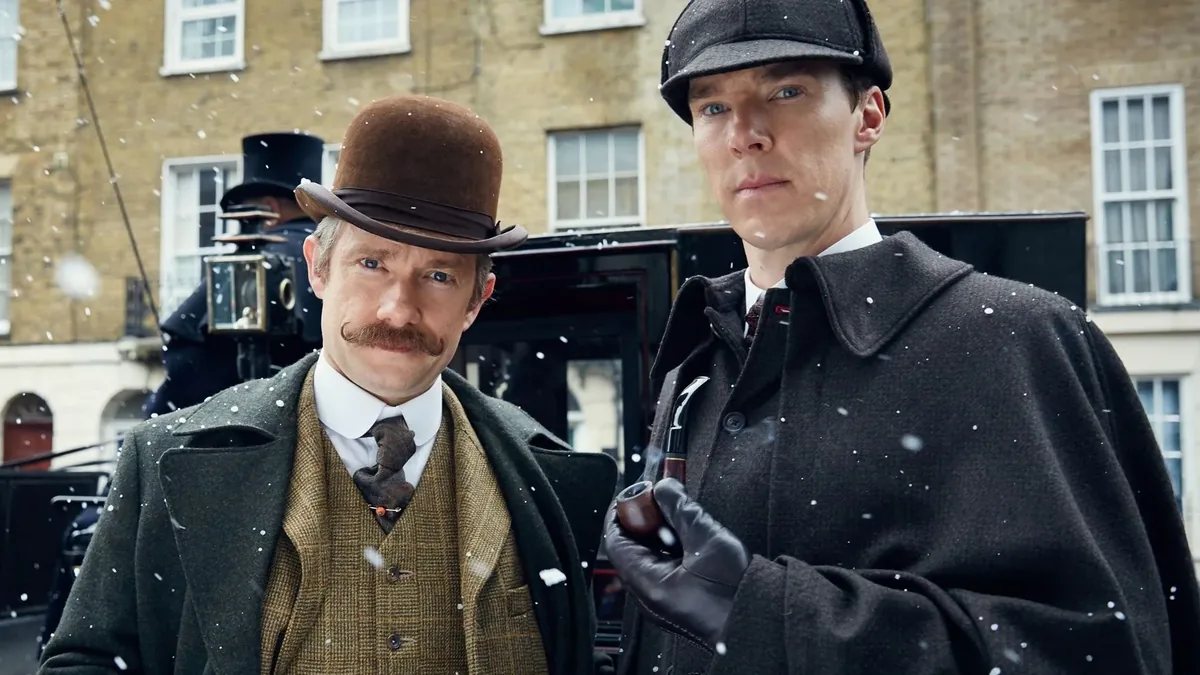
The fifth question deserves a word. Films, series and stage versions are different works with their own writers, and any number attached to a screen version belongs to that script or to the fans around it. This review treated none of them as a source for any figure. The photograph at the top of this page is a staged still of two men in Victorian dress standing in snow in front of a carriage. It records a costume tradition, and nothing in it bears on intelligence, so it carries no evidence for the 190 or against it.
When the checklist is applied to other claims, the results differ. A figure that cites an issue and a page passes the second question and can then be checked on the page. A figure that names a test passes the third, and then the reader asks whether the test could produce it. A claim that fails the first question has no owner, and a number with no owner cannot be corrected, which is why it travels so well.
10 What the Evidence Supports, Stated Narrowly
The evidence supports four narrow statements about Sherlock Holmes and IQ, and it does not support the headline claim that he was a 190. Each statement below rests on a source opened for this review, and each stops where its source stops.
First, the Doyle texts searched contain no IQ, no quotient, no intelligence test and no mental age, so Holmes has no score in the canon. The search covered the nine Project Gutenberg files named in the sources, and it is a statement about those files only. Second, the figure of 190 is attributed to John Radford in the sources opened here that name anyone, the earliest of them a Norwegian newspaper interview dated July 15, 1999, and the book itself was not opened, so its wording is unknown. Third, a score of 190 would sit 6.0 standard deviations above the mean on the standard scale, about one person in a billion on our arithmetic, so it could not be a norm referenced measurement. Fourth, the stories depict a profile of strengths and gaps, and in one case Holmes himself places a relative above him on a specific faculty.
The same evidence does not support several things that appear in headlines. It does not support the claim that Holmes is a genius of a stated size, because the canon uses the word as a description and not as a threshold. It does not support a comparison with any real person, because a comparison needs two scores on one scale. It does not support a figure for any film or series, because none was opened as a source. And it does not support any statement that the 190 is wrong in the way a measurement can be wrong, because it is not a measurement. It is a literary estimate that traveled without its context.
The distinction is worth keeping, because the opposite error is also possible. A reader could conclude that Holmes is therefore unintelligent, or that fiction about intelligence is naive. Neither follows. The stories show a mind that observes closely, knows a few fields well and reasons from evidence, and readers have responded to that portrait for well over a century. The portrait is the achievement. A number added later is a different kind of thing, and the page on genius and the 140 threshold shows that even for real people the word has no single official cutoff.
11 What does Holmes's method teach about measuring your own reasoning?
The lesson of Holmes is the reverse of the number: reasoning from evidence is something a standardized task can sample, and a real score comes from an instrument that states its scale, so a reader who wants to know where they stand needs a test, not a quotation. The detective's own distinction between seeing and observing is a useful frame. A person who has seen an item hundreds of times may still not have registered it, and a person who has read a score hundreds of times may not have asked what it came from.
ACIS is one concrete option. It is an online, self-administered assessment with 20 subtests in six CHC domains, reported as a Full Scale IQ and six primary indices: verbal comprehension, fluid reasoning, quantitative reasoning, visual spatial, working memory and processing speed. Scores are on the standard scale with a mean of 100 and a standard deviation of 15, scaled subtest scores run from 1 to 19, and the report gives percentiles and a 95 percent confidence interval. Adult norms cover ages 16 to 90. The documentation is in the technical manual, and this page quotes no figure from it.
The forms are a one time payment with no subscription, breaks are allowed, and there is a free trial with no card. Prices below were read on October 20, 2026 and can change. The Quick form costs 15 dollars, with 6 subtests in 3 domains and about 45 minutes. The Optimized form costs 30 dollars, with 13 subtests in 5 domains and about 110 minutes. The Full Scale form costs 50 dollars, with all 20 subtests in six domains and about 175 minutes. There is a 5 day quality guarantee, and a purchaser has 30 days to complete the test.
The limits matter as much as the features. ACIS is online and unsupervised, which is a different condition from a psychologist administering an instrument in person. It is not a clinical or diagnostic instrument. It is not for hiring, for school accommodations or for admission to high IQ societies, and it is in English only. The page on professional versus online IQ tests explains what changes when a test is supervised, and the page on online IQ tests describes what to look for in a normed one.
None of this makes a reader a detective, and none of it produces a Holmes-sized number. It produces a profile, with its uncertainty, for a real person. That is the thing the fictional figure cannot provide, and it is a more interesting result than a single large number, because it shows where a person's reasoning, knowledge and speed differ from one another.
12 What do the Standards for Educational and Psychological Testing say about reading a score?
The Standards for Educational and Psychological Testing, published by AERA, APA and NCME in 2014, ask that every score come with a stated interpretation, a described scale and a described norm group, which is exactly what a figure such as the 190 lacks. The page that carries the number is not obliged to meet professional standards, but a reader is entitled to use them as a yardstick.
The Standards open with a general requirement. Standard 1.0 says that clear articulation of each intended test score interpretation for a specified use should be set forth, and that appropriate validity evidence in support of each intended interpretation should be provided. Applied to the 190, the intended interpretation would be that Holmes is a person with an IQ of 190, the specified use would be ranking characters, and the validity evidence would be a test. None exists.
Three further standards bear on the scale. Standard 5.1 says test users should be provided with clear explanations of the characteristics, meaning and intended interpretation of scale scores, as well as their limitations. Standard 5.2 says the procedures for constructing scales used for reporting scores, and the rationale for them, should be described clearly. Standard 5.8 says norms, if used, should refer to clearly described populations. A number that does not say what scale it is on, how the scale was built or whom it was built on fails each of these by omission. Standard 6.10 adds a requirement for the audience: when test score information is released, interpretations should describe in simple language what the test covers, what the scores represent, and the precision or reliability of the scores. A listicle that prints "IQ 190" with no further words does the opposite.
The American Psychological Association's Ethical Principles of Psychologists and Code of Conduct, text effective January 1, 2017, speaks to the person side. Standard 9.01 asks psychologists to base their opinions on information and techniques sufficient to substantiate their findings, and to give opinions about the psychological characteristics of individuals only after an examination adequate to support them. Where an examination is not practical, it asks them to clarify the probable impact of their limited information on the reliability and validity of their opinions and to limit their conclusions. For a record review, it asks them to explain the sources on which their conclusions rest. Standard 9.06 asks them to take into account the purpose of the assessment and to indicate any significant limitations of their interpretations.
Those standards were written for real people and professional practice. For a fictional character they point to a simple conclusion: an examination is impossible, a record review has no childhood or performance data to review, and the limits of any interpretation would swallow the interpretation. The same principles protect the reader of a real report. A score is a statement about one person on one instrument at one time, and the report that carries it should say so. The page on reliability and validity shows what those two words mean in practice, and the page on the IQ score chart shows how the standard scale is usually divided into ranges.
Every figure above is traceable to one of the following, and each is linked at the point where it is used. Web pages and files were read on October 20, 2026. Figures marked as our arithmetic are calculations on a normal distribution and are not attributed to any author. Translations from the Norwegian are ours. Wikipedia was not used as a source for any figure.
Doyle AC. A Study in Scarlet (ebook 244), The Sign of the Four (ebook 2097), The Adventures of Sherlock Holmes (ebook 1661) and The Memoirs of Sherlock Holmes (ebook 834). Project Gutenberg. Read for Watson's list, the attic passage, the passages on observation and on Mycroft, and the description of Moriarty. Also text searched for IQ terms: The Hound of the Baskervilles (ebook 2852), The Valley of Fear (ebook 3289), The Return of Sherlock Holmes (ebook 108), His Last Bow (ebook 2350) and The Case-Book of Sherlock Holmes (ebook 69700, first published 1927 according to its header).
Arthur Conan Doyle Encyclopedia. A Study in Scarlet (first publication in Beeton's Christmas Annual, 1887) and Joseph Bell (Doyle's 1892 letter and 1923 memoir statements).
Terman LM. The Measurement of Intelligence. Houghton Mifflin, 1916. Project Gutenberg ebook 20662, read for the definition of the intelligence quotient as the ratio of mental age to chronological age.
Terman LM. The Intelligence Quotient of Francis Galton in Childhood. The American Journal of Psychology, 1917, vol 28, issue 2, p 209. DOI checked in Crossref. The estimate was read through Revelle W, Francis Galton, submitted version of March 1, 2014, for the Encyclopedia of Clinical Psychology.
Pearson. WAIS-5 sample score report. Pearson Assessments, date of testing September 16, 2024. Text extracted from the PDF.
United Nations. The day of 8 billion. Page stating the projection for November 15, 2022.
American Educational Research Association, American Psychological Association and National Council on Measurement in Education. Standards for Educational and Psychological Testing. AERA, 2014. Standards 1.0, 5.1, 5.2, 5.8 and 6.10 read in the open access PDF.
Sherlock Holmes has no documented IQ. Arthur Conan Doyle's stories describe his mind in scenes and never state a score, and a fictional character cannot sit a test. The number that circulates, 190, is a later estimate attributed to one author, not a measurement of anyone.
Is Sherlock Holmes's IQ 190?
No source opened for this review shows that it is. The figure appears in articles that attribute an estimate to John Radford and in one page that names no source at all. None of them cites a Doyle passage, a test or a norm group, so 190 is a circulating figure, not a result.
Who said Sherlock Holmes has an IQ of 190?
The sources that name anyone credit John Radford, a British psychology professor who wrote a book on Holmes's intelligence. The earliest one opened is a Norwegian newspaper interview from July 15, 1999, which reports that he reckons Holmes at about 190. Doyle, the stories and any test are not named.
How smart is Sherlock Holmes?
The stories portray a mind that observes closely, reasons from small clues and knows a few fields in depth, such as chemistry, while Watson rates his knowledge of literature, philosophy and astronomy as nil. That is a profile of strengths and gaps written for a plot, and it does not reduce to one number.
Is Sherlock Holmes a genius?
Doyle's texts use the word genius descriptively, and characters apply it to people in the stories, including Moriarty. No story defines it by a threshold or a score. As a literary description, Holmes is plainly written as exceptional, but a genius with a measured size is a claim the canon never makes.
Is Sherlock Holmes smarter than Einstein?
That comparison has no basis. Ranking two people needs a score for each on the same scale, and Holmes has none because he is a character, not a person who took a test. Any list that puts him above or below a real scientist is comparing an adjective with a reputation.
Did Arthur Conan Doyle ever give Sherlock Holmes an IQ?
No. A text search of the four novels and five story collections on Project Gutenberg found no IQ, quotient, mental age or intelligence test. Doyle began the series in 1887, before the first Binet-Simon scale, and the stories contain no number for Holmes even in the later volumes.
Who is John Radford?
Radford is described in the 1999 Dagbladet interview as a British psychology professor and a recognized expert on intelligence testing. He is the author of The Intelligence of Sherlock Holmes and Other Three-Pipe Problems, published in London by Sigma Forlag in 1999. This review did not open the book itself.
Did Radford measure Holmes's IQ with a test?
No source opened says so. The interview reports that he reckons Holmes at about 190, and the Arthur Conan Doyle Society review reports a conclusion that Holmes's intelligence is of the very highest order. A fictional character cannot take a test, so any figure is a literary estimate, not a measurement.
Could an IQ score have existed when Holmes was written?
No. The first Holmes story appeared in 1887, the Binet-Simon scale came years later, and Terman's 1916 book describes the intelligence quotient as the ratio of mental age to chronological age. A score in the 1887 story would have been an anachronism, which is why none appears.
How rare would an IQ of 190 be?
On a scale with a mean of 100 and a standard deviation of 15, a 190 is 6.0 standard deviations above the mean. Our arithmetic for a normal distribution gives about one person in a billion, which is far past anything a norm group of realistic size can represent.
Why do real score reports not show a 190?
Real reports show scores only within the range an instrument supports. The Pearson WAIS-5 sample report charts composite scores on an axis from 40 to 160. Beyond that range a norm group contains almost nobody, so a printed number would be an extrapolation rather than a comparison with peers.
What does the canon say about what Holmes knows?
Watson's list in the first novel rates Holmes nil in literature, philosophy and astronomy, feeble in politics, profound in chemistry and practical but limited in geology. Holmes explains the gaps with the image of a brain as a small attic that a skilled worker stocks only with useful tools.
Who in the canon is smarter than Holmes?
Holmes says in "The Greek Interpreter" that his brother Mycroft has better powers of observation than he does, and calls this the exact and literal truth. Moriarty is described as having a phenomenal mathematical faculty. The stories name no scores, but they do not rank Holmes first on every faculty.
Can anyone estimate the IQ of a person who cannot be tested?
Researchers have tried with real people. Terman estimated Francis Galton's childhood IQ from a biography, and Cox rated 301 eminent people from records of their youth. Those estimates relied on documented childhood performance and are still judgments, and a fictional character offers no childhood record to rate.
What would a test measure about someone who reasons like Holmes?
A battery would measure separate abilities, such as fluid reasoning, acquired knowledge and working memory, each as its own index before any composite. Strong reasoning from clues would appear mainly under fluid reasoning, while deep knowledge of chemistry would not by itself lift the other indices.
Does a high IQ make someone good at solving crimes?
A score summarizes performance on a set of tasks, and it does not guarantee skill at any particular job. Even in the stories, Holmes says a detective needs observation, deduction and knowledge, and he builds that knowledge by deliberate selection. Practice and domain training matter as well as reasoning.
How can I find out my own reasoning level?
Take a normed test that reports a scale, a percentile and a confidence interval. ACIS offers one online, with a free trial and one time forms priced at 15, 30 and 50 dollars as read on October 20, 2026. It is unsupervised and not a clinical instrument, so use it for orientation.
Are online IQ tests accurate?
Quality varies widely. A trustworthy online test states its scale, its norm group and the precision of its score, and it says what it is not for. Unsupervised conditions differ from a psychologist's room, so an online score is best read as an estimate with a range.
How should I read an IQ figure I see online?
Ask who first gave it, whether a source text or test supports it, which scale it is on and which group it was compared with. A figure with no answer to those questions is a number in circulation. Check how rare it would be on the standard scale before trusting it.
Why does the confidence interval matter on a score report?
Every test score carries error, so one number overstates precision. A 95 percent confidence interval shows the range in which a person's true score likely lies, and a report that prints only a single figure hides that. Reading the interval keeps small differences between two scores from being overinterpreted.
Take the assessment
You get a profile, not a number
ACIS measures six CHC domains across 20 subtests and reports each one with its own normed score and confidence interval, so you can see where you are strong and where you are not.