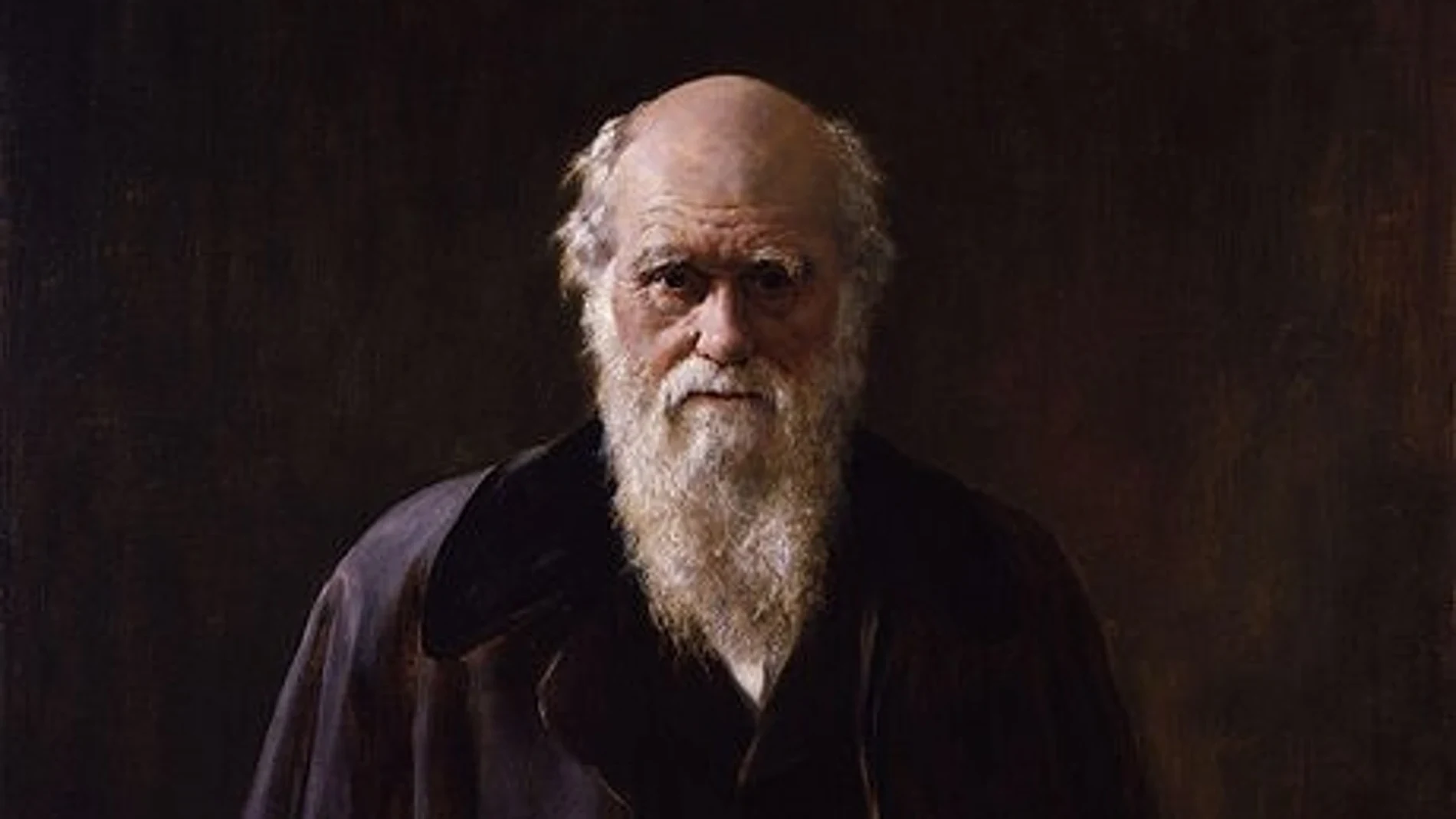
Charles Darwin's IQ: Cox's 135 and 140 beside his own words
ACIS has never assessed Charles Darwin, holds no record belonging to him, and no retrospective assessment of anyone is possible. The 165 that many pages print has no test behind it. The numbered source is Catharine Cox's 1926 table, which prints 135 and 140 on thin records, and the other primary source is Darwin's own Autobiography, where he recalls being thought a very ordinary boy. This page sets them side by side.
Darwin was born at Shrewsbury on February 12, 1809, according to the first page of his Autobiography.
0 The short answer
Charles Darwin has no documented IQ: no intelligence test ever measured him, and the one numbered source for his name, Catharine Cox's 1926 table, prints 135 for his record to age 17 and 140 for ages 17 to 26, not 165. Cox attached data reliabilities of .43 and .53 to those ratings, which means her raters were working from incomplete records, and the 165 that many pages print has no source that can be checked. What Darwin wrote about himself is more informative than either figure: in his Autobiography he says he was considered a very ordinary boy at school, and in 1876 he said he had no great quickness of apprehension.
135 and 140
The two ratings Cox printed for Darwin in 1926, for the record to age 17 and for ages 17 to 26.
.43 and .53
The reliability coefficients Cox attached to the data behind those two ratings. They describe the records, not a test.
1876
The year Darwin wrote his Autobiography, begun about May 28 and signed off on August 3.
1 Where do the figures 165, 140 plus and 130 come from?
Every figure for Darwin traces either to Catharine Cox's 1926 volume or to a page that names no source, and none traces to a test. The pages below were read on October 6, 2026. The ones that give a source name Cox. The ones that give none print the largest, roundest numbers.
"165, or, as some state, 160", and a range of 160 to 180
An anonymous user answer, last updated September 14, 2023
No source. The answer concedes Darwin never took a test
Three observations follow from the table. First, the circulating numbers disagree with one another by 40 points or more, from 140 to 180, and by 25 points on a single page, which is a sign that no measurement sits behind them. A measured score has one value and a confidence interval. Second, the only page that cites a document cites Cox, and Cox is a document about historical records, not about a test (the next section reads what she printed). Third, the 130 that some summaries attach to Darwin, along with an attribution of it to the biologist E. O. Wilson, was not found on any page we opened, and no quotation from Wilson was located, so this page does not repeat it.
The same pattern appears for every historical figure on the page on the highest IQ ever recorded and in the trace of Isaac Newton's circulating 190: a number that began as a retrospective rating, or as an unsourced list entry, gets copied until it reads like a result. This page does not endorse any of these figures. It lists them to trace them.
ACIS has not tested Charles DarwinACIS has never assessed Charles Darwin and holds no record belonging to him. Nothing on this page is an estimate of his IQ, and none can be derived from a biography. Where a number appears, it is a number that someone else printed, and the page says who.
2 What did Catharine Cox print for Darwin in 1926?
Cox's volume gives Darwin an AI rating of 135 and an AII rating of 140, each printed with a reliability coefficient for the data: .43 for the first and .53 for the second. The book is the second volume of Genetic Studies of Genius, edited by Lewis M. Terman and published by Stanford University Press in 1926 (Cox, The Early Mental Traits of Three Hundred Geniuses, on the Internet Archive). Darwin's case occupies pages 398 to 399, with his references on page 400. Its heading reads "AI IQ 135 All IQ 140", and the two ratings are closed by the lines "AI IQ 135 (Rel. coeff. of data, .43)" and "All IQ 140 (Rel. coeff. of data, .53)".
Table 28, on page 113, lists the group of cases rated 135 on the first rating, and Darwin's row prints the same numbers with a margin: 135 plus or minus 8, reliability .43, then 140 plus or minus 7, reliability .53. Cox's method describes those margins as probable errors that follow from the reliability of the data. The pattern in her table is orderly: the less reliable the record, the wider the margin. Franklin, whose data she rates at .75, is printed as 135 plus or minus 5. Erasmus, whose dates she doubts, is printed at 135 plus or minus 10 with a reliability of .11.
What Cox's volume prints for Darwin
Figure
Where
First rating (AI), the record to age 17
135, plus or minus 8
Case heading, page 398; Table 28, page 113
Reliability of the data behind AI
.43
Case, page 399; Table 28
Second rating (AII), the record from 17 to 26
140, plus or minus 7
Case heading, page 398; Table 28
Reliability of the data behind AII
.53
Case, page 399; Table 28
Average reliability of the 41 cases rated 135 on the first rating
.48
Page 112
Two things are worth noticing. First, Darwin's .43 sits below the .48 that Cox gives as the average for the 41 cases in his group, so his first rating rests on a thinner record than the average of the people she placed beside him. Second, Cox names the raters. Terman, Maud Merrill and Cox herself rated all 301 subjects, and each rater's score is printed in a folded table, Table 12A, which faces page 60. The AI figure is the average of the three raters' independent estimates, and the AII figure the average of three more. That table is a folded insert, and the machine-readable text of the volume available to us does not reproduce it. This page therefore does not print the three individual scores for Darwin, and it does not guess them. The case heading, Table 28 and the case lines are the figures we could read, and they agree with one another.
For comparison, the three raters' scores are readable in the text for some other cases in his group. For John Franklin, Cox writes that Terman, Merrill and she gave 135, 135 and 135, and for Robertson, 140, 135 and 135. Cox printed such triples for the examples she discussed so that a reader can see whether the raters agreed, and for Darwin that evidence sits in the folded table. For the full method, the page on how Napoleon's 135 and 140 were rated sets out the procedure, and this page does not repeat it.
3 Is Cox's number an IQ in the modern sense?
It is a rating on an IQ scale made by judges reading biography, not a score produced by a person answering test items. Cox is explicit about this. She defines the IQ as "the ratio of mental age to chronological age" and sends the reader to Terman's 1916 The Measurement of Intelligence, and Terman's book gives the same definition in a note (Terman, The Measurement of Intelligence, Project Gutenberg). That ratio was the scoring rule Terman's book used. It is not how current tests are scored, and the page on how an IQ is calculated explains the deviation scale that replaced it.
Cox then does something a ratio cannot do for an adult. She says she uses the IQ "with a theoretical significance", as "a constant measure which expresses the relative degree of 'brightness' or intelligence of any given individual compared with a large unselected group in the same way that a sigma index would do." In plain terms, her 135 is meant as a relative standing, a position in a group, assigned to the person whose recorded behavior she reads. A person rated at 135 is described as someone whose recorded behavior resembles that of children who would pass the Stanford-Binet at that level. No item was ever put to Darwin.
Three features of the method keep the figures modest as evidence.
The raters judged the record, not the career. Cox says each record was to be evaluated on its own merits without reference to the later career. A rating of 135 therefore says what the recorded facts of one period of life suggested to three readers, and it was not meant to reflect what Darwin later achieved.
Thin records were pulled toward 100. Cox writes that when data were insufficient the raters "regressed toward the 100 IQ mean", and she says that procedure "introduced a large error". That is why the reliability coefficient is printed beside every figure.
Each score belongs to a period. Cox cautions that each score "registers simply the average IQ rating of all individuals who do the things that are recorded of the given subject at a particular age". She also warns against reading the difference between the two ratings as a change in the true IQ.
None of this is a criticism of Cox. It is the reason her figures are cited correctly only as retrospective ratings. The page on reliability and validity separates the consistency of a test from the justification for an interpretation, and a data reliability of .43 is neither. It is Cox's own measure of how adequate the biography was as a basis for judging.
4 Where does Darwin sit inside Cox's own group, and did her raters agree?
Inside Cox's group of 282 eminent people, Darwin's first rating equals the group average and his second rating falls five points below it, so the 135 does not mark him out even among the eminent. In her discussion of the corrected estimate, Cox gives the obtained averages for the whole group as 135 on the first rating (reliability .46) and 145 on the second (reliability .54), and a footnote labels them the averages for Group A. Darwin's printed ratings are 135 and 140. The comparison is our arithmetic on two printed sets of numbers: it places him at the mean on AI and 5 points under it on AII, within a sample that Cox selected for eminence.
That fact corrects a common reading. A page that says "Cox gave Darwin 135" often implies a position near the top of the population, and relative to the general population it is. Inside Cox's own sample it is an ordinary entry. Her book is about how the eminent compare with unselected children, and her own conclusion about the group is that its average rating of about 135 on the first rating is "far above" the mean of 100 for the generality. Darwin's 135 is the sample average, and Cox argues that the group's true level was higher because its records are incomplete.
The other question is whether her three raters agreed. Table 14 reports the ratings on the first rating by four raters. For Cox, Merrill and Terman, who each rated all 282 cases, the means were 134.0, 134.7 and 136.2 and the standard deviations were 16.4, 21.9 and 19.4. The correlations between the raters' series ran from .73 to .75 for the pairs among the three of them (Cox with Merrill .73, Cox with Terman .74, Merrill with Terman .75). Cox adds that no rater knew another's estimates until his own were complete.
Those figures are a real strength of the method, and they meet the spirit of the Standards' requirement that raters decide independently and report their agreement. They also have a limit that Cox's own coefficients point to. Raters who read the same case file in similar ways will agree with each other whether or not the file is a good basis for judging ability. Agreement shows consistency among readers. It does not show that a biography measures a trait, and it is the reason Cox pairs every rating with a separate reliability coefficient for the data. A correlation of about .74 among raters and a data reliability of .43 for Darwin say different things: the first that the raters read alike, the second that the record they read was thin.
5 Where might the 165 have come from?
The 165 has no documented origin on any page we read, and the closest passage in Cox's volume is a group statement, not a rating of Darwin. There are two candidates, and both are hypotheses.
The first is a sentence on page 115. After describing the group rated 135 on the first rating, Cox writes that its "true lower limit" can scarcely fall below 120, and that "Its true upper limit, set by such youths as Cousin, Darwin, Erasmus, Da Vinci, and Kant, is probably in the IQ range above 160." That sentence names five people together and concerns the upper edge of a group whose records were incomplete. It says the best-documented members of the group probably stood above 160. It does not give Darwin 165, and it does not give any individual a number. A page that wanted a figure for Darwin could still read the passage as one, which would make 165 a misreading of a range. We cannot show that anyone did.
The second is the correction. Cox did not stop at the averaged ratings. She applied a formula that adds to an obtained score an increment that depends on the group mean and on the reliability of the data, on the grounds that low-reliability records pulled the estimates toward 100. Her formula is printed in a footnote on page 82, and on page 83 she states that the corrected values are "probably in most cases still too low" and are "no more than an approximation to a true score." The LifeScore page says Cox's corrected estimate for Darwin was 165. We could not confirm a corrected individual figure for Darwin in the readable text of the volume. Tables 20A and 20B print corrected estimates for certain groups, and individual corrected figures, if she printed them, may sit in the folded Table 12A, which we could not read. We therefore report the claim as the page makes it and do not endorse it.
Whichever route produced 165, two cautions hold. A figure that applies a correction for gaps in the record is a higher guess about a rating, not a better measurement of the person. And a 165 carries no confidence interval, because no score was observed. If you want to see how rare a given value would be on a modern scale, the IQ rarity calculator shows what 135, 140 and 165 each imply as a position in a population. That is a statement about the scale, not about Darwin.
The LifeScore page also reports that adjusting 165 down by about 22 points for the Flynn effect gives roughly 145. This page does not use that adjustment. The explainer on the Flynn effect describes gains across populations, and a population gain cannot convert one retrospective rating from 1926 into a present-day score.
6 What does Darwin's Autobiography say about his abilities at Shrewsbury?
Darwin wrote that he believed his masters and his father considered him a very ordinary boy, and that is a statement about other people's opinion, recalled from about 50 years earlier. The text comes from the Autobiography, which Darwin wrote for his children. In the 1887 edition prepared by his son Francis, the closing note reads, "Aug. 3, 1876. This sketch of my life was begun about May 28th," and Francis adds that it was written without any thought that it would be published (The Autobiography of Charles Darwin, Project Gutenberg). A later edition by his granddaughter Nora Barlow restored passages that the 1887 text had left out, and the Darwin Online record describes it as the standard scholarly edition (Barlow, ed., 1958, on Darwin Online). The passages quoted here come from the 1887 text, and we did not compare their wording with the 1958 edition.
The chronology in his own words is short. He was born at Shrewsbury on February 12, 1809. His mother died in July 1817, and that spring he was sent to a day school in the town for a year. He writes that he had "been told that I was much slower in learning than my younger sister Catherine." In the summer of 1818 he went to Dr. Butler's school, where he stayed until Midsummer 1825, when he was 16.
The school passage is the best known one in the book, and it is worth reading whole. Darwin writes: "When I left the school I was for my age neither high nor low in it; and I believe that I was considered by all my masters and by my father as a very ordinary boy, rather below the common standard in intellect."
Four details change how the sentence reads. First, it reports his belief about how others saw him ("I believe that I was considered"), not a grade, a rank list or a test. Second, the first clause is a placement: "neither high nor low" in the school. Third, the father's remark that he records next, that he cared for "nothing but shooting, dogs, and rat-catching," is followed by Darwin's own judgment that his father, whom he calls the kindest man he ever knew, "must have been angry and somewhat unjust when he used such words." Fourth, the sister remark is reported as hearsay, since he says he "had been told" it. Cox's case summary writes the same point as "Darwin states that he was much slower in learning than his sister," which drops the hedge, and it is an example of how a retrospective rating can drift away from its source.
Darwin's complaint about the school is about its curriculum. He writes that Dr. Butler's school was "strictly classical, nothing else being taught," and that "the school as a means of education to me was simply a blank." He adds that "during my whole life I have been singularly incapable of mastering any language." He could learn "forty or fifty lines of Virgil or Homer" in morning chapel, but the exercise was "utterly useless, for every verse was forgotten in forty-eight hours." The headmaster publicly rebuked him for spending time on chemistry with his brother, which Darwin calls "the best part of my education at school."
The same passage lists what he thought promised well: "strong and diversified tastes, much zeal for whatever interested me, and a keen pleasure in understanding any complex subject or thing." He remembers the "intense satisfaction" of Euclid's proofs. Cox read the same text and wrote, "Perhaps his true ability was not recognized, for his was the original mind that retains only what itself has created." That is Cox's opinion, not a datum, and it is the opposite of a measurement. What the school record establishes is that a boy with strong interests did unremarkably in a curriculum that did not use them. The page on the difference between intelligence and knowledge explains why a school's view of a pupil and a test of reasoning ability do not coincide.
7 What did Darwin say about his own mind in 1876?
Darwin's self-portrait in the same book is uneven by his own account: no quickness of wit, a limited power with long abstract argument, a hazy memory, and a strength in noticing things and in sustained curiosity. The passage comes near the end, where he writes that he will try to analyze "the mental qualities and the conditions on which my success has depended; though I am aware that no man can do this correctly" (Autobiography, Project Gutenberg). Several of its statements bear on the question of IQ, so they are given here close to his wording.
Speed. "I have no great quickness of apprehension or wit which is so remarkable in some clever men, for instance, Huxley." He draws the consequence that he is "a poor critic," because a paper "when first read, generally excites my admiration," and only after reflection does he see the weak points.
Abstraction. "My power to follow a long and purely abstract train of thought is very limited; and therefore I could never have succeeded with metaphysics or mathematics." Of Cambridge he says that in mathematics he "got on very slowly" and did not believe he "should ever have succeeded beyond a very low grade."
Memory. "My memory is extensive, yet hazy." He adds that he has "never been able to remember for more than a few days a single date or a line of poetry."
Reasoning. In answer to critics who said he had no power of reasoning, he replies that the Origin of Species "is one long argument from the beginning to the end." He claims "a fair share of invention, and of common sense or judgment, such as every fairly successful lawyer or doctor must have, but not, I believe, in any higher degree."
Observation. "I think that I am superior to the common run of men in noticing things which easily escape attention, and in observing them carefully." He credits his result to industry, a steady love of natural science and the patience "to reflect or ponder for any number of years over any unexplained problem."
Two cautions govern how to use this. The statements are a man's opinion of himself, written when he was 67, and Darwin says in the same sentence that no one can do this analysis correctly. And the profile they describe is uneven in the way real profiles are. Weak algebra, weak memory for dates and verse, and strong noticing and sustained attention are different abilities, and a single figure averages them. In CHC terms the reported strengths and weaknesses fall in different broad abilities, and the page on the CHC model and the page on what IQ measures explain why a Full Scale IQ can sit well above or below some of its parts. The page on signs of high intelligence separates traits that research links to ability from traits that only look like it, and it is a useful companion to Darwin's own list, because several of the qualities he credits (patience, persistence, a wish to explain) are not what an IQ test scores.
Darwin does not say he was dull, and he does not say he was brilliant. He says what he thinks he did well and badly, and he locates his success in application. A reader who wants a number from this passage has to supply it, and that would be an invention. The honest use of the passage is the reverse: it shows that the man whose career is cited as proof of high ability described his own mind in terms no single test score would capture.
8 What do Edinburgh, Cambridge and the Beagle voyage document?
The record from 17 to 26 documents a rising pattern of self-directed study and scientific work, which is what Cox's second rating of 140 was built on. Cox's AII rating covers the years from 17 to 26. What follows is the record in Darwin's own telling, set beside what Cox chose to use.
At Edinburgh, which he entered in October 1825 with his brother, he found that the instruction "was altogether by lectures, and these were intolerably dull." He writes that his belief that he would inherit enough to live on was "sufficient to check any strenuous efforts to learn medicine." In the same years he collected marine animals with Dr. Grant, and "about the beginning of the year 1826" he read a short paper before the Plinian Society reporting that the so-called ova of a marine animal named Flustra "had the power of independent movement by means of cilia, and were in fact larvae." Cox's summary records the paper at age 17 and a remark by Sir J. Mackintosh at 18 ("There is something in that young man that interests me").
At Cambridge, from January 1828, Darwin says his time "was wasted, as far as the academical studies were concerned." He passed the B.A. examination in January 1831. Of the order of merit he writes that he "gained a good place among the oi polloi or crowd of men who do not go in for honours," and that he cannot remember whether he stood fifth, tenth or twelfth. A parenthesis in the printed text says "Tenth in the list of January 1831," and Cox gives it as tenth. He credits one part of the course with educating him: working through Paley's Evidences and Moral Philosophy without learning anything by rote, along with Euclid. Outside the syllabus the botanist John Henslow "persuaded me to begin the study of geology," and a letter from Henslow brought the offer of a place as naturalist on the Beagle.
The Beagle sailed on December 27, 1831 and returned on October 2, 1836. Darwin writes, "I have always felt that I owe to the voyage the first real training or education of my mind; I was led to attend closely to several branches of natural history, and thus my powers of observation were improved, though they were always fairly developed." He adds that the pleasure of observing and reasoning proved "a much higher one than that of skill and sport," and that on his return his father said to his sisters, "Why, the shape of his head is quite altered."
Three points follow for the number question. First, nothing in this record is a performance on a standardized task. It is a sequence of choices, projects and testimony, and Cox's raters turned it into 140 by comparing it with what young people of those ages do. Second, Darwin's own account puts his intellectual development after school and credits experience. That is consistent with Cox's reading that his true ability was not recognized earlier, and it is equally consistent with ordinary development in a person who found his subject late. The record cannot tell those apart. Third, an achievement can be real and large without fixing the position of the person on a population scale. The page on genius and IQ traces where the 140 threshold for the word came from and why it is a convention, not a discovery.
9 What did Galton's English Men of Science and Darwin's reply record?
Galton's 1874 survey of English scientists is the nearest thing to a contemporary inquiry into Darwin's abilities, and Darwin's reply to its questionnaire says he could not estimate the degrees of his own traits. Francis Galton was Darwin's second cousin, descended like him from Erasmus Darwin, according to the Darwin Correspondence Project (Darwin Correspondence Project, Francis Galton). In the preface to English Men of Science: Their Nature and Nurture, Galton says he began the inquiry after reading Alphonse de Candolle's analysis of 200 scientific men, drew up a list of 180 men, and built the book on "the autobiographical replies to a very long series of printed questions" sent to them (Galton, 1874, on Darwin Online). Galton's pedigree section describes "Charles Darwin, F.R.S., 'the Aristotle of our days,' whom all scientific men reverence and love." That is praise by a relative, in a book about heredity. It is not a measurement.
Darwin's own reply survives. He sent his answers to Galton on May 28, 1873, with a covering letter that the Darwin Correspondence Project has transcribed (Darwin to Galton, 28 May 1873). Four things in it bear on this page.
He declined to grade himself. "I have filled up the answers as well as I could; but it is simply impossible for me to estimate the degrees."
He distrusted self-judgment. "It is so impossible for any one to judge about his own character that George first wrote several of the answers about myself, but I have adopted only those which seem to me true."
He gave a plain list of traits. The enclosure begins, "Special talents, none, except for business, as evinced by keeping accounts, being regular in correspondence, and investing money very well." It continues with "great curiosity about facts, and their meaning" and "Memory bad for dates or learning by rote; but good in retaining a general or vague recollection of many facts." It says "Very studious, but not large acquirements," and "I suppose that I have shown originality in science, as I have made discoveries with regard to common objects."
He placed his education late. "My education really began on board the Beagle," and the one compulsory exercise at school that "improved my intellect, was doing Euclid, & this was partly voluntary."
The Darwin Correspondence Project summarizes the same reply as insisting that he had no particular inherited talents except for business. Read next to the Autobiography, the 1873 enclosure is consistent with it on every point that overlaps: weak memory for dates and rote material, steady curiosity, late development. Two accounts written three years apart agree, and neither contains a figure.
The letter ends with a question about measurement. Darwin asks Galton whether, with 50 men from each of two nations, the mean height of the 10 tallest in each nation would approximate the mean of all 50. It is a question about what a selected extreme tells you about a whole group, and it bears on Cox's book, because her 301 subjects were chosen for eminence and rated from the records that eminent lives leave behind.
One historical sentence of context is needed. Galton proposed a society that would keep registers of people judged naturally gifted, and Darwin, answering an essay of his on January 4, 1873, called the plan "utopian" while agreeing the object was grand (Darwin to Galton, 4 January 1873). The history of how that program developed belongs on the page on the history of IQ testing, and this page does not cover it.
10 How does Darwin's Cox entry compare with Napoleon, Newton and Da Vinci?
Placed beside three other cases from the same volume, Darwin's 135 and 140 show that two cases can share headline numbers and rest on very different evidence. The comparison below uses the ratings and reliabilities printed in the case headings of Cox's volume, read in the local OCR text of the archive scan. It ranks nobody, and the final column is our reading of what each row tells you about the record, not a claim by Cox.
Napoleon and Darwin carry the same two ratings, 135 and 140, and Cox's own coefficients say the Napoleon record is the better one (.60 and .75 against .43 and .53). A page that lists both at "135 and 140" and moves on has treated two different kinds of evidence as equal. Newton's first rating of 130 and second of 170 differ by 40 points, and Cox warns against reading that kind of gap as a change in the person. In her discussion of the ratings she says that the difference between two scores for Mill and Milton "should not be interpreted to mean that the true score of Mill during his first seventeen years was 45 IQ points higher than that of Milton." The scores register what is recorded at each age, and what is recorded depends on what survives.
The same table explains why the "above 160" sentence for the upper limit of Darwin's group was never a statement about Darwin alone. Cox's group at 135 includes cases with reliabilities as low as .11. For those, the raters regressed toward 100, and she says so. A group statement made to bound the damage done by missing data is not a ranking of the people inside the group.
If you want the largest picture of how Cox's numbers compare with a modern scale, the page on standard deviation 15 explains why a score of 135 means a position about two and a third standard deviations above the mean on a deviation scale (our arithmetic: 35 points divided by 15). The conversion applies to a deviation score. It does not turn Cox's ratings into one.
11 What can a career show about ability, and what can it not?
A scientific career is evidence that high ability is common among scientists, not a measurement of any one scientist, and Darwin's life illustrates both halves of that statement. Two modern studies show the group-level link and the limits of retrospective figures.
Park, Lubinski and Benbow followed 1,586 intellectually talented adolescents (the top 1 percent), who had been assessed on the math portion of the SAT by age 13 and were tracked for more than 25 years. Within groups defined by their terminal degree (bachelor's, master's or doctorate), the proportion with at least one patent or scientific publication rose with the early SAT score (Park, Lubinski and Benbow, 2008, Psychological Science). The result is a group-level association between measured early ability and later scientific output. It does not say that every scientist scored high or that a given achievement implies a given score.
The second study shows how retrospective figures are produced when researchers need them. Simonton estimated IQs for all 42 U.S. presidents by applying missing-values estimation to three published ratings, of which the IQ ratings, taken from Cox (1926), covered only eight presidents (Simonton, 2006, Political Psychology). It is a legitimate research method for studying correlations across a sample. It also makes plain that such figures are built from a handful of retrospective ratings and statistical imputation, not from administered tests, and they should not be carried back as a personal score.
For Darwin, at least five other things sit between a career and a score.
Opportunity and money. Cox notes that his father became the leading physician of Shropshire and accumulated an abundant fortune, and Darwin himself says he came to believe he would inherit enough to live on. A career funded by private means can run for decades on one problem.
Interest and persistence. Darwin credits "patience to reflect or ponder for any number of years" and a love of natural science that was "steady and ardent." Those are motivational and dispositional qualities. The page on IQ and creativity explains why ability, interest and persistence contribute separately to creative work.
A network. The Darwin Correspondence Project offers the full texts of more than 15,000 of his letters (Darwin Correspondence Project). The work was done in exchange with many correspondents, so credit for the product does not reduce to the contribution of one head.
Selection into the sample. Cox's 301 people are known because they became eminent. A procedure that reads the early lives of people already known to be eminent cannot show what the same records would have looked like for people who were not.
Family. Galton's pedigree of the Darwin family lists several able relatives. A family in which able people are frequent cannot separate shared genes from shared home, schooling, books and contacts, which is the central point of the page on what heritability does and does not mean.
The conclusion is narrow. Darwin's achievements are very large and are consistent with high general ability. They are also consistent with a wide range of scores on a modern test, because achievements are shaped by everything in the list. No number can be recovered from them.
12 What would a modern assessment measure, and how should any score be read?
A modern assessment would report a normed score from a defined procedure with an interval around it, and no part of that procedure can be applied to a person who is no longer here. The Standards for Educational and Psychological Testing (AERA, APA and NCME, 2014) set the requirement. Standard 1.0 says that "clear articulation of each intended test score interpretation for a specified use should be set forth, and appropriate validity evidence in support of each intended interpretation should be provided." Standard 1.9 asks that when a validation rests on the opinions of expert judges or raters, the procedures for selecting them and for eliciting their ratings be fully described, including whether they decided independently and how much they agreed (Standards for Educational and Psychological Testing, open access edition). Cox met the second in part: she names her raters and reports how their ratings correlated. She could not meet the first for Darwin, because there is no test score for him against which the rating could be checked.
The American Psychological Association's Ethical Principles of Psychologists and Code of Conduct applies the same logic to individuals. Standard 9.01(b) says that, except as noted in 9.01(c), "psychologists provide opinions of the psychological characteristics of individuals only after they have conducted an examination of the individuals adequate to support their statements or conclusions." Where an examination is not practical, they must clarify the probable impact of their limited information on the reliability and validity of their opinions and limit their conclusions (APA Ethical Principles of Psychologists and Code of Conduct, text effective January 1, 2017). For a historical figure, the examination is impossible, so the conclusions that remain are descriptions of the record, which is what this page has offered.
For a living reader, the difference is concrete. A test given to you under a standard procedure produces a score that can be placed on a population distribution, with a percentile and a confidence interval. The page on IQ score versus percentile explains why the two must not be mixed, and the page on how IQ scores are normed explains how a score gets its meaning from a comparison group. Darwin's own remark that it is "simply impossible" to estimate the degrees of one's traits is the reason to measure rather than guess, and the page on estimating your own IQ reviews how far self-estimates miss.
ACIS is one way to get a measured profile, with limits that should be stated plainly. Prices were read on October 6, 2026 and can change. It offers a Quick form at 15 dollars (6 subtests in 3 domains, about 45 minutes), an Optimized form at 30 dollars (13 subtests in 5 domains, about 110 minutes) and a Full Scale form at 50 dollars (all 20 subtests in six domains, about 175 minutes), each a one time payment with no subscription, and a free trial with no card. The report gives a Full Scale IQ and six indices on a scale with a mean of 100 and a standard deviation of 15, scaled subtest scores from 1 to 19, percentiles and a 95 percent confidence interval, with adult norms for ages 16 to 90. It is online and unsupervised, it is not a clinical or diagnostic instrument, and it is not for hiring, school accommodations or admission to high IQ societies. It is available in English only. The documentation sits in the technical manual. For a comparison of the options, see the pages on the best online IQ tests and where to take an IQ test.
Every figure, quotation and attribution above is traceable to one of the following, each linked at the point where it is first used, and every web page was opened on October 6, 2026. The 40-point spread among circulating figures, the 35 points divided by 15 and the comparison table are our own arithmetic or reading on published numbers. Darwin's ratings in Cox's volume were cross-checked among the case heading, Table 28 and the case lines in a local OCR text of the volume. The three raters' individual scores for Darwin are in Table 12A, a folded insert that the text does not reproduce, and are not given here.
Cox C M. The Early Mental Traits of Three Hundred Geniuses. Genetic Studies of Genius, volume 2, edited by L M Terman, Stanford University Press, 1926. Darwin's case, pages 398 to 400; Table 28, page 113; discussion of the group rated 135, pages 112 to 115; the corrected estimate, pages 81 to 84; the definition of the IQ and of the AI and AII ratings, pages 47 to 49. Public domain.
Darwin C. The Autobiography of Charles Darwin. Edited by Francis Darwin, Project Gutenberg eBook 2010. The 1887 text, read in full for the school, Edinburgh, Cambridge and Beagle passages and the passage on his mental qualities.
Darwin C. Letter to Francis Galton, 28 May 1873, with the enclosed answers to Galton's questionnaire. Darwin Correspondence Project, letter DCP-LETT-8924.
Darwin Correspondence Project. Francis Galton and the project home page. Used for the relationship between Darwin and Galton, the summary of Darwin's reply to the questionnaire and the count of more than 15,000 letters.
Terman L M. The Measurement of Intelligence. Houghton Mifflin, Boston, 1916. A note defines the intelligence quotient as the ratio of mental age to chronological age.
American Educational Research Association, American Psychological Association and National Council on Measurement in Education. Standards for Educational and Psychological Testing. AERA, 2014. Standards 1.0 and 1.9 read in the open access PDF.
Nobody knows, because Darwin never took an intelligence test and none existed in his lifetime. The only numbers tied to a document are the ratings of 135 and 140 that Catharine Cox printed in 1926 from biographical records. Figures such as 165 appear on websites without any test, date or examiner.
Did Charles Darwin ever take an IQ test?
No. Darwin died in 1882, before intelligence testing began in the early 1900s. He answered a questionnaire from Francis Galton in 1873, but it asked about family, habits and traits, and Darwin said he could not estimate degrees. No scored cognitive test was ever put to him.
Was Charles Darwin's IQ 165?
There is no evidence for 165. It appears on lists such as Famous Scientists and Celebrity IQs without a source, and LifeScore attributes a corrected 165 to Cox, which we could not confirm. Cox's printed ratings for him are 135 and 140, and 165 is neither of them.
Was Charles Darwin a genius?
His achievements place him among the most influential naturalists in history, and few historians would dispute that. Whether he qualifies as a genius depends on a definition that is a convention, not a measurement. High achievement is consistent with high ability but does not fix a score, and Darwin himself credited industry and patience.
Can Charles Darwin's IQ be compared with Newton's?
Not in any meaningful way, because neither took a test. Cox rated Darwin at 135 and 140 and Newton at 130 and 170, each on records of different quality and covering different ages. A larger printed number does not show a more able person.
Why do some websites say Darwin's IQ is 140 or higher?
Those pages usually lean on Cox's second rating of 140 or on a general sense that scientists score high. LifeScore, for example, lists 140 plus with a range up to 165 and says confidence is low. A figure presented as a floor is still an estimate built from biography, not a result.
Is there a way to estimate Charles Darwin's IQ today?
No defensible way exists. Any estimate would rest on a biography, and biographies preserve achievements, not performance on standard tasks. Cox attempted it with three raters and warned that her figures register recorded behavior at an age. Professional ethics also bar opinions about individuals without an adequate examination.
Who was Catharine Cox?
Catharine Morris Cox wrote the second volume of Genetic Studies of Genius, published by Stanford University Press in 1926 and edited by Lewis Terman, with assistance from Lela Gillan, Ruth Livesay and Terman. Her book rated the early mental traits of 301 eminent people, using their recorded childhood and youth.
What do AI and AII mean in Cox's table?
AI is the average of three raters' estimates of a subject's IQ from the record up to the 17th birthday. AII is the average of three estimates using the record to the 26th birthday. For Darwin, Cox prints AI as 135 and AII as 140, each with a reliability coefficient.
What does a reliability of .43 mean in Cox's table?
It is Cox's measure of how adequate the historical data were as a basis for rating an IQ, not a statistic from a test. A value of .43 for Darwin's first rating is a little below the .48 average she reports for the 41 cases in his group. It signals a thinner record.
Who rated Darwin for Cox?
Cox says Terman, Maud Merrill and she herself rated all 301 subjects, and the AI and AII figures average their independent estimates. Each rater's score for each person is printed in Table 12A, a folded insert. The readable text we used does not reproduce it, so individual scores are not quoted.
What did Darwin say about his own intelligence?
In his 1876 Autobiography he said he had no great quickness of apprehension or wit, a very limited power to follow long abstract reasoning, and a hazy memory. He claimed a fair share of invention and judgment, and said he was superior to most people in noticing and observing things carefully.
What was Darwin like at school?
By his own account he was neither high nor low in Dr. Butler's school and believed his masters and father thought him a very ordinary boy. He disliked the classical curriculum, forgot memorized verse within two days, and loved chemistry experiments, Euclid, collecting, shooting and long walks.
What did Darwin tell Galton about his abilities?
In his May 28, 1873 reply he wrote that it was impossible for him to estimate degrees and listed no special talents except business. He described great curiosity about facts, a poor memory for dates and rote learning, and a belief that he had shown originality in science.
Does being slow at school mean low intelligence?
No single school outcome settles it. School results reflect the curriculum, the pupil's interests, health, teaching and effort as well as reasoning ability, and early lateness can be followed by strong development. Darwin attributed his school record partly to a classical syllabus that gave him little to use.
Can a person's achievements be converted into an IQ?
Not reliably. Achievements depend on opportunity, money, persistence, collaboration and chance as well as ability. Studies find that measured ability predicts achievement across groups, but that is an average pattern and cannot be run backward to give one person's score. Retrospective figures built from biography carry large and unquantifiable error.
Is a retrospective IQ estimate the same as a test score?
No. A test score comes from a standard procedure, a norm group and a known measurement error. A retrospective estimate is a judgment about records, and Cox's coefficients describe how complete the records were. The two share decimal notation, but they answer different questions about different kinds of evidence.
How is IQ measured today?
An examinee completes standardized tasks under a defined procedure, raw scores are converted using norms, and the result is reported on a scale with a mean of 100 and a standard deviation of 15, with a percentile and a confidence interval. The ratio of mental age to chronological age is no longer the scoring rule.
What would a score of 135 mean today?
On a deviation scale with a mean of 100 and a standard deviation of 15, 135 sits about 2.3 standard deviations above the mean, which is about the 99th percentile if scores are normally distributed. That is our arithmetic about a number on the scale, not a statement about Darwin.
Can an online test measure my IQ?
An online test can report a normed profile if it is built and normed for that purpose, but it is unsupervised and not a clinical instrument. ACIS reports a Full Scale IQ and six indices with percentiles and a 95 percent confidence interval. It is not for hiring, accommodations or high IQ societies.
Should I compare my result with famous people?
No. Famous IQ figures are almost all retrospective ratings or unsourced list entries, so they offer no valid benchmark. Compare your result with the norm group it was scored against, read the interval around it, and use the profile across domains, which says more than one number.
Take the assessment
You get a profile, not a number
ACIS measures six CHC domains across 20 subtests and reports each one with its own normed score and confidence interval, so you can see where you are strong and where you are not.