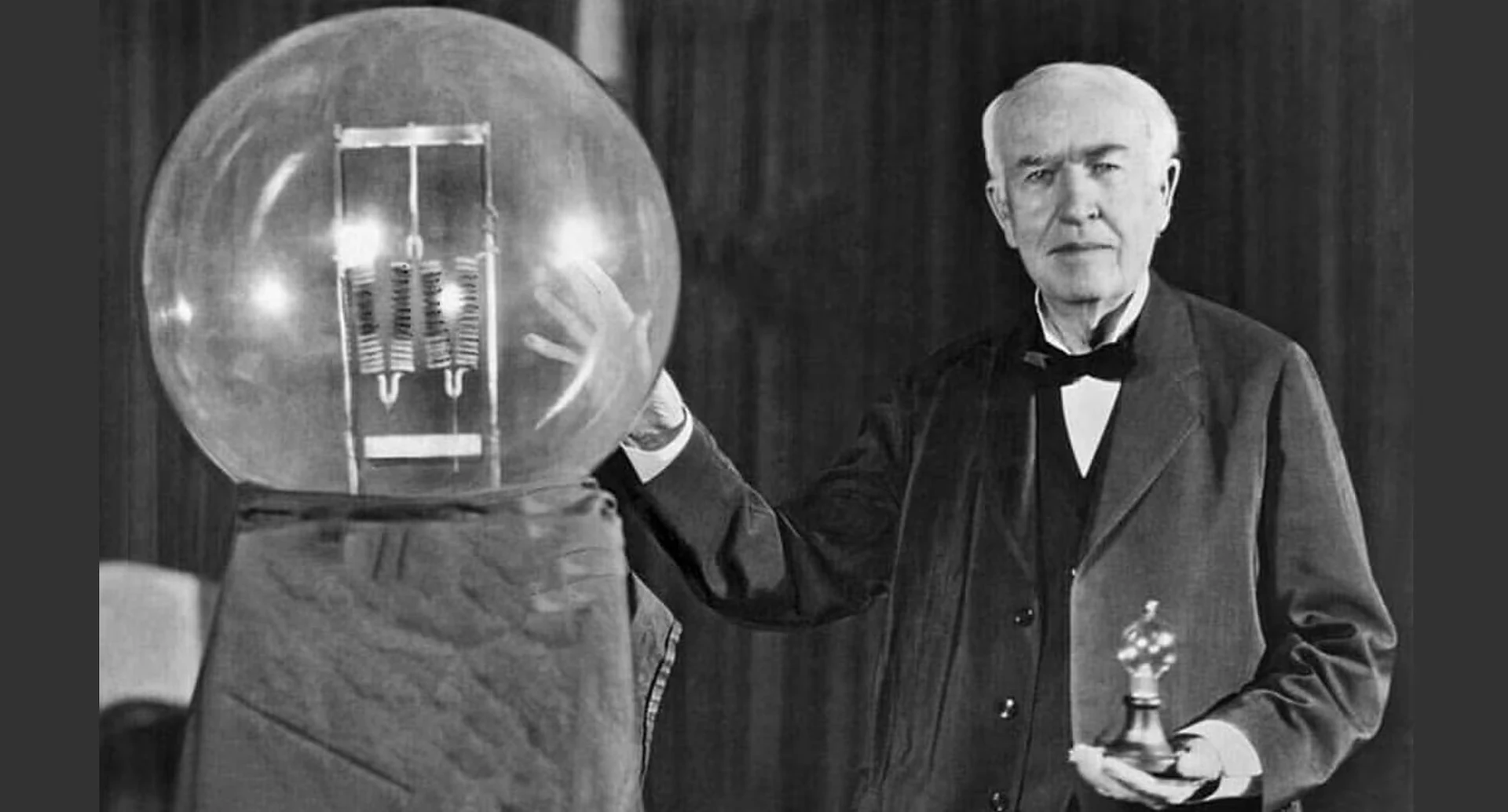
What Thomas Edison's 163-question test really measured
ACIS has never assessed Thomas Edison, holds no record belonging to him, and no retrospective assessment of anyone is possible. No IQ test result for him appears in any source opened for this page. What the archive does document is a boyhood with about three months of school, 1,093 patents, and a 1921 general knowledge questionnaire of 163 questions that most of the 718 men who took it did not pass.
Edison executed the first of his 1,093 successful U.S. patent applications on October 13, 1868, at the age of 21, according to the Thomas A. Edison Papers at Rutgers.
0 The short answer
No IQ test result for Thomas Edison is documented, so every figure printed for him, from 145 to 235, is an estimate with no test, date or examiner behind it. What the archive does document is that he had about three months of regular schooling by one 1910 account, executed 1,093 successful U.S. patent applications, and in 1921 gave job seekers and employees a general knowledge questionnaire that, in the account used here, 57 of 718 men passed. That questionnaire sampled memory for miscellaneous facts, and Rutgers professors of his own day already said it confused information with intelligence.
1,093
Successful U.S. patent applications Edison executed, the first on October 13, 1868, according to the Thomas A. Edison Papers at Rutgers.
163
Questions in the 1921 questionnaire in Paul Collins's account in The Psychologist. Pages that reproduce the list printed by the New York Times count 146.
57 of 718
Men who scored above the 70 percent pass mark on the questionnaire, 32 of them above 90 percent, in the same account.
No source opened for this page reports Edison sitting an intelligence test, and standardized mental tests did not exist until he was in his late fifties. The Binet test dates from 1905, according to Paul Collins's history of the Edison questionnaire in the British Psychological Society's magazine The Psychologist. Edison executed his first patent application at 21 in October 1868, according to the Thomas A. Edison Papers, so in 1905 he was in his late fifties (our arithmetic), and he already held an honorary doctorate from Rutgers, awarded in 1879. The Army Alpha test that Collins describes came during the First World War, when he was in his early seventies. The ratio IQ is credited to Lewis Terman's 1916 volume in Catharine Cox's footnote on the term, in her 1926 volume on the early mental traits of geniuses.
The sources searched for this page were the Thomas A. Edison Papers biographical essays on his boyhood and on his relations with Rutgers, the full text of the 1910 biography by Frank Dyer and Thomas Martin, Collins's article, the abstract of a 1984 journal article on the questionnaire, and a full text search of Cox's 1926 volume. None reports an IQ result for him. The Papers project at Rutgers describes its collection as roughly five million pages, and no one reading this page can search all of them. So the absence is a finding about these sources and not a proof about the world. A school record or a private examination could exist and be unpublished. What can be said is that no one who prints a figure for him has cited one.
ACIS has not tested Thomas EdisonACIS has never assessed Thomas Edison and holds no record belonging to him. Nothing on this page estimates his score. Where the page uses numbers such as 145, 165, 185 or 195, they are numbers that other pages print, each traced to the page that prints it. The page never infers an IQ from his patents, his habits or his schooling.
A claim about a person's IQ needs the same three details as any other measurement: the instrument, the date and the examiner. The page on what an IQ test measures explains why those details decide whether a number means anything, and the guide to celebrity IQ numbers and how they trace to sources applies the same test to other famous names. The same exercise for a different scientist, with a similar pattern of circulating numbers and no test behind them, is the audit of Alan Turing's IQ.
2 Where do the IQ figures printed for Edison come from?
Pages that print an Edison IQ range from 145 to 235 and none names a test, an examiner or a date, so the spread says more about the pages than about the man. Each page below was opened on October 6, 2026 and the basis it states is reproduced, because the basis decides whether a figure is evidence.
"Experts estimated" a range from his inventions and his academic background
No expert is named. The same page says he never took the test
Three patterns show up. The first is that the pages reuse each other's numbers: check-iq.org builds its estimate from other listing sites and not from any record. The second is that the pages are candid in their fine print and loud in their headlines. LifeScore, iqtests.com, check-iq.org and celebsiq.com each admit within the page that no test exists, yet each prints a number in its title or first line. The third is that the numbers drift upward as they travel, from 145 to 195 and then to 235, with nothing in the record that would move them.
Those numbers also collide with what a modern IQ scale can express. On a scale with a mean of 100 and a standard deviation of 15, the figures imply the following, which is our own arithmetic on a normal curve and not a statement from any of the pages. The IQ rarity calculator runs the same calculation for any score.
Printed figure
Standard deviations above the mean
About 1 person in
145
3.0
741
165
4.3
136,000
185
5.7
137 million
195
6.3
8.3 billion
235
9.0
More than 1 quintillion
The point of the table is not that Edison was or was not at any of these levels. It is that the figures from 185 upward describe positions that no norm sample ever collected could anchor, as the page on how IQ scores are normed explains, and that the pages printing them are not describing a measurement. The broader audit of the highest IQ claims shows the same ceiling problem across other famous names.
3 Why is Edison missing from Catharine Cox's 1926 ratings, and what would a rating have been?
Edison is not among the 301 historical geniuses whose childhoods Catharine Cox rated in 1926, so the best known retrospective IQ study offers no standard figure for him, and its ratings were never test results. A full text search of the digitized volume found no occurrence of his name. The book is The Early Mental Traits of Three Hundred Geniuses, the second volume of Lewis Terman's Genetic Studies of Genius, published by Stanford University Press in 1926. Cox describes her subjects as great men and women who lived between 1450 and 1850. Edison was 21 in 1868, according to the Edison Papers, and he died on October 18, 1931, according to the National Park Service biography, so he was alive when her book appeared. The text searched gives no reason for his absence, and this page does not claim one.
The absence matters because pages that print a Cox figure for another famous name are quoting her case studies and tables. For Edison there is nothing of that kind to quote. Any page that credits "historiometric research" for an Edison number is pointing at a study that never rated him.
It also matters what a Cox rating is. She defines the IQ in a footnote as the ratio of mental age to chronological age and refers readers to Terman's 1916 volume The Measurement of Intelligence, where the ratio is credited. She then explains that she uses the term in a theoretical sense, as a constant measure of relative brightness compared with a large unselected group, in the way a sigma index would do. She says the ratings were made on the basis of the standards and norms for intelligent behavior established by mental tests, applied to recorded behavior. A rating of that kind is a judgment about how a recorded childhood compares with children of a given standing, and nobody sat a test. The guide to mental age explains why that ratio fails at the top of the range, and the history of IQ testing places Terman's volume in sequence.
So the honest summary of the historical literature is short. No test of Edison exists in the sources searched, and the one study that rated eminent people from their records did not include him. A reader who sees a precise Edison figure online is looking at an editorial choice.
4 Is it true that a teacher called Edison addled, and how much schooling did he have?
The addled story comes from a 1910 biography that reports the teacher's word second hand, and the Edison Papers' own essay on his boyhood schooling does not use it, so it stands as a biographer's tradition and not as a school record. The source is Edison: His Life and Inventions by Frank Lewis Dyer and Thomas Commerford Martin, available in full text from Project Gutenberg. In an early chapter the authors say that, because of his assumed delicacy, Edison was not allowed to go to school for some years, and that when he did attend for a short time "the results were not encouraging," his mother being "hotly indignant upon hearing that the teacher had spoken of him to an inspector as 'addled.'" A later chapter repeats the point. It says the Port Huron public school gave him "all the regular scholastic instruction he ever enjoyed," which was "just three months," that his teacher "had found him 'addled,'" and that he was "always, according to his own recollection, at the foot of the class."
Read closely, the passage has three layers. The word is the teacher's, reported through an inspector and then through a mother's anger. The three months come from the authors. The place at the foot of the class is Edison's own recollection, given decades later. None of the layers is a school record, and none is a score.
The Edison Papers give a different outline in their essay on the boyhood years. It says his exposure to formal education in boyhood was limited, but that he did attend the private school of the Rev. George Engle in 1854 and, from 1859 to 1860, the publicly supported Port Huron Union School in Michigan. It quotes a letter Engle wrote to Edison in 1885, when Engle was retired and asking for financial help, which recalls that Edison had attended school under his direction and that, his father not being flush with money, Engle had not urged him to pay the bill. A text search of the essay for the word addled found nothing. That does not make the 1910 account false, and it does not make it a documented school report. It means the Papers essay does not lead with it.
What the essay does document is learning outside a classroom. Edison credited his mother as his most important teacher: "My mother taught me how to read good books quickly and correctly," he later recalled. The essay lists Edward Gibbon, David Hume and Thomas Paine among the writers he read early, says that reading Paine taught him how to think by his own later account, and names Richard Parker's Natural Philosophy, used at the Port Huron school, and Carl Fresenius's Qualitative Chemical Analysis among the scientific books he studied. It adds that he set up a chemical laboratory and a mechanical workshop at home. Paul Collins, writing in The Psychologist, calls him "home-schooled."
The sources do not agree on how long he sat in a classroom, and this page does not settle it. The 1910 book says three months at one school. The Papers essay lists two separate periods and gives no total. Either way, a teacher's remark in a pre-test era says nothing about a score. School reports, even today, are not IQ tests, and the page on IQ and academic achievement covers how the two relate in groups. For the difference between what a person has been taught and how well a person reasons, the guide to intelligence versus knowledge is the better place to start.
5 How deaf was Edison, and what is known about the cause?
Edison's deafness is documented as a fact and disputed as to cause, and no source opened for this page connects it to any measure of his intelligence. In the 1910 biography the authors say the deafness came from a box on the ears given by an angry conductor after a fire in the baggage car where the boy kept a chemical laboratory, and they quote Edison saying that the deafness had been "of great advantage" to him. His examples are practical. In a telegraph office he could hear only the instrument on his own table, and in working on the telephone transmitter and the phonograph he had to improve the apparatus until he could hear it. The Edison Papers repeat his own account in their boyhood essay, in which the baggage master "boxed my ears so severely that I got somewhat deaf thereafter."
Edison told more than one version. In a 2018 article on the medical mystery of Edison's deafness, the physician and historian Howard Markel reports a second version in which a trainman lifted the boy by the ears as he climbed into a freight car, and Edison felt something snap in his head. Markel writes that Edison later told close friends that neither event had actually occurred, while holding to the basic premise that his hearing loss began around age 12. Paul Israel, the director and general editor of the Edison Papers and one of his biographers, has suggested numerous childhood ear infections and perhaps a serious bout of scarlet fever. A few ear surgeons have retrospectively diagnosed otosclerosis or a cholesteatoma, Markel says. He adds that Edison had a mastoid abscess in 1905 and another in February 1908 that required surgical drainage. The honest summary is that the loss is real and its cause is a matter of reconstruction.
Two points matter for a page about IQ. First, Edison read heavily as a boy. Markel quotes him on the Detroit Public Library: "I read the library." Second, nothing in these sources says how hearing loss affected his performance on any measure of reasoning, because he is not recorded as taking one. Speculation of that kind is the same move as inferring a score from patents, and this page does not make it.
6 What was the Edison questionnaire of 1921?
The Edison questionnaire was a general knowledge test of 163 questions that Edison wrote himself and used on job seekers and employees in 1921, and the figures that survive describe a pass mark, a failure rate and a press craze, not a validated instrument. It is the best documented measurement episode in his life, and it is one that he gave to others. A 1984 article in the Journal of the History of the Behavioral Sciences by P. Dennis, The Edison questionnaire, is the scholarly treatment of it. Its abstract calls it a heavily publicized and controversial general information questionnaire and a neglected topic in the history of the mental test.
The Edison Papers place it inside a business story. Their essay on Edison and Rutgers says he caused a stir in May 1921, after returning to direct the Edison companies from his wartime service with the Naval Consulting Board. His son Charles had been running Edison, Inc. in his absence, and Edison told the New Brunswick Sunday Times that he found "the efficiency of the organization required rehabilitation." One of the reforms was an intelligence test for employees and for college graduates seeking jobs, which the essay dates to 1920 for employees. The same essay says the companies grew to approximately 10,000 employees by 1920 and were cut to 3,000 by 1922, so the test coincided with a downsizing.
Collins's account fills in how it ran. Early in 1921, New Yorkers who answered an anonymous job advertisement in the New York Times were told to take an early bus to Edison's works in West Orange, New Jersey, and ask for a Mr Stevenson, with no letter of introduction or resume. Inside they faced what Collins counts as 163 questions. He reports that Edison also tested people already on the payroll, that failing employees, labeled XYZ men against Grade A men in Edison's own terms, were given a week's pay and let go, and that the pass mark was 70 percent. Of 718 men who took the test, only 57 scored above 70 percent, and 32 of those scored above 90 percent. By our arithmetic, 661 of the 718 did not reach the pass mark, which is about 92 percent. The 718 is the count in Collins's account, and this page has not seen the underlying tally.
The number of questions differs by source. Collins counts 163. The pages that reproduce the list the New York Times printed in May 1921, Open Culture and Paleofuture, count 146. One reading is that the version printed for readers was a subset of the full list, but no source opened for this page says so, and the discrepancy is left open. The page uses 163 as the count from the most detailed account and says so each time.
The content was deliberately miscellaneous. From the Papers essay and Collins, the items asked for comparisons of geographic area, the material that a common container is made of, the meaning of a trade term, and a technical judgment about the safe speed at which to rotate a steel wheel of stated size. This page describes the kinds of questions and does not reproduce them. Edison's own explanation, as Collins reports it, was that reliability in an employee depended partly on a good memory and attention to detail. He said he did not care whether a man knew the capital of Nevada or the source of mahogany, but that if a man had once known such things and no longer did, he cared very much about that.
Two features are absent from every source opened. None reports a norm group, a time limit or a study linking scores to later job performance. A pass mark of 70 percent on a list of facts says how many of the answers a man could produce on that day. It does not say how that figure compares with any reference population, and it cannot be turned into a standard score.
7 How did the press, Rutgers and Einstein react?
The reaction was immediate, public and divided, and the sharpest critics made the distinction that this page turns on: the questionnaire measured information, not intelligence. Edison himself set the tone. He told the Sunday Times in New Brunswick that the result of the test had been "astonishingly disappointing" and that men who had been through college were "amazingly ignorant." A few days later, the Papers essay says, two lawyers who had recently graduated with high honors from Rutgers and belonged to Phi Beta Kappa took the test. One scored 52 out of 100 and the other 58, and the Sunday Times reported that under Edison's regulations neither would have received a passing rating.
Rutgers faculty answered. The essay says some accused Edison of having "fallen into the error of confusing information and intelligence." Dr. Walter T. Marvin, a professor of logic and philosophy and chair of the psychology department, argued that college men vary widely in information and that any group of highly educated people would probably do poorly on such a test, because the questions draw on many fields while most men are specialists. Dean Louis Gevier replied on the other side, saying that statisticians had found the highest successes in professions, business and politics to be won by college graduates out of all proportion to their number. That is the dean's claim, quoted in the essay, and not a finding this page has checked.
Collins records the wider uproar. The New York Times asked in print whether any man was ever kinder to his aged mother because he knew what copra is, and advised Edison to burn his questionnaire. One critic called it not a Tom Edison test but a Tom Foolery test. A New York University professor said that men who have succeeded without college often show a touching faith in higher education and a profound misunderstanding of its aims. The test then escaped the laboratory. After the complete questionnaire was leaked to newspapers, the questions spread across the country, journalists put them to politicians and professors, and New York's governor, the mayor of New York City, its police commissioner and its superintendent of schools failed. A reporter found Edison's son Theodore, an MIT student, who failed and admitted that his father would find him amazingly ignorant. Advertisers joined in, including a film studio and a fashion magazine.
The best known episode involved Albert Einstein. Collins reports that on May 20, 1921, on his first visit to Boston, Einstein was asked at a breakfast with the mayor and the governor what the speed of sound is and said he did not know off hand, which produced headlines that he had failed the Edison test. Collins adds that Einstein answered patiently that he did not carry information of that kind in his head when he could look it up in a book. The incident shows how a newspaper can take a famous person's lapse on one fact for a verdict on his mind, and readers interested in the physicist can turn to the page on Albert Einstein's IQ.
Professionals were not persuaded either. The Harvard psychologist A. A. Roback pointed out, in words Collins quotes, that it would be more sensible, in testing a man's intelligence, to ask how he would go about finding the answers to such questions. That sentence is the whole critique in a line. The questionnaire counted the answers a person had stored, and it did not ask how that person finds, checks or uses information.
8 Why is a general knowledge questionnaire not an IQ test?
A knowledge questionnaire counts what a person has stored from experience, while an IQ test samples several abilities against a norm group, so the two overlap without being interchangeable. Edison's critics at Rutgers saw this in 1921, and later research has given the distinction more structure. In a 2000 study in The Journals of Gerontology, Phillip Ackerman gave an array of tests to 228 educated adults between ages 21 and 62, including a broad assessment of what he called intelligence-as-knowledge alongside traditional estimates of fluid and crystallized intelligence. The abstract reports that the middle-aged adults were more knowledgeable in many domains than the younger adults. That is a design with one sample of educated adults, so it does not generalize to everyone, but it shows the direction of the problem. A test that rewards stored facts rewards years of reading, work and curiosity, which is a different thing from how quickly a person solves a problem that is new to them.
The CHC model of cognitive abilities keeps the two apart. Crystallized ability (Gc) covers acquired knowledge and language, and fluid reasoning (Gf) covers solving novel problems, as the pages on fluid and crystallized intelligence and the CHC model explain. A questionnaire of miscellaneous facts leans on the first. It says little about the second, or about working memory (Gwm), processing speed (Gs) or visual spatial ability (Gv). Modern batteries do include knowledge tasks, but as one component among several. In ACIS, for example, a subtest called Information is one of five in the verbal comprehension index, which sits beside five other indices, and each subtest is converted to a scaled score through norms.
Four differences separate a questionnaire like Edison's from a scored subtest.
Feature
Edison questionnaire, as reported
Scored subtest in a modern battery
Content
Miscellaneous facts across many fields, chosen by one man
Defined content domain, items selected and reviewed against it
Score
Percent correct against a 70 percent pass mark
Raw score converted through norms to a scaled score with a stated mean and spread
Reference group
None reported in the sources opened
A norm sample for the age of the person tested
Evidence for use
No validity study reported in the sources opened
Reliability and validity evidence, described in a technical manual
The professional standard that governs employment tests asks for exactly what the sources do not report. The Standards for Educational and Psychological Testing ask for a thorough and explicit definition of the content domain when validity rests on test content (Standard 11.2), and a close link between test content and the job requirements when content is the primary source of evidence (Standard 11.3). Edison's list was designed to be broad. No source opened for this page reports a job analysis tying its items to the work of any position, and this page does not say that none exists. It says the evidence the Standards require is not in the accounts that survive.
None of this makes the questionnaire foolish. Edison's claim, as Collins reports it, was narrower than the public argument suggested: that attention to detail and memory mattered in an employee. That is a hypothesis that could have been tested against job performance. The sources opened do not show that anyone did. The page on aptitude versus intelligence explains the difference between a test built for a task and a test built for a general ability, and the guide to types of intelligence places practical knowledge in the wider picture.
The questionnaire left a lasting mark on how Americans thought about testing, because its publicity helped carry short answer, right or wrong testing into schools, civil service and employers. Collins, whose account is the source for this section, calls the publicity a fillip for the budding testing industry. He reports that within days the Eastman Kodak company announced a similar test for its employees and that the Groton School in Massachusetts extended its use to applicants. The state of New Jersey soon awarded a top civil service job on the results of a three-hour questionnaire, and the winner, Collins notes, was a former Edison A-man.
The administrator of the New Jersey test was the Princeton psychologist Carl C. Brigham, who went on to play a leading role in introducing the College Board's Scholastic Aptitude Test. Collins draws the parallel directly. Like the Edison test, he writes, the SAT stripped knowledge from context or process, so that only right and wrong answers mattered. He also notes that critics argued the SAT's potential for cultural bias made it suspect, and that Brigham had earlier used results of the Army Alpha test to push for anti-immigrant legislation, although he later renounced the notion of inferior nationalities. The relationship between the SAT and IQ is covered on the page about IQ versus the SAT, and the wider story, from Galton to Binet to the Army tests, is in the history of IQ testing.
Edison did not drop the idea. Collins reports that in 1929, at 83, he announced a nationwide search for his intellectual successor, beginning with a competition for a scholarship to MIT. Forty-nine finalists came to his factory for an ice cream social, a day at Coney Island and a day-long final examination conducted by the inventor and marked by a panel that included Edison, Henry Ford, Charles Lindbergh and George Eastman. The winner was Wilber Huston of Seattle, who, Collins writes, went on to become mission director for the launch of NASA's Nimbus and Landsat satellites.
The heirs of the 1921 craze also include the employer tests of later decades, and the page on Wonderlic scores and IQ covers the best known of them as a historical question. Nothing here recommends using any test, including ACIS, to hire. The point is historical: a general knowledge list in 1921 started a public argument about what tests should measure, and that argument was never settled by the list itself.
10 Did Edison really say that genius is one percent inspiration and 99 percent perspiration?
Edison can be credited in print with the 1 percent and 99 percent form from 1901, though the earliest versions are second hand reports, the first person acknowledgment is a recollection published in 1932 after his death, and a popular companion quotation about 10,000 failures departs from what the 1910 record says. The most careful dated history is by the Quote Investigator, in its entry on the origin of the genius ratio. It reports that the earliest version located with the 1 to 99 ratio appeared in a 1901 Idaho newspaper, found by the researcher Barry Popik, which quoted Edison as saying genius is 1 per cent inspiration and 99 per cent perspiration. In 1902 Scientific American gave a 2 to 98 version, as the answer he once gave to a man who thought genius worked only when the spirit moved him. In 1932, after Edison had died, a man who worked in his laboratory, Martin Andre Rosanoff, published an article in Harper's Magazine that quoted Edison taking credit, in words the article attributes to him: "You may have heard people repeat what I have said, 'Genius is one per cent inspiration, ninety-nine per cent perspiration.'"
The 1910 biography adds a contemporary record. Its authors call the line his "historic remark" and say that attributing great success to genius "has always been repudiated by Edison." They then print an exchange between Edison and his associate E. H. Johnson, in which Johnson alludes to Edison's genius, and Edison replies that genius is "hard work, stick-to-it-iveness, and common sense." Johnson answers that there is still more to it than that, and goes on to list the telephone receiver and the subdivision of the electric light. Even in the book that records the slogan, then, the slogan was contested by the man at the next desk.
The companion quotation is the popular claim that Edison said he had not failed but had found 10,000 ways that would not work. That wording does not appear in the 1910 biography. What does appear is a story told by W. S. Mallory, whom the authors call one of Edison's closest associates for many years. According to Mallory, Edison had made over nine thousand experiments on a new storage battery with nothing promising, and when Mallory sympathized that he had gotten no results, Edison replied that he had gotten a lot of results because he knew several thousand things that would not work. The experiments, Mallory adds, ran to over ten thousand before the missing link appeared. So the record has several thousand, it concerns a storage battery, and the 10,000 is a count of experiments. The popular version is a paraphrase that changed the number and the meaning.
Does the slogan describe how achievement works? A meta-analysis gives a measured answer for one kind of effort. In Macnamara, Hambrick and Oswald's 2014 analysis in Psychological Science, deliberate practice, defined as structured activity created to improve performance, explained 26 percent of the variance in performance for games, 21 percent for music, 18 percent for sports, 4 percent for education and less than 1 percent for professions. The authors conclude that deliberate practice is important, but not as important as has been argued. That study is about deliberate practice and not about Edison, and it is a correlational synthesis, so it cannot say how his work habits related to his output. It does show that a fixed 99 percent share for effort is a slogan and not a measured quantity, and it fits the page on IQ and creativity, which looks at how ability and effort relate across domains.
11 What does the documented record show about Edison, and what can it not show?
The record documents output, institutions and a long public life, and none of that converts into an IQ. The table lays out each frequent claim beside the status of its evidence, as found in the sources opened for this page.
Claim
What the sources show
Status
1,093 successful U.S. patent applications
The Edison Papers list 1,093 and estimate 500 to 600 unsuccessful or abandoned applications, the first executed on October 13, 1868
Documented
About three months of school
One 1910 account says three months. The Papers essay lists 1854 and 1859 to 1860 and gives no total
Sources differ
A teacher called him addled
Second hand report in the 1910 biography. Not used in the Papers boyhood essay
Biographer's tradition
Deafness from childhood
Documented. Cause disputed: blows to the ears, infections, scarlet fever, otosclerosis and cholesteatoma have all been proposed
Fact documented, cause open
He wrote and used a 163-question questionnaire in 1921
Rutgers essay, Collins and the Dennis article agree on the episode. Counts of questions differ
Documented, details vary
He was rated in Cox's 1926 volume
No occurrence of his name in a full text search of the volume
Not in the study
An IQ of 145 to 235
Six pages print figures, none names a test, date or examiner
No evidence
Patents are the strongest documented fact, and the most tempting to misuse. The Papers describe his applications as ones he executed, over a career that began at 21. By 1920 his companies employed approximately 10,000 people, according to the Rutgers essay. A patent count records an output of an organization led by one person. It does not separate talent from team, capital, timing or luck, and no test or study turns it into a score. This page does not estimate an IQ from patents, for the reason a statistician would give: the output is not a calibrated measure of the trait.
The comparison readers most often ask for, Edison against his rival Nikola Tesla, belongs to its own page. The audit of Nikola Tesla's IQ figures takes the same approach to a person whose circulating numbers are also unsourced. The related guide on genius and IQ covers what the word genius does and does not mean in measurement.
12 What should a reader take from this about measuring their own IQ?
A famous questionnaire, a slogan or a list of patents cannot tell you where you stand, because a score is only meaningful when the instrument, the norm group and the error are known, and professional standards ask for exactly that. The Standards for Educational and Psychological Testing, published by AERA, APA and NCME in 2014, say in Standard 1.0 that each intended score interpretation for a specified use should be clearly articulated and supported by appropriate validity evidence. Standard 1.3 adds that if validity for some common or likely interpretation has not been evaluated, that fact should be made clear and potential users strongly cautioned. For employment settings, Standards 11.1 to 11.3 ask for a clear statement of the intended interpretation, an explicit definition of the content domain and, where content is the evidence, a close link to the job. Applied to this page, the sentence "Edison had an IQ of 145" has no articulated interpretation and no evidence, and the 1921 percent correct has a stated use but no reported validity study.
The APA gives related guidance for psychologists. In the Ethical Principles of Psychologists and Code of Conduct, Standard 9.01(b) says psychologists provide opinions of the psychological characteristics of individuals only after an examination adequate to support their statements, and, when an examination is not practical, they document their efforts, clarify the probable effect of limited information and appropriately limit their conclusions. Standard 9.01(c) covers record reviews and asks psychologists to explain the sources of information their conclusions rest on. A psychologist following that code could say a great deal about what the archive shows about Edison, as this page does, and nothing about what his IQ was.
The practical advice for your own result is to ask the same questions of it: which test, which norm group, which date and how much error. ACIS sells a paid assessment, so treat this paragraph as a disclosure. It reports a Full Scale IQ and six primary indices on the standard scale with a mean of 100 and a standard deviation of 15, with percentiles and a 95 percent confidence interval, and adult norms cover ages 16 to 90. The page on standard deviation 15 explains the scale. Prices and forms read on October 6, 2026 can change: Quick costs 15 dollars for 6 subtests in 3 domains and takes about 45 minutes, Optimized costs 30 dollars for 13 subtests in 5 domains and takes about 110 minutes, and Full Scale costs 50 dollars for all 20 subtests in six domains and takes about 175 minutes. Payment is one time with no subscription, breaks are allowed, there is a free trial with no card, a 5 day quality guarantee and 30 days to complete.
The limits are plain. ACIS is online and unsupervised, it is not a clinical or diagnostic instrument, it is not for hiring, school accommodations or admission to high IQ societies, and it is available in English only. It measures cognitive abilities and not stored trivia, curiosity or the habits of an inventor. The technical manual holds the documentation, and the page on reliability and validity explains how to read it. No ACIS statistic is quoted here. For choosing a test, the comparison of the best online IQ tests and the guide to where to take an IQ test apply the same questions, and the page on what an IQ score means covers interpretation.
Every figure, quotation and attribution above is traceable to one of the following, each linked at the point where it is first used, and every web page was opened on October 6, 2026. The rarity table, the count of 661 men who did not reach the pass mark and the 92 percent are our own arithmetic on published numbers. The statements that no source reports an IQ test for Edison, and that his name does not occur in Cox's volume, come from our own text searches of the sources listed.
Collins P. Looking Back: 163 ways to lose your job. The Psychologist, British Psychological Society, January 18, 2010, printed with permission from New Scientist, August 9, 2008.
Dennis P. The Edison questionnaire. Journal of the History of the Behavioral Sciences, 1984, volume 20, issue 1, pages 23 to 37. Record verified through Crossref. Only the abstract as returned by a search result was seen, because the publisher page blocked access.
Cox CM. The Early Mental Traits of Three Hundred Geniuses. Genetic Studies of Genius, volume 2, edited by Terman LM. Stanford University Press, 1926. Read in an OCR text of the volume, which was searched for the name Edison.
Terman LM. The Measurement of Intelligence. Houghton Mifflin, Boston, 1916. Cited as the source of the ratio IQ through Cox's footnote.
Ackerman PL. Domain-specific knowledge as the "dark matter" of adult intelligence: Gf/Gc, personality and interest correlates. The Journals of Gerontology Series B, 2000, volume 55, issue 2, pages P69 to P84.
Macnamara BN, Hambrick DZ, Oswald FL. Deliberate practice and performance in music, games, sports, education, and professions: a meta-analysis. Psychological Science, 2014, volume 25, issue 8, pages 1608 to 1618.
American Educational Research Association, American Psychological Association and National Council on Measurement in Education. Standards for Educational and Psychological Testing. AERA, 2014. Standards 1.0, 1.3, 11.1, 11.2 and 11.3 read in the open access PDF.
Nobody knows, because no IQ test result for Thomas Edison appears in any source opened for this page. Websites print figures from 145 to 235 without naming a test, a date or an examiner. What is documented is his patents, his schooling and the 1921 questionnaire he wrote.
Did Thomas Edison ever take an IQ test?
No record of it appears in the sources searched. The first prominent mental test came in 1905, when Edison was in his late fifties, and the Army tests came later. A private examination could exist unpublished, but nobody who prints a figure has cited one.
Was Thomas Edison's IQ 145?
The 145 is an editorial estimate, not a result. One site that prints it labels its own basis as an editorial comparison with very low confidence, and another averages sites that also print 145. None cites a test, so 145 describes the pages that repeat it and not the man.
Was Thomas Edison smarter than Einstein?
No source can answer that, because neither man has a documented IQ test result. Pages that rank them reuse unsourced estimates. The 1921 episode in which Einstein could not name the speed of sound for reporters was a newspaper quiz, not a measurement.
How much school did Thomas Edison attend?
Accounts differ. A 1910 biography says about three months at the Port Huron public school. The Edison Papers list a private school in 1854 and a public school from 1859 to 1860 without giving a total. By all accounts his mother taught him much of what he learned at home.
Did a teacher really call Thomas Edison addled?
It is reported but not documented as a school record. The 1910 biography says the teacher described him that way to an inspector and that his mother was indignant. The Edison Papers essay on his boyhood schooling does not mention it, so treat it as a biographer's tradition.
Why do websites give Edison different IQs?
Because the figures are guesses, not measurements, and each site picks its own. Estimates run from 145 to 235 online, and some sites average other sites. Without a test, a date and an examiner, there is nothing to reconcile, and the numbers drift upward as they are copied.
What was the Edison questionnaire of 1921?
It was a general knowledge test that Edison wrote for job applicants and employees at his works in New Jersey. Its questions ranged across geography, materials, trade terms and engineering. Rutgers professors criticized it at the time for confusing information with intelligence, and it became a national newspaper craze.
How many questions were on Edison's test?
The most detailed account counts 163 questions. Two pages that reproduce the list printed by the New York Times count 146. The sources opened do not explain the gap, and the size may have varied by version or by the position being filled.
How many people passed Edison's questionnaire?
In the account by Paul Collins, 57 of 718 men scored above the 70 percent pass mark, and 32 of those scored above 90 percent. That leaves 661 who did not reach the mark. The count comes from one secondary account, and the underlying tally was not seen.
Did Einstein fail Edison's test?
Newspapers said so. On May 20, 1921, reporters in Boston asked Einstein the speed of sound, he did not know it off hand, and headlines declared that he had failed the Edison test. He replied that he did not carry such facts in his head when a book could supply them.
Who criticized Edison's questionnaire?
Rutgers faculty, the New York Times and testing experts all did. A Rutgers psychology chair argued that specialists would score poorly on any list of miscellaneous facts. A Harvard psychologist said a better test of intelligence would ask how a person would find the answers.
Why was Thomas Edison deaf?
The cause is disputed. Edison blamed a blow to the ears on a train, but later told friends that neither version of the story had happened. Biographers and doctors have suggested childhood ear infections, perhaps scarlet fever, and, retrospectively, otosclerosis or a cholesteatoma.
Did Edison really say that genius is one percent inspiration?
In a sense, but the early evidence is second hand. A 1901 newspaper and the 1910 biography attribute the line to him, a 1902 report gives a 2 to 98 version, and a laboratory worker recalled Edison claiming it in a 1932 article. The popular 10,000 failures quotation differs from the 1910 record.
Is a general knowledge test the same as an IQ test?
No. A knowledge test counts facts a person has stored, while an IQ battery samples several abilities, including reasoning, working memory, speed and spatial skills, and converts scores through norms. Knowledge tasks can be one component of a battery, but they are not the whole of it.
Can you estimate IQ from inventions or patents?
No. A patent count measures output of an organization over a career and does not separate talent from team, capital or timing. No test or study converts patents into a score, and an estimate from patents would be a guess dressed as a measurement.
Why is Edison not in Catharine Cox's 1926 study?
The volume searched does not explain it. Her subjects were eminent people who lived between 1450 and 1850, and Edison was alive when the book appeared. Whatever the reason, there is no Cox rating for him, so pages citing historiometric research for an Edison IQ cite nothing.
Does a poor school record mean a low IQ?
No. A school report reflects a child's experience of a particular teacher, curriculum and period, and a remark such as addled is not a score. A teacher's word cannot stand in for a test, and the reverse also holds for a high mark.
What does a modern IQ test measure that Edison's questionnaire did not?
It samples reasoning with new problems, working memory, processing speed, spatial ability and quantitative reasoning as well as verbal knowledge, and it compares the result with a norm group. Edison's list measured one kind of stored knowledge against a pass mark with no comparison group.
Is ACIS a hiring test?
No. ACIS is not for hiring, school accommodations or admission to high IQ societies, and it is not a clinical or diagnostic instrument. It is an online, unsupervised cognitive assessment in English that reports indices, percentiles and a confidence interval for the person who takes it.
How should I read my own IQ score?
Read it as a range, not a point. A good report gives the test, the norm group, a percentile and a confidence interval, and it treats a gap of a few points as noise. A single number without those details, like the figures printed for Edison, is not evidence.
Take the assessment
You get a profile, not a number
ACIS measures six CHC domains across 20 subtests and reports each one with its own normed score and confidence interval, so you can see where you are strong and where you are not.