Jensen Huang IQ: the transcript, the 180 and the documented record
ACIS has never assessed Jensen Huang, holds no record belonging to him, and no retrospective assessment of anyone is possible. This page follows the phrase "low IQ era" back to the interview it was attached to, follows the figures 180 and 185 to pages that cite no test, and separates both from what Nvidia, Oregon State University and his own speeches document about his education, work and public statements.
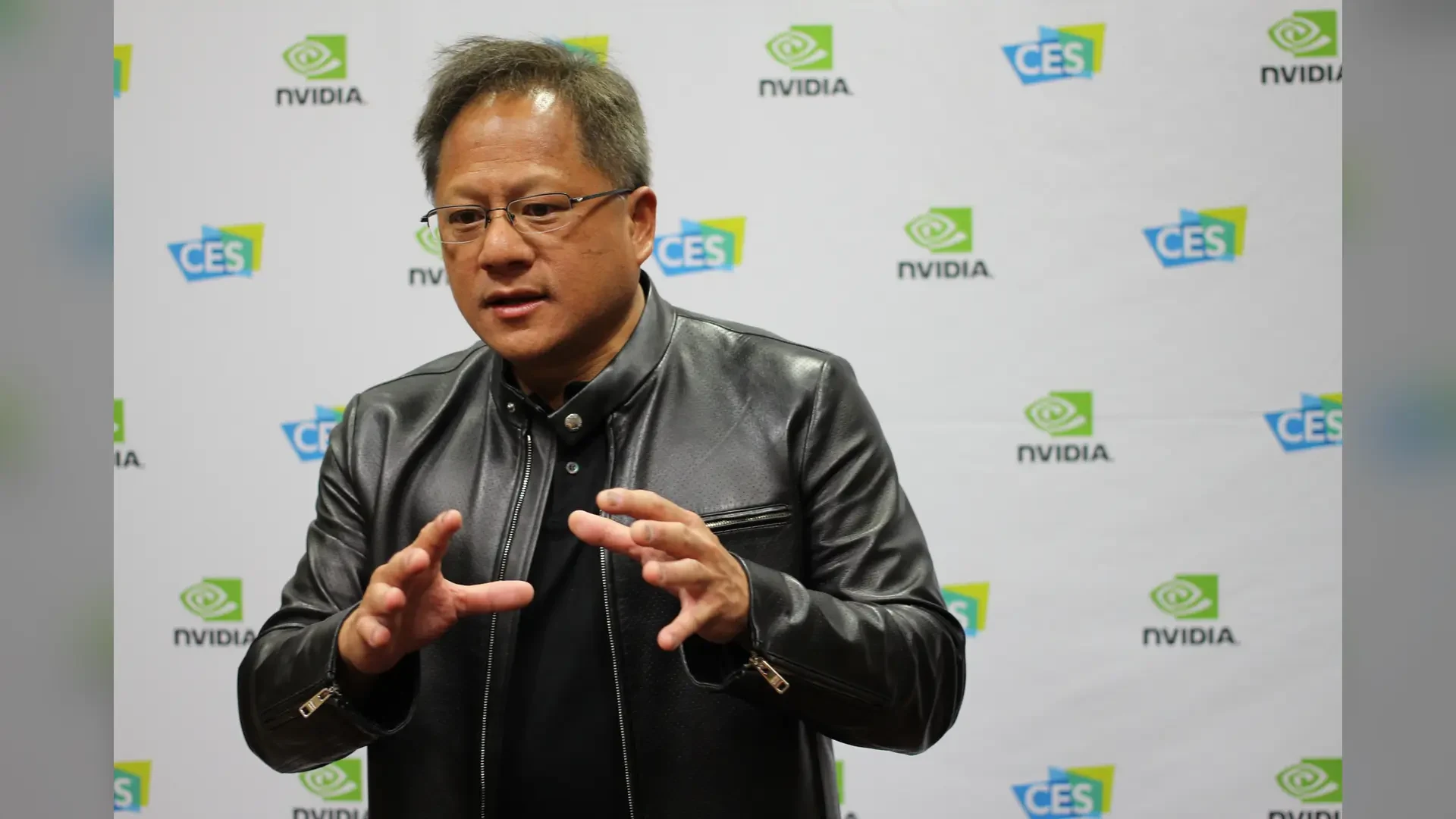
The backdrop pairs Nvidia logos with CES logos; the file supplied for this page names no date, venue or photographer.
0 The short answer
Jensen Huang has no published IQ score, and the phrase "low IQ era" that went viral in September 2026 does not appear in the machine transcript of the interview that coverage ties it to. In the September 23, 2026 episode of The Ezra Klein Show, Huang agreed that children are forgetting basic arithmetic, asked "Does it matter?" and answered that he did not think it does; the words "IQ" and "low IQ" are absent from the transcript we searched. The 180 and 185 on celebrity lists come with no test, examiner or date. What the record does document is an Oregon State engineering degree, a Stanford master's earned while working, and the 1993 founding of Nvidia, and none of that is an IQ.
ACIS has not tested Jensen HuangJensen Huang is a living person and has never been assessed by ACIS. This page does not estimate his IQ, does not infer a score from his career, and does not offer a measured score for him. It audits a quotation and two circulating numbers, and it reports his education and public statements only from records and dated interviews we read.
180 and 185
The two IQ figures that circulate for Huang, with no test, examiner or date attached to either.
September 23, 2026
Date shown for the Ezra Klein Show episode that contains the long division exchange.
1993
Year Nvidia says Huang founded the company, according to its official biography.
1 What did Jensen Huang actually say in the interview behind the "low IQ era" headlines?
Huang said that basic arithmetic skills are being forgotten and that he does not think it matters, and he said it in reply to a question about a study of Chinese students. The exchange comes from the September 23, 2026 episode titled "Jensen Huang vs. the A.I. Doomers," as reproduced in the Podscripts transcript, which is machine generated from the audio. We downloaded that transcript and searched its full text for "IQ". There was no match. We did not listen to the audio ourselves, so the claim is limited to the transcript: no spoken "IQ" appears in it.
Klein had just read from a study. He described research on 26,000 students in grades 7 to 12, with staggered adoption of AI tools, and read out that AI adoption raises homework scores by 18 percent, cuts completion time by 30 percent and lowers monthly exam scores by 20 percent within six months, with entrance exam scores falling by 18 and 24 percent after about two years. The study is real and can be checked: it is CEPR Discussion Paper 21577, "The Generative AI Learning Penalty: Evidence from Chinese Secondary Education," by David Strömberg, Victor Lei and Yanhui Wu, dated June 2, 2026, and its abstract reports a panel of 26,811 students over 30 months. It is a discussion paper, a working paper form that circulates before journal peer review. Its outcome measures are exam and homework scores, not IQ.
Huang's reply, in the words the transcript prints, began with agreement: "I think the last part, I completely agree." He then said that if you try to get a kid to do long division now, the multiplication table is starting to be forgotten and square roots are worse. He posed the question himself: "Does it matter?" Klein asked him to answer it, and Huang said he did not think it does, repeating that he did not. When Klein pressed that some set of skills must matter, Huang agreed in principle and added that perhaps they are not those skills and that new ones will be discovered.
Two further moves in the exchange are worth recording because the viral posts left them out. First, Huang offered a personal example of a forgotten fact: he said he does not know his own address, that he once had to pump gas and could not produce his ZIP code, and that he does not know his telephone number but can live with it. Second, when Klein took the other side and said he values an attention span formed on physical books, Huang replied that engineers today are far better "systems thinkers" than he was when he graduated, though he was a much better "transistor thinker." As evidence he said the first chip he worked on had about 200 transistors and "I knew every one of them by name," and that no engineer does that today.
That is the whole of the material relevant to the headlines. It is a position about which skills a person needs to keep learning, stated in a conversation about schooling and AI. It is not a statement about measured intelligence, it contains no figure for anyone's IQ, and it does not describe any population as having a low IQ. A careful reader can disagree with the position, as Klein partly did in the same conversation, without needing the posts' wording to do so. The broader question of what AI systems do to cognition belongs to the page on IQ and artificial intelligence, and the separate question of how language models score on tests is covered on the ChatGPT IQ page; this page stays with the quotation and with Huang.
2 How did "low IQ era" become a quotation?
The phrase appears in headlines and posts from September 25, 2026, two days after the episode, and in the coverage we read it is the writer's wording, never traced to a spoken line. The earliest items we found are posts on X whose numeric identifiers decode to timestamps on that date. A post identifier on X encodes the moment of posting, so converting the identifiers of the three posts the search engines returned gives 15:08 UTC and 15:11 UTC for two of them and 18:58 UTC for a third (this decoding is our arithmetic on the identifiers, not a figure the platform printed). The posts say that Huang says society is entering a "low IQ era" in which children will not need to learn basic math, or in one case that AI is changing how we think and learn. None of the posts we saw names the interview. We connect them to this exchange because they describe the same remark about children and basic math, and because reports from the same day, such as the American Bazaar and Futurism articles in the table, tie that remark to the Klein interview. We did not search exhaustively, so earlier items may exist.
Outlets that wrote at length used different words. The table sets out what we read.
Item (read on October 6, 2026)
Date shown
Uses the phrase "low IQ"?
What it attributes to Huang
Ezra Klein Show transcript (Podscripts)
September 23, 2026
No
Basic math skills forgotten; "Does it matter?"; he does not think it does
Watcher.Guru post on X
Identifier decodes to September 25, 2026, 15:08 UTC
Yes, in quotation marks
A "low IQ era" in which children will not need to learn basic math
Conor Kenny post on X
Identifier decodes to September 25, 2026, 15:11 UTC
Yes, in quotation marks
A "low IQ era" in which kids may no longer need basic math
wabble.news article
September 25, 2026, 3:10 PM UTC as printed on the page
Yes, in the headline and opening
Presented as a direct statement, with no verbatim quote of the original words
KuCoin news item
September 25, 2026
Yes, as "what he calls" a low-IQ era
Cites an X post by an account named tradermustafa44 as its source
American Bazaar article
September 25, 2026
No
Basic math skills do not matter in the AI era
Futurism article
September 25, 2026
No
Quotes "Does it matter?" and the answer, in a critical frame
The pattern is that the quotation marks sit around words the article's own text never traces to a speaker. A wabble.news item opens with the phrase, yet gives no verbatim sentence from Huang containing "IQ"; the KuCoin item says "what he calls" a low-IQ era and names a social post as its source. Two reports that stayed close to the interview, the American Bazaar article and the Futurism article, do not use the phrase at all.
What this audit can and cannot sayWe can say that the phrase is absent from the transcript we searched and from two reports that quote the exchange. We cannot say that Huang never used the words anywhere, because we did not hear every minute of audio or every other appearance, and a machine transcript can mishear. The claim on this page is narrower: nothing we located shows him saying "low IQ era," and the quoted exchange is about basic math skills.
Why would a paraphrase take that form? "IQ" works as a compact word for a person's general mental sharpness, and "low IQ era" compresses a claim about skills into a claim about people. That compression changes the meaning. Saying a society no longer needs to practice long division is a statement about which learned procedures are worth teaching. Saying it is entering a low IQ era is a statement about the cognitive capacity of the population, which is what an IQ score is supposed to describe. The second claim needs measurement over time. The research that bears on it is reviewed later on this page, in the sections on the Flynn effect and on schooling.
3 Is Jensen Huang's IQ 180 or 185?
Neither number has a test behind it, and the two competitor pages that examined them were both dated in August 2026, before the September posts, which means the figures predate the "low IQ era" quotation. The 180 and the 185 circulate on celebrity lists and in answers from search assistants. We looked for the page that prints each figure and for any document behind them.
RIOT IQ publishes an article titled "What Is Jensen Huang's IQ?", dated August 16, 2026 on the page and credited to Dr. Russell T. Warne, who is listed as its chief scientist. It states that he has no verified IQ score, that he has never said he took an IQ test, that no result has been published, and that the "180" or "185" attached to his name on celebrity IQ sites cites no test, no examiner and no date. IQ Metrics publishes a page on the same question, marked as last reviewed in August 2026. It says the figure, "180 or sometimes 185," cannot be traced to a test, an examiner or even one dominant source, and that after checking it could not say which of the two numbers has the stronger claim to being the one attached to him. Both sites promote or sell IQ assessments, so neither is a neutral party. We cite them for one narrow purpose, which is to show that independent attempts to trace the figures ended in the same place. We read both pages on October 6, 2026.
Neither page is evidence of a score, and neither is offered here as one. The point is that the search for a source returned nothing: no test name, no administration date, no examiner, no norm group, no report. A circulating number with none of those attributes is a label, not a measurement. The page on celebrities with the highest IQ applies the same test to other names, and the page on the highest IQ ever recorded covers why figures at the top of a list are the least reliable ones.
IQ Metrics adds an estimate of its own, 150 to 165, which it derives from "achievement and academic record." That is an inference from a biography, and it shares a weakness with the 180: no test was given. ACIS does not endorse it, does not use it and does not offer a replacement. A career as a founder is consistent with many different measured scores, and a score cannot be run backward from outcomes. The same logic runs through the page on what IQ tests measure: a score is a property of an administration, and a biography is not an administration.
It also helps to know what numbers like these would mean if they were real. On the standard scale, with a mean of 100 and a standard deviation of 15, a score of 180 sits 5.33 standard deviations above the mean. On a normal curve that is roughly 1 person in 21 million, and 185 is roughly 1 in 137 million. These are our arithmetic on the normal curve, offered to show scale, not frequencies anyone has measured. A norming sample of a few thousand people would contain no one that rare, so a figure of that size is an extrapolation of the curve rather than an observed score. The IQ rarity calculator lets you run the same arithmetic for any figure, and the page on how IQ scores are normed explains why the tails of a distribution are the least supported part of any test. The scale convention itself is explained on the page about the standard deviation of 15.
4 What does the record document about Jensen Huang?
The record documents a path through engineering degrees, chip-industry jobs and one company founded in 1993, and every item in it is an event, not a score. Nvidia's official biography, read on October 6, 2026, says he founded Nvidia in 1993, that he holds a BSEE degree from Oregon State University and an MSEE degree from Stanford University, and that he held positions from 1985 to 1993 at LSI Logic Corp. and from 1984 to 1985 at Advanced Micro Devices, Inc. The table collects the items that carry a date and a primary or reliable record.
Item
What the record says
Where it is documented
Move to the United States
Parents working in Thailand in 1973 sent the two sons to the United States; Huang was 9 on arrival at his Kentucky school, his brother 10
Master's in electrical engineering, earned while working full time
Oregon State Hall of Fame record; Nvidia official biography for the degree
Nvidia
Founded 1993; at age 30, cofounded at a Denny's meeting
Nvidia official biography; Carnegie Corporation of New York
Honors from Oregon State
Honorary PhD in engineering, 2009; Engineering Hall of Fame, 2013
Oregon State College of Engineering
Three cautions keep this table honest. First, the sources differ on his age at Oneida, 9 in his own account to NPR and 10 in the Carnegie record, and we report both rather than pick one. Second, the year of the Stanford degree, 1992, is printed on the RIOT and IQ Metrics pages and not in Nvidia's biography, so we treat the year as reported by those pages, not as an item in an official record we opened. Third, one widely repeated detail, that he skipped two grades, appears on the IQ Metrics page, but we did not find a primary record for it. What the primary records support is the age, not the mechanism: graduation from high school at 16 and arrival at Oregon State at 16.
Oregon State's own 2013 story about his visit adds a detail that is easy to check, that he lived in McNary Hall as the youngest student in his dormitory. The Hall of Fame entry says he completed the Stanford master's while working full time. The honest summary of the record is that it shows an unusually young start in higher education, a sustained technical career and a long tenure leading one firm. It does not show a test.
5 What do Oneida and Denny's tell us, and what do they not?
They tell us where he worked and studied and in what order, and they say nothing about his measured intelligence. The two places are the most repeated parts of the story, and both are documented in his own words. They are also the parts most often bent to fit a narrative of effortless genius or of triumph over adversity, so it is worth being precise about what the sources say.
At Oneida, NPR's Steve Henn reported in 2012 that Huang's parents, working in Thailand during the social unrest of 1973, decided it was probably safer for the boys to go to the United States first and follow later. In that account Huang was assigned to clean the bathrooms when he arrived, helped an older dorm-mate in math and joined the swim team. His own summary is short: "The ending of the story is I loved the time I was there." The report adds that in the early 1970s many local people thought of Oneida as a religious reform school, and it quotes the school's president saying Oneida would not take some of the students it took in the 1970s and 1980s. The Carnegie Corporation record describes it as a reform academy that his uncle mistook for a prestigious boarding school. The two accounts agree on the school and differ in emphasis and in his age on arrival.
Denny's appears twice. The first is the job. In the September 26, 2023 Nvidia blog post about the plaque unveiled at the San Jose restaurant, Huang said "I was a dishwasher, I was a busboy, I waited tables," and the post says he got the job in Portland at 15. In a View From The Top talk at Stanford Graduate School of Business, published by the school on April 25, 2024, he called Denny's "my alma mater, my first company" and said he was probably Denny's best dishwasher because he planned his work and was organized. The second is the booth. The Nvidia post says three friends, Huang, Chris Malachowsky and Curtis Priem, met there in 1993 to discuss a chip for realistic 3D graphics on personal computers, and it quotes Huang explaining the choice: "It had all the coffee you could drink and no one could chase you out."
What can be drawn from these? A reader can take the narrow facts: a teenage job, a school in Kentucky, a restaurant meeting. A reader should not take an inference about aptitude from them. Companies are founded in diners by people across every range of measured ability, and a hard start does not imply a score in either direction. When a celebrity page moves from "he washed dishes" to "so his IQ must be," it is replacing evidence with a story. That is also why this page does not describe his character or private life beyond what he has said publicly: the sources support a timeline, and the timeline does not support a personality profile.
6 Why did he say intelligence is "not top of that list"?
The most relevant thing Huang has said in public about his own intelligence is that it is not the quality he values most in himself, and it comes from his 2024 Caltech commencement address. On June 14, 2024, Huang delivered the keynote at Caltech's 130th commencement, as the Caltech news page records. In the part of the speech headed "Setbacks and Superpowers" in the Singju Post transcript, he told graduates that pain and suffering "will strengthen your character, your resilience and agility, and they are the ultimate superpowers." The next sentence is the one that matters for this page: "Of all of the things that I value most about my abilities, intelligence is not top of that list." He then named what he does value: his ability to endure pain and suffering, to work on something for a very, very long period of time, and to handle setbacks and see the opportunity just around the corner.
This is a self-description in a speech, and it has to be read as one. It is not a test result and it is not evidence that he is more or less intelligent than anyone else. It does show that the person at the center of the 180 and 185 claims, when speaking publicly about himself, ranks persistence above intelligence. A page that wanted to be accurate about him would not put a number on the one quality he himself does not put first.
It is also worth reading the sentence for what it does not claim. Huang does not say that he is unintelligent, and he does not say that intelligence is unimportant. He ranks a set of qualities in his own view of his abilities. A ranking by the person himself is a statement of values, which is a different category of evidence from an assessment. Anyone using it to argue for a high IQ or against one would be overreading it. The same caution applies to the stronger claim, common on success pages, that persistence alone explains outcomes, a question the page on IQ and success treats with the evidence on both sides.
7 Is long division an IQ skill?
Long division, the multiplication table and square roots are learned procedures, so forgetting them is a change in acquired knowledge before it is evidence about reasoning ability. The skills Huang listed are taught in school, practiced by repetition and retained only while they are used. In the Cattell-Horn-Carroll framework that ACIS reports on, which the page on the CHC model explains, school-taught arithmetic belongs to quantitative knowledge (Gq), alongside acquired verbal knowledge (Gc). Solving a problem that cannot be answered from memorized procedures belongs to fluid reasoning (Gf). A person can lose speed at long division while keeping the ability to work out a new problem, and the reverse is also possible.
The distinction matters because a "low IQ era" claim is a claim about the second kind of ability, or about all of them together, and the evidence Huang was answering concerns the first. Klein's study measured homework and exam scores in school subjects. Exam scores reflect what students learned and can reproduce, which is knowledge and skill acquired through instruction. A student who handed homework to a chatbot and then did worse on a closed-book exam is consistent with a practice that did not transfer to what the student can recall unaided. It does not show that the student's capacity to reason about new problems fell. Those are different constructs, and the page on fluid versus crystallized intelligence sets out why tests treat them separately, while the page on intelligence versus knowledge covers the everyday confusion.
There is a second reason the label does not fit. A measured IQ is a position on a norm scale, a comparison of one person to a reference group tested under standard conditions. For a population to enter a "low IQ era," the population mean on the same test, normed the same way, would have to fall across cohorts. That requires repeated measurement, with a stable instrument, in comparable samples. A viral post cannot supply it, and neither can a CEO's observation that children are forgetting the multiplication table, whether or not that observation is correct. Nothing in the transcript attempts such a measurement, and Huang's own remark is framed as a view about what is worth learning.
If you want to see how a test separates the two kinds of ability, the ACIS subtests for mathematical achievement and arithmetic sit in the quantitative reasoning index, while the page on the fluid reasoning test covers the reasoning side of the contrast. The point of linking them is the contrast: a taught procedure and a novel problem are different tasks, and a score report should keep them apart.
8 What does research on the Flynn effect and schooling say about a "low IQ era"?
The research shows that population IQ scores rose for a century, that the rise has slowed in recent decades, and that schooling raises measured ability, but none of it tests whether artificial intelligence tools lower IQ. The Flynn effect is the name for rising test performance across generations. In a meta-analysis of 271 independent samples covering almost 4 million participants from 31 countries, spanning 1909 to 2013, Jakob Pietschnig and Martin Voracek reported gains that differ by domain, estimated at 0.41 IQ points a year for fluid tests, 0.30 for spatial, 0.28 for full-scale and 0.21 for crystallized, in Perspectives on Psychological Science. They also reported that gains have decreased in more recent decades. The pattern supports a careful sentence about the past: scores rose, unevenly by domain, and the pace has fallen. It does not support a forecast, and the authors do not offer one.
On the role of schooling, Stuart Ritchie and Elliot Tucker-Drob meta-analyzed quasi-experimental studies in Psychological Science. Across 142 effect sizes from 42 data sets with over 600,000 participants, they found consistent evidence for beneficial effects of education on cognitive abilities of approximately 1 to 5 IQ points for an additional year of education, with effects that persisted across the life span. That result concerns additional years of education, not the content of lessons or the tools used to complete them. It would be a mistake to read it as showing that any particular teaching method raises or lowers IQ.
Put the two findings next to Huang's remark and the logical gap is visible. If a population's schooling shifted toward AI-assisted homework, the CEPR paper suggests exam performance in school subjects may suffer, at least among the Chinese students it studied. Whether that would move a population's mean on an IQ test is an open empirical question that none of these studies answers. We did not find a study that measured IQ before and after AI adoption in a representative population, and we do not treat the absence as proof in either direction. The broader subject is covered on the page about IQ and artificial intelligence, which is the right place for it.
Design matters for the verbs on this pageThe CEPR paper observes students over 30 months with staggered adoption of AI tools and reports associations and estimated penalties on exam scores. The Pietschnig and Voracek meta-analysis describes trends over time in test scores. The Ritchie and Tucker-Drob meta-analysis draws on quasi-experimental designs that test whether education causes IQ gains. None of the three tests whether AI tools change IQ, so no sentence on this page says they do.
9 Does handing tasks to machines change what people can do?
Research on memory shows that expecting future access to information changes what people retain, and Huang's own claim that the loss is offset by systems thinking is a view that none of the sources we read tests. In four studies reported in Science, Betsy Sparrow, Jenny Liu and Daniel Wegner found that when people expect to have future access to information, they have lower rates of recall of the information itself and enhanced recall instead for where to access it. The authors framed the internet as a form of external or transactive memory. The result is about recall of trivia under expected access, not about reasoning ability or IQ. It is, however, the kind of evidence that makes Huang's observation plausible as a description: people do retain less of what they expect to look up.
The harder part of his argument is the offset. Huang said in the interview that engineers today are better at thinking about systems than he was at graduation, though he was a better "transistor thinker," and that people will discover new skills in place of the forgotten ones. That is a claim about the future composition of skills. It could be right, partly right or wrong. Klein read from the CEPR paper that the full penalty on entrance exams emerged only after about two years, a reminder that short-run gains can hide long-run costs; and Klein's own reply, that an attention span formed on physical books is a capacity worth protecting, is a counterpoint the transcript preserves. This page does not take a side on policy. It reports that the evidence we located supports two narrow statements and no broad one: AI-assisted homework was associated with lower exam scores in one large study, and expected access to information is associated with lower recall of the information itself.
For a reader trying to decide what to do about their own skills, the practical takeaway is modest. If you want to know how well you reason, remember and compute, those are measurable, and the measure is the same whether or not a famous person has an opinion about them. A well-built test samples several abilities under standard conditions and reports each separately. The guide to taking an IQ test as an adult explains what to expect, and the page on online tests worth considering compares options by what they report, not by the fame of the people who cite them.
10 Does a high IQ explain Nvidia?
No source we read can say how much of Nvidia's course reflects anyone's IQ, and the sources that describe the company's early years emphasize events, partners and timing. NPR's 2012 report says that Chris Malachowsky, a cofounder, told the reporter that without Huang the company probably would not exist, and it says Nvidia nearly went bankrupt in the 1990s. Those are statements about one person's role in one company at specific moments. They are not statements about a trait that can be measured and weighed against others.
There is a body of research on how IQ relates to educational and occupational outcomes in groups, and the pages on IQ and success and on IQ and job performance review it. The key limit is the unit of analysis. A correlation across thousands of people describes a tendency in the group. It cannot be run backward to assign a particular number to one person who succeeded, because outcomes at the extreme also depend on timing, partners, market conditions and chance, and many people with the same measured score end in very different places. Reading a number off a career is the mistake that produces 180 and 185 in the first place.
RIOT's page makes a related observation about how such numbers behave, writing that celebrity figures follow a life cycle in which one aggregator invents a plausible number, others copy it, and the figure rises with the person's fame. That is the page's claim, and we did not test it. It is a hypothesis about how unsourced numbers spread, and it fits one feature of the trail we saw: the figures 180 and 185 carry no origin on any page we read, and the two pages that tried to trace them agree that no origin could be found.
The same audit has been applied to other technology figures, and readers comparing founders will find it useful to see the pattern repeat. The pages on Sam Altman, Elon Musk, Bill Gates and Steve Jobs each separate what is documented from what circulates, and the sibling pages on Warren Buffett, Thomas Edison, Alan Turing and Lady Gaga do the same for people outside technology. Where a page can trace a figure to a named source, it says so. Where it cannot, as here, it says that too.
11 How should anyone check an IQ claim about a living person?
A usable IQ claim names a test, a date, an administrator, a scale and a source for the report, and a claim missing all five is a rumor, however often it is repeated. Living people add a further consideration. Test results are personal information, and a person may or may not choose to disclose one. The absence of a disclosed score is not evidence of a high or low result, and nothing a reader infers from it should be presented as fact. The table applies the checks to the Huang figures.
Question to ask
Why it matters
What the Huang figures show
Which test and edition?
Different instruments measure different things and report on different scales
None named for 180 or 185
When was it given, and at what age?
Norms and scores shift with age and with the era of the norm sample
No date attached
Who administered it?
Supervised and unsupervised results differ in what can be trusted
No examiner named
What scale is the number on?
A figure on a scale with a standard deviation other than 15 cannot be read as if it were
Not stated
Is there a report, or did the person disclose it?
A primary record separates a result from a rumor
The pages we read say he has never said he took a test and no result has been published
Is the number an estimate from achievement?
Estimates from a career are inferences, not measurements
The 150 to 165 on one page is of this kind
If a claim passes these checks, the next step is to read it with its uncertainty. Every score has measurement error, so a good report gives an interval and not only a point. The page on reliability and validity explains the vocabulary, and the page on how IQ scores are normed explains what it means to compare a result with a reference group. For anyone who wants a figure for themselves, the useful path is a test they can take, with a report that says what it covers.
For scale, here is the arithmetic from earlier extended to the other numbers on the page. On the standard scale, 150 sits 3.33 standard deviations above the mean, roughly 1 person in 2,300, and 165 sits 4.33 above, roughly 1 in 136,000. These are our arithmetic on a normal curve, not measured frequencies. The conclusion is not that the figures are impossible, but that none of them can be placed on a scale without the information in the table.
12 How should a score be read? What professional standards ask
A score should be read with its intended use, its meaning and its precision stated, and the professional standards on testing and on psychologists' opinions both say so. The Standards for Educational and Psychological Testing, published by AERA, APA and NCME in 2014, ask in Standard 5.1 that test users be given clear explanations of the characteristics, meaning and intended interpretation of scale scores, as well as their limitations. Standard 6.10 asks that when score information is released, the interpretations describe in simple language what the test covers, what scores represent, the precision of the scores and how they are intended to be used. A circulating figure of 180 has none of that: no test coverage, no definition of what the score represents, no precision, no stated use. By the Standards' logic, it is not a released score in the first place.
The APA Ethical Principles of Psychologists and Code of Conduct speak to the question of opinions about individuals. Standard 9.01(b) says psychologists provide opinions of the psychological characteristics of individuals only after they have conducted an examination of the individuals adequate to support their statements or conclusions, and that when such an examination is not practical, they document their efforts, clarify the probable impact of their limited information on the reliability and validity of their opinions, and limit their conclusions. Standard 9.01(c) covers record reviews: when an individual examination is not warranted, psychologists explain this and the sources of information on which they based their conclusions. We read the text effective January 1, 2017 in a public copy, because apa.org blocks automated reading. A page like this one is a review of public records, not an examination, and for that reason it estimates no score and offers no opinion about Huang's abilities.
What would a measured profile look like, then? ACIS reports a Full Scale IQ and six primary indices on the standard scale with a mean of 100 and a standard deviation of 15, with scaled subtest scores from 1 to 19, a percentile and a 95 percent confidence interval. The assessment covers 20 subtests in six domains. The forms read on October 6, 2026 were a Quick form at 15 dollars (6 subtests in 3 domains, about 45 minutes), an Optimized form at 30 dollars (13 subtests in 5 domains, about 110 minutes) and a Full Scale form at 50 dollars (all 20 subtests, about 175 minutes), each a one-time payment with no subscription, with a free trial that needs no card, a 5 day quality guarantee and 30 days to complete. Prices can change.
The limits are as important as the features. The assessment is online and unsupervised, it is not a clinical or diagnostic instrument, it is not for hiring, school accommodations or admission to high IQ societies, and it is offered in English only. Documentation is on the technical manual page. If you want to place yourself on a scale, a measured score with an interval is a better answer than a number copied from a list, and the choice between forms and other tests is laid out on the page about the best online IQ tests.
Every source below was opened or checked on October 6, 2026. Journal articles were verified against Crossref records. Web pages were read directly, and their dates are the ones the pages print. Where a transcript is machine generated, or a publisher blocks automated reading, the entry says so.
Klein, E. (host). "Jensen Huang vs. the A.I. Doomers." The Ezra Klein Show, The New York Times, episode dated September 23, 2026. Machine-generated transcript at Podscripts, searched in full for the word "IQ".
Strömberg, D., Lei, V., and Wu, Y. (2026). The Generative AI Learning Penalty: Evidence from Chinese Secondary Education. CEPR Discussion Paper DP21577, June 2, 2026. CEPR page.
NVIDIA. Jensen Huang, Co-founder, President and Chief Executive Officer, official biography. Read October 6, 2026.
Henn, S. (2012, February 20). Tech Pioneer Channels Hard Lessons Into Silicon Valley Success. All Things Considered, NPR.
Carnegie Corporation of New York. Great Immigrants: Jensen Huang.
Caulfield, B. (2023, September 26). NVIDIA Founder and CEO Jensen Huang Returns to Denny's Where NVIDIA Launched a Trillion-Dollar Vision. NVIDIA Blog.
Warne, R. T. (2026, August 16). What Is Jensen Huang's IQ? RIOT IQ, Famous People and IQ. Cited as the origin of a published trace of the figures, not as proof of any score.
IQ Metrics. What is Jensen Huang's IQ? Last reviewed August 2026. Cited for its trace of the 180 and 185 and for its own estimate, which ACIS does not endorse.
Ritchie, S. J., and Tucker-Drob, E. M. (2018). How Much Does Education Improve Intelligence? A Meta-Analysis. Psychological Science, 29(8), 1358 to 1369. doi:10.1177/0956797618774253.
Pietschnig, J., and Voracek, M. (2015). One Century of Global IQ Gains. Perspectives on Psychological Science, 10(3), 282 to 306. doi:10.1177/1745691615577701.
Sparrow, B., Liu, J., and Wegner, D. M. (2011). Google Effects on Memory: Cognitive Consequences of Having Information at Our Fingertips. Science, 333(6043), 776 to 778. doi:10.1126/science.1207745.
American Educational Research Association, American Psychological Association, and National Council on Measurement in Education. Standards for Educational and Psychological Testing. AERA, 2014. Standards 5.1 and 6.10 read in the open access PDF.
American Psychological Association. Ethical Principles of Psychologists and Code of Conduct, text effective January 1, 2017. Standard 9.01 read in a public PDF copy hosted by UT Health San Antonio, because apa.org blocks automated reading.
14 Frequently Asked Questions
What is Jensen Huang's IQ?
No published IQ score exists for Jensen Huang. The numbers 180 and 185 that appear on celebrity lists cite no test, examiner or date, and two pages that tried to trace them found no source. Treat any figure as unverified unless a named test, date and report are shown.
Is Jensen Huang's IQ 180?
The figure of 180 is attached to his name online, but it comes with no test, no examiner and no administration date. Pages that attempted to trace it reported finding nothing behind it. It is a circulating number, not a documented score, and it should not be repeated as fact.
Is Jensen Huang's IQ 185?
The 185 figure circulates beside 180 and has the same problem: no test, no date and no report. One page that checked both said it could not tell which has the stronger claim to being the number attached to him, because neither traces to a source.
Did Jensen Huang say we are entering a low IQ era?
Not in the transcript we searched. The September 23, 2026 Ezra Klein Show transcript contains no match for the word IQ. Huang said he did not think forgetting basic math matters. The phrase "low IQ era" appears in posts and headlines from September 25, 2026, as the writers' wording.
How smart is Jensen Huang?
Intelligence cannot be read off a biography, so no honest figure exists. The record shows an Oregon State engineering degree, a Stanford master's earned while working, and the 1993 founding of Nvidia. Those are achievements. They are consistent with many different measured scores, and none of them is a score.
Has Jensen Huang ever taken an IQ test?
No source we read reports that he has. The RIOT IQ page says he has never said he took one, and the IQ Metrics page says no result has been published. That does not mean he never sat a test, only that no test result is on the public record.
Is Jensen Huang a genius?
Genius is not a measured category, and no source we read applies the label to him with evidence. Nvidia and Oregon State document his honors and career. In his 2024 Caltech address he said intelligence is not at the top of the abilities he values most in himself.
Where did Jensen Huang say basic math does not matter?
He said it on The Ezra Klein Show, in an episode dated September 23, 2026. Asked whether forgetting long division and the multiplication table matters, Huang answered that he did not think it does, then added that other skills will matter. The remark came in reply to a study of Chinese students.
What did Jensen Huang say about intelligence at Caltech?
In his June 14, 2024 commencement address he said that of all the things he values most about his abilities, intelligence is not at the top of that list. He named his ability to endure pain and suffering, work on something for a long time and handle setbacks as his superpowers.
What study did Ezra Klein cite to Jensen Huang?
Klein read from a study of Chinese secondary students, a CEPR discussion paper by Strömberg, Lei and Wu dated June 2, 2026. It follows 26,811 students over 30 months and reports that AI use raised homework scores while lowering exam scores. It measures school exams, not IQ.
Where did Jensen Huang go to college?
Nvidia's official biography says he holds a bachelor's degree in electrical engineering from Oregon State University and a master's degree in electrical engineering from Stanford University. Oregon State's records date the bachelor's degree to 1984 and say he completed the Stanford master's while working full time.
Did Jensen Huang really start Nvidia at a Denny's?
He and two friends, Chris Malachowsky and Curtis Priem, met at a Denny's in Silicon Valley in 1993 to discuss the chip that led to Nvidia, according to Nvidia's own blog. The company marked the booth with a plaque in September 2023. Huang also worked at Denny's as a teenager.
What was the Oneida Baptist Institute?
It was a boarding school in eastern Kentucky where Huang and his older brother were sent as children in the 1970s, while their parents were working in Thailand. NPR reported that local people in the early 1970s regarded it as a religious reform school. Huang told NPR he loved the time he was there.
Did Jensen Huang skip grades?
The primary records we found say he graduated from high school at 16 and arrived at Oregon State at 16. One page reports that he skipped two grades, but we did not find a primary record for that detail, so this page states only the ages that sources document.
Can you estimate IQ from career success?
Not with any precision. Cognitive ability is related to educational and occupational outcomes across groups, but those group tendencies cannot be run backward to assign a number to one person. Many other factors shape careers, and only a standardized test given under defined conditions produces an IQ.
Does AI lower IQ?
No study we found shows that. The research on AI in schooling that Klein cited measures homework and exam scores, which reflect school learning. Population IQ trends have been studied for a century, but none of the sources we read measured IQ before and after widespread AI adoption.
Is long division a measure of intelligence?
Not by itself. Long division is a learned procedure, and in the CHC framework school-taught arithmetic belongs to quantitative knowledge. Tests of reasoning on novel problems sample a different ability. A person can be rusty at a procedure and still reason well about new problems.
How rare would an IQ of 180 be?
On a normal curve with a mean of 100 and a standard deviation of 15, a score of 180 is 5.33 standard deviations above the mean, roughly 1 person in 21 million. That is our arithmetic, not a measured frequency, because no norm sample is large enough to observe it.
What does a trustworthy IQ claim look like?
It names the test and edition, the date and age at testing, the person who administered it and the scale, and it points to a report or to the person's own disclosure. It also gives the score with an interval. Lists that give a bare number fail every one of those checks.
Can I compare my IQ with a celebrity's number?
Only if the celebrity number has a documented test and scale. A figure with no test cannot be placed next to a measured score. A better comparison is your own score against a reference group, which a report with a percentile and a confidence interval provides.
What does an ACIS report show that a celebrity figure does not?
It shows a Full Scale IQ and six index scores on a stated scale, with percentiles and a 95 percent confidence interval, and the subtest scores behind them. It is online and unsupervised, not a clinical instrument, and it cannot be used for hiring or high IQ society admission.
Take the assessment
You get a profile, not a number
ACIS measures six CHC domains across 20 subtests and reports each one with its own normed score and confidence interval, so you can see where you are strong and where you are not.