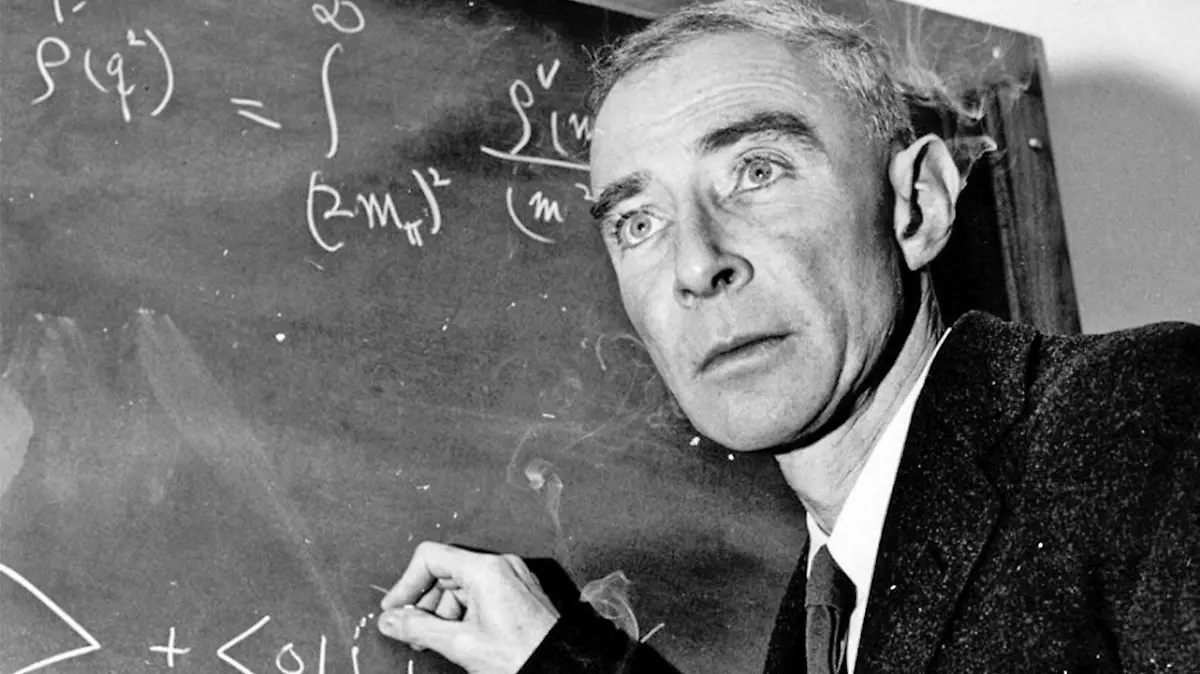
J. Robert Oppenheimer's scientific achievement is firmly documented, but his exact IQ is not. Numbers such as 135 and 145 circulate without an authenticated test report. This guide separates his real record from reverse engineered celebrity estimates.
Oppenheimer's achievements are documented. A public score report supporting the exact IQ claims is not.
0 The Short Answer
There is no verified IQ score for J. Robert Oppenheimer, and there almost certainly never will be. He was born in 1904 and died of throat cancer on February 18, 1967, at the age of 62. No standardized adult cognitive battery was ever administered to him under documented conditions, no score report exists in any archive, and no biographer working from his papers has ever produced one. The numbers that circulate online, usually 135 or 145 and occasionally higher, are back projections invented decades after his death by people working from his biography rather than from any test. A number carries information only when an instrument, a date and a comparison group stand behind it, which is the short version of the conditions for an accurate IQ score.
That much is true of most historical figures, and on its own it would make for a short and fairly dull page. What makes Oppenheimer genuinely interesting is the shape of his career, because he is arguably the best documented example in twentieth century history of a fact that cognitive testing has never been good at capturing: the intellectual achievement he is remembered for was not primarily an act of individual reasoning. Directing Los Alamos meant coordinating thousands of people, refereeing feuds between physicists who did not like each other, translating between scientists and the Army, and holding an organization together under conditions of secrecy and time pressure that broke other people. No cognitive battery in existence measures that.
There is also a real experiment that speaks to this, run during Oppenheimer's own lifetime. In 1921 Lewis Terman began following more than 1,500 California schoolchildren selected for very high measured IQ. He tracked them for decades. Not one of them won a Nobel Prize. Two boys who were screened for the study and turned away, William Shockley and Luis Alvarez, both did. That story is the argumentative center of this page, and it is worth more than any number anyone could invent for Oppenheimer.
Where ACIS stands
ACIS has never tested J. Robert Oppenheimer and could not: he died in 1967 and no retroactive assessment is possible. Everything here evaluates public claims and the historical record. No figure on this page is an ACIS result, and an unmeasured IQ is a statement about missing evidence, not about a person's mind.
1 The Numbers That Circulate and Why They Fail
Search his name alongside the word IQ and you will meet two figures repeatedly. The first is 135, which tends to appear on aggregator pages that assign scores to hundreds of historical names at once. The second is 145, which shows up on pages that treat the first number as insultingly low for the man who ran the Manhattan Project. Occasionally you will find 160 or higher on lists that no longer bother pretending to have a method. Escalation of that kind has no natural stopping point: the figures quoted for John von Neumann, who consulted on the same wartime problems, climb to 180 and 200 without ever naming a test either.
None of the three ever arrives with the four details that would make it a measurement rather than an opinion: the name and edition of the instrument, the date of administration, the person who administered and scored it, and the norm sample the score was compared against. Those are not bureaucratic formalities. A score is a comparison, and without knowing what it was compared to, the digits mean nothing. A 135 on a 1920s ratio scale, a 135 on a modern deviation battery and a 135 from an unnormed web quiz are three unrelated objects that happen to share three characters.
The disagreement between the numbers is itself informative. When independent measurements of the same quantity differ, you can sometimes average them and get closer to the truth. When independent guesses differ, averaging produces a new guess with a false air of precision. Nothing about the 135 and the 145 traces back to a shared underlying record, so there is no arithmetic that can reconcile them. They differ because their authors had different intuitions about how impressive he was, which is a fact about the authors.
It is worth naming why Oppenheimer in particular attracts this treatment. He fits the popular template of the singular genius almost perfectly: the young prodigy, the doctorate at 23, the wartime laboratory, the ruined public figure, the Sanskrit quotation. A story shaped like that seems to demand a number at the end of it. The number gets supplied because the story wants one, not because anyone found one.
2 The One Time Someone Actually Ran This Experiment
Here is the part of this subject that celebrity IQ lists never mention, and it is the reason this page exists. While Oppenheimer was an undergraduate, a Stanford psychologist was running the study that would have settled the question of whether high childhood IQ predicts historic achievement, if the answer had come out the way he expected.
Lewis Terman, who had adapted the Stanford-Binet for American use and who effectively introduced the term IQ to the English speaking public, began his Genetic Studies of Genius in 1921. The recruitment worked in stages: California teachers nominated their brightest pupils, the nominees sat a group test, and the top performers were then given an individual Stanford-Binet by Terman's assistants. The final cohort was 1,528 children, 856 boys and 672 girls, all scoring at roughly 135 and above, with Terman treating 140 as his target threshold for the core sample. They became known as the Termites, and they were followed for the rest of their lives, in what became one of the longest running longitudinal studies in the history of psychology. The word in that study's title came out of Terman's own 1916 manual, where the classification table on page 79 set 140 as the floor for near genius or genius, and the genius classification band appears on no test in professional use today.
Terman expected to have captured the next generation's great minds. He had not. The Termites produced no Nobel laureates at all. Meanwhile two California boys who had been screened during the selection process and not accepted went on to win the Nobel Prize in Physics: William Shockley, who shared the 1956 prize for the invention of the transistor, and Luis Alvarez, who won in 1968 for his work in particle physics. The single most consequential technology of the century came from a child the gifted study had passed over.
1,528 children
The size of Terman's cohort, selected from California schools starting in 1921 and followed for more than eighty years.
Zero Nobel Prizes
The number won by the entire selected group, despite decades of tracking and a threshold near the top one percent.
Two rejected laureates
Shockley (Physics, 1956) and Alvarez (Physics, 1968) were screened out and later won the prize the Termites never did.
The honest reading of this is not that IQ testing is worthless, and the researcher who did the most careful work on the episode makes that point himself. Russell Warne, writing in the journal Intelligence in 2020, simulated Terman's selection procedure and concluded that with Nobel Prizes as rare as they are, and with a threshold set as high as Terman set it, the study had somewhere between a 53 and an 83 percent chance of catching neither future laureate purely by the mathematics of base rates. Warne's title states his conclusion plainly: low base rates and a high selection threshold, not a broken test.
The irony has a second layer worth sitting with. The threshold was built to identify the people who would go on to transform their fields, and it screened out two of the men who did exactly that while admitting more than 1,500 who did not. A cutoff can be perfectly reliable as a measurement and still be the wrong instrument for the question being asked of it.
3 What Happened to the Children Who Passed
The fate of the Termites who did make the cut matters just as much as the two who did not, and it is routinely misreported in both directions. One camp claims the study proved high IQ leads nowhere. The other claims it proved gifted children thrive. The data supports a more specific and more useful statement than either.
As a group the Termites did well. They were healthier, better educated, more likely to hold professional jobs and earned more than comparable peers of average measured ability. High childhood IQ was clearly not the social handicap that early twentieth century folklore had assumed. What the group did not produce was a single figure of the kind Terman had set out to find. Plenty of professors, physicians, lawyers and executives. No transformative scientist, no Nobel laureate, nobody whose name outlived them the way Oppenheimer's did.
The most revealing analysis came from inside the study itself. In her 1968 forty year follow up, Melita Oden compared the 100 most professionally successful men in the cohort with the 100 least successful, where success meant working in a field that used their measured abilities. The successful group contained the scientists and academics. The unsuccessful group contained technicians, tradesmen and a scattering of people who had washed out of professional careers. The two groups barely differed in average IQ. What separated them, as recorded from childhood onward, was persistence, self confidence, goal directedness and the degree of encouragement they had received at home.
Read that finding against Oppenheimer's life and the relevance is immediate. Every member of Oden's comparison had cleared a threshold most people never reach. Above that threshold, the measured score stopped doing explanatory work and something else took over. If you want to understand why one very bright physicist ended up running the largest scientific project ever attempted while other very bright physicists worked for him, the score is not where the answer lives. Our page on IQ and job performance covers the same pattern in modern occupational data.
4 What Oppenheimer's Record Actually Documents
Strip out the invented numbers and the documented biography is still remarkable, and it is worth setting out precisely because the real record is what any honest estimate would have to work from.
Harvard, 1922 to 1925. He entered as a chemistry student and graduated summa cum laude in three years rather than four, carrying a course load well beyond the requirement while reading widely outside his field.
Cambridge, 1925 to 1926. A year at the Cavendish Laboratory that went badly. He was a poor experimentalist, was miserable in the lab, and the episode is the best documented failure of his early career. It is also the clearest evidence that his strengths were narrow rather than universal.
Göttingen, 1926 to 1927. Max Born invited him to Germany, where quantum mechanics was being built in real time. He completed his doctorate in 1927 at 23. The Born-Oppenheimer approximation, published that same year, remains standard equipment in quantum chemistry a century later.
Berkeley and Caltech, from 1929. He built the first significant school of theoretical physics in the United States, training a generation of American physicists who had previously had to go to Europe.
Los Alamos, 1943 to 1945. Chosen by General Leslie Groves in late 1942 to lead Project Y, a decision that surprised nearly everyone given that Oppenheimer was a pure theorist with no administrative record.
Princeton, 1947 to 1966. Director of the Institute for Advanced Study for nineteen years, the longest tenure in the institution's history.
Notice what this record contains and what it lacks. It contains an extraordinary early trajectory in a field that rewards mathematical reasoning, plus a documented episode of ordinary incompetence at laboratory work. Real cognitive profiles look like this: uneven, with genuine peaks and genuine troughs. The flat superlative implied by a single number is the least accurate description of him available.
5 The Job at Los Alamos Was Not a Cognitive Task
Here is where the argument becomes concrete. Take the thing Oppenheimer is actually famous for and ask what abilities it required, item by item.
The Manhattan Project employed roughly 130,000 people at its peak across 37 facilities and cost close to two billion wartime dollars. Los Alamos itself grew from an empty mesa to a town of more than 5,000 residents in about two years. Oppenheimer's job was to make a laboratory out of that, staffed by scientists who were used to running their own shows, working on a problem nobody had solved, under military secrecy, with a deadline set by a war.
What that actually demanded, in daily practice: recruiting people who had no reason to move their families to a mesa in New Mexico. Deciding which of several bomb designs to pursue with incomplete physics. Refereeing between personalities as difficult as Edward Teller's without losing them. Maintaining credibility simultaneously with theoretical physicists, with metallurgists and engineers, and with an Army general who reported to the Secretary of War. Absorbing enough of every specialty to follow the whole project at once. Hans Bethe, who led the theoretical division and later won his own Nobel Prize, described exactly this quality as what made Oppenheimer the right choice: he grasped the substance of any explanation before it finished, across every group in the laboratory, and everyone there knew it.
Now map that against what a cognitive battery samples. What an IQ test measures is performance on standardized tasks under controlled conditions: verbal comprehension, fluid reasoning, quantitative reasoning, visual spatial processing, working memory and processing speed. Those are real abilities and Oppenheimer plainly had a strong version of several of them. But no subtest asks you to keep a metallurgist and a general in the same room. No index score captures the willingness to absorb a specialty that is not yours in order to talk to the people who own it. The battery measures the raw material. Los Alamos measured what someone could build with it under pressure, and those are different measurements.
6 Why Retroactive IQ Estimates Are Storytelling
The practice of assigning IQ scores to the dead is older than most people assume, and its founding document reveals exactly why the method cannot work.
In 1926, Catharine Cox published The Early Mental Traits of Three Hundred Geniuses as the second volume of Terman's own series. Working from biographical records, school rankings, surviving juvenilia and recorded anecdotes about 301 eminent figures born between 1450 and 1850, she estimated a childhood IQ for each one. Goethe came out highest at 210. Isaac Newton was first scored at 170 on the evidence available from his first seventeen years, and Cox then applied an upward correction for incomplete records that raised him to 190.
That correction is the whole story in miniature. Cox understood that her estimates depended on how much documentation happened to survive, and she adjusted for it, which means she knew the primary input to her method was the size of the archive rather than the size of the mind. Figures from wealthy, literate, well documented Western European families scored higher because more of their childhood had been written down. Later researchers, including Dean Keith Simonton, have re-analysed her figures and found real statistical structure in them, but nobody treats them as measurements of individuals. They are a numerical restatement of how thoroughly each subject was biographied.
Modern retroactive estimates are not even that rigorous. Cox at least had a stated procedure, a defined sample and an explicit correction. The pages that assign Oppenheimer a 145 have a vibe. And the failure is structural rather than a matter of effort, because the input is achievement and achievement is produced by ability combined with training, health, opportunity, money, timing, collaborators and persistence. Running that equation backwards to recover one variable is not possible even in principle when every other term is unknown. The same problem plays out on our page for Albert Einstein, another physicist who never sat a modern battery and who collects invented numbers anyway.
7 What 135, 145 and 160 Would Actually Mean
Since the numbers attached to Oppenheimer are specific, it is worth knowing what they claim. On the modern standard scale, with a mean of 100 and a standard deviation of 15, each step outward gets rare fast. Rarity statements like those mean something only against a real reference sample, which is why a normed IQ test taken from home reports score bands and rarity relative to a defined group rather than as free standing labels.
IQ 115
One standard deviation up, roughly the top 16 percent. Common among university graduates and unremarkable in a physics department.
IQ 130
About the top 2 percent, roughly 1 person in 44. The conventional line used in gifted identification programs.
IQ 135
Roughly 1 in 260. The lower figure circulated for Oppenheimer, and close to Terman's own selection threshold.
IQ 145
Three standard deviations up, roughly 1 in 740. The higher figure people assign him when 135 feels insufficient.
IQ 160
Four standard deviations, roughly 1 in 31,000, at or beyond the ceiling of most professional instruments.
IQ 175
Five standard deviations, roughly 1 in 3.5 million. No mainstream battery reports this without extended norms.
Two things follow. First, the gap between the two most commonly cited figures for Oppenheimer is enormous in population terms: 135 describes about one person in 260, while 145 describes about one in 740, nearly three times rarer. Anyone who could shrug between those two values was never working from data. Second, and more useful, the entire range from 135 upward sits inside the territory where Oden's comparison found that score differences stopped predicting who accomplished what. Our IQ percentile chart lays out the full conversion if you want to see how quickly the tail thins.
There is a further complication specific to historical figures. The scale itself has moved. Norms are restandardized every few decades because raw performance drifts upward across generations, which means a score assigned in 1925 and a score assigned today are denominated in different currencies. Any retroactive number for a man born in 1904 would need to declare which era's norms it used, and none of them do.
8 Achievement Has No Exchange Rate With Score
Suppose you reject everything above and insist that the Manhattan Project must correspond to some number. Try to actually do the conversion and the problem becomes obvious: what is the exchange rate?
Does a doctorate at 23 equal 140? Does directing Los Alamos add ten points, or twenty? Is the Born-Oppenheimer approximation worth more or less than nineteen years running the Institute for Advanced Study? Every answer is arbitrary, and the arbitrariness is not a gap in current knowledge that better research could close. No psychometrician performs this conversion because there is no coefficient to perform it with. Cognitive tests are validated by correlating scores with other measurements, not by decoding biographies.
The relationship does exist at the group level, and it is worth stating precisely so the argument here is not mistaken for a claim that measured ability is irrelevant. Cognitive test scores predict educational attainment, occupational level and job performance across large populations with meaningful reliability. That is a statement about averages across thousands of people. It licenses no inference in the reverse direction about one individual, because the correlations, even the strong ones, leave enormous variance unexplained, and because the range restriction inside elite fields makes the predictor nearly useless there. Among people who complete physics doctorates at Göttingen, everyone has already cleared the bar. The remaining variation in who does what is carried by other things.
This is precisely why a serious assessment reports a profile with confidence intervals rather than one number. Verbal comprehension and processing speed can differ by twenty points in the same person, and knowing which is which tells you something actionable. A single figure derived from a biography tells you nothing at all, in either direction, about the person it is attached to. If you want the underlying distinction between the abilities that build over a lifetime and the ones that do not, our page on fluid and crystallized intelligence works through it.
9 The Physicist Who Never Won the Prize
One detail cuts against the whole enterprise of scoring him, and it is the kind of thing the listicles leave out because it complicates the narrative. Oppenheimer was nominated for the Nobel Prize in Physics three times, in 1946, 1951 and 1967. He never won it.
Not because the committee failed to notice him. The usual assessment among physicists is that his pre-war output, while broad and often prescient, contained no single result of the magnitude the prize demands. His most durable contribution may be the 1939 paper with his student Hartland Snyder, "On Continued Gravitational Contraction," which described the collapse of a sufficiently massive star past the point of no return. It is now recognized as the first serious theoretical description of what we call a black hole. Oppenheimer himself appears never to have thought much of it, and he did not return to the problem.
Consider what that means for the reverse estimation project. Here is a man whose raw ability nobody doubted, working in the most productive period in the history of physics, surrounded by the people who were winning the prizes, and his own research record did not clear the bar. His contemporaries Bethe, Feynman, Rabi and Fermi all won. If you tried to infer his cognitive score from his publication record alone, you would rank him below several people who considered him the quickest mind in the room.
The reason is not mysterious, and it is not a slight against him. He was pulled into administration, teaching and public service at precisely the age when theorists usually do their best work, and he had a temperament that scattered across problems rather than driving one to the ground. Both facts describe how a career gets spent, not what the person was capable of. Any estimate built on achievement would have to pick a lane: score him on the physics and you get one answer, score him on Los Alamos and you get another, and the difference between them is entirely biography.
10 The Security Hearing and the Limits of Being Quick
The last act of his public life makes the same point from the opposite direction. In 1954, after a nineteen day proceeding, the Atomic Energy Commission revoked Oppenheimer's security clearance, citing his past associations and finding defects in his character. It ended his role in government. In December 2022, Energy Secretary Jennifer Granholm formally vacated the 1954 decision, on the grounds that the process had violated the Commission's own regulations and had been driven by bias.
The hearing is often used as evidence in the IQ argument, in both directions. Some cite his testimony as proof of a mind under pressure; others read his earlier misjudgments, particularly the tangled account he gave the security services about an approach from a friend, as evidence of a blind spot. Neither reading survives contact with what the proceeding actually was. An adversarial hearing conducted by people who had already decided the outcome does not sample cognitive ability. It samples political exposure and institutional power.
What it does illustrate is that being the quickest person in the room offers no protection against the situations that actually determine a life. Oppenheimer's downfall came from associations formed in the 1930s and from having made powerful enemies over hydrogen bomb policy. Nothing on a cognitive profile predicts either. The same man received the Enrico Fermi Award from President Johnson in 1963, nine years after the hearing, which tells you the variable that changed was politics.
If you accept that his security clearance had nothing to do with his intelligence, you should accept the symmetrical claim: his laboratory directorship did not straightforwardly measure it either. Both were outcomes shaped by a hundred inputs. A cognitive score is one input among them, and not usually the decisive one once a person is already operating at that level.
11 How to Audit Any Historical IQ Claim
Everything on this page can be replicated for any dead famous person in about ten minutes. The method has four steps. For a public figure where a supervised administration actually exists, with two defensible numbers and a paper trail, see the Garry Kasparov case.
Ask when the person died against when testing became routine. Standardized adult batteries in anything like their current form are a mid twentieth century development, and administering one to a private adult was uncommon unless there was a clinical or occupational reason. Oppenheimer died in 1967 having had no such reason at any point. For anyone born before about 1930, the prior probability that a documented adult score exists is close to zero.
Trace the number to its earliest appearance. Search the exact figure with the name, sorting by date, and keep going backwards. Real testing events leave contemporaneous traces: an article, a letter, an interview. Invented figures thin out into aggregator pages that cite each other in a circle and terminate in nothing.
Check whether the person ever mentioned it. Oppenheimer wrote and spoke extensively and left a large body of correspondence and testimony. His own words on a great many subjects are on the record. A score is not among them, in any source, ever.
Ask what the estimate is actually made of. Almost every historical IQ figure decomposes into an achievement list run backwards. Once you can see the achievements that produced the number, you can see that the number adds no information the achievements did not already carry.
Run this on the standard list of historical geniuses and you will find that essentially none of the numbers survive step two. That is not a scandal, it is just what happens when a modern measurement concept is applied retroactively to people who lived before it existed. The lists at highest IQ ever recorded face the same problem from the other end, where even the living entries frequently rest on instruments that were never properly normed. One wartime episode does survive the method, because the psychological program at the Nuremberg jail in the autumn of 1945 names its examiner, its instrument and its dates, and the table of results published for the defendants who sat it is the rare mid century case where all four steps can be completed.
12 Verdict: Unmeasured, and the Better Question
J. Robert Oppenheimer's IQ is unknown and unknowable. He was never tested with a standardized adult battery, no score report exists, and the figures circulating online are retroactive inventions that name no instrument, no date and no examiner. That verdict would change the day a dated administration record surfaced in an archive, and not before. For a living person that record is straightforward to create, since an adult-normed IQ test produces a dated result with a named instrument and a stated comparison group.
The more interesting conclusion is the one his career forces. Terman selected more than 1,500 children for exactly the trait these lists want to assign to Oppenheimer, followed them for a lifetime, and got no Nobel laureates, while two boys his screening rejected won the prize outright. Oden then went back inside the cohort and found that among people who had all cleared the threshold, the ones who accomplished the most were separated from the ones who accomplished the least not by score but by persistence and confidence. That is the experiment that a hundred years of IQ speculation about historical figures has been running away from.
Applied to Oppenheimer specifically: he was fast, he was broad, he was capable of holding an entire multidisciplinary project in his head, and he was also a bad experimentalist, a scattered researcher, a man who never won the prize his contemporaries did, and someone whose public life was destroyed by things no cognitive measure predicts. Every one of those facts is documented. None of them is a score, and collapsing them into one would lose all of the information that makes him worth reading about.
If the part that interests you is what a real cognitive profile actually looks like when it is measured rather than inferred from a biography, that is the one thing on this page you can do something about. Yours is measurable today, across separate domains, with intervals around each one.
Unknown. He was never given a documented standardized battery, and no archive holds a score report for him. Every figure online was assigned after his death by writers working from his biography.
Was his IQ 135?
It is the most common figure online, and it identifies no instrument, no administration date and no examiner anywhere it appears. Repetition across many sites does not create provenance.
Was his IQ 145 instead?
The 145 claim generally appears on pages that considered 135 too modest. Substituting one unsourced integer for another does not improve the evidence behind either.
Could he have been tested as a child?
Group intelligence testing spread through American schools in the 1910s and 1920s, so it is conceivable he encountered something. No record of any result has ever been produced by biographers working from his papers.
Why is the Terman study relevant here?
Because it is the only large scale attempt to identify future greatness from childhood IQ, and it did not work. The selected group produced no Nobel laureates while two rejected applicants did.
Who were Shockley and Alvarez?
William Shockley shared the 1956 Nobel Prize in Physics for the transistor. Luis Alvarez won it in 1968 for particle physics work. Both were screened for Terman's cohort as California schoolchildren and not accepted.
Does that mean IQ tests do not work?
No. Russell Warne's 2020 simulation in Intelligence showed that with prizes that rare and a threshold that high, missing both was the statistically expected outcome. The lesson concerns prediction of rare events, not test validity.
How did the Terman children turn out overall?
Better than average peers on health, education, occupational level and income. Comfortably successful as a group, without producing the transformative figures Terman had hoped to catch.
What did Melita Oden find in 1968?
Comparing the hundred most and least professionally successful men in the cohort, she found their average scores nearly identical. The separating factors were persistence, confidence, goal direction and childhood encouragement.
Where did Oppenheimer study?
Harvard from 1922, finishing summa cum laude in three years, then a difficult year at the Cavendish Laboratory in Cambridge, then Göttingen, where he took his doctorate under Max Born in 1927.
What is the Born-Oppenheimer approximation?
A method published in 1927 that treats nuclear and electronic motion separately when solving molecular problems. It is still standard practice in quantum chemistry.
Was he a bad experimental physicist?
By his own account and every biography, yes. His Cambridge year in the laboratory was a documented failure, which is a useful reminder that strong minds have uneven profiles.
Did Oppenheimer win a Nobel Prize?
No. He was nominated three times, in 1946, 1951 and 1967, and never received it. Physicists generally attribute this to the absence of a single result of prize magnitude.
What was his most important scientific paper?
Many would name the 1939 work with Hartland Snyder on continued gravitational contraction, which anticipated black holes. He seems not to have valued it highly and did not pursue it.
What did directing Los Alamos require?
Recruitment, technical arbitration between rival approaches, mediation between scientists and the Army, and enough command of every specialty to follow the whole enterprise at once, under secrecy and deadline.
How large was the operation he joined?
The Manhattan Project peaked near 130,000 workers across 37 facilities at a cost approaching two billion wartime dollars. Los Alamos alone grew past 5,000 residents.
Can leadership ability be measured by an IQ test?
Not directly. Batteries sample reasoning, knowledge, memory and speed under standardized conditions. Coordination, persuasion and tolerance for ambiguity are assessed with different instruments entirely.
Who first assigned IQ scores to historical figures?
Catharine Cox, in 1926, in the second volume of Terman's series. She estimated childhood scores for 301 eminent people born between 1450 and 1850, correcting upward where records were sparse.
Why is that correction a problem?
Because it concedes that the estimates tracked surviving documentation. Subjects whose childhoods were written about in detail scored higher, which measures archives rather than minds.
Does the 1954 security hearing say anything about his mind?
Nothing usable. It was an adversarial political proceeding, and the Department of Energy vacated its outcome in December 2022 as procedurally improper and biased.
Does unknown mean his intelligence was ordinary?
No. Unknown describes absent evidence and carries no direction. His documented record points to formidable ability that simply was never converted into a measured score.
14 Sources Behind This Page
No figure on this page should be taken on faith, including ours. The sources below are the primary records and the research needed to audit any IQ claim attached to a public figure.
Encyclopaedia Britannica. The reference biography of J. Robert Oppenheimer, the documented record that any circulating IQ figure has to be checked against.
Cox, C.M. (1926). The Early Mental Traits of Three Hundred Geniuses, full text at the Internet Archive. The historiometric study behind most IQ figures still attached to historical figures.
Frey, M.C. & Detterman, D.K. (2004). Scholastic Assessment or g? Psychological Science, 15(6). The study linking SAT scores to measured cognitive ability, and the reason SAT conversions are estimates rather than measurements.
Lubinski, D. & Benbow, C.P. (2006). Study of Mathematically Precocious Youth after 35 years. Perspectives on Psychological Science. What long term follow up of verified high scorers actually shows.
Voncken, L., Albers, C.J. & Timmerman, M.E. (2019). Improving confidence intervals for normed test scores. Behavior Research Methods. Open access. Documents the mean 100, SD 15 metric and the uncertainty that norming from samples adds to any score.
Pearson (2008). WAIS-IV Score Report sample. What a real report contains: every composite paired with a percentile rank, a 95% confidence interval and a qualitative description, never a bare number.
Pearson Clinical Assessment Scientific Council (2023). Standardized Clinical Assessment for Practitioners: A Primer. How standard scores, percentile ranks and the standard error of measurement are meant to be read together.
Pearson (2024). WAIS-5, Wechsler Adult Intelligence Scale, Fifth Edition. The current adult battery, covering ages 16:0 to 90:11 across five cognitive domains.
Take the assessment
You get a profile, not a number
ACIS measures six CHC domains across 20 subtests and reports each one with its own normed score and confidence interval, so you can see where you are strong and where you are not.