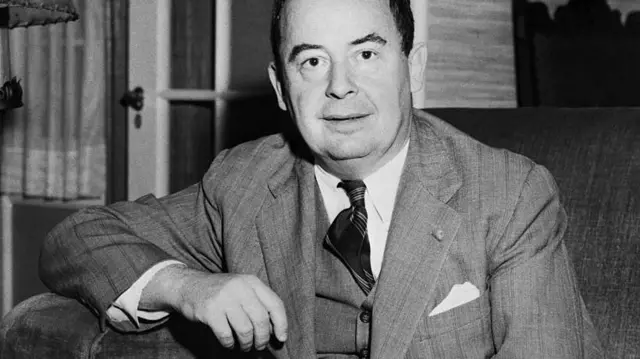
John von Neumann IQ Extreme Ability, Unmeasured Number
John von Neumann's contributions across mathematics, physics, economics, computing, statistics, and defense make an extreme ability estimate unusually defensible. They do not verify the viral 180 or 200. No modern score report exists, childhood anecdotes are not deviation IQ, and most validated tests cannot distinguish exact values at that level.
The strongest evidence is von Neumann's documented range of original work. The weakest part is the precise number later attached to it.
1 The Short Answer
John von Neumann's exact IQ is unknown. The famous values of 180 and 200 are post hoc estimates, not authenticated modern test results. His documented record is unusually strong evidence of extreme general and quantitative ability because it spans original work across mathematics, physics, economics, statistics, computing, and applied wartime problems. The evidence supports the neighborhood of an ordinary test ceiling, not a precise point beyond it.
No verified modern score
No public report identifies the instrument, date, examiner, norms, composite, or uncertainty behind 180 or 200.
150 to 160
This is the most plausible modern reportable range from the documented breadth and depth of performance.
135 to 160
The 90 percent uncertainty band widens for biography and stops where ordinary tests lose useful precision.
Ceiling ruleAn upper boundary of 160 does not mean von Neumann could not perform beyond it. It means a responsible estimate should not invent exact distinctions that most validated instruments cannot measure.
Von Neumann is a natural target for extreme numerical mythology. Colleagues described extraordinary speed, memory, mental calculation, and the ability to move between fields. Later writers needed a familiar scale for that reputation, and IQ supplied one. Values such as 180 and 200 convert awe into a sortable number even when no score report exists.
The numbers rarely arrive with test provenance. There is no named adult battery, edition, administration date, examiner, age norm, Full Scale composite, or confidence interval. Some pages present 180 as a common estimate. Others escalate to 200. The range of claims reveals that writers are translating biography, not reporting a shared measurement.
Child prodigy stories can also generate informal ratio calculations. If a six year old is described as performing like a twelve year old, mental age divided by chronological age yields 200. That arithmetic does not establish how mental age was measured, whether the tasks were standardized, or how the result maps to a modern adult deviation IQ. A memorable anecdote becomes a score through an obsolete formula.
The prestige of mathematics strengthens the myth. Because von Neumann worked at the highest level, an ordinary high score can feel inadequate to admirers. The number is raised until it seems proportionate to the achievement. Psychometric scales do not work that way. Career rarity and score rarity are related imperfectly and need not match.
The responsible correction is not to flatten him toward average. It is to keep the evidence strong and the number modest in precision. The record supports exceptional ability more convincingly than it supports 180 rather than 170, 160, or an above ceiling notation.
A precise number also simplifies a multidimensional reputation. Von Neumann was remembered for calculation, memory, abstraction, speed, practical application, and conversation. Admirers compress those qualities into one scalar and then compare it with numbers assigned to Einstein, Newton, or modern founders. The comparison looks quantitative while each number was created from a different mixture of anecdotes and achievements.
The source date is another warning. Modern adult batteries, current norms, and the mean 100 standard deviation 15 convention cannot be projected backward without specifying a linking method. A number published decades after a person's death may describe a writer's impression using a modern scale. It does not become contemporaneous evidence because it sounds familiar.
3 What the Institutional Record Verifies
The Institute for Advanced Study describes von Neumann as a classic child prodigy and documents his doctoral degree from the University of Budapest in 1926. It records his faculty role in the School of Mathematics and his movement from foundational mathematics and quantum theory into applied problems of major scientific and national importance.
The institutional biography names hydrodynamics, ballistics, meteorology, game theory, statistics, wartime consulting, and computing. This breadth matters because it reduces the chance that one narrow practiced skill explains the reputation. He repeatedly learned and transformed distinct technical domains rather than producing one early success.
The IAS Electronic Computer Project adds another concrete record. Von Neumann helped lead a project that developed stored program computing ideas and a machine whose influence extended through later computer development. The work combined mathematical abstraction, engineering constraints, organization, and a vision of uses beyond faster calculation.
Institutional histories can celebrate their figures and are not neutral cognitive tests. Their documented dates, projects, publications, and roles are nevertheless stronger than anonymous anecdotes. They establish achievement that can be checked independently. The estimate weights that record heavily and treats colorful stories as supporting context rather than the foundation.
No institutional source used here reports an IQ. That absence matters because later precise numbers cannot be presented as though the Institute measured them. The biography supports an extreme qualitative conclusion and leaves the psychometric value open.
Peer context strengthens the achievement signal. Von Neumann worked among leading mathematicians and physicists at institutions where exceptional ability was common. Standing out in that selected environment is more informative than public fame alone. It still depends on recollections and output rather than common test conditions, so it raises the plausible range without determining exact standard deviations.
The documentary record also benefits from proximity. Project archives, appointments, degrees, publications, and institutional reports were created near the work itself. Later anecdotes about childhood feats may pass through several retellings. The estimate gives more weight to the traceable adult record and uses prodigy stories mainly to show developmental consistency.
4 Breadth Across Mathematics and Science
Many eminent thinkers produce deep work in one specialty. Von Neumann contributed to set theory, functional analysis, operator theory, quantum mechanics, ergodic theory, game theory, numerical methods, computer architecture, and applied defense and weather problems. The exact list varies by historian, but the cross field pattern is not controversial.
That pattern is relevant to general ability because it shows transfer. Specialized knowledge can explain high performance inside a mature field. Moving into a new field and producing foundational work requires learning its language, representing its structure, and recognizing connections. Repeated transfer is stronger indirect evidence of Gf and g than fame or wealth alone.
General ability still does not act alone. Von Neumann received elite education, worked with exceptional peers, had access to major institutions, and lived during rapid growth in formal science and computing. Motivation, memory, personality, historical opportunity, and the choice of problems shaped his output. Great conditions do not create great work automatically, but they prevent achievement from being a pure test.
Publication and institutional records also select successes. Unfinished ideas, errors, collaborators' contributions, and ordinary days are less visible. Historians reconstruct a career from surviving outputs, while psychometrics scores a standardized sample including errors. The estimate must discount that difference even when the outputs are extraordinary.
Among the famous figures covered by ACIS, this is one of the strongest cases for an estimate near the ceiling because the evidence is technical, original, sustained, and broad. It remains an estimate for exactly the same reason that Albert Einstein's IQ and Isaac Newton's IQ remain estimates.
Cross domain breadth should not be counted by the number of labels alone. Mathematics, physics, economics, and computing overlap through formal methods, so they are not independent tests. The important evidence is that von Neumann applied shared tools to genuinely different problem structures and produced work recognized within each. The estimate discounts overlap while retaining transfer.
Speed is similarly difficult to separate from depth. Colleagues often emphasized how quickly he understood or calculated. Rapid performance can reflect exceptional processing, working memory, and a huge organized knowledge base. A modern test would try to distinguish these contributions with different tasks. Biography observes the combined outcome, which is impressive but less diagnostic.
5 Memory and Mental Calculation Claims
Biographies and recollections portray von Neumann as having remarkable memory and mental calculation. Colleagues reported rapid arithmetic, extensive recall, and the ability to retain detailed information. These stories are consistent with the technical record, which required manipulating complex formal material across many domains.
The popular label photographic memory should be used cautiously. It has no single agreed everyday meaning and can imply a literal internal image unsupported by the anecdote. Exceptional recall can involve attention, encoding strategies, interest, knowledge organization, and retrieval practice. Different memory systems may be uneven.
Mental calculation is also a narrow performance. It can draw on Gq, working memory, processing speed, learned algorithms, and practice. A person can calculate rapidly without having equally extreme verbal or spatial scores. Von Neumann's broader achievements make the calculation stories more informative than they would be alone, but they still cannot yield Full Scale IQ.
Anecdotes grow because they are memorable and repeated. Numbers of digits increase, ages become younger, and a colleague's impression becomes an exact feat. The safest method is to retain claims corroborated across serious biographies as qualitative evidence while refusing to score them as if an examiner recorded standardized responses.
A modern battery would test working memory through common tasks and age norms rather than celebrity stories. It might show a ceiling, but the specific result cannot be reconstructed. The distinction between exceptional observed behavior and a standardized score is central to Reliability and Validity.
Memory anecdotes can be selected because they surprise witnesses. Everyday forgetting or areas of ordinary recall are less likely to enter biographies. This asymmetry does not make the famous stories false. It means they sample peak impressions. A cognitive profile would record performance across a planned set of tasks, including errors, and compare the complete response pattern with norms.
Knowledge can make memory appear limitless. Experts encode new material through rich structures and recognize relations that novices must remember as separate facts. Von Neumann's mathematical organization may have reduced apparent memory load. That possibility is itself evidence of expertise and reasoning, but it cautions against treating recall capacity as a simple storage number.
Calculation skill is not one thing either. A twin study of almost 3,000 pairs at age 7 found a genetic correlation of .67 between mathematics and general intelligence and .74 between mathematics and reading, and about a third of the genetic variance in mathematics was independent of both. The comparison of math ability with general intelligence adds that such a figure describes a population, not any one gifted child.
6 Computing, Game Theory, and Applied Reasoning
Von Neumann's role in computing illustrates more than technical knowledge. He saw that electronic computers could serve purposes beyond speedy calculation and helped organize an institutional project around that vision. The work required connecting mathematical logic, engineering architecture, numerical applications, and future scientific use.
Game theory provides another transfer. Formalizing strategic interaction required representing choices, incentives, and outcomes mathematically. The contribution influenced economics and decision science beyond its original setting. The cognitive evidence lies in building a formal framework that other fields could use, not in the later popularity of the term.
Applied wartime work involved hydrodynamics, ballistics, statistics, and committee consulting under urgent constraints. These environments demand abstraction and practical approximation, not only theorem proving. Moving between pure and applied problems supports a broad reasoning inference while also depending on collaborators, institutional resources, and classified work that is difficult to reconstruct fully.
Achievement credit should remain historically careful. Modern computing was created by many mathematicians, engineers, programmers, and prior projects. The phrase von Neumann architecture can hide contributions by others. Recognizing collective work does not weaken the evidence that his individual role was substantial. It prevents a genius narrative from claiming every downstream computer as a personal cognitive item.
The same attribution rule used for technology executives applies to scientists. Organizational output is not individual IQ. Original individual contributions documented within the output are stronger evidence. Von Neumann's record contains many such contributions, which is why the estimate differs from one based on title alone.
World War II and Cold War institutions created unusual opportunities to apply theory at scale. Access to data, engineering teams, government problems, and other elite scientists expanded the range of work one person could influence. Historical opportunity does not explain the originality away. It is a multiplier that must be separated from the underlying ability when translating achievement to an IQ range.
Game theory also illustrates the difference between creating a framework and forecasting every outcome. A founder can contribute a powerful mathematical language without personally predicting every later application. The cognitive signal comes from formalization and transfer. Later influence should not be counted repeatedly as new proof of individual IQ.
7 How the Estimate Was Calibrated
The evidence hierarchy begins with direct testing, and none is available. Authenticated school scores or contemporaneous standardized records could offer a quantitative anchor, but no modern comparable result is known. The strongest evidence is therefore sustained original achievement across multiple cognitively demanding domains, supported by institutional documentation and peer recollection. Achievement evidence cannot stand in for measurement, because reliability, validity and a defined comparison group are what an accurate IQ score actually requires, and a documentary record supplies none of the three. Direct testing of well known adults in that period is almost absent from the archive, the clearest exception being the psychological program run at the Nuremberg jail in the autumn of 1945, where an adaptation of the Wechsler-Bellevue was administered to the defendants under recorded conditions.
The contemporary case of Christopher Hirata also requires separating exceptional achievement from the evidence needed to authenticate an IQ figure.
This evidence makes a central estimate below about 135 difficult to reconcile with the breadth and speed of the record. High motivation and exceptional opportunity can elevate achievement, yet producing foundational work across so many technical fields is rare even among highly selected scientists. The convergence supports the extreme upper region more strongly than in ordinary celebrity estimation.
A central reportable range of 150 to 160 reflects that evidence while respecting the ceiling. It does not say a real test would yield the same value on every edition or at every age. Some subtests might hit ceilings, others might be merely very high, and a composite could be limited by the scoring rules.
The lower interval of 135 allows for biography, survivor selection, domain expertise, educational opportunity, and embellished anecdotes to overstate standardized breadth. It remains very high because the documented original work is difficult to explain through fame, teams, or one specialty alone.
The upper limit of 160 is epistemic. It marks where ordinary modern tests often stop distinguishing useful exact values. If von Neumann's ability exceeded that ceiling, a valid report might say at least 160 or provide bounded extended information. Assigning 180 would pretend the unmeasured distance is known.
Alternative explanations were considered. Elite education and opportunity could amplify a person in the 130s into an extraordinary contributor when combined with exceptional memory, motivation, and historical position. Conversely, a person at or above the ceiling may produce much less without opportunity or interest. Von Neumann's record likely reflects a rare combination, which is why the lower bound remains high and the exact score remains uncertain.
The estimate avoids using secondhand praise as a numerical multiplier. Statements that a famous scientist considered von Neumann the fastest or smartest person he knew are valuable testimony about relative impression within an elite group. They are not calibrated rankings, and social memory can favor the most striking colleague. The testimony supports the upper region qualitatively.
8 The 90 Percent Band and the Ceiling
Range
Fit with the documented record
Judgment
Below 130
Difficult to reconcile with repeated foundational work across technical domains
Outside the main interval
130 to 134
Possible only if achievement and anecdotes substantially overstate broad ability
Lower tail
135 to 149
Very high ability consistent with the record and historical uncertainty
Plausible lower interval
150 to 160
Best balance of exceptional cross field evidence and modern reportable limits
Most plausible
Above 160
Ability may exceed ordinary ceilings, but exact ranking becomes unsupported
Possible, not measurable precisely
180 or 200
No modern test record and no defensible ordinary scale precision
Viral historical estimates
The 90 percent band is not a confidence interval from an actual score. It is a transparent uncertainty judgment about where a modern reportable result would most plausibly fall. A test based interval might be much narrower around an observed composite, but validity and ceiling concerns could still dominate.
The band is capped for interpretation, not biology. A person can perform beyond the hardest items. Once the instrument has no information to distinguish those performances, the honest result is censored or bounded. Giving different exact numbers to two people beyond the ceiling turns reputation into decimals.
The IQ Rarity Calculator can illustrate normal curve values, but extreme tail calculations assume a distribution and a valid input score. It cannot validate 180 or recover a score from a biography. Mathematical rarity is downstream of measurement.
At a ceiling, two people can both answer every available difficult item while differing in unobserved ability. The test reports the same or similarly bounded value because it lacks harder calibrated information. Ranking them through biography after the fact reintroduces uncontrolled tasks and incompatible evidence. The scientific answer may remain tied rather than satisfy the desire for a winner.
The lower interval should also be read carefully. A value near 135 is already around the upper one percent on the common scale. It appears modest only when compared with internet claims of 200. The contrast shows how celebrity content can distort intuition about rarity and make extraordinary validated scores seem ordinary.
9 Ratio IQ Is Not Modern Deviation IQ
Early IQ testing often used mental age divided by chronological age, multiplied by 100. If a child performed on tasks assigned to an older age, the ratio could become dramatic. The method was intuitive for childhood development but behaved poorly across adulthood and at extremes. Deviation scoring replaced the ratio by comparing a person with others of the same age, which is why an IQ test scored against adult norms reports where an adult stands among adults instead of dividing one age by another.
Modern deviation IQ instead locates performance within the distribution for an age based norm group. A score of 130 means a position relative to peers on that instrument, not that an adult has the mental age of someone thirty percent older. The scales answer different questions and cannot be interchanged by keeping the same label.
Prodigy anecdotes invite ratio calculations because they say a child mastered material years ahead. Mastering advanced mathematics early is powerful evidence of exceptional development. It is not a standardized mental age covering the full set of cognitive tasks. One accelerated domain cannot define a global mental age.
Claims of 200 sometimes arise when a reported developmental lead is divided by age. That value should be labeled an informal ratio inference if used at all. It is not comparable with an adult Full Scale score of 100 mean and 15 standard deviation.
This distinction also matters across other historical pages, including Leonardo da Vinci, Nikola Tesla, and Isaac Newton. Celebrity charts that mix ratios, estimates, and modern tests create a numerical hierarchy from incompatible evidence.
Developmental acceleration is still important even when ratio scoring is rejected. Mastering advanced material unusually early narrows plausible explanations and supports exceptional learning capacity. The correction is about units. Early achievement should remain documented developmental evidence rather than being forced into a modern score whose norms and item content did not exist.
Age equivalent scores on modern tests also require care. They describe the median raw performance associated with an age group on a specific task, not a child's global mental age. Combining age equivalents across domains or extending them beyond the normative range can recreate the same ratio errors under a newer label.
10 Cox 1926 and Historiometric Estimation
Catharine Cox's 1926 study estimated intellectual levels for eminent people using biographical and developmental records. Historiometry offered a way to study figures who could not take contemporary tests. It also tied the estimate to surviving documents, raters, achievement selection, and assumptions about what early behavior represented.
A historiometric estimate is not a hidden test result. The subject did not receive standardized instructions or a common item set. Raters infer performance from descriptions written for other purposes. Famous people have richer records than ordinary people, and favorable anecdotes are more likely to survive.
Von Neumann was born after many figures in Cox's work and had a more modern documentary record, but the logic of post hoc estimation remains similar. Analysts observe prodigy stories and achievements, then map them onto a scale. The technical record improves confidence in high ability while leaving the exact mapping uncertain.
Historiometry can compare patterns under explicit methods. Popular lists usually do not publish a coding scheme, rater reliability, source rules, or uncertainty. They retain the number and remove the research limitations. Calling 180 a Cox estimate without showing that Cox assessed him would be inaccurate. The modern continuation of Cox's method makes the distinction concrete, since Dean Keith Simonton published historiometric estimates for all forty two presidents in Political Psychology in 2006, while the only documented figures in the presidential IQ record are Nixon at 143 and Kennedy at 119, both from an Otis group test taken at school.
Cox's window also shows why some mathematicians of the early twentieth century cannot be placed in her frame at all. Srinivasa Ramanujan was born in 1887, after the period her subjects covered, and no childhood rating of him exists. What survives is a documentary record, set out in the page on Ramanujan's IQ and Hardy's reported 0 to 100 rating, which supports admiration without producing a score.
Another mathematician with a strong record and a circulating number is Alan Turing. The header of his 1936 paper on computable numbers gives May 28 as the date received and November 12 as the date read, and the paper itself cites Alonzo Church's parallel work. The page on the 185 attributed to Alan Turing reads that record as evidence of achievement, not of a score.
The method on this page is intentionally modest. It states the evidence hierarchy, gives a broad range, labels the interval editorial, and caps precision at the test ceiling. It does not claim to have administered a historical test through prose.
Historiometric evidence is particularly vulnerable to archival inequality. Elite men working in prestigious institutions left more records than people excluded from those institutions. A method that estimates ability from documented achievement can confuse opportunity to produce and preserve records with underlying capacity. Von Neumann's evidence remains exceptional, but the limitation matters when constructing cross historical rankings.
Rater expectations can influence interpretation too. Once a subject is known as a genius, ambiguous childhood stories are read as early signs and ordinary events disappear. Blinded standardized testing reduces that halo effect. Historical research cannot eliminate it, so uncertainty should widen rather than vanish.
11 What a Modern Cognitive Profile Might Show
Quantitative reasoning and knowledge would likely be a strong hypothesis given von Neumann's mathematics, but a modern battery would still need direct items. Fluid reasoning would sample novel relations outside rehearsed work. Working memory tasks would examine controlled maintenance and manipulation rather than remembered anecdotes. Batteries differ in how much of that ground they actually cover, and a ranked comparison of the top online IQ tests scores them on breadth, score range and the technical evidence each one publishes.
Crystallized intelligence or verbal comprehension could be strong given multilingual education, scholarship, and rapid engagement with technical language. Visual spatial processing might contribute to geometry, physics, and computing, but those achievements cannot specify a Gv score. Processing speed could be high, yet mental calculation speed is not the same standardized construct.
A profile could hit multiple ceilings. That would reduce the ability to compare domains because each score would be censored near the top. Extended or specialized measures might provide more information, but they would introduce different norms and constructs. Combining them into one exact Full Scale value would require validated linking.
Age would matter. A test in youth, midcareer, or during illness would produce different raw performance and use different norms. Von Neumann died in 1957 after serious illness. A timeless IQ inferred from his entire career ignores developmental and health conditions that modern interpretation would document.
A real report would include confidence intervals and validity observations even for an exceptional examinee. Intelligence testing does not become exact at the top. In fact, ceilings and rare norms often make extreme scores less precise. See Comprehensive IQ Test and Cognitive Domains.
Specialized high range tests would introduce a new comparison group and often narrower construct coverage. A difficult mathematical reasoning measure could distinguish performance above a general battery ceiling while saying less about verbal comprehension or processing speed. Linking the specialized result back to one Full Scale IQ would require evidence, not a simple table found online.
Profile interpretation would also resist the label uniformly brilliant. Even exceptional people can show relative strengths, ordinary areas, fatigue, or task preferences. A ceiling in several domains and a lower score in another could still produce remarkable achievement. Human cognitive architecture does not need to be flat to support a genius reputation.
12 Myths About von Neumann's Intelligence
Myth: von Neumann had a confirmed IQ of 180. No authenticated modern score report supports it. The number is a retrospective estimate.
Myth: his IQ was definitely 200. The value often comes from prodigy stories or escalation. Ordinary deviation tests cannot support that precision.
Myth: photographic memory explains everything. Memory anecdotes are impressive, but original work also required reasoning, knowledge, motivation, collaboration, and opportunity.
Myth: he alone invented the modern computer. His contributions were foundational, and computing emerged through many mathematicians, engineers, programmers, and projects.
Myth: smartest person ever is an objective title. No common test spans historical figures, abilities are multidimensional, and ceilings prevent exact upper tail ranking.
Myth: estimating 150 to 160 diminishes him. That is the extreme upper reportable region. The career evidence is stronger than any need for a larger decorative number.
Myth: achievement equals IQ. Achievement can provide unusually strong indirect evidence while remaining influenced by education, personality, health, collaborators, institutions, and historical conditions.
These Institute for Advanced Study sources document von Neumann's faculty career, breadth of work, prodigy description, and computing leadership. Neither reports an IQ. That is why the page can be confident about achievement while remaining cautious about the score.
Encyclopaedia Britannica. The reference biography of John von Neumann, the documented record that any circulating IQ figure has to be checked against.
Cox, C.M. (1926). The Early Mental Traits of Three Hundred Geniuses, full text at the Internet Archive. The historiometric study behind most IQ figures still attached to historical figures.
Frey, M.C. & Detterman, D.K. (2004). Scholastic Assessment or g? Psychological Science, 15(6). The study linking SAT scores to measured cognitive ability, and the reason SAT conversions are estimates rather than measurements.
Lubinski, D. & Benbow, C.P. (2006). Study of Mathematically Precocious Youth after 35 years. Perspectives on Psychological Science. What long term follow up of verified high scorers actually shows.
Voncken, L., Albers, C.J. & Timmerman, M.E. (2019). Improving confidence intervals for normed test scores. Behavior Research Methods. Open access. Documents the mean 100, SD 15 metric and the uncertainty that norming from samples adds to any score.
Pearson (2008). WAIS-IV Score Report sample. What a real report contains: every composite paired with a percentile rank, a 95% confidence interval and a qualitative description, never a bare number.
Von Neumann is one of the rare cases where the public record strongly supports an extreme ability estimate independent of wealth, political office, or celebrity. The evidence is original technical achievement across fields. The honest correction targets the precision, not the conclusion that he was extraordinarily capable.
ACIS measures a present user's performance across 20 subtests and six CHC based domains: fluid reasoning, crystallized intelligence or verbal comprehension, quantitative reasoning, visual spatial processing, working memory, and processing speed. It reports Full Scale context, domains, subtests, percentiles, rarity, and confidence intervals.
ACIS is an independent online adult cognitive self assessment using an English speaking reference frame. It is not a historical reconstruction, clinical diagnosis, legal credential, employment selection test, or measure of scientific creativity and achievement. It does not claim unlimited precision beyond its documented scale.
A high ACIS score would not make a user the next von Neumann. Scientific achievement requires knowledge, problem choice, motivation, collaboration, opportunity, health, and years of work. A lower score would not prevent meaningful technical contribution. Cognitive performance is one ingredient rather than a destiny.
The practical lesson from 180 and 200 is to respect ceilings. When evidence suggests ability beyond what an instrument can separate, the answer is a bounded result, not a larger invented number. Measurement becomes more trustworthy when it admits where the scale ends.
ACIS users should apply the same restraint to their own high results. A confidence interval and ceiling are not obstacles to recognition. They are the conditions that make recognition credible. Repeating a test until a larger number appears, converting one strong subtest into Full Scale IQ, or comparing across incompatible scales weakens the result.
Von Neumann's legacy is secure in the documented work. It does not depend on winning an imaginary contest by twenty IQ points. Separating the record from the rumor leaves a more impressive conclusion: extraordinary cross field performance that remains visible even after the largest numbers are removed.
For readers comparing historical figures, consistency matters more than spectacle. Use the same hierarchy of evidence for every subject: authenticated standardized records first, closely related documented measures second, educational and occupational performance next, and anecdotes last. Then widen uncertainty when the person lived in another testing era, worked beyond common test ceilings, or has been surrounded by a strong genius narrative. Under that rule, von Neumann remains an exceptional case because independent technical achievements converge across mathematics, physics, economics, and computing. What disappears is only the unsupported claim that those achievements reveal a precise score of 180 or 200.
No verified modern score exists. A cautious modern equivalent estimate is about 150 to 160, with a 90 percent uncertainty band of roughly 135 to 160.
Did von Neumann have an IQ of 180?
No primary modern test record supports 180. The value is a later biographical estimate repeated as fact.
Did von Neumann have an IQ of 200?
No. A score of 200 is even less defensible because no test record exists and ordinary validated instruments cannot support that precision.
Was John von Neumann the smartest person ever?
There is no valid cross historical test for that title. His documented breadth places him among the most exceptional thinkers, but exact ranking is impossible.
Did von Neumann take an IQ test?
No authenticated modern IQ administration or score report is known from the public historical record used here.
Was von Neumann a child prodigy?
Yes, authoritative biographies describe him as a classic child prodigy. Anecdotes still require caution and are not standardized scores.
Could he calculate large numbers mentally?
Contemporaries and biographies describe exceptional mental calculation. The feats support quantitative and memory strengths but cannot be converted exactly to IQ.
What fields did von Neumann contribute to?
His documented work included pure and applied mathematics, quantum theory, game theory, statistics, computing, hydrodynamics, ballistics and meteorology.
Did von Neumann invent the modern computer?
He made foundational contributions to stored program computing and led the IAS Electronic Computer Project, but computing history involved many contributors.
Why is his estimate higher than most celebrities?
The evidence includes original, highly technical contributions across multiple fields, not only fame, wealth, office or prepared public performance.
Why stop the estimate at 160?
Most validated tests have limited precision near that ceiling. The cap reflects what ordinary modern instruments can report defensibly, not a claim that ability cannot exceed it.
What does the 90 percent interval mean?
It is an editorial historical uncertainty band, not a confidence interval from a test. The upper boundary is constrained by measurement ceiling.
Is 160 the highest possible IQ?
No universal maximum exists across all instruments, but precision becomes poor near extreme ceilings. A printed higher number does not guarantee valid discrimination.
What is ratio IQ?
It is the older mental age divided by chronological age method. It should not be compared directly with modern age normed deviation IQ.
Did childhood mental age prove an IQ of 200?
No. Retrospective mental age anecdotes are not standardized records, and ratio calculations do not equal modern adult deviation IQ.
What was Cox's 1926 method?
Cox inferred intellectual level from biographies of eminent people. Her estimates were historiometric achievements ratings, not tests taken by the subjects.
Can achievement estimate IQ accurately?
Achievement can narrow plausibility, especially when original and technically demanding, but motivation, opportunity, health, collaboration and domain knowledge remain confounds.
Was his memory photographic?
Biographies describe extraordinary memory, but photographic memory is an imprecise popular label and anecdotes are not a standardized memory battery.
Was von Neumann smarter than Einstein?
No defensible exact ranking exists. Their work, strengths and evidence differ, and neither has a verified comparable modern score.
Could a modern test measure von Neumann?
It could sample a profile, but an ordinary battery might hit ceilings in some domains and still leave uncertainty about extreme standing.
How does ACIS handle extreme scores?
ACIS reports standardized performance and uncertainty within its documented scale. It does not claim to recover historical genius scores or rank people beyond supported ceilings.
Take the assessment
You get a profile, not a number
ACIS measures six CHC domains across 20 subtests and reports each one with its own normed score and confidence interval, so you can see where you are strong and where you are not.