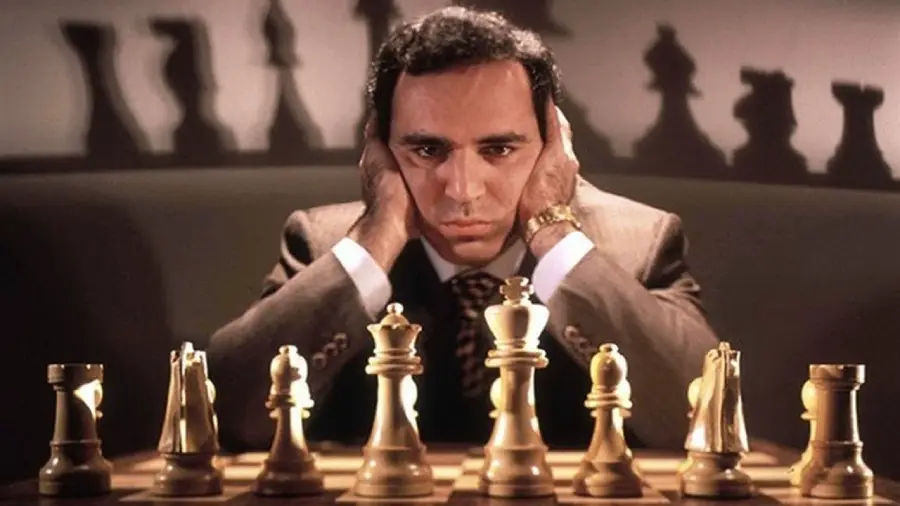
Garry Kasparov reportedly scored 135 on an Eysenck-associated test and 123 on Raven matrices during a 1987 magazine project. Those results are historically meaningful but belong to different instruments. The much repeated IQ in the 190s has no comparable evidence.
The reported 135 and 123 belong to different tests. Neither supports the repeated IQ in the 190s claim.
0 The Short Answer
Garry Kasparov was actually tested, and that makes his case the most valuable one in the entire celebrity IQ genre. In December 1987 the German news magazine Der Spiegel spent three days putting the reigning world chess champion through a battery of cognitive tasks in a suite of the Hotel Azerbaijan in Baku. The results were published on 21 December 1987 under the headline "Genieblitze und Blackouts", which translates roughly as flashes of genius and blackouts. Two numbers came out of it: 135 on an intelligence test that Hans Jürgen Eysenck assembled for the occasion, and 123 on Raven's Progressive Matrices.
Almost every figure you meet on a celebrity IQ list is folklore with no test behind it. This one is different. There was a named magazine, a named place, a named date, named instruments and a comparison sample tested alongside him. You can argue about how to read the numbers, and this page will, but you cannot argue that no measurement happened.
Here is why that matters more than the digits themselves. The archetypal genius of the twentieth century, a man who became world champion at 22 and stayed at the top of world chess for roughly two decades, scored high but not mythically high. Not 190, the figure that celebrity sites still print. Not 180. A 135, which is roughly the 99th percentile, and a 123 on the narrower nonverbal test, which is roughly the 94th. Impressive numbers for any human being, and nowhere near the cartoon that people expect from a chess champion.
Three uncomfortable lessons follow, and the rest of this page works through each of them: elite domain performance does not require a stratospheric general score; thousands of hours of chess build chess-specific pattern recognition rather than general reasoning capacity; and even a real testing event leaves a number that is hard to interpret without knowing the edition, the norm table and the scoring conventions behind it.
Where ACIS stands
ACIS has never tested Garry Kasparov and has no connection to him or to Der Spiegel. Everything here analyzes a publicly reported 1987 assessment and the published research literature on chess expertise. No figure on this page is an ACIS result, and nothing here should be read as a clinical judgment about any individual.
1 What Der Spiegel Actually Did in Baku
The project was unusually ambitious for a magazine feature. According to the published account, Kasparov had agreed to the idea at a Spiegel discussion in Hamburg nearly two years earlier, motivated in part by wanting to attempt the memory feats attributed to Harry Nelson Pillsbury and Bobby Fischer, including recall of nonsense syllables and sentences in languages he did not speak. He was 24 years old at the time of testing, at the absolute peak of his powers, and the session took place immediately before he sequestered himself with his seconds on the Caspian coast to prepare for the world championship match against Anatoly Karpov in Seville.
The magazine's team traveled to Baku carrying three established instruments plus a chess test and several smaller tasks. The intelligence measures were authored by three well known figures in the field: Hans Jürgen Eysenck, whose compiled test produced the 135; John C. Raven, whose Progressive Matrices produced the 123; and Adolf Otto Jäger of Berlin, whose Berlin Intelligence Structure model breaks performance into roughly thirty task types spanning numerical, verbal and figural content.
Crucially, the magazine did not test Kasparov in isolation. It ran the same materials on comparison groups: around thirty German Bundesliga chess players, plus a couple of dozen Hamburg schoolchildren and students who played for the HSV chess section. That design detail is what raises the exercise above a stunt. Having a comparison sample, even a small and unrepresentative one, is the difference between a number and a number with context.
What the exercise did not produce is a modern clinical score report. There is no published record of which edition of the Raven was used, which norm table converted his raw score, what the standard deviation convention was, whether time limits were applied, or what confidence interval sat around either figure. Those omissions do not make the event fictional. They make the outputs harder to translate into the language a psychologist would use today, which is the third lesson of this page and the subject of section nine.
One more feature of the reporting deserves attention: the article was not written to flatter. Its title promises blackouts alongside flashes of genius, and the body delivers both. A magazine setting out to manufacture a genius number would not have printed the tasks he did poorly on. This one did, and those results turn out to be the most instructive part of the whole record.
2 Why There Are Two Numbers, and Why That Is Normal
People treat the 135 and the 123 as a contradiction that has to be resolved, usually by picking the higher one. They are not a contradiction. They are two different measurements of two different things, and a twelve point gap between them is completely ordinary.
Raven's Progressive Matrices is a single-format test. Every item shows a pattern with a piece missing and asks which of several candidate pieces completes it. Nothing verbal, nothing numerical, nothing that draws on stored knowledge. In modern terms it samples one specific slice of fluid reasoning, figural induction, and nothing else. Eysenck's compiled test, by contrast, was a mixed battery in the style of his popular puzzle books, drawing on verbal analogies, number series and figural items together. A mixed test taps both fluid reasoning and stored verbal knowledge, so it can land higher for someone with a strong knowledge base and a merely good figural score.
Anyone who has read a real score report knows this pattern. Full batteries produce a profile across separate domains, and individual index scores routinely differ from each other by ten, fifteen or twenty points within the same person on the same afternoon. That spread is the normal texture of human cognition, not evidence of a mistake. It is precisely why serious assessment reports a profile rather than a single digit string, a principle explained further in what an IQ test actually measures.
There is a second reason not to average them. Averaging assumes the two scores are on the same scale, which nobody has established. Raven's results in 1987 could have been converted using British norms of several different vintages, and Eysenck's popular instruments carried informal norms of their own. Combining two numbers whose reference populations are unknown produces a third number whose meaning is unknown squared.
The honest reading keeps both attached to their sources: on a mixed test, high; on pure figural reasoning, comfortably above average but not exceptional. That is a real finding about a real person, and it is more interesting than any single averaged digit would have been.
3 What 135 and 123 Mean on a Modern Scale
Take the two figures at face value on the contemporary standard scale, mean of 100 and standard deviation of 15, and their meanings are easy to state. A 135 sits about two and a third standard deviations above the mean, roughly the 99th percentile, so about one person in a hundred. A 123 sits about one and a half standard deviations up, roughly the 94th percentile, so about one person in seventeen. Both are strong. Neither is rare enough to be remarkable in a large university lecture hall. Running that translation backwards is where most celebrity numbers break, and the 1964 armed forces result recorded for Muhammad Ali is the clearest example: it was a percentile rank, reported at roughly the 16th, which the press then reprinted for decades as an IQ of 78 as if the two scales were the same currency.
Now hold that against the expectation. Ask a hundred people to guess the IQ of the man who was arguably the strongest chess player who ever lived and the guesses will cluster somewhere between 160 and 200. The gap between that intuition and the measured 135 is the single most useful fact in this article, because it exposes how badly the popular model of genius maps onto measurement. People imagine that world-historical performance in a cognitively demanding domain must correspond to a world-historical test score. The one time somebody actually checked, it did not. Fiction trains that intuition, since the canon figures spoken by characters like Spencer Reid and Sheldon Cooper both sit at 187, which under the normal model is about one person in 302 million.
It is worth being precise about how big the gap is. A 190 on an SD 15 scale is six standard deviations above the mean. That corresponds to a rarity somewhere around one in a billion, a figure that describes perhaps a handful of humans alive, and it sits far beyond the measuring range of any standardized battery ever normed. The distance from 135 to 190 is not a matter of a few extra questions answered correctly. The two numbers describe entirely different claims about the structure of the population, as the percentile chart makes visible at a glance.
None of this diminishes the 135. On the contrary: a documented 135 tells you something concrete and checkable about how one specific person performed on named tasks on named days. An undocumented 190 tells you only about the enthusiasm of whoever typed it. For a broader sense of where these thresholds fall, what counts as a good score covers the same ground without a chess champion attached.
4 The Rarity Ladder
Because the entire argument here turns on what specific numbers imply about population frequency, here is the ladder on the modern scale. Rarity grows gently at first and then violently, which is why claims in the upper range deserve scrutiny that claims in the middle range do not.
IQ 100
The median by construction. Half of a representative sample scores above this point and half below it.
IQ 123
Kasparov's Raven result. Roughly the 94th percentile, about 1 person in 17. Common among graduates of selective programs.
IQ 135
His Eysenck result. Roughly the 99th percentile, about 1 person in 100, comfortably past the usual gifted threshold of 130.
IQ 145
Three standard deviations up, about 1 in 740. Most people will never knowingly meet someone with a documented score here.
IQ 160
Four standard deviations, about 1 in 31,000, at or beyond the ceiling of most professional batteries.
IQ 190
The number celebrity sites attach to Kasparov. Six standard deviations, roughly 1 in a billion, past the range any instrument can score.
Read the ladder from top to bottom and the shape of the problem becomes obvious. Kasparov's measured results sit in the third and fourth rungs, which is where you would expect to find a highly capable professional in any demanding field. The number the internet assigns him sits three rungs higher, in territory no standardized instrument can even reach. Anyone curious about what the genuine upper extreme looks like when it is documented can compare against the highest measured scores on record, where the sourcing problems are severe even for the best known cases.
5 Domain Expertise Is Not General Ability
This is the section that explains everything else, and it rests on one of the best replicated findings in cognitive psychology.
The work begins with Adriaan de Groot, the Dutch psychologist and chess master whose 1946 dissertation compared how grandmasters and ordinary club players think through a position. The expected answer was that masters calculate deeper, searching more moves ahead. De Groot found they largely do not. What separated them was that the strong players saw the right candidate moves almost immediately, before any calculation started. Their advantage was in perception, not in raw search.
William Chase and Herbert Simon formalized that observation in 1973. They showed players real positions from tournament games for a few seconds and asked them to reconstruct the board. Masters were dramatically better, as expected. Then they ran the decisive control condition: the same task with pieces scattered at random across the board. The master advantage collapsed. Chase and Simon concluded that expert chess memory does not come from a bigger memory system but from a large stored library of meaningful configurations, which they called chunks, later estimated by Fernand Gobet and colleagues to number in the tens of thousands.
The finding has been refined rather than overturned. Gobet and Simon reported in 1996 that a small but reliable master advantage does survive on random positions, because even scrambled boards contain occasional familiar fragments. The refinement matters for accuracy, but the headline holds: strip a position of chess meaning and most of the expert's memory advantage disappears with it.
Now apply that to a test. Raven's Progressive Matrices contains no chess. It presents abstract figural patterns that match nothing in a 50,000 item chess library. From the perspective of expertise research, Kasparov's 123 is exactly what the theory predicts: decades of the world's most intensive chess training built an extraordinary domain-specific perceptual system, and that system offers essentially no help on abstract matrices.
The general relationship between chess strength and cognitive ability is real but modest. A 2016 meta-analysis in the journal Intelligence by Burgoyne, Sala, Gobet, Macnamara, Campitelli and Hambrick pooled the available studies and found chess skill correlating with fluid reasoning at about r = .24, with comprehension-knowledge at .22, with short-term memory at .25 and with processing speed at .24. A correlation of roughly .24 means cognitive ability accounts for something in the region of six percent of the variance in chess skill. It is a real signal. It is not a conversion formula, and it certainly does not license reading a rating backwards into a score.
6 The Two Results Nobody Quotes
The Spiegel article contains two specific task results that almost never appear in the pages recycling the 135. Together they illustrate the profile idea better than any abstract explanation could.
The first is the memory demonstration. Shown chess diagrams for five seconds each, Kasparov reconstructed 117 of the 120 pieces across five positions. That is close to flawless, and it is exactly the performance the expertise literature predicts for a world champion looking at meaningful positions. It is also, by the logic of the previous section, the least generalizable result in the entire assessment. It measures the size and quality of his chess library, not the capacity of his working memory in the sense a cognitive battery uses the term.
The second is the one that gets left out of every listicle. Given a sheet of 24 blank ellipses and three minutes to turn as many as possible into distinct drawings, a standard figural fluency task from the Berlin Intelligence Structure model, he reportedly sat for roughly half the time without producing anything, and finished with three. The young HSV chess players used as a comparison group averaged seven. On that particular measure of ideational fluency, the world chess champion came out below a group of teenage club players.
The reasonable interpretation is not that Kasparov lacked imagination. It is that figural fluency under time pressure is a narrow task with its own demands, that a single administration carries substantial error, and that a 24 year old about to enter a world championship match may not have been optimally motivated by a page of ovals. Any one task result is weak evidence about a person.
But the pairing is the point. In the same assessment, on the same days, the same man produced a near-ceiling result on one task and a below-comparison result on another. That is what a real cognitive profile looks like when someone bothers to measure more than one thing. Uneven. Domain-shaped. Impossible to compress into a single number without throwing away the interesting part.
7 What the Comparison Groups Showed
The most easily missed finding in the whole exercise concerns the other people who were tested. Across the German Bundesliga players and the Hamburg student group, the magazine reported no meaningful relationship between test scores and chess strength. The stronger players were not the higher scorers.
Declare the sample size before drawing any conclusion: this was roughly thirty Bundesliga players plus a couple of dozen students, tested by journalists rather than in a controlled research protocol. With numbers that small, a null result is weak evidence on its own. It could easily be noise. It should not be cited as if it settled anything.
What makes it worth mentioning anyway is that a much better powered literature points the same direction for exactly this kind of sample. The 2016 meta-analysis mentioned earlier found that the correlation between fluid reasoning and chess skill was strongly moderated by the population studied. Among youth samples it ran around .32; among adults, .11. Among unranked players it ran around .32; among rated players, .14. In other words, cognitive ability predicts chess skill reasonably well when you look at beginners and children, and predicts it very poorly once everyone in the room is already good.
Statisticians call this range restriction, and it explains a great deal about elite performance in general. Once a domain has filtered its population, whatever got people through the filter stops discriminating among them, and the remaining differences come from practice volume, preparation quality, temperament, coaching, opening theory and competitive nerve. Comparing two grandmasters on general reasoning tells you almost nothing about which one wins. The same effect appears across occupations, discussed further in how cognitive ability relates to job performance.
So the Spiegel null result, tiny as it is, is consistent with the shape of the better evidence. Within an elite chess population, general ability has largely stopped being the variable that matters.
8 Where the 190 Comes From
Given that a documented assessment exists and produced 135, the persistence of the 190 figure is worth explaining rather than merely dismissing. The general point survives the specific case: a number only becomes evidence when it comes from an IQ test normed for adults with a stated reference group and a published date.
Trace it and you find the standard citation chain of the genre: celebrity IQ aggregators citing each other, occasionally citing a general interest article that was itself syndicated onto Kasparov's own website at some point, which people then mistake for a personal disclosure. A domain carrying someone's name republishing a third party article does not convert that article into testimony from the person. No version of the 190 claim names an instrument, a date, an examiner or a norm sample. It is a number with no measurement event attached.
The psychological mechanism behind it is straightforward. People reason backward from achievement to score, and they calibrate the score to the achievement rather than to the population. Kasparov's chess dominance felt like a one in a billion event, so a one in a billion number got assigned. The reasoning is intuitive and completely invalid, because the rarity of an achievement and the rarity of a test score are not the same quantity and do not convert into each other. World championships are won by the joint action of ability, opportunity, training infrastructure, obsession and decades of accumulated preparation. Any of those can be extreme without the others being extreme too.
There is also a structural reason the invented number outcompetes the real one. A page that prints 190 promises a more exciting fact than a page that prints 135, and nothing in the incentive system rewards accuracy. Nobody sues over an inflated IQ attribution. The subject is being flattered, so he rarely objects. The result is an information environment in which the least sourced figure spreads fastest, and it explains why so many other celebrity IQ claims follow the same arc with no testing event whatsoever behind them.
The irony is that Kasparov's case did not need the invention. He is one of the only famous people on earth whose cognitive testing actually happened, and the genre still preferred to make something up. That is not a figure of speech: across the thirty five famous people graded on the hub that sorts each claim by class of evidence, four have any administration on record at all, and Kasparov is the only one whose instrument, date, venue and comparison group are all named.
9 Even Real Testing Leaves a Number Hard to Read
Here is the lesson that people skip because it is less satisfying than the other two. A documented testing event is necessary for a defensible score. It is not sufficient. Reading it well means asking what the instrument could support, which is the work done by the reliability, validity and norms behind an accurate score rather than by the digits alone.
Consider what would have to be known to state Kasparov's 123 with real confidence. Which edition of the Progressive Matrices was administered: Standard, Advanced or Coloured? Advanced Progressive Matrices is designed for the upper range and would place a given raw performance very differently from the Standard version. Which norm table converted the raw score? Was the administration timed or untimed, since Raven's results shift depending on that choice? On what scale was the resulting figure expressed, given that some traditions used a standard deviation of 24 rather than 15?
The norm question is not a technicality, and it cuts in a direction most readers do not expect. James Flynn's 1987 analysis in Psychological Bulletin documented substantial score gains across generations in fourteen nations, with the steepest rises appearing precisely on abstract figural tests of the Raven type, running at roughly three points per decade in many samples. Older norms therefore make a given raw performance look better, not worse. If a 1987 administration was scored against a norm table assembled decades earlier, the honest correction moves the 123 down rather than up. Without knowing the table, the direction of the error is knowable but its size is not.
Similar questions apply to the 135. Eysenck's popular tests were widely distributed in book form with informal norming, which is a different enterprise from the standardization program behind a clinical battery. A number produced by a compiled magazine instrument and a number produced by a professionally normed battery are not the same kind of object, even when they share three digits.
None of this is a reason to throw the 1987 results away. They remain the best cognitive data that exists on any world chess champion, and far better than the zero data supporting every rival claim. The point is narrower and more useful: the question "was he tested?" and the question "what does the number mean?" are separate questions, and answering the first one yes does not automatically answer the second. That distinction is the working core of reading any test result well, including the ones you take yourself, and it is the same reason the average score is defined as exactly 100 only within a specific reference population.
10 What Kasparov Himself Says About It
Unusually for the subject of a celebrity IQ claim, Kasparov has spoken directly and repeatedly about whether chess ability generalizes, and his position lines up almost exactly with the research literature. Declining to wear the label is not unique to chess; Neil deGrasse Tyson has made the same argument about astrophysics for years.
In an interview with The Talks he put it plainly: having an aptitude for chess is nothing but aptitude for chess. He has drawn the contrast with poker, where the skills involved connect visibly to probability and risk assessment, and argued that chess skill simply does not carry over the way people assume it does. He has also noted the historical irony that Alfred Binet, whose work led to the first practical intelligence scale, took an interest in chess precisely because he expected it to reveal the machinery of thought.
The significance of this is not that a chess player's self-assessment settles a psychological question. It is that the person best positioned to notice transfer, someone who spent his life at the outer limit of one cognitive domain, reports that he did not observe any. That testimony aligns with what the controlled studies find, which is a stronger form of agreement than either would be alone.
It also reframes what the 1987 numbers are evidence about. If the world's best chess player says chess ability is chess ability, then a modest score on abstract matrices is not a scandal requiring explanation. It is the expected outcome. The surprise only exists for people who believed the transfer story in the first place.
Kasparov's career after chess complicates any simple reading in the other direction, and it should be acknowledged rather than smoothed over. He has written substantial books, run a political opposition movement in Russia and become a widely cited commentator on artificial intelligence. Those are demanding activities in domains far from a chessboard. They are also, exactly like his chess titles, achievements rather than measurements, and converting them into a score would repeat the error this page exists to correct.
11 Does Playing Chess Raise Your IQ?
The natural follow-up question runs in the opposite direction. If chess expertise does not produce a high general score, does chess training at least improve general ability? This has been studied properly, and the answer is instructive about how easily an appealing result can dissolve.
Giovanni Sala and Fernand Gobet published a meta-analysis in Educational Research Review in 2016 covering 24 studies of chess instruction in schools. The pooled effects looked encouraging at first pass: about d = 0.38 for mathematics achievement, d = 0.34 for measures of cognitive ability and d = 0.25 for literacy. Those are the numbers quoted by every organization promoting chess in classrooms.
The same paper reported the finding that matters more. Effect sizes were inversely related to the methodological quality of the study design. The weaker the control condition, the larger the apparent benefit. When treatment groups were compared against active control groups, meaning children who spent equivalent time doing some other structured activity, the effects shrank toward zero. Sala and Gobet extended the argument in a 2017 paper in Current Directions in Psychological Science, grouping chess with music training and working memory training as domains where far transfer keeps failing to appear once the comparison is fair.
Put the two directions together and a consistent picture emerges. General cognitive ability contributes modestly to how quickly someone learns chess, especially early on. Chess practice builds an enormous, highly specific body of pattern knowledge. Neither channel is strong enough to make chess strength a proxy for general ability, in either direction of inference.
This is not an argument against chess, which is a superb activity for reasons that have nothing to do with test scores. It is an argument against the specific claim that time at the board reshapes the underlying architecture that a cognitive battery samples. The evidence for that claim keeps evaporating under better designs, and a field where effect sizes shrink as rigor increases is a field telling you something.
12 Verdict: A Real 135 Beats an Invented 190
The defensible statement about Garry Kasparov's IQ is this. In a three day assessment organized by Der Spiegel in Baku and published on 21 December 1987, he scored 135 on a mixed intelligence test compiled by Hans Jürgen Eysenck and 123 on Raven's Progressive Matrices, alongside a near-perfect chess memory demonstration and a below-comparison result on a figural fluency task. The edition, norms and scoring conventions behind those figures are not public, so both should be treated as historically sourced results rather than as modern index scores. The 190 that circulates online has no testing event behind it at all.
Why is this case more useful than any other page in the celebrity genre? Because the invented numbers are all interchangeable and teach you nothing. A fabricated 190 for a chess champion, a fabricated 160 for an action star, a retroactive 160 for a physicist who died before modern batteries existed: they are the same empty object wearing different names, and once you have seen one traced back to nothing, you have seen them all.
The Kasparov record teaches something the fabrications cannot. It shows that the popular model of genius, in which extraordinary domain achievement implies an extraordinary general score, is wrong in a specific and measurable way. It shows what a cognitive profile actually looks like when several abilities are sampled in the same person on the same days, which is uneven rather than uniformly elevated. And it shows that even a genuine measurement needs its instrument, edition and norm table named before anyone can say precisely what it means. Those three lessons transfer to every score you will ever encounter, including your own.
The final irony is worth stating plainly. The chess world produced the single best documented case of celebrity cognitive testing in existence, and the internet responded by ignoring it in favor of a number somebody made up. The measured man is more interesting than the myth. He usually is.
If reading this made you curious about what a real multi-domain profile looks like when it is measured rather than assumed, that part is available to you today. A structured battery reports separate results for verbal comprehension, fluid reasoning, visual spatial processing, working memory, processing speed and quantitative reasoning, with intervals around each, which is the format the 1987 exercise was groping toward.
Two figures come from the same 1987 magazine assessment: 135 on a compiled Eysenck test and 123 on Raven's matrices. No modern clinical score exists for him.
Who tested him, and when?
Der Spiegel, over three days in Baku, with results published in its 21 December 1987 issue under a headline promising both brilliance and blackouts.
Is the 190 figure real?
No source for it names a test, an examiner or a date. It appears only in aggregator pages that cite one another, and it contradicts the one assessment that did take place.
Why is the Raven result lower than the other one?
Matrices tests use only abstract visual patterns. A mixed battery also credits stored verbal and numerical knowledge, so the two instruments sample different things and can diverge by a wide margin.
Should the two figures be averaged into one?
No. Their reference populations and scaling conventions were never published, so any arithmetic combining them produces a result with no defined meaning.
Was this a clinical evaluation?
It was journalism using established instruments, not a licensed psychologist's assessment. That distinction affects how precisely the outputs can be quoted, though it does not make the event fictional.
How rare is a score of 135?
Roughly one person in a hundred reaches it on a scale with a standard deviation of 15. That is high, and it is several orders of magnitude away from the figures fan pages print.
Does a low-ish matrices score mean he was not brilliant?
It means one narrow task placed him around the 94th percentile. Ability is not a single dial, and a career of that magnitude was never going to be summarized by any one item type.
What was the memory result?
Shown chess diagrams for five seconds each, he reproduced 117 pieces out of 120 across five boards. Meaningful chess structures were involved, which is why the feat does not generalize.
What happens when chess positions are scrambled?
Chase and Simon showed in 1973 that the expert recall advantage largely disappears on randomly arranged boards. Later work found a small residual edge, but the collapse is the headline.
How strongly does chess skill track cognitive ability?
Around r = .24 in the 2016 pooled analysis, which leaves the overwhelming majority of skill differences unexplained by ability measures.
Why does that correlation shrink among strong players?
Selection narrows the ability range at the top, so remaining differences come from practice volume, preparation and competitive temperament rather than from reasoning capacity.
Can a chess rating be converted into a score?
There is no valid conversion. The two scales measure different constructs against different populations with different error structures, and no published formula links them.
Will chess lessons make a child smarter?
Benefits shrink toward nothing when the comparison group also does a structured activity. Chess is worth learning for its own sake, but the transfer claim keeps failing rigorous designs.
Why do editions and norm tables matter so much?
The same raw performance converts to different figures depending on which version was given and which reference sample it was compared against. Digits without that context are uninterpretable.
Would generational score drift change the reading?
Yes. Gains have been steepest on abstract pattern tests, so an older reference table flatters a given performance. Without knowing the table used, the size of that effect stays unknown.
Has he ever endorsed a specific figure?
He has not claimed a number of his own. His public position concerns transfer instead: chess ability, in his framing, buys you chess ability and nothing further.
Did losing to Deep Blue say anything about his cognition?
Nothing at all. A machine searching millions of positions per second and a human using pattern recognition are not competing on a shared cognitive scale.
Were other players tested at the same time?
Yes, Bundesliga competitors and a Hamburg student group took comparable materials. Their results showed no clear link between scores and playing strength, though the group was far too small to settle the question.
Why do so few famous people have documented testing?
Assessment is private, expensive and offers celebrities no upside. Publication almost always requires an unusual arrangement, which is why this magazine project stands nearly alone.
What would improve on the 1987 record?
A named modern battery, a dated professional administration and a published index profile with intervals. Until something like that surfaces, the magazine figures remain the strongest evidence available.
14 Sources Behind This Page
No figure on this page should be taken on faith, including ours. The sources below are the primary records and the research needed to audit any IQ claim attached to a public figure.
Encyclopaedia Britannica. The reference biography of Garry Kasparov, the documented record that any circulating IQ figure has to be checked against.
Cox, C.M. (1926). The Early Mental Traits of Three Hundred Geniuses, full text at the Internet Archive. The historiometric study behind most IQ figures still attached to historical figures.
Frey, M.C. & Detterman, D.K. (2004). Scholastic Assessment or g? Psychological Science, 15(6). The study linking SAT scores to measured cognitive ability, and the reason SAT conversions are estimates rather than measurements.
Lubinski, D. & Benbow, C.P. (2006). Study of Mathematically Precocious Youth after 35 years. Perspectives on Psychological Science. What long term follow up of verified high scorers actually shows.
Voncken, L., Albers, C.J. & Timmerman, M.E. (2019). Improving confidence intervals for normed test scores. Behavior Research Methods. Open access. Documents the mean 100, SD 15 metric and the uncertainty that norming from samples adds to any score.
Pearson (2008). WAIS-IV Score Report sample. What a real report contains: every composite paired with a percentile rank, a 95% confidence interval and a qualitative description, never a bare number.
Pearson Clinical Assessment Scientific Council (2023). Standardized Clinical Assessment for Practitioners: A Primer. How standard scores, percentile ranks and the standard error of measurement are meant to be read together.
Pearson (2024). WAIS-5, Wechsler Adult Intelligence Scale, Fifth Edition. The current adult battery, covering ages 16:0 to 90:11 across five cognitive domains.
Take the assessment
You get a profile, not a number
ACIS measures six CHC domains across 20 subtests and reports each one with its own normed score and confidence interval, so you can see where you are strong and where you are not.