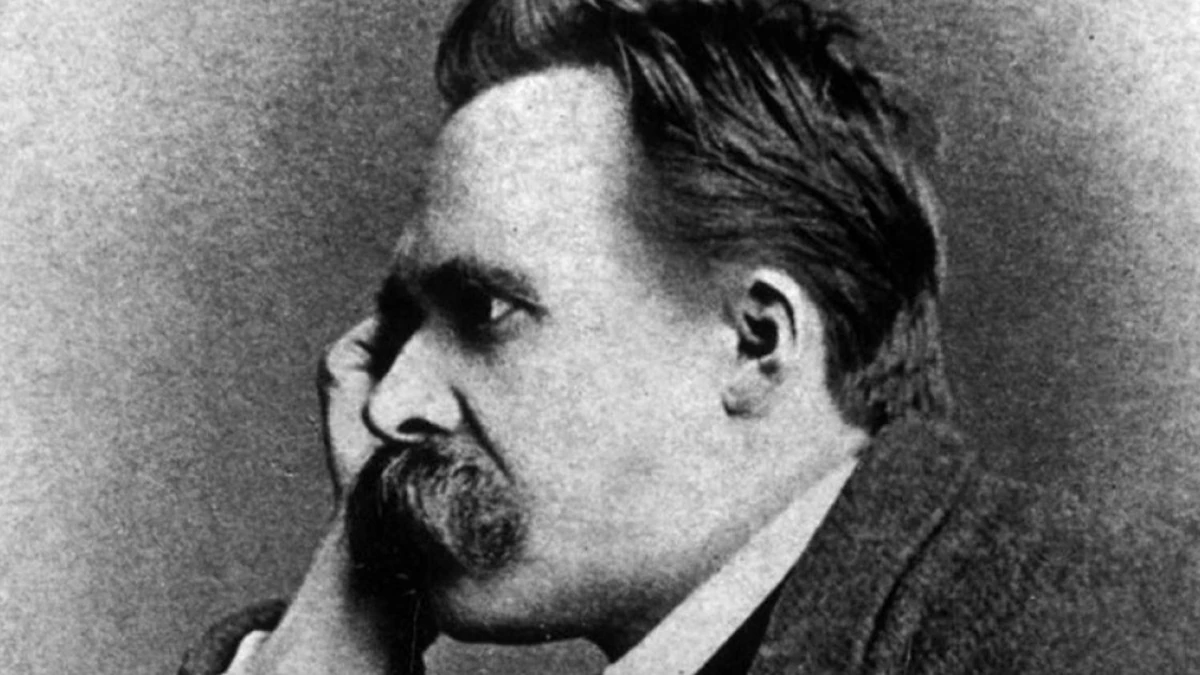
Friedrich Nietzsche's IQ: the 165 credited to Cox and the record that exists
ACIS has never assessed Friedrich Nietzsche, holds no record belonging to him, and no retrospective assessment of anyone is possible. The 165 credited to Catharine Cox is not in Cox's volume, the 190 has no test behind it, and the 144 is a median of strangers' guesses. This page traces each figure, then separates them from the record: a free place at Pforta, a Leipzig doctorate and a Basel chair at 24.
Friedrich Nietzsche was born on October 15, 1844, and the Stanford Encyclopedia of Philosophy says he was the youngest person ever appointed to a classical philology chair at Basel, at 24.
0 The short answer
Friedrich Nietzsche has no documented IQ: no test, date, examiner or norm group stands behind the 165, the 190 or the 144 that circulate. ACIS has never assessed him. The 165 is labeled a Cox estimate, but Catharine Cox's 1926 volume of 301 subjects does not contain him in either of two full text copies searched for this page, so the label is wrong. What the record does document is a free place at the Pforta school, a Leipzig doctorate awarded without an oral examination on March 23, 1869, and a Basel chair at 24, which show achievement and an uneven school record that includes a near failure in mathematics, not a score.
165
The figure credited to Cox on corebrain.app, although Nietzsche is not among the 301 subjects of Cox's 1926 volume.
190
The figure on a Geni list that credits Cox's volume and a ranking by Libb Thims, with no test, date or examiner named.
24
His age when he arrived in Basel on April 19, 1869, our arithmetic from his birth date of October 15, 1844.
1 Which IQ figures circulate for Nietzsche, and what does each page offer as its basis?
Five different numbers circulate for Nietzsche, 165, 190, 160, 150 to 165 and 144, and every page that prints one either names no test or says in its own words that the number is an estimate. On October 13, 2026, this review opened the pages that rank for the question and read what each says about the basis of its figure. The table sets each claim beside the evidence the page offers for it.
A median from an informal survey run through Emil Kirkegaard's Twitter account
A poll of opinions, not an assessment. The next sections examine it
Two things stand out. First, the pages disagree with one another by more than 45 points, from 144 to 190, which no measurement of one person would do. Second, three of the pages credit Cox, and the next section shows that the volume they name does not contain him. A figure that three pages repeat and none documents is one claim appearing several times, not three findings.
The corebrain page also contradicts itself on rarity. Its stat box says top 0.003 percent, its body says top 0.001 percent, and it prints 1 in 136,176. On the standard scale with a mean of 100 and a standard deviation of 15, those three lines correspond to about 160, about 164 and about 165. Those conversions are our arithmetic, and they show that the page's own rarity statements do not describe a single score.
ACIS has not tested Friedrich NietzscheACIS has never assessed Friedrich Nietzsche, holds no record belonging to him, and no retrospective assessment of anyone is possible. Nothing on this page is an estimate of his IQ, and no figure here should be read as one. Numbers on the page come from named sources or are labeled as our own arithmetic.
2 Is the 165 a Cox estimate?
The 165 cannot be a Cox estimate, because Nietzsche is not among the 301 subjects Catharine Cox rated in her 1926 volume. The book is The Early Mental Traits of Three Hundred Geniuses, volume 2 of Lewis Terman's Genetic Studies of Genius, published by Stanford University Press. Its introduction says the subjects are 301 of the most eminent men and women of history, and that they lived between 1450 and 1850. Nietzsche was born in 1844, so his birth year is inside that range and does not explain his absence.
Cox built the group from a list of the 1,000 most eminent men compiled by James McKeen Cattell. She removed the hereditary aristocracy and nobility, dropped those born before 1450, struck out names beyond the 510th on the original list, and discarded eleven cases for lack of data, which left 301 case histories. This review did not check whether Nietzsche appears on Cattell's list, so it cannot say why he is missing, only that he is.
The absence was checked in two independent text copies of the book. One is a local optical character recognition copy held by ACIS, about 62,500 lines long, and the other is the full text served by the Internet Archive for the same volume, about 61,600 lines. Neither contains the name Nietzsche or a close spelling variant, and the printed contents pages, which list every subject by IQ band, do not name him either. Optical recognition can miss a word, but a name absent from two copies and from a table of contents is absent from the book.
The volume is not short of philosophers. Its contents list Kant, Fichte, Hegel, Schelling, Hume, Descartes, Berkeley, Comte and John Stuart Mill, among many others. A reader who wants to see how her figures read for subjects who are in the book can open the pages on Goethe and Charles Darwin.
What Cox actually produced also differs from what the pages imply. She rated each subject on the surviving record in childhood and early youth, which she called the AI IQ and took to age 17, and in the first period of young manhood, the AII IQ, taken to age 26. Each rating averaged the estimates of three judges. She expressed them in IQ terms, the ratio of mental age to chronological age, but wrote that she treated the IQ as a measure of relative "brightness" compared with a large unselected group, in the way a sigma index would. She stated that the ratings were estimated from the records as they stand.
She also warned against over-reading the numbers. Comparing John Stuart Mill, whom she rated 190 on the AI IQ, with John Milton, she wrote that her figures should not be taken to mean the true scores differed by that many points, because each score registers the average rating of people who do the things recorded of the subject at a given age. Her top band for the childhood rating, 190 to 200, holds one case in the whole volume, Mill.
A page that writes "Cox estimate" beside a number for Nietzsche is therefore asserting that a specific rating exists, made by named judges, on a documented procedure. None of the three pages that use the label names a page, a table or a chapter. The label is best read as a way to borrow the authority of the best known study of historical IQs, not as a citation.
3 Where does the 190 come from?
The 190 traces to a list on Geni that credits two sources at once and describes its numbers only as a ranking, so it is a label attached to a name, not a result. The page, read in an archived copy with a 2024 copyright footer, is titled "Famous Historical Genius IQs." It prints Nietzsche in a long block of names marked 190 IQ, and it closes with two credits. One reads "Genius IQs of Historicals" based on the work of Catherine Morris Cox, Stanford Press, 1926. The other reads "Libb Thims's Genius IQ Rankings," with the address of a Hmolpedia list, ranked by IQ or "relative brightness or intellect."
Cox's volume cannot support a block of 190 labels. Her range is people born from 1450 to 1850, yet the same block carries Empedocles and Archimedes, who lived in antiquity, and twentieth century scientists such as Paul Dirac and Linus Pauling. Nietzsche is not in her book at all, as the previous section shows. Among her childhood ratings, the only one that reaches 190 is Mill's, at the top of her scale. A page that credits Cox for a flat 190 on many names has not copied her table.
The second credit leads to a ranking this review could not read. Requesting the Hmolpedia address returned a verification challenge page instead of the list, so how Thims assigned his numbers is not known to this review, and the Geni page does not say. A ranking by "relative brightness or intellect" is a statement about order, and the page gives no indication that any number in it is a measured score on a named scale.
The iqtests.com article that prints 190 adds nothing that would anchor it. It calls the figure a rumor, says IQ tests did not exist when Nietzsche lived, and credits "scholars like Catherine Morris Cox" without a citation. Its own body text, "around 1901," shows how loosely the number is handled.
On the standard scale, 190 is 90 points above the mean, which is 6.0 standard deviations. Under a normal model that is about 1 in 1.01 billion, our arithmetic. No norm sample of any real test could document a case that rare, which is why a stated 190 can only be an extrapolation of a curve or a label, never a count of people. The page on how IQ scores are normed explains how scale scores are built, and the page on why standard deviation 15 matters explains what a point on that scale means.
4 What is the 144, and can a poll of strangers measure a philosopher who died in 1900?
The 144 is a median of opinions collected through one account on social media, so it measures how intelligent a name seems to that audience, not how a man performed on a test. Ronald Henss, in a post dated April 5, 2023, lists Nietzsche at 144 among the top estimates from a survey run by Emil Kirkegaard, a researcher who writes about intelligence. The list reads Newton 160, Kant 149, Aristotle 148, Plato 146, Socrates 145 and Nietzsche 144. Henss describes the survey as an impromptu, just-for-fun exercise, notes that the raters were recruited through Kirkegaard's Twitter account, which he calls a very atypical sample, and says the raters were asked to estimate the IQ of 54 people.
Kirkegaard's own post, published in March 2023, describes what he did in plain terms. He called it a real survey, defined as polling random people on Twitter, and reported results from 584 people who contributed data. Some respondents trolled by entering very low estimates for people they disliked, so he deleted all estimates below 70 and used medians instead of means. He also reported that the respondents rated themselves at a median of 132, which he suggested could reflect overestimation or the largely male sample. The text of his post that this review could read did not include a Nietzsche row, so the 144 rests on Henss's report of the survey.
None of that makes the exercise worthless as a curiosity. It makes it a different kind of object from a test score. A rater who is asked to put a number on Nietzsche has no test to consult, no age to compare against and no norm group, so the number summarizes what the rater already believes about the man's reputation. A median of 584 such beliefs is more stable than one belief, but it remains a belief. Averaging many guesses about a dead person does not turn them into a measurement of that person, because the thing being guessed was never measured.
Henss draws a stronger conclusion. He argues that it is absurd to assign IQ scores of 170 or more to individuals, because even the best tests are normed on samples too small to resolve scores that far out, and he gives the example of a German adult Wechsler norming sample of 1,650 people, in which he expects about one person above 150. That is his argument, with his figure, and this page does not rely on it. The point that matters here is simpler. A survey median of 144 for Nietzsche is a statement about the audience, and it sits 21 points below the 165 and 46 below the 190, which shows how much of the spread between circulating figures comes from who is guessing, not from anything in the man's record.
The pages that print each figure also use different scales without saying so. A guess of 144 from a survey respondent, a ratio IQ in Cox's sense and a deviation IQ on the standard scale are three different quantities, and a reader cannot tell which one a page means. The page on why scores and percentiles cannot be averaged explains how much a number depends on the scale behind it.
5 What does the documented record hold, year by year?
The documented record is a sequence of dated school, university, publishing and professorship events, and none of it is an intelligence test. The table lists what the sources opened for this review establish, with the source for each line. Where sources give different dates, the table says so instead of choosing one.
Date
What is documented
Where it is documented
October 15, 1844
Born in Röcken, near Leipzig, where his father was a Lutheran minister
Called to the chair, in the Stanford Encyclopedia's dating
Stanford Encyclopedia of Philosophy
1872
Publishes The Birth of Tragedy, which classicists received badly
Stanford Encyclopedia of Philosophy
1876 to 1879
Leave from Basel in 1876 and 1877, then forced to resign in 1879
Stanford Encyclopedia of Philosophy
January 1889
Collapses in Turin
Stanford Encyclopedia of Philosophy
1900
Dies
Stanford Encyclopedia of Philosophy
Read down the third column and the pattern is plain. The sources are a philosophy encyclopedia, a biographical essay on the young Nietzsche, a university department's history of its own seminar, a college biography page and the book he wrote himself. They record where he studied, who recommended him, what he published and what he held. They are the kinds of source that anchor any documented biography, and they answer different questions from an intelligence test.
The sources disagree on small points, and the disagreement is worth showing. The offer is dated February 1869 by Beckman, the arrival April 19, 1869 by the Basel department, and the call May 1869 by the Stanford Encyclopedia, which is consistent with an offer followed by a formal appointment but is not spelled out in any source read. The Basel page also refers to an "only twenty-five year old" in its account of the appointment, while the Stanford Encyclopedia says he was 24. Counting from October 15, 1844, he was 24 in April 1869, and he turned 25 that October. That is our arithmetic, and it is why this page says 24.
The 1889 and 1900 lines are included only as chronology. The page records the collapse and the death and draws no inference from either. The Stanford Encyclopedia states the facts, and this page leaves them there.
6 What does the Pforta record show?
The Pforta record shows a boy admitted to an elite school on a free place, praised for language and philosophy, and nearly failed in mathematics, which is evidence of an uneven school profile and not of a score. Helmut Walther's essay on the young Nietzsche, a revised version of a lecture given on May 8, 2002, reports that before his move to Pforta in 1858 he had obtained a free place, and describes the school as one of the oldest elite schools in Germany, whose earlier pupils included Klopstock, Novalis, Ranke and Fichte. Beckman gives the years at Pforta as 1858 to 1864 and calls it a free place without adding terms. Neither source gives the number of applicants or says where Nietzsche ranked among them, so the free place is evidence of selection, not of a rank.
Nietzsche described his own schoolwork in Ecce Homo. He says he could compose a long Latin essay in one night, revise and copy it, and aim at the terseness of his model, the Roman historian Sallust, while a pupil at Pforta. That is his own recollection, written decades later, and it records a habit of work, not a measurement.
The final examination of 1864 is where the record is most informative. Beckman says he earned the commendation "extraordinary" in Greek. Walther says the leaving certificate shows excellent marks in German, Latin and Greek, only satisfactory marks in the natural sciences and history, and a good mark in religion. Walther adds that he nearly failed mathematics and owed his certificate in part to a teacher's plea, and he quotes the teacher asking whether the school wished to fail the most gifted pupil Pforta had had in his time there.
That quotation needs care. Walther's footnote for it cites a book by "E. F.-N." titled Der junge Nietzsche, page 129, and this review did not open that book. The initials appear to stand for his sister Elisabeth Förster-Nietzsche, who later controlled his literary estate. The Stanford Encyclopedia notes that her editorial work on his notebooks was not well founded in his surviving plans and left a misleading impression of the writings. That does not show that the quotation is wrong. It does mean that a remark about the "most gifted pupil" is a teacher's opinion reported through a family source, with no scale, comparison group or date beyond the year.
Walther also quotes a recommendation written on September 7, 1864 by another teacher, Steinhart, to a Bonn professor. In our translation, it calls Nietzsche a deep, thoughtful nature devoted with enthusiasm to philosophy, especially Plato's. The letter describes a temperament and an interest. It says nothing that can be placed on a population scale.
Put together, the documents show a pupil far ahead in languages, close to failing in one subject, and noticed by his teachers. School marks measure how a pupil meets a curriculum, taught by particular masters, in a particular year. A near failure in mathematics shows how uneven a profile can be, and it is the strongest reason to distrust any single number for him. It is not a measurement of quantitative reasoning (Gq), and this page draws no such inference.
7 What did Leipzig and Basel decide, and on what evidence?
The Leipzig doctorate and the Basel chair were expert judgments about a classical philologist's published work and promise, made partly because Basel needed young scholars, and they carry no comparison with a population. By Nietzsche's own account in Ecce Homo, he became a philologist when his master Ritschl obtained his first philological work for publication in the Rheinisches Museum, and he became a university professor when he was "scarcely four-and-twenty." He wrote that he had never had the remotest idea of such a thing. That is a recollection written near the end of his working life, and it agrees with the dates elsewhere in the record.
Friedrich Wilhelm Ritschl was the Leipzig philologist who edited that journal. The Stanford Encyclopedia says his letter of reference said Nietzsche was so promising that "He will simply be able to do anything he wants to do," and cites Walter Kaufmann's 1954 volume for the line. The University of Basel's department of ancient civilizations describes the sequence from its own side. The president of the curatorship, Wilhelm Vischer, approached Ritschl in Leipzig, partly to find an alternative to an unwelcome local candidate, and Ritschl replied with an effusive letter of recommendation. A 2015 article in Nietzsche-Studien by M. Pernet is devoted to a letter from Ritschl to Vischer-Bilfinger. This review confirmed the article's record in Crossref and did not read its text.
The doctorate followed the recommendation. The Basel page says Leipzig awarded it without an oral examination on March 23, 1869, and that he had not yet received it when he was appointed. Beckman says the degree rested on his articles in Ritschl's journal. The appointment, the Basel page adds, rested on personal recommendations and his published philological work, and it caused a stir because of his youth.
The same page gives a reason that has nothing to do with his intellect. Basel, it says, did not have the means to bring established philologists from Germany, so the seminar became a springboard for young German philologists. That context matters. A very young appointee was partly a product of what a small university could afford. It does not diminish the achievement, since Ritschl's judgment and the published articles were real, but it shows why "appointed at 24" is a fact about 1869 and about Basel as much as about a person.
The Stanford Encyclopedia adds that at 24 he was the youngest ever appointed to such a post. That is a superlative in a secondary source, and this review did not find a count behind it. All of these steps were decisions by scholars who knew his work, made in a field they judged with their own standards, and none of the sources gives the pool of candidates. An appointment in 1869 is a fact about 1869. It is not a percentile.
8 What did Nietzsche himself say about being clever?
Nietzsche answered the question of his own cleverness in a late self-portrait that explains it by habits, diet and place, never by a measured quantity, and a rhetorical self-description is not evidence of a score. Ecce Homo, which the introduction to the English edition says he began on October 15, 1888, his 44th birthday, has chapters titled "Why I Am So Wise" and "Why I Am So Clever." The Stanford Encyclopedia says his sister Elisabeth, who took control of his literary legacy during his illness, eventually published the book. The English text translated by Paul V. Cohn opens the second of those chapters with the question "Why, in fact, am I so clever?"
His answer in the opening pages is a list of things he says he never did. He says he never pondered questions that are not questions and never squandered his strength, and he then turns to a question he says matters far more, nutrition, asking how one must feed oneself to reach a maximum of power. The word IQ does not appear anywhere in the book, nor does the phrase intelligence quotient, which is no surprise in a text of 1888. The chapter treats cleverness as a way of conducting a life, which includes what to eat, where to live and what to ignore.
That view is interesting, and it differs from the construct a modern test measures. A standardized battery samples performance on defined tasks under fixed conditions and compares the result with a reference group of the same age, as the page on what IQ measures explains. Nietzsche's cleverness is closer to what the page on intelligence versus wisdom discusses: judgment about how to live. Neither is a lesser thing, but they are not interchangeable, and a reader who wants an IQ for him is asking one question of a writer who was answering another.
It is also worth saying what the passage cannot do. A man describing himself in rhetorical prose, in a book that, according to the Stanford Encyclopedia, his sister published after his collapse, is giving a self-portrait. The claims about his diet and habits are his own, uncorroborated by the passages read here, and nothing in them could be converted into a number.
9 Could any test have returned 165 or 190 for a man who died in 1900?
No instrument that could return an IQ existed during Nietzsche's working life, so any figure for him is a reconstruction on a scale chosen by whoever prints it. The Stanford Encyclopedia places his collapse in January 1889 and his death in 1900. J. McKeen Cattell's Mental Tests and Measurements appeared in the journal Mind in 1890, the year after the collapse. Binet and Simon's article on new methods for diagnosing intellectual level appeared in volume 11 of L'année psychologique, which Crossref dates 1904, four years after he died. Cox's footnote defining the IQ as the ratio of mental age to chronological age cites Terman's book The Measurement of Intelligence, published in Boston by Houghton in 1916, sixteen years after his death. The page on the history of IQ testing traces how those instruments developed.
Even if a test had existed, the figure would need a scale. Cox's ratings are ratio IQs used as a relative standing, a different object from the deviation scale in use today, which places a person within a distribution of people of the same age with a mean of 100 and a standard deviation of 15. Every page that prints a number for Nietzsche omits which of these it means. The table converts each figure on the standard scale, so that a reader can see what it would claim.
Figure
Standard deviations above 100
About 1 in
Where it appears
144
2.93
596
Henss's report of a survey median
150
3.33
2,331
Lower end of the iqmetrics.org range
160
4.00
31,574
geniuses.club
165
4.33
136,176
corebrain.app and the upper end of the iqmetrics.org range
190
6.00
About 1.01 billion
iqtests.com and the Geni list
All of these conversions are our arithmetic on a normal distribution. They are not measurements of Nietzsche. The table shows why small differences in a stated IQ hide large differences in rarity: the iqmetrics.org range of 150 to 165 spans a factor of about 58 in how rare the score would be. Two pages give ranges, 150 to 165 and 150 to 170, and corebrain.app says its 165 sits within plus or minus 10 to 15 points, but none of these is a confidence interval from a test.
A norm sample would also need to be large enough to contain anyone that rare. To expect even one case at 165, a sample would need to hold on the order of 136,000 people, and at 190 on the order of a billion. Far into the tail, a stated rarity is therefore an extrapolation of the normal curve, not a count of people. The IQ rarity calculator and the IQ percentile calculator apply that curve, and the page on why standard deviation 15 matters shows what each step on it means.
10 What can the surviving record say about his abilities, and what can it not?
The record documents exceptional, language based scholarship at a young age and an uneven school profile, and it cannot supply the rest of a cognitive profile, so it cannot yield a Full Scale IQ. In the terms of the CHC model, the evidence points to crystallized knowledge (Gc) and to reading and writing ability (Grw). Classical philology is the close study of Greek and Latin texts, and the sources show a pupil with excellent marks in German, Latin and Greek, a student whose work a leading philologist chose to print, and a candidate whom that philologist recommended in strong terms. Those are the abilities such work draws on, and the documents record them.
The same reasoning has limits. Achievement in a field combines ability with practice, opportunity and mentoring, and Nietzsche's record shows all three: a free place at an elite school, a master who placed his first work, and a university that could not afford established scholars. The record cannot separate how much of the result came from each. A reader who calls him a genius is describing eminence, which the record supports, and the page on where the genius threshold of 140 came from explains why that word and a number are different things.
The record is silent on most of the other abilities. It offers nothing that could be read as fluid reasoning (Gf), working memory (Gwm), processing speed (Gs) or visual spatial processing (Gv). The one school episode in quantitative territory, the near failure in mathematics, is a mark in a single subject in a single year, and the sources do not say why it happened. It is a reason to avoid inference, not a measurement of quantitative reasoning (Gq). The page on fluid versus crystallized intelligence shows how differently those two kinds of ability behave, and a profile that is strong in one and unknown in the other cannot be averaged into a single figure.
Health adds a further problem. The Stanford Encyclopedia says his fragile health forced him to take leave from Basel in 1876 and 1877 and to resign in 1879. In Ecce Homo he writes that in 1879 his eyes could distinguish nothing three paces away. This page makes no diagnosis and draws no conclusion from either statement. The point is practical: any timed or visual task given to him at that point would have measured a man in a particular state of health, and Standard 6.1 of the Standards for Educational and Psychological Testing asks administrators to follow the standardized procedures carefully, which ties any score to the conditions under which it was obtained.
A reader who wants to see what verbal and general knowledge measures look like in a modern test can read the pages on Vocabulary and Information, two of the five subtests in the ACIS verbal comprehension index. Those pages describe formats and do not reproduce items. They illustrate why a verbal strength is one index among several, and the page on the Full Scale IQ explains what a single composite does and does not summarize.
11 What would a defensible number for Nietzsche require?
A defensible figure would require either a document naming the instrument, date, examiner, reference group and interval, or a published estimating procedure with named raters, and nothing opened for this review supplies either. The only published procedure for historical figures in this review is Cox's. It rests on judges reading a record to age 17 and to age 26, on a ratio definition of IQ, and on her own warning that the figures register the average rating of people who do the recorded things at a given age. Someone could apply her method to Nietzsche. That has not been done in any source this review found, and the result would still be a judged estimate with the limits she stated, not a score.
Several things would not suffice. More achievements would not, because the record of achievement is already strong and is not a score. More pages repeating a number would not, because repetition is not independence. A teacher's remark about the most gifted pupil would not, because a remark is an opinion with no scale. A phrase such as "scholars estimate" would not, until the scholars are named and the method can be read. A poll of strangers would not, because it measures reputation, as the earlier section on the 144 explains.
A reader can apply five questions to any celebrity figure. Which test and which edition? When was it given, and at what age? Who administered it? Which norms were used? What interval surrounds the score? If a page cannot answer them, the number is circulating, not measured. The guides to celebrity IQ claims with every number sourced and to the highest IQ claims apply the same questions across many names, and the pages on Albert Einstein, Alan Turing and Galileo Galilei apply them to other famous names.
An exact account has no room for an invented number, and it does not need one. The record that exists for Nietzsche is rich: a school place, a doctorate, a chair and a body of published writing. That record can be described accurately without a score. The figure of 165, the 190 and the 144 add nothing to it and take away a reader's ability to tell what was documented from what was supposed.
The lesson of the 165 and the 190 is that a score is only as meaningful as the documentation behind it, and professional standards say the same about every score, including yours. The Standards for Educational and Psychological Testing, published by AERA, APA and NCME in 2014, ask for clear articulation of each intended score interpretation, with validity evidence in support of each (Standard 1.0). They ask the developer to delimit the population for which a test is intended and to describe the construct clearly (Standard 1.1). They ask that test users receive clear explanations of the characteristics, meaning and intended interpretation of scale scores, as well as their limitations (Standard 5.1). They ask that users be explicitly cautioned when specific misinterpretations of a score scale are likely (Standard 5.3). They also ask that norms refer to clearly described populations that include the people with whom users will ordinarily want to compare an examinee (Standard 5.8). A number with no scale, no reference group and no stated purpose fails each of these before it is read.
The APA Ethics Code, in the text effective January 1, 2017, adds that psychologists base their opinions on information and techniques sufficient to substantiate their findings (Standard 9.01a). It says that they give opinions about the psychological characteristics of individuals only after an examination adequate to support them, and that when an examination is not practical they document their efforts, clarify the effect of limited information and limit their conclusions (Standard 9.01b). It says that in interpreting results they take account of the purpose of the assessment and the characteristics of the person assessed, and indicate significant limitations (Standard 9.06). A psychologist following those standards could say very little about a man who died in 1900 and left no test record, which is the answer this page gives.
Ask the same questions of your own result. ACIS sells a paid assessment, so treat this section as a disclosure. The report gives a Full Scale IQ and six primary indices on the standard scale with a mean of 100 and a standard deviation of 15, with percentiles and a 95 percent confidence interval, and adult norms cover ages 16 to 90. It is online and unsupervised. It is not a clinical or diagnostic instrument, and it is not for hiring, school accommodations or admission to high IQ societies. It is available in English only. The technical manual holds the documentation, and the page on what an accurate IQ test looks like sets out how to judge any provider.
The forms are a one time payment with no subscription, breaks are allowed, and there is a free trial with no card. Prices below were read on October 13, 2026 and can change. The Quick form costs 15 dollars, with 6 subtests in 3 domains and about 45 minutes. The Optimized form costs 30 dollars, with 13 subtests in 5 domains and about 110 minutes. The Full Scale form costs 50 dollars, with all 20 subtests in six domains and about 175 minutes. A 5 day quality guarantee applies, and you have 30 days to complete a form.
To choose among options, the guides to the best online IQ tests, where to take an IQ test and the IQ test for adults set out the routes, and the page on what your IQ is and how to read it covers interpretation. If you need a result for a formal purpose such as a diagnosis, accommodations or a hiring decision, ask the receiving body what evidence it accepts and consult a licensed professional. A number you can understand and defend is worth more than a famous one you cannot trace.
Every figure above is traceable to one of the following, and each is linked at the point where it is used. Web pages were read on October 13, 2026. Figures marked as our arithmetic are calculations on a normal distribution and are not attributed to any author.
Cox C M. The Early Mental Traits of Three Hundred Geniuses. Genetic Studies of Genius, volume 2, edited by L M Terman, Stanford University Press, 1926. The text was searched in two copies, a local optical character recognition copy and the Internet Archive full text. The ratio definition of the IQ in the volume is cited there to Terman L M, The Measurement of Intelligence, Boston, Houghton, 1916.
Anderson R L. Friedrich Nietzsche. Stanford Encyclopedia of Philosophy, first published March 17, 2017, substantive revision June 25, 2026.
University of Basel, Department of Ancient Civilizations. Greek philology: portrait. Text by Ueli Dill and Martin Müller, 1987, with later updates by the site's webmasters.
Walther H. Der junge Nietzsche. Revised version of a lecture of May 8, 2002 for the Gesellschaft für kritische Philosophie Nürnberg, hosted on f-nietzsche.de.
American Educational Research Association, American Psychological Association and National Council on Measurement in Education. Standards for Educational and Psychological Testing. AERA, 2014. Standards 1.0, 1.1, 5.1, 5.3 and 5.8 were read in the open access PDF.
Nietzsche's IQ is unknown, because no intelligence test result belonging to him is on record. The figures of 165, 190 and 144 that circulate come from pages and a poll that name no test, date, examiner or norm group. His achievements are well documented, but they are not a score.
Did Nietzsche ever take an IQ test?
No source read for this review says he did. Intelligence tests of the modern kind appeared after his collapse in 1889 and after his death in 1900, so no such test was available to him. That is an absence in the sources reviewed, plus a matter of chronology, not proof about every possible examination.
Is Nietzsche's IQ 165?
The 165 is a figure printed on at least one website and labeled a Cox estimate, but it has no test behind it. Catharine Cox never rated Nietzsche, who is absent from her 301 subjects. At most the number is someone's guess presented under borrowed authority.
Is Nietzsche's IQ 190?
The 190 is a label that appears beside Nietzsche's name on a Geni list and in an article that calls it a rumor. No page offers a test, a date or an examiner for it. On the standard scale a 190 would be about one person in a billion.
Was Nietzsche a genius?
Nietzsche was clearly eminent: a Basel professor at 24, a doctorate from Leipzig and a body of writing read worldwide. Genius is a judgment about achievement and influence, not a test result, and the documented record supports the first without supplying the second as a number.
Was Nietzsche's IQ higher than Kant's?
No valid comparison exists, because neither man has a test score. In one informal Twitter survey reported by a critic, Kant received a median guess of 149 and Nietzsche 144, but those medians describe how respondents see the two names. They do not measure either philosopher.
Is Nietzsche in Catharine Cox's study of 301 geniuses?
No. Searches of two full text copies of her 1926 volume and its list of subjects found no Nietzsche, although he was born in 1844, inside her range of 1450 to 1850. Her contents do list many philosophers, so the omission is specific to him.
Why do some websites call the 165 a Cox estimate?
The label borrows the reputation of the best known study of historical IQs. Three pages credit Cox, none gives a page or table, and the volume has no entry for him. The likeliest reading is careless attribution, because a famous name makes an unsourced number look established.
How did Catharine Cox estimate the IQs of historical geniuses?
Cox had three judges read biographical records and assign ratings, one for development to age 17 and one for age 17 to 26. She expressed them as IQs but used them as relative standing, and she wrote that they were estimated from the records as they stand.
What does the Geni list of 190 IQs actually say?
It prints a block of names labeled 190 IQ, including antiquity figures and twentieth century scientists, and credits Cox's 1926 volume and a ranking by Libb Thims. Cox's volume covers only people born between 1450 and 1850, so it cannot be the source for the whole block.
How old was Nietzsche when he became a professor at Basel?
He was 24. He was born on October 15, 1844, and the University of Basel says he could arrive on April 19, 1869 to take up his duties. The Stanford Encyclopedia says he was then the youngest ever appointed to such a post, although one Basel page says twenty-five.
Did Nietzsche really receive his doctorate without an exam?
According to the University of Basel's department, Leipzig awarded the doctorate without an oral examination on March 23, 1869, and he had not yet received it when appointed. Other sources describe the degree as based on his published articles, so the exact procedure varies by account.
How did Nietzsche do at the Pforta school?
He entered Pforta in 1858 on a free place and left in 1864 with excellent marks in German, Latin and Greek and the commendation extraordinary in Greek, according to two biographical sources. One of them says he nearly failed mathematics and was helped by a teacher's plea.
What is the 144 figure for Nietzsche?
It is a median guess attributed to an informal survey run through Emil Kirkegaard's Twitter account in 2023 and reported by Ronald Henss. The survey asked respondents to estimate IQs of about 54 people. The author of the survey said its estimates might not reflect real IQs.
Can anyone estimate the IQ of someone who died before IQ tests existed?
Researchers can rate surviving records, as Cox did, but the result is a judged estimate on a chosen scale, not a score. Two raters can weigh the same documents differently, and nothing can be checked against a test. A responsible estimate states its method, raters and limits.
How rare would an IQ of 165 be?
On the standard scale with a mean of 100 and a standard deviation of 15, a 165 is 4.33 standard deviations above the mean, which is about one person in 136,000 under a normal model. That is our arithmetic, and it describes the curve, not a person.
Why do IQ numbers for dead people differ so much between websites?
Sites use different methods, scales and levels of care, and many repeat one another. Some rate achievements, some copy lists, some average opinions. Because none uses a test given to the person, nothing constrains the answers, and the spread reflects who is guessing and how they define IQ.
Does being a great philosopher mean having a very high IQ?
Not by itself. Eminence reflects ability, effort, opportunity, mentors and timing, and philosophy draws on different abilities from those a test samples. A great philosopher may score high, average or unevenly across indices, which is why the reputation of a thinker does not translate into a number.
How can I check a celebrity IQ claim myself?
Ask which test and edition, when and at what age it was given, who administered it, which norms were used, and what interval surrounds the score. If the page cannot answer, treat the number as circulating, not measured. Prefer pages that cite a document you can open yourself.
Does one weak school subject lower a person's IQ?
No. A mark in one subject is not an IQ, and a Full Scale IQ is a composite of many tasks. Uneven profiles are common, and a weakness in one area can sit beside a strength in another, which is why modern reports show several index scores beside the composite.
How can I get a documented IQ score of my own?
A licensed psychologist can give a clinical assessment with an individually administered test, which is the route for diagnoses, accommodations or formal evidence. A normed online test can give an informational score. Whatever you choose, keep the name of the test, the date, the norms and the confidence interval.
Take the assessment
You get a profile, not a number
ACIS measures six CHC domains across 20 subtests and reports each one with its own normed score and confidence interval, so you can see where you are strong and where you are not.