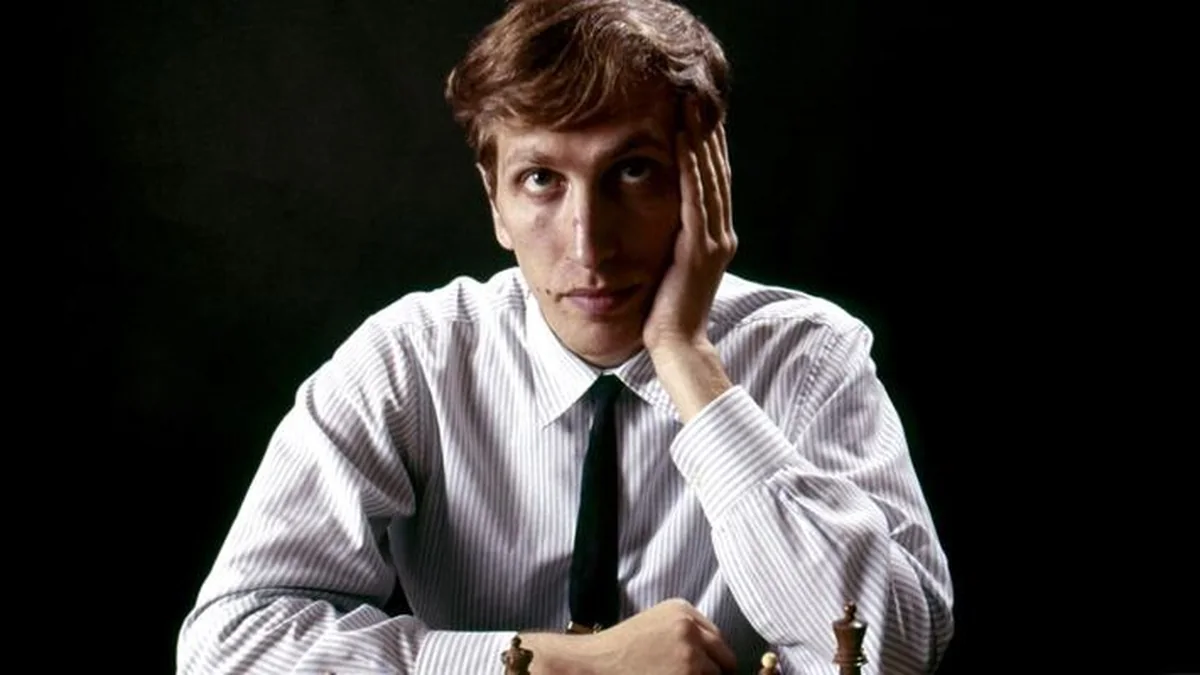
Bobby Fischer's IQ: a number from one biography, and a record from the board
ACIS has never assessed Bobby Fischer, holds no record belonging to him, and no retrospective assessment of anyone is possible. The 181 that dominates search results traces to one biography published in 1965, which reported a school test result at second hand and named no instrument, no date and no examiner. What the record holds instead is the most documented competitive career in the history of the game, and this page keeps the two apart.
The World Chess Hall of Fame records eight United States championships from eight entries and a perfect score in 1963 to 1964; no testing body records anything.
0 Quick Answer
No IQ score for Bobby Fischer has ever been published by anyone who administered a test, and the 181 that circulates traces to a secondhand anecdote about a school record in Frank Brady's 1965 biography, Profile of a Prodigy, which named no instrument, no date and no examiner. Other pages repeat 180, 184, 187 and lower figures with the same absence of documentation, and the Wikipedia article, used here as a pointer to the biography and not as a source for any figure, carries the number with the same provenance. No document of any test has surfaced in six decades, and Brady's later work did not supply one.
What the record holds is the reverse of the number: exhaustively documented and independent of anyone's memory. The World Chess Hall of Fame, which inducted him in 1986 and 2001, records that he won the United States Open in 1957, became the youngest winner of the United States Championship in 1957 to 1958 at fourteen, won all eight United States Championships he entered, achieved the only perfect score in the event's history in 1963 to 1964, won twenty consecutive games in world championship qualifying events in 1970 and 1971, and defeated Boris Spassky in 1972 to become the eleventh world champion, with a rating gap of 125 points over the second ranked player at the time. Every one of those facts rests on published game scores and tournament tables.
The two categories are different kinds of evidence. Chess skill is measured continuously, publicly and precisely by a rating system built on results, and Fischer's results are the strongest of his era. Measured intelligence is a rank on a normed instrument administered under stated conditions, and no such administration is on the record. The research on how the two relate, reviewed below, shows a real and modest correlation, which is a reason to keep them apart rather than to convert one into the other.
1965
The year Brady's biography reported the school test anecdote from which every circulating figure descends.
8 of 8
United States Championships won from entries, including the only perfect score in the event's history, 11 wins from 11 games in 1963 to 1964, per the World Chess Hall of Fame.
20
Consecutive wins in world championship qualifying events in 1970 and 1971, a record the Hall of Fame describes as all time.
.22
The average correlation between cognitive ability and chess skill across the literature, from the 2016 meta-analysis by Burgoyne and colleagues in Intelligence.
1 Where the 181 Comes From, and Where the Trail Stops
The number has a single origin, a biography written when its subject was twenty two, and the origin is an anecdote rather than a record. Frank Brady, who knew Fischer from the Brooklyn chess world of the 1950s and later founded Chess Life, published Profile of a Prodigy in 1965, with revised editions in 1973 and 1989. In it he reported that a test administered during Fischer's schooling had produced a result in the very high range, a figure that later editions and later writers rendered as 180, 181 or higher. The account came at second hand, from a person recalling a school record, and it named no instrument, no date, no examiner and no scale. Brady's 2011 biography, Endgame, revisited the whole life and added no document.
Everything since has copied the anecdote. The pages that carry 181, 184, 187 or 180 point to one another and, when they point anywhere else, to Brady. The pages that carry lower figures, and some do, have the same evidential basis, which is none. The page on celebrities with the highest IQ sorts such figures by the kind of evidence behind them, and the Fischer figure sorts into the class of secondhand recollection, above pure invention and below any documented administration.
Two features of the anecdote deserve attention. First, a school test in Brooklyn in the early 1950s, if one was given, would have been a group administered instrument scored on a scale that may have used a standard deviation of 16 or a ratio, and the page on the 15 point standard deviation explains why a number from such an instrument cannot be placed against a Wechsler scale without knowing which it was. Second, a figure of 181 exceeds the ceiling of every individually administered adult instrument then and now, which the WAIS-5 sets at 160 per Pearson's product documentation, read on September 19, 2026. A group test for schoolchildren does not resolve differences at that level either. Whatever the school record held, the number that reached print is not one that any documented instrument would have produced for an adult.
2 The Brooklyn Years, and What the Schools Recorded
The only place a test could have entered the record is the Brooklyn school system of the early 1950s, and what is documented about that period is a boy who left school at sixteen to play chess. Brady's biography records that Fischer learned the game at six, joined the Brooklyn Chess Club and then the Manhattan Chess Club as a child, and attended Erasmus Hall High School, which he left in 1959 at sixteen after winning the national championship, with the stated intention of devoting himself to chess. The Wikipedia article, a pointer to the biography and not a source for any figure, agrees on the outline.
New York schools in that period administered group intelligence tests as a matter of routine, and a record of such a test would have been a single number on a school card, scored on whatever scale the instrument used. The page on types of IQ tests explains the difference between a group test given to a class and an individual administration by a psychologist; the group tests of the era were short, timed and normed on schoolchildren, and their ceilings were low. A card from Erasmus Hall, had one survived, would document a group test result and its scale, and would still not document an adult IQ. No card has been produced, and Brady reported a recollection of one rather than the card itself.
That is the entire documentary basis of the 181: a school that gave group tests, a person who remembered a high result, and a biographer who reported the memory. Everything else in the Fischer record is a game score.
3 What the Record Documents: 1957 to 1964
The documented career begins with a fourteen year old winning the national championship of the United States, and every step of it is recorded in game scores that can be replayed today. The World Chess Hall of Fame's biography, read on September 19, 2026, states that Fischer won the United States Open in 1957 and was the youngest person to gain first place in the United States Chess Championship in 1957 to 1958. He went on to win all eight of the championships in which he participated, and in the 1963 to 1964 competition he became the only player to achieve a perfect score in the event, eleven wins from eleven games against the strongest players in the country. The page on Garry Kasparov's IQ and the page on Magnus Carlsen's IQ cover the two later champions whose names are most often set beside his.
The perfect score is the fact to hold onto, because it is a measurement of a kind. Chess results are recorded exactly, aggregated into ratings by a published formula, and comparable across players and decades within the limits of the rating system. Eleven wins from eleven games against a national championship field is a result no other player has produced in that event before or since, and it documents a level of skill at the board that no anecdote could inflate or deflate. The page on IQ and academic achievement explains the difference between an achievement measure, which records what a person has done, and an ability measure, which ranks what a person can do against a norm; the perfect score is the purest achievement measure in the record.
The record also documents the age at which the skill appeared, which is the feature that draws intelligence claims. Winning a national championship at fourteen against adult grandmasters is the chess equivalent of the prodigies reviewed elsewhere in this section, and the page on William James Sidis's IQ shows how precocity in a formal domain attracts numbers that the domain itself never produced. In Fischer's case the domain produced its own numbers, the ratings, and they are the ones that can be checked.
4 What the Record Documents: 1970 to 1972
The peak of the career is the best documented sequence of results in the history of the game, and its documentation is why the IQ claim is unnecessary. The Hall of Fame records that from 1970 to 1971 Fischer won twenty consecutive games in world championship qualifying events, including matches against Mark Taimanov and Bent Larsen, and defeated the former world champion Tigran Petrosian in the 1971 Candidates Match. It records that at that point the rating gap between Fischer, ranked first, and Boris Spassky, ranked second, was 125 points, which it describes as a record. It records that Fischer won the 1972 world championship match in Reykjavik after twenty one games, the first non Soviet player to hold the title in twenty four years, and that he did so without the state support the Soviet Union provided its champions, in a country with about 5,000 registered players against the Soviet Union's five million in 1960.
Twenty consecutive wins at the candidates level is a statistical event of a kind that the rating system can quantify. A 125 point rating gap corresponds to an expected score of about two thirds in a match between the two players, and the qualifying results exceeded even that expectation. The World Chess Federation publishes the historical rating lists from which these figures come, and the game scores are in every database. The page on IQ and job performance explains why measured ability predicts performance moderately in most occupations; chess is the domain in which performance is measured most precisely of all, and the precision belongs to the results, not to any test of the player.
The Hall of Fame adds that Fischer declined to defend his title in 1975, withdrew from competition until an unofficial rematch with Spassky in 1992, and spent the rest of his life abroad after that match violated an executive order. None of that is evidence about a number either. It is the documented shape of a life whose competitive record is complete.
5 The Rating System, Explained in the Terms a Test Uses
The Elo system is the closest thing chess has to psychometrics, and reading it in those terms shows exactly where the analogy to an IQ scale holds and where it fails. Arpad Elo, a physics professor and chess master, designed the system for the United States Chess Federation in 1960 and the World Chess Federation adopted it in 1970; his account of it, The Rating of Chessplayers, Past and Present, appeared in 1978. The core is a formula: the expected score of a player against an opponent is one divided by one plus ten raised to the power of the rating difference over 400, so that a player rated 200 points higher is expected to score about 76 percent and one rated 125 points higher, Fischer's margin over Spassky before 1972, about 67 percent. After each game the rating moves by a factor times the difference between the actual and expected scores. The system is self correcting, transparent and public.
In test terms, a rating has excellent reliability, because it aggregates hundreds of games, and excellent validity for its purpose, because it predicts results. What it lacks is a norm sample and a construct beyond chess. The page on how IQ scores are normed explains that an IQ is a rank within a defined population at a defined time, with a mean fixed at 100 and a standard deviation at 15; a rating has no fixed mean, drifts across decades as the pool of players changes, and describes performance against other players rather than standing in a population. Elo himself treated the scale as an interval scale of chess performance and made no claims about intelligence.
The analogy therefore holds for one property and fails for the rest. Both scales are numerical and both have a top that few reach. Only one is anchored to a population sample, only one has content other than a single game, and only one carries a stated error band on each score. A reader who wants to know whether a rating can be converted to an IQ has the answer in the structure of the two systems: it cannot, because they are not measuring the same object, and the meta-analysis reviewed above shows how weakly the two objects are related.
6 Chess Skill and Measured Intelligence: What the Research Shows
Chess skill correlates with measured intelligence, the correlation is modest, and it is weakest exactly where the Fischer claim needs it to be strongest, among elite adult players. Burgoyne, Sala, Gobet, Macnamara, Campitelli and Hambrick published a meta-analysis of the relationship in Intelligence in 2016, volume 59, pages 72 to 83, synthesizing the available studies of cognitive ability and chess rating. The average correlation across the literature was about .22, with similar figures for fluid reasoning, comprehension knowledge, short term memory and processing speed, and the relationship was stronger in samples of children and of lower rated players than in samples of skilled adults. A correlation of .22 explains about five percent of the variance in chess skill, which means that at the elite level almost all of the difference between players is something other than measured intelligence.
The chess evidence review distinguishes documented testing, player samples and training studies before drawing conclusions about cognitive ability.
The something else has been studied since the 1970s. Chase and Simon showed in Cognitive Psychology in 1973, volume 4, issue 1, pages 55 to 81, that chess masters recall positions from real games far better than novices and recall random arrangements of pieces no better, which established that expertise consists of a vast store of learned patterns, or chunks, rather than of superior general memory. Ericsson, Krampe and Tesch-Römer generalized the finding in Psychological Review in 1993, volume 100, issue 3, pages 363 to 406, arguing that expert performance across domains reflects years of deliberate practice more than any trait. The page on IQ and memory reviews what memory research says about trained recall, and the page on working memory tests explains how the untrained capacity that does relate to intelligence is measured.
None of this argues that Fischer was not highly intelligent. It argues that his rating is not a measure of it. The research places chess skill among the most practice dependent of human accomplishments, and a rating records the accumulated result of that practice. A test would have recorded something else, on one day, with an error band, and no test is on the record.
7 Why Chess Attracts IQ Numbers
Chess attracts IQ claims because it is the one domain whose performance is measured on a numerical scale that looks like an IQ scale, and the resemblance is the source of the confusion. A chess rating has a numerical scale, a published formula, a distribution across the population of players and a top that only a handful reach. So does an IQ scale. The two are nonetheless different objects. A rating is a running record of results against other rated players, updated after each game, with no norm sample and no age adjustment; a person's rating is entirely determined by whom they beat and lost to. An IQ is a rank on a normed sample of the general population at the time of testing, and the page on how IQ is calculated walks the chain from items to standard score.
The confusion has a history in the section this page belongs to. The page on Garry Kasparov's IQ examines the one case in which a world champion sat a published test, and the result, which was far lower than the numbers attached to Fischer, is instructive: a documented score from a strong player is a specific number with a specific origin, and it bears little resemblance to the round figures assigned to players who were never tested. The page on Magnus Carlsen's IQ examines the modern champion, to whom numbers are attached with the same absence of any test.
The pattern across the three is the same. The player with a documented test has an unremarkable documented number. The players without one have remarkable undocumented numbers. That pattern is what one would expect if the numbers were generated by the ratings rather than by any measurement, and the page on common myths about IQ tests covers the belief that achievement in a formal domain fixes a person's score.
8 The One Champion Who Sat a Test
A world champion has been tested on the record exactly once, and the result is the most informative fact in the whole subject of chess and IQ. In December 1987 the German magazine Der Spiegel put the reigning world champion, Garry Kasparov, through three days of cognitive testing in Baku and published the results, and the page on Garry Kasparov's IQ examines the episode in full. The numbers that came out of it were specific, belonged to different instruments, and were far below the figures that circulate for Fischer, Carlsen and Kasparov himself in the lists. That is what a documented administration of a strong player looks like: a particular number, from a particular test, on a particular day, with all the interpretive problems that any single administration carries.
The contrast with the Fischer figure is the point. Kasparov's number can be criticized, and the Kasparov page does criticize it, because it can be examined: the instrument can be named, the conditions described, the norms questioned. The Fischer number cannot be criticized in that way, because there is nothing to examine, only a recollection. A number that cannot be examined is not stronger than one that can; it is weaker, and it survives only because it cannot be tested against anything.
The contrast also shows the pattern the page on celebrities with the highest IQ documents across the genre. Where a real administration exists, the number is ordinary and specific. Where none exists, the number is extraordinary and round. Fischer's 181 is extraordinary and round.
9 What 181 Would Require
A supported 181 would require an instrument that reports 181, and no individually administered intelligence test does, which makes the number unplaceable before any question of evidence arises. The WAIS-5 reports composite scores up to 160. The Stanford-Binet 5 offers extended scoring above its standard ceiling that reports a range rather than a point, as the page on how the Stanford-Binet 5 works describes. ACIS reports to a ceiling set by its norm frame and states in its technical manual that rarity language above the ceiling is compressed. On a scale with a mean of 100 and a standard deviation of 15, a 181 is 5.4 standard deviations above the mean, a frequency of roughly one in 30 million, our arithmetic on the normal distribution; a norm sample of that size does not exist and no instrument's items resolve differences at that level.
The only instruments that produce such numbers are the high range tests reviewed on the page on high range IQ tests, whose norms are extrapolated rather than sampled, and no one has claimed that Fischer took one. A school group test of the 1950s could not have produced it as a deviation score either, and if it produced it as a ratio, the page on mental age explains why a ratio is not a rank and cannot be converted to one.
What a supported claim about Fischer's measured intelligence would look like is therefore modest: an administration of a normed adult instrument, with its scale, date, examiner and standard error, reporting at most the instrument's ceiling. Such an administration would have described a profile, with reasoning, memory and speed indices reported separately, and it would have said nothing about chess. It does not exist, and the number that circulates in its place describes no instrument that does.
10 The Rest of the Record: the Book and the Decline
Fischer's writing and his later life are documented as thoroughly as his results, and neither converts to a score. My 60 Memorable Games, published in 1969 and available in the 1969 edition, is described by the Hall of Fame as widely considered one of the greatest pieces of chess literature, and its annotations are the most direct record of his reasoning at the board: candid, precise and unusually honest about his own errors. The Hall of Fame also credits him with valuable contributions to opening theory and with renowned preparation and endgame technique, each of which is documented in the games themselves.
The later record is documented in a different register. His refusal to defend the title in 1975, his absence from competition for seventeen years, the 1992 match in Yugoslavia that violated an executive order, the years of exile, the arrest in Japan in 2004 and the grant of Icelandic citizenship in 2005, and his death in Reykjavik in 2008 at 64, are matters of public record; Brady's 2011 biography covers them in detail. His public statements in those years, which included antisemitic broadcasts and statements celebrating the attacks of September 11, 2001, are also documented and are not softened by anything on this page.
The page on IQ and mental health reviews the evidence on measured ability and psychological distress, and the page on IQ and personality reviews the traits that do and do not travel with high scores. Neither literature supports a diagnosis of a person who was never assessed, and this page offers none. What the later record documents is a life that diverged sharply from the career, and the divergence is itself a reason not to read a number back from either.
11 Every Claim on This Page, With Its Label
A page that grades other people's numbers owes the reader a grade on its own, so the table below labels every substantive claim above by the evidence behind it. Documented means a primary or institutional record is linked. Reported means the claim rests on Brady's biographies, which agree with the institutional record on every result. Anecdotal means a secondhand recollection. No measurement means exactly that.
Claim
Source
Label
Won the United States Open in 1957 and the United States Championship in 1957 to 1958 at fourteen
World Chess Hall of Fame
Documented
Won all eight United States Championships entered, with a perfect score in 1963 to 1964
World Chess Hall of Fame
Documented
Twenty consecutive wins in qualifying events in 1970 and 1971
World Chess Hall of Fame
Documented
125 point rating gap over the second ranked player before the 1972 match
World Chess Hall of Fame, from World Chess Federation rating lists
Documented
Won the 1972 world championship match after twenty one games
World Chess Hall of Fame
Documented
Published My 60 Memorable Games in 1969
The book, digitized
Documented
Declined to defend the title in 1975; rematch with Spassky in 1992
World Chess Hall of Fame
Documented
A school test produced a result in the 180s
Brady, 1965, from a secondhand recollection
Anecdotal, no instrument, date or examiner
IQ of 181, 184, 187 or 180
Later writers copying Brady
Anecdotal, and unplaceable on any adult scale
Any administration of a normed intelligence test
None exists
No measurement
The last two rows answer the search. The number has one source and the source is a recollection. Everything above those rows has a source that stands.
12 What the Ratings Can and Cannot Say
A chess rating is a real measurement of a real ability, and the honest reading of Fischer's ratings is that they describe chess and nothing else. The Elo system, used by the World Chess Federation since 1970, assigns each player a number that rises with wins against rated opponents and falls with losses, weighted by the opponents' ratings, so that the difference between two ratings predicts the expected score in a game between them. Fischer's peak rating in 1972 stood at the top of the list by the margin the Hall of Fame records. The system is a model of what a good measurement looks like: transparent formula, public data, continuous updating and a stated relationship between the number and an observable outcome.
What the system does not have is a norm sample of the general population or any content other than chess results. A rating says how a player performs against other players. It does not say how the player would perform on reasoning items, span tasks or speed tasks scored against age norms, and the meta-analysis reviewed above says that the relationship between the two is real and small. The page on reliability and validity explains that validity is always validity for a purpose, and a rating is valid for predicting chess results and invalid for estimating an IQ, in the same way that an IQ is valid for predicting academic and occupational outcomes in populations and invalid for predicting who will win a chess match.
For a reader, the consequence is a division of labour. If the question is how good Fischer was at chess, the ratings and the results answer it more precisely than any measurement in psychology could. If the question is his measured intelligence, the answer is that it was not measured, and the ratings cannot stand in.
13 Measuring Your Own Profile Instead of Ranking His
The question behind most searches for a champion's IQ is answerable for the person searching, and the answer separates the abilities a chess rating blends together. ACIS is a normed online battery of 20 subtests across six domains, scored against an adult reference frame of 3,243 records in age bands from 16 to 90. Its technical manual, version 1.4 updated August 3, 2026, reports a Full Scale IQ composite reliability of .9886 with a standard error of 1.60 points and a reliability and standard error for every index and subtest. We sell it, which the reader should weigh against everything on this page, and it is not accepted for Mensa admission or any institutional purpose.
The domains a chess player might wonder about are reported separately. The Fluid Reasoning Index, built from five subtests including Matrix Reasoning, has a composite reliability of .9727 and a standard error of 2.48 points and loads .922 on the general factor in the manual's confirmatory model. The Working Memory Index, from three span tasks, has a standard error of 4.12, and the Processing Speed Index is scored on its own. The page on cognitive domains describes each, and the page on the g factor explains why the general factor is estimated from all of them together rather than from any one. A person who plays chess seriously can see whether their profile matches the pattern the research describes, strong pattern recognition built on practice sitting beside a measured reasoning score that the practice did not produce.
The forms are priced one time: 15 dollars for six subtests, 30 for thirteen, 50 for all twenty, and a per subtest price for a custom selection on the order page. Five subtests are free without a card, purchased access stays open for 30 days, and the quality guarantee is a full refund within five days if the report does not deliver the features described at checkout or a technical issue prevents access. The limits are the ones stated across this site: self administered rather than supervised, normed on English speaking adults, and a Visual Spatial Index affected by the retirement of one subtest on September 7, 2026 pending the next edition's tables.
14 What a Reader Should Take From the Fischer Case
The Fischer case is the cleanest example in this section of a measured domain being mistaken for a measured person, and the lesson transfers to every rating, ranking and score a reader meets. The domain measurement is excellent: ratings, results and game scores that anyone can verify. The person measurement is absent: no test, no date, no examiner, and a number that no adult instrument reports. The two have been fused in the public mind because both are numbers, and the fusion is the whole error.
The lesson applies in the other direction as well. A reader who scores well on a reasoning test has not thereby become a strong chess player, because the research puts the shared variance near five percent and the rest is practice. A reader who plays chess well has not thereby measured their reasoning, working memory or speed, each of which a battery reports with its own band and each of which the rating blends with years of pattern learning. The page on signs of high intelligence discusses what documented accomplishment can indicate, and the page on what an IQ test measures explains what it cannot.
The most useful thing to do with the Fischer record is to admire it as what it is. Eight championships from eight entries, eleven from eleven in one of them, twenty in a row at the highest qualifying level, and a world title won alone against a state system. Those are measurements. The 181 is a story someone told Brady, and it has been retold ever since as if it were one of them.
Every figure above is traceable to one of the following, and each is linked at the point where it is used. The World Chess Hall of Fame biography and the Pearson product page were read on September 19, 2026 and may change; Wikipedia is cited only as a pointer to the biography; the standard deviation arithmetic on 181 is ours on the normal distribution and is labelled as such.
World Chess Hall of Fame. Robert (Bobby) James Fischer, inductee biography. worldchesshof.org, read September 19, 2026.
Brady F. Profile of a Prodigy: The Life and Games of Bobby Fischer. David McKay, 1965. archive.org.
Fischer R J. My 60 Memorable Games. Simon and Schuster, 1969. archive.org.
Burgoyne A P, Sala G, Gobet F, Macnamara B N, Campitelli G and Hambrick D Z. The relationship between cognitive ability and chess skill: A comprehensive meta-analysis. Intelligence, 2016, volume 59, pages 72 to 83.
Chase W G and Simon H A. Perception in chess. Cognitive Psychology, 1973, volume 4, issue 1, pages 55 to 81.
Ericsson K A, Krampe R T and Tesch-Römer C. The role of deliberate practice in the acquisition of expert performance. Psychological Review, 1993, volume 100, issue 3, pages 363 to 406.
Elo A E. The Rating of Chessplayers, Past and Present. Arco, 1978. archive.org.
World Chess Federation. Rating lists and historical records. fide.com, read September 19, 2026.
Unknown. No administration of an intelligence test to him has ever been documented. The 181 that circulates traces to a secondhand anecdote about a school record in Frank Brady's 1965 biography, which named no instrument, date or examiner, and every later figure, 180, 184 or 187, copies that anecdote.
Was Bobby Fischer's IQ really 181?
There is no evidence that it was, and no adult intelligence test reports a score of 181. The WAIS-5 stops at 160. The figure comes from one biography's report of a school test result relayed at second hand, and no document has appeared in six decades to support it.
Was Bobby Fischer a genius?
At chess, by any measure the game has: eight United States championships from eight entries, a perfect 11 to 0 in 1963 to 1964, twenty consecutive wins at the candidates level and the 1972 world title. The word genius has no psychometric definition, and no test score exists to apply one.
Did Bobby Fischer ever take an IQ test?
Possibly at school, according to a secondhand account in Brady's 1965 biography, but no record, instrument, date, examiner or scale has ever been published. No individually administered test of him as an adult is on the record, and Brady's 2011 biography added no document.
How does Bobby Fischer's IQ compare with Magnus Carlsen's?
Neither has a documented score, so no comparison exists. Both have round figures attached to them by writers who name no test. The comparison that does exist is between their ratings and results, which the chess rating system measures precisely and which say nothing about measured intelligence.
Is a high IQ needed to be a chess grandmaster?
The 2016 meta-analysis by Burgoyne and colleagues found an average correlation of about .22 between cognitive ability and chess skill, weaker among skilled adults than among children and beginners. Measured intelligence helps, explains little of the variance at the top, and is dwarfed by years of deliberate practice.
What is Bobby Fischer most documented for?
The 1972 world championship match in Reykjavik, where he defeated Boris Spassky after twenty one games as the first non Soviet champion in twenty four years, and the run before it: twenty consecutive wins in qualifying events in 1970 and 1971 and a 125 point rating gap over the second ranked player.
Where does the 181 figure come from?
From Frank Brady's Profile of a Prodigy, published in 1965 when Fischer was twenty two, which reported at second hand that a school test had produced a result in the very high range. Later editions and later writers rendered it as 180, 181 or higher, none with any document.
What did Chase and Simon show about chess memory?
In 1973 they showed that chess masters recall real game positions far better than novices but recall random piece arrangements no better, establishing that chess expertise consists of a vast learned store of patterns rather than superior general memory. The finding reshaped the study of expertise.
What did the 2016 meta-analysis find?
Burgoyne and colleagues synthesized the studies of cognitive ability and chess rating and found an average correlation of about .22, similar across fluid reasoning, knowledge, short term memory and processing speed, and stronger in samples of children and lower rated players than in skilled adults.
How does the Elo rating system work?
Each player holds a number that rises with wins and falls with losses, weighted by the opponents' ratings, so that the difference between two ratings predicts the expected score between them; a 125 point edge predicts about two thirds of the points. The system has no norm sample of the general population and no content but chess.
What was Fischer's perfect score?
Eleven wins from eleven games in the 1963 to 1964 United States Championship, the only perfect score in the event's history according to the World Chess Hall of Fame. It is a result recorded in published game scores, which makes it a measurement of chess skill that no anecdote can alter.
What is My 60 Memorable Games?
A collection of Fischer's own annotated games published in 1969, which the World Chess Hall of Fame describes as widely considered one of the greatest pieces of chess literature. Its annotations are the most direct record of his reasoning at the board, including candid analysis of his own mistakes.
What happened to Fischer after 1972?
He declined to defend his title in 1975, withdrew from competition until an unofficial rematch with Spassky in 1992 that violated an executive order, lived abroad afterward, was arrested in Japan in 2004, received Icelandic citizenship in 2005 and died in Reykjavik in 2008. His public statements in those years included antisemitic broadcasts.
Why is a chess rating not an IQ?
A rating records results against other rated players by a published formula, with no norm sample of the general population and no content other than chess. An IQ is a rank on a normed sample at the time of testing. Both are numbers; they measure different things, and the correlation between them is small.
Could a test today place Fischer on a scale?
No. A score requires a sitting, and he died in 2008 without any documented administration. Retrospective estimates from achievement produce guesses rather than scores, and the research on chess and intelligence shows that a rating, however high, cannot be converted into a measured IQ.
What would a real IQ test have shown for Fischer?
A profile across reasoning, verbal, quantitative, spatial, working memory and speed domains, each with a standard error, reporting at most the instrument's ceiling on any index he reached it on. It would have said nothing about chess, and it might have shown an unremarkable number, as the one documented test of a world champion did.
Does practice explain chess skill better than intelligence?
The research says so. Ericsson and colleagues argued in 1993 that expert performance reflects years of deliberate practice, and the chess literature's finding that expertise rests on learned pattern stores supports it. Intelligence contributes modestly, more in beginners than in masters.
How should a reader treat lists that give Fischer an IQ of 180 or more?
As lists of secondhand figures that name no test and that exceed the ceiling of every adult instrument. A number above 160 from any source is an extrapolation or a guess, and in Fischer's case it is a recollection of a school record that has never been produced.
What is the difference between documented and anecdotal on this page?
Documented means an institutional record or a primary document is linked, such as the World Chess Hall of Fame biography or the 1969 book. Anecdotal means a secondhand recollection reported in a biography, which is the entire basis of the IQ figure.
What is the most useful thing to do after reading about Fischer's IQ?
Admire the record for what it is and measure the question you actually had, which is usually about your own standing. A normed battery reports reasoning, working memory and speed separately with error bands, which is the profile a chess rating blends and a school anecdote cannot supply.
Take the assessment
You get a profile, not a number
ACIS measures six CHC domains across 20 subtests and reports each one with its own normed score and confidence interval, so you can see where you are strong and where you are not.