The chess IQ test, explained: what your Elo rating really says about intelligence and which test measures it
There is no test that is both a chess test and a normed IQ test. Chess strength quizzes measure chess, and an IQ test measures abilities that are not specific to chess. This page sets out what an Elo rating is, what a corrected 2016 meta-analysis finds between chess skill and cognitive ability, and which tests measure those abilities.
In the 2016 meta-analysis, the seven studies that recorded Elo ratings averaged 2018, from an amateur 1311 to an elite 2607.
0 The short answer
No chess test is an IQ test, and an Elo rating is not an IQ score: chess strength tests measure chess, while an IQ test samples reasoning, memory, speed and spatial abilities against a reference group of adults. A corrected meta-analysis of 19 studies found an average correlation of 0.22 between chess skill and broad cognitive abilities, a modest link that is strongest among the broad abilities for short-term memory and fluid reasoning and weakest among adult and rated players. A player who wants those abilities measured can take a psychologist administered battery or a normed online one such as ACIS, which offers three one time forms at 15, 30 and 50 dollars (prices read on October 28, 2026) and is online, unsupervised and not a clinical instrument.
0.22
Corrected average correlation between chess skill and broad cognitive abilities across 19 studies and 1,779 participants (Burgoyne and colleagues, corrigendum 2018).
0.10
Corrected correlation of chess skill with Full Scale IQ, from five studies, with a 95 percent interval from negative 0.19 to 0.38, so the data cannot settle it.
0.04
Corrected correlation of fluid reasoning with chess skill in adult samples, against 0.31 in youth samples.
1 What Is a Chess IQ Test, and Why Are Most of Them Not IQ Tests?
A chess IQ test is not a recognized instrument: the pages that use the phrase are either tests of chess strength or general IQ tests with a chess theme, and neither gives a chess player a normed estimate of cognitive ability. A search for the phrase on October 28, 2026 returned three kinds of result: tests of how strong a player is, general online IQ tests that appear in the same results, and articles and forum threads arguing about whether chess players are smarter. We found no page offering a test that was at once a chess test and a normed IQ test, and that is not an accident. One of the pages we opened, a chess strength test, says its purpose is to estimate how strong a player is, which is a statement about chess ability and nothing else. It does not name an intelligence construct, a reference group or a score scale.
The difference matters because an IQ score has a specific meaning. It places a person relative to a defined population on abilities that are not tied to one game: reasoning with new material, holding and manipulating information, working quickly and accurately, and picturing shapes in space. A chess puzzle set or a position quiz taps something else, a large body of learned patterns and calculation habits that serious players build over years. A player who scores well on such a quiz has shown chess knowledge. That is valuable, and it is also the reason a high chess quiz score cannot be translated into an IQ.
This page answers four questions in order. What is an Elo rating, and why is it a different kind of number from an IQ? What does the best available meta-analysis report between chess skill and cognitive ability, ability by ability? Why does that link look different for children, for adults and for strong players, and what does chess training do to intelligence? And which test measures the abilities that chess skill does correlate with, with norms? The page on the correlation between chess and IQ owns the full account of the correlation evidence, and the pages on practice versus ability and on individual famous players own those questions. Here we use their conclusions and focus on the decision a player faces: which test to take, what it will return, and how to read it.
DisclosureACIS sells a paid cognitive assessment, so this page has a commercial interest. It names ACIS as one option among several, and every third party price and fact below comes from a page named in the text and opened on October 28, 2026. Prices can change. Any figure we derived ourselves is labeled as our arithmetic.
2 How Do the Real Options for a Chess Player Compare?
A chess player who wants a number for intelligence has five real routes, and they differ more in who supervises the session, what the score is compared with and what it costs than in how smart they claim to be. The table sets them side by side. Only the rows with a named source carry a price, and where we could not verify a figure the cell says so.
Option
What it measures
Normed against whom
Supervised
Time
Cost (read October 28, 2026)
What you receive
Psychologist giving a full individual battery, such as a Wechsler adult scale
Verbal, nonverbal reasoning, memory and speed abilities, observed by a clinician
The publisher's standardization sample of adults of the same age
Yes
Set by the clinician
Set by the clinician; ask for an itemized quote that includes scoring, the written report and feedback
Scores plus a professional interpretation
American Mensa supervised session
A qualifying score at or above the 98th percentile of the general population
The test's own reference group (not described on the page we read)
Yes, proctored by Local Group volunteers
Not stated
60 dollars for Local Group testing, with a 30 dollar offer shown for purchases through October 31 and no year given
A membership qualification result
Chess rating from rated games
Results against rated opponents, not cognitive ability
The pool of rated players
Yes, over the board games
Rating lists are prepared monthly
Not stated on the FIDE page
An Elo rating, which is not an IQ
Free online screeners, quizzes and games
Whatever the product samples; often one narrow task
Often no published norms
No
Minutes
Free, or a fee for the report
A number or a label, with no confidence interval in many cases
Practice tests built for job screening
Familiarity with employer style item formats
Not an IQ norm group
No
Varies
Free or low fee
Practice, not an IQ score
Normed online battery such as ACIS
Up to six domains of cognitive ability, depending on the form
Adult norms for ages 16 to 90
No
About 45, 110 or 175 minutes by form
15, 30 or 50 dollars one time
A Full Scale IQ with a 95 percent confidence interval and index scores
The first row is the strongest route for a diagnostic or documentation purpose, and ACIS says plainly that it is not a clinical instrument and cannot stand in for it. The second row is the route for membership in a society, and the American Mensa testing page we opened states that its qualifying score is a test at or above 98 percent of the general population, that Local Group sessions are proctored by volunteers, and that testing is not offered under age 14. The third row is included because it is the number chess players actually carry, and the next section explains why it cannot be read as IQ.
If the aim is a rough look at where you stand on several abilities and a profile you can study, a normed online battery is the practical route, and the page on IQ tests for adults explains how to choose one. If the aim is an official result for a society or a school, the supervised routes are the ones that count, and the map of where to take an IQ test lists them. A player curious about the far end of the scale should read what a high range IQ test can and cannot separate before paying for one, because normed tests lose resolution at the extremes.
3 What Is an Elo Rating, and Why Is It Not an IQ?
An Elo rating is a running estimate of results against rated opponents on an arbitrary scale, so it describes how a player performs in games, not how the player reasons in general. The International Chess Federation (FIDE) publishes its rating regulations, and the version effective from March 1, 2024, which we opened on October 28, 2026, is explicit about what the system is. It converts fractional scores into rating differences and back, and it states that its rating scale is "an arbitrary one with a class interval set at 200 points". The expected score of a player against an opponent is read from a table using the difference between the two ratings. After a tournament, each game's score minus its expected score is summed and multiplied by a factor, and the product is the rating change.
Three features of that design separate an Elo rating from an IQ in ways that matter to a reader. First, the rating is relative to the pool. It rises when a player beats opponents by more than the table predicts and falls when the player does worse, so the number encodes results against a particular population of rated opponents, not performance on a fixed set of tasks. Second, the regulations set the speed of change: a new player has a factor of 40 until completing events totaling at least 30 games, a player under 2400 generally has a factor of 20, and a player whose published rating has reached 2400 has a factor of 10. A rating therefore moves faster at the start of a career and settles as games accumulate. Third, the list has a floor: players whose ratings drop below 1400 are shown as unrated on the next list, so the published scale has no information about the bottom of the range.
An IQ is built the other way. It is a standardized score from a fixed battery given under standard conditions, converted to a scale with a known mean and spread using a norming sample (the page on how IQ scores are normed explains the logic). The scale of 100 with a standard deviation of 15 is a convention, which the page on why the standard deviation is 15 covers, and it means that the same number has the same meaning for every person who takes the same test. A rating of 2000 does not translate to an IQ for the simple reason that there is no common scale between the two numbers: one comes from games against a changing pool, the other from tasks scored against a reference sample. Converting between them would require a validated prediction model with appropriate samples, and we found no such model published.
The 2016 meta-analysis we use below shows how wide the rated range in research can be. Across the seven studies that recorded Elo ratings, the weighted average rating was 2018 with a standard deviation of 177, and the ratings ranged from 1311, an amateur level, to 2607, an elite level. Samples of that kind give a useful picture of what correlation means in practice, and they also show why an Elo rating cannot work as a stand in for general ability: the same rating can be earned by players with very different amounts of practice, starting ages and training, a point the research below makes repeatedly.
4 Does Chess Require a High IQ? What the Best Meta-Analysis Found
Chess skill and cognitive ability are positively related, but the relationship is modest, and it does not show that a person needs a high IQ to play chess well. The most comprehensive synthesis is the meta-analysis by Burgoyne, Sala, Gobet, Macnamara, Campitelli and Hambrick, published in Intelligence in 2016. The authors found 2,287 potentially relevant articles and kept 19 studies that met their inclusion criteria. Those studies held 26 independent samples, 82 effect sizes and 1,779 participants. The original abstract reported an average correlation of 0.24 between chess skill and broad cognitive abilities, and that is the figure most often repeated online.
That figure was later corrected. In 2018 the authors published a corrigendum explaining that they had inadvertently applied a sample size adjustment for dependent effect sizes in the wrong form, using it on each effect size rather than on an average. They redid the analysis with the intended method, based on Cheung and Chan's procedure. The corrected average of the correlations between chess skill and the four broad abilities they coded is 0.22 with a 95 percent confidence interval from 0.16 to 0.28, still statistically significant, against 0.24 originally. The authors state that the overall conclusion, that cognitive ability contributes meaningfully to individual differences in chess skill, is unchanged. This page uses the corrected values throughout, the same ones reported on the page about the 0.22 correlation, so a reader finds one consistent set of numbers.
A correlation of 0.22 is not a prediction rule for a person. It describes covariation across pooled studies and leaves most of the variation in chess skill unexplained by those abilities. Squaring it gives about 5 percent, which is our arithmetic and only a descriptive operation within a statistical model, not a statement that intelligence causes 5 percent of chess skill and practice causes the rest.
The meta-analysis also bears on a question people type into search engines, the average IQ of chess players. Among the five studies that reported Full Scale IQ, the weighted mean was 120.5, with an average standard deviation of 14.8. That number describes the participants who were studied, not everyone who plays chess, and the data cannot separate why it sits above the population mean of 100: selection into those studies, selection into serious chess, or one influencing the other. When the authors tested the correlation between chess skill and Full Scale IQ directly, they found 0.10, with a 95 percent interval from negative 0.19 to 0.38. With only five studies that interval is too wide to say whether the true value is near zero or moderately positive.
5 Which Cognitive Abilities Does Chess Skill Track?
After correction, chess skill correlates reliably with fluid reasoning (Gf), short-term memory (Gsm) and numerical task content, and the data are inconclusive for crystallized knowledge (Gc), processing speed (Gs), verbal and visual spatial measures. The table gives the values from the corrigendum, using the authors' own labels for the abilities, which come from the Cattell-Horn-Carroll framework plus separate analyses by task content.
Ability or grouping
Original correlation
Corrected correlation
Corrected 95 percent interval
Reading
Average of four broad abilities
0.24
0.22
0.16 to 0.28
Modest and positive
Fluid reasoning (Gf)
0.24
0.23
0.16 to 0.31
Positive
Short-term memory (Gsm)
0.25
0.25
0.13 to 0.37
Positive
Crystallized intelligence (Gc)
0.22
0.13
negative 0.05 to 0.30
Interval includes zero
Processing speed (Gs)
0.24
0.19
negative 0.03 to 0.41
Interval includes zero
Numerical ability
0.35
0.34
0.30 to 0.39
Strongest of the content groupings
Verbal ability
0.19
0.12
negative 0.04 to 0.28
Interval includes zero
Visuospatial ability
0.13
0.08
negative 0.03 to 0.20
Interval includes zero
Full Scale IQ
0.10
0.10
negative 0.19 to 0.38
Five studies, very wide interval
Two cautions apply before anyone builds a theory of chess talent on this table. First, an interval that includes zero does not show that the true correlation is zero. It shows that the pooled data could not tell a small positive value from none, and the intervals for processing speed and crystallized knowledge are wide enough to hide real effects of either size. The authors say that the correlations of chess skill with Gc and Gs are no longer statistically significant after correction, while those with Gf and Gsm are unaffected. Second, the content groupings are not the same as a modern battery's indices. The numerical grouping covers tests with numbers in them, which is not identical to a quantitative reasoning index, and the visuospatial grouping is not a mental rotation test.
The vocabulary matters, and the page on the CHC model lays out the framework these labels come from. Fluid reasoning is the ability to solve novel problems whose rules must be discovered, and the page on what a fluid intelligence test measures describes the task families. Short-term memory in the meta-analysis corresponds most closely to what a modern battery calls working memory, holding information and working on it in the moment, and the page on working memory tests explains the span tasks involved. Processing speed is the efficiency of simple timed operations, covered by the page on processing speed testing. The pattern worth keeping is that the two abilities with positive, reliably nonzero estimates are the two a player uses at the board: working out a position never seen before and holding lines in mind. It is a correlational finding, and the next sections explain why it should not be pushed further.
6 Why Does the Link Shrink Among Adults and Strong Players?
The correlation between fluid reasoning and chess skill is much larger in youth and unranked samples than among adults and rated players, and the research on strong players shows why a single correlation can mislead. The corrected meta-analysis splits the fluid reasoning correlation by age. In youth samples it is 0.31, with a 95 percent interval from 0.22 to 0.39. In adult samples it is 0.04, with an interval from negative 0.11 to 0.18. Split by rating status, unranked samples show 0.33 (0.24 to 0.43) and ranked samples 0.10 (negative 0.01 to 0.21). The 2016 paper concluded that cognitive ability contributes meaningfully to differences in chess skill, particularly in young players and at lower levels of skill.
These moderator results are not proof that intelligence stops mattering at a given birthday or rating. Age and rating status overlap in the included studies, since adults are generally rated and many children are not, so the data cannot say which one drives the difference. Range restriction is one plausible contributor: a sample made only of strong players leaves out beginners, and a correlation computed inside a narrow band is usually smaller than one computed across the whole range. It is a possibility to investigate, not a measured cause.
Two individual studies show the same caution from different angles. Bilalić, McLeod and Gobet (2007) studied 57 young chess players using the Wechsler Intelligence Scale for Children, third edition, with measures of practice and experience. Practice had the most influence on chess skill, and intelligence explained some variance even after practice was included. But in an elite subsample of 23 children, intelligence was not a significant factor and, if anything, tended to correlate negatively with chess skill. The authors attribute that to a negative correlation between intelligence and practice inside the elite group, and they conclude that the study shows the danger of focusing on a single factor where several interconnected factors operate. Grabner, Stern and Neubauer (2007) studied 90 adult tournament players rated from 1311 to 2387 and found a clear moderate relationship between general, and in particular numerical, intelligence and playing strength, while the strongest single predictor was chess experience. Their measures of experience, tournament activity, intelligence and personality together accounted for about 55 percent of the variance in chess expertise.
These results do not contradict each other, because they use different measures in different groups. Intelligence relates to chess skill across a broad range of players, experience and practice matter at least as much, and among strong players the picture is muddied by selection and training. The same question, practice against ability, is taken further on the page that owns it. For reference, a meta-analysis of deliberate practice by Macnamara, Hambrick and Oswald (2014) found that it explained 26 percent of the variance in performance for games, 21 percent for music and 18 percent for sports, and the authors concluded that deliberate practice is important but not as important as has been argued. The category is games in general, not chess alone, and the figure does not mean that the remaining 74 percent is intelligence.
7 Does Playing Chess Raise IQ?
The evidence supports the claim that stronger chess players tend to score higher on cognitive tests, and it does not support the claim that learning chess reliably makes people more intelligent. The correlational findings above are about covariation, and whether chess instruction changes cognitive ability is a different design. Sala and Gobet (2017), writing in Current Directions in Psychological Science, reviewed meta-analyses of chess and music instruction and of working memory training in children. They report that benefits were small to moderate and that effect sizes were inversely related to the quality of the experimental design, for example whether a study had an active control group. In the chess analysis only one study used an active control group, and its effect was 0.10 standard deviations. Their conclusion is that far transfer, improvement in abilities unrelated to the trained skill, rarely occurs: smarter people may be more likely to become strong players, but there is little evidence that chess instruction makes people smarter.
For a person deciding whether to take a test, this changes what a result means. A high score on a cognitive test does not show that chess raised it, and a low score does not show that chess is a poor use of time. Correlational data do not establish the direction of influence, and the training evidence is weak. A player can enjoy chess, improve and compete without any claim about intelligence attached, and an IQ test measures abilities at one moment, not the value of a pastime. The page on what IQ measures sets out the construct and its limits, which are worth knowing before reading any score tied to a hobby.
8 What About Famous Players and the Highest IQ in Chess?
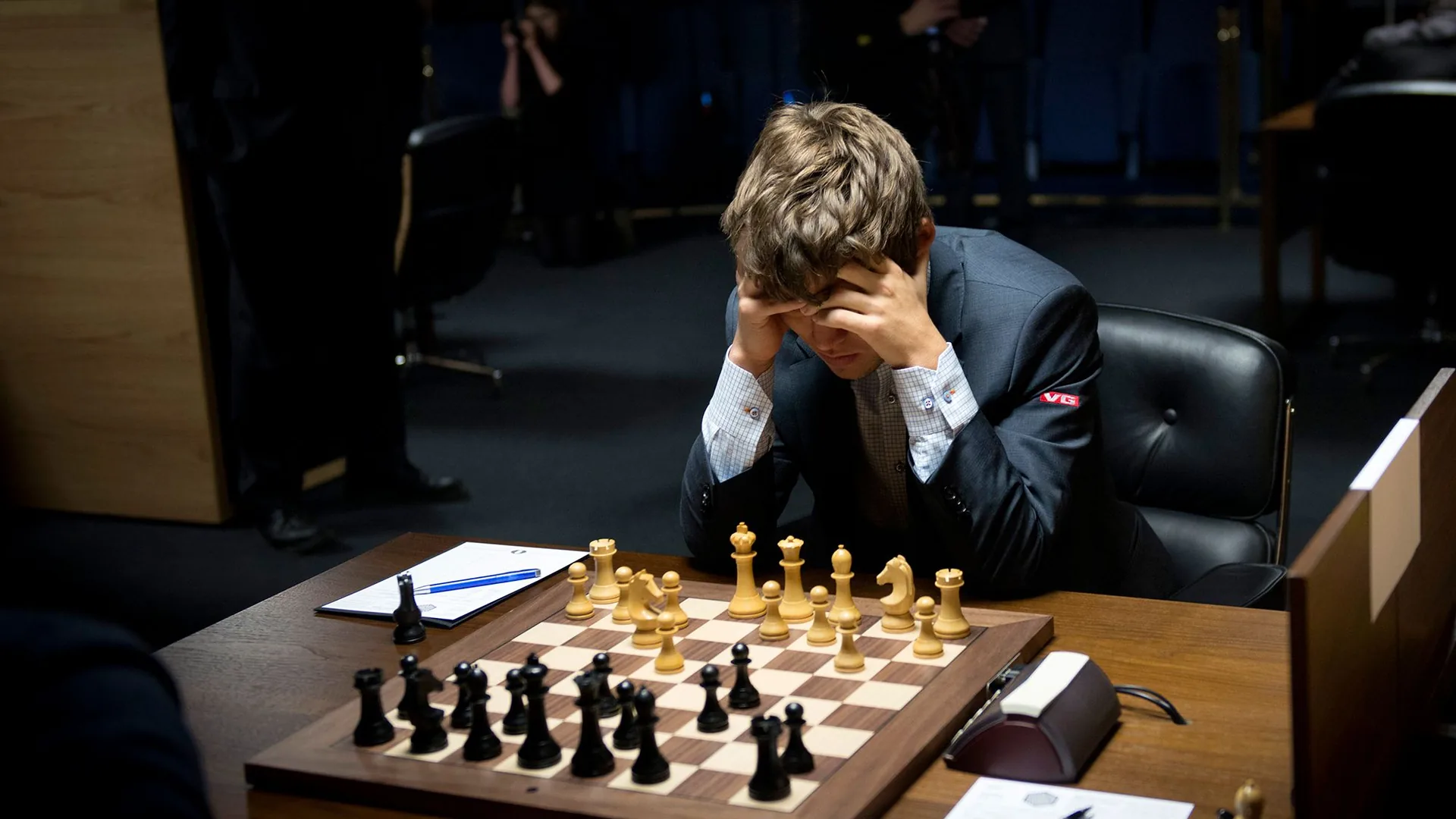
No documented, normed IQ result settles who has the highest IQ in chess, and the research reviewed here studied samples of players, not named champions. The meta-analysis reports averages across studies and says nothing about any individual grandmaster. The photograph at the top of this page shows a player at a board with his head in his hands, and it is there to show the concentration of a game in progress, not to attach a score to anyone. A high number attached to a famous name online is a claim that needs its own source: which test, which year, who administered it, and whether the result was ever published. Three pages on this site take that question for the best known cases, with the sources checked: the page on Bobby Fischer's reported IQ, the page on Garry Kasparov's IQ and the page on Magnus Carlsen's IQ.
Two points from the research help a reader judge any such claim. First, a single sitting of a test gives an estimate with an error band, so a quoted number without its interval overstates precision, and the page on reliability and validity explains why. Second, the correlation among strong adult players is weak in the pooled data, so a famous player's rating is not a reason to expect a high score and a high score is not a reason to expect a famous rating. If your own motive is to see whether you are unusual, the page on gifted testing for adults describes what a normed test can establish and where its resolution ends.
9 Which Normed Test Measures the Abilities Chess Skill Tracks?
The abilities the meta-analysis links most reliably to chess skill are fluid reasoning, short-term memory and numerical content, and a battery that samples each domain returns an index for it with norms. ACIS has 20 subtests in six CHC domains, and a player can read where each ability sits on its own page before paying. Each subtest below is described only as its page describes it, and nothing here reproduces an item.
Visual Puzzles: mentally combining pieces into a whole; Layer Rotation: turning transparent layers to a common orientation
None
Spatial Comprehension, Layer Rotation
All three
Quantitative reasoning (Gq)
Mathematical Achievement, Arithmetic
Described on the subtest pages
None
None
Both
The fluid reasoning domain is the closest match to the strongest broad ability in the table above. Matrix Reasoning belongs to the classic tradition of nonverbal abstract reasoning, where the person studies a pattern and infers the missing element from the rule structure. The page on the Logic IQ test separates deduction from the other Gf abilities. For working memory, Digit Span samples immediate auditory verbal storage and, in harder versions, manipulation of ordered material, and the page on a visual memory test addresses memory for visual material. For visual spatial ability, Visual Puzzles asks whether separate pieces can be combined mentally into a finished whole, and Layer Rotation asks the person to turn transparent layers to a common orientation and identify the combined figure. The technical manual says Layer Rotation carries no words at all, so it places little load on language. The page on a spatial IQ test separates those spatial skills further.
Two points fit chess players specifically. The meta-analysis found the weakest results for visuospatial ability, so a player should not expect the spatial index to track a rating, and a modest spatial score is not a sign of a weak chess mind. And the strongest content grouping was numerical, which in a battery sits closest to the quantitative domain. Only the Full Scale form reports a quantitative reasoning index, and the technical manual lists a composite of Mathematical Achievement, Figure Weights, Arithmetic and Visual Number Series, available when those subtests are. The Optimized form covers five domains without quantitative subtests, and the Quick form samples three domains, which are enough for a first look at reasoning and memory but not for speed or spatial ability.
A buyer who wants only some domains can use the Custom Test at 5 dollars per subtest, where any domain completed returns its full index score. The arithmetic is ours: covering fluid reasoning (five subtests), working memory (three), processing speed (two) and visual spatial ability (three) would be 13 subtests, 65 dollars, which is more than the 50 dollar Full Scale form that adds the rest and reports the Full Scale IQ.
Read the Full Scale IQ and each index as an estimate with a confidence interval against adult norms, read the profile for pattern and not for rank, and never convert it to or from an Elo rating. ACIS reports indices and the Full Scale IQ on the standard scale with a mean of 100 and a standard deviation of 15, scaled subtest scores from 1 to 19 with a mean of 10 and a standard deviation of 3, percentiles, and a 95 percent confidence interval. Adult norms cover ages 16 to 90. What it means to be compared with a reference group was covered above, and the page on IQ score and percentile explains why the two cannot be averaged and why the conversion is not linear. A score of 130 is the 98th percentile on that scale, for example, and a chess player who sees a score near a threshold should read the whole interval, not the point estimate.
A single subtest is less precise than an index, and an index is less precise than a battery, for a simple reason: a score built from fewer tasks has more room for error from the day, the item set and the moment. That is why the interval is reported, and why a gap between two indices deserves attention only after it clears measurement error and is rare among people at the same overall level, a rule the page on index score differences sets out. Comparing every pair in a profile will find a gap in many ordinary profiles, so decide which comparison matters before looking. A chess player might reasonably ask whether working memory sits above or below fluid reasoning, and that is a legitimate single comparison.
The profile will not look like a chess rating and does not need to. With an average correlation of 0.22, a player rated far above others can show any profile from average to very high, and the reverse holds for strong index scores and modest ratings.
11 How Should You Prepare and Sit the Test?
Sit the test as a standardized measurement and not as a game: rested, in a quiet room, with working sound, without engines or help, and with no attempt to practice the task formats. The session is online and unsupervised, which has a consequence for interpretation that the Standards for Educational and Psychological Testing state directly: where unproctored administrations cannot ensure standardization, results should be interpreted with caution. That caution is the reader's responsibility as much as the test's, so keep the conditions as close to those of a supervised session as a home allows.
Practical points follow from the presentation of the subtests. Digit Span, Alphanumeric Sequencing and Arithmetic present their items as audio and need working sound, so check speakers or headphones first. The forms allow breaks, save progress between subtests and give 30 days to complete, which means a player can split the Full Scale form of about 175 minutes across sittings. The timed tasks reward steady, uninterrupted attention, so a rested session is the sensible choice, and a long tournament day or a late night of analysis is a poor time. Verbal and knowledge tasks are affected by English proficiency and educational exposure, according to the technical manual, and the test is in English only. The free trial opens part of the battery with no card, and finished trial subtests are kept if a form that includes them is unlocked later.
12 Where ACIS Sits, and What a Buyer Should Do
ACIS can show a chess player how reasoning, memory, speed and spatial ability compare with adult norms, but it cannot measure chess strength, it is not a clinical instrument, and its score carries the limits of an unsupervised online session. The strengths are concrete. It is a normed adult battery with 20 subtests in six CHC domains, every form reports a Full Scale IQ with its 95 percent confidence interval, the full battery returns six index scores, and it is a one time payment with no subscription. Its guarantee is stated in these words: "Full refund within 5 days if the report does not deliver the features described at checkout or a technical issue prevents you from accessing your results." The technical manual holds the documentation for readers who want to judge the instrument before paying, and the page comparing the best online IQ tests puts it beside other options.
The limits are as plain. The test is online and unsupervised, it is not a clinical or diagnostic instrument, and it is not for hiring, school accommodations or admission to high IQ societies. It is in English only, and verbal and knowledge tasks are affected by English proficiency and educational exposure. It does not measure chess knowledge, calculation or opening preparation, and nothing in the evidence reviewed here supports using an ACIS score to predict a rating or a rating to predict a score.
The Standards for Educational and Psychological Testing (American Educational Research Association, American Psychological Association and National Council on Measurement in Education, 2014), give the test for this page. Standard 1.0 asks that each intended score interpretation for a specified use be clearly articulated and supported by validity evidence, and Standard 1.1 asks that the intended population and the construct be delimited. Applied here, the intended interpretation of an ACIS result is a position relative to adult norms on defined cognitive abilities. A chess player who reads a score as a verdict on chess talent, or as a rating prediction, is using it for an interpretation nobody has supported with evidence. The same document says that results of unproctored administrations should be interpreted with caution, which is why an ACIS result is best read as an informative estimate and not as an official one. The American Psychological Association is one of the three bodies that publish the Standards, which is why they are the benchmark this page applies.
A sensible next step follows from what the reader wants. For a first look with no payment, start the free trial, which needs no card. For a quick estimate of reasoning and memory, the Quick form costs 15 dollars and takes about 45 minutes. For a profile across five domains including speed and spatial ability, Optimized costs 30 dollars and takes about 110 minutes. For all six domains, including quantitative reasoning where chess research found its strongest content grouping, the Full Scale form costs 50 dollars and takes about 175 minutes. These prices were read on October 28, 2026 and can change, and the example report for each form is available before purchase. If the goal is membership in a society or documentation for a school, the supervised routes in the table above are the ones that count.
Every third party fact and figure on this page comes from the documents below, opened or verified on October 28, 2026, and any figure we derived ourselves is labeled in the text as our arithmetic. Prices and policies on commercial pages change, so check the page before you pay.
Burgoyne, A. P., Sala, G., Gobet, F., Macnamara, B. N., Campitelli, G., and Hambrick, D. Z. (2016). The relationship between cognitive ability and chess skill: A comprehensive meta-analysis. Intelligence, 59, 72 to 83. https://doi.org/10.1016/j.intell.2016.08.002
Burgoyne, A. P., Sala, G., Gobet, F., Macnamara, B. N., Campitelli, G., and Hambrick, D. Z. (2018). Corrigendum to "The relationship between cognitive ability and chess skill: A comprehensive meta-analysis" [Intelligence 59 (2016) 72 to 83]. Intelligence, 71, 92 to 96. Corrected values read in the authors' accepted manuscript, Table 1. https://doi.org/10.1016/j.intell.2018.08.004
Bilalić, M., McLeod, P., and Gobet, F. (2007). Does chess need intelligence? A study with young chess players. Intelligence, 35(5), 457 to 470. https://doi.org/10.1016/j.intell.2006.09.005
Grabner, R. H., Stern, E., and Neubauer, A. C. (2007). Individual differences in chess expertise: A psychometric investigation. Acta Psychologica, 124(3), 398 to 420. https://doi.org/10.1016/j.actpsy.2006.07.008
Sala, G., and Gobet, F. (2017). Does far transfer exist? Negative evidence from chess, music, and working memory training. Current Directions in Psychological Science, 26(6), 515 to 520. https://doi.org/10.1177/0963721417712760
Macnamara, B. N., Hambrick, D. Z., and Oswald, F. L. (2014). Deliberate practice and performance in music, games, sports, education, and professions: A meta-analysis. Psychological Science, 25(8), 1608 to 1618. https://doi.org/10.1177/0956797614535810
International Chess Federation (FIDE). FIDE Rating Regulations effective from 1 March 2024, FIDE Handbook, read October 28, 2026. https://handbook.fide.com/chapter/B022024
American Educational Research Association, American Psychological Association, and National Council on Measurement in Education (2014). Standards for Educational and Psychological Testing. Washington, DC: AERA. Open access edition read October 28, 2026. https://www.testingstandards.net/open-access-files.html
No instrument is both a chess test and a normed IQ test. Chess strength tests measure playing ability, and IQ tests measure abilities that are not tied to one game. A player who wants an IQ estimate takes a normed cognitive battery and keeps the chess rating as a separate number.
Can I take a chess IQ test online for free?
You can take free chess strength tests and free online IQ screeners, but neither is a chess IQ test with norms. A free chess test estimates playing strength, and a free IQ screener often has no published norms. A free trial of a normed battery gives a first look at some abilities.
What is the average IQ of chess players?
No study gives the average IQ of everyone who plays chess. In a 2016 meta-analysis, the five studies that reported Full Scale IQ had a weighted mean of 120.5, but those were research samples, not all players. Selection into studies and into serious chess both plausibly raise that number.
Does chess require a high IQ?
No, chess does not require a high IQ, although the two are modestly related. The corrected meta-analytic average correlation between chess skill and broad cognitive abilities is 0.22, which leaves most of the variation in skill unexplained. Experience and practice matter at least as much as measured ability.
Is an Elo rating the same as an IQ?
No, an Elo rating and an IQ are different kinds of numbers. A rating comes from results against rated opponents on a scale FIDE describes as arbitrary, while an IQ is a standardized score against a norming sample. We found no validated conversion between them, so a rating cannot be turned into an IQ.
Who has the highest IQ in chess?
No documented, normed result identifies the chess player with the highest IQ. Numbers attached to famous names online often lack a named test, a date or an administrator. The meta-analysis studied groups of players, not individual champions, so it cannot rank anyone by measured intelligence.
Do chess players score higher on IQ tests?
On average, studied chess players score above the population mean, but the data cannot say why. In five studies reporting Full Scale IQ the weighted mean was 120.5. Selection into the studies, selection into serious chess and the influence of one on the other cannot be separated with these data.
What is the corrected correlation between chess skill and cognitive ability?
The corrected average correlation is 0.22, with a 95 percent interval from 0.16 to 0.28. The original 2016 paper reported 0.24. The authors state that the overall conclusion is unchanged, and they describe the relationship as a meaningful contribution of cognitive ability to differences in chess skill.
Why was the chess and intelligence meta-analysis corrected?
The authors applied a sample size adjustment for dependent effect sizes in the wrong form, using it on each effect size instead of on an average. They redid the analysis with the intended method. Correlations with crystallized intelligence and processing speed lost statistical significance, while fluid reasoning and short-term memory did not change.
Which abilities does chess skill correlate with most?
Among the content groupings, numerical ability correlated most strongly, at 0.34 after correction. Among broad abilities, short-term memory was 0.25 and fluid reasoning 0.23, both with intervals above zero. Crystallized knowledge, processing speed, verbal and visuospatial results had intervals that included zero.
Why is the link weaker among adult and strong players?
In adults, the corrected fluid reasoning correlation is 0.04, against 0.31 in youth samples, and it is 0.10 in ranked samples against 0.33 in unranked ones. The authors do not identify one cause. Age and rating overlap in the studies, and range restriction is only a plausible explanation.
Does playing chess make you smarter?
The evidence does not show that it does. A 2017 review found that apparent benefits of chess instruction shrank as study design improved, and the one chess study with an active control group showed an effect of 0.10 standard deviations. Stronger players tend to be smarter, but training has not been shown to cause it.
What does the ACIS test measure that matters to a chess player?
ACIS measures up to six domains of cognitive ability depending on the form: verbal comprehension, fluid reasoning, quantitative reasoning, visual spatial ability, working memory and processing speed. The abilities that research links to chess skill, fluid reasoning, working memory and numerical content, are covered by the fluid, working memory and quantitative domains.
How much does the ACIS test cost?
ACIS has three one time forms, read on October 28, 2026: Quick at 15 dollars, Optimized at 30 dollars and Full Scale at 50 dollars. There is no subscription, and the Custom Test costs 5 dollars per subtest. Prices can change, so confirm them at checkout before paying.
Can I estimate my IQ from my Elo rating?
No, you cannot estimate IQ reliably from a rating. A pooled correlation of 0.22 describes groups, and an individual prediction would need a validated model, appropriate samples and known error. Players at the same rating can have very different cognitive profiles, so the rating gives no usable estimate.
Which ACIS form should a chess player choose?
Choose by the abilities you want measured. Quick covers verbal, reasoning and memory subtests in about 45 minutes, Optimized adds speed and spatial ability, and Full Scale adds quantitative reasoning and reports the Full Scale IQ across all 20 subtests. The free trial is the lowest cost way to see the format first.
Should I take the test before or after a tournament?
Take it when rested, not during or right after a long event. We found no study that measured how tournament fatigue changes cognitive test scores, so this is general testing practice, not a chess finding. The forms allow breaks and 30 days to finish, so you can wait for a good day.
Can an online test replace a psychologist's evaluation?
No, an online test cannot replace a clinical evaluation. A psychologist observes the session, supervises standardization and can interpret results in context, and only that route supports diagnosis or accommodations. An online normed test can describe abilities against adult norms, but it is not clinical and carries the limits of unsupervised testing.
Will a high IQ make me a better chess player?
Not by itself. Chess skill relates modestly to cognitive ability, and studies of young and adult players show that practice and experience carry at least as much weight. A high score does not predict a rating, and a modest score does not cap one.
Can an ACIS score qualify me for Mensa?
No, ACIS results are not accepted for admission to high IQ societies. Mensa qualifies members through its own supervised test or accepted prior testing, and its qualifying level is the 98th percentile. Use ACIS as a personal estimate, and check the society's own rules for an official result.
How should I read an uneven profile?
Treat a gap between two indices as meaningful only if it is larger than measurement error and unusual among people at the same overall level. Many ordinary profiles contain at least one large gap. Compare the one pair you care about, and read the confidence interval before the point score.
Take the assessment
You get a profile, not a number
ACIS measures six CHC domains across 20 subtests and reports each one with its own normed score and confidence interval, so you can see where you are strong and where you are not.