Mental rotation test online: the 1971 task, the 24 item MRT and a normed spatial score
A mental rotation test asks whether a turned figure is still the same object. The classic version comes from a 1971 laboratory study, and the test most people mean is the Vandenberg and Kuse Mental Rotations Test. This page separates the original task, the 24 item redrawn form and the free copies online, reviews what the research says about scores, and shows where a normed spatial test fits.
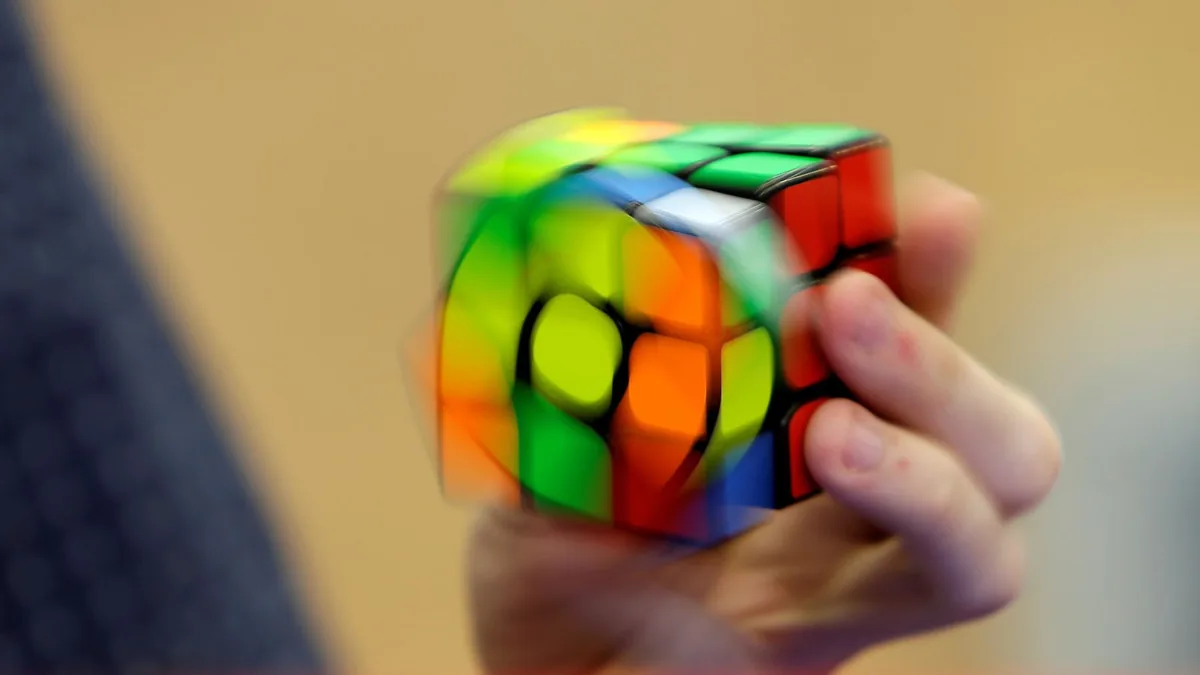
Turning a cube in the hand is physical, while Shepard and Metzler asked people to do it mentally and found that response time rose in a straight line with the angle.
0 The short answer
A mental rotation test asks you to judge whether a turned figure is the same object as a reference, and the test most people mean is the Vandenberg and Kuse Mental Rotations Test of 1978, whose redrawn 24 item form is copyrighted and released to researchers rather than posted as a public quiz. The 1971 Shepard and Metzler task behind it is a laboratory timing experiment, and free online versions are lookalikes that carry no norms. ACIS offers one concrete option, Layer Rotation, a different word free task in which the stimulus stays in view, included in the Optimized form (30 dollars, about 110 minutes) and the Full Scale form (50 dollars, about 175 minutes), with prices read on October 28, 2026. It is not the MRT and its score cannot be compared with an MRT score, and no online test is a clinical instrument.
1971
Shepard and Metzler reported that the time to judge two drawn objects rose in a straight line with the angle between them.
24 items
The length of the redrawn Vandenberg and Kuse form that its distributors supply to researchers under conditions of use.
0.47
The average effect of spatial training across 217 studies, expressed as Hedges g, in the review by Uttal and colleagues.
1 What Is Mental Rotation, and What Did Shepard and Metzler Find in 1971?
Mental rotation is the ability to imagine an object turning in space well enough to judge whether it matches another object seen from a different angle, and the first strong evidence that people do something like it came from a three page paper in 1971. In the study, Shepard and Metzler showed observers two perspective drawings and asked whether they portrayed objects of the same three dimensional shape. The paper appeared in Science, volume 171, issue 3972, pages 701 to 703. Its abstract reports two results. The time needed to recognize a match was a linearly increasing function of the angular difference between the two portrayed orientations. And differences that amounted to a rigid turn of the drawing in its own picture plane were no quicker than differences that required a turn of the object in depth.
The straight line is the finding that made the paper famous. If the judgment were a simple lookup, the angle should not matter. Because response time grew steadily with the angle, later researchers read the result as evidence that observers carry out something analogous to a gradual turn. That reading is an interpretation of a response time pattern and not an observation of an image, and it remains contested in detail. A review by Zacks, published in the Journal of Cognitive Neuroscience (2008, volume 20, issue 1, pages 1 to 19), names the two questions that remained open at the time of the review: whether mental rotation depends on analog spatial representations, and whether it depends on motor simulation.
The paradigm matters for test buyers because it is not itself a test. The 1971 task measures how response time changes with angle, usually in a laboratory, usually in milliseconds, and usually across many trials per person. It describes a process that is common to most people. A psychological test, by contrast, has to sort people. It needs a fixed set of items, a scoring rule, a time limit and a reference group before one person's result can be compared with anyone else's. The step from the first to the second is the subject of the next section, and it is why the phrase "mental rotation test" covers several quite different things.
Two practical consequences follow. First, anyone who offers a "Shepard and Metzler test online" is offering a task built on the same logic, not the instrument of the 1971 paper, and the output of such a task is usually a response time or an accuracy count with no population behind it. Second, the ability sits inside a broader family. The page on spatial intelligence and how it is tested and trained places rotation beside perspective taking, visualization and spatial memory, which are related but not interchangeable abilities.
2 What Is the Vandenberg and Kuse Mental Rotations Test?
The Vandenberg and Kuse Mental Rotations Test is the paper and pencil, group administered instrument that turned the Shepard and Metzler paradigm into a score.Vandenberg and Kuse published it in Perceptual and Motor Skills in 1978 (volume 47, issue 2, pages 599 to 604) under the title "Mental Rotations, a Group Test of Three-Dimensional Spatial Visualization". According to the abstract, the new test was constructed from the figures used in the chronometric study of Shepard and Metzler. The shift is the important part. A laboratory study needed one participant at a time and a timer. A group test needed only a booklet, a room and a clock, and it produced a number of correct answers for every person present.
The abstract reports four properties, all of them from large samples. Internal consistency, measured with the Kuder-Richardson 20 coefficient, was .88. Test-retest reliability was .83. Sex differences were consistent over the entire range of ages investigated. And correlations with other measures showed a strong association with tests of spatial visualization and virtually no association with tests of verbal ability. Read together, these are the standard first checks of a new instrument. Internal consistency asks whether the items hang together. Retest reliability asks whether the same person gets a similar result on a second occasion. The pattern of correlations asks whether the test relates to what it should resemble and not to what it should not. The page on reliability and validity in IQ testing explains each of these terms with examples.
Three cautions apply when those numbers are quoted. They describe the test of 1978 as studied in the samples of that paper, and they say nothing about any online lookalike. A retest coefficient of .83 still implies visible movement in an individual score, which the section on reading a score quantifies. And the retest figure reflects a second sitting with practice already in play, which matters because the research on practice effects is strong, as the section on training shows.
It is also worth noting what the abstract does not say. It does not describe an IQ style scale, and it does not claim that a rotation score estimates general intelligence. The test was built to measure one narrow ability well. That narrowness is a strength when the question is spatial visualization and a weakness when the question is "what is my IQ", which depends on many abilities at once. The page on what IQ actually measures sets out why a single task cannot stand in for a battery.
3 Why Is the Redrawn 24 Item MRT Not Simply a Free Online Test?
The redrawn form of the test exists because the original deteriorated, and it is distributed as a copyrighted research instrument, which is why a free public page is not that instrument.Peters and colleagues opened their 1995 paper in Brain and Cognition (volume 28, issue 1, pages 39 to 58) with a practical problem: the available versions of the Vandenberg and Kuse test had physically deteriorated because only copies of copies were left. They redrew the test and also prepared alternate versions. Their abstract reports that males performed better than females, that students from the physical sciences performed better than students from the social sciences and humanities, and that participants found the test very hard when the stimuli required rotation along both the top to bottom and the left to right axis. The effect size for sex accounted, on average, for some 20 percent of the variance and did not increase with task difficulty. Practice effects were dramatic, including when test and retest used different versions.
The distributors describe the current arrangement on the spatial learning page for the redrawn test, read on October 28, 2026. It offers a 24 item version and notes that the literature also describes a 20 item version, with the author preferring the 24 item form because some groups score uncomfortably close to the ceiling on the shorter one. It lists four versions: MRTA, the basic test, MRTB, an alternate form, MRTD, with stimuli rotated around the horizontal axis, and MRTC, a very difficult test in which stimuli have to be rotated around both axes. The page states that the test is protected by copyright, that it is provided free to researchers who agree to conditions of use that protect it from general circulation, and that access is limited to faculty and graduate students. The page I read did not state time limits or a scoring rule.
For a reader searching "mental rotation test free", this has a direct meaning. The controlled instrument is free, but to qualified researchers, and it is withheld from general circulation on purpose. A public page that calls itself the MRT is therefore a copy of unknown fidelity or a different task using the same name. Item sets, time limits, scoring rules and even the number of items may differ from the controlled form, and the literature the reader may have in mind (including the sex difference figures discussed below) was gathered on specific versions under specific timing. A score from a lookalike cannot be placed on those comparisons.
There is a second reason to be careful. A count of correct items has no meaning for a person until it is set against reference data for the same version, the same time limit and the same scoring rule. The sources read for this page do not offer such reference data to the public. When a free page reports that you scored in the "top 10 percent", it may be comparing you with its own visitors, who are a self chosen group, and not with a defined population. The page on how IQ scores are normed describes what a real reference group requires.
4 Which Mental Rotation Tests Can You Actually Take, and What Does Each Give You?
There are six realistic routes to a mental rotation result, and they differ far more in what they compare you with than in how their figures look. The table sets them side by side. Prices and conditions were read on October 28, 2026 from the pages cited in this article and can change. Where a page was silent, the cell says so instead of guessing.
Option
What it measures
Normed against whom
Supervised
Time
Cost (read October 28, 2026)
What you receive
Psychologist giving a full battery such as the WAIS-5
Visual spatial tasks (the publisher page names Block Design and Visual Puzzles); a Vandenberg style rotation test is not named there
Adults aged 16:0 to 90:11, normed on people whose primary language is English
Yes, in person
Not stated on the page
Clinician fee not stated; the complete kit lists at 1,784 dollars for the purchaser, qualification level C
Scores interpreted by a qualified examiner
Shepard and Metzler style laboratory task
How response time and errors change with angle
Research samples, not a population norm for individuals
Typically in a laboratory
Varies by study
Free stimulus sets exist for researchers
Response times and error rates
Redrawn Vandenberg and Kuse MRT (24 items)
Count of correct items on a rotation test of cube figures
Research samples in the literature; no public norm table in the sources read
Set by the researcher
Not stated on the distributor page
Free to faculty and graduate students under conditions of use
A raw count for research use
Free online "mental rotation" quizzes
Unknown; each page sets its own items, timing and scoring
No defined reference group is typically stated
No
Varies
Free
A number with no defined reference group
Practice sets built for job selection tests
Practice for one employer's spatial test
Not applicable, they are practice material and not IQ tests
No
Varies
Varies
Familiarity with a format
Online battery such as ACIS (Layer Rotation inside the Optimized or Full Scale form)
Visual processing (Gv), with a word free rotation and integration task
The battery reports against adults aged 16 to 90; the technical manual holds the documentation
No, online and unsupervised
Optimized about 110 minutes, Full Scale about 175 minutes
30 dollars or 50 dollars one time; Custom Test 5 dollars per subtest
The subtest result in the report, the visual spatial index when its three subtests are taken, and a Full Scale IQ with its 95 percent confidence interval from the Optimized or Full Scale form
The first row deserves a comment. The WAIS-5 listing on the publisher page gives a publication year of 2024, an age range of 16:0 to 90:11, qualification level C and administration on paper or on the Q-interactive platform. It names Block Design and Visual Puzzles as visual tasks, and it does not list a mental rotation test of the Vandenberg type. A person who wants the clinical route for spatial ability should therefore ask the examiner which tasks the battery contains and which spatial abilities they sample, and should not assume that a rotation score is part of the report. The page on where to take an IQ test compares clinical, society and online routes in more detail.
The fourth and fifth rows are where most searches end. A free quiz that calls itself a mental rotation test can be entertaining and can even resemble a real task, but it is not an instrument with a known reference group. The page on free IQ tests and what a free profile can show explains the same distinction for whole batteries, and the guide to the best online IQ tests lists how normed products differ. Practice sets for job screening are a separate category. They are built to familiarize applicants with an employer's format, they should be read as practice material and not as IQ tests, and their scores are not comparable with anything outside that format.
5 Where Does Mental Rotation Sit Among Cognitive Abilities?
Mental rotation is a visual processing (Gv) ability, and in the Cattell-Horn-Carroll framework it is described by narrow abilities, visualization and speeded rotation, and not by a pop label such as "spatial intelligence" or "right brain thinking". The page on the CHC model lays out the broad abilities (Gf, Gc, Gq, Gv, Gwm and Gs) and the narrow abilities beneath them. Within Gv, the ACIS page for Layer Rotation uses two of them. Visualization (Vz) covers perceiving a complex figure and simulating how it would look once transformed. Speeded rotation (SR) covers doing that transformation quickly on simpler figures. A rotation test can lean on either, depending on how complex the figures are and how tight the time limit is.
Three boundaries keep the construct clean. First, rotation is not the same as remembering. A task that shows a layout and then removes it asks about retention and not turning, and it belongs to the territory of the guide to the visual memory test. Second, rotation is not rule discovery. Fluid reasoning (Gf) tasks ask a person to find the principle that links a set of figures, which is the territory of the pattern recognition test guide. A person can be quick at turning shapes and slower at inferring rules, and the reverse also occurs. Third, rotation is not the whole of spatial thinking. Perspective taking, part-whole assembly and spatial scanning are different demands, and the battery guide on the spatial IQ test maps them across tasks.
The convergent evidence from 1978 supports the same picture. The Vandenberg and Kuse abstract reports a strong association with tests of spatial visualization and virtually no association with tests of verbal ability. That is what a visual processing test should show, and it also explains why rotation tasks are often described as having a low language load. Board games raise a related question, whether skill at visualizing positions carries over to rotation, which the guide to the chess IQ test treats on its own terms. The page on cognitive domains shows how the same distinctions are reported in an ACIS profile.
6 How Large Is the Sex Difference in Mental Rotation, and What Changes It?
Mental rotation shows one of the most consistently reported average differences between men and women in cognitive testing, but it is an average difference in a specific task, it varies with age, time limit and test, and it says nothing about any one person. Four studies give the shape of the evidence.
Voyer, Voyer and Bryden meta-analyzed 286 effect sizes from a variety of spatial ability measures in Psychological Bulletin (1995, volume 117, issue 2, pages 250 to 270). Their abstract reports that sex differences are significant in several tests, that some differences exist between tests, that there was partial support for a decrease in the magnitude of the difference in recent years, and that the age at which a difference emerges depends on the test used. The point to take from it is that "the spatial sex difference" is not one number. It belongs to a test.
Lauer, Yhang and Lourenco focused on development in Psychological Bulletin (2019, volume 145, issue 6, pages 537 to 565). They meta-analyzed 303 effect sizes from 30,613 children and adolescents. A small male advantage in mental rotation first emerged during childhood and then increased with age, reaching a moderate effect size during adolescence. Task and stimulus characteristics also accounted for variability, even when age was controlled. The authors open by calling the male advantage in mental rotation among the most robust gender differences in adult cognition, which is their characterization of the literature and not a measurement of the reader.
Voyer examined time limits in Psychonomic Bulletin and Review (2011, volume 18, issue 2, pages 267 to 277), with 36 effect sizes from paper and pencil rotation tasks. Differences were significantly larger when the task had time constraints than when it did not, and the size of the difference was linearly related to the time available. This is a finding about administration. A rotation test that is shortened, speeded or run with a browser timer may produce a larger gap than the same task run with generous time, which is one more reason a free online copy is not comparable with the published literature.
Peters and colleagues, in the redrawn test paper cited above, found that sex accounted on average for some 20 percent of the variance on the MRT and that the effect did not grow as the task became harder. Twenty percent of variance is a substantial share, and it also leaves most of the variation in scores unexplained by sex, so the distributions overlap heavily. The page on average IQ by gender covers the wider picture of sex differences in IQ test performance. The decisive reading rule is simple. A group statistic describes a group, and no one should infer their own result, or anyone else's, from it.
7 Can Mental Rotation Be Trained, and What Does That Mean for Retesting?
Mental rotation responds to practice and training, which means that a first score and a later score from the same person are not interchangeable.Uttal and colleagues meta-analyzed 217 studies of spatial training in Psychological Bulletin (2013, volume 139, issue 2, pages 352 to 402). After eliminating outliers, the average effect size of training relative to control was 0.47 (Hedges g, standard error 0.04). Training effects were stable and were not affected by delays between training and posttesting, and training transferred to other spatial tasks that were not directly trained. The authors drew the policy conclusion that spatially enriched education could pay substantial dividends for participation in mathematics, science and engineering, which is their conclusion and a claim about education, not about any single test.
The Peters paper adds a testing specific result. Practice effects were dramatic, and they appeared in a transfer paradigm where test and retest used different versions. That matters for anyone planning to measure change. If a person takes a rotation task three times in a week, the third score reflects the first two sittings as well as the ability. It also matters for the Vandenberg and Kuse retest coefficient discussed earlier, because a high retest correlation can coexist with a systematic gain for everyone.
Feng, Spence and Pratt tested a specific kind of experience in Psychological Science (2007, volume 18, issue 10, pages 850 to 855). After only 10 hours of training with an action video game, participants showed substantial gains in both spatial attention and mental rotation, with women benefiting more than men, while control participants who played a non action game showed no improvement. The study was an experiment with a control condition, so a causal reading for that training is reasonable, but it covers a short intervention and a laboratory outcome.
What follows for a reader is practical. A rotation score is a snapshot of performance under specific conditions, not a permanent trait. If the aim is to know where you stand, take one well conditioned sitting and avoid repeating the same task within days. If the aim is to improve, the evidence supports practice as effective, and the best use of a test is then a before and after comparison on different but comparable forms, interpreted with the measurement error discussed below. The Uttal review also shows that the benefit extends to spatial tasks that were not directly trained.
8 What Does a Mental Rotation Score Predict, and What Happens in the Brain?
Spatial ability, of which rotation is one measured form, predicts later achievement in science, technology, engineering and mathematics at the group level, and imaging studies place the process in parietal cortex, but neither fact turns one rotation score into a verdict on one person. The opening of the Uttal review states that good spatial skills strongly predict achievement and attainment in these fields and cites a longitudinal analysis by Wai, Lubinski and Benbow, published in the Journal of Educational Psychology (2009, volume 101, issue 4, pages 817 to 835) under the title "Spatial ability for STEM domains: Aligning over 50 years of cumulative psychological knowledge solidifies its importance". The relationship is a population pattern. It tells an educator why spatial skills deserve attention in curricula. It does not tell a reader that a below average score on one task rules out a technical career or that a high score guarantees one.
The brain evidence is more specific and also more modest. In the meta-analysis and review by Zacks, mental rotation was accompanied by increased activity in the intraparietal sulcus and adjacent regions. These areas contain spatially mapped representations, and activity in them was modulated by parametric manipulations of the rotation task, which the review takes as support for the view that rotation depends on analog representations. Activity in the medial superior precentral cortex also appeared, particularly under conditions that favor motor simulation, which supports the view that rotation depends on motor simulation in some situations. The review frames the relationship between the two processes as one of updating spatial reference frames.
Two cautions keep this honest. A brain region that is active during a task is not a score and does not make the task a brain measurement. And "analog" in this literature describes how information is represented, not whether a person experiences a picture in the mind. Whatever a person experiences while solving an item, the test sees only the answers and the response times.
A third point concerns language. The 1978 abstract found virtually no association between the rotation test and verbal ability tests. That pattern fits the use of rotation tasks in nonverbal measures. The page on the nonverbal IQ test explains what nonverbal measures can and cannot show, including the fact that "nonverbal" describes the content of the items and not a guarantee that language plays no part in following the instructions.
9 How Should a Mental Rotation Score Be Read?
A rotation score is a count of correct answers until it is converted against a reference group, and even then it is a single estimate with a band of uncertainty around it. A raw count such as 14 out of 24 means different things on different versions, with different time limits and with different scoring rules, as the alternate versions in the redrawn test paper and the time limit meta-analysis both indicate. A norm based report translates the raw count into a position among comparable people. That translation is the work of a norming study, and the guide to why the standard deviation of 15 matters explains the scale on which index scores and Full Scale IQ are reported: a mean of 100 and a standard deviation of 15. Subtest results are usually reported on a scaled score metric with a mean of 10 and a standard deviation of 3.
Percentiles and scores are different views of the same position. A percentile says what share of the reference group scored lower, and it compresses differences near the middle and spreads them at the extremes. The page on IQ score versus percentile explains why the two cannot be averaged or compared as if they were on one scale. Three tools help with the conversion: the IQ percentile calculator, the IQ score chart and the calculator for how rare a given IQ is. They work on the scale with a mean of 100 and a standard deviation of 15, so they apply to a score that has already been normed, not to a raw count from a free quiz.
Precision is the second half of the reading. Classical test theory gives the standard error of measurement as the standard deviation multiplied by the square root of one minus the reliability coefficient. We applied that formula to the two coefficients published by Vandenberg and Kuse in 1978, as an illustration of the method and not as a property of any current version.
Published coefficient (1978)
Square root of one minus reliability
Standard error on the 15 point scale
Rough 95 percent band around an observed score
Internal consistency .88
0.35
About 5.2 points
About 10 points either side
Test-retest .83
0.41
About 6.2 points
About 12 points either side
These numbers are our arithmetic on published coefficients. They are not figures reported by Vandenberg and Kuse, and they treat a retest correlation as a reliability estimate, which is only an approximation. The practical meaning is that a single rotation score of the 1978 kind, expressed on an IQ style scale, would carry a band of roughly 10 to 12 points either side of the observed value. Two people whose scores differ by five points have not been shown to differ in ability. The same logic explains why a battery is more informative than a task. Combining several tasks of a domain averages out some of the error of each, which is how an index score earns its narrower band. The discussion above develops this, and the page on index score differences shows how often a person's own indices disagree by chance and by real profile variation.
A final reading rule concerns the word "gifted". One strong spatial result is a single data point and does not establish giftedness.
10 What Changes When a Rotation Task Is Taken Online and Unsupervised?
Taking a rotation task online changes the conditions that the published research held constant, so a score from a browser is a different measurement from a laboratory or booklet score even when the figures look alike. The best documented resource for online rotation work is a stimulus set. Ganis and Kievit published 384 shaded, rendered three dimensional stimuli, built from 48 baseline objects, in the Journal of Open Psychology Data (2015, volume 3), under an open license. A validation study with 54 participants showed the expected linear rise in response times and error rates with angular disparity. The article states that the set is especially useful for studies that need to avoid stimulus repetition, such as training studies. Participants in the validation were tested individually while sitting about 60 centimeters from a computer screen, so the validation was in person and not online.
That detail is the point. Viewing distance, screen size, screen brightness, input device and distractions were controlled in the validation, and they are uncontrolled in a home session. Whether they matter for a given task is an empirical question that depends on the task, and we have no evidence either way for the free quizzes found online. What can be said is that the 1971 pattern, the training literature and the time limit finding all come from controlled settings, and that Voyer found the size of the sex difference changes with the time available. An unsupervised browser timer is one more change to the conditions.
For a reader who takes any online rotation or spatial task, a few habits protect the result:
Use a full size screen and a mouse or keyboard if the task allows it, and keep the same device for every spatial subtest in one battery.
Sit in a quiet room, silence notifications and avoid sitting after a long day, because interruption and fatigue are conditions the controlled studies were designed to exclude.
Take breaks between subtests and not within one. A normed battery that lets you pause between subtests is built for this, and the ACIS forms allow breaks, save progress between subtests and give 30 days to finish.
Do not repeat the same task on consecutive days to "improve", because practice effects will inflate the second result.
Check whether the battery contains audio subtests. Digit Span, Alphanumeric Sequencing and Arithmetic in the ACIS battery present items as audio and need working sound, while Layer Rotation carries no words at all.
The page on the processing speed test discusses the related issue of speeded tasks: a timed rotation subtest draws on speed as well as on transformation, and the two should be read together. The guide to the cognitive ability test covers how a whole sitting should be planned.
11 How Does ACIS Measure Mental Transformation, and How Is It Different From the MRT?
ACIS measures mental transformation with Layer Rotation, a word free task in which the stimulus stays in view, and it is a different task from the Vandenberg and Kuse MRT, so the two scores cannot be converted into one another. The technical manual describes Layer Rotation as a mental transformation task in which the stimulus stays in view. Its subtest page says the examinee must establish the orientation of each part from a visual marker, rotate each part in the mind, combine the rotated parts into one figure and select the option that matches. Because the instruction to turn is carried by a mark on each layer and not by a sentence, the manual states that the task carries no words at all, which is why the subtest also contributes to the Nonverbal Index. In CHC terms the page relates the task to visual processing (Gv), and within Gv to visualization and speeded rotation.
The comparison with the MRT is worth stating plainly, because a reader who searched for the Vandenberg test could otherwise assume the two are interchangeable.
Feature
Vandenberg and Kuse MRT (redrawn, 24 items)
ACIS Layer Rotation
Stimulus
Cube based figures, described by the distributors as Shepard type stimuli
Layers that each carry a visual marker, turned and combined into one figure
What the person does
Mental rotation of cube based figures
Turns each layer in the mind, combines the parts and selects the matching figure
Language load
Not stated on the distributor page
No words in the task, according to the manual
Where it is taken
Booklet or research setting under the researcher's conditions
Online, unsupervised, inside a battery
Availability
Free to faculty and graduate students under conditions of use
In the Optimized and Full Scale forms, or as a Custom Test subtest
Comparable with the other?
No
No
Two cautions come with the table. First, the 1971 abstract is a reminder that planar and depth rotation are not trivially different. For the drawn objects of that study, turns within the picture plane were no quicker than turns in depth. That finding does not make Layer Rotation equivalent to the cube task, but it does mean that a flat rotation task is not an "easy cousin" of the three dimensional one. The two tasks overlap in what they ask of the person and differ in what else they involve, such as the combining of several parts. Second, the manual states that each item has a time limit, so the speed of the transformation contributes to the result, and it also states that Layer Rotation is not a processing speed task, because the dominant demand is figural transformation and not speed of response. The speed domain is covered separately in the ACIS documentation.
Layer Rotation is one of three subtests in the ACIS visual spatial domain, and the other two address neighboring abilities. The Spatial Comprehension subtest concerns understanding of orientation, position and imagined movement, and its page notes that it can involve mental rotation and perspective taking. The Visual Puzzles subtest concerns mental part-whole assembly, in which the person imagines how pieces could combine, rotate or fit into a target form. The manual describes the domain as capturing visualization, speeded rotation, spatial scanning, imagery and visual memory when those operations serve visual processing, and it recommends reading the three together: agreement supports broad visual spatial strength, and divergence can separate rotation, scanning, imagery and memory contributions. The Nonverbal Index is one of the composites described in the manual, which says it emphasizes nonverbal reasoning, visual spatial ability, working memory and speed with minimal reliance on verbal content.
The forms matter for a buyer. Layer Rotation and Spatial Comprehension are in the Optimized form (30 dollars, 13 subtests in 5 domains, about 110 minutes) and in the Full Scale form (50 dollars, 20 subtests in six domains, about 175 minutes). Visual Puzzles is only in the Full Scale form. A visual spatial domain result needs all three of its subtests. The Custom Test costs 5 dollars per subtest, so the three visual spatial subtests chosen on their own come to 15 dollars, which is our arithmetic on the listed price, and at 10 subtests the Full Scale form costs the same. The Full Scale IQ needs the Full Scale battery. Prices were read on October 28, 2026 and can change. The free trial is a sampler of the battery with no card and one trial per person, so check on the start page which subtests it opens before assuming that a spatial subtest is among them. The guide to the IQ test for adults compares the forms from an adult's point of view, and the page on high range IQ testing covers readers whose question is about very high scores.
ACIS sells a competing assessment, so this section is a disclosure: it is an online, unsupervised battery that is not a clinical instrument, and the right choice depends on whether you need the research MRT or a broad spatial profile. The limits come first. ACIS is not a diagnostic tool and says nothing about learning, attention or any clinical condition. Its results are not for hiring, school accommodations or admission to high IQ societies. It is available in English only, and the manual notes that verbal and knowledge tasks are affected by English proficiency and educational exposure, which matters less for a word free task such as Layer Rotation and more for the verbal subtests in the same sitting. It is taken without an examiner, so effort, distraction and device conditions are not observed. The technical manual documents the battery, and it is the place to read the details instead of relying on any summary on a guide page.
The framework for judging any score is the Standards for Educational and Psychological Testing (AERA, APA and NCME, 2014), which is open access at testingstandards.net. The 2014 text was read before it was cited. Standard 1.1 says that the test developer should set forth clearly how test scores are intended to be interpreted and used, and that the population and construct should be described clearly. Its comment adds that no test permits interpretations that are valid for all purposes or in all situations. Standard 6.1 says that test administrators should follow carefully the standardized procedures for administration and scoring, and its comment warns that departures from standard procedures may jeopardize validity or complicate the comparability of score interpretations. Applied here, the first standard explains why a rotation result has to be read as a statement about visual processing and not as a verdict on intelligence, and the second explains why an unsupervised home session is a departure that a reader should weigh.
The APA's Guidelines for Psychological Assessment and Evaluation, approved by the APA Council of Representatives in March 2020, point the same way. Guideline 7 asks psychologists to use multiple sources of relevant and reliable information, and its rationale describes individual test performance as only one piece of an assessment. Guideline 15 asks psychologists who use technology to remain aware of its influence on assessment. A score from an online battery is therefore a piece of information to place beside others, not a conclusion.
What should a buyer do? Start from the question. If the goal is research and the exact Vandenberg and Kuse instrument is needed, contact the distributors named on the redrawn test page, who supply it to faculty and graduate students under conditions of use. If the goal is a clinical or legal answer, or a question about attention, learning or accommodations, see a qualified psychologist, and use a guide to the available routes to compare them. If the goal is curiosity about spatial ability in the context of a whole cognitive profile, the free trial costs nothing and needs no card, and the Optimized or Full Scale form adds Layer Rotation inside a full battery. The example reports show what the output looks like before you pay. The refund guarantee reads: "Full refund within 5 days if the report does not deliver the features described at checkout or a technical issue prevents you from accessing your results."
Every figure above is traceable to one of the following, and each is linked at the point where it is used. Calculations labelled as our arithmetic are not attributed to the authors, and web pages were read on October 28, 2026.
American Educational Research Association, American Psychological Association and National Council on Measurement in Education. Standards for Educational and Psychological Testing. 2014, Standards 1.1 and 6.1.
A mental rotation test shows a figure and asks whether another figure is the same object turned to a new orientation. Researchers score either response time, as in the 1971 Shepard and Metzler task, or the number of correct answers, as in the Vandenberg and Kuse test. Different versions are not interchangeable.
What is mental rotation?
Mental rotation is the process of imagining an object turning in space so that its orientation can be compared with another object. Shepard and Metzler found that judgment time rose in a straight line with the angle between two drawn objects, which researchers read as a gradual transformation, though details remain debated.
Is there a free mental rotation test online?
Many free quizzes exist, but they are lookalikes with their own items, timing and scoring. The redrawn Vandenberg and Kuse test is copyrighted and, according to its distributors page read on October 28, 2026, supplied free to faculty and graduate students under conditions of use, so a free page is not that instrument.
What is the Vandenberg mental rotation test?
It is a paper and pencil group test published in 1978 by Vandenberg and Kuse, built from the figures of the Shepard and Metzler study. The authors reported internal consistency of .88 and test-retest reliability of .83, with strong links to spatial visualization tests and virtually none to verbal ability.
Can I take the Shepard-Metzler mental rotation test online?
You can take tasks modeled on it, and open stimulus sets exist for researchers, but the 1971 study was a laboratory experiment and not a published test with norms. An online version yields response times or accuracy with no reference group, so it illustrates the effect without ranking you.
What is a 3D mental rotation test online?
It is a task that shows two renderings of a three dimensional object and asks whether they match after a turn. One open stimulus set holds 384 shaded renderings, but its validation used 54 people tested in person, so online use changes conditions that the validation did not cover.
What is a good score on a mental rotation test?
No score is good in general. A raw count depends on the version, the time limit and the scoring rule, and it only means something against reference data for that same version. Compare against norms, not against a number from a free page, and read any result with its error band.
What did Shepard and Metzler actually find?
They found that the time to decide whether two drawings showed the same three dimensional shape increased linearly with the angular difference between them. They also found that turning a drawing within its own picture plane was no quicker than turning the object in depth. The paper appeared in Science in 1971.
How reliable is the Vandenberg and Kuse test?
In large samples, the 1978 paper reported a Kuder-Richardson 20 coefficient of .88 and a test-retest reliability of .83. Those values describe that version in those samples. Practice effects are large on this test, so a high retest coefficient does not mean a second score will match the first.
Who can get the redrawn MRT?
According to the distributors page read on October 28, 2026, the test is protected by copyright and provided free to researchers who accept conditions of use, with access limited to faculty and graduate students. The page lists four versions, labelled A, B, C and D, and describes a 24 item form.
How big is the sex difference in mental rotation?
Meta-analyses find a male average advantage that is small in childhood and moderate by adolescence, according to Lauer and colleagues, and that varies by test. On the redrawn MRT, sex accounted for about 20 percent of variance in the study by Peters and colleagues, so the groups overlap heavily.
Does the time limit change the sex difference?
Yes, in paper and pencil tasks. A 2011 meta-analysis of 36 effect sizes found larger sex differences when time constraints applied, and a linear relation between the size of the difference and the time available. Speeded administrations can therefore enlarge the gap compared with untimed ones.
Can you get better at mental rotation?
Yes. A meta-analysis of 217 training studies found an average effect of 0.47 relative to controls, stable over time and transferring to untrained spatial tasks. A separate experiment found that 10 hours of action video game play improved mental rotation, with women gaining more than men.
Which brain areas are involved in mental rotation?
A meta-analysis of imaging studies found increased activity in the intraparietal sulcus and adjacent regions during mental rotation, with modulation by the amount of rotation. Activity in the medial superior precentral cortex appeared mainly under conditions that favor motor simulation. Activity in a region is not a test score.
Is mental rotation the same as spatial intelligence?
No. Rotation is one narrow skill within visual processing (Gv). Visualization, perspective taking, spatial scanning and visual memory are related but distinct demands, and a person can differ across them. A single rotation task describes one slice of spatial ability, not the whole of it.
Does a mental rotation test measure IQ?
Not by itself. It measures a narrow visual processing ability, and Vandenberg and Kuse found virtually no association with verbal tests. IQ estimates need several abilities measured under standard conditions. A rotation task can contribute to a profile, but a single task cannot stand in for a battery.
Is ACIS Layer Rotation the same as the MRT?
No. Layer Rotation is a mental transformation task in which the stimulus stays in view and which carries no words at all. It is a different task from the Vandenberg and Kuse test, so results on the two cannot be compared or converted into one another.
Which ACIS forms include Layer Rotation, and what do they cost?
The Optimized form (13 subtests, about 110 minutes, 30 dollars) and the Full Scale form (20 subtests, about 175 minutes, 50 dollars) include it. Custom Test charges 5 dollars per chosen subtest. Prices were read on October 28, 2026 and can change.
Can an online rotation result support a diagnosis or school accommodation?
No. ACIS is online and unsupervised, not a clinical or diagnostic instrument, and its results are not for hiring, school accommodations or admission to high IQ societies. Questions about learning or attention need a qualified professional using standardized, supervised assessment.
How should I prepare for an online spatial test?
Use a full size screen in a quiet room, silence notifications and keep the same device throughout. Do not practice the same task repeatedly beforehand, because practice effects inflate scores. If the battery has audio subtests, confirm working sound first. Breaks between subtests are fine.
How precise is a single rotation score?
Less precise than a battery. Our arithmetic on the reliabilities Vandenberg and Kuse published in 1978 implies a standard error of about 5 to 6 points on an IQ style scale, so a rough 95 percent band is 10 to 12 points either side. Combining several tasks narrows the band.
Take the assessment
You get a profile, not a number
ACIS measures six CHC domains across 20 subtests and reports each one with its own normed score and confidence interval, so you can see where you are strong and where you are not.