A pattern recognition test: what it measures, whether IQ is just that, and where to take a normed one
A pattern recognition test, in intelligence testing, asks you to discover the rule behind a display and apply it to what is missing. This page explains that ability, how closely it tracks general intelligence, what the viral meme is, what research reports about pattern tasks in autistic groups, and where a normed version can be taken, with prices read on October 28, 2026.
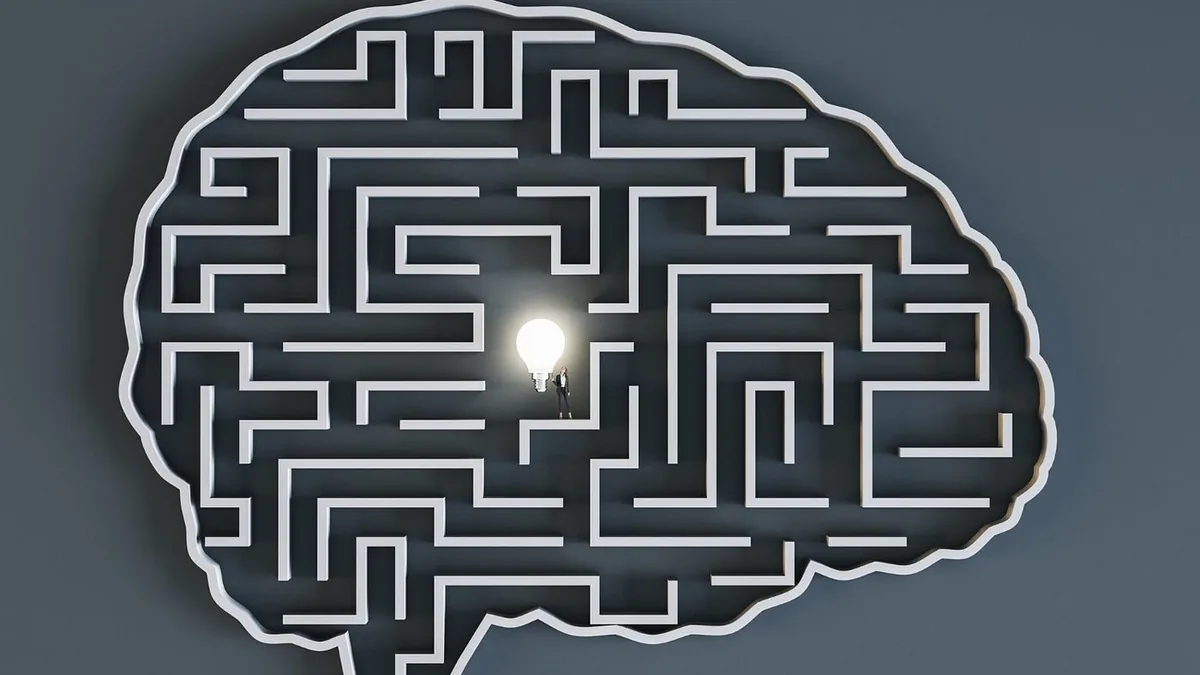
A maze is an illustration, not a test item; the Cattell-Horn-Carroll name for discovering the rule behind a display is induction, which Schneider and McGrew call probably the core aspect of Gf.
0 The short answer
When the phrase means intelligence testing, a pattern recognition test measures inductive reasoning: you infer the rule behind a display of figures, numbers or categories and apply it to the missing piece, an ability that the Cattell-Horn-Carroll model places inside fluid reasoning (Gf). An IQ test is not just that. Gignac's analysis found that Raven's Progressive Matrices shared about 50 percent of its variance with general intelligence, so a normed result needs several kinds of task, and the viral meme with the same name is a joke about recognizing references, not a measure of anything. ACIS is one concrete option, never the only one: its Quick form costs 15 dollars and takes about 45 minutes with two pattern subtests, and the Full Scale form costs 50 dollars and takes about 175 minutes with all five, with prices read on October 28, 2026. It is online and unsupervised, so it cannot replace a clinical evaluation.
.93 to .99
The correlations between general intelligence (g) and fluid reasoning (Gf) in the remaining studies of the 14 that Matzke and colleagues reviewed, as Kovacs and Conway report.
50 percent
The share of its variance that Raven's shared with g across several large samples in Gignac's analysis, with about 25 percent specific to the test itself.
30 percentile points
How much higher 38 autistic children scored on Raven's than on the Wechsler scales, on average, in Dawson and colleagues (2007).
In an intelligence context, a pattern recognition test is a test of inductive reasoning: the task is to discover the principle that organizes a display and to use it on a case you have not seen. W. Joel Schneider and Kevin McGrew, in their chapter on the Cattell-Horn-Carroll theory in the fourth edition of Contemporary Intellectual Assessment, define Induction as the ability to observe a phenomenon and discover the underlying principles or rules that determine its behavior, and they note that it is also known as rule inference. They describe how such tests are built: stimuli are arranged according to a principle, and the examinee shows that the principle is understood, for example by producing a new stimulus that obeys it, by identifying stimuli that do not conform to the pattern, or by explaining the principle. The same chapter calls induction probably the core aspect of Gf and says that no measurement of Gf is complete, or even adequate, without a measure of it. The page on fluid intelligence tests covers the wider family, and the page on the CHC model shows where Gf sits among the other broad abilities.
The word "recognition" is slightly misleading, and the difference matters for what you buy. Recognizing a pattern retrieves something you already know: a face, a melody, a familiar logo. Induction infers something you do not know yet. Cattell's classic definition of fluid intelligence, quoted by Kristof Kovacs and Andrew Conway in Psychological Inquiry in 2016, describes it as the level of complexity of the relationships a person can perceive and act upon when there are no stored answers to such complex issues to fall back on. A good matrices item is built so that the answer cannot be looked up, which is why it works as a measure of reasoning rather than of memory.
Four different things share the search phrase, and it helps to separate them. The first is the intelligence meaning above, found in matrix, series and classification subtests of batteries such as the Wechsler scales and in standalone tests such as Raven's. The second is the hiring use, where employers screen candidates with short abstract reasoning tasks; the page on the abstract reasoning test owns that genre and its relation to IQ. The third is perceptual, where a person decides quickly whether two displays match, which is a speed task rather than a reasoning one. The fourth is the meme, covered in its own section below. A reader who types the phrase after seeing a post and a reader who types it before a job application want different pages, and this one is written for the person who wants to know what the intelligence version measures and where to take a normed one.
Carroll, whose three stratum model feeds the CHC framework, found three narrow abilities under fluid reasoning, according to the same Schneider and McGrew chapter: induction, general sequential (deductive) reasoning and quantitative reasoning. The chapter adds that the three are different but often difficult to distinguish empirically. That is the reason this page treats pattern tasks, series, deduction puzzles and quantitative reasoning as neighbors: the page on the number series test and the page on the logic IQ test take the series and deduction cases in detail, and this page keeps to what they share with matrices.
2 Is an IQ Test Just Pattern Recognition?
An IQ test is not just pattern recognition: inductive reasoning sits very close to the center of general ability, which is why matrices became the emblem of intelligence testing, yet one matrices test carries only about half its variance from g, and a battery measures a good deal more than one task. The first half of that sentence has strong support. Kovacs and Conway report that Gustafsson, in 1984, demonstrated that the higher order general factor, g, was statistically identical to the lower order fluid reasoning factor, Gf, and that numerous studies since have found the same. Matzke, Dolan and Molenaar reviewed 14 such studies; most were underpowered to refute an identity, the single study with the necessary power and two slightly underpowered ones found the general factor identical to the fluid reasoning factor, and in the remaining studies the correlations between g and Gf ranged from .93 to .99, with Gf correlating more strongly with g than any other group factor in the CHC model. Kovacs and Conway add that a perfect correlation was found between Gf and the lower order factor called inductive reasoning, typically measured by matrix reasoning items and number series, which would make the correlation between g and inductive reasoning perfect or almost perfect as well. All of these figures are theirs as reported in a review, not new analyses on this page.
The second half of the sentence has equally strong support, and it comes from a study of the matrices test itself. Gignac fitted bifactor models across several large samples and reported that Raven's shared approximately 50 percent of its variance with g, approximately 10 percent with a fluid intelligence group factor orthogonal to g, and had approximately 25 percent test specific reliable variance. He concluded that Raven's is not a particularly remarkable test with respect to g and discouraged researchers from including only Raven's when a valid estimate of g is the goal; as one example of a better route he suggested a four subtest combination from the Wechsler scales with a g validity coefficient of .93 and 14 minutes of administration time. Put the two results together and the picture is consistent. The ability that matrices sample is nearly the same thing as the general factor at the level of latent abilities, yet any single task measures that ability with a good deal of task specific noise and a little of something else. A result from one task is a noisy window on a strong construct.
Why should an ability that carries so much of general intelligence be hard to reduce to one skill? Kovacs and Conway's process overlap theory, the account they offer in the same article, holds that cognitive tests tap domain general executive processes, identified primarily in research on working memory, as well as more domain specific processes, and that executive processes are required more often than the specific ones across tests. On that account the positive manifold, the all positive pattern of correlations among diverse cognitive tests, which they call perhaps the most replicated result in the field, arises from overlapping processes rather than from a single pattern recognizing faculty. You do not need to accept the theory to use the practical point: a high correlation between g and Gf tells you that induction is a good place to look for general ability, not that general ability is induction and nothing else.
For a buyer the conclusion is simple. If you want to know how you reason with unfamiliar rules, a matrices or series result answers that. If you want an IQ, you need tasks from more than one family, because the Full Scale composite is built from several domains. The page on what IQ measures sets out g, the CHC domains and the limits, and the page on cognitive domains shows how ACIS arranges its 20 subtests in six of them, five of the 20 being fluid reasoning tasks.
3 What Happens in Your Head When You Solve a Matrix?
Solving a matrix is less about seeing the pattern than about finding several rules one after another and keeping each in mind while you look for the next, which is why working memory and not eyesight sets the difficulty. The classic account is Carpenter, Just and Shell's 1990 analysis in Psychological Review of what the Raven Progressive Matrices Test measures. Kovacs and Conway summarize its finding: a detailed analysis of item performance concluded that an important aspect of the test is the discovery and maintenance of the rules that govern the variation among the entries in a problem. They add that more difficult matrix problems typically involve more rules, so that solving one means discovering a rule and then maintaining it while searching for a second, and so on. The ability to hold goal relevant information, the rules, in the face of concurrent processing and distraction is therefore essential to success.
Two consequences follow. First, difficulty is not the same as visual complexity. An item with many shapes and one rule can be easier than an item with few shapes and three interacting rules. Second, a low score on a matrices task can come from different places: failing to discover a rule at all, discovering the rules but losing one while searching for another, or choosing hastily among the options. Kovacs and Conway also report that, in a study using the same rules Carpenter and colleagues identified, it was the application of new rules and the switching from old ones that drove the correlation between complex span, a working memory measure, and Gf (the study is Wiley and Jarosz, 2011, as they cite it). Working memory matters most, they note, in situations that do not allow the use of prior knowledge, which is exactly the situation a well built pattern task creates.
This is also why the ACIS subtest pages ask readers to compare results rather than rely on one. The Matrix Reasoning page says that a weaker result can reflect difficulty discovering rules, comparing several visual relations or maintaining several possible hypotheses at once, and the Logic Grid page says that a weaker result may reflect working memory load, impulsive elimination or difficulty coordinating conditions. Both statements describe possibilities that a score alone cannot separate, and the pages recommend reading each result beside related subtests. A person who sees a low matrices result next to a low working memory result has a more specific question than a person whose working memory result is strong.
None of this means the task is "just" working memory. Kovacs and Conway's figure on the difference between correlations with working memory and with short term memory shows the largest difference for Raven's, and negligible differences for tests of general knowledge, tests with verbal content and tests of perceptual speed. It is a statement about group correlations among test scores. It does not say what is happening in any one person during any one item.
4 What Do Matrix, Series and Odd One Out Tasks Look Like?
Pattern tasks come in four common formats, matrices, series, classification and constraint puzzles, and each is built so that the answer cannot be retrieved from memory but only inferred from the display. This section describes formats, never items; no question or answer from any real test appears on this page, and a page that showed you the items from a test you may later take would damage the measurement it advertises.
In a matrix task a grid of figures has one cell missing, and the person infers from the way the rows and columns change which of several options completes it. The ACIS Matrix Reasoning page describes the format in these terms: a person studies a pattern of shapes, notices how rows or columns change, and infers the missing element from the underlying rule structure. The format belongs to the Raven tradition, and the page on Raven's 2 explains that test, its age range and its uses. In a series task the person infers the rule that generates an ordered sequence of numbers, letters or figures and predicts what comes next. The Visual Number Series page describes the ACIS version as asking whether a person can infer the rule that generates a sequence and predict what comes next, and notes that although numbers are involved the core demand is usually induction rather than school mathematics. A classification task asks which stimulus does not belong, which in Schneider and McGrew's description is the form of identifying stimuli that do not conform to the pattern.
The fourth family is less a pattern than a constraint. In a deduction puzzle such as a logic grid the person combines several stated conditions, eliminates impossible combinations and keeps what each clue excludes. The Logic Grid page describes the demand as controlled deduction under multiple constraints, and its introduction contrasts it with fast pattern detection. That contrast matters for the term this page covers: strictly, deduction is general sequential reasoning, the second of Carroll's three narrow abilities under Gf, not induction, and a person can be quicker at one than the other.
Two further ACIS subtests sit near the pattern family without being plain pattern completion. The Figure Weights page describes relational balance reasoning: the person infers how visual quantities relate, preserves equality and applies a hidden rule to a new arrangement, and the page places the task between Gf and quantitative knowledge or reasoning in CHC terms. The Complex Relations page describes relational integration, where several elements correspond, change or combine within a single problem. Across these five, the ACIS technical manual lists an inductive reasoning composite, IRI, which it says focuses on induction through Visual Number Series, Matrix Reasoning and Complex Relations, and which is available when those subtests are available. The manual is on the technical manual page for readers who want its documentation, and no manual figures are quoted here.
Not every visual task is a pattern task. Rotating a shape in the mind or judging how pieces fit is a visual spatial demand, handled by the page on the spatial IQ test, and the ACIS Layer Rotation subtest belongs to the visual spatial index, not the fluid reasoning index. Keeping the two apart helps you read a profile: a person can be strong at inferring rules and weaker at mental rotation, or the reverse, and both are information a single "pattern" label would hide.
5 Which Pattern Recognition Test Should You Take? The Real Options
Which test fits depends on whether you need a clinical result, a normed estimate or a quick look, and only the first two kinds return a score compared with a defined group of adults. The table sets the real options side by side. Prices and terms were read on October 28, 2026 and can change; the ACIS rows come from the published site, and the two Pearson rows come from Pearson product pages opened that day.
Option
What it measures
Normed against whom
Supervised
Time
Cost
What you receive
Psychologist giving the WAIS-5
A full battery in which matrix and figure tasks sit beside verbal, memory and speed tasks
Pearson's page states ages 16:0 to 90:11 and norming on individuals whose primary language is English
Yes, one to one, qualification level C
45 minutes for the 7 subtest Full Scale IQ, 60 minutes for the 10 primary index subtests
The complete print kit is 1,784 dollars for the professional; the fee to a client is not on the page
A clinician's report and interpretation
Raven's 2 through a professional
Matrix reasoning with the publisher's aim of limiting language and cultural influence
A Pearson page lists a standard score and a percentile rank; norm sample details are not stated on it
Level B purchaser; individual or group, paper or digital
Not stated on the page
Not stated on the page
A standard score and a percentile rank
Free pattern games, memes and social posts
Recognition of a reference or a quick puzzle; no stated ability construct
None
No
Seconds to minutes
Free
Entertainment, not a score
Practice tests for job screening
Abstract reasoning formats chosen by the employer or publisher; not IQ tests
Set by the publisher or employer
Varies
Varies
Varies
A score for a hiring process, see the abstract reasoning page
ACIS Quick
Matrix Reasoning and Figure Weights with four other subtests in three domains
Adults 16 to 90
No, online and unsupervised
About 45 minutes
15 dollars
A Full Scale IQ with its 95 percent confidence interval
ACIS Optimized
13 subtests in five domains, adding Logic Grid
Adults 16 to 90
No
About 110 minutes
30 dollars
A Full Scale IQ with its 95 percent confidence interval
ACIS Full Scale
All 20 subtests in six domains, with all five fluid reasoning subtests
Adults 16 to 90
No
About 175 minutes
50 dollars
A Full Scale IQ with its 95 percent confidence interval and six indices
ACIS Custom Test
Any subtests you choose, one at a time
Adults 16 to 90
No
Depends on the subtests
5 dollars per subtest
An index for each domain you complete and a scaled score for each subtest
The Wechsler row needs two reading notes. The Pearson WAIS-5 page lists a 2024 publication year and names Matrix Reasoning and Figure Weights among the contents of its first stimulus book, but it does not assign them to a domain, so this page does not say which index they feed. The kit price is what a qualified professional pays; the cost of an evaluation to the person being tested depends on the practice and is covered on the page on the adult IQ testing process. For the Raven row, the Pearson India page describes Raven's 2 as a measure of clear thinking ability and intellectual capacity, lists ages 4 to 90 and says the test is available on paper, digitally or in combination; it states no administration time, so none is given here. Where to find a supervised administration in person is covered in the closing section.
The ACIS rows are one concrete option and not a ranking. Two details change what a pattern focused buyer should pick. Quick contains two of the five fluid reasoning subtests, Matrix Reasoning and Figure Weights; Optimized adds Logic Grid; only the Full Scale form contains all five, including Visual Number Series and Complex Relations. And the Custom Test lets a buyer choose only the pattern subtests: five fluid reasoning subtests at 5 dollars each come to 25 dollars, which is our arithmetic on the published per subtest price, and the buyer receives the domain index for any domain completed, though the Full Scale IQ needs the Full Scale battery. The page on the IQ test for adults compares the forms for a general reader, and the page on the best online IQ tests places ACIS next to other products.
A pattern test with no words is not automatically fair across cultures or across generations, and two cautions follow: check how current the norms are, and do not treat a nonverbal label as a guarantee. Publishers often describe matrices as reducing the influence of language. The Pearson India page for Raven's 2 says it aims to limit the influence of language skills and cultural differences, which is a statement of design intent by the publisher and not a finding. The page on culture fair IQ tests explains what that label can and cannot promise, and the page on nonverbal IQ tests explains what the nonverbal format does and does not remove. Familiarity with grids, with timed multiple choice formats and with the kind of puzzle thinking taught in some schools can still differ between people, which is a reason to compare a result with a norm group of adults and not with a general impression.
The generational point is documented. Kovacs and Conway report, citing Flynn, that on tests requiring fluid inductive reasoning such as Raven's the gains per generation have been as high as 15 IQ points, whereas on tests measuring crystallized abilities such as vocabulary and mental arithmetic the gains have been negligible, 2 to 3 IQ points over half a century. The figures are theirs, citing a source this page did not open, and they describe population averages. What follows for the reader is practical: pattern tasks are the kind of test whose raw performance has shifted most across birth cohorts, so a score is only as good as the recency and the age matching of the norms behind it. The American Psychological Association's Guidelines for Psychological Assessment and Evaluation, approved in March 2020, make the same point in their rationale to Guideline 8, which says the agedness of the norms and the continued relevance of the constructs being measured can be particularly important considerations in test selection. The page on how IQ scores are normed explains the mechanics of turning raw counts into standard scores against a comparison group.
Language and schooling still matter at the edges. ACIS is available in English only, and the technical manual states that verbal and knowledge tasks are affected by English proficiency and educational exposure. The Matrix Reasoning page describes its content as abstract and usually nonverbal. The pages of the other pattern subtests do not say how much reading their instructions or items require, so that is not stated here, and a buyer who is still learning English should read each subtest page before paying. Finally, a result from a format you have practiced says less about discovering rules in unfamiliar problems than a first encounter does, which follows from Cattell's definition of fluid intelligence as reasoning without stored answers. It is a reason to avoid rehearsing items from the test you plan to take.
7 What Is the Pattern Recognition Test Meme?
The pattern recognition test meme is a joke format built on recognizing a reference, it spread on social media without a known single origin, and it is not an intelligence test, a psychological measure or a screen for any condition.Know Your Meme, read on October 28, 2026, describes it as abstract or simplistic images that reference famous memes or pop culture, usually captioned "pattern recognition test", where viewers try to work out what each one refers to. The page says it spread mainly on X and Twitter. It records the earliest notable example it found as a post of June 6, 2021, notes that the exact origin of the meme is unknown, and says the format grew gradually through 2023 and 2024, with several versions going viral in 2024 and 2025.
A related format carries a more pointed caption. Know Your Meme's entry on the "autism test" pattern recognition parodies, also read on October 28, 2026, describes posts in which a pattern of shapes and colors resembles a character or logo from a fandom, captioned "autism test", with the joke that recognizing the image means you are autistic. The page says the original was posted on May 28, 2023 and that the trend became popular in late May 2023 and continued into June. It classifies the entries as parodies and does not claim they are a real test. Nothing on either page says the images measure anything.
The meme is worth understanding without ridicule, because the experience it plays on is real. Recognizing a half hidden reference gives a small shared pleasure, the sense of belonging to a group that notices the same things, and a joke told inside a community is not an insult to that community. As a measure, though, it cannot work. Recognizing a character from an abstract shape depends on having seen that character, which is acquired familiarity and in CHC terms sits closer to knowledge than to fluid reasoning, where the point is that no stored answer is available. A person who recognizes every image has told you something about the media they follow, and that is all.
The practical advice is short. Enjoy the images as images. If a post makes you wonder about your own thinking, the next step is not a viral picture but a conversation with a clinician if the question is about autism, and a normed test if the question is about how you reason, which is what the rest of this page is for.
8 What Does Research Say About Pattern Tasks in Autistic People?
Group studies report that autistic people often score relatively higher on Raven's matrices than on the Wechsler scales, the size of that gap is disputed, and none of it makes a pattern task a way to detect autism or rule it out. The influential study is by Michelle Dawson, Isabelle Soulières, Morton Ann Gernsbacher and Laurent Mottron, published in Psychological Science in 2007. They assessed a broad sample of 38 autistic children on Raven's Progressive Matrices, which they call the preeminent test of fluid intelligence, and report that the scores were on average 30 percentile points, and in some cases more than 70 percentile points, higher than the same children's scores on the Wechsler scales. Typically developing control children showed no such discrepancy, and a similar contrast was observed when a sample of autistic adults was compared with a sample of nonautistic adults. The authors concluded that intelligence has been underestimated in autistic people.
Soulières and colleagues extended the question to Asperger syndrome in PLoS ONE in 2011. Thirty-two Asperger adults displayed a significant advantage on Raven's over Wechsler Full Scale and Performance scores relative to typical controls, while in 25 Asperger children the advantage appeared over the Wechsler Performance scores only. As previously found with autistic participants, the Raven's scores reached a level reflecting the Wechsler peaks of ability, and the authors concluded that strengths in Raven's performance span the autistic spectrum.
A third study found a much smaller effect. Sven Bölte, Isabel Dziobek and Fritz Poustka tested 48 individuals with autism, a mixed clinical group of 28 and a neurotypical control group of 25, and published the result in the Journal of Autism and Developmental Disorders in 2009. Average Raven's IQ was higher than Wechsler IQ only in the autism group, but to a much lesser degree than previously reported and only for individuals whose Wechsler IQ was below 85. They recommended the Wechsler scales as the first choice IQ measure in high functioning individuals, with additional Raven's testing perhaps required at the lower end of the spectrum. The honest summary is that the direction of the difference is reported in more than one study, and its size depends on the sample and on the scales compared.
Three limits keep these results in proportion. They compare two kinds of test within groups, and a difference between group means cannot tell you where any one person falls. They are comparisons of scores on tests, not evidence that pattern tasks cause or reveal autism, and the memes should not be read into them. And autism is identified by clinical assessment of history and behavior, not by cognitive scores, so a high or low matrices result neither confirms nor excludes it. The page on autism and IQ reviews the wider evidence on the full range of scores, and the page on the IQ test for autistic adults explains how an adult who wants a normed score can approach one. The ACIS report is not a diagnostic instrument and does not claim to detect any condition.
A pattern recognition result is read as a scaled score or an index against an age matched adult comparison group, with a confidence interval, and a single subtest is always less precise than the battery it belongs to. The raw count of correct answers means little by itself, because a hard test and an easy one produce different counts. A norm table converts the count into a scaled score for the subtest, on a scale with a mean of 10 and a standard deviation of 3, and a set of subtests is combined into an index on the familiar scale with a mean of 100 and a standard deviation of 15. Percentiles describe where a score falls in the comparison group, and the page on IQ score versus percentile explains why the two scales cannot simply be averaged. On a normal model, a scaled score of 13 and an index of 115 each sit one standard deviation above the mean, which is about the 84th percentile; that figure is our arithmetic on the normal curve and not a statistic of any test.
A confidence interval is the statement that a score is an estimate. A report that gives a Full Scale IQ with its 95 percent confidence interval is telling you the range in which the person's underlying standing is likely to lie, and the narrower the range the more precisely the battery measured. Every ACIS form reports a Full Scale IQ with its 95 percent confidence interval. This page quotes no interval, because it depends on the form and the person and is printed on each report.
Why is one subtest less precise than the battery? Gignac's analysis gives a concrete picture for the best known pattern test. Approximately 25 percent of Raven's variance was reliable variance specific to the test, so a result partly reflects how a person does on that particular task and format, not only how they reason in general. His own suggestion, a four subtest combination from the Wechsler scales with a g validity coefficient of .93 and 14 minutes of administration time, shows the direction a measurement should take when the goal is g: more than one task, from more than one family. This is a general psychometric finding about another instrument, not a statistic of ACIS. The page on reliability and validity explains the two ideas in plain terms, and the same logic is why ACIS reports pattern reasoning as an index built from several subtests.
In a profile, read the pattern result beside its neighbors. The manual's inductive reasoning composite, IRI, is built from Visual Number Series, Matrix Reasoning and Complex Relations, and the fluid reasoning index draws on all five fluid reasoning subtests, so the two answer related but different questions. A person whose matrix result is high and whose deduction result is lower has a question about how they handle several constraints at once, not a defect. A gap between two subtests of three scaled points is one standard deviation of the subtest scale, and whether that gap is larger than chance and how often it occurs in the population are questions for the instrument's own discrepancy procedures, not for a reader's eye.
10 Is There a Free Pattern Recognition Test Online?
Free pattern tests exist and are fine for practice or curiosity, but a free result is a count of correct answers and not an IQ unless the test says who it was normed on and how the score was built. The questions to ask of any free test are short. Who is the comparison group, and how old are its members? How many items are there, and do they sample more than one kind of rule? Does the result become a percentile or a standard score, or only a number out of the total? Is a confidence interval reported? A site that cannot answer these may still be a pleasant puzzle, but it is not telling you where you stand among adults, and the page on the free IQ test explains the ACIS route for a reader who wants that.
The ACIS free trial deserves a plain statement because it is easy to misread. There is no card, and each person gets one free trial: the site refuses a second trial from the same email address or the same browser. Started from the Full Scale form, the trial opens five subtests, and those five come from the working memory and processing speed domains, so the trial does not return a fluid reasoning index or any pattern result. Finished trial subtests are kept if the person later unlocks a form that includes them. A reader who wants the five pattern subtests chooses a form or a Custom Test, with the prices in the table above.
For the other half of the search, "pattern sequence IQ test", the useful distinction is between a series of numbers or figures and a matrix. Both ask for the rule behind an ordered display, and both sit under induction. A series is one dimensional and a matrix is two dimensional, which changes how many relations must be held at once, and the Visual Number Series page and the page on the number series test describe the series format in its own terms. If you only want to try the format for fun, many free puzzles are enough. If you want a number you can compare with other adults, you need the norms, and the table above shows what to compare when judging any product.
11 How Should You Set Up an Unsupervised Session?
Online pattern tests reward a quiet room, a screen large enough to show every figure clearly and a plan for breaks, because the research above describes holding several rules in mind while searching for the next one, and an interruption can break exactly that. An unsupervised session has no examiner to notice that a doorbell rang or that a phone buzzed, so the setup is the test taker's job. The American Psychological Association's assessment guidelines, in Guideline 8, ask psychologists to adhere to standardized administration procedures to support valid interpretations of norms, and the same logic applies to a person taking a test alone: the conditions you create are part of the result.
Practical points follow from the format. Use a screen where small differences between figures are easy to see, and do not squint at a phone in a bright room if you can avoid it. ACIS allows breaks, saves progress between subtests and gives 30 days to complete a form, so there is no reason to push through fatigue; stop between subtests, not in the middle of one. Three ACIS subtests present items as audio and need working sound: Digit Span, Alphanumeric Sequencing and Arithmetic. They are not pattern subtests, but the Quick form includes the first two, so check your sound before starting that form. This page does not state time limits for the pattern subtests, so read each subtest page for what it says and do not assume.
Keep the session honest in three ways. Do not look up answers or ask anyone for help, because the score is then a score for the helper. Do not rehearse items from the test you plan to take, because a familiar item no longer samples rule discovery. And do not take the same battery repeatedly within days to improve a number, which turns a measurement into a practice effect. If you are unsure whether an online route is right for your purpose at all, the page on the cognitive ability test describes the ACIS approach for adults, and the page on adult IQ testing describes what a supervised assessment involves.
12 Where ACIS Sits, and What a Buyer Should Do
ACIS is a normed, self administered online battery that samples pattern reasoning with five subtests and reports it inside a wider profile, and it is not a clinical, diagnostic or supervised instrument, so the right use is a considered estimate and not a verdict. On the strengths side, the battery has 20 subtests in six CHC domains, and five of them are fluid reasoning: Matrix Reasoning, Figure Weights, Visual Number Series, Logic Grid and Complex Relations. Results are reported on the standard scale with scaled subtest scores, percentiles and a 95 percent confidence interval, against adult norms covering ages 16 to 90, as a one time payment with no subscription. The manual lists an inductive reasoning composite where its subtests are available. Example reports are public, so a buyer can see what a report contains before paying, and the technical manual documents the instrument for readers who want the evidence behind it.
The limits matter as much. ACIS is online and unsupervised. It is not a clinical or diagnostic instrument, and it does not detect autism, ADHD or any other condition. It is not for hiring, for school accommodations or for admission to high IQ societies, and it is available in English only. A reader who needs a result for any of those purposes needs a supervised evaluation by a qualified professional, or the society's own exam, and the page on where to take an IQ test lists the routes.
The Standards for Educational and Psychological Testing (AERA, APA and NCME, 2014) are the field's reference for how a score should be read, and the three organizations provide them in an open access files page, read on October 28, 2026. In the chapter on using the Standards to evaluate the validity evidence for intelligence tests, in the fourth edition of Contemporary Intellectual Assessment, Alyssa Montgomery, Erica Torres and Jamie Eiseman quote them: the validation process never ends, because there is always additional information that can be gathered about a test and the inferences drawn from it, and validation evidence allows a summary judgment that the intended interpretation is well supported and defensible. Applied here, the intended interpretation is a pattern reasoning result for a self understanding purpose, and the evidence for it should be asked for, not assumed. The American Psychological Association's Guidelines for Psychological Assessment and Evaluation add two points. Guideline 7 says psychologists strive to use multiple sources of relevant and reliable information, and its rationale says individual performance on tests is only one piece of an assessment. Guideline 8 asks that test selection, scoring and administration reflect the appropriate normative comparison, situational influences, effort and standardized administration. An unsupervised online score is one source, and its administration is not standardized in the way a clinic's is, so read it as context and not as a conclusion.
The next step depends on the question. If you are curious how you handle rules and patterns, a Custom Test with the five pattern subtests costs 25 dollars by our arithmetic, and the Quick form at 15 dollars includes two of them within a six subtest profile. If you want a Full Scale IQ with all five pattern subtests and the rest of the profile, the Full Scale form is 50 dollars and takes about 175 minutes, with prices read on October 28, 2026. If a decision hangs on the result, start with a professional. The ACIS guarantee reads, in its own words, "Full refund within 5 days if the report does not deliver the features described at checkout or a technical issue prevents you from accessing your results." It is a conditional refund, not an unconditional one, and it does not turn the score into a clinical result.
Every figure and claim above traces to one of the following sources, each linked where it is first used. Findings from Kovacs and Conway's review (the Gustafsson, Matzke, Flynn and Wiley and Jarosz results, and the Carpenter, Just and Shell analysis) are reported as that review states them. The 25 dollar total for five Custom subtests and the 84th percentile for one standard deviation above the mean are our own arithmetic on published figures. Prices and product facts were read on October 28, 2026. The book chapters were read in a local copy of the fourth edition of Contemporary Intellectual Assessment.
Montgomery A, Torres E, Eiseman J. Using the Joint Test Standards to evaluate the validity evidence for intelligence tests (chapter 30). In Flanagan DP, McDonough EM, editors, Contemporary Intellectual Assessment: Theories, Tests, and Issues, 4th edition. Guilford Press, 2018.
American Educational Research Association, American Psychological Association, National Council on Measurement in Education. Standards for Educational and Psychological Testing. AERA, 2014, read October 28, 2026.
American Psychological Association. Guidelines for Psychological Assessment and Evaluation. APA Task Force on Psychological Assessment and Evaluation Guidelines, approved by the APA Council of Representatives, March 2020.
In intelligence testing it is a task that asks you to infer the rule behind a display of figures, numbers or categories and apply it to a missing piece. Psychologists call the ability induction, a narrow ability within fluid reasoning, and matrix and series subtests are the usual formats.
Is an IQ test just pattern recognition?
No. Inductive reasoning sits close to general ability, but one matrices test shared only about 50 percent of its variance with g in Gignac's analysis. An IQ battery samples several abilities, such as verbal comprehension, working memory and speed, so that no single task decides the Full Scale score.
Is there a free pattern recognition test online?
Yes, many free puzzles and games use pattern formats, and they are fine for practice. Most return a count of correct answers rather than a standard score, because they lack adult norms. A free result becomes an IQ estimate only when the test names its comparison group and reports its uncertainty.
What is a pattern sequence IQ test?
It is a series task: you see an ordered run of numbers, letters or figures, infer the rule that generates it and predict what comes next. It samples induction and, with numbers, some quantitative reasoning. A matrix asks the same question across rows and columns instead of along one line.
Is there a pattern recognition test for autism?
Not as a diagnostic tool. The viral autism test images are parodies, and cognitive pattern tasks are not diagnostic. Autism is identified through clinical assessment of history and behavior, so a matrices score or a recognized cartoon image neither confirms nor excludes it.
What is the pattern recognition test meme?
It is a social media format of abstract or simplistic images that hint at a famous meme or piece of pop culture, captioned as a pattern recognition test. Viewers guess the reference. Know Your Meme records examples from 2021 onward and says the exact origin is unknown.
Can you take a pattern recognition test online and get a real IQ score?
You can get a normed estimate if the test states its adult comparison group and reports a confidence interval, but an online, unsupervised result is not a clinical IQ. A supervised evaluation by a psychologist remains the standard when a decision such as a diagnosis or accommodation depends on the score.
Which ability does a pattern recognition test measure?
It measures induction, the ability to discover underlying rules from a set of stimuli, which the Cattell-Horn-Carroll model places under fluid reasoning, Gf. Schneider and McGrew call induction probably the core aspect of Gf, though series and constraint puzzles also draw on deduction and quantitative reasoning.
How closely does fluid reasoning track general intelligence?
Very closely at the level of latent factors. Kovacs and Conway report that Gustafsson in 1984 first showed the general factor to be statistically identical to Gf, and that in the other studies Matzke and colleagues reviewed the correlations ran from .93 to .99. Single tests are less tightly linked.
Why are some matrix problems harder than others?
According to the analysis by Carpenter, Just and Shell, as Kovacs and Conway summarize it, harder problems typically involve more rules. Solving one means discovering a rule, then keeping it in mind while searching for the next, so the burden falls on working memory more than on perception.
Which ACIS subtests are pattern tasks?
Five subtests make up the ACIS fluid reasoning domain: Matrix Reasoning, Figure Weights, Visual Number Series, Logic Grid and Complex Relations. Quick contains the first two, Optimized adds Logic Grid, and the Full Scale form contains all five. Logic Grid is a deduction task more than a pattern completion task.
What is the ACIS inductive reasoning composite?
The technical manual lists IRI among its composites. It focuses on induction through Visual Number Series, Matrix Reasoning and Complex Relations, and it is available when those subtests are available. That means the Full Scale form, because Quick and Optimized each contain only one of the three.
How much does ACIS cost for pattern reasoning?
Prices read on October 28, 2026: Quick is 15 dollars, Optimized 30 dollars and Full Scale 50 dollars, each a one time payment. The Custom Test is 5 dollars per subtest, so the five fluid reasoning subtests come to 25 dollars by simple arithmetic. Prices can change, so check the order page.
Do autistic people score higher on Raven's than on Wechsler scales?
Some studies report it. Dawson and colleagues found Raven's scores 30 percentile points higher on average in 38 autistic children, while Bölte and colleagues found a much smaller difference, only for those with Wechsler IQ below 85. Results depend on the sample, and none of it is diagnostic.
Does a high score on a pattern test mean a high IQ?
It means strong performance on that task, which correlates with general ability but does not equal it. A single matrices test carries task specific variance, so a battery gives a steadier estimate. Read a high pattern score as a strength in rule discovery and check it against other indices.
Does a low pattern score mean I am not intelligent?
No. A low result can reflect difficulty finding rules, losing a rule while searching for another, hasty answering, a poor screen, fatigue or an interrupted session. One task is a noisy window on reasoning. Compare it with related subtests and with the confidence interval before drawing any conclusion about yourself.
Can a pattern test show that I have autism or ADHD?
No. Group studies describe average differences, and individuals differ within every group. Neither diagnosis is made from a cognitive score; both rely on clinical assessment of history and functioning. An online pattern score can be context to bring to a clinician, never a screen or a verdict.
Will practice raise my pattern recognition score?
Familiarity with a format can help you with that format, but rehearsing the exact items of a test you plan to take weakens what it measures, because fluid reasoning is defined by problems without stored answers. Avoid memorizing items, and do not retake the same battery within days to chase a number.
How accurate is an online pattern recognition test?
Accuracy depends on its norms, its number of items and its conditions. An online, unsupervised test cannot control noise, effort or help from others, and a single task is less precise than a battery. Look for a stated adult comparison group, several subtests and a reported confidence interval.
Can I use an ACIS result for hiring or a school accommodation?
No. ACIS is not for hiring, school accommodations or admission to high IQ societies, and it is not a clinical or diagnostic instrument. Those purposes need a supervised evaluation by a qualified professional or the organization's own exam. Use the report for self understanding and as context for a conversation.
When should I see a professional instead?
See a psychologist when a decision depends on the result, such as a diagnosis, an accommodation or a legal or educational placement, or when you have concerns about attention, learning or development. The assessment guidelines of the American Psychological Association favor multiple sources of information, which an interview and a supervised battery supply.
Take the assessment
You get a profile, not a number
ACIS measures six CHC domains across 20 subtests and reports each one with its own normed score and confidence interval, so you can see where you are strong and where you are not.