A spatial IQ test that reports a normed index, not a quiz
A spatial IQ test is a set of tasks that ask you to build, turn and compare shapes in your head, scored against adult norms. This page separates the task families, compares a clinician's battery, free quizzes and the ACIS Visual Spatial Index with their prices, reviews what spatial ability predicts and how much it can be trained, and states the limits of every option.
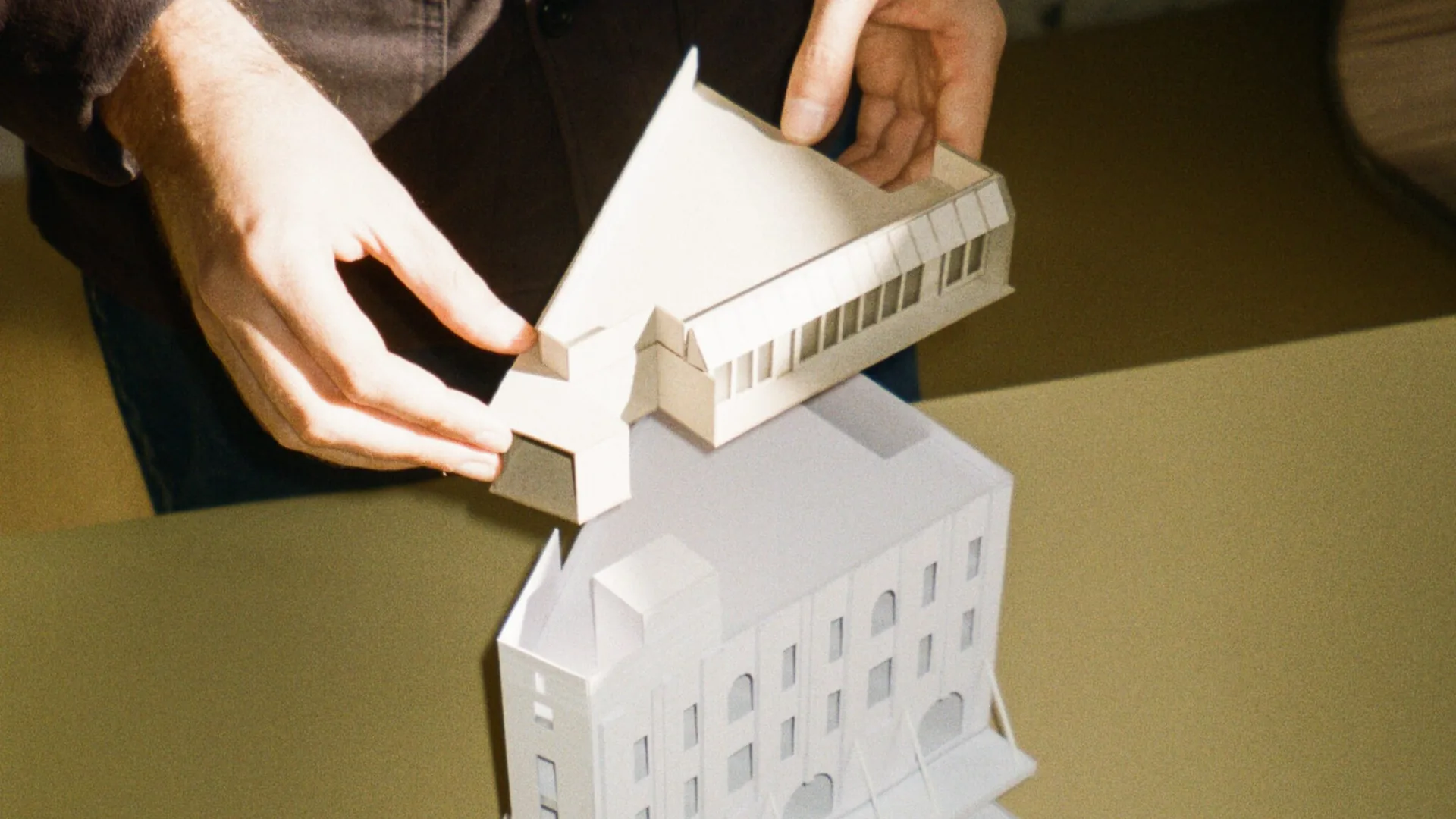
A physical model is joined by hand, while spatial tests ask for the same part to whole judgment without the model; Wai and colleagues followed about 400,000 students for 11 years to see what that judgment predicts.
0 The short answer
A spatial IQ test measures visual processing (Gv), the ability to assemble, rotate and compare mental images of shapes, and the version worth taking reports a normed score instead of a quiz result. A psychologist can give the Visual Spatial Index of the Wechsler scale (Block Design and Visual Puzzles) in a supervised session, and ACIS offers three online spatial subtests, Visual Puzzles, Layer Rotation and Spatial Comprehension, which the Custom Test returns as a Visual Spatial Index for 15 dollars (prices read October 28, 2026). The Quick form has no spatial subtest and the Optimized form includes two of the three. The decisive limit is that an online, unsupervised, non clinical index describes performance on those tasks and cannot diagnose, certify or select anyone.
400,000
US high school students tracked for 11 years or more in the Project TALENT analysis by Wai, Lubinski and Benbow, where spatial ability marked who went on to advanced STEM credentials.
0.47
The average effect of spatial training relative to control across 217 studies in the Uttal meta-analysis, durable and transferring to untrained spatial tasks.
15 dollars
The Custom Test price for the three ACIS visual spatial subtests at 5 dollars each, read October 28, 2026; it returns the full Visual Spatial Index.
A spatial IQ test measures visual processing, one broad ability in the Cattell-Horn-Carroll (CHC) model, and "spatial IQ" is a search phrase rather than a standard score category. The phrase has no official definition. What exists is the CHC broad ability called Gv, and a good test reports it as an index on the familiar scale with a mean of 100 and a standard deviation of 15. The page on the CHC model lists the broad abilities and the narrow abilities beneath each, and the page on what IQ measures explains how those abilities relate to a general factor.
The ACIS subtest pages describe Gv as including spatial relations, visualization, mental rotation, visual analysis and the ability to manipulate visual forms internally. Two narrow abilities matter most for adult testing. Visualization is perceiving a complex figure and simulating how it would look once it is transformed. Speeded rotation is doing that transformation quickly on simpler figures. A third, imagery, is the narrow ability the ACIS technical manual assigns to Spatial Comprehension. The manual maps its three visual spatial subtests onto these names, and the technical manual is the place to read the definitions in full.
The construct is narrower than the phrase suggests. A spatial test samples what a person does with figures on a screen or a page. It does not sample navigation in a city, handiness with tools or artistic talent, and a score on one task family does not describe every spatial skill. The Spatial Comprehension page makes the same point: performance on one format does not describe every spatial skill. This is also why a single short quiz is a weak instrument. A battery that samples several formats can show whether strength lies in assembly, in rotation or in perspective, and the page on cognitive domains shows where visual spatial ability sits among the six domains ACIS reports.
Spatial ability is also separate from fluid reasoning, even though both use pictures. Pearson's WAIS-5 product page, read October 28, 2026, lists "Separate visual spatial and fluid reasoning indexes" among the features of the test. The distinction matters when choosing a test, and the fifth section below returns to it.
2 Which task families do spatial tests use?
Spatial tests use four recurring task families, assembly, mental rotation, folding or unfolding, and orientation or perspective, and they overlap more than their names suggest. Uttal and colleagues, in their meta-analysis of spatial training in Psychological Bulletin, organize spatial skills on two dimensions, intrinsic versus extrinsic and static versus dynamic. Intrinsic skills concern the properties of a single object, and extrinsic skills concern relations among objects or locations. Static skills involve fixed forms, and dynamic skills involve transformation. They also describe the older three family grouping of Linn and Petersen (spatial perception, mental rotation and spatial visualization) and map it onto their own scheme.
Assembly or part to whole tasks ask which pieces form a finished figure, or which figure the pieces make. In a clinic the classic format is Block Design, where the examinee reproduces a design with blocks. Pearson's WAIS-5 page states that Visual Puzzles does "not involve visual-motor integration or trial-and-error problem-solving with feedback," which is the difference between the two. In the ACIS version, the manual says the examinee is shown a completed figure and selects the three pieces that would reconstruct it; pieces may be mentally rotated but not reflected, and exactly three must be chosen. The Visual Puzzles page places the format in the tradition of figure assembly.
Mental rotation tasks ask whether a turned copy matches a target. The experimental basis is the work of Shepard and Metzler, whose 1971 paper in Science found that the time to judge whether two perspective drawings show the same three dimensional shape was a linearly increasing function of the angular difference between them. That result is why rotation items can be built with graded difficulty, and why time is part of many rotation scores. The sibling page on the mental rotation test covers that family in depth. In the ACIS Layer Rotation format, as the manual describes it, the examinee sees several transparent layers of a square grid, each carrying a tab on one edge, and selects from eight options the figure that results from turning every layer until its tab is at the top and stacking them. The Layer Rotation page calls this figural transformation.
Folding and unfolding tasks ask what a flat pattern becomes when folded, or what a folded sheet looks like opened. The Project TALENT battery analyzed by Wai, Lubinski and Benbow included a three dimensional visualization test of this kind, in which a flat piece of metal is shown with fold lines and the examinee picks the object the folding would make. Folding is a visualization task because the answer has to be constructed, then matched.
Orientation and perspective tasks ask how relations change when the viewpoint, the heading or the object moves. The ACIS manual describes Spatial Comprehension as answering directional and geometric items with a standard compass convention, with a knowledge sheet defining the required terms before the subtest begins so that performance reflects visualization rather than vocabulary. The Spatial Comprehension page describes the demand as understanding orientation, position and imagined movement.
None of these families is pure. A rotation item can be solved partly by assembly, and an orientation item can require rotation. This is why the ACIS manual says agreement across its three subtests supports a broad visual spatial strength and that divergence can distinguish mental rotation, scanning, imagery and visual memory contributions. It also explains why the subtest pages and the manual describe formats only, never items.
3 What are the options for taking a spatial IQ test?
You can take a spatial test from a psychologist, from a free quiz, from a job screening vendor or from a normed online battery, and the options differ more in what they report than in how they look. The table sets them side by side. Prices and times were read on October 28, 2026 and can change, and the ACIS rows use the forms and prices on the home page of that date.
Option
What it measures
Normed against whom
Supervised
Time
Cost
What you receive
Psychologist with the WAIS-5
Visual Spatial Index from Block Design and Visual Puzzles, inside a five domain battery
Published 2024 with norms for ages 16:0 to 90:11
Yes, one to one, by a qualified professional
45 minutes for the 7 subtest Full Scale IQ and 60 minutes for the 10 primary index subtests
Clinician's fee, not published by Pearson; the complete print kit is 1,784 dollars to the professional
A report from a clinician with indexes and interpretation
Free spatial quiz
Mixed items, often rotation and assembly
Often not stated
No
A few minutes
Free or freemium; read the page
A number or a label, often without a percentile or an interval
Job screening spatial test
A pass mark for an employer's decision
The vendor's own reference group, set for selection rather than a general adult population
Varies by vendor
Varies
Usually paid by the employer
A result for a selection decision; it is not an IQ index
ACIS Custom Test, three spatial subtests
Visual Spatial Index (Visual Puzzles, Layer Rotation, Spatial Comprehension)
Adult norms for ages 16 to 90
No, online and unsupervised
Not stated as a total for the three on the subtest pages
15 dollars, at 5 dollars per subtest
Full index score for the domain and a scaled score for each subtest
ACIS Optimized
13 subtests in 5 domains, including Spatial Comprehension and Layer Rotation
Adult norms for ages 16 to 90
No
About 110 minutes
30 dollars
Full Scale IQ with its 95 percent confidence interval
ACIS Full Scale
All 20 subtests, including all three spatial subtests and Visual Sequence
Adult norms for ages 16 to 90
No
About 175 minutes
50 dollars
Full Scale IQ, six indices and the manual's composites, including the visual spatial composite
The clinician route is the reference. Pearson's product page lists the WAIS-5 as published in 2024, with a qualification level of C, administration on paper or Q-interactive, and a complete print kit at 1,784 dollars. The kit price is what a professional pays, not what a client pays, and the fee for an assessment is set by the clinician. Pearson's overview brochure lists the Visual Spatial Index as Block Design and Visual Puzzles, and the page on every WAIS-5 subtest explains which of the 20 tasks build the Full Scale IQ. Visual Puzzles, notably, does not contribute to the Full Scale IQ according to Pearson's FAQ, so a clinician's Visual Spatial Index and a Full Scale IQ are separate numbers.
Free quizzes answer a different question. They are entertainment or screening, they usually give a count or a label, and the ones whose pages were read for this guide did not state a norm group. The page on free IQ tests explains what a free result can and cannot support, and the same questions apply to paid products.
A word on hiring tests. Spatial and mechanical aptitude tests used to select train drivers, engineers or technicians serve an employer's selection decision, they are not IQ indexes, and they are outside the scope of this page.
ACIS is a seller in this market, so treat this section as a disclosure. The comparison above lists where the options differ: only the clinician route is supervised and clinically interpreted, and only the ACIS and Wechsler routes report a normed index. Other online batteries exist, and the page on the best online IQ tests and the page on where to take an IQ test compare them without a spatial focus.
4 What does the ACIS Visual Spatial Index consist of?
The ACIS Visual Spatial Index (VSI) is built from three subtests, Visual Puzzles, Layer Rotation and Spatial Comprehension, each sampling Gv through a different task family. All three are reported as scaled scores from 1 to 19 (mean 10, standard deviation 3), and together they yield the index on the scale with a mean of 100 and a standard deviation of 15, with a percentile and a 95 percent confidence interval. The technical manual, read on October 28, 2026, assigns narrow abilities to each: visualization and speeded rotation to Visual Puzzles and Layer Rotation, and imagery and visualization to Spatial Comprehension.
Each subtest has its own page, and the pages describe the construct without disclosing items. The Visual Puzzles page frames the task as internal construction, picturing how parts align, rotate and occupy a single form before any visible arrangement is complete. The Layer Rotation page describes figural transformation in which the answer cannot be recognized but has to be constructed and then matched, and the manual adds that the task carries no words at all, because the instruction to turn is given by the tab on each layer. The Spatial Comprehension page frames the task as keeping track of how forms relate in space and how those relations change under transformation, and notes that people who report no voluntary visual imagery still complete rotation tasks by following the transformation as a rule.
The manual also gives a reading rule for the profile. Strong Layer Rotation with weaker Visual Puzzles suggests efficient rotation with less efficient mental assembly, and the reverse pattern suggests the opposite. If Spatial Comprehension is high while Visual Puzzles is lower, the manual says the user may show stronger imagery than speeded manipulation of decomposed forms. These are descriptions of profile shapes, not diagnoses, and they depend on every score carrying its own uncertainty, which the section on reading scores covers.
Speed enters in a limited way. The manual says Layer Rotation is not a processing speed task: the per item limit controls pacing, but the dominant demand is figural transformation rather than speed of response. It also notes that Visual Puzzles can be affected by speed, visual scanning and strategy. A reader who wants to know how a speed index differs from a spatial index can use the page on the processing speed test, which covers the Coding and Symbol Search domain separately.
Which form contains which subtest decides what the report can show. Quick (15 dollars, six subtests, about 45 minutes) has no spatial subtest. Optimized (30 dollars, 13 subtests, about 110 minutes) includes Spatial Comprehension and Layer Rotation. Full Scale (50 dollars, 20 subtests, about 175 minutes) includes all three and adds the manual's composites. The Custom Test, at 5 dollars per subtest, lets a buyer pick any subtests, and its description states that "any domain you complete returns its full index score, and every subtest returns its scaled score." Three spatial subtests at 5 dollars each is 15 dollars. The Full Scale form costs the same as ten Custom subtests, so a buyer who wants more than ten should take the Full Scale form. The free trial needs no card, is limited to one per person and is a way to see the platform before paying; it is not a route to the spatial index, which is why the Custom Test is the direct path.
One composite in the manual is relevant here. The technical manual describes the visual spatial composite (CVSI) as one that "expands visual spatial coverage beyond the primary VSI by including Layer Rotation, Visual Puzzles, Spatial Comprehension, and Visual Sequence." Visual Sequence belongs to the working memory domain, and its page describes it as sampling the ability to hold ordered visual material in mind and reproduce it after brief exposure. The Visual Sequence page explains why a visual memory task sits beside spatial tasks in this composite. The manual says composites are available when their subtests are available, so the CVSI needs all four of its subtests, which the Full Scale form contains.
The manual also lists a nonverbal composite (NVI) that "emphasizes nonverbal reasoning, visual spatial ability, working memory, and speed with minimal reliance on verbal content." A reader whose question is about tests that avoid words will find the broader treatment on the page about the nonverbal IQ test, including why nonverbal does not mean spatial.
5 How is spatial ability different from fluid reasoning and nonverbal tests?
Spatial ability and fluid reasoning both use pictures, but spatial tasks sample the transformation of a form while fluid reasoning tasks sample the discovery of a rule. The ACIS pages state the contrast directly. The Layer Rotation page says the task should be compared with fluid reasoning tasks to separate spatial work from rule discovery, and the Visual Puzzles page says it becomes especially informative beside Layer Rotation, because a person can reason well about finished forms and be less efficient when turning several parts. The WAIS-5 also reports the two as separate indexes, as Pearson's product page states.
In ACIS the fluid reasoning domain has its own index, the Fluid Reasoning Index (FRI), built from Matrix Reasoning, Figure Weights, Visual Number Series, Logic Grid and Complex Relations. A matrix task presents a pattern of figures and asks what completes it, so the picture carries a rule. A spatial task presents figures and asks what happens when they are moved. A person can be strong at one and ordinary at the other, which is why a spatial index is more useful beside a fluid reasoning index than alone. The sibling page on the pattern recognition test covers the rule discovery side.
Nonverbal tests are a third category. A nonverbal test reduces the load of language, and a spatial test is one way of doing so, but the two terms are not interchangeable. A matrix test is nonverbal without being spatial, and a rotation test is both.
Readers sometimes ask whether a spatial test avoids arithmetic. The three ACIS visual spatial subtests are not arithmetic tasks, since Arithmetic and Mathematical Achievement sit in the quantitative reasoning domain. The page on an IQ test without math takes up the broader question of which parts of a battery depend on number.
Finally, a spatial index is read in the context of the other indexes. The page on how often index scores differ describes the size of gaps between a person's indexes, which is the context a single spatial index needs. An uneven profile is common and is not a defect. A spatial index well above or below the other indexes describes a pattern, and it does not say why the pattern exists.
6 What does spatial ability predict?
Spatial ability, measured in adolescence, marks who goes on to advanced STEM credentials and occupations, and it adds to what mathematical and verbal scores show. The strongest evidence is longitudinal. Wai, Lubinski and Benbow analyzed Project TALENT in the Journal of Educational Psychology in 2009. The participants were drawn from a stratified random sample of US high schools in Grades 9 through 12, about 400,000 students, and were tracked for 11 years or more. The authors aligned those findings with pre-1957 findings and with contemporary data from the Graduate Record Examination and the Study of Mathematically Precocious Youth. Their abstract concludes that spatial ability plays a critical role in developing expertise in STEM and that including it in modern talent searches would identify adolescents with potential for STEM who are currently being missed.
The spatial measure in that study was a composite of four tests, not one quiz: three dimensional spatial visualization, two dimensional spatial visualization, mechanical reasoning and abstract reasoning. The authors also report that among students in the top 1 percent in spatial ability but not in the top 1 percent in mathematical or verbal ability, a large proportion earned STEM and visual arts degrees and entered STEM and visual arts occupations well beyond base rate expectations. That finding concerns a rare subgroup, and it is a group statistic.
A second study followed a very different sample. Kell, Lubinski, Benbow and Steiger reported in Psychological Science in 2013 on 563 intellectually talented adolescents, identified at age 13 in the top 0.5 percent on the SAT, whose spatial ability had been assessed in the late 1970s. More than 30 years later, outcomes that included patents and refereed publications were examined. The SAT mathematical and verbal subtests together accounted for 10.8 percent of the variance in those outcomes, and spatial ability added a further 7.6 percent, a statistically significant increase. The authors report an increment beyond two reasoning measures, in a sample already selected for high ability.
The limits are as important as the findings. These are associations at the group level, based on composites of several spatial tests, in samples drawn from specific decades and countries. They do not show that spatial training would cause STEM careers, and they do not tell an individual which career to choose. The Standards for Educational and Psychological Testing (AERA, APA and NCME, 2014), Standard 1.19, asks that analyses of how a test predicts an outcome include the other relevant predictors, and Kell and colleagues do that by estimating the increment over the SAT subtests. An increment of 7.6 percent of variance also leaves most of the variation in outcomes unexplained.
The page on spatial intelligence owns the full evidence base, including the career literature and what circulates about spatial jobs, and this page does not rebuild it. For an adult wondering whether a high spatial index says something about giftedness, the pages on a gifted test for adults and on a high range IQ test explain what one elevated index does and does not establish.
7 Can spatial ability be trained, and what does a retake show?
Spatial skills respond to training, the gains are durable and they transfer to untrained spatial tasks, but a retake score mixes ability with familiarity. Uttal and colleagues pooled 217 studies in their meta-analysis in Psychological Bulletin in 2013. After eliminating outliers, the average effect size (Hedges g) for training relative to control was 0.47 with a standard error of 0.04. Training effects were stable and were not affected by delays between training and post testing. Training also transferred to other spatial tasks that were not directly trained. The authors examined the presence and type of control groups, sex, age and type of training as moderators, and concluded that spatially enriched education could pay substantial dividends in increasing participation in mathematics, science and engineering.
To make 0.47 concrete, a standardized effect of that size on a scale with a standard deviation of 15 is about 7 points (0.47 times 15, our arithmetic). That conversion illustrates scale. It is not a claim that a course raises an index by 7 points, because the studies used many different outcome measures and many kinds of training, from video games to semester courses to practice on spatial tasks. The page on whether you can increase your IQ places spatial training among the other training claims.
Two consequences follow for a reader taking a test. First, a low first score is not a fixed trait. The evidence supports the statement that spatial skills are malleable, which is a statement about averages over studies. Second, a high second score after practicing the same format cannot be read as pure ability change, because practice on a particular format makes that format easier. The meta-analysis found transfer to other spatial tasks, which is a reason to treat gains as real, but the size of transfer to a specific test is not known for an individual. A sensible plan is to take a spatial test once under good conditions, treat the interval around the score as the answer rather than the single number, and compare any later retake with that interval.
The same reasoning applies to the claim that a board game or video game builds spatial ability. The training meta-analysis includes video game interventions as one training category, and the sibling page on the chess IQ test takes up one specific game that people often assume is spatial. This page makes only the narrower claim, that spatial training in general has a reliable average effect.
8 What do sex differences in spatial tests show?
On average, males outscore females on several spatial tests, above all mental rotation, the gap varies by task and age, and none of it predicts an individual. The evidence is a series of meta-analyses. Voyer, Voyer and Bryden analyzed 286 effect sizes from a variety of spatial ability measures in Psychological Bulletin in 1995. They reported that sex differences are significant in several tests but that some intertest differences exist, that there was partial support for a decline in the size of sex differences over recent years, and that the age at which differences emerge depends on the test used. A statement about "spatial ability" that does not name the task is therefore not supported.
Lauer, Yhang and Lourenco looked at mental rotation specifically in Psychological Bulletin in 2019. Their meta-analysis covered 303 effect sizes from 30,613 children and adolescents. The male advantage was small in childhood and grew with age, reaching a moderate effect size in adolescence, and task and stimulus characteristics also accounted for variability. The authors describe significant developmental change in the size of the gap, which is a reason not to treat it as a fixed constant.
Training adds a further nuance. In the Uttal meta-analysis, males on average outperformed females at pretest and posttest, but the mean weighted effect sizes for improvement were very similar, differing by only 0.01, so both sexes improved about the same amount and the gap did not shrink because of training. The authors add that some studies with more extensive training found the gap can be attenuated.
Three limits keep these findings in proportion. The meta-analyses describe averages, and the distributions of males and females overlap, so a score cannot be predicted from sex. The effect is specific to certain tasks, mainly rotation, and the sources above do not support a general statement across every spatial test. And the sources describe samples from particular decades and settings. A test taker should read their own score against the norm group for adults, which is what the percentile reports. The page on average IQ by gender reviews overall scores by gender, a different question from performance on rotation tasks.
9 How do you read a spatial IQ score?
A spatial score has three layers, a scaled score for each subtest, an index for the domain and a percentile with a confidence interval, and the interval matters more than the point. Each ACIS subtest returns a scaled score from 1 to 19 with a mean of 10 and a standard deviation of 3. The Visual Spatial Index converts the combined performance to a scale with a mean of 100 and a standard deviation of 15, the same scale as the Full Scale IQ. The page on how IQ scores are normed explains how a reference sample turns raw counts into those scores, and the page on the 15 point standard deviation explains why that unit is used.
A percentile says what share of the comparison group scores at or below a given result. On a normal model the scale points correspond to the percentiles in the table. These are our arithmetic on the normal curve, not a figure from any test manual, and they hold only to the degree that a score distribution is close to normal.
Scaled score (mean 10, SD 3)
Index score (mean 100, SD 15)
Distance from the mean
Percentile on a normal model
4
70
2 SD below
2nd
7
85
1 SD below
16th
10
100
At the mean
50th
13
115
1 SD above
84th
16
130
2 SD above
98th
19
145
3 SD above
99.9th
The pages on percentile versus score and how rare a given IQ is go from one number to another, and the site also offers a score chart and a percentile calculator. They also explain why scores and percentiles cannot be averaged with each other, which matters when combining three subtests.
Precision is the second layer. Every score has a standard error of measurement, and Standard 2.13 of the Standards for Educational and Psychological Testing asks that it be provided in the units of each reported score. As a general illustration only, and not an ACIS figure, suppose a hypothetical index has a standard error of measurement of about 4.7 points, which is 15 times the square root of one tenth under the classical formula. A 95 percent band is then roughly plus or minus 9 points. An observed 115 would then be consistent with a true standing from about 106 to 124. A single subtest is less precise than the index built from three, because a subtest samples one format with fewer items, and a hypothetical subtest whose standard error is about 1.3 scaled points (3 times the square root of one fifth) has a band of roughly plus or minus 2.6. The practical rule is that a one point difference between two spatial subtests is not a finding.
Standard 2.3 of the Standards asks for reliability and precision estimates for each total score, subscore or combination of scores that is to be interpreted. Its comment adds that total scores can be consistent while subscores have unacceptably low reliability. That is why the page on reliability and validity and the technical manual are the places to read the precision of a specific ACIS score, and why this page quotes no ACIS coefficient.
The third layer is the profile. A spatial index is one of six, and it is more informative beside the others. The manual's reading rules for spatial subtests, quoted earlier, treat divergence between the three subtests as a clue to rotation, assembly or imagery, and treat agreement as support for a broad strength. Neither agreement nor divergence is a diagnosis. A low spatial index with strong verbal and reasoning indexes is a profile that occurs, and it describes performance on the tasks given.
10 What should you set up for an unsupervised session?
An unsupervised spatial test is only as standardized as the room and the screen you give it, so set both up before the first item. The Standards address this under test administration: Standard 6.3 asks that changes or disruptions to standardized administration be documented, and the APA Guidelines for Psychological Assessment and Evaluation (2020), Guideline 8, ask psychologists to attend to standardized administration, effort and situational influences. A clinician controls those. An online test taker has to control them personally.
For the three ACIS spatial subtests, the pages and manual state some conditions and are silent on others. The manual says Layer Rotation has a per item limit with no shared time bank, so an interruption in the middle of an item cannot be repaid from another item. Spatial Comprehension combines multiple choice answers with typed numeric answers, and a reference sheet of terms is available before the subtest begins, so read it first. The three spatial subtests are not among the audio subtests: working sound is needed for Digit Span, Alphanumeric Sequencing and Arithmetic, which matters only if the form you choose includes them, as the Optimized form does. The Visual Puzzles and Layer Rotation device requirements, screen size and the reading load of Visual Puzzles are not stated on the pages or in the manual.
Where the sources are silent, the advice is practical and is not a published requirement. Use the largest screen available so that every layer and every answer option can be seen without scrolling. Use a mouse or trackpad you know. Choose a time when you are rested and free of interruptions, silence notifications and close other tabs. The home page states that breaks are allowed, progress is saved between subtests and a form can be completed within 30 days, so there is no reason to start a subtest when tired. Take the break between subtests, not within one.
English proficiency matters less for some of these subtests than for others. The manual says verbal and knowledge tasks are affected by English proficiency and educational exposure, and Layer Rotation carries no words at all. Spatial Comprehension uses written directional and geometric items, so the test is English only and its wording should be comfortable for you.
If a result looks surprising, check conditions before concluding anything about ability: sleep, noise, the device, whether you rushed a subtest, whether you read the knowledge sheet. Then read the interval, not only the point.
11 Which spatial test should you take?
Choose by the decision the score has to support: curiosity, a profile of your own abilities, or a formal use that no online test can serve. The options map onto four situations.
If you are curious and want a quick look, a free quiz or a trial is enough, and the number should be treated as entertainment unless the page states a norm group and an interval. A free result supports little unless the page states a norm group and an interval. ACIS also offers a free trial with no card, limited to one per person, though it does not open the spatial index.
If you want your own visual spatial index with an adult norm and a confidence interval, the Custom Test with Visual Puzzles, Layer Rotation and Spatial Comprehension costs 15 dollars at the prices read October 28, 2026 and returns the full index score for the domain. It is the cheapest route to the index. It does not return a Full Scale IQ, which, per the Custom Test description, needs the Full Scale battery.
If you want the spatial index in the context of a whole profile, the Optimized form (30 dollars, about 110 minutes) includes two of the three spatial subtests, and the Full Scale form (50 dollars, about 175 minutes) includes all three and the visual spatial composite. Prices are one time and there is no subscription. The page on an IQ test for adults lays out how the ACIS forms compare for a first time test taker.
If you need a formal use, the answer is a psychologist, and for some uses it is not a test score at all. ACIS is not designed for hiring, school accommodations or admission to high IQ societies. A clinician can give the Wechsler Visual Spatial Index in a supervised session, and the comparison table earlier on this page lists the in person and online routes. A spatial score also cannot establish a learning difference or any other diagnosis, and a person with such a question should speak to a qualified professional.
A last case is the reader who wants to choose a career from the score. The longitudinal studies describe groups, and the increment spatial ability added was a fraction of the variance in outcomes. A high spatial index may be one reason to try a spatial field, and a modest one is not a reason to avoid it. Training evidence suggests the gap between where you start and where you can get is not fixed.
ACIS sells a competing spatial assessment, so treat this section as a disclosure and check it against the rest of the page: the ACIS Visual Spatial Index is an online, unsupervised, non clinical measure of three tasks, and it should be used for self knowledge, not for decisions that need a supervised score. ACIS is not a clinical or diagnostic instrument, and it is not for hiring, school accommodations or admission to high IQ societies. It is English only, and the manual says verbal and knowledge tasks are affected by English proficiency and educational exposure. It is online and unsupervised, so conditions are in the test taker's hands. The Wechsler Visual Spatial Index from a psychologist is supervised and clinically interpreted, and no online test replaces it for diagnostic questions or formal uses.
What ACIS offers within those limits is concrete. Three spatial subtests, each with its own public description, each returning a scaled score, and an index with a percentile and a 95 percent confidence interval against adult norms for ages 16 to 90. The Custom Test is 5 dollars per subtest, so the spatial index costs 15 dollars, and the forms are one time payments with no subscription. The guarantee reads: "Full refund within 5 days if the report does not deliver the features described at checkout or a technical issue prevents you from accessing your results." That is a conditional refund, not an unconditional one. Prices and terms were read on October 28, 2026 and can change.
The Standards for Educational and Psychological Testing (AERA, APA and NCME, 2014) bear on how any score from this page should be read. Standard 1.1 asks the developer to set out how scores are intended to be interpreted and used, to delimit the population and to describe the construct, and its comment says it is incorrect to use the unqualified phrase "the validity of the test", because each interpretation for a given use requires validation. Standard 6.10 asks that interpretations describe in simple language what the test covers, what scores represent and the precision of the scores. Standard 2.3 asks for reliability evidence for each score that is interpreted, including composites. The APA Guidelines for Psychological Assessment and Evaluation (2020) add that tools should show sufficient validity evidence for their uses and sufficient score reliability (Guideline 6), that multiple sources of information should be used (Guideline 7), and that normative comparison, situational influences and standardized administration should be considered (Guideline 8). For ACIS those mean three things for the reader: read the interval and not the point, read the subtest pages for what each task samples, and read the technical manual for the documentation before leaning on any score.
A concrete next step is simple. If you want a spatial index, start with the Custom Test and the three subtests. If you want to see what the report looks like first, the example Full Scale report shows the layout. If a question behind your interest involves a diagnosis, a school or a job, begin with a psychologist, and bring this page's table to the conversation.
Every figure above is traceable to one of the following, and each is linked at the point where it is used. Arithmetic that is ours (the percentile table, the 7 point conversion of an effect size and the illustrative standard errors) is labelled as ours where it appears. ACIS task descriptions come from the subtest pages and the technical manual read on October 28, 2026, and prices were read from the ACIS home page on the same date.
Wai J, Lubinski D and Benbow CP. Spatial ability for STEM domains: Aligning over 50 years of cumulative psychological knowledge solidifies its importance. Journal of Educational Psychology, 2009, volume 101, issue 4, pages 817 to 835.
Kell HJ, Lubinski D, Benbow CP and Steiger JH. Creativity and technical innovation: Spatial ability's unique role. Psychological Science, 2013, volume 24, issue 9, pages 1831 to 1836.
Uttal DH, Meadow NG, Tipton E, Hand LL, Alden AR, Warren C and Newcombe NS. The malleability of spatial skills: A meta-analysis of training studies. Psychological Bulletin, 2013, volume 139, issue 2, pages 352 to 402.
Voyer D, Voyer S and Bryden MP. Magnitude of sex differences in spatial abilities: A meta-analysis and consideration of critical variables. Psychological Bulletin, 1995, volume 117, issue 2, pages 250 to 270.
Lauer JE, Yhang E and Lourenco SF. The development of gender differences in spatial reasoning: A meta-analytic review. Psychological Bulletin, 2019, volume 145, issue 6, pages 537 to 565.
Shepard RN and Metzler J. Mental rotation of three-dimensional objects. Science, 1971, volume 171, issue 3972, pages 701 to 703.
American Educational Research Association, American Psychological Association and National Council on Measurement in Education. Standards for Educational and Psychological Testing. Washington, DC: AERA, 2014 (Standards 1.1, 1.19, 2.3, 2.13, 6.3 and 6.10).
Pearson. WAIS-5 overview brochure, with the primary index scales and their subtests, read October 28, 2026.
14 Frequently Asked Questions
What is a spatial IQ test?
It is a set of timed or untimed tasks that ask you to assemble, rotate, fold or reorient shapes mentally, scored against a comparison group. The phrase is informal. The measured ability is visual processing (Gv), and a trustworthy result is reported as an index with a percentile and a confidence interval.
Is there a free spatial IQ test?
Free spatial quizzes exist and are fine for curiosity, but many report a count or a label without an adult norm group or an interval. ACIS offers a free trial with no card, one per person, and its three spatial subtests are sold through the Custom Test at 5 dollars each.
What is a visual spatial IQ test?
Visual spatial IQ test is another name for a test of the CHC broad ability Gv, which covers visualization, mental rotation and spatial relations. Clinicians report it as the Wechsler Visual Spatial Index. ACIS reports a Visual Spatial Index from three subtests on the same scale, with a mean of 100.
What is a spatial ability test?
A spatial ability test samples how well you hold and transform visual forms, using families such as assembly, mental rotation, folding and perspective tasks. Research versions have been used for decades, and the best known evidence links adolescent spatial scores to later STEM degrees. Short quizzes are not the same instrument.
Can I take a spatial ability test online?
Yes, and the main question is what you receive. An online test that states an adult norm group, reports a confidence interval and documents its method is more useful than one that returns a label. ACIS is online and unsupervised, which limits how it can be used.
What is a spatial awareness test?
It is an informal name for tests of how you perceive and mentally manipulate objects and positions. Most are the same task families as spatial ability tests. Job screening versions rank applicants for an employer and do not report an IQ index, so check what a given test reports.
Is a spatial awareness IQ test the same as a spatial IQ test?
In practice the terms overlap, because both usually refer to rotation, assembly and orientation tasks. The useful distinction is between a normed index with an interval and a quiz with a score. Whatever the name, ask which group your result is compared with and how precise it is.
Which subtests make up the ACIS Visual Spatial Index?
Visual Puzzles, Layer Rotation and Spatial Comprehension. Each has its own public page that describes the task family without items. The technical manual assigns visualization and speeded rotation to the first two and imagery and visualization to Spatial Comprehension, and the three together return the index.
What does the ACIS Custom Test cost for the three spatial subtests?
It costs 15 dollars, at 5 dollars per subtest, on prices read October 28, 2026, and the price can change. The Custom Test description says any domain you complete returns its full index score. A Full Scale IQ needs the Full Scale battery, which costs 50 dollars.
Does the ACIS Quick form include a spatial subtest?
No. Quick has six subtests: Similarities, Vocabulary, Matrix Reasoning, Figure Weights, Digit Span and Alphanumeric Sequencing, in three domains. The Optimized form includes Spatial Comprehension and Layer Rotation, and the Full Scale form includes all three spatial subtests. The Custom Test lets you choose them directly.
What is the CVSI composite in the ACIS manual?
It is the manual's visual spatial composite, which expands coverage beyond the primary index by including Layer Rotation, Visual Puzzles, Spatial Comprehension and Visual Sequence. Composites are available when their subtests are available, so it needs the Full Scale form. Visual Sequence belongs to the working memory domain.
What does the Wechsler Visual Spatial Index contain?
On the WAIS-5, Pearson's overview brochure lists Block Design and Visual Puzzles as the two subtests of the Visual Spatial primary index. Pearson reports it separately from fluid reasoning. A qualified professional gives it one to one, and the complete print kit costs the professional 1,784 dollars.
What did Project TALENT find about spatial ability?
Wai, Lubinski and Benbow analyzed about 400,000 US high school students tracked for 11 years or more. Spatial ability assessed in adolescence marked those who later earned advanced STEM credentials and occupations. The authors argue it is overlooked in talent searches. The data are associations in groups, not predictions for individuals.
How large is the training effect on spatial skills?
Uttal and colleagues, pooling 217 studies, reported an average effect of 0.47 for training relative to control, with stable effects over time and transfer to untrained spatial tasks. It is an average across many designs. It does not promise any particular gain on a single test.
What is a good score on a spatial IQ test?
There is no pass mark. An index of 100 is the median of the comparison group, 115 is about the 84th percentile and 85 about the 16th on a normal model. What counts as good depends on your purpose, and the confidence interval around the score matters as much as the number.
Does a high spatial score mean I should study engineering?
No score settles a career choice. Longitudinal studies show that spatial ability is associated with advanced STEM credentials in groups, and Kell and colleagues found it added to SAT scores in predicting patents and publications. Interest, training and opportunity also matter, and the studies cannot say what suits you.
Can a spatial test diagnose a learning difficulty?
No. A spatial index describes performance on the tasks given, and group findings are never individual diagnoses. ACIS is not a clinical or diagnostic instrument. A person with concerns about learning, attention or development should speak to a qualified psychologist who can use history and several sources of information.
Should I retake a spatial test to improve my score?
A retake mostly measures familiarity plus any real change. Spatial skills can be trained, but practice on the same format makes that format easier, so a gain is not pure ability. Take the test once under good conditions and compare later results with the interval around the first.
How precise is one spatial subtest compared with an index?
A single subtest is less precise because it samples one format, and the Standards require reliability evidence for each score that is interpreted. The index combines three subtests and has a narrower interval. A small difference between two spatial subtest scores is usually not meaningful on its own.
Do spatial tests need sound or special equipment?
The three ACIS spatial subtests do not use audio, though Digit Span, Alphanumeric Sequencing and Arithmetic do and need working sound. Spatial Comprehension combines multiple choice with typed numeric answers. Device and screen requirements are not otherwise stated, so use the largest screen and a quiet room.
Can I use a spatial IQ score for a job, school or Mensa application?
No. ACIS is not for hiring, school accommodations or admission to high IQ societies, and employers use their own screening tests for spatial roles. Those uses need a supervised score from the body concerned. An ACIS spatial index is suited to self knowledge about your own profile.
Take the assessment
You get a profile, not a number
ACIS measures six CHC domains across 20 subtests and reports each one with its own normed score and confidence interval, so you can see where you are strong and where you are not.