Logic IQ test: how deduction is scored and where to take one
A logic IQ test is a test of deduction: reaching a conclusion that must follow from stated rules. In intelligence research that ability sits inside fluid reasoning, beside induction and quantitative reasoning, and a single puzzle cannot give an IQ. This page sets out the formats, the batteries that measure deduction, what the training evidence says about getting smarter from puzzles, and where to take a test that compares you with a norm group.
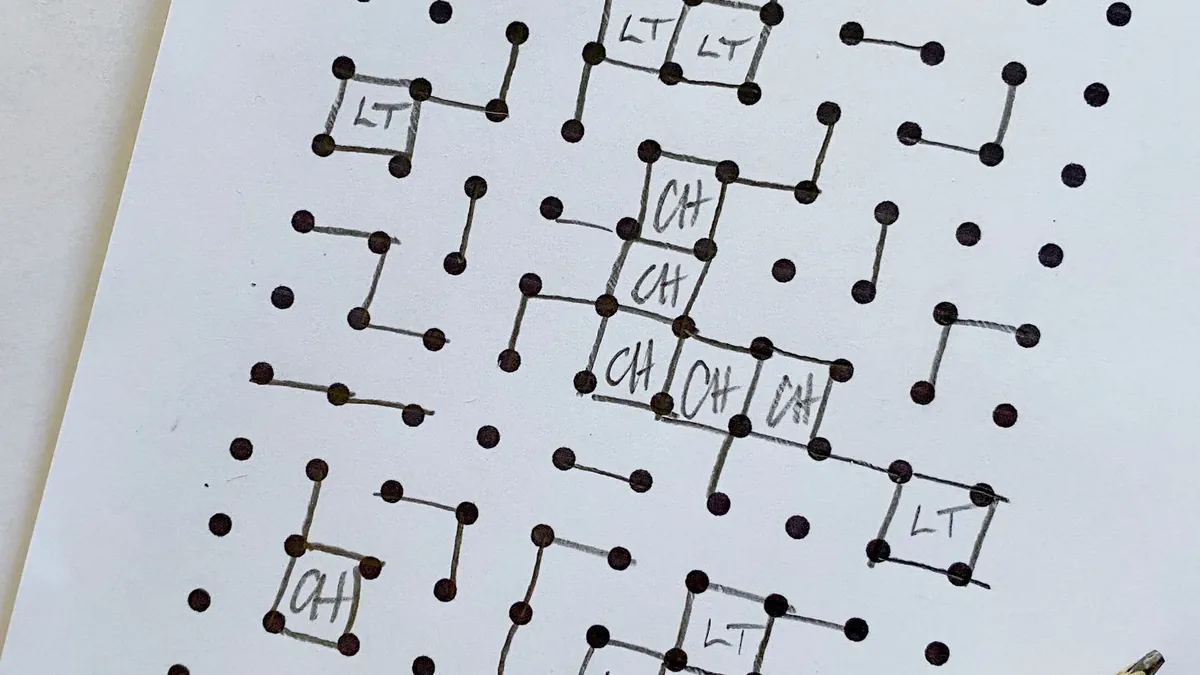
In the paper game dots and boxes, a player who closes the fourth side of a square writes initials in it and takes another turn.
0 The short answer
A logic IQ test measures deduction, which the Cattell-Horn-Carroll (CHC) model calls general sequential reasoning, one of three narrow abilities inside fluid reasoning (Gf) beside induction and quantitative reasoning. A normed score for it comes from a psychologist's battery or from a normed online battery, and ACIS is one concrete option: its Logic Grid subtest is in the Optimized form (30 dollars, 13 subtests, about 110 minutes) and the Full Scale form (50 dollars, 20 subtests, about 175 minutes), prices read on October 28, 2026 and subject to change. The decisive limit is that a quiz of logic puzzles without a norm group cannot report an IQ, and ACIS is online, unsupervised and not a clinical instrument.
3
narrow abilities in fluid reasoning in the CHC codebook: induction, general sequential reasoning and quantitative reasoning
74
training experiments pooled in the Klauer and Phye (2008) meta-analysis of inductive reasoning training in nearly 3,600 children
5 dollars
the ACIS Custom Test price for one subtest, such as Logic Grid, read on October 28, 2026
In intelligence testing, logic means deduction: reasoning from known premises and rules to a conclusion that has to be true if they are. The CHC model, the framework most modern batteries are built on, files that skill under fluid reasoning. The Institute for Applied Psychometrics codebook of CHC definitions, which Kevin McGrew dated June 14, 2014 and adapted from Schneider and McGrew (2012), describes Gf as the deliberate but flexible control of attention to solve novel problems and lists three narrow abilities inside it. The page on the CHC model explains how those narrow abilities fit under the broad ones.
Narrow ability in Gf
CHC definition (paraphrased from the codebook)
Typical task format
General sequential reasoning (RG)
Reasoning logically from known premises and principles
Constraint grids, conditional rules, syllogisms
Induction (I)
Observing a phenomenon and discovering the rules that govern it
Matrices, series, analogies
Quantitative reasoning (RQ)
Reasoning, by induction or deduction, with numbers, relations and operators
Balance problems, numeric rules
Two things follow from that table. First, "logic" in a popular quiz is a much wider word than "logic" in the codebook. A quiz called a logic IQ test may contain number series, shape matrices, word analogies and riddles, and in the CHC taxonomy several of those are induction, not deduction. A reader who wants to know what a test measures has to look at what the task demands, not at the name on the page.
Second, deduction has a precise meaning that is easy to state. The psychologist Philip Johnson-Laird, in his review of deductive reasoning in the Annual Review of Psychology, describes three families of theory about how people deduce: that they rely on factual knowledge, on formal rules, or on mental models. The same abstract argues that people have a modicum of deductive competence that is useful in daily life and a prerequisite for acquiring logical expertise. The review does not say that logic is a single trainable skill, and it does not equate deduction with intelligence. It describes a family of mental operations that researchers explain in competing ways.
The broader picture matters for a reader who searches "logic behind IQ tests". An IQ test does not have a logic of its own. It samples several cognitive abilities, scores each against people of the same age, and combines the results into a composite. The page on what IQ measures sets out that structure, and the page on how IQ scores are normed explains the comparison step. Deduction is one of the abilities sampled, and in most batteries it is sampled by one or two tasks among many.
2 What formats do logic IQ tests use?
Logic IQ tests ask for deduction in a handful of formats: constraint grids, clue elimination puzzles, conditional rules and syllogisms, and relational analogies. They share one feature. The answer is forced by the information on the page, and a person who reasons correctly cannot reach a different one. That is the difference between deduction and the guesswork a riddle sometimes invites.
Constraint grids. A partly filled grid carries rules about what may repeat in each row, column or outlined region, and the solver works out which symbol belongs in a marked cell by elimination. The ACIS technical manual describes its Logic Grid subtest this way: the examinee sees a partially filled grid and determines which shape belongs in a highlighted cell, every row, column and outlined region must contain each shape exactly once, and the answer follows by elimination rather than by recognizing a pattern. The manual lists 26 grids and a 20 minute limit for the subtest.
Clue elimination puzzles. Here a list of statements fixes who owns what, and the solver builds a table of possibilities and strikes out the impossible ones. The famous example is the zebra puzzle, and the page on Einstein's riddle traces where its attribution to Einstein and its claimed pass rate come from. For a logic test the point is the demand, not the legend: each clue removes options, and the solver must keep every earlier removal in mind.
Conditional rules and syllogisms. Two premises are given and the solver judges whether a stated conclusion follows. This is the oldest laboratory format for deduction, and it is where psychologists documented that what people believe about a conclusion interferes with whether it follows. Section 7 returns to that evidence.
Relational analogies. An analogy asks the solver to find the relation between one pair and apply it to another. In the CHC taxonomy this is mainly induction, because the rule must be discovered before it is used. ACIS places Complex Relations here: the manual describes a frame in which the examinee supplies both missing terms, so the linking rule has to be induced and then applied twice.
Matrices and balance problems.Matrix Reasoning is the best known fluid reasoning format, and it is mainly inductive. Figure Weights presents balance scales with one side incomplete, and the manual maps it to quantitative reasoning. Neither is a deduction task in the strict sense, and both belong in a battery that wants to separate induction, deduction and quantitative reasoning.
Original illustration written for this page, not taken from any testThree desks, numbered 1, 2 and 3, each hold one folder, and the folders are red, blue and green. The red folder is not on desk 1. The blue folder is on a lower numbered desk than the green folder. The green folder is on desk 2. The blue folder must then be on desk 1, which leaves the red folder on desk 3. Every step was forced by a stated rule, which is what makes it deduction. A real test uses many more rules and much larger grids, and it times the solver.
A short example also shows why the format is more than a party trick. Even this three line puzzle asks the solver to hold two constraints, apply them in the right order and update an internal table. Larger grids multiply the number of constraints that must be kept active at once, which is why a deduction task leans on working memory as well as on reasoning, a point the ACIS manual makes when it says that a low Logic Grid score with weak working memory may reflect difficulty maintaining rules.
3 Which intelligence batteries measure deduction?
Most major batteries measure fluid reasoning, but only some of them contain a task that isolates deduction, so the label "logic" on a subtest tells you less than its description. The comparison below uses only what the publishers' own pages say.
The Pearson product page for the Wechsler Adult Intelligence Scale, Fifth Edition, read on October 28, 2026, lists five primary indexes including a separate Fluid Reasoning index and a separate Visual Spatial index, an age range of 16:0 to 90:11, and a Full Scale IQ built from seven subtests in about 45 minutes. The page names Set Relations as a new fluid reasoning subtest, and its Stimulus Book 1 includes Matrix Reasoning and Figure Weights. The page does not give a complete subtest list for the Fluid Reasoning index, so this article does not either.
The Woodcock-Johnson IV Tests of Cognitive Abilities spell out the induction and deduction split more explicitly. Riverside Insights, the publisher, wrote in its Assessment Service Bulletin Number 9, which this page opened on October 28, 2026, that Test 9, Concept Formation, is a fluid reasoning task that assesses verbal inductive reasoning and requires working memory to hold information and goals until the rules are formed. The same bulletin refers to the deductive reasoning component of Test 15, Analysis-Synthesis, and its table describes the task as solving a visual puzzle based on a given key, tagged to fluid reasoning and quantitative reasoning. That makes Analysis-Synthesis a rare example of a commercial subtest that is openly described as deductive, which is the opposite of the many quizzes that merely use the word logic.
The ACIS battery separates the three narrow abilities across the five subtests of the Fluid Reasoning Index (FRI). According to the technical manual, Logic Grid maps to general sequential reasoning, Complex Relations and Visual Number Series to induction, and Figure Weights to quantitative reasoning within Gf, with Matrix Reasoning as the central matrix task. The manual states that agreement across these tasks supports broad fluid reasoning, and that disagreement suggests that format, quantitative content, general sequential reasoning or relation abstraction may be influencing the profile.
The practical consequence is that a reader who wants "a logic score" should ask three questions of any product. Does the description say deduction, or only logic? Is the score compared with a norm group, and which one? And does the score appear next to other reasoning tasks, so that one narrow ability is not mistaken for general intelligence? The page on the fluid intelligence test sets out what Gf tasks measure.
4 What are the real ways to take a logic IQ test?
Six routes lead to something called a logic test, and only two of them, a psychologist's battery and a normed online battery, report a score against stated norms for adults. The rest can be useful practice or entertainment, but they cannot say where a person stands relative to others. The table lays out the options with what each measures, how it is compared, whether anyone supervises it, how long it takes, what it costs and what the buyer receives. Prices and times were read on October 28, 2026 where a source is named, and they change.
Option
What it measures
Compared with whom
Supervised
Time
Cost
What you receive
Psychologist giving the WAIS-5
Five primary indexes, including a Fluid Reasoning index
Publisher norms for ages 16:0 to 90:11
Yes, one on one
About 45 minutes for the 7 subtest Full Scale IQ, about 60 for the 10 primary subtests
Client fees vary by clinic; the examiner's print kit is listed at 1,784 dollars
A scored report and interpretation
Psychologist giving the Woodcock-Johnson IV cognitive tests
Includes Concept Formation (induction) and Analysis-Synthesis (deduction)
Publisher norms
Yes, one on one
Not read for this page
Not read for this page
A scored report and interpretation
Society admission test
Whether you qualify for membership
The society's own cutoff
Yes, at a session
Not stated here
Set by each society
A pass or fail
Free quiz or app of logic puzzles
Whatever its items sample, often mixed formats
Usually no stated norm group
No
Minutes to about half an hour
Free or ad supported
A number or a rank, rarely with an interval
Logical reasoning test for job screening
Reasoning in a work setting, chosen by an employer
The employer's comparison groups
Varies
Short
Paid by the employer
A result that goes to the employer, not an IQ
ACIS Optimized, Full Scale or Custom Test
Logic Grid inside the Fluid Reasoning Index; Optimized has 13 subtests, Full Scale all 20
Adult norms for ages 16 to 90
No, online and unsupervised
About 110 minutes for Optimized, about 175 minutes for Full Scale
30 dollars, 50 dollars, or 5 dollars per subtest
Scaled scores, indexes, percentiles and a 95 percent confidence interval
The first two rows are the benchmark. A clinician controls the room, reads the instructions in a fixed way, watches effort and writes a report, and those controls are what the test publishers' norms assume. The page on where to take an IQ test compares the in person routes with their fees, and the page on IQ testing for adults explains what a self administered adult test can and cannot replace. A reader who needs a result for a legal, clinical or school decision should book a clinician, and nothing in this table changes that.
The society row is not a profile. It answers one question, whether a person reaches a cutoff, and a person who wants to explore scores above the usual range can read the page on high range IQ tests for how those tests are built and what they can and cannot document.
The free row is where most searches for "logic iq test free" and "logic iq quiz" land. A free quiz can be well made, but a free quiz that reports an IQ has to say which people it compared you with, and most do not. That is a statement about what a page publishes, not an accusation: a quiz can be fun and still fall short of a norm. The page on the free IQ test covers what free options give you, and the page on the best online IQ tests compares paid ones. ACIS offers a free trial with no card, but Logic Grid is not among the subtests the trial opens, so a reader who wants a deduction score pays for the Optimized form, the Full Scale form or a Custom Test.
The job screening row is a different genre with a different purpose. A logical reasoning test sent by an employer is built to compare applicants for a role and is not an IQ test, and the page on the abstract reasoning test covers that genre and how it overlaps with IQ.
One more place where puzzles meet high stakes is law school admission. According to the Law School Admission Council's post of August 28, 2024, the August 2024 LSAT has two scored Logical Reasoning sections and one scored Reading Comprehension section, plus an unscored section of either type, and the council reports that scores were very much in line with recent Augusts. The older Analytical Reasoning section, widely called logic games, is not among those sections. The lesson for this page is modest: an organization that once included a logic puzzle section in its exam treated it as one way of sampling reasoning, not as an IQ.
5 How do the ACIS logic and relation subtests work?
ACIS covers deduction with Logic Grid and relational induction with Complex Relations, and it reads both beside three other fluid reasoning tasks instead of reporting a standalone "logic IQ". The two subtests sit in different forms, so the form decides what a buyer can obtain.
The public page for Logic Grid describes the task family as controlled deduction under multiple constraints: the person keeps several rules active, eliminates impossible combinations and preserves what each clue rules out. The same page states that two practice puzzles come first, that they are not scored, and that the clock starts after them. The technical manual maps the subtest to general sequential reasoning within Gf and notes that it differs from Matrix Reasoning because it is not primarily about visual pattern completion, and from Arithmetic because its rules are logical and relational rather than numerical. The manual adds that a person may be strong at pattern induction but weaker at stepwise deductive tracking, or the reverse, which is the reason the two are sampled separately. The technical manual is where ACIS documents each subtest and its evidence.
The Complex Relations subtest covers the inductive side. The manual describes an abstract analogy with two blanks, so the rule linking the given pair must first be induced and then applied twice, and it lists 30 analogies at 45 seconds each with typed answers. Because the answers are typed words, vocabulary can matter, and the manual says in general that verbal and knowledge tasks are affected by English proficiency and educational exposure. A reader whose first language is not English should expect that to bear on this subtest more than on a grid of shapes.
The other three tasks in the Fluid Reasoning Index complete the picture. Matrix Reasoning and Figure Weights are in the Quick form, Logic Grid joins them in the Optimized form, and Visual Number Series and Complex Relations appear only in the Full Scale form, together with five other subtests. The page on the number series test takes up the numerical induction format, and the page on the pattern recognition test takes up the matrix format.
ACIS form
Price (read October 28, 2026)
Fluid reasoning subtests it contains
Time
Quick
15 dollars
Matrix Reasoning, Figure Weights
About 45 minutes
Optimized
30 dollars
Matrix Reasoning, Figure Weights, Logic Grid
About 110 minutes
Full Scale
50 dollars
All five: Matrix Reasoning, Figure Weights, Visual Number Series, Logic Grid, Complex Relations
About 175 minutes
Custom Test
5 dollars per subtest
Any you choose
Depends on the subtests
The Custom Test deserves a closer look for this reader. ACIS states that any domain you complete returns its full index score and that every subtest returns its scaled score. The fluid reasoning domain has five subtests, so completing all five in a Custom Test costs 25 dollars, which is our arithmetic on the posted per subtest price. Taking only Logic Grid costs 5 dollars and returns a scaled score for that subtest, but not an index, because one subtest does not make a domain. The Full Scale IQ needs the Full Scale battery, and at 10 subtests the Full Scale form costs the same as a Custom Test.
Each form reports a Full Scale IQ with its 95 percent confidence interval, and every form is a one time payment with no subscription, breaks allowed, progress saved between subtests and 30 days to finish. The refund promise is narrower than people assume, and it should be read as written: "Full refund within 5 days if the report does not deliver the features described at checkout or a technical issue prevents you from accessing your results." The example reports, linked below, show what each form returns before any payment.
6 Is deduction a separate ability, or the same thing as general intelligence?
On paper deduction is a distinct narrow ability, but in practice it is tangled up with induction, working memory and attention control, which is why a battery reads it beside other tasks instead of on its own. The CHC definition separates general sequential reasoning from induction and quantitative reasoning, and the ACIS manual keeps them apart by assigning them to different subtests. The separation is a tool for reading a profile, not a claim that the three live in different parts of the mind.
Two published descriptions show the entanglement. The manual says Logic Grid should be read with Complex Relations, Matrix Reasoning and the working memory index (WMI), and that a low Logic Grid score with weak working memory may reflect difficulty maintaining rules, while a low score with adequate working memory may reflect difficulty using constraints strategically. Riverside's bulletin on the WJ IV says much the same about its tasks: Concept Formation requires working memory to hold information and goals in mind until rules form, and the deductive component of Analysis-Synthesis requires cognitive flexibility. Neither source treats deduction as pure.
The consequence is that a deduction score is a mixture of the narrow ability and the resources used to deploy it. A person who tracks constraints well but runs out of working memory on a large grid will score lower than the ability alone predicts, and the opposite pattern also occurs. The page on what IQ measures describes how a general factor and narrower abilities coexist in the same battery, and the page on index score differences explains why gaps between indexes are common and how to judge whether a gap is meaningful. The point for a reader is to treat one subtest as a clue, not a verdict.
There is a second reason to read narrow abilities cautiously. Stanovich and West, in their Behavioral and Brain Sciences paper on individual differences in reasoning, report experiments on most of the classic tasks of the heuristics and biases literature. Their abstract concludes that performance errors are a minor factor in the gap between normative and observed responding, and that computational limitations underlie non normative responding on several tasks, particularly those involving some type of cognitive decontextualization. In plain terms, many wrong answers on logic problems reflect limits in how much a person can hold and manipulate, not carelessness, and the tasks that strip away context are the hardest. That fits the demand a constraint grid makes.
7 Why do capable people still miss logic problems?
A missed logic problem is weak evidence about ability, because what people believe about a conclusion changes whether they accept it, even when the logic is plain. The classic demonstration is the study by Evans, Barston and Pollard in Memory and Cognition, which reported three experiments on how people weigh logic against belief when judging syllogisms. It found substantial belief bias even after controlling for possible conversions of the premises, and equally substantial effects of logic after controlling for two response biases. Belief bias was more marked on invalid syllogisms than on valid ones, and the authors concluded that a conflict between logic and belief appears at several levels.
Two practical points follow for anyone choosing a logic test. First, a test whose items mention real world facts invites belief to interfere, which is why standardized deduction tasks usually use abstract symbols, shapes or arbitrary labels. The grid format of Logic Grid carries no real world content to disagree with, and that is a design choice in favor of measuring the reasoning process. The Standards for Educational and Psychological Testing (AERA, APA and NCME, 2014) make the same point in general terms in Standard 3.2, which asks developers to minimize the potential for test scores to be affected by construct irrelevant characteristics such as linguistic, communicative, cognitive and cultural ones.
Second, a single failed syllogism says very little about a person. The findings of Evans and colleagues and of Stanovich and West are group level patterns about how reasoning behaves, not diagnoses of individuals, and they show that variation in logical performance has many sources. A reader who misses a puzzle in a free quiz has learned something about that puzzle, not about intelligence. A normed battery handles this by combining many items and several subtests, so that one stumble does not decide the result.
Practicing logic puzzles reliably makes you better at logic puzzles, but the evidence that it raises general intelligence is thin, mixed and concentrated in studies of children. The question is really about transfer: whether skill gained on a trained task carries over to tasks that were not trained, and how far. Researchers separate near transfer, to similar tasks, from far transfer, to different tasks and everyday performance.
The broadest review is by Simons and colleagues in Psychological Science in the Public Interest. They examined the peer reviewed intervention studies cited on the websites of leading brain training companies, using a set of best practices for such studies. Their abstract reports extensive evidence that training improves performance on the trained tasks, less evidence that it improves closely related tasks, and little evidence that it improves distantly related tasks or everyday cognitive performance. It also reports that many of the studies had major shortcomings in design or analysis, and that none of the cited studies met all of the best practices. That does not prove that no training can transfer. It means the strongest claims rest on the weakest designs.
Sala and Gobet reached a similar verdict from a different direction in Current Directions in Psychological Science. They ran meta-analyses of chess instruction, music instruction and working memory training on children's cognitive and academic skills. The effects were small to moderate, but the effect sizes were inversely related to the quality of the experimental design, for example the presence of active control groups, and the authors concluded that far transfer of learning rarely occurs. The page on the chess IQ test takes up chess in detail, which is the game most often cited as proof that board games build intelligence.
The counter-evidence deserves a fair hearing, because it is the reason the question stays open. Mackey, Hill, Stone and Bunge, in Developmental Science, trained children aged 7 to 9 from low socioeconomic backgrounds for 60 minutes a day on 2 days a week for 8 weeks, using commercially available games. The reasoning group played games emphasizing planning and relational integration, and the speed group played games emphasizing rapid visual detection and rapid motor responses. The reasoning group improved substantially on a nonverbal reasoning test, with a Cohen's d of 1.51 and an average gain of 10 points in Performance IQ, and did not improve on a coding speed test, while the speed group showed the reverse pattern. The authors concluded that both fluid reasoning and processing speed are modifiable by training.
A larger body of work points the same way for a specific kind of training. Klauer and Phye, in the Review of Educational Research, pooled 74 training experiments with nearly 3,600 children in which participants learned a procedural strategy for inductive reasoning, comparing the elements of a problem. They report that training raised fluid intelligence test performance and academic learning, that the effect on intelligence test performance grew over time, and that the results cannot be explained by placebo or test coaching effects. Their transfer to academic learning was larger than their transfer to intelligence test performance.
Adults are less well studied. Mackey, Whitaker and Bunge, in Frontiers in Neuroanatomy, compared 23 adults enrolled in a course to prepare for the Law School Admission Test with 22 age and IQ matched controls, scanning both groups three months apart. White matter measures in frontal and parietal regions changed in the trained group and not in the controls, and larger gains on the LSAT went with larger changes in one measure. The abstract reports brain structure changes after reasoning training. It does not report a change in IQ, so it cannot be read as showing that the course raised intelligence.
Three cautions keep these studies in proportion. The two positive findings that raise IQ scores are about children, who change quickly for many reasons, and in both the training was a structured program of reasoning games or a taught strategy, not a person working through a puzzle book on their own. The strongest positive result is on a nonverbal reasoning test that sits close to the trained skill, which is near transfer by the definition above. And the reviews of the broader literature find that effect sizes shrink as designs improve. A fair reading is that a structured program can improve reasoning test performance in children, that whether the gain reflects a lasting change in the ability or a better grip on the test format is not settled, and that no study on this page shows that puzzles raise the IQ of an adult. The page on practice versus IQ weighs how much of performance practice explains across domains.
9 Does practice inflate a logic test score?
Practice on one puzzle format can raise a score on a test of that format without raising the ability the test is meant to measure, which is why normed tests keep their items private. The best evidence on this is not about logic specifically. It is the meta-analysis by Scharfen, Peters and Holling in Intelligence, which covered 122 studies of retest effects in cognitive ability tests. It found significant retest effects and no further score gains after the third test administration, and it reported that the size of the effect depends on the cognitive ability operation and content, on whether the forms are equivalent, on the retest interval and on age.
Constraint grids are an easy format to learn. A solver who discovers that a candidate table, with each cell's remaining possibilities written out, makes deduction faster has acquired a strategy, and the strategy helps on every grid of the same kind. That is an inference from the strategy training results above, not a finding about any one test, but it explains why puzzle fans often outscore their other abilities on a puzzle based test. The score then measures two things: reasoning and familiarity with the format. A normed test minimizes the second by using unfamiliar items, a fixed procedure and, in the best case, fresh items for retesting.
This is the technical reason behind a rule in the Standards for Educational and Psychological Testing: Standard 6.7 says that test users have the responsibility of protecting the security of test materials at all times. A published item with its answer can be learned, and a learned item no longer samples reasoning. ACIS states on its public subtest pages that they do not disclose protected item content, and this page reproduces no item from any test. The short original illustration earlier in this article was written for the page and is not from any instrument.
A reader who plans to take a normed test and wants to prepare has a sensible option: practice the general skill of working through constraints on material that is clearly not from the test, then take the test once, without hurry, when rested. A reader who has already practiced intensively on one format should say so when interpreting the result, because the score may overstate ability on a different task. A reader who retakes a normed test within weeks should expect some gain from familiarity alone, as the meta-analysis implies, and should not read it as growth.
10 How should you read a logic score?
A deduction score is a scaled score for one subtest, and it should be read through its scale, its percentile and its confidence interval, beside the other fluid reasoning tasks, instead of as a stand alone "logic IQ". ACIS reports subtest results as scaled scores from 1 to 19 with a mean of 10 and a standard deviation of 3, indexes and the Full Scale IQ on the standard scale with a mean of 100 and a standard deviation of 15, and percentiles and a 95 percent confidence interval. The page on why the standard deviation is 15 explains the scale.
Scaled score (mean 10, SD 3)
Distance from the mean
Same position on the IQ scale (mean 100, SD 15)
Approximate percentile under a normal curve
4
2 SD below
70
2
7
1 SD below
85
16
10
At the mean
100
50
13
1 SD above
115
84
16
2 SD above
130
98
The percentile column is our arithmetic, assuming a normal distribution, and it shows the position and not a measurement. The page on IQ score versus percentile explains why scores and percentiles cannot be averaged. Moving between the two scales is a rescaling, not a new measurement.
Precision is the second reason to be cautious. The Standards for Educational and Psychological Testing (2014) say in Standard 2.3 that estimates of relevant indices of reliability and precision should be reported for each total score, subscore or combination of scores that is to be interpreted, and the comment warns that total scores may be consistent while subscores have unacceptably low reliability. Standard 6.10 asks that released interpretations describe in simple language what the test covers, what scores represent and the precision of the scores. A single subtest is a short sample of one narrow ability, so its score carries more uncertainty than the index it feeds. The page on reliability and validity explains the terms with examples, and the technical manual is where ACIS documents its own evidence.
Three habits follow. Compare the interval, not the point: two scores whose intervals overlap are not clearly different. Compare the set, not one subtest: if Logic Grid, Matrix Reasoning and Figure Weights agree, the fluid reasoning picture is well supported, and if they diverge, the manual's guidance on working memory and strategy applies. And compare against the purpose: a number is informative for curiosity or self knowledge, and it is not a basis for a diagnosis or a decision about a person.
11 What should an unsupervised logic test session look like?
An unsupervised session is only as standardized as the room and the device you give it, so set both up before the first item and treat the 20 minute limit as part of the test. The Standards ask administrators to follow standardized procedures carefully (Standard 6.1) and ask that disruptions to standardized administration be documented (Standard 6.3). The APA Guidelines for Psychological Assessment and Evaluation, approved in March 2020, ask in Guideline 8 that psychologists be aware of the need for test selection, scoring and administration to reflect the appropriate normative comparison, situational influences, effort and standardized procedure. A clinician controls those things. An online test taker has to control them personally.
Specific points for Logic Grid. The public page states that the task is timed at 20 minutes in total, that two unscored practice puzzles come first and that calculators, notes, scratch paper and drawing tools are not allowed. The manual adds that there is no visible countdown, so a reader should plan the whole subtest as one uninterrupted block and not start it with a meeting in 15 minutes. Because deduction leans on working memory, a noisy room or a phone notification changes what the subtest measures. Breaks are allowed between subtests, and progress is saved, so the time to rest is before starting the grid and not during it.
Working sound is needed only for the three subtests that present items as audio, Digit Span, Alphanumeric Sequencing and Arithmetic, and Logic Grid is not one of them. A reader taking a full form needs the sound for those, a stable connection and a device with a screen large enough to see a grid without scrolling. Timed formats also reward speed in ways that are separate from reasoning, and the page on the processing speed test explains how speed is measured on its own so that the two can be told apart in a profile.
Effort and mood matter as well. A score taken tired, anxious or after a sleepless night describes that evening. If the result will inform a personal decision, retesting on a different day, with the same conditions, gives a second estimate to compare, though the retest effects described above mean the second score is not a clean replication.
12 Where ACIS sits, and what a buyer should do
ACIS sells one of the options in this comparison, so treat this section as a disclosure: it is a normed online battery that includes a deduction subtest, and it is not a clinical instrument, a supervised test or a substitute for a psychologist. ACIS offers Logic Grid in the Optimized and Full Scale forms and Complex Relations in the Full Scale form, and it sells a Custom Test at 5 dollars per subtest, all one time payments with prices read on October 28, 2026. Its limits are plain. It is online and unsupervised. It is not for hiring, school accommodations or admission to high IQ societies. It is English only, and the manual says verbal and knowledge tasks are affected by English proficiency and educational exposure. The free trial needs no card, but it does not open Logic Grid.
The Standards for Educational and Psychological Testing (AERA, APA and NCME, 2014) are the benchmark for how a score should be read. Standard 1.1 says a test developer should set forth clearly how scores are intended to be interpreted and used, and delimit the population and the construct, and its comment says that no test permits interpretations that are valid for all purposes or in all situations. The APA's 2020 guidelines add in Guideline 7 that psychologists strive to use multiple sources of relevant and reliable information. Applied here, a Logic Grid score is a good indicator of how a person handled constraint based deduction under one set of conditions, and it should be one input among several.
What should a buyer do? If the question is curiosity about deduction specifically, take Logic Grid alone in the Custom Test for 5 dollars, read its scaled score and interval, and do not call it an IQ. If the question is fluid reasoning as a whole, the five subtest fluid reasoning domain in a Custom Test costs 25 dollars by our arithmetic and returns a full index. If the question is where your whole profile sits, the Full Scale form at 50 dollars returns all six indexes and a Full Scale IQ with its confidence interval, and the page on the cognitive ability test explains how a full profile reads. If the result will be used for a decision about you, book a clinician and take this page's table with you.
Every figure above is traceable to one of the following, and each is linked at the point where it is used. Percentiles for scaled scores and the 25 dollar total for five Custom Test subtests are our own arithmetic on published figures and are labelled as such. ACIS facts come from the live ACIS pages and the technical manual, read on October 28, 2026.
McGrew K. CHC Theory Codebook 1: Cognitive Definitions. Institute for Applied Psychometrics, slides dated June 14, 2014, adapted from Schneider and McGrew (2012) and McGrew, LaForte and Schrank (2014).
Johnson-Laird P. Deductive reasoning. Annual Review of Psychology, 1999, volume 50, issue 1, pages 109 to 135.
Simons D, Boot W, Charness N, Gathercole S, Chabris C, Hambrick D, Stine-Morrow E. Do "Brain-Training" Programs Work? Psychological Science in the Public Interest, 2016, volume 17, issue 3, pages 103 to 186.
American Educational Research Association, American Psychological Association, National Council on Measurement in Education. Standards for Educational and Psychological Testing. Washington, DC: AERA, 2014, Standards 1.1, 2.3, 3.2, 6.1, 6.3, 6.7 and 6.10.
American Psychological Association, Task Force on Psychological Assessment and Evaluation Guidelines. APA Guidelines for Psychological Assessment and Evaluation. Approved by the APA Council of Representatives, March 2020, Guidelines 7 and 8.
14 Frequently Asked Questions
What is a logic IQ test?
A logic IQ test is a set of reasoning problems that sample deduction, the ability to reach conclusions that follow from stated rules. In intelligence research that ability is called general sequential reasoning and belongs to fluid reasoning. Many online quizzes use the label loosely, mixing patterns, numbers and words with true deduction tasks.
Is there a free logic IQ test online?
Free logic quizzes exist in large numbers and suit practice or fun, but most do not say which people they compared you with, so the number they give is not an IQ. ACIS offers a free trial with no card, though Logic Grid is not among the trial subtests.
Can logic puzzles give you an IQ score?
A set of logic puzzles can give you a score, but an IQ requires comparison with a norm group of the same age. Without that comparison the result is a raw count of puzzles solved. Normed batteries combine several subtests and report the result with a confidence interval.
Do logic puzzles make you smarter?
Practice reliably improves performance on the puzzles practiced. Evidence that it raises general intelligence is weak: reviews find little far transfer, while a few studies of children report gains on reasoning tests after structured training. No study cited here shows puzzles raising the IQ of an adult.
What is the logic behind IQ tests?
An IQ test samples several cognitive abilities with timed tasks, scores each against people of similar age, and combines the results into a composite with a mean of 100 and a standard deviation of 15. The logic is comparison: your performance is placed relative to a norm group, not graded against a fixed pass mark.
How accurate is a logic IQ quiz on an app?
An app quiz is as informative as its publisher documents. If it names its norm group, its scoring method and its precision, the result carries information. If it gives only a number, treat it as a game score. Short quizzes also carry large uncertainty because few items are sampled.
Is logic the same as intelligence?
No. Logic, meaning deduction, is one narrow ability within fluid reasoning, which is one of several broad abilities in the CHC model. A person can be strong at deduction and weaker in vocabulary, speed or memory, which is why batteries report several indexes beside a Full Scale IQ.
What is general sequential reasoning?
General sequential reasoning is the CHC name for deductive reasoning. The codebook of the Institute for Applied Psychometrics defines it as the ability to reason logically using known premises and principles. It sits in fluid reasoning beside induction, which discovers the rules behind a phenomenon, and quantitative reasoning, which applies induction or deduction to numbers.
How is deduction different from induction?
Deduction applies given rules to reach a conclusion that must be true, while induction observes cases and infers the rule. Constraint grids are mostly deductive, and matrices, series and analogies are mostly inductive. Real items often mix both, so publishers classify a task by its main demand.
What did the Mackey study of reasoning training find?
Mackey and colleagues trained children aged 7 to 9 for 8 weeks with commercial games. The reasoning group improved on a nonverbal reasoning test by a Cohen's d of 1.51, about 10 Performance IQ points, and the speed group did not. The participants were children, so the study says little about adults.
What did Sala and Gobet conclude about far transfer?
Sala and Gobet ran meta-analyses of chess, music and working memory training. Effects were small to moderate, but they shrank as experimental designs improved, for example with active control groups. They concluded that far transfer of learning rarely occurs, which weakens claims that games raise general intelligence.
What does the ACIS Logic Grid subtest ask?
Logic Grid shows a partially filled grid and asks which shape belongs in a highlighted cell. Every row, column and outlined region holds each shape exactly once, so the answer follows by elimination. Two unscored practice puzzles come first, and the manual lists a 20 minute limit for the subtest.
What is belief bias in syllogisms?
Belief bias is the tendency to accept a conclusion because it sounds believable, whether or not it follows. Evans, Barston and Pollard found it was more marked on invalid syllogisms, while logic still had a substantial effect. Standardized deduction tasks use abstract material to limit the problem.
Which Woodcock-Johnson IV test measures deduction?
Riverside Insights describes Analysis-Synthesis, Test 15 of the Woodcock-Johnson IV Tests of Cognitive Abilities, as having a deductive reasoning component, with the examinee solving a puzzle from a given key. Its Concept Formation test, Test 9, is described as a measure of verbal inductive reasoning.
How should I read a Logic Grid score?
Read it as a scaled score from 1 to 19 with a mean of 10 and a standard deviation of 3, together with its percentile. One subtest is a short sample of one narrow ability, so compare it with Matrix Reasoning, Figure Weights and the working memory results before drawing conclusions.
Does a low logic score mean a low IQ?
No. A low deduction score can reflect working memory load, hasty elimination, a noisy room or the format, and it says little alone. The Full Scale IQ and the indexes combine many tasks. A single subtest result is never a diagnosis and cannot label a person.
Can I practice before a normed logic test?
You can practice the general skill of working through constraints on material that is not from the test. Practicing the exact format raises scores through familiarity, and meta-analytic evidence shows retest gains level off after the third administration. Take the real test once, rested, and without hurry.
What do I need to take a logic test at home?
A quiet room, a screen large enough to show the whole grid, a stable connection and an uninterrupted block of time. Logic Grid allows no calculators, notes or scratch paper. Working sound is needed only for the audio subtests, Digit Span, Alphanumeric Sequencing and Arithmetic.
Which ACIS form includes Logic Grid?
Logic Grid is in the Optimized form at 30 dollars and the Full Scale form at 50 dollars, and it can be taken alone in the Custom Test at 5 dollars per subtest. It is not in the Quick form. Prices were read on October 28, 2026 and can change.
Is a logic IQ test used for hiring?
Employers use logical reasoning tests to compare applicants, but those are job screening products and not IQ tests, and ACIS is not for hiring. A logic score from a consumer test should not be offered to an employer as evidence of ability.
Can a logic test confirm that I am gifted?
No online test can confirm giftedness for official purposes. ACIS is online, unsupervised and not clinical, and it is not for admission to high IQ societies. It can show where you sit on its scales, and a clinician or a society's supervised test is needed for official confirmation.
Take the assessment
You get a profile, not a number
ACIS measures six CHC domains across 20 subtests and reports each one with its own normed score and confidence interval, so you can see where you are strong and where you are not.