Napoleon IQ: what Cox estimated and what history can establish
Napoleon's intelligence is usually discussed through military achievements, school anecdotes and an IQ number copied from historical rankings. The most useful starting point is the original source: Catharine Cox's 1926 study. Its Napoleon entry gives two estimates and explains the quality of the biographical evidence behind them. Reading that material carefully reveals both what the figures mean and why they cannot become a modern test result.
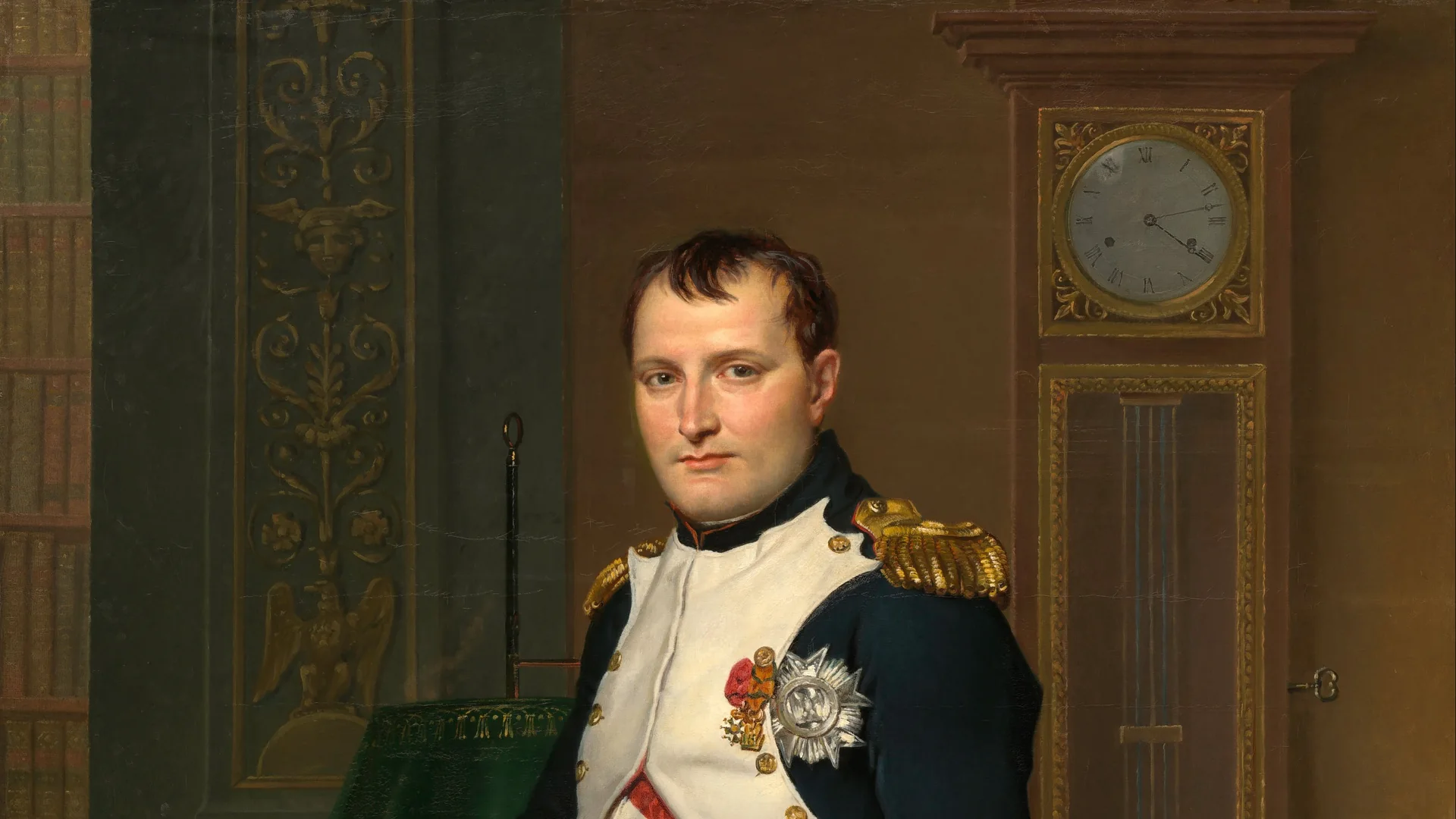
Detail from Jacques-Louis David's The Emperor Napoleon in His Study at the Tuileries, 1812. The portrait presents a public image; it is not evidence of a cognitive score. Public domain, via Wikimedia Commons.
0 The short answer
Napoleon has no administered modern IQ score, but Catharine Cox's 1926 case study assigned retrospective estimates of 135 and 140. The original Napoleon entry on printed pages 425 to 428 labels these AI and AII. They refer to ratings from biographical material about different early life periods. They are estimates of records, not results from a test Napoleon completed.
Napoleon died in 1821. Binet and Simon's early practical intelligence scale appeared in 1905, as documented in their original work. The 84 year gap is our subtraction of those dates. This article audits historical evidence; it does not assess Napoleon, diagnose him or infer a new score from his campaigns.
135
Cox's AI case rating, based on the record of development through age 17.
140
Cox's AII case rating, based on the record of development from age 17 to 26.
1926
Publication year of the retrospective study, more than a century after Napoleon's death.
425 to 428
Printed pages containing Napoleon's case study in Cox's original volume.
1 Which Napoleon IQ numbers can be traced to a source?
The clearest verifiable figures are the two ratings printed in Cox's individual case study. A reader can inspect the entry, its life periods and the biographical references. That makes the attribution traceable. It does not make the ratings direct measurements of Napoleon's cognitive performance.
Figure or claim
Source or method
Evidence class
What the reader should conclude
AI IQ 135
Cox, 1926, Napoleon case, pages 425 and 427
Retrospective rating
A rating of early biographical evidence within Cox's procedure.
AII IQ 140
Cox, 1926, Napoleon case, pages 425 and 428
Retrospective rating
A rating of the later early life record within the same study.
145 or another revised figure
Requires an exact table, column or later calculation
Unresolved without a specific citation
Do not assume it is the case rating or an administered test result.
A present day percentile
Requires a specified modern scale and applicable norms
Not established for Napoleon
A historical estimate cannot supply the missing administration and norming evidence.
A new score inferred from battles
Informal interpretation of accomplishments
Unsupported assessment
Historical achievements are not a completed cognitive test.
Cox's book also discusses corrections to its estimates. For that reason, a different number should not automatically be called invented merely because it differs from the case heading. The correct procedure is to identify the exact table and column, determine whether the value is corrected, and explain the assumptions. This page verifies the individual case ratings and does not present an unverified corrected value as settled fact.
This is a more useful answer to "Napoleon IQ 145" than either repeating the number or dismissing every retrospective study. A figure can have a scholarly origin while still being unsuitable as a modern personal score. The evidence class should travel with the number whenever it appears in a caption, table or search summary.
It also prevents a common form of accidental inflation. A reader sees a range, selects its highest endpoint, removes the word estimated and calls the result Napoleon's IQ. Each small edit strengthens the claim without strengthening the evidence. By the time the number reaches another website, the original procedure may have disappeared entirely.
The guide to celebrity IQ evidence explains this source hierarchy across cases. The highest IQ claims overview concerns a different question: what kinds of evidence support extreme score claims. Neither page provides a reason to put a historical estimate and a documented contemporary assessment into one undifferentiated ranking.
For Napoleon, the reliable starting point is therefore the source wording and method. State the verified case figures, preserve their retrospective status and leave unverified variants unresolved. Precision about provenance is more informative than precision invented about a person's mind.
2 How did Cox construct the historical estimates?
Cox organized biographical evidence into early life records and asked raters to evaluate the ability those records suggested. Her book, The Early Mental Traits of Three Hundred Geniuses, was the second volume in Genetic Studies of Genius. It studied a selected group of eminent historical people. It was not a program in which those people sat the same examination.
The individual case format makes the procedure visible. Napoleon's entry begins with family circumstances, then describes interests, education, school progress, associates, reading and early accomplishments. A later part covers development from age 17 to 26. The numerical headings summarize the raters' interpretation of the assembled record. They do not summarize answers Napoleon gave to standardized items.
Cox explains on printed page 49 that the AI and AII values average ratings for the two life periods. The same page explicitly treats them as estimates of paper records. That phrase is methodologically important. The available material stands between the historical person and the numerical judgment. The study cannot observe what was never recorded.
The Napoleon case lists biographies by authors including William Milligan Sloane, August Fournier and John Holland Rose. Those references let a researcher investigate the historical chain behind the dossier. They do not eliminate every problem in the chain. A nineteenth century biography may rely on a memoir, a school report, a family story or an earlier biography, each requiring its own evaluation.
One can reconstruct the logic with a simple hypothetical example. Imagine that a biography records a child mastering a subject unusually early. A rater compares that performance with an expected developmental level and assigns a rating. The estimate depends on the accuracy of the age, the meaning of "mastering," the difficulty of the work and the comparison standard. A vague anecdote leaves each of those quantities less certain.
Another record might describe an ordinary milestone with an exact date. It could be more securely documented but less informative about unusual ability. More certainty about the historical event does not automatically imply a more extreme estimate. Historical accuracy and cognitive diagnostic value are separate questions.
The method also requires distinguishing early evidence from later fame. A researcher should not reason backward from an emperor's status and assume that every childhood anecdote demonstrates exceptional cognition. Cox's discussion of correction states that raters were instructed to evaluate records without reference to the later career. That intention is relevant, but it does not make every source immune to hindsight.
The selection of eminent subjects matters as well. Their biographies were worth preserving because of later accomplishments and public attention. A study of those biographies cannot automatically describe the distribution of ability among all children in the same eras. It is a selected historical sample, and the questions it can answer follow from that selection.
This is why historiometry deserves its own label. It can make historical judgments explicit enough to inspect, compare and criticize. Its value lies in a stated procedure and a recoverable evidence base. Calling the output a test score would hide the very features that a serious evaluation of the method needs to examine.
3 Why does the quality of the surviving record matter?
The estimates depend partly on what biographers preserved, and Cox explicitly investigated that dependence. In Napoleon's case, the book prints a data reliability coefficient of .60 beside the AI rating and .75 beside AII. These belong to Cox's assessment of the historical record. They are not internal consistency coefficients for an IQ test administered to Napoleon.
The distinction protects readers from a misleading comparison. A modern test reliability coefficient concerns a defined measurement procedure and population. Cox's coefficient concerns evidence available for a retrospective rating within her study. Similar numerical notation does not mean the coefficients describe the same source of uncertainty.
On printed pages 79 to 82, Cox discusses a positive relationship between the adequacy of the data and the size of estimated IQ. She interprets incomplete records as a source of downward regression and proposes corrections. A reader should identify those corrections as part of the study's model, rather than treating corrected values as newly observed facts.
The underlying problem can be understood without adopting every feature of that model. Imagine two equally capable children in different historical circumstances. One leaves dated exercise books, correspondence and detailed school reports. The other leaves almost nothing before adulthood. The first record gives a later researcher many opportunities to identify precocity. The second may provide no comparable opportunity.
That asymmetry could create a difference in ratings even if the children had performed similarly on a suitable test. It could also conceal a real difference. The available biography alone does not identify which possibility occurred. A correction must therefore rest on assumptions about the missing information and should not be mistaken for recovering the missing observation itself.
Rich records introduce other risks. A celebrated person's childhood may attract flattering recollections, while hostile biographers may emphasize errors or weaknesses. Several accounts can repeat the same anecdote without providing independent confirmation. Counting repetitions as independent evidence can exaggerate confidence in a story.
Dates can also be uncertain. A task completed at one age may suggest a different developmental interpretation if it was actually completed several years later. Translation can change how demanding an achievement sounds. School labels can shift across countries and periods. A responsible historical rating must confront those problems before assigning a number.
The book's transparency about record quality is therefore worth preserving. Removing the coefficients, period labels and methodological discussion leaves readers with the strongest looking part of the result and none of its context. A modern article should restore that context instead of presenting the number as a recovered medical fact.
Our conclusion is narrower than declaring all historical quantitative research useless. The ratings can be studied as the product of a specific research procedure. What they do not provide is an independently administered score with a modern norm group and an individual confidence interval. Those missing elements cannot be created by attaching a bell curve to the case heading.
This is also why the two case ratings should not be read as proof that Napoleon gained five IQ points. The life periods contain different evidence. A difference between retrospective ratings is not the same observation as change across two comparable assessments of one person.
4 What does the school record actually suggest?
The historical accounts describe strong interests alongside uneven school performance, without supplying a modern cognitive profile. Cox's dossier emphasizes mathematics, geography and reading while reporting difficulties in some language work. It also records an undistinguished overall leaving rank. Those details complicate the simplistic story of universal brilliance in every classroom subject.
Historian Thierry Lentz's Fondation Napoléon account of Napoleon as a pupil supplies useful chronological context. It places his entry to Brienne in May 1779 and his Paris military schooling in 1784 to 1785. It describes strong mathematics and history results and gives a leaving rank of 42nd among 58. Those are historical educational claims, not IQ measurements.
The denominator matters. A class of military students is a selected educational group. A rank within that class does not directly locate a person in the entire population. Translating 42nd of 58 into a national intelligence percentile would require assumptions the ranking does not support.
The curriculum matters too. An overall result may combine several subjects, attendance requirements and evaluation procedures. Strength in one area can coexist with a less impressive total. To understand the total, a researcher would need the actual grading rules and component records. An anecdote about being excellent at mathematics cannot supply the missing weights.
Language adds another interpretive question. School performance through a particular language can involve familiarity with spelling, grammar and classroom expression as well as the intended content. That observation is a reason to investigate the educational context, not a license to invent a numerical correction for Napoleon or to diagnose a language disorder from retrospective descriptions.
Cox's dossier itself requires source criticism. It repeats striking characterizations and childhood anecdotes from earlier biographies. We use it primarily to establish what the 1926 researchers rated. We do not assume every story within the dossier has been independently authenticated simply because it appeared in a scholarly volume.
A careful account separates three layers. First is the surviving original school document, if available. Second is the historian's account of that document and its context. Third is a psychological interpretation imposed afterward. Each layer can add useful analysis, but it should remain visible. Collapsing them into "Napoleon's test proves" erases the differences.
The guide to cognitive domains explains why varied performance is compatible with a broader profile. It should not be used to assign Napoleon a quantitative reasoning index from a mathematics anecdote or a verbal index from spelling comments. A framework can organize questions without producing unobserved scores.
The same care applies to school reports that predict future success. An instructor's favorable judgment documents an expectation. Later achievements may make that expectation look perceptive, but hindsight does not transform it into a standardized assessment. Conversely, a modest school ranking does not make later accomplishments paradoxical once one remembers that the records concern different tasks and contexts.
What remains defensible is a historical description: the available accounts portray an engaged, capable student in some areas and a less uniformly successful student in others. The exact nature and limits of those strengths belong to historical investigation. They do not yield an authenticated modern IQ.
5 Why can Cox's ratings not be placed directly on today's scale?
The historical rating procedure and a modern deviation IQ scale do not share an automatically valid conversion. A numeral needs a defined scoring system before its distance from the mean can be interpreted. Using the abbreviation IQ in two periods does not establish that every point represents the same quantity.
The early ratio approach related an estimated mental age to chronological age. Terman's 1916 manual is a primary source for that historical framework. Cox's work belongs to this early measurement context. Her estimates of biographical records are further removed from direct performance than an actual administration using an early scale.
Modern deviation scoring generally places performance relative to a reference distribution for an appropriate age group. The conventional mean and standard deviation describe that scale. A reported modern IQ of 140 under specified norms is therefore a different evidential object from a retrospective case rating that happens to use the same numeral.
The mental age guide explains why the ratio concept should not be treated as a literal age of an adult mind. The SD 15 scale explanation addresses the unit used in many contemporary reports. Neither supplies a validated conversion from Napoleon's biographies to current performance.
For example, a normal curve can calculate the percentile corresponding to an assumed score, mean and standard deviation. The arithmetic can be perfectly correct while the application is unsupported. If the original historical rating was not obtained on the stipulated scale, the calculated percentile describes a hypothetical input rather than the historical person's measured position.
This distinction is especially important with claims of rarity. Saying that a historical figure was one in a certain number of people implies a reference distribution and a valid placement within it. The retrospective record does not supply a representative modern norm sample or a tested mapping between its ratings and that distribution.
Nor can the problem be solved with a universal Flynn effect adjustment. Pietschnig and Voracek's meta-analysis concerns secular changes in test performance across groups and periods. It does not establish a formula for transporting one historical person's estimated ability across centuries.
The Flynn effect explanation is useful for understanding why norms have dates. It should not be used to announce how Napoleon would perform after receiving modern education or taking a current battery. That counterfactual changes the person, environment and measurement conditions simultaneously. A simple adjustment cannot identify all those changes.
The responsible statement is therefore about the original study: Cox assigned particular ratings under a particular procedure. Those ratings can be compared within that historical research with appropriate methodological care. They should not be displayed as if Napoleon had received a current report with a modern percentile and confidence interval.
Military achievement is evidence about performance in war, while an IQ claim requires a measurement procedure. The word genius is often used informally to express extraordinary accomplishment. In that usage, it is a historical judgment rather than a score category. Confusing the two meanings produces a numerical conclusion that the historical evidence never measured.
Cox's early career account includes Napoleon's artillery training, advancement and role at Toulon. Those events explain why later writers saw unusual ability in the young officer. Their relevance to military history does not depend on assigning him an exact composite score. They can be examined through decisions, available resources and contemporary accounts.
A commander works with information that is incomplete and changing. Plans depend on communications, logistics, terrain, timing and the actions of opponents. Staff members and subordinate commanders contribute knowledge and execution. Success in that environment is a collective outcome shaped by many interacting conditions.
This means a victory cannot be inverted into an individual IQ value. Even if cognitive ability contributes to successful planning, the reverse inference needs a model that separates all the other contributors. Without such a model and relevant data, a numerical estimate derived from the victory is simply an interpretation wearing a score label.
The same is true of defeat. A failed campaign does not prove low cognitive ability, just as a successful campaign does not establish infallibility. Evaluating a decision requires asking what information was available at the time, what alternatives were feasible and what risks were foreseeable. The eventual outcome alone cannot answer all those questions.
The genius IQ discussion distinguishes informal praise from measurement terminology. The IQ and success overview addresses the broader temptation to treat achievement as a direct conversion of one psychological variable. Napoleon's career is an especially vivid example of why the distinction matters.
It is possible to analyze sophisticated planning without diagnosing the planner. A historian can identify coordination, adaptation or miscalculation in a documented episode. Those are claims about actions and evidence. Turning them into a working memory score or a fluid reasoning score would require a different kind of data.
There is also a moral distinction. Cognitive capability does not establish that a policy is just or that a war's human costs were acceptable. Calling a leader intelligent cannot serve as an ethical defense of everything that leader did. Conversely, condemning an action does not require making unsupported claims about cognitive impairment.
For a reader interested in Napoleon's abilities, the most productive route is therefore detailed history. Ask what he understood, what he overlooked and how his decisions interacted with institutions and circumstances. Those questions retain the complexity of the record instead of substituting an unobserved number for the explanation.
7 What does the Civil Code show about Napoleon's role?
The Civil Code documents a major institutional project whose production involved several people and bodies. The French Ministry of Justice's bicentennial account identifies the four member drafting commission and the subsequent institutional review. It records the consolidation of the laws into the Civil Code on March 21, 1804. That history should not be reduced to the image of one person writing every provision alone.
The distinction matters when accomplishments are used as evidence of intelligence. Sponsoring a project, organizing its political adoption, reviewing proposals and drafting its text are different contributions. Each can require skill, but an accurate account should identify who did what. A famous leader's association with the final product does not erase the work of jurists and institutions.
A legal code also responds to inherited problems. Its content reflects earlier law, competing interests, political choices and practical demands. To understand it, a reader needs to examine those sources and decisions. Attributing every feature to a single psychological trait leaves the legal and institutional explanation incomplete.
This is a general attribution problem, not a claim that Napoleon was unimportant. One can recognize a leader's influence while distinguishing it from sole authorship. The question is what the record supports about the contribution. That approach permits a strong historical claim without requiring an unsupported cognitive score.
Imagine applying the opposite rule consistently. Every law adopted under a head of government would become evidence of that individual's solitary reasoning. Every administrative failure would be assigned to the same person's private ability. Such a method would ignore legislatures, officials, advisers and constraints. It would explain too much with too little information.
The full scale IQ explanation describes a composite built from specified cognitive performance. A large legal project is not such a composite. It contains negotiation, institutional power, technical expertise and judgments about social order, none of which can be added together as if they were standardized subtests.
Nor does durability make the conversion valid. A legal text can remain influential for historical reasons that require their own explanation. Survival and impact do not reveal the drafter's score, still less the score of every political actor involved. The appropriate evidence remains the record of the work and its consequences.
The Civil Code therefore belongs in an account of Napoleon's public role. It can support discussion of administration and political ambition. It cannot establish that a particular IQ estimate is correct. A reader learns more by preserving the institutional history than by attaching a modern psychometric label to a collective achievement.
8 What can the scientific expedition to Egypt establish?
The expedition demonstrates organized scientific work associated with a military campaign, not a personal intelligence test for Napoleon. The Bibliothèque nationale de France's account of the Description of Egypt describes the scientific expedition accompanying the campaign launched in 1798 and the later publication project. Its history makes the collaboration visible rather than attributing every observation to the commander.
That visibility is essential. Scholars, artists, engineers and other participants contributed different forms of expertise. Collecting observations, recording monuments, classifying material and producing a publication are distinct tasks. The resulting work is evidence of their activity and of the conditions that made the project possible.
A leader's support for science can be historically significant without proving that the leader possessed each specialist's knowledge. Patronage, organization and scientific discovery are different roles. Treating them as interchangeable would misattribute the work and obscure the people who actually performed it.
The military context also belongs in the account. Scientific production can accompany conquest. Recording useful knowledge does not make the coercive setting disappear. An evidence led discussion should be able to recognize scholarship while examining the purposes, power relations and consequences of the expedition.
None of those questions is answered by a celebrity IQ number. A high estimate would not tell us who made a particular observation, how an object was obtained or which interpretation later proved reliable. The sources needed are expedition records, publications and historical analysis of the campaign.
The problem resembles the attribution issue in the Civil Code, but the substantive evidence differs. In one case, the reader studies legal drafting and institutional adoption. In the other, the reader studies scientific observation and publication. The shared lesson is to identify the actual contribution before treating a collective result as a personal trait.
This is also why historical accomplishment should not be summarized solely through lists of titles. "Emperor," "general" and "patron of science" identify roles. They do not describe standardized performance across a cognitive battery. A meaningful account explains what happened within those roles and what evidence survives.
The guide to what IQ measures is helpful precisely because it defines a narrower domain than a whole life. Cognitive assessment does not replace the study of scientific institutions, politics or ethical responsibility. Napoleon's association with the expedition can be explored without pretending it identifies a numerical score.
For readers drawn to the history of knowledge, the Description offers a richer subject than an IQ ranking. Its plates, observations and publication history can be inspected. They remain historical evidence even when the limits of personal inference are stated clearly.
9 What does David's portrait tell us, and what does it conceal?
David's portrait is evidence of a constructed public image rather than direct evidence of Napoleon's cognitive performance. The National Gallery of Art identifies the painting as an 1812 work, The Emperor Napoleon in His Study at the Tuileries. The image supplied for this page is a crop of that painting.
The Gallery's interpretation of its details explains how the picture presents the ruler through military and administrative imagery. It is an organized representation, with choices about setting, dress and objects. Those choices help viewers understand the image's argument, but they do not establish an assessment result.
A portrait can encourage an impression of diligence or composure. The viewer sees a pose, a room and selected symbols. The artist has decided what to include and how to arrange it. Even when the likeness is recognizable, the composition remains an interpretation shaped for an audience.
That makes the painting relevant to the IQ question in a specific way. Celebrity numbers often borrow authority from familiar images. A dignified portrait next to a precise numeral can make the claim feel documented. The visual confidence comes from the presentation, while the numerical evidence may still be absent.
The source roles should therefore remain separate. The museum record supports the painting's title, attribution and date. Cox's book supports the existence of a retrospective rating. Neither source independently validates the other type of claim. Putting both on the same page does not create a new measurement.
The crop also limits what the reader can see. The full painting contains details outside the hero image. A caption should describe the supplied image accurately rather than claiming that every object discussed in the museum's account is visible in the crop. This is a small but useful example of matching claims to the actual evidence presented.
Similar care is needed with photographs of contemporary public figures. An image can establish an appearance or document an event when its provenance is known. It cannot reveal a score merely because the subject looks scholarly, confident or intense. Those impressions belong to visual interpretation, not psychometric scoring.
The Marilyn Monroe IQ audit examines another case in which public image can dominate how people interpret intelligence claims. The JFK IQ article distinguishes a reported school result from later estimates and political mythology. Different people and records require different conclusions, while the obligation to match evidence to claims remains the same.
David's portrait is worth looking at closely as art and political communication. It does not need to function as a substitute score report. Reading it on its own terms makes its historical meaning more visible and the limits of the IQ claim easier to understand.
10 Can Napoleon be ranked against Einstein, Newton or Leonardo?
A ranking is not valid simply because every row contains a famous name and a number. Historical figures differ in the kinds of evidence available, the periods in which they lived and the methods used to generate their attributed scores. A common table format can conceal those differences instead of resolving them.
The Albert Einstein IQ audit, Isaac Newton IQ audit and Leonardo da Vinci IQ audit each examine a separate source problem. Their accomplishments should not be treated as interchangeable test items. A scientific theory, an artwork and a military campaign require different historical explanations.
Even if one retrospective study assigns ratings to several figures, the resulting comparison remains conditional on that study's method. It may be reasonable to describe where the researchers placed them within the model. It is a stronger and unsupported claim to say that a modern standardized test proved the same ordering.
Record quality can also differ between subjects. One person's childhood may be extensively documented while another's is largely unknown. Languages, educational opportunities and biographies differ. A numerical ranking can make those unequal evidence bases look equivalent unless the limitations are reported alongside the values.
There is a further problem in selecting only the most flattering published estimate for each person. That produces a table whose rows were generated by different rules. One row may use an original rating, another a corrected value, another an informal guess. The table then ranks the selection choices as much as the historical subjects.
The same standard applies when a figure is morally condemned. The Adolf Hitler IQ evidence page concerns claims that must be checked rather than inferred from approval or horror. Ethical judgment and cognitive measurement answer different questions. Neither should be manipulated to make the other seem easier.
An informative comparison would begin with evidence types: directly administered assessment, reported historical result, retrospective rating or unsupported attribution. It would show the instrument or method and disclose missing information. Some rows might remain incomparable. Leaving them incomparable is more honest than manufacturing a single ordered list.
The IQ rarity calculator cannot fix the problem. It can translate a score under stated distributional assumptions. It cannot tell whether a historical person's assigned number belongs on that distribution. An accurate calculation applied to an unjustified input remains an unjustified historical conclusion.
For readers interested in exceptional achievement, a comparison of documented work is often more productive. Ask what problem each person addressed, what resources were available and what changed because of the work. Those questions respect the record without requiring a competition between unobserved test results.
11 What would a modern cognitive battery measure in a strategist?
A modern battery would sample defined tasks under standardized conditions, while strategic achievement would remain a broader question. Depending on the instrument, it might assess verbal comprehension, fluid reasoning, quantitative reasoning, visual spatial processing, working memory and processing speed. The resulting profile would concern the person actually tested.
The distinction prevents retrospective diagnosis. We can describe why holding information in mind might matter during planning without asserting Napoleon's working memory index. We can discuss the role of quantitative reasoning in artillery without giving him a quantitative score. A plausible relationship between a domain and an occupation is not an observation of an individual's performance.
The working memory assessment guide addresses a specific cognitive domain. The fluid intelligence assessment guide concerns performance on novel relationships and problems within an assessment framework. Neither domain is synonymous with being a successful commander. Their relevance to a task would need appropriate evidence and a clearly defined outcome.
A battery would also have limits. It would not automatically measure ethical judgment, historical knowledge, political authority or the quality of an entire military organization. Those concepts cannot be added to an IQ interpretation simply because a reader cares about them. A useful score has a defined scope.
Standardization would matter before interpretation. Instructions, time limits, scoring rules and the reference group would need to be specified. A result obtained under substantially different conditions might require qualification. Historical anecdotes provide none of that administration record for a current battery.
This is why imagined testing scenarios remain speculation. Asking whether Napoleon would enjoy a particular task or score highly on it can be an engaging thought experiment. It should be labeled as such. No amount of confidence in the story produces the absent responses or the missing standardized administration.
The Standards for Educational and Psychological Testing connect interpretations to their supporting evidence and intended uses. A claim about task performance, a claim about military leadership and a claim about a historical individual's exact score each requires a different evidential argument. Using the same word intelligence does not remove that requirement.
An assessment of a living strategist could contribute information about current cognitive performance. It would still need to be interpreted alongside the purpose of the evaluation and relevant contextual evidence. For Napoleon, the living examinee and the administration are absent, so the historical account remains the appropriate source of knowledge.
That limit makes the distinction useful rather than empty. History can explain decisions and accomplishments. Cognitive assessment can measure specified present performance. Allowing each method to answer the questions it can actually address produces more reliable conclusions than forcing them into one numerical biography.
12 How should you investigate your own ability?
Your own cognitive questions are better addressed with current evidence than with a comparison to Napoleon's retrospective rating. Begin by deciding what you want to learn. Curiosity about a profile, a clinical concern and a formal documentation requirement call for different routes. A famous historical number does not identify the correct route for you.
We sell ACIS, a paid online assessment, so the recommendation here has a commercial interest. ACIS is self-administered and is not a clinical diagnostic instrument. Its technical manual documents the Full Scale form's 20 subtests and six primary domains. Review the documentation and intended use before choosing a form.
The relevant comparison is with the assessment's reference frame. A current report should identify its scale, interpretation and uncertainty. It should also make clear what was completed and under what conditions. Matching a historical estimate would not add validity to the result, and exceeding one would not establish comparable accomplishments.
For a formal use, ask the receiving organization what it accepts before purchasing an assessment. Clinical questions may require a qualified professional who can integrate test performance with other information. This page does not claim that ACIS provides a clinical diagnosis, a signed professional evaluation or acceptance for every outside purpose.
For personal exploration, use the score as information about assessed performance. Read the profile and the composite together. Consider whether conditions were suitable and whether the tasks match the question that brought you to testing. A high number should not become a promise of success, and a lower than expected number should not become a verdict on personal worth.
The reliability and validity guide explains why a measurement needs both consistency and a justified interpretation. Those requirements apply to ACIS as well as other assessments. Our commercial interest does not change the source standard used to evaluate historical claims or current product claims.
The APA Ethics Code also includes standards for assessment practice. Referencing that guidance is not an endorsement by the APA. It is a reminder that responsible interpretation attends to evidence, purpose and limits rather than treating every numerical output as universally meaningful.
Napoleon's history can inspire curiosity about strategy, learning and the relationship between ability and achievement. It cannot tell you your score. A current assessment can provide evidence about your performance, while a study of his life provides evidence about his actions. Keeping those purposes clear respects both the reader and the historical record.
The primary sources identify the historical ratings and documented projects, while measurement guidance sets limits on interpretation. Sources were checked on September 24, 2026. Cox's original case and methodological chapters were read directly. No modern psychological assessment of Napoleon is claimed.
Catharine Morris Cox. The Early Mental Traits of Three Hundred Geniuses. Genetic Studies of Genius, volume II, Stanford University Press, 1926. Napoleon case, printed pages 425 to 428; explanation of ratings, page 49; data quality and correction discussion, pages 79 to 82. Public domain source.
Alfred Binet and Théodore Simon. New Methods for the Diagnosis of the Intellectual Level of Subnormals. Original work published in 1905; English translation preserved by Classics in the History of Psychology. Historical title retained for identification; its terminology is not current guidance.
Lewis M. Terman. The Measurement of Intelligence. Houghton Mifflin, 1916. Primary historical account of ratio IQ and early measurement practice.
Thierry Lentz. Was Napoleon a Good Pupil?. Fondation Napoléon, May 2019. Historian's account of Brienne, Paris and the school results.
French Ministry of Justice. Bicentenaire du Code Civil. 2004. Official historical account of the drafting commission, review and adoption of the Civil Code.
Bibliothèque nationale de France, Bibliothèques d'Orient. The Description of Egypt. Institutional account of the scientific expedition and collaborative publication.
American Educational Research Association, American Psychological Association and National Council on Measurement in Education. Standards for Educational and Psychological Testing. 2014. Evidence supporting specific score interpretations and uses.
Napoleon has no administered modern IQ score. Catharine Cox's 1926 case study gave retrospective ratings of 135 and 140 for different early life records. Those figures are traceable to the original book, but they describe a historical rating procedure rather than a test Napoleon completed.
Was Napoleon's IQ 145?
The individual case heading verified here gives 135 and 140. Cox also discussed corrected estimates, so any alternative figure needs an exact table and column before it can be interpreted. A number repeated online should not be treated as an administered score or automatically assigned to the case heading.
Did Napoleon ever take an IQ test?
He could not have taken a modern IQ assessment, because he died in 1821, before the early Binet and Simon scale of 1905. School examinations and military evaluations existed during his lifetime, but they were different procedures and do not constitute a modern cognitive battery.
Who estimated Napoleon's IQ?
Catharine Cox's research team assigned retrospective ratings in a study published in 1926. The raters evaluated biographical material about early development. Their procedure can be examined in the book, but it did not involve direct testing of Napoleon or observation of his responses to standardized tasks.
What do Cox's AI and AII labels mean?
AI refers to ratings based on development through age 17, while AII refers to the record from age 17 to 26. These are periods in the retrospective study. They are not modern index names, separate clinical diagnoses or proof of measured change between two test administrations.
Was Napoleon a genius?
Genius can be an informal historical judgment about extraordinary achievement, but it is not a verified score in this case. Napoleon's military and administrative work can be studied directly. Calling him a genius does not establish that a particular IQ estimate is accurate on a current scale.
How smart was Napoleon Bonaparte?
The historical record supports investigating his learning, planning and accomplishments, while also examining errors and limitations. It does not provide a complete modern cognitive profile. A more informative answer describes specific documented abilities and decisions instead of treating an estimated number as a summary of his entire mind.
Where is Napoleon's entry in Cox's book?
The case appears on printed pages 425 to 428 of The Early Mental Traits of Three Hundred Geniuses. Digital scan numbers differ from printed page numbers. The entry contains its ratings, biographical summary and references, which should be read together rather than extracting only the numerical heading.
What do the .60 and .75 coefficients mean?
They are Cox's data reliability coefficients associated with the two historical records. They are not reliability statistics from an IQ test Napoleon took. Using the same decimal notation as modern psychometrics does not make them evidence of the same measurement procedure or uncertainty.
Did Cox consider missing historical evidence?
Yes. Her methodological discussion examines the relationship between record quality and estimated IQ and proposes corrections. Those corrections depend on the study's assumptions. They should be identified as modeling choices rather than described as newly discovered observations or proof of a person's true modern score.
Was Napoleon good at mathematics?
The historical accounts used here describe mathematics as a strength, alongside interests in history and geography. That supports a qualified educational description. It does not establish a modern quantitative reasoning index, and the accuracy of individual school anecdotes still depends on their documentary sources.
Did Napoleon graduate 42nd out of 58?
Thierry Lentz's Fondation Napoléon account gives that leaving rank for the Paris military school. It is a position within a selected class, not a population intelligence percentile. The curriculum, grading procedure and comparison group matter before interpreting what the rank says about academic performance.
Did Napoleon personally write the Civil Code?
The Code was an institutional project involving a drafting commission and subsequent review. Napoleon's role should be described within that history rather than as sole authorship of every provision. Political sponsorship and influence can be significant without erasing the contributions of jurists and other institutions.
Does the Egyptian expedition prove a high IQ?
The expedition and its publications document organized scientific work involving many specialists. They do not constitute a cognitive assessment of Napoleon. Supporting or directing a project is different from personally making every observation, and collective achievements require careful attribution before drawing conclusions about any one contributor.
Can Cox's 140 be converted to a modern percentile?
No validated conversion is established here. A modern percentile calculation requires a specified scale and reference distribution, while Cox's figure came from retrospective ratings. A calculator can perform correct arithmetic on assumed inputs without showing that those assumptions apply to Napoleon's historical estimate.
Can the Flynn effect update Napoleon's estimated IQ?
A general cohort trend does not provide a valid personal update across centuries. Such a calculation would require unsupported assumptions about education, test content, norms and historical conditions. The Flynn effect helps explain why reference groups change; it does not reconstruct Napoleon's performance on a current battery.
Was Napoleon more intelligent than Einstein or Newton?
A defensible numerical ranking is not established by comparing attributed scores from different methods. Each person's source record and measurement status must be examined separately. Their documented achievements concern different problems and contexts, which cannot be converted into equivalent test results through a celebrity table.
Does strategic success reveal working memory or fluid reasoning?
It can motivate questions about those domains, but it does not supply an individual's index scores. Strategy also involves knowledge, collaborators, information and circumstances. A plausible role for a cognitive process in planning is different from observing that person's performance on standardized tasks designed to assess it.
Can I compare my IQ with Napoleon's estimate?
The numbers can be placed side by side, but that does not create a valid measurement comparison. Interpret your current result against its own norms and uncertainty. Napoleon's retrospective rating is not a substitute for a reference group and does not establish a target score for personal worth.
Can ACIS assess Napoleon retrospectively?
No. This article is a historical source audit, not a psychological evaluation. ACIS is a paid online assessment for current users, administered by those users under its directions. Its documentation concerns that assessment and does not validate a method for assigning scores to deceased historical figures.
What should I use an IQ result for?
Use it for a purpose supported by the assessment's evidence and intended interpretation. Read the scale, norms, profile and uncertainty before drawing conclusions. For clinical or formal requirements, confirm the accepted professional route. A score should provide information about assessed performance rather than become a biography or a ranking of human worth.
Take the assessment
You get a profile, not a number
ACIS measures six CHC domains across 20 subtests and reports each one with its own normed score and confidence interval, so you can see where you are strong and where you are not.