JFK IQ: the reported school score and the evidence behind it
John F. Kennedy is associated with several incompatible IQ numbers. One is a school test result reported by a biographer, another comes from a statistical reconstruction, and another circulated in a fabricated presidential ranking. This page identifies the sources, separates their evidential status, and explains why none should become a precise modern benchmark for comparing yourself with a president.
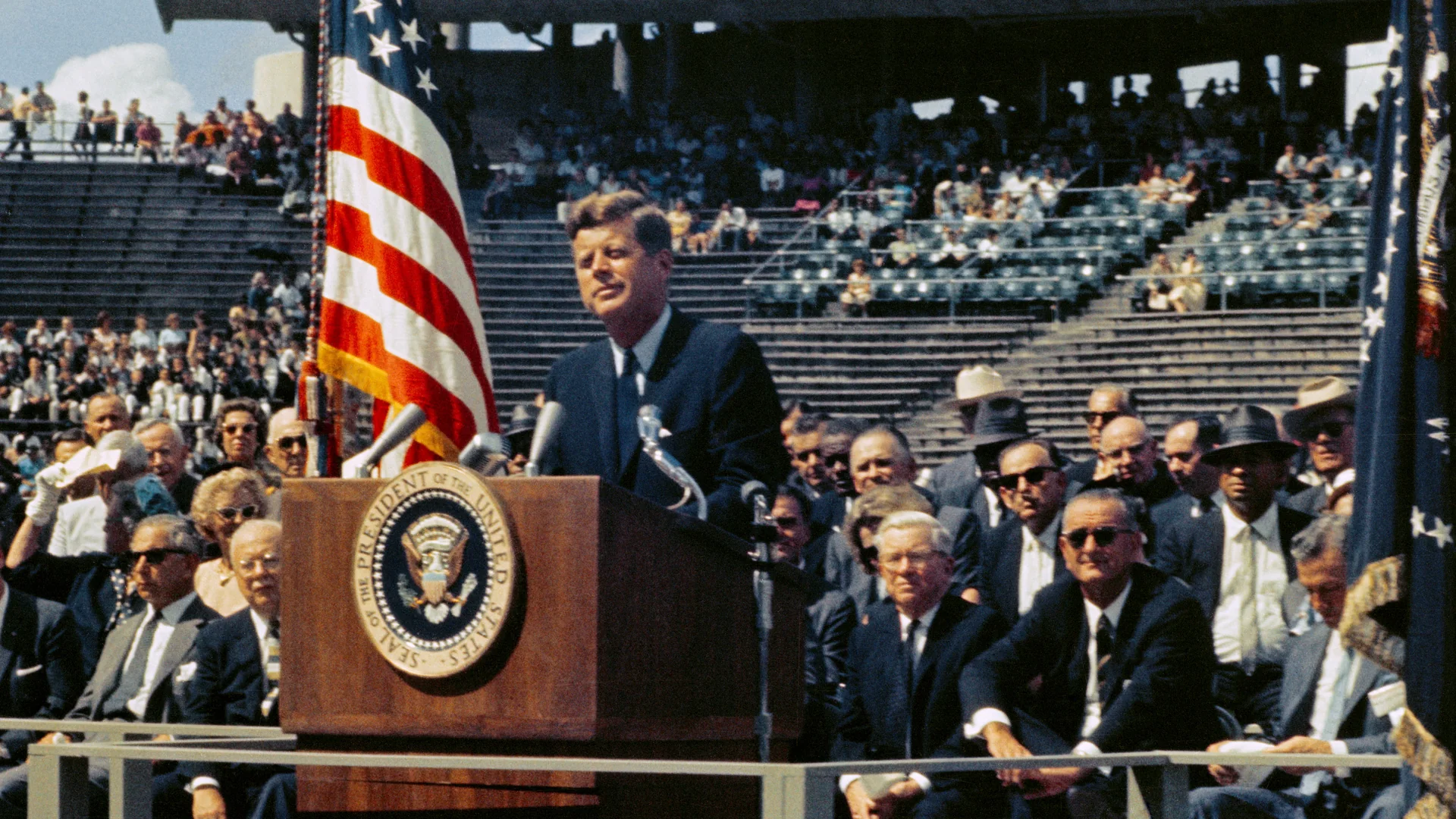
Kennedy speaking at Rice University in 1962. A photograph documents an appearance, not a cognitive test score. Photo from NASA on The Commons, no restrictions, via Wikimedia Commons.
0 The short answer
John F. Kennedy's IQ is reported as 119 by biographer Thomas C. Reeves, but an authenticated test report is not presented here. In his November 2006 History News Network commentary, Reeves says Kennedy obtained that score before entering Choate. The article does not supply the test edition, scoring table, administration record or original answer sheet. The appropriate label is therefore a reported historical result, not a verified modern assessment.
The much higher figure 159.8 has a different origin. It is one of the estimates in Dean Keith Simonton's 2006 presidential study, not a score Kennedy earned by taking that researcher's test. Neither number licenses a diagnosis or a numerical verdict on Kennedy's leadership. This page is a source audit, not a psychological assessment of him.
119
A school test result reported by Thomas C. Reeves, without the original test record reproduced in that commentary.
159.8
A statistical estimate in Simonton's research table, not an administered IQ result.
1957
The year of the Pulitzer Prize awarded to Kennedy for Profiles in Courage, documented by the prize organization.
The main distinction is between a reported test, a modeled estimate and a fabricated ranking. A number can be traceable without being a verified measurement. Conversely, a claim can be unsupported without proving that the person never took any test. Keeping these categories separate answers the search query more accurately than choosing the most impressive number.
Figure or claim
Identifiable source
Evidence class
Responsible interpretation
119
Reeves's 2006 commentary
Reported historical test result
Attribute the report to Reeves; the underlying protocol is not reproduced there.
159.8
Simonton, 2006, Table 1, II-C column
Historiometric estimate
Identify the model and column; do not describe it as an examination score.
174
A fabricated presidential list reproduced and criticized in 2001
Hoax claim
Evidence of a false story's circulation, not evidence of Kennedy's ability.
158
Repeated in some popular listings without a verified origin here
Unresolved attribution
Do not assign it to a test, a particular research column or the hoax without a source.
A precise current percentile
Requires a known scale and applicable norms
Not established
Historical numerals alone do not supply a contemporary reference distribution.
The hoax row can be traced to a contemporary Unit for the Study of Personality in Politics correction. That source reproduced the false list and explained why it should not be trusted. Its evidential role is narrow: it documents a misinformation episode. It does not authenticate every biographical assertion made elsewhere on the same page.
This matters because search results often collapse several different relationships into the phrase "JFK had an IQ of." A historian can report that a school recorded a result. A researcher can estimate an unobserved variable. A website can repeat a number. Those are different verbs, with different implications for what a reader can verify.
An evidence table should also preserve missing information. If the assessment date is unknown, the correct entry is unknown. If an edition is unconfirmed, it should not be filled in from the test brand most often mentioned online. Completing empty cells with plausible details creates the appearance of a better documented claim without adding evidence.
The broader presidential IQ overview addresses comparisons across officeholders. This page owns the narrower question of Kennedy's reported result and the sources behind the rival figures. The distinction prevents a biographical search from turning into an unsupported ranking of every president.
The same source hierarchy applies to Donald Trump IQ claims and Barack Obama IQ claims. Political approval should not determine the evidential threshold. A low claim about an opponent needs the same documentation as a high claim about an admired figure. Otherwise the number measures the publisher's preferences more clearly than the subject's cognition.
2 What does Reeves's account establish about the reported 119?
Reeves establishes an identifiable published attribution, while the original assessment remains a separate evidential question. He was a Kennedy biographer commenting on presidential intelligence research. That gives readers a named person and a recoverable text to inspect. It is stronger provenance than a list that merely places a number beside Kennedy's photograph.
However, a biographer's statement and a surviving score report are not interchangeable records. To authenticate a test result independently, a researcher would want the original document or a verifiable archival reproduction. The record should connect the person, assessment, date and scoring procedure. A reference to a book can guide that search, but it does not replace locating the relevant passage and checking what the passage actually supports.
Here, the defensible formulation stays close to the available evidence: a result is reported by a named author. We do not claim that this page has inspected Kennedy's completed test, established the exact date or reconciled its scoring convention with a current battery. This boundary is not a suggestion that Reeves must be wrong. It identifies what has and has not been independently checked.
A useful way to think about authentication is to imagine receiving a cropped school record. The first task would be to inspect the whole page. Is the numeral in a column headed IQ, percentile, achievement, grade equivalent or something else? Does the page contain an abbreviation requiring a key? Is it a result for the student, a comparison average or an admissions recommendation? A famous name does not resolve those questions.
The next task would be to establish provenance. Where is the document held? Who created it? Does its date match the student's enrollment? Is the image a complete scan or a transcription made much later? Those are ordinary historical questions before any psychometric interpretation begins. They protect against accidental mistakes as well as deliberate fabrications.
The JFK Library provides an accessible Choate scrapbook and album record for 1933 to 1935. It is a real archival collection item. Its existence does not turn it into an IQ report. Linking to an archive is useful only when the linked material supports the particular claim being made.
This is also why we avoid assigning a precise age to the reported assessment from general school chronology. "Before Choate" is a relative description. Converting it into a specific test day, test form or age in months would require additional evidence. Small invented details are especially hazardous when readers later use them to reconstruct a scoring formula.
If an original report becomes publicly available, the account should be updated. A responsible revision would identify the archive, reproduce only permissible material, state the edition and norms, and separate the old result from any modern interpretation. Evidence can improve without requiring either uncritical acceptance or categorical rejection today.
3 Was Kennedy's test an Otis group assessment?
An Otis attribution appears in historical commentary, but it does not establish the exact instrument administered to Kennedy. The contemporary correction discussed above names an Otis test. Reeves's short commentary does not supply a corresponding manual, form or record. We therefore describe the attribution while keeping the instrument details unresolved.
There was a real family of Otis assessments. A digitized bibliographic record identifies Arthur S. Otis's 1918 manual for primary and advanced examinations. The existence of that manual provides historical context. It does not prove that a particular later student received that edition, those norms or that reporting scale.
This distinction becomes clearer when a test name persists over time. Publishers can revise instructions, materials, score conversions and reference groups while retaining a recognizable family name. Someone saying "an Otis test" may therefore have identified a product family without identifying the version needed to interpret an individual result. Exactness about the label must come from the record.
Group administration means several examinees can work under a shared set of instructions. Individual administration means an examiner works with one person, following the procedure of that instrument. Neither description, by itself, tells you whether a score is valid for a particular use. The relevant questions concern standardization, content, norms and administration quality.
A group test can be carefully standardized and informative. An individual test can be mishandled. Conversely, an individually administered assessment can provide observations and a broader profile that a brief school screening does not provide. These are practical differences in the available evidence, not grounds for dismissing every old school assessment as meaningless.
Reading demands also matter. A task with written instructions samples performance through language and schooling as well as its intended reasoning demands. An examiner must interpret a result in relation to the instrument's intended population. We cannot reconstruct Kennedy's experience from a modern description of what group testing usually looks like.
The history of IQ testing explains why product names and scoring conventions changed across the twentieth century. For this case, the operational conclusion is specific: do not call the reported result a WAIS score, do not invent an Otis edition, and do not reproduce purported test items as if they were known to have been administered to Kennedy.
If the school result is eventually authenticated, its historical purpose will matter too. Was it used for placement, counseling, admission or a broad educational survey? A score should be interpreted in relation to what its developers and users were trying to learn. It need not answer every later question that a celebrity biography creates.
4 Can 119 from an old report be converted into a modern IQ?
A historical numeral cannot be converted responsibly until its original scale and reference group are known. Some early uses of IQ depended on a ratio involving mental age and chronological age. Modern deviation scores generally express position relative to an age appropriate reference distribution. The shared abbreviation does not make those procedures identical.
Lewis Terman's 1916 account of intelligence measurement is a primary historical source for ratio IQ and its interpretation. It also contains language and assumptions that should not be adopted as current guidance. Reading a historical manual helps identify what a number meant in that system; it does not require endorsing the manual's broader social conclusions.
The mental age explanation describes the underlying distinction. A ratio compares two age quantities under a particular developmental model. A deviation score compares performance with a reference distribution. Converting one into the other is not simply changing the label printed beside the number.
Suppose, as an explicitly hypothetical example, an adult has a verified score of 119 on a modern scale with mean 100 and standard deviation 15. The standardized distance would be 19 divided by 15. A normal curve calculator could then estimate the corresponding percentile. That calculation would describe the stipulated modern scale. It would not establish Kennedy's historical percentile, because the required assumptions have not been supplied for his reported result.
This is the difference between correct arithmetic and justified interpretation. A calculator can produce an accurate answer to the inputs it receives. It cannot determine whether a historical score actually used those inputs. The guide to norming IQ scores explains why the reference group is part of the result, rather than an optional footnote.
Norms also change over time. Pietschnig and Voracek's 2015 meta-analysis examined secular changes in cognitive test performance. Its findings concern groups, periods and abilities. They do not provide a personal adjustment that can be added to or subtracted from every historical individual's score.
An automatic correction would require unjustified assumptions about the original test, the relevant population, the time interval and the way cohort change applies to one person. Multiplying a broad average trend by decades does not solve those problems. It can instead produce a very precise looking answer to a question the available data cannot identify.
The Flynn effect guide treats norm drift as a measurement issue. It should not be used to announce what Kennedy "would score today." That counterfactual would require a living examinee, a specified current test and a real administration, not a formula applied to a biographical sentence.
5 How did Simonton's 159.8 estimate enter the discussion?
Simonton's figure comes from a research model that reconstructs missing historical values, not from Kennedy completing an IQ battery. The study covered 42 presidents. It combined earlier IQ estimates with ratings of intellectual brilliance and openness, then used missing data methods. Table 1 contains four IQ columns. For Kennedy, the II-C column gives 159.8. The paper itself describes the reconstructed IQ values as tentative and approximate.
These methodological facts identify what the result is. They do not settle whether every assumption in the model is persuasive. They also explain why the publication should not be represented as a newly discovered school report. Statistical reconstruction and archival authentication answer different questions.
Consider a general example unrelated to Kennedy. A dataset might contain a historical reputation rating for one person and an estimated childhood ability rating for another. A model can use relationships among variables to fill empty cells. The completed table is useful for exploring the model's implications, but the filled cells remain estimates. They do not become observations merely because every row now has a number.
This is especially easy to miss when a result has a decimal place. Decimal precision reflects the output format of a calculation. It does not guarantee that the underlying evidence supports tenth of a point distinctions between historical individuals. An estimate reported as 159.8 can be less directly observed than an imprecise qualitative statement based on a contemporaneous document.
Readers should also distinguish a research question about group relationships from a question about one person's exact score. A model can investigate whether historical ratings covary across leaders without establishing a clinical result for each leader. Whether the group analysis is useful requires examining its assumptions and evidence. Individual authentication is a further requirement.
The number should therefore travel with its method. An honest caption would call it a historiometric estimate from a specified column. Removing that phrase and retaining only "Kennedy IQ 159.8" changes the claim. The source then appears to support a stronger assertion than its design produced.
Nor should the reported school result and the model output be averaged. Their difference is not simply disagreement between two equivalent test administrations. They have different origins, missing information and intended interpretations. Averaging them would create a third number with no validated procedure behind it.
The related Napoleon IQ evidence audit shows another form of retrospective rating. The Christopher Hirata IQ article addresses a different source trail involving a living scientist and a widely repeated claim. These cases share a need for provenance, but their evidence should not be blended into one universal celebrity scoring method.
The fabricated presidential ranking is a separate misinformation episode and should not be confused with scholarly historiometry. In August 2001, the Unit for the Study of Personality in Politics published a correction identifying the supposed Lovenstein Institute report as a hoax. Its preserved version assigns Kennedy 174. That is the figure associated with the reproduced false list, not proof of a measurement.
This also corrects an easy source error: 158 should not automatically be called the hoax value. Numbers can circulate through unrelated lists, rounded estimates and copied pages. Unless a particular version is inspected, it is safer to leave its provenance unresolved than to attach it to the nearest famous misinformation story.
The distinction between fabrication and estimation is equally important. A legitimate research paper can use debatable assumptions without being the same thing as an invented institution and an invented study. Conversely, identifying a real paper does not turn its modeled estimates into test results. Critical reading requires more categories than simply true and fake.
A practical check begins with the institution and the publication. Can a reader identify the organization, the investigators and the original document? Does the claimed method explain how the number was obtained? Is there evidence that the individual actually completed an assessment? Those checks should precede discussion of whether the result sounds plausible.
Familiarity is a poor substitute for that process. Seeing the same list on several websites may feel like confirmation, but the pages can share a single source. Independent corroboration requires independent evidence. Repeating a claim does not increase the number of original examinations or archival records behind it.
The political context can make the problem harder. A flattering result fits admiration; an insulting result fits hostility. Both create an incentive to stop checking too early. A source standard should be chosen before looking at whether the number supports one's view of the president.
The Joe Biden IQ audit and JD Vance IQ audit concern other political claims. Their purpose is not to award cognitive points by party. The transferable habit is to ask what kind of evidence a number represents and to preserve that label when summarizing it.
For Kennedy, the correction is straightforward. Keep the reported school claim, the research estimate and the fabricated list in separate rows. Explain what each source actually contains. Do not manufacture a single consensus IQ by combining their numerals or by counting how many search results repeat them.
7 What do Kennedy's school and university records show?
Educational records describe achievements and circumstances that can be investigated without converting them into an IQ score. The JFK Library's biographical account describes his Choate schooling, interests in history and English, Harvard education and the thesis that became Why England Slept. It records his Harvard graduation in 1940. These are biographical facts with a different evidential purpose from a standardized assessment.
The distinction prevents two opposite mistakes. One is to assume that an elite institution guarantees a particular IQ. The other is to treat uneven school performance as proof of low ability. Neither follows from the name of the school or from a short narrative about classroom habits.
A transcript measures performance under the requirements of particular courses. A thesis demonstrates work on a particular subject. An admission decision reflects an institution's process. An IQ assessment samples specified cognitive tasks under its own conditions. These records can be related, but no single one automatically supplies the others.
Historical interpretation also requires attention to selection. A boarding school class and an entire age cohort are different comparison groups. Finishing in the middle of a selected class does not mean finishing in the middle of the general population. Equally, admission to a selective class does not establish a precise population rank for every admitted student.
One can ask concrete questions about a piece of academic work: What problem did it address? What sources did it use? How were competing explanations handled? Which passages show independent analysis? Those questions produce a more informative account than treating the existence of the work as an indirect score report.
They also allow evidence to remain mixed. A student may produce thoughtful work in one subject while showing inconsistent engagement elsewhere. That observation does not require inventing a domain profile. Without suitable subtest data, it would be inappropriate to assign Kennedy a verbal index or a working memory index from school anecdotes.
The cognitive domains overview explains why a composite is not a description of every skill. However, the framework should not be applied retrospectively by matching each favorite subject to a modern score. A historical interest in government does not identify a numerical index. A poor mark in another course does not diagnose a cognitive weakness.
The useful outcome is a fuller historical picture with explicit boundaries. Educational evidence can support claims about study, interests and completed work. It does not need an invented conversion into modern IQ to remain relevant or impressive. The questions it cannot answer should remain open rather than being filled with a celebrity number.
8 Does the Pulitzer Prize establish Kennedy's intelligence?
The Pulitzer establishes an award, not an IQ measurement or a complete account of authorship. The Pulitzer organization's official record identifies Profiles in Courage as the 1957 Biography winner under Kennedy's name. That is the primary source for the award claim. It is not a psychometric report.
Authorship is a further historical question. A prize entry tells a reader who received the award, but not necessarily who performed every stage of research, drafting and editing. For a work produced with assistance, understanding the contributors matters. The evidential task is to identify drafts, correspondence and attributable accounts, rather than assuming either total solitary authorship or complete noninvolvement.
Reeves's commentary raises the role of Ted Sorensen. That is a reason to investigate the production history, not a reason to adopt every judgment in a polemical essay. This page does not assign a percentage of authorship, because doing so would require a separate, documented analysis of the surviving materials.
The same restraint applies to intelligence claims drawn from any collaboratively produced work. Editors can improve organization. Researchers can locate documents. Advisers can challenge arguments. The final product may therefore contain contributions from several people. Its quality is not a standardized measurement of each contributor's cognitive ability.
Nor does collaboration make the final work meaningless. Political and scholarly work often involves teams. The question is what the individual contributed and what the evidence shows. Treating all assistance as disqualification is as simplistic as attributing every sentence to the person named on the cover.
A useful comparison is a scientific article with several authors. The publication establishes that the work exists and credits the listed contributors. It does not tell a reader each author's IQ, private division of labor or score on an unrelated examination. Additional evidence is needed for each additional claim.
The guide to IQ and success discusses why achievements cannot be reduced to one cognitive number. In Kennedy's case, the award belongs in the documented biographical record. It should neither be converted into a score nor used as a reason to dismiss a reported school result simply because that result feels insufficiently prestigious.
A careful account can therefore hold several propositions at once: the award is documented, the work's production history deserves specific sources, and none of those facts establishes a modern IQ. That is a more accurate reading than using literary recognition as a shortcut to either admiration or debunking.
9 Can a famous speech reveal a president's IQ?
A speech provides evidence of public communication, while its delivery does not reveal an IQ score. The JFK Library preserves the Rice University address of September 12, 1962. The hero photograph on this page depicts that occasion. A transcript and recording allow readers to examine the argument and performance directly.
That direct evidence is valuable, but its scope must be respected. A prepared speech can involve research, drafting, rehearsal and advice. Its successful delivery may demonstrate skill in communicating to an audience. It does not reproduce the conditions of a standardized cognitive assessment or separate the contributions of every participant in its preparation.
An unscripted answer raises different questions but does not remove the problem. Responses are affected by the question, the available information and the setting. A difficult interview can expose uncertainty about a topic; a familiar question can invite a polished answer. Neither provides the controlled sampling needed to assign a score.
The problem is clearest when only a short clip is available. The editor chooses the beginning, the ending and the surrounding context. A sequence of fluent moments can create one impression; a sequence of pauses can create another. Without the full material, viewers may be evaluating the selection process as much as the speaker.
Even a complete speech cannot measure every domain. Spoken argument does not directly test visual spatial processing, timed symbol search or the other tasks that a broad battery might include. Using eloquence as a substitute for the entire profile silently changes the construct being discussed.
A more useful reading of the Rice address asks how it frames a public goal, connects costs to commitments and addresses its audience. Those are questions about rhetoric and political communication. They can be answered by analyzing the text. They do not require a conversion table from memorable sentences to IQ points.
The same reasoning explains why jokes, verbal slips and debate highlights should not become informal diagnostic instruments. They are observations made in particular contexts. Calling them a test does not standardize them, provide norms or demonstrate that the proposed inference is valid.
The broader celebrity IQ source guide addresses the temptation to transform visible talent into a universal number. Kennedy's communication skills can be studied on their own terms. Preserving that distinction produces a more informative account of the speech and a more honest account of what remains unknown.
10 What could one school score predict about a presidency?
A single historical school result cannot establish the causes of a later presidency's successes or failures. Prediction requires a defined outcome, a relevant comparison group and evidence connecting the measure to that outcome. Simply observing that a person later held office does not reveal how much a particular childhood score contributed.
The outcome itself is not one thing. Electoral success, legislative negotiation, crisis management, administrative judgment and ethical conduct are different questions. A number associated with cognitive performance cannot be assumed to answer all of them. The connection must be demonstrated for the interpretation being proposed.
Time introduces further complications. A school assessment samples performance at an earlier stage under particular conditions. Later work involves acquired knowledge, experience, collaborators and institutional constraints. This does not mean cognitive measures are irrelevant to adult life. It means a precise claim about an individual's political career requires more than the existence of an old score.
There is also a difference between explaining and predicting. After an event, many biographical details can be selected to fit the outcome. A persuasive story assembled afterward is not automatically a validated predictive model. To establish prediction, one would need to define the procedure in advance and examine how well it works beyond the examples that inspired it.
The Standards for Educational and Psychological Testing frame validity around proposed score interpretations and uses. That principle matters here: evidence supporting a school placement use would not automatically establish a claim about presidential judgment decades later. A new use needs its own justification.
It is equally mistaken to use one leader as a verdict on intelligence testing as a whole. If someone with an apparently ordinary result achieved something exceptional, that case would not prove all cognitive measurement useless. If someone with a high result made serious mistakes, that would not mean the measurement had promised infallibility. Those conclusions ask a test to guarantee outcomes it does not define.
A more modest use of the historical claim is to resist simplistic narratives. Political accomplishment does not require every attractive biographical number to be true. An unflattering anecdote does not establish incapacity. A complex career can contain skill, error, opportunity and constraint without being reducible to a score.
For this reason, the article does not decide whether Kennedy was a good president from the reported result. That historical and political assessment requires evidence about decisions and consequences. Cognitive testing terminology should clarify the limits of a claim, not provide a numerical shortcut around the substantive debate.
11 Can you compare your score with JFK or Nixon?
A meaningful personal comparison requires comparable measurements, which the available Kennedy evidence does not provide. Your current report may name a test, an edition, a norm group and a confidence interval. A reported historical result with unresolved details does not offer the same information. Placing both numerals in one chart does not repair that mismatch.
The Kennedy versus Nixon question adds another layer. Historical commentary reports numbers for both men, but a fair comparison would require establishing each source and instrument independently. A larger reported numeral does not by itself establish an equivalent difference on a shared modern scale. This article does not authenticate a Nixon protocol or construct a two person ranking from those reports.
The interpretation of a score near 120 can explain a verified contemporary result under specified assumptions. It cannot certify a famous person's historical measurement. Likewise, a percentile calculator is a tool for understanding an input score, not a method of validating the input's biography.
If you use the IQ percentile calculator, enter the scale that belongs to your own assessment. Read its output as a model based interpretation, and compare it with the test publisher's report where one exists. Do not treat agreement with a celebrity number as additional evidence that your score is accurate.
Small score differences should also be interpreted in light of uncertainty. Two reported results can differ because of measurement error, different content or different administration conditions. Without knowing the relevant evidence, it is unwise to treat every point as a meaningful ranking. This is a general measurement issue even when both people are living and both tests are documented.
The personal purpose matters more than the historical comparison. If you want to understand your strengths, a domain profile may answer a more useful question than whether a composite exceeds a famous claim. If you need an assessment for a formal decision, the receiving organization determines what documentation it accepts. A celebrity benchmark contributes little to either purpose.
The reliability and validity guide explains why consistency and justified interpretation are separate considerations. A repeatable score can still be used for an unsupported comparison. Conversely, a careful statement of uncertainty can make an assessment more useful by preventing it from being asked to answer the wrong question.
Kennedy is an interesting historical subject, but he is not a norm group. Your result should be interpreted against the appropriate reference data and the purpose of your assessment. That provides a defensible comparison without requiring anyone to invent the missing details of a president's school record.
12 What should a current assessment offer instead?
A useful current assessment should explain what it measures, how its scores are interpreted and where its claims stop. The starting point is the reader's purpose. Curiosity about current performance, a clinical question and an organization's formal documentation requirement are different uses. The same product need not satisfy all of them.
We sell ACIS, a paid online assessment, so this recommendation carries a commercial interest. ACIS is self-administered and is not a clinical diagnostic instrument. Its technical manual describes the Full Scale form's 20 subtests and six primary domains. Readers should consult that documentation before deciding whether the assessment fits their question.
The relevant benefit is a documented account of your own performance. It is not a claim that you have been tested on the same instrument as Kennedy, that a result establishes political aptitude, or that a high score creates a biographical equivalence. Those promises would exceed the evidence.
Before choosing any assessment, check the intended age range and language, the form you will complete, the reporting scale and the available evidence. Ask whether the product reports only one composite or also provides information about the tasks contributing to it. Look for a clear explanation of uncertainty rather than an unexplained number with an impressive label.
Administration conditions deserve attention too. Follow the published directions, use the required environment and record any meaningful interruption. If the procedure was substantially altered, that limitation belongs with the interpretation. A number is not made comparable simply by appearing in a professional looking report.
For a clinical concern, consult an appropriately qualified professional. For admission, accommodations or another formal use, ask the receiving body which assessments and reports it accepts before paying. ACIS does not promise those uses here. That boundary is part of choosing the correct service for the actual question.
The APA Ethics Code includes standards for assessment practice. Together with the testing Standards, it supports an approach that attends to evidence, purpose and interpretation. Referencing these documents is not a claim that they endorse ACIS or certify an article about Kennedy.
The lasting lesson from the JFK question is practical. Preserve the name of the source, identify the type of number and resist converting missing information into precision. A well documented current assessment can answer questions about your own performance. It cannot recover a president's unobserved score, and it does not need to do so to be useful.
The sources below support specific historical or measurement claims, not an assessment of Kennedy by ACIS. Research and archival links were checked on September 24, 2026. The original school test protocol was not authenticated in this review. The distinction between a reported score and an inspected record remains explicit.
Thomas C. Reeves. Presidential IQ. History News Network, November 6, 2006. Primary published attribution of the reported school result.
Unit for the Study of Personality in Politics. Election 2000 Reporters' Tipsheet. Correction dated August 6, 2001. Contemporary documentation of the Lovenstein hoax and its reproduced list.
Lewis M. Terman. The Measurement of Intelligence. Houghton Mifflin, 1916. Primary historical account of ratio IQ; historical terminology is not adopted as current guidance.
John F. Kennedy Presidential Library and Museum. Life of John F. Kennedy. Institutional biographical account of schooling, Harvard and Why England Slept.
American Educational Research Association, American Psychological Association and National Council on Measurement in Education. Standards for Educational and Psychological Testing. 2014. Guidance on evidence supporting score interpretations and uses.
JFK's IQ is reported as 119 by biographer Thomas C. Reeves. The commentary providing that attribution does not reproduce the original assessment record. A higher figure, 159.8, comes from a statistical historical estimate rather than an administered test, so the numbers should not be treated as interchangeable results.
Did John F. Kennedy really score 119?
Reeves reports that Kennedy obtained 119 before entering Choate. That is an identifiable attribution, but this review did not authenticate the underlying test protocol. The careful wording is a reported historical result, with the original instrument details and scoring context still requiring verification.
Was Kennedy's IQ 159.8?
The figure 159.8 appears in one column of Dean Keith Simonton's 2006 presidential research table. It is a modeled historiometric estimate. Kennedy did not complete a test for that study, and the decimal should not be interpreted as precision established by an individual assessment.
Was JFK's IQ 174?
The figure 174 appears in a fabricated presidential ranking circulated in 2001. A contemporary correction preserved that list and identified the supposed report as a hoax. It is evidence about the spread of a false story, not evidence of Kennedy's measured ability.
Where does the JFK IQ claim of 158 come from?
This review did not verify a specific original source for 158. It should not automatically be attributed to a test, Simonton's table or the presidential hoax. A page repeating that number needs to identify the actual source and method before the claim can be interpreted responsibly.
Did Kennedy take an Otis intelligence test?
An Otis attribution appears in historical commentary about his reported score. However, the exact edition, form and norm table were not authenticated here. Otis was a real test family, but identifying that family does not establish the details of a particular assessment.
Was JFK the smartest American president?
The available evidence does not establish a precise cognitive ranking of American presidents. Historical reports and statistical estimates differ in method and documentation. Evaluating Kennedy's decisions, writings or leadership requires relevant historical evidence rather than selecting the largest number from a presidential IQ list.
Is 119 about the 90th percentile?
It is approximately that position under a modern normal model with mean 100 and standard deviation 15. That conditional calculation does not establish Kennedy's historical percentile. His reported result would require a verified instrument, scale and reference group before such a conversion could be justified.
Can the Flynn effect update Kennedy's score?
No validated personal update is established by applying a general cohort trend to his reported score. Secular changes differ across periods, populations and abilities. An old numeral with unresolved test details cannot be converted into a current result by adding or subtracting a fixed amount per decade.
What is a historiometric IQ estimate?
A historiometric estimate uses historical records and a stated analytical method to infer an unobserved quantity. It can be part of legitimate research, but it is not an examination taken by the person. The assumptions and uncertainty should remain attached whenever its numerical output is reported.
Did Kennedy win a Pulitzer Prize?
Yes. The Pulitzer organization's official record identifies Profiles in Courage as the 1957 Biography winner under Kennedy's name. That establishes the award. It does not measure IQ or, by itself, identify the contribution of every person involved in researching, drafting and editing the book.
Did Kennedy write every word of Profiles in Courage?
The award record does not answer that question. Establishing the division of work requires drafts, correspondence and attributable accounts of the book's production. This article acknowledges the authorship issue without assigning an unsupported percentage or treating collaboration as a cognitive score.
Did Kennedy graduate from Harvard?
Yes. The JFK Library's biography records his Harvard graduation in 1940 and describes the thesis that became Why England Slept. Those are documented educational achievements. A university degree and a published thesis do not supply a precise IQ score or a modern cognitive profile.
Does the Rice University speech prove a high IQ?
The speech documents public communication on a specific occasion. It can be analyzed for argument, structure and delivery, but it was not a standardized cognitive assessment. Preparation, collaboration and the audience's response cannot be converted into a numerical IQ through the transcript alone.
Was Nixon more intelligent than Kennedy?
A numerical comparison is not established by placing reported historical scores side by side. Each result would need independent authentication and comparable scoring information. Differences in instruments, norms and administration prevent a simple conclusion, while political judgment and accomplishment require their own evidence.
Can I compare my IQ with JFK's reported score?
You can notice the numerals, but a defensible measurement comparison is not available from the historical claim alone. Interpret your result against your assessment's reference group and uncertainty. A president with an incompletely documented score is not an appropriate substitute for a norm group.
Does a school IQ score predict political success?
A school result alone cannot establish the causes of an individual's later political career. Prediction needs a defined outcome and evidence for the proposed use. Political work also involves experience, collaborators, institutions and circumstances, which cannot be recovered from one historical numeral.
Why not average 119 and 159.8?
They are not two equivalent measurements of the same kind. One is a reported school result with unresolved details, and the other is a statistical reconstruction. Their average would create a new number without a validated interpretation or an original assessment behind it.
What evidence would improve the account?
An authenticated original record identifying Kennedy, the assessment date, instrument, edition and scoring convention would improve the historical test claim. A complete archival citation would let readers inspect its context. Modern interpretation would still require understanding the old norms and the limits of comparison.
Can ACIS diagnose Kennedy or reconstruct his IQ?
No. ACIS does not assess Kennedy through this article and cannot recover an unobserved historical score. It is a paid online, self-administered assessment for current users, with stated limits. Its results should be interpreted for the person tested and the purpose described in its documentation.
What should I check before taking an IQ assessment?
Check the intended age range, language, administration instructions, norms, reporting scale and evidence supporting your intended use. For clinical or formal requirements, confirm which professional assessment the receiving body accepts. A documented current result is more useful than comparison with an uncertain celebrity number.
Take the assessment
You get a profile, not a number
ACIS measures six CHC domains across 20 subtests and reports each one with its own normed score and confidence interval, so you can see where you are strong and where you are not.