Christopher Hirata IQ: tracing 225 and the documented science
This page does not assess Christopher Hirata or assign him a new IQ. It traces the widely repeated number 225 to an identifiable contemporary report, examines what that report leaves unspecified, and separates the claim from the degrees, research, and scientific recognition that can be documented independently. A remarkable career deserves a more precise account than an unsupported leaderboard position.
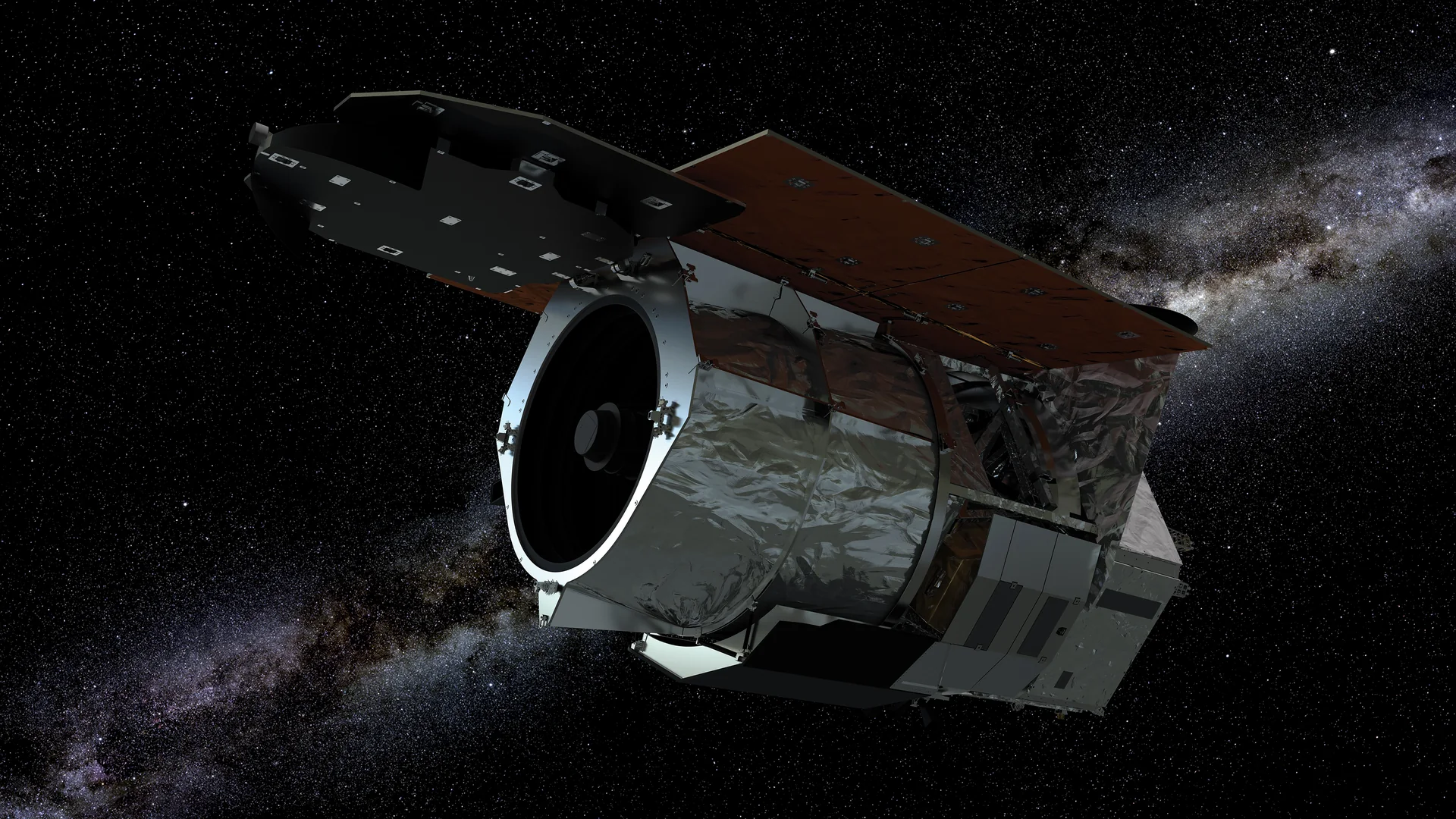
Artist's illustration of the Nancy Grace Roman Space Telescope, formerly WFIRST, a project connected to Hirata's documented cosmology work. Image: NASA and NASA GSFC, public domain, via Wikimedia Commons.
0 The short answer
Christopher Hirata is widely credited with an IQ of 225, but the source located here reports an estimate rather than an identifiable test result. A 2001 Daily Princetonian profile uses the wording “estimated to be around 225” without naming a test, edition, scale, or examiner. His scientific achievements have a separate documentary record. Treat 225 as an attributed estimate, not a verified modern deviation IQ or proof of a world ranking. The distinction also governs the broader highest IQ claims review.
2001
Year of the contemporary Princeton student newspaper profile located for the 225 attribution.
2005
Physics PhD year listed by Ohio State University, following a Caltech BS in 2001.
2018
Award year of Hirata's New Horizons in Physics Prize in the official laureate record.
The number has an identifiable early published attribution, but attribution and verification are different steps. The Daily Princetonian profile matters because it is contemporary reporting about Hirata as a young graduate student, rather than a recent list assembled from other lists. It establishes that the claim was circulating in that setting in 2001. It does not establish the assessment procedure from which the number arose.
The distinction can be stated without accusing the subject or the reporter of dishonesty. A feature writer can repeat a number supplied in background material without publishing the documentation a psychometric interpretation would require. That may be adequate context for a human interest story. It is not enough to calculate a defensible percentile on a specified adult scale decades later.
What is missing is specific: the instrument, edition, administration date, age at testing, raw or composite score, reference population, and scoring convention. A named examiner or an authorized report could help establish provenance. None of those details should be supplied by guessing from the subject's age or achievements. In particular, the magnitude of a number does not prove that it must have been a ratio IQ.
This review found a 2001 attribution; it does not claim to have found the first occasion on which anyone said 225. Establishing the first occurrence would require a broader archival search and a clear definition of publication. A dated example establishes a lower bound on how long a claim has circulated, not its original source or its accuracy.
There is also a distinction between what someone has said about a person and what that person has publicly claimed. The report does not authorize us to recast the number as Hirata's own assessment of himself. Keep the attribution attached to the reporting source unless a direct statement is available. That protects the record from acquiring a stronger claim each time it is summarized.
The guide to celebrity IQ evidence applies the same rule to other names. A page should retain words such as reported, estimated, or attributed when those words describe the evidence. Dropping them from a headline may make a claim sound decisive, but it also changes what the source actually supports.
2 What is documented, reported, and still unknown?
The strongest available evidence concerns education and scientific work, while the psychometric details behind 225 remain unspecified. An evidence table is useful because it prevents the uncertain claim from borrowing authority from well documented achievements. A university can confirm a degree. A prize organization can confirm an award. Neither confirmation supplies a missing intelligence test report.
Claim
Evidence class
What the source establishes
The IQ number 225 appeared in a contemporary profile
Reported attribution
The existence of the published estimate
Caltech BS in physics, 2001
Documented institutional record
A completed degree and its year
Princeton PhD in physics, 2005
Documented institutional record
A completed doctorate and its year
New Horizons in Physics Prize, 2018 award year
Documented award record
Recognition by the named prize body
A modern deviation IQ of exactly 225
Not verified by the sources inspected
Test, norms, scale, and report remain unspecified
A world rank based on that number
Unsupported comparison
Comparable measurements across candidates are absent
The Ohio State faculty record lists the degrees and describes his research. It is an appropriate source for those institutional facts. It is not a psychological report, and this article does not treat it as one. Its purpose is to describe a scientist's professional record.
Evidence classes can change if better documentation becomes public. If an authorized report were supplied, the next task would be to interpret the named instrument and its scoring conventions. It would not automatically settle every comparison with other people or other tests. Verification of one score and comparability across scores remain separate questions.
An honest audit also avoids overstating the negative. We have not verified a public test report in the sources reviewed. That is narrower than saying no test ever occurred, no private record exists, or the numerical claim has been disproved. A missing public document does not justify those universal assertions.
For the reader, the practical benefit is clarity about which question has been answered. The record can establish that Hirata was an unusually accomplished young physicist without settling his percentile on an unnamed battery. The lack of a verified number does not diminish the documented work. It simply prevents a separate, more specific statement from being presented as if it had already been measured.
3 What does the education record show?
The institutional record supports unusually early advanced study without requiring an inferred IQ. Caltech's June 2001 profile describes Hirata graduating at 18 after entering at 14. Ohio State lists the subsequent Princeton doctorate in 2005. These are concrete educational milestones with sources close to the institutions involved.
The Caltech account also describes his participation in academic and campus activities. For this review, the important point is the type of evidence: an institution reporting on a student it taught. Such evidence can support statements about what he completed and when. It cannot be converted into a standardized score by assigning an IQ to each year of educational acceleration.
Acceleration is a relationship between a learner and a curriculum. It depends on readiness, prior knowledge, institutional decisions, and available opportunities. Completing advanced material early is evidence of achievement under those conditions. It is not a measurement of every cognitive domain, and it is not a direct substitute for a population norm table.
The same distinction applies to grades. A grade is awarded within a course or program using its assessment rules. It can be highly informative about mastery and performance. There is no universal formula that turns a university grade point average into an IQ, because courses, grading systems, selection, and preparation differ. The IQ versus academic achievement discussion addresses a related distinction between correlated measures and interchangeable scores.
Caltech's later account of undergraduate research participation documents a 1999 research project with Fiona Harrison. That adds a different kind of achievement evidence: engagement in research during undergraduate study. It should be described as the documented project, not expanded into a claim that Hirata single-handedly solved a space mission or directed a research program at an invented age.
A useful biographical account therefore keeps dates and roles attached to their sources. It distinguishes enrollment from graduation, student research from project leadership, and a quoted recollection from an institutional record. These are small distinctions, but they are exactly where extraordinary biographies often acquire embellishments as they are repeated. Precision respects the achievement more than an inflated number does.
4 What did the New Horizons prize recognize?
The award recognized contributions to physics and cosmology, not an intelligence test result. The official 2018 laureate list includes Christopher Hirata among the New Horizons in Physics Prize recipients. Ohio State's announcement was published in December 2017, explaining why both years can appear in accounts without referring to different prizes.
The university announcement describes work on early galaxy formation and methods for precision cosmology. It places theoretical reasoning alongside computation, observation, and statistics. Those are descriptions of scientific contributions and professional practice. They do not report a standardized cognitive profile.
An award can be strong evidence of peer recognition in a field. It is still not a common metric for comparing the general intelligence of every scientist. Prize criteria can concern originality, impact, a particular discovery, or a stage of career. Two awards may recognize different accomplishments, and many valuable contributions never receive a prize at all.
The category also matters. A New Horizons in Physics Prize is not a Nobel Prize, and it should not be described as one. Both are scientific honors, but they have different organizations and rules. Replacing a specific title with a more famous one would make a biographical paragraph easier to recognize at the cost of accuracy.
For a reader interested in why Hirata is respected scientifically, the next step is to examine the work and its reception. Which problem did a paper address? What method did it introduce or improve? What evidence supported its conclusions? How did later researchers use or test it? These questions provide a richer account than treating a prize as a certificate for a predetermined IQ number.
The relationship between IQ and achievement is a research question about patterns across people. An individual prize cannot answer it by itself. Conversely, the existence of group associations does not let us work backward from a prize to a precise personal score. That would require a validated prediction model with appropriate uncertainty, not a celebrated example selected after the outcome was known.
5 How is Hirata's work connected to the Roman telescope?
The connection is documented through cosmology research and survey planning, not through a story about one prodigy building a telescope alone. A 2017 WFIRST science team report, posted in 2018 with Hirata among its authors, discusses the High Latitude Survey cosmology program. WFIRST is the former name associated with what is now the Nancy Grace Roman Space Telescope.
NASA's explanation of weak lensing describes how small changes in the apparent shapes of distant galaxies can reveal intervening matter. The signal requires statistical analysis across many observations and careful control of instrumental effects. That is a concrete example of why theoretical physics, data analysis, and measurement design can matter together in cosmology.
The NASA overview of dark energy investigations explains the broader goal of using observations to understand cosmic expansion. A project of this kind involves teams, instruments, data processing, and several complementary methods. Attributing the entire mission to one person would obscure both the scientific process and the documented roles.
This connection also explains the supplied hero image. It is an artist's illustration of the telescope, not a photograph of Hirata and not an image of an intelligence test. Its relevance is his research context. The caption should make that relationship explicit so that a reader does not mistake an illustration for evidence about the score claim.
Mission schedules change, so an old faculty page's projected launch year should not be repeated as if it were a verified current event. This article does not need a launch prediction to establish the research connection. The dated report and institutional descriptions are sufficient for the narrower claim. Keeping the claim narrow avoids making a durable biography depend on a schedule that can change.
For understanding intellectual work, the important feature is the chain from a question to a method and then to evidence. A scientific contribution can be evaluated through that chain. A celebrity IQ attribution often lacks its equivalent chain from tasks to scores to norms. Putting the two side by side shows why the research record can be strong while the numerical psychological claim remains unverified.
6 Could 225 be a ratio IQ rather than a deviation IQ?
It could refer to a different scoring convention, but the size of the number does not identify that convention. A historical ratio IQ compares an estimated mental age with chronological age and multiplies the ratio by 100. A deviation IQ describes relative performance in a reference distribution. The shared letters IQ do not make those procedures interchangeable.
In a purely hypothetical ratio calculation, a mental age 2.25 times chronological age would produce 225. That arithmetic illustrates the definition; it is not a reconstruction of Hirata's testing history. We have no basis in the located report for assigning a mental age, a chronological age at testing, or a particular test edition to the claim.
Terman's 1916 book is a primary historical source for early quotient based testing. Reading it also makes clear how much the terminology and framework differ from a contemporary adult report. The article on mental age explains why that older concept cannot simply be extended into a universal adult ranking.
A modern deviation score instead requires a defined reference group and transformation. If the mean is 100 and the standard deviation is 15, a numerical result can be expressed as a distance from that mean. Other reporting scales can use different units. Without the scale, the same printed number may imply a radically different position.
Scoring idea
What is needed to interpret it
What cannot be assumed
Ratio IQ
Mental age procedure, chronological age, edition, scoring rule
Equivalence to a current adult normal percentile
Deviation IQ
Reference distribution, mean, standard deviation, norm method
That every instrument measures identical content
Extended score
The extension procedure and validation evidence
That extrapolated precision equals direct normative support
Journalistic estimate
The estimator and underlying method
That a standardized assessment occurred
The history of IQ testing provides context for why these distinctions developed. For the specific 225 attribution, the conclusion remains limited: the method is unspecified in the source located. Calling it definitely ratio IQ would replace one unsupported assertion with another. A careful audit should explain plausible distinctions without pretending that plausibility has identified the missing procedure.
7 Why is an extreme percentile calculation not verification?
A calculator can transform an assumed score without establishing that the assumption describes a real assessment. If we insert 225 into a normal model with mean 100 and SD 15, the standardized distance is (225 minus 100) divided by 15, approximately 8.33. That is arithmetic on an assumed scale. It is not evidence that Hirata was measured at that distance from a representative adult mean.
The distinction becomes especially important far into a distribution's tail. A smooth mathematical curve can produce probabilities at points where an actual norm sample contains little or no direct information. The calculation remains mathematically defined. The empirical support for interpreting a test result at that point may be much weaker. Those are different questions.
The IQ percentile calculator is useful when the input and scale are appropriate. It cannot authenticate a celebrity claim, recover a missing test edition, or validate an extrapolated score. The IQ rarity calculator likewise describes a model rather than counting verified people in a historical population.
Assumed scale for the printed number 225
Standardized distance from 100
What this demonstrates
SD 15
About 8.33
A very extreme implication under one assumed scale
SD 16
About 7.81
Changing the unit changes the implied position
SD 24
About 5.21
The same numeral is not a stable rarity claim
These examples are deliberately labeled assumptions. They do not suggest that any of the three scales was used in the reported estimate. Their purpose is to show why a naked number is insufficient. Choosing one scale because it produces the most dramatic rarity would be selecting the conclusion before establishing the evidence.
Even with an identified instrument, rare tail interpretation depends on how the norms were developed, how ceiling performance was handled, and whether the score is an ordinary composite or an extension. There may be legitimate methods for extending measurement, but their assumptions must be evaluated. Printing a long string of decimal places does not increase the amount of evidence.
The safest public account therefore avoids a numerical population frequency for the attributed 225. It can explain why such calculations circulate and what assumptions they require. It should not turn them into a statement that one particular person is rarer than a specified number of human beings. That claim would sound more precise than the underlying documentation permits.
8 Do test ceilings make every score above 160 impossible?
No universal ceiling applies to every instrument, edition, age group, and reporting procedure. Some batteries have ordinary reporting ranges near a particular upper score. Others provide extended procedures or different scales. A statement that no IQ result can exceed 160 is therefore too broad. The relevant question is what a named instrument can support and under which method. Tests marketed for that territory deserve the same caution, since most so called high range tests are untimed, unstandardized puzzle sets without representative norms, as our high range IQ test guide explains.
Pearson's WAIS-5 sample report illustrates the structure of a contemporary adult report: named composites, percentiles, uncertainty, and a defined reporting framework. It does not authenticate a number appearing in a newspaper profile. A modern report's format shows the kinds of details that would be needed, not a ceiling that can be imposed retroactively on an unknown assessment.
A ceiling can arise because the tasks stop distinguishing high performers. If several people answer all available items correctly, their equal raw scores do not prove equal underlying ability. Another ceiling can come from the conversion table or from the limits of a validated scoring method. A report may indicate a bound rather than an exact estimate in such circumstances.
Extended scores require their own scrutiny. How was the extension derived? What evidence supports ordering people at that level? Is the estimate based on an extrapolation, a different set of tasks, or a specific age related method? Does its uncertainty widen? Those questions are more useful than declaring all unusually high scores either genuine or impossible as a class.
The highest IQ ever discussion has to distinguish these systems because a leaderboard otherwise mixes unlike measurements. The standard deviation guide explains a simpler version of the same problem: even changing the scale unit can change an impressive numeral while leaving the standardized position unchanged.
For Hirata, ceiling arguments do not fill the documentary gap. We cannot infer a particular test merely because 225 would exceed a familiar adult scale's ordinary range. Nor can we validate the estimate by pointing out that some other instrument permits high outputs. The instrument and scoring procedure must be identified first. Without them, both the categorical rejection and the categorical endorsement go beyond the evidence.
9 Can Hirata be ranked against Einstein, Tao, or other scientists?
A numerical ranking requires comparable measurements, which a collection of biographical attributions does not provide. To compare two assessed scores responsibly, one would need to know what each instrument measured, how it was normed, when it was administered, and how uncertainty affects the difference. Historical estimates and unnamed childhood scores do not automatically meet those conditions.
The familiar comparison with Albert Einstein's attributed IQ is particularly vulnerable to this problem. If one number is a retrospective attribution and another a journalistic estimate, subtracting them does not produce a measured difference. The arithmetic is easy, but the operands do not carry the same evidential meaning.
The same caution applies to Terence Tao IQ claims or any other scientist discussed in a high IQ list. Mathematical distinction and scientific achievement can be documented through specific work. An exact cross-person psychological ranking is a separate claim. It should not inherit certainty from achievements that were measured in entirely different ways.
There is also no complete sampling frame for the title smartest person in the world. Not everyone has taken an appropriate assessment, not all results are public, and the word smartest can refer to different abilities. A list assembled from available publicity is a list of public claims. It is not a population study with a defensible maximum.
Proposed comparison
Missing requirement
Better supported alternative
225 versus an attributed historical IQ
Comparable test procedures and norms
Compare the provenance of the claims
Scientist A versus scientist B by prizes
A validated mapping from honors to general ability
Describe the specific contributions and awards
Fast graduation versus an adult composite
A common measurement framework
State the educational milestones separately
Highest number found online
A defined population and verified comparable results
Report the limits of the available record
This does not make comparison itself illegitimate. One can compare methods, educational timelines, fields of work, or evidence quality. The important step is choosing a question the sources can answer. A discussion of two physicists' contributions may be valuable. A confident IQ ranking built from incompatible anecdotes is a different product and requires evidence that the anecdotes do not supply.
Respect for a scientist does not depend on assigning the highest numeral. A careful account can admire documented work while leaving an unknown psychological parameter unknown. That is a stronger form of recognition than treating the subject as an entry in a table whose scale and records cannot be checked.
10 What can physics achievement tell us about cognitive ability?
Advanced physics demonstrates demanding learned performance, but it does not reveal a complete standardized cognitive profile. Research can require mathematical reasoning, theoretical knowledge, working with representations, sustained attention, and the ability to evaluate evidence. It also depends on training, collaboration, tools, and persistence. An actual contribution reflects the interaction of these factors rather than a single isolated test score.
The 2006 review of mathematically precocious youth by Lubinski and Benbow is relevant to the broader study of talent development. Its cohort approach examines abilities and later paths across people. It does not provide a formula for assigning an exact IQ to a physicist after observing an impressive career.
Working backward from an outcome creates several problems. There can be many routes to that outcome, and selecting only successful examples hides people with similar abilities who followed other paths. A prediction in one direction does not automatically become an equally precise prediction in reverse. Knowing that an ability can contribute to research success is not the same as knowing a particular researcher's score.
The CHC model supplies a framework for discussing related cognitive abilities. A broad battery might sample verbal knowledge, fluid reasoning, quantitative reasoning, spatial processing, working memory, and speed through defined tasks. Those domains are not a checklist that can be scored by reading a biography. The tasks, administration, and reference data do the measurement work.
For example, matrix reasoning and mathematical achievement are different assessment targets even when both are relevant to some aspects of scientific work. Solving a technical research problem is not equivalent to taking either subtest. A research problem can involve specialized knowledge and extended time, whereas a subtest may deliberately standardize demands in a narrower way.
No index values are assigned to Hirata here. We cannot infer his processing speed, memory, verbal comprehension, or spatial score from his institutional biography. It would also be inappropriate to infer personality or mental health from a score attribution. The available sources describe professional achievement and one numerical estimate; they do not authorize a psychological examination at a distance.
That boundary leaves plenty of meaningful information. A reader can study the work, understand why a method was difficult, and follow the documented scientific response. The result is a description of expertise grounded in evidence. It does not need an invented cognitive profile to make the accomplishment intelligible.
11 What should a reader ask before sharing the 225 claim?
Preserve the source's uncertainty and distinguish a traceable attribution from an authenticated assessment. A responsible caption can say that an early newspaper profile reported an estimate, while explaining that the test details were not provided. It should not call the number officially certified, describe it as a modern Full Scale result, or assign a global rank without additional evidence.
Start by opening the source rather than copying the text of a search result. A search snippet can omit a qualifying word. A later article can cite an earlier article while adding unsupported specifics. Trace the claim far enough to see what the earliest source you can inspect actually says, and record the publication date separately from the date you read it.
Next, identify the type of source. An institutional biography may be primary for a degree. A prize registry is primary for an award. A reporter's interview is primary for what was reported in that interview. None automatically becomes primary psychometric documentation for a test whose procedure it does not describe. Authority is claim specific.
The JFK IQ review illustrates a different situation involving a biographer's reported school score and later historiometric estimates. The Napoleon IQ review concerns retrospective historical methods. The Marilyn Monroe and Michael Jackson pages examine still other claim trails. These comparisons concern evidence types, not a ranking of the people.
If new documentation appears, inspect whether it resolves the actual gaps. A screenshot with no provenance is not enough. A named test without a score report may resolve the instrument question but leave the result unverified. A complete authorized report may still require expert interpretation of historical or extended norms. Verification can advance in stages without becoming all or nothing.
Finally, ask whether the numerical claim is necessary to communicate the achievement. A factual description of a paper, degree, or award may be both clearer and more interesting. If the IQ attribution is included because readers search for it, the article should answer that search honestly and then lead readers toward the stronger record. That is what an evidence review can contribute beyond another recycled number.
An example of how one report can become many apparent sources
Suppose a biographical page cites a newspaper profile for 225, a list of scientists cites the biography, and a social media post cites the list. A search engine may show three pages repeating the number. That is three appearances, not three independent assessments. Following the links can reveal that the entire chain ends at one sentence describing an estimate. A fourth page that removes the word estimated does not improve the evidence; it changes the claim. This example describes a common citation problem, not a claim that every particular Hirata page follows exactly that chain.
A simple source record can keep the chain clear. Record the page title, publication date, author if given, exact type of claim and the source it cites. Distinguish a report of a test from a report of an estimate. Record whether a test name, administration date, norm reference or authenticated result is actually supplied. Blank fields should remain blank rather than being completed from assumptions about what a gifted child would probably have taken. This is especially important when a familiar instrument name appears on a later page without appearing in the earlier source.
There are also several different meanings of independent. Two journalists can independently interview the same person and reproduce the same biographical claim, yet neither article may contain independently verified assessment documentation. Two institutions can independently verify educational achievements without supplying any IQ evidence at all. Conversely, one authenticated assessment record might provide stronger evidence for a particular score than dozens of secondary articles. Counting mentions therefore cannot replace evaluating what each source had access to and what proposition it actually supports.
What would change this article's conclusion?
The conclusion could change if additional, reliable documentation established the assessment behind the number. Relevant information would include the instrument, edition, date, age at administration, scale definition, norm reference and the way the result was reported. A qualified explanation of an unusual extended score could also matter. The point is not to demand public access to private clinical material. Hirata has no obligation to release such information. The point is that a public article must limit its claim to the evidence that can responsibly support it.
Different new evidence would resolve different uncertainties. A statement identifying a test could clarify what instrument was involved while leaving the score unverified. A contemporary report quoting an examiner could strengthen the historical attribution while still leaving the norm scale unclear. An authenticated score record could support a more specific claim, but its meaning would still depend on the instrument and age reference. None of these steps would automatically create a valid world ranking, because comparing people across instruments and historical periods raises additional measurement questions.
The absence of that documentation also has a precise meaning. It means this review cannot authenticate 225 as a comparable modern deviation IQ. It does not establish that Hirata never took an assessment, that the original estimate was deliberately deceptive or that the documented academic record is in doubt. Those would be additional claims requiring their own evidence. A careful article can recognize remarkable scientific achievement while declining to add an unsupported numerical certificate to it. That is a stronger account of the record than either uncritical repetition or an equally unsupported categorical denial.
For a reader sharing the story, preserve the distinction in the wording. A sentence about a reported estimate should remain a sentence about a reported estimate even when shortened for a caption or summary. A sentence about the New Horizons prize should name what the award recognized. A sentence about the telescope work should describe the contribution rather than translating it into a percentile. These choices let the documented achievements carry the story and allow an uncertain numerical claim to remain visibly uncertain.
12 What does this mean for someone considering an IQ test?
Your assessment should answer a question about your own performance, not reproduce a celebrity comparison whose reference score is unverified. A useful starting point is deciding whether you want personal cognitive information, formal documentation, or clinical evaluation. Those aims can require different instruments and administration conditions. A high numerical target does not identify the correct route.
ACIS sells a paid online assessment, so this discussion carries a commercial interest. Its Full Scale form covers 20 subtests across six primary domains. The technical manual and reliability and validity information describe the basis for its scores. The assessment is unsupervised online administration, not a clinical diagnosis or a signed psychologist's report. Its scores do not automatically qualify for society admission or institutional decisions.
If the question concerns how a broad composite relates to domain differences, read Full Scale IQ. If the question concerns a formal threshold, consult the receiving organization's accepted evidence rules before testing. If it concerns symptoms, disability, or accommodations, seek the appropriate professional evaluation. These routes differ because the decisions require different evidence.
The Standards for Educational and Psychological Testing provide the professional framework for evaluating score interpretations and uses. The APA ethics code describes assessment responsibilities for psychologists. Citing those documents is not a claim of their endorsement of ACIS. Their relevance is the need to match conclusions to appropriate evidence and purpose.
A report should make its score interpretable by naming the relevant scale, reference group, and uncertainty. That is exactly what a celebrity attribution often lacks. Do not respond to the missing documentation by seeking the highest number an online page will print. Seek a result that you can understand and use, even if it is less dramatic.
Hirata's documented education and scientific work stand independently of the unresolved psychometric details. The same distinction is useful for the reader: achievements can be valued on their own terms, and cognitive testing can provide a different kind of information. Neither needs to impersonate the other. Treat the attributed 225 with its proper uncertainty and the documented research with its proper specificity.
The sources below serve different evidential roles: reporting provenance, institutional biography, scientific work, and assessment methodology. None is presented as an authenticated intelligence test report for Hirata.
The widely repeated figure is 225, but this review did not verify an identifiable public test report supporting it. A contemporary newspaper profile calls it an estimate. The appropriate description is an attributed estimate with unspecified test details, not a confirmed modern deviation score.
Where was the 225 claim published?
A 2001 Daily Princetonian profile is an identifiable early published attribution. That establishes the claim's presence in contemporary reporting. It does not establish its first origin or provide the instrument, scale, examiner, and normative details needed for a psychometric interpretation.
Did Hirata personally claim an IQ of 225?
The source discussed here reports the estimate but does not establish it as Hirata's own direct claim. A statement about someone and a statement by that person are different evidence. Do not change the attribution without a verifiable direct source.
Is the 225 number proven false?
The narrower conclusion is that its psychometric basis was not verified in the sources reviewed. That is different from proving no test occurred or no private record exists. A responsible review preserves uncertainty instead of replacing an unverified claim with an unsupported universal denial.
Was 225 definitely a childhood ratio IQ?
No scoring convention can be identified from the magnitude alone. Ratio IQ is one concept that can produce very high numbers, but the located report does not specify that method. Assigning a test or childhood age would add details that the source does not provide.
Is Christopher Hirata the smartest person in the world?
The available evidence does not support a numerical world ranking. Comparable verified assessments and a defined population would be needed, and intelligence can refer to different abilities. His documented scientific achievements can be described accurately without claiming that a global psychometric contest was conducted.
Is Hirata's IQ higher than Einstein's?
A precise comparison is not supported when the figures are attributions or estimates with different or missing measurement histories. Subtracting the numbers does not create comparable evidence. It is more defensible to examine each claim's provenance and describe each scientist's documented work separately.
What education is documented for Hirata?
Institutional sources list a Caltech physics bachelor's degree in 2001 and a Princeton physics doctorate in 2005. Caltech's contemporary account describes unusually early university study. These are educational achievements, not a conversion table from age at graduation to standardized IQ.
Did Hirata enter Caltech at 14?
Caltech's own 2001 profile states that he arrived at 14 and was graduating at 18. That institutional account is the source for this milestone. It supports early advanced study without establishing a particular intelligence test result or a complete cognitive profile.
What was his New Horizons prize for?
The award record and university announcement concern contributions to physics, including early galaxy formation and precision cosmology. The prize recognizes scientific work. It is not an IQ certification, and it should not be renamed a Nobel Prize or used as a numerical test result.
Was the award in 2017 or 2018?
The official laureate record uses the 2018 award year, while Ohio State announced the recognition in December 2017. Those dates describe different aspects of the same award cycle. Keeping announcement date and award year separate prevents an unnecessary apparent contradiction.
What is his connection to the Roman telescope?
His documented work includes cosmology and survey planning associated with WFIRST, the former name of the Roman project. A science team report provides a specific research connection. That does not mean he designed or built the entire telescope alone.
Does the telescope image show an IQ achievement?
No. It is an artist's illustration of a telescope connected to the scientific context discussed in the article. It is not an assessment record or a photograph of Hirata. The caption identifies the connection so that the image does not imply evidence it cannot provide.
Can physics achievements reveal someone's exact IQ?
They cannot establish an exact score without an appropriate assessment or validated prediction procedure. Scientific achievement reflects knowledge, abilities, opportunities, collaboration, and sustained work. A broad association between ability and achievement does not permit a precise reverse inference for one selected person.
What would verify the score claim more strongly?
An authorized report identifying the test, edition, date, age at administration, scale, score type, and norms would provide much stronger evidence. Historical or extended scoring might still require interpretation. A repeated number, even on a reputable biography page, does not supply those missing details.
Can an IQ ever exceed 160?
There is no universal ceiling across every test and scoring procedure. Some instruments have extended methods or different scales. The right question is what the named assessment supports and how it was validated, rather than assuming every high number is either impossible or trustworthy.
How rare would 225 be on an SD 15 scale?
It would be about 8.33 standard deviations above 100 as a mathematical input. But the claim's scale is unspecified and extreme tail extrapolation requires caution. This article therefore does not present a population rarity for Hirata as if a supported percentile had been measured.
Why not use a rarity calculator to settle the issue?
A calculator transforms an input under stated assumptions; it does not verify the input's origin or validity. It cannot recover missing norms, an examiner, or a test edition. Precise arithmetic on an unverified score remains an interpretation of an assumption rather than new evidence.
What cognitive domains would a broad battery measure?
A broad battery can sample several related abilities through defined tasks, including reasoning, knowledge, memory, spatial processing, and speed. The exact coverage depends on the instrument. None of Hirata's personal domain scores can be inferred from the biographical sources reviewed here.
Should I compare my own IQ with 225?
That comparison is not informative when the reference claim lacks a verified scoring framework. Interpret your own report using its norms, interval, and purpose. A suitable assessment can answer questions about current performance without needing an uncertain celebrity number as a target.
Does ACIS certify celebrity IQ claims?
No. This article audits public evidence and does not assess Hirata. ACIS sells an unsupervised online cognitive assessment for users who choose to take it. Its technical documentation describes its own scores; it does not validate biographical numbers attributed to other people.
Take the assessment
You get a profile, not a number
ACIS measures six CHC domains across 20 subtests and reports each one with its own normed score and confidence interval, so you can see where you are strong and where you are not.