The WASI-II explained: four subtests, two forms and who may give it
The WASI-II is Pearson's short Wechsler test, published in 2011 for ages 6 to 90. It gives a Full Scale IQ from four subtests in about 30 minutes, or from two in about 15. This page reads it from Pearson's own pages and from peer reviewed reviews: what each subtest asks, what the scores cover and leave out, who may buy and give it, what the kit costs, and where it stops.
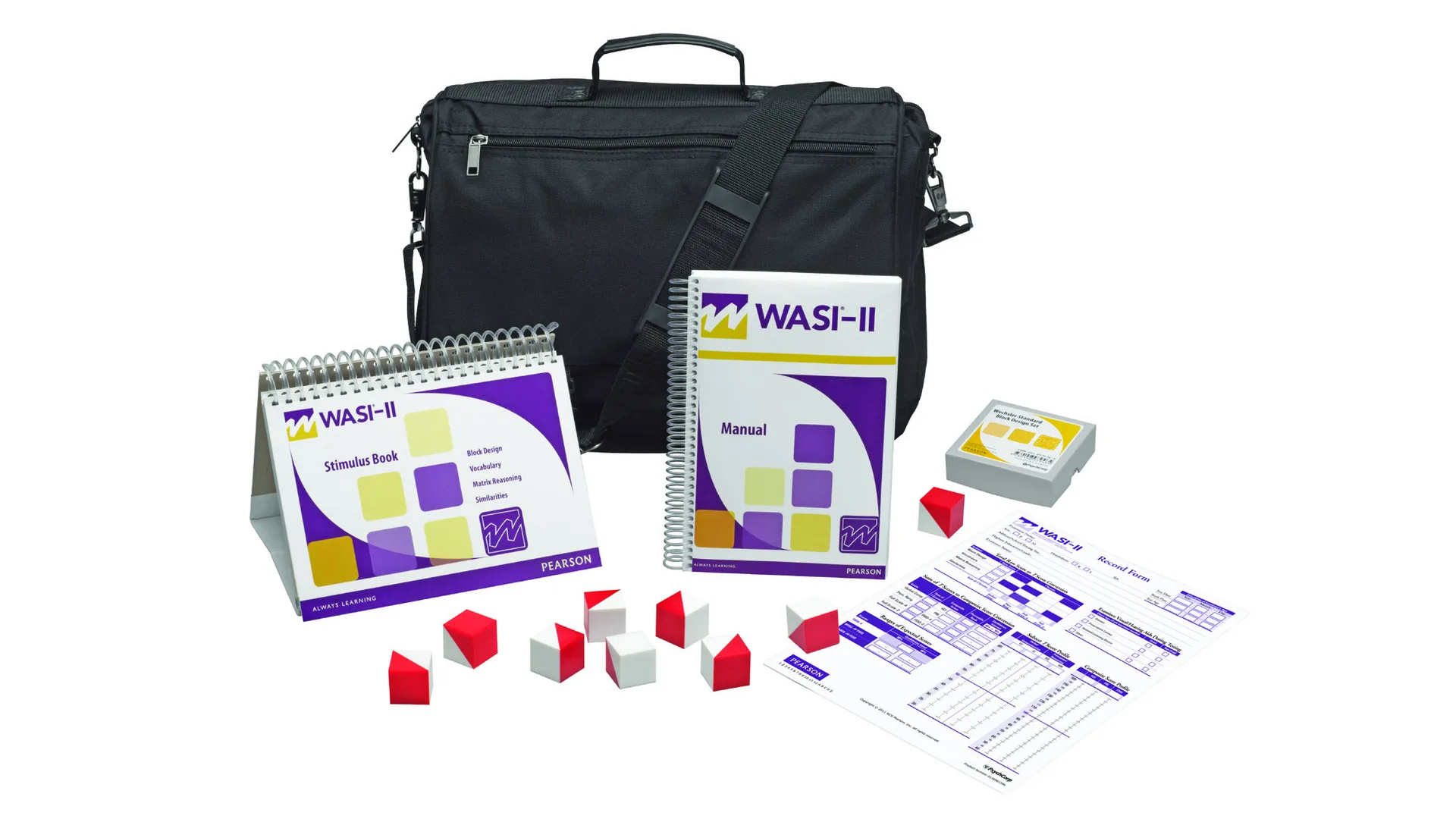
Pearson's brochure lists the complete kit as a manual, a stimulus book, 25 record forms and 9 blocks in a canvas bag.
0 The short answer
The WASI-II is the Wechsler Abbreviated Scale of Intelligence, Second Edition, a Pearson test published in 2011 for ages 6 to 90 that estimates general ability from four subtests (Vocabulary, Similarities, Block Design and Matrix Reasoning) in about 30 minutes, or from two of them (Vocabulary and Matrix Reasoning) in about 15. It reports a Verbal Comprehension Index, a Perceptual Reasoning Index and a Full Scale IQ, and it contains nothing on working memory or processing speed, so it works as a screening and research instrument and not as a replacement for the WAIS-IV or the WAIS-5. Pearson sells it at Level C, so a qualified examiner is involved, and an adult meets it in a clinic or a research study and not at a kitchen table.
4
Subtests in the full form: Vocabulary, Similarities, Block Design and Matrix Reasoning, according to Pearson's brochure.
30
Minutes for the four subtest form, and 15 for the two subtest form, according to the same brochure.
530.40
US dollars for the WASI-II Complete Kit (Print) on Pearson's store, read on October 20, 2026.
The WASI-II is a brief, individually administered Wechsler test published by Pearson, a 2011 revision of the 1999 Wechsler Abbreviated Scale of Intelligence, built to estimate intelligence when a full battery is unnecessary or impractical. Pearson's product page, read on October 20, 2026, gives the publication date as 2011 and the age range as 6:0 to 90:11, which is the notation for 6 years 0 months through 90 years 11 months. It describes the test as a brief, reliable measure of cognitive ability for clinical, educational and research settings. The peer reviewed test review by Irby and Floyd, whose abstract the ERIC database reproduces, says the same about the age span and adds that the test revises the 1999 original.
A disclosureWe sell ACIS, a separate online cognitive assessment, so we have a commercial interest in how readers choose between tests. ACIS is not a Wechsler product, does not produce WASI-II scores and is not equivalent to one. Every WASI-II fact on this page comes from Pearson's own pages and brochure or from peer reviewed work, each linked where it is used, and the final section states where ACIS sits.
Pearson's brochure (copyright 2019) says the norms rest on a national sample of approximately 2,300 individuals aged 6 to 90, and the product page calls the sample nationally representative and dates the testing from January 2010 to May 2011. The page on how a short battery is built and what it costs you already reports the WASI family's published reliability and validity figures, and this page does not repeat them. It adds what that page leaves out: the subtests and their formats, the forms, the qualification rules, the price list, the telepractice guidance and the relation to the WAIS-5.
Two facts frame everything that follows. First, Pearson positions the test as a screener before it positions it as anything else. The first use on its brochure is "Screen to determine if in-depth intellectual assessment is needed", and the other listed uses are reassessment after a comprehensive evaluation, estimating a Full Scale IQ in busy practice settings, psychiatric referrals, and IQ scores for vocational, rehabilitation or research purposes. Second, the pages we read show no retirement or replacement notice for the WASI-II, and they name no successor, so on October 20, 2026 it is still the product Pearson sells for this job. The page on the types of IQ tests places it among the brief instruments, and this page is the long version.
The kit in the hero image is the published one. Pearson's brochure lists the Complete Kit as the manual, the stimulus book, 25 record forms and 9 blocks in a canvas bag. The stimulus book in the photo is a spiral easel with the four subtest names printed on its cover, and Pearson's frequently asked questions say it flips forward toward the examinee. The manual, the stimulus book and the blocks are materials an examiner presents, which already tells you how the test is meant to be given.
2 What are the four subtests, and what does each one ask?
The four subtests are Vocabulary, Similarities, Block Design and Matrix Reasoning, and three of them are answered aloud or by pointing to a physical stimulus book while the fourth is built by hand with blocks. Pearson describes them as updated from the first edition, with the items of the WASI-II designed to parallel the WISC-IV and the WAIS-IV more closely. The product page's frequently asked questions add that 20 to 40 percent of the items across the four subtests are new or revised. This section gives formats only. No item, answer or scoring rule appears here or anywhere on this site, because they are protected test material.
The best public description of how each subtest is delivered is Pearson's telepractice guidance, whose first table lists the demands subtest by subtest and whose second table lists inputs and outputs. The table below follows them. The CHC column is our reading using the standard classification, not Pearson's wording, and the page on the CHC model explains the letters.
Subtest
Composite
How it is delivered (Pearson's tables)
CHC reading (ours)
Vocabulary
Verbal Comprehension Index
Spoken, printed and pictorial stimuli; the examinee answers aloud in an open ended way
Gc, comprehension-knowledge
Similarities
Verbal Comprehension Index
Spoken and pictorial stimuli, with pointing allowed on the first three items; the examinee otherwise answers aloud in an open ended way
Gc, with reasoning about verbal concepts
Block Design
Perceptual Reasoning Index
Physical blocks and pictured designs, with a motor demonstration, item level time limits and a stopwatch
Gv, with a motor component
Matrix Reasoning
Perceptual Reasoning Index
Pictured patterns with multiple choice answers, given by pointing or a brief spoken answer; some items depend on color
Gf, fluid reasoning
Three details in that table matter to a reader. The two verbal subtests are open ended and spoken, so an examiner has to listen and judge each answer, which is exactly the kind of judgment an unsupervised screen cannot supply. Block Design is physical, which is why the telepractice table says a professional facilitator can assist with it, that the examiner uses a stopwatch, and that the stimulus book should lie flat because the effect of presenting it on a vertical screen has not been researched. And Matrix Reasoning is flagged in Pearson's second table as containing color critical items, so a person with a color vision difference is a case for the examiner to handle, not a detail to ignore.
The ACIS pages on the Vocabulary, Similarities and Matrix Reasoning subtests describe ACIS versions of tasks with the same names. They are separate instruments with their own items, so the names overlap and the scores do not transfer. ACIS has no block-building task at all.
3 What are the two forms, and what scores does the WASI-II give?
The test comes in a four subtest form that yields three scores and a two subtest form that yields one, and the two forms trade about 15 minutes for the two index scores. Pearson's brochure states the forms and what each provides, and the table below follows it.
FSIQ-4 estimates general cognitive ability; VCI measures crystallized abilities; PRI measures nonverbal fluid abilities and visuomotor and coordination skills
Two subtest
Vocabulary, Matrix Reasoning
15 minutes
FSIQ-2
An estimate of general cognitive ability
The scale is the familiar one. An instrument listing on txautism.net says subtests report T scores with a mean of 50 and a standard deviation of 10, and composites report standard scores with a mean of 100 and a standard deviation of 15, together with percentile ranks and confidence intervals. The page on why the standard deviation of 15 matters explains what that scale means, and the page on IQ score versus percentile explains why a composite and a percentile are not interchangeable.
The Verbal Comprehension Index and the Perceptual Reasoning Index replaced the older names. Pearson's frequently asked questions say the first edition's Verbal IQ became the Verbal Comprehension Index and its Performance IQ became the Perceptual Reasoning Index, matching the names used on the WISC-IV and WAIS-IV. The page on Verbal IQ and Performance IQ tells the story of why the comprehensive Wechsler scales dropped the older pair.
A reader should hold one limit in mind. Each WASI-II index rests on two subtests, and the two subtest form rests on two subtests in total. McGeehan, Ndip and McGill, who reanalyzed the test's structure, report in their abstract that both methods they used show the WASI-II measures general intelligence well, and they caution that interpreting scores beyond that general dimension requires care, even though the test provides index scores. We return to that paper below. The practical reading is that the Full Scale IQ is the number the test is built to give, and a gap between VCI and PRI is a prompt for a fuller evaluation, not a finding. The page on the g factor explains why a general composite carries most of a short test's information.
4 What does the WASI-II leave out?
The WASI-II contains no working memory subtest and no processing speed subtest, so two of the four index scores of the WAIS-IV have no counterpart on it and the test cannot tell you how a person compares on those abilities. Pearson's brochure shows this in a table of which WASI-II subtests can stand in for which core WISC-IV and WAIS-IV subtests: Vocabulary and Similarities sit under the Verbal Comprehension Index, Block Design and Matrix Reasoning sit under the Perceptual Reasoning Index, and the Working Memory and Processing Speed columns hold nothing from the WASI-II.
The same brochure gives the practical consequence. If a WASI-II screen shows that a full evaluation is needed, its four subtest scores can be substituted for the four corresponding subtests on the WISC-IV or WAIS-IV. Administering "only six more subtests" instead of ten then yields all of the comprehensive composites, and Pearson says the substitution reduces the additional testing time by an average of 48 percent. That is Pearson's claim about its own linking studies, and we did not test it. It does show how the publisher sees the WASI-II: as the first four subtests of a longer Wechsler assessment.
The WAIS-5 changes what "perceptual reasoning" means. Pearson's WAIS-5 documents list five primary indices (Verbal Comprehension, Visual Spatial, Fluid Reasoning, Working Memory and Processing Speed), and Pearson's sample score report places Block Design under Visual Spatial and Matrix Reasoning under Fluid Reasoning. The WASI-II keeps those two subtests together in one Perceptual Reasoning Index, so a WASI-II PRI averages two abilities that the WAIS-5 reports apart. The page on the WAIS-5 subtests lists the twenty tasks and the indices they feed.
What is missing matters most when the question is about those abilities. Working memory and processing speed are measured by dedicated tasks, as the pages on the working memory test and processing speed describe. A reader whose question concerns those abilities needs a battery that includes them. A reader whose question concerns a broad ability level may be well served by a short measure, if they accept the trade described on the page on index score differences, which shows how often a person's index scores differ from one another within a single battery.
5 How reliable is the WASI-II, and what do the reviews and studies say?
The published evidence supports the WASI-II as a measure of general ability and supports caution about everything beyond that, and the independent literature on the second edition is small. The reliability coefficients and the correlations with the comprehensive Wechsler scales that Pearson reports in the manual are summarized on the page on short batteries, and this page works from the reviews and studies we could open. The table lists what each source did and found, as its abstract states.
Source
Design
Sample or object
What the abstract reports
McCrimmon and Smith (2013), Journal of Psychoeducational Assessment
Peer reviewed test review
The WASI-II as a product
An economical, easy to administer brief measure; a Level C test; limits include reduced clinical accuracy
Irby and Floyd (2013), Canadian Journal of School Psychology
Peer reviewed test review
The WASI-II as a product
Describes a brief test for ages 6 to 90 that revises the 1999 WASI
McGeehan, Ndip and McGill (2017), Archives of Assessment Psychology
Schmid-Leiman and exploratory bifactor reanalysis
The WASI-II's structure
Strong measurement of general intelligence; care beyond it, because the manual implies a hierarchy that the publisher's studies did not test
Ryan, Kreiner, Teichner and Gontkovsky (2021), Brain Injury
Pilot comparison of two clinical groups
59 outpatients: 32 neurological, 27 psychiatric or age-related decline
Neurological group scored lower on all subtests and composites, with no pattern difference; preliminary validation only
Ryan, Gontkovsky and Kreiner (2024), Assessment
Analysis of age effects
The standardization sample
Vocabulary varies little with age; Block Design and Matrix Reasoning drop substantially from younger to older groups
Axelrod (2002), Assessment
Comparison with the WAIS-III
72 participants in a mixed clinical sample; the first edition
WASI estimates did not consistently match WAIS-III scores; use cautiously
Read the table for design before result. The two reviews are expert opinion on a product, not studies of people. The McCrimmon and Smith review, as the ERIC record of its abstract gives it, calls the test an economical and easy to administer brief intelligence measure and a measure of choice when time is limited, and it lists limitations including reduced clinical accuracy. The Irby and Floyd review is recorded in ERIC with an abstract that was cut short in the copy we could read, so we use it only for what it says about the age span and the 1999 original.
The structural paper is the one a researcher should read first. McGeehan and colleagues apply two exploratory methods and conclude that the test measures general intelligence strongly, and they note that although the manual and the scores imply a hierarchical structure, the publisher's validation studies never tested one. Their cautions apply to the Verbal Comprehension and Perceptual Reasoning Index scores. The page on reliability versus validity explains the vocabulary, and the page on short batteries quotes their numbers.
The pilot study by Ryan and colleagues is the only criterion check in our table, and its design caps what it can say. It compared 32 patients with neurological diagnoses against 27 with psychiatric diagnoses or age-related cognitive decline, all referred for outpatient neuropsychological evaluation. The neurological group scored lower on every subtest and composite, and when premorbid IQ estimates were compared with WASI-II IQs, the neurological group showed evidence of intellectual deterioration while the controls did not. The authors describe this as preliminary validation, which is the right size for a 59 person pilot. It says the test is sensitive to the condition of the brain in that sample. It does not say a single WASI-II score diagnoses anyone.
The earliest comparison is about the first edition, and it is the one that most cautions a buyer. Axelrod's study compared the original WASI with the WAIS-III in 72 participants from a mixed clinical sample. His abstract reports that the WASI verbal IQ came out higher than the WAIS-III verbal IQ, that the performance IQ estimates all differed from the actual WAIS-III scores, and that clinicians should use the WASI cautiously if at all when accurate estimates of an individual's WAIS-III results are needed. That is a finding about the first edition and one clinical sample, so it does not transfer automatically to the second edition. It does fit the pattern in this whole section: a short test is useful for a rough placement and risky as a stand-in for an individual's full result.
Reading these studiesOf the six sources, one concerns the first edition, two are reviews of the product and two analyze the standardization data. Only one, the 2021 pilot, tests the WASI-II against a clinical criterion, in 59 people. A reader should not treat "the WASI-II is validated" as a single settled fact. It is a set of narrower facts, each with its own design and sample.
6 Who was in the WASI-II norm sample, and what do age effects mean for an adult?
Pearson's norms for the WASI-II come from about 2,300 people aged 6 to 90 tested between January 2010 and May 2011 in the United States, so an adult's score is a comparison with an age group as it stood about 15 years before October 20, 2026. The 15 years is our arithmetic from the end of standardization. Pearson's brochure calls the updated sample more representative of today's population, which is a publisher statement we cannot test, and the product page gives the dates. The page on how IQ scores are normed explains what a norm sample does and why its date matters.
The country matters as much as the date. Pearson's Australian product page says the WASI-II standardization was undertaken in the United States and that the test uses U.S. norms, and it gives that as the reason a WASI-II substitution can be made with the Australian and New Zealand adapted WAIS-IV, which also uses U.S. norms. A reader outside the United States should therefore ask which norms a report uses, and the page on an IQ test in Australia takes up that reader's choices. The page on the Flynn effect explains why a norm group's age matters, because average performance on a test can drift between the year of standardization and the year of use. We found no restandardization announcement for the WASI-II on the Pearson pages we read.
Age shapes the subtests differently, and the 2024 paper by Ryan, Gontkovsky and Kreiner shows how. Using the WASI-II standardization sample, they report that Vocabulary showed minimal variation with age, that Similarities peaked between ages 30 and 54 and then declined, that Block Design peaked between 17 and 44 and then declined, and that Matrix Reasoning peaked between 20 and 29 and then deteriorated consistently. For the composites, the Verbal Comprehension Index peaked between 30 and 44, with its maximum drop at 85 to 90, and the Perceptual Reasoning Index peaked between 20 and 29, with a marked decline by 65 to 69. The Full Scale IQ was average until age 65 and declined after. The authors call the results consistent with crystallized and fluid intelligence theory.
What does that mean for an adult? Two things, both modest. A vocabulary subtest and a matrix subtest are expected to age differently, so a gap between the Verbal Comprehension and Perceptual Reasoning Index scores in an older adult is not by itself a finding about that person. And because the abstract does not say whether these are raw scores or scores already adjusted for age, we treat the pattern as a description of the standardization sample and not as a table of expected scores. The page on IQ testing for people over 60 covers which scores hold up with age, and the page on processing speed covers an ability that the WASI-II does not measure and that declines earliest.
7 WASI-II, WAIS-IV or WAIS-5: which one will an evaluator use?
The choice between them is a choice between a screen and a battery, and the deciding factors are the question being asked, the time available and the abilities that must be covered, not which test is better. The table sets the WASI-II beside the WAIS-5 on facts that Pearson's own pages state, read on October 20, 2026. The WAIS-5 column is drawn from Pearson's WAIS-5 product page and its by the numbers sheet.
Fact
WASI-II
WAIS-5
Publication date
2011
2024
Age range
6:0 to 90:11
16:0 to 90:11
Subtests in the whole test
4 (2 in the short form)
20
Composite scores
VCI, PRI, FSIQ
5 primary indices plus the FSIQ
Abilities covered
Verbal and nonverbal reasoning, no working memory or speed
Verbal comprehension, visual spatial, fluid reasoning, working memory, processing speed
Time
30 minutes (15 for the short form)
45 minutes for the 7 subtest FSIQ, 60 for the 10 primary subtests
Scoring options
Manual scoring
Paper, Q-global or Q-interactive
Qualification level
C
C
Complete kit (print), US dollars
530.40
1,784.00
The WAIS-IV is the older comprehensive scale. Pearson's WASI-II brochure shows that it has ten core subtests feeding four composites (Verbal Comprehension, Perceptual Reasoning, Working Memory and Processing Speed). The page on the WAIS-IV lists them, and the page on the differences between the WAIS-IV and the WAIS-5 explains why a person's score can shift when the edition changes. The WASI-II was built to link to the WAIS-IV, and Pearson's store page lists technical reports on using it with the WISC-IV, the WAIS-IV and the WISC-V.
The WAIS-5 is where the record is thin. The same Pearson page lists no technical report on using the WASI-II with the WAIS-5, and the WASI-II pages we read do not mention the WAIS-5. The four subtest names do exist on the WAIS-5: Pearson's sample score report lists Similarities and Vocabulary under Verbal Comprehension, Block Design under Visual Spatial and Matrix Reasoning under Fluid Reasoning. But a shared name does not establish that the WASI-II and WAIS-5 versions can be exchanged, and we found no Pearson document that says they can. An evaluator who wants to use WASI-II subtest scores inside a WAIS-5 evaluation should confirm the procedure with the publisher, and a reader who is handed a WASI-II score should not expect it to line up with a WAIS-5 composite. The page on the WAIS-5 gives that instrument's own facts.
In practice an evaluator chooses a WASI-II when the question is rough placement, a research control or a quick check on whether a full evaluation is worth doing, and a comprehensive Wechsler scale when the result will carry weight, when working memory or speed matter, or when a profile is needed. The reader does not usually choose. A clinician, a school or a research team does, and what the reader can do is ask which instrument will be used, why, and what the result will be used for.
8 Who may buy and give the WASI-II?
Pearson lists the WASI-II at qualification Level C, the highest of its three levels, and a reader cannot buy the kit without credentials that Pearson accepts for that level. Pearson's qualifications policy, read on October 20, 2026, says Level C is for tests that require a high level of expertise in test interpretation, and it gives three routes. The first is a doctorate in psychology, education or a closely related field, with formal training in the ethical administration, scoring and interpretation of clinical assessments related to the intended use. The second is licensure or certification to practice in the buyer's state in a related field. The third is certification by, or full active membership in, a professional organization such as the APA, NASP, NAN or INS that requires training and experience in the relevant area. Level B asks for a master's level background in a related field plus ethics training, and Level A needs no special qualification.
Giving a test and buying it are not the same. The same policy says some tests may be administered or scored by people with less training as long as a qualified user supervises them. The McCrimmon and Smith review applies that to the WASI-II. Its abstract says the examiner's manual states that a person with a bachelor's degree may give the test with appropriate supervision because it is easy to administer, and that ideally the same person would administer and interpret it, preferably with master's or doctoral level training. That is a reviewer's reading of the manual, not a license rule, and a school, clinic or research ethics board may set stricter conditions than Pearson does.
The American Psychological Association's code speaks to the same boundary. Standard 9.07 of the Ethical Principles of Psychologists and Code of Conduct says psychologists do not promote the use of psychological assessment techniques by unqualified persons, except for training purposes with appropriate supervision. The page on who can administer an IQ test explains Levels A, B and C in more detail, and the page on the professional IQ test covers what a qualified examiner adds that a score alone does not.
Pearson's Australian page also lists Level C for the WASI-II, so the category is not only an American one, though the credentials that satisfy it differ by country. For a reader the point is simple. If you want your own WASI-II result, you ask a qualified examiner for an evaluation. You do not buy the test, and you should be wary of any website that offers a "WASI" or "Wechsler" score for a fee without naming a qualified examiner, because the instrument is sold to qualified buyers and not to the public.
9 What does the WASI-II cost, and what does an adult pay to take it?
Pearson prices the WASI-II complete kit at 530.40 US dollars, and the figure that matters to an examinee, the fee for an evaluation, is not published by Pearson at all. The table lists the products Pearson's U.S. and Australian stores showed on October 20, 2026. Prices change, so treat them as dated. The Australian prices are in Australian dollars as the page listed them.
Product
US dollars (Pearson U.S.)
Australian dollars (Pearson Australia)
WASI-II Complete Kit (Print): manual, stimulus book, 25 record forms, 9 blocks in a canvas bag
530.40
862.73
Record Forms, quantity 25 (Print)
128.70
202.62
Manual (Print)
298.10
473.33
Q-global Manual (Digital, view only)
289.80
473.33
Stimulus Book (Print)
272.70
433.07
Q-global Stimulus Book (Digital, view only)
265.20
433.07
Pearson's U.S. page also lists three trainings: a three hour live webinar at 2,395 dollars, a three hour in person session at 7,950 dollars, and a one hour live question and answer session at 575 dollars, each covering up to 40 people. The page lists manual scoring as the only scoring option and names no scoring or reporting subscription for this test. By comparison, Pearson's WAIS-5 page lists a one year Q-global scoring subscription at 60 dollars and score reports at 3 dollars each. The complete WAIS-5 print kit at 1,784 dollars is about 3.4 times the WASI-II kit, which is our arithmetic on the two list prices.
Those are costs to a clinic or a lab, spread over many examinees. As a rough picture of the consumables, 25 record forms at 128.70 dollars come to about 5 dollars a form, our arithmetic, and the examiner's time is the larger cost. What an individual pays is a professional fee for an evaluation, and Pearson does not publish it. The page on adult IQ testing, the process, cost and wait covers what a full evaluation involves, and the page on how long an IQ test takes sets the WASI-II's 15 and 30 minutes beside the longer batteries. A WASI-II session is short, but an evaluation can include an interview, scoring and a written report around it.
10 How is the WASI-II given, and what changes when it is given remotely?
The WASI-II is an examiner led, face to face test, and Pearson's telepractice guidance shows how much of it depends on the examiner being in the room: Block Design in particular depends on a professional facilitator in the examinee's room. The brochure lists the administration as paper and pencil with hand scoring. The product page lists print and digital formats, but the digital items it sells are a view-only manual and a view-only stimulus book in Pearson's Q-global library. Nothing it lists is a self-administered version.
Pearson says the second edition simplified delivery. Its brochure lists streamlined directions, reading instructions shortened by 40 percent, shorter discontinue rules and reversal rules that are more consistent with the comprehensive Wechsler scales. Those changes make the test faster for the examiner. They do not make it a test an examinee can take without one.
The telepractice tables describe what remote delivery demands. Vocabulary and Similarities need high quality audio for both parties, and the examiner points with the mouse at the stimuli on screen for all Vocabulary items and the first three Similarities items. Block Design calls for a professional facilitator with the examinee, who presents the blocks as the manual directs, and the guidance says it is not recommended to let a nonprofessional facilitator present the blocks or to have the examinee scramble them. It calls for either a print stimulus book at the examinee's location or a digital stimulus book on a tablet of about 9.7 inches diagonal, a stopwatch for the examiner, and a stable camera that shows the examinee's constructions. Matrix Reasoning needs high quality video and a camera that shows the examinee's pointing.
Pearson's second table adds a caution. It lists the equivalence evidence for each subtest between remote and face to face delivery and between digital and traditional formats, and its note says that more research is needed to establish equivalence in all ages and for all subtests. For a reader, the lesson is that even the publisher treats remote delivery of this test as something that needs a trained examiner, specific equipment and further research. An unsupervised online test has none of those, and the page on professional versus online IQ tests sets out what that difference does to what a score can claim.
11 What is the WASI-II used for, and what should it not be used for?
Pearson lists screening, reassessment, quick Full Scale IQ estimates, psychiatric referrals and vocational, rehabilitation or research IQ scores as the uses of the WASI-II, and the evidence supports a rough estimate of general ability, not a diagnosis, a profile or a decision about a person. Its product page also describes the test as a fast and reliable measure for screening for intellectual disability or intellectual giftedness. Every use on that list is a professional use, and the brochure's first one, deciding whether an in depth assessment is needed, builds a follow-up into the definition.
The literature on brief tests explains why. Pierson, Kilmer, Rothlisberg and McIntosh, writing about schools that use brief tests as the first step in identifying gifted students, say in their abstract that brief measures are often used without consideration of the underlying constructs or psychometric properties, and without regard to the link between a screening decision and what follows it. Their subject is children and giftedness, so the paper is not about adult use, but its point travels: a screen is only as good as the decision it feeds. The page on the general ability index shows the same logic with a different composite.
Several limits follow directly from the design described above. Each index rests on two subtests, so an index gap is a prompt and not a finding. There is no working memory or processing speed score at all. The norms are a U.S. sample tested in 2010 and 2011. The only criterion study of the second edition we could open is a pilot of 59 patients. And a shorter test averages over fewer items, which is the reason a report prints a confidence interval and the reason the page on short batteries spends so long on what a short test costs you.
It is also worth saying what no WASI-II score can do. A group statistic is never an individual diagnosis, and a single short score cannot show that a person has a disability, is gifted, or is eligible for any accommodation. Those are decisions made by the bodies that receive a report, under their own rules, and this page does not advise on them. The pages on dyslexia and IQ and ADHD and IQ cover the research on those topics.
A researcher choosing an instrument should treat the WASI-II as a face to face, examiner led option and ask what a report would need to state. At a minimum that is the form used (FSIQ-4 or FSIQ-2), who gave it and with what training, how it was delivered, which norms were used and their date, and the confidence interval. The page on reporting IQ in research sets out eight facts a score hides, and the page on measuring intelligence in online studies compares the options when participants cannot be tested in person. Scores from different instruments should not be averaged or pooled as if they were one scale.
For an adult who has been offered a WASI-II, a few questions are fair. Which form will be used, and why? What is the result for, and what happens next? Will the report give a confidence interval and name the norms? And is this a screen that might lead to a longer evaluation, or the whole evaluation? The answers tell you how much weight the number can carry. The page on how to choose a test and read it walks through the same questions for any test.
12 Where ACIS sits, and what a buyer should do
We sell ACIS, a separate online assessment, and it is not a WASI-II, a substitute for one or a source of WASI-II scores; the right choice depends on what the score is for. ACIS has 20 subtests in six CHC domains (verbal comprehension, fluid reasoning, quantitative reasoning, visual spatial, working memory and processing speed) and reports a Full Scale IQ and six primary indices on the same mean 100, standard deviation 15 scale, with percentiles and a 95 percent confidence interval and adult norms for ages 16 to 90. Read on October 20, 2026, its one time forms were Quick at 15 dollars (6 subtests in 3 domains, about 45 minutes), Optimized at 30 dollars (13 subtests in 5 domains, about 110 minutes) and Full Scale at 50 dollars (all 20 subtests, about 175 minutes), with a free trial that needs no card. Prices can change, so check the current forms.
The limits are as important as the features. ACIS is taken online and unsupervised, in English only. It is not a clinical or diagnostic instrument, and it is not for hiring, school accommodations or admission to high IQ societies. It has no examiner, so it carries no observation of how a person worked, and it has no block-building task. Its Quick form takes longer than the WASI-II's four subtest form, and it is a different instrument with different items and its own norms, so a score from one cannot be converted into a score from the other. The shared subtest names, Vocabulary, Similarities and Matrix Reasoning, show where the task formats overlap, not that the scores agree. ACIS documentation is in the technical manual, and this page quotes nothing from it.
A buyer can reason in four steps. If a school, clinician, court or employer asks for an assessment, ask which instrument, which qualifications and which report they will accept before paying for anything, because an online score will not substitute. If you are curious about your own profile, an online battery is a reasonable start when read for what it is, as the pages on the best online IQ tests and where to take an IQ test set out. If a WASI-II report has reached you, read the form, the norms, the examiner and the interval together, and do not compare it with a WAIS-5 composite as if they were one scale. If you run a study, the page on using ACIS in research describes that option, with the limits stated above.
The Standards for Educational and Psychological Testing (AERA, APA and NCME, 2014) is the framework this page uses to read any of these scores: the evidence must support the specific interpretation, the reference group must suit the person, and the reliability and error of the score being interpreted must be known. By that framework, the evidence summarized above supports reading a WASI-II Full Scale IQ as an estimate of general ability for a person tested as the manual describes, and it supports less for the Verbal Comprehension and Perceptual Reasoning scores, which deserve the caution that McGeehan and colleagues recommend. The American Psychological Association's Ethical Principles of Psychologists and Code of Conduct adds, in Standard 9.02(b), that psychologists use assessment instruments whose validity and reliability have been established for the population tested, and, where that has not been done, describe the strengths and limits of the results. Standard 9.07, cited above, keeps the instrument in qualified hands. All three apply to a WASI-II report, a WAIS-5 report and an online score alike: a number is only as good as the match between instrument, person and use.
Every WASI-II fact on this page comes from Pearson's own pages and documents or from a peer reviewed source, and every ACIS fact comes from the ACIS home page. Pearson pages and prices were read on October 20, 2026 and can change. Journal records for the two test reviews were read as abstracts, because the publisher blocked the full text. The WASI-II manual itself (Wechsler, 2011) is sold only to qualified buyers and was not opened.
Pearson. Wechsler Abbreviated Scale of Intelligence, Second Edition, product page, and WASI-II brochure, copyright 2019, read October 20, 2026.
Pearson Clinical Australia and New Zealand. Wechsler Abbreviated Scale of Intelligence, Second Edition, product page, read October 20, 2026.
McCrimmon A, Smith A. Review of the Wechsler Abbreviated Scale of Intelligence, Second Edition (WASI-II). Journal of Psychoeducational Assessment, 2013, volume 31, issue 3, pages 337 to 341.
Irby S, Floyd R. Test Review: Wechsler Abbreviated Scale of Intelligence, Second Edition. Canadian Journal of School Psychology, 2013, volume 28, issue 3, pages 295 to 299.
McGeehan B, Ndip N, McGill R J. Exploring the Multidimensional Structure of the WASI-II: Further Insights from Schmid-Leiman Higher-Order and Exploratory Bifactor Solutions. Archives of Assessment Psychology, 2017, volume 7, issue 1.
Ryan J, Kreiner D, Teichner G, Gontkovsky S. Validity of the Wechsler Abbreviated Scale of Intelligence, Second Edition (WASI-II) as an Indicator of Neurological Disease/Injury: A Pilot Study. Brain Injury, 2021, volume 35, issue 12 to 13, pages 1624 to 1629.
Ryan J, Gontkovsky S, Kreiner D. Age Effects on Subtest and Composite Scores of the Wechsler Abbreviated Scale of Intelligence, Second Edition. Assessment, 2024, volume 31, issue 5, pages 1165 to 1174.
Axelrod B. Validity of the Wechsler Abbreviated Scale of Intelligence and Other Very Short Forms of Estimating Intellectual Functioning. Assessment, 2002, volume 9, issue 1, pages 17 to 23.
Pierson E, Kilmer L, Rothlisberg B, McIntosh D. Use of Brief Intelligence Tests in the Identification of Giftedness. Journal of Psychoeducational Assessment, 2012, volume 30, issue 1, pages 10 to 24.
The WASI-II is a short, individually given intelligence test from Pearson, published in 2011. It estimates general ability from four subtests, or from two in a shorter version, and it is used by qualified examiners for screening, reassessment and research. It is a brief relative of the full Wechsler scales.
What does WASI-II stand for?
WASI-II stands for Wechsler Abbreviated Scale of Intelligence, Second Edition. Wechsler is the psychologist whose name the family carries, abbreviated means the test is shortened, and the II marks the second edition. The first edition appeared in 1999, so the letters tell you the edition and not the content.
How many subtests are in the WASI-II?
The WASI-II has four subtests: Vocabulary, Similarities, Block Design and Matrix Reasoning. The shorter form uses only two of them, Vocabulary and Matrix Reasoning. Their items are designed to parallel subtests on the comprehensive Wechsler scales, which is what lets the short test link to the longer ones.
What ages does the WASI-II cover?
Pearson lists an age range of 6 years 0 months through 90 years 11 months, so one test spans childhood to very old age. For an adult that means the norms include the full adult range, although different ages are compared with different reference groups, as with any normed test.
How long does the WASI-II take?
Pearson gives about 30 minutes for the four subtest form and about 15 minutes for the two subtest form. Those times cover the test itself. A real appointment is longer because it includes introductions, any other measures, scoring and, for a clinical evaluation, an interview and a written report.
How is the WASI-II different from the WAIS-5?
The WAIS-5 is a comprehensive adult battery with 20 subtests and five primary indices, published in 2024, while the WASI-II is a four subtest screen published in 2011. The WAIS-5 covers working memory and processing speed. The WASI-II does not, and it has no published link to the WAIS-5 that we found.
How is the WASI-II different from the WAIS-IV?
The WAIS-IV is an older comprehensive adult battery with ten core subtests and four composites, and the WASI-II was designed to link to it. Its four subtests can substitute for four of the WAIS-IV core subtests, which shortens a follow-up evaluation. Working memory and processing speed still need the WAIS-IV tasks.
What scores does the WASI-II report?
The four subtest form reports a Full Scale IQ (FSIQ-4), a Verbal Comprehension Index and a Perceptual Reasoning Index. The two subtest form reports only a Full Scale IQ (FSIQ-2). Composites use a mean of 100 and a standard deviation of 15, and subtests use T scores with a mean of 50.
What is the difference between FSIQ-4 and FSIQ-2?
FSIQ-4 comes from all four subtests and FSIQ-2 from Vocabulary and Matrix Reasoning alone. Both estimate general ability, but the two subtest score rests on less evidence and gives no index scores. A clinician or researcher picks the longer form when the number will carry weight.
Does the WASI-II measure working memory or processing speed?
No. Its four subtests cover verbal knowledge and reasoning, visual construction and matrix reasoning. Pearson's own comparison table leaves the working memory and processing speed columns empty for the WASI-II. Anyone who needs those abilities assessed has to use a comprehensive battery or a separate measure built for them.
What do the reviews say about the WASI-II?
A peer reviewed test review from 2013 calls it economical and easy to give, with limitations. A structural reanalysis found it measures general intelligence strongly and urged caution about its index scores. A 2021 pilot of 59 patients offered preliminary support for its sensitivity to neurological conditions.
When were the WASI-II norms collected?
Pearson says standardization ran from January 2010 to May 2011 with about 2,300 people aged 6 to 90. That makes the reference group about 15 years old in 2026. A norm sample is a snapshot, and Pearson's pages we read show no restandardization, so an examiner should state which norms a report used.
Are the WASI-II norms American?
Yes. Pearson's Australian page says the WASI-II standardization was done in the United States and that the test uses U.S. norms. Readers in other countries should ask whether a report uses those norms or a local adaptation, because the reference group changes what a given raw performance means.
How much does the WASI-II cost?
On October 20, 2026, Pearson's U.S. store listed the complete print kit at 530.40 dollars and a pack of 25 record forms at 128.70 dollars. Those are prices for qualified buyers. Pearson does not publish what an examinee pays, which depends on the clinic, the length of the evaluation and the local fee.
Who can give the WASI-II?
Pearson sells it at Level C, which requires a doctorate in a related field, a relevant license or certification, or membership in a professional organization with the right training. A review of the test says its manual allows a bachelor's level examiner to give it under supervision, and reviewers still recommend that one trained person gives and interprets it.
Can I take the WASI-II online?
Not as an unsupervised test. Pearson sells print materials and view-only digital manuals, and its telepractice guidance calls for a trained examiner, good audio and video, and a professional facilitator for Block Design. It also says more research is needed on whether remote and in person delivery give equivalent results.
Can I buy the WASI-II for myself?
Not without qualifying. Pearson restricts Level C tests to buyers with accepted credentials, and the kit is meant for examiners. A person who wants a WASI-II result asks a psychologist or qualified clinician for an evaluation. A site selling a Wechsler score without naming an examiner is not selling this test.
Is the WASI-II an IQ test?
It reports a Full Scale IQ, so yes in the ordinary sense, but it is a short screening version of one. Its estimate rests on two or four subtests, while a comprehensive scale uses more tasks and covers more abilities. The number is real and its precision is limited, which is why the interval matters.
Can the WASI-II diagnose a condition?
No. A single short cognitive score cannot diagnose anything, and Pearson itself presents the test as a way to decide whether a fuller assessment is needed. Diagnosis, eligibility and accommodations rest on a broader evaluation by a qualified professional, using history, observation and several measures, not on one number.
Should a researcher use the WASI-II to measure IQ in a study?
It is a reasonable choice when participants can be tested face to face by a trained examiner and a brief estimate of general ability is enough. It is a poor fit for online or self-administered studies, and it reports no working memory or speed. Reports should state the form, norms, examiner and delivery mode.
Is ACIS the same as the WASI-II?
No. ACIS is a separate online assessment with its own subtests and norms, taken without an examiner and in English only. It does not produce WASI-II scores, a score from one cannot be converted into a score from the other, and it is not a clinical or diagnostic instrument or a replacement for an evaluation by a qualified examiner.
Take the assessment
You get a profile, not a number
ACIS measures six CHC domains across 20 subtests and reports each one with its own normed score and confidence interval, so you can see where you are strong and where you are not.