ArealMe IQ test reviewed: a free score compared with its own users
ArealMe offers a free IQ test in a 49 question Quick version and a 119 question Complete version, and its score is placed on a mean 100 scale by comparison with recent ArealMe participants. This review reads its test page, data page, terms, privacy page, certificate code and public ratings as they stood on October 20, 2026, and separates what is documented from what is only asserted.
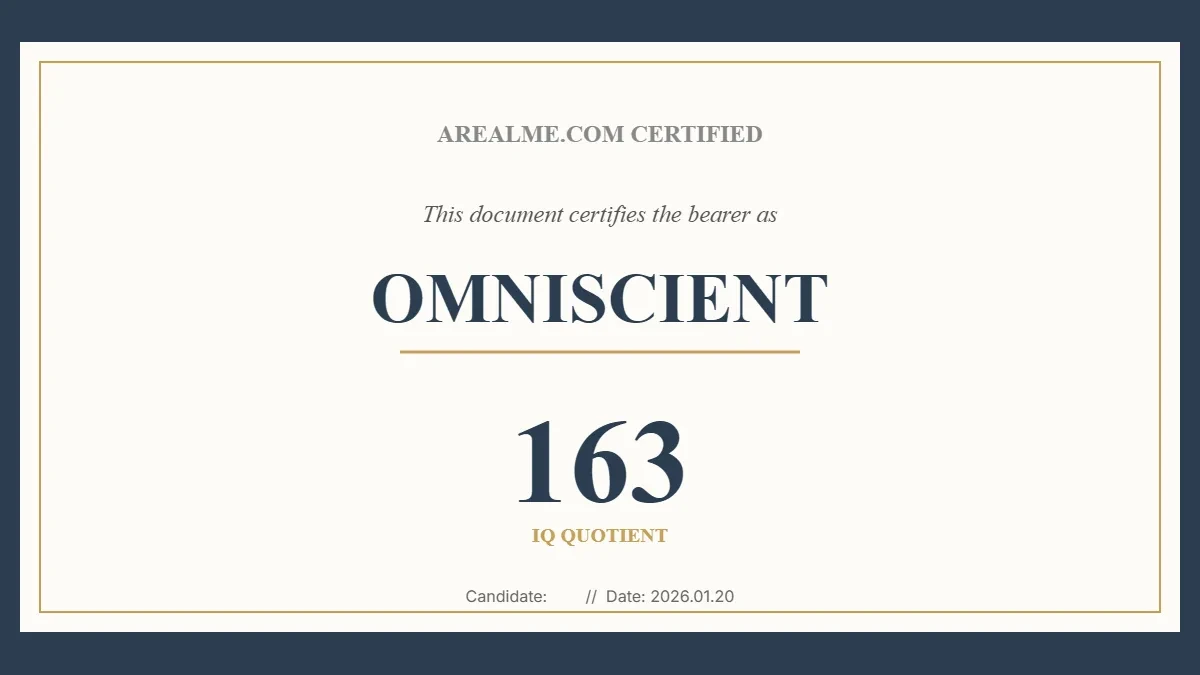
An image hosted on a public forum that we could not authenticate, in which Omniscient is the top band of the label ladder in the page configuration we read on October 20, 2026, and the card's date falls before ArealMe's July 2026 renorming.
0 The short answer
The ArealMe IQ test is a free, advertising funded web test, in a 49 question Quick version and a 119 question Complete version, whose score is placed on a scale with a mean of 100 and a standard deviation of 15 by comparison with recent ArealMe participants, not with a sample of the general population. ArealMe says this on its own pages and adds that the result is "not a clinical IQ assessment," so the number is a position among the self-selected visitors of one site, not a normed IQ of the kind a Wechsler battery reports. Its popular mental age test is a different product, a 30 statement entertainment quiz that does not measure intelligence. Use the IQ result for curiosity, and read the sections below before you rely on a certificate or a label for anything else.
DisclosureACIS sells a competing paid IQ assessment, so we have a commercial interest in how this page reads. Every product fact below comes from ArealMe's own pages and public scripts as they appeared on October 20, 2026, from public third party records that are linked, or from a cited document, and we say where something could not be verified. We did not take the ArealMe test, create a certificate or open the verification page behind it, so the result screen and certificate are described from the text and code that ArealMe publishes, not from a rendered result. This is a competitor review written by the seller of a rival product, and a reader should weigh it that way.
7,563
Eligible completed Quick records in the reference sample, collected September 26 to October 11, 2026, according to ArealMe's data page.
119
Questions in the Complete version on October 20, 2026, after the bank was cut from 147 earlier in 2026.
0 dollars
The price of the test and of the score on October 20, 2026. ArealMe states that advertising funds the site.
The ArealMe IQ test is the flagship IQ test of arealme.com, a site of more than 1,000 quizzes, tests and games run by AREALME LIMITED, a company incorporated in Hong Kong. The About page gives the legal name AREALME LIMITED, an address in Tsim Sha Tsui, Kowloon, and a contact email, and says the site is "run by a small team led by" its founder and chief editor, John Kevin, PhD. It states that he holds a PhD in cognitive psychology and designed the IQ test. It does not name the institution that awarded the degree, and we did not verify the credential, so the page is the only basis for it. The Terms of Service, last updated January 15, 2023, say the site is registered in Hong Kong but name no company, only "arealme.com."
The IQ test page tells the history in the founder's first person. The first version went live in November 2013, an English translation appeared in February 2014, and the page says the Wayback Machine can prove the date back to March 2, 2014. A new edition followed each year from 2015 to 2021, and in 2026 ArealMe stopped adding editions and merged what it called the strongest questions from every test since 2014 into one version. Its update log dates the "2026 flagship edition" to July 4, 2026. The page says more than seven million people have taken the test across all languages according to Google Analytics, a figure we cannot check.
The test page names one creator and a last update date of October 15, 2026. The About page says tests in sensitive areas, such as mental health and relationships, are checked by an outside reviewer whose name is shown on the test page. We did not see a separate reviewer named on the IQ test page, and the About page lists its reviewers with a count of tests each but, in the text we read, no test names, so we cannot say whether the IQ test had an outside review. The Mental Age Test page, by contrast, names a reviewer and says its new edition was rewritten after an external psychometric review.
The test belongs to a family that includes the Mental Age Test, which the About page says has been taken by more than 150 million people from 239 countries. The two products share a publisher, a site and a brand, but not a scoring method or a purpose, which the mental age section below shows in detail. For the general question of how free tests differ from tests with documented norms, the page on free versus validated IQ tests sets out the criteria this review applies.
2 What Is Inside the Free ArealMe IQ Test?
The test comes in two lengths, a 49 question Quick version that takes about 15 to 20 minutes and a 119 question Complete version that takes about 35 to 45 minutes, and only the Complete version produces the seven part profile and the certificate. These are the figures ArealMe gives on its test page on October 20, 2026. The Quick version gives a score straight away, and a user can continue into the Complete version with progress carried over. A user who leaves can return within 7 days on the same device and browser to resume. No email, sign-up or payment is asked before the result, a point the page makes several times.
The Complete version adds a profile across seven abilities that ArealMe names as pattern recognition, visual-spatial reasoning, numerical ability, logic, working memory, planning and attention. The page says plainly that these bars "are not population percentiles," and describes them as showing how the user's answers fall by dimension. Those seven names are ArealMe's labels, not terms from the Cattell-Horn-Carroll model, and the page we read does not say how many items feed each bar or how a bar is scaled. The page on what IQ measures and the page on the CHC model give the standard vocabulary. A battery whose profile is meant to be read as indices reports each domain on the standard scale with an error band. ArealMe presents its bars as a description of answers by dimension, not as scaled indices.
On format, the page and its update log describe visual pattern puzzles answered by tapping an image, a number grid puzzle, and maze puzzles. Three maze puzzles were added on June 20, 2025, and the final maze has a 6 minute limit. We do not reproduce any question, and we describe formats only as ArealMe itself describes them.
The item bank has moved a good deal in 2026, and the update log records it. On August 1, 2026 the Complete version went from 147 questions to 120 because answer data showed that some old puzzles were confusing rather than fair. On August 24 it went to 119 with one underperforming item retired, one visual answer corrected, and two experimental items kept in the test but no longer counted in the score. On September 5 an ambiguous number puzzle was replaced with a clearer pattern question, and the new item started with a clean data history. This is good practice in one sense, because a publisher that retires an item it found confusing and says so is behaving as test publishers should. It also means a score from June and a score from October came from different tests, which the section on older scores takes up.
The data page publishes a sample of how the test is taken. For September 5 to 13, 2026, with the English interface, it lists 5,327 anonymous attempts, of which 2,162 were completed, a completion rate of 40.59 percent. It reports that 68.73 percent of attempts were on mobile devices, 29.02 percent on desktop and 2.25 percent on tablets or other devices, and that the United States (28.14 percent) and the United Kingdom (14.79 percent) were the largest labeled countries. Those figures matter because the unsupervised conditions, the screen size and the audience are part of what a score reflects, and the International Test Commission guidelines list control among the main issues in internet delivered testing, as the section on accuracy explains.
3 What Does the ArealMe IQ Test Cost, and Who Pays?
The test, the score and the certificate cost nothing on October 20, 2026, the site says advertising pays for them, and the terms and privacy pages we read contain no price, payment, subscription or refund term at all. The test page states "No email, sign-up, or payment required," and a question on the page about payment answers that results appear after finishing with no payment, email or account. The About page says the quizzes and tests are free to take, that the results are free to see, and that the site is funded by advertising, adding that advertisers have no say in what is published or in the results.
We searched the text of the Terms of Service and the Privacy page for refund, payment, purchase and subscription terms as read on October 20, 2026. The Terms contain no refund term and no price. The only payment or purchase words are boilerplate, such as a ban on using a buying agent to make purchases on the site. The Privacy page, last updated March 24, 2025, has no price or refund term either. There is therefore nothing to quote about cancellation or refunds, because there is nothing to cancel and nothing to refund, and we report that as an absence and not as a gap in the product. The Terms and Privacy pages were last updated before the 2026 test was released, and neither mentions the IQ test, certificates, or the age group and gender prompts that the update log says were added in September 2026.
The cost to the user is attention and data. The Privacy page says the site does not store personal data such as email addresses or phone numbers, that non-personal data may include the browser, device type, operating system and internet provider, and that advertising partners may set cookies. It names Google, Ezoic and Publift as ad providers. The test page says the age group chosen before the result stays private unless the user publishes it on a certificate, and that gender never affects scoring. ArealMe also says it releases aggregate data under a Creative Commons non-commercial license for academic research, with attribution. It does not say how long anonymous attempt data is kept, and we found no retention period on the pages we read.
Option
Price read October 20, 2026
Renewal
12 month cost
Time to complete
ArealMe Quick version
0 dollars
None
0 dollars, advertising funded
About 15 to 20 minutes
ArealMe Complete version and certificate
0 dollars
None
0 dollars, advertising funded
About 35 to 45 minutes
ACIS Quick form
15 dollars
None, one time payment
15 dollars
About 45 minutes, 6 subtests in 3 domains
ACIS Optimized form
30 dollars
None, one time payment
30 dollars
About 110 minutes, 13 subtests in 5 domains
ACIS Full Scale form
50 dollars
None, one time payment
50 dollars
About 175 minutes, all 20 subtests in six domains
On price alone ArealMe wins, and that should be said plainly. A person who wants an idea of how they do on a puzzle test, with no card and no account, gets that from ArealMe for nothing, and no subscription appears on the pages we read, which differs from the subscription billed products that the page about paid IQ test billing covers. The question is what the number is worth, not what it costs, and the page on how much an IQ test costs places a free test within the full range of what the market charges. ACIS prices are those on its home page on October 20, 2026 and can change.
The result page reports one number on a scale with a mean of 100 and a standard deviation of 15, draws it on a bell curve, labels it with the reference it was computed against and with a qualitative confidence label, and for the Complete version adds seven bars that ArealMe says are not percentiles. We did not take the test, so this section describes the text and code that ArealMe publishes for the result screen, namely the test page and the scripts it loads, and not a rendered result. The scripts label the number "Your IQ Score" and draw a chart titled "IQ score distribution." The chart text marks the average as 100 and the bottom 2 percent, bottom 16 percent, top 16 percent and top 2 percent of the curve, and its caption can print a percentile together with the size of the reference sample when one applies. The result strings also include a "Result confidence" label, which the code sets to Moderate for a Quick result and Highest for a Complete result, and labels for raw accuracy, adjusted ability and a guessing baseline that fit the calculation details ArealMe says a past report reopens. We found no definition of what the confidence label means, it is a label and not an interval, and we did not see how any of these strings appear on a rendered result. A Quick result carries a note that it is an early score and that finishing the Complete version unlocks the profile and the certificate.
The scripts also carry the wording for the reference behind a number. A result can be marked as an age-adjusted reference or as an overall reference, and a third wording reads, in English, "Approximate result: this item set has no validated reference." A fourth marks a historical score from the original model. In other words, the page can tell a user that a number came from a group matched on age, from the whole pool, or from no validated reference, and that is a more candid design than a bare number. We did not see which wording a typical user receives, because that depends on the version, the age group chosen and the model in force on the day.
Three other things are visible in the published text. Reports are kept in the user's browser and nowhere else, so a retake does not overwrite earlier results, and the update log of September 14, 2026 adds that a past report can be reopened with its seven part profile, calculation details and certificate. There is a comment section below the test where users post scores, and ArealMe's own FAQ warns that people with high scores may be more likely to share them, so the comments do not represent all participants. The script also shows a returning user's last score beside an invitation to retake the test.
What we looked for and did not find is as informative as what is there. In the two scripts we read, the result code and the certificate code, we found no string for a confidence interval, a margin of error, a reliability coefficient or a standard error of measurement, and neither the test page, the data page nor the summary file that the data page links states one. The only confidence wording is the qualitative label described above. A score from a normed test is normally accompanied by an interval, because every test score has measurement error, a point the page on reliability versus validity develops. ArealMe publishes a number, a reference label and a qualitative confidence label, and the user has no way to tell from what we read whether a result of 118 is distinguishable from 112. The ACIS report gives a 95 percent confidence interval, and that is a difference in what the two reports present.
ArealMe says the Quick and Complete modes are "calibrated separately" on the same scale, so a user who takes both can receive two different numbers, and the next section gives the size of that gap. Neither number is an official IQ.
5 Which Group Is the ArealMe Score Compared With?
ArealMe compares each score with the eligible completed records of recent ArealMe participants, 7,563 Quick records and 2,993 Complete records in the sample for scoring model n20261015a, so the reference is a self-selected online group and not a sample of a population. The data page gives the current version as n20261015a, dated October 15, 2026, with a reference sample collected from September 26 to October 11, 2026, and states that each count uses the first eligible completion per identifiable browser and mode, and that the two counts overlap and cannot be added as unique people. It says all languages are pooled. It says age groups 13 to 17, 18 to 34 and 35 to 54 receive adjustments of at most 5 points, other ages use the overall reference, and gender does not affect scoring. It describes the scale as mean 100 and standard deviation 15, calibrated separately for each mode.
Its own limitations are stated in plain words. The data page says "These are self-selected AREALME participants, not a representative world sample," and the test page says the empirical norm describes recent ArealMe test completers and is not a census-weighted sample. We take ArealMe at its word, and the consequence is the point of this review. A score of 115 on this test means that a user did better than about 84 percent of the recent completers who produced the reference, by our arithmetic and if their scores follow the normal curve the scale assumes, and it says nothing about the share of the adult population who would do better. Who completes a free puzzle test on a site that hosts more than 1,000 quizzes, in a browser tab and often on a phone, is a selected group, and its mean and spread can differ from those of the population in unknown ways. The page on how IQ scores are normed explains what a norm sample is for, and the page on the standard deviation of 15 explains what the scale means when it is attached to a representative sample.
The Standards for Educational and Psychological Testing (AERA, APA and NCME, 2014) speak to exactly this. Standard 5.8 says norms, if used, should refer to clearly described populations that include the groups with whom users will want to compare examinees. Standard 5.9 says reports of norming studies should include the population sampled, the sampling procedures, participation rates, any weighting of the sample, the dates of testing and descriptive statistics. Judged against that list, ArealMe supplies dates, counts, a counting rule (the first eligible completion per identifiable browser and mode) and a candid statement that the group is self-selected, which goes further than a bare score. On the pages we read it gives no participation rate, no weighting of the reference to a population and no sampling plan beyond who finished the test, and it describes its age adjustments as limited to 5 points.
The data page also reports a validation check. For records from October 6 to 11, 2026 it lists 2,228 Quick and 882 Complete records and 55 paired completions in which the same person finished both. The mean score was 98.6 in both modes under the current method, against 110.8 for Quick and 109.1 for Complete under the previous model, and the mean absolute gap between modes fell from 11.7 points to 7.0. We read the fall in the gap between modes, from 11.7 to 7.0 points, as a sign that the recalibration brought the two scoring routes closer together, and the checking is a useful sign of a publisher that tests its own work. The equal means say less, because each mode is calibrated separately to the same scale. It is not a validity study. ArealMe itself says the 55 paired results "provide limited evidence of internal consistency, not clinical validity," and a mean of 98.6 in a validation group shows that the reference was applied consistently, not that the number tracks reasoning ability the way an established battery does. The page on the WAIS-5 and its age range shows what a representative norming effort looks like by comparison.
6 Why Do Older ArealMe Scores Not Match the New Ones?
A score from before July 2026 and a score from October 2026 were computed against different question sets and different reference groups, and ArealMe itself says they are not directly comparable. The update log records three changes that bear on this. On July 4, 2026 the flagship edition merged every earlier test into one and recalibrated question difficulty. On July 9, 2026 scores were renormed against 2026 test-taker data, with the note that the average taker now lands just above 100 and that results from before July 2026 are not directly comparable. On October 15, 2026 the scoring model was updated again, and the page says earlier scores retain their original model and should not be compared directly with scores from the current model.
A person who took one of the yearly editions from 2015 to 2021 may wonder whether the number still means what it meant. The test page says the current test is the successor to those editions and that a score taken on it is comparable across everyone taking the current edition. It does not say the old scores map onto the new ones. The data page gives one size of the shift. For the October 6 to 11 validation records the mean was 110.8 for Quick and 109.1 for Complete under the previous model, against 98.6 under the current one, so a score from the previous model should not be read as the same number now. ArealMe's own note says that a shift in average scores reflects the new reference, not a change in ability. That reading of the published means is ours, not a conversion that ArealMe offers, and we do not propose one.
Moving norms are a normal feature of tests that are recalibrated from the people who take them, and they are the reason professional batteries are normed once and published with a manual. A normed instrument keeps its norm tables fixed until a new edition, so a score from one year can be set beside a score from another within the error band, and the page on the Flynn effect explains why even fixed norms age and are eventually replaced. The APA Guidelines for Psychological Assessment and Evaluation (2020) make the point from the user's side. Guideline 8 asks psychologists to see that test selection, scoring and administration reflect the appropriate normative comparison, and its discussion lists the age of the norms among the things to weigh. ArealMe does the opposite of freezing a norm, and it says so openly: it recalibrates from fresh data and gives each model a version name.
Three practical consequences follow for a reader. First, keep the model name and the date with any score you plan to quote, for example n20261015a and October 20, 2026, because a bare number is ambiguous. Second, do not compare a result from the current edition with a friend's result from an older edition. Third, retaking the test changes what is being measured, because practice with familiar formats can raise a score without raising the ability the score is meant to reflect, and the page on preparing for an IQ test separates legitimate preparation from practice that contaminates a result.
7 What Does an ArealMe IQ Certificate Say, and What Do Its Labels Mean?
The certificate is a graphic that prints the score, a title chosen from a ladder of labels, a name or initials the user types and the date, with a footer saying it is an online test and not clinical, and the labels carry no standard meaning. The certificate is free and optional after the Complete version. The update log of September 22, 2026 describes three designs, a seven part breakdown and a permanent online verification link with a QR code. In the certificate script the dialog is titled "Official AREALME IQ Certificate," asks the user to enter a name or initials of up to 15 Latin or European letters and spaces that are permanently bound to the attempt, and says automated certification is unavailable for scores below 80. The card code prints a "verify at" address, the line "Online score record" and a footer line that can carry the reference sample size and period followed by "Online test; not clinical." Because the user types the name, the card does not establish identity, and we did not open a verification page, so we cannot say what it confirms beyond that a record exists. The page on IQ test certificates explains why institutions do not recognize certificates from free online tests, and ArealMe's own footer labels the card as an online test that is not clinical.
The card in the image at the top of this page matches an earlier certificate design. It reads, in the picture, ArealMe Certified, a bearer certified as Omniscient, a score of 163, the caption IQ Quotient, initials D.F and the date 2026.01.20. We cannot authenticate that individual image, which is hosted on a public forum, and if it is genuine its date places it before the July 2026 renorming, so it would belong to the earlier scoring. What we can say is that its wording matches strings in the configuration that the test page serves today, including the line "This document certifies the bearer as" and the label Omniscient, which the configuration assigns to the top band.
That configuration holds a ladder of 13 bands with a label for each, and three naming sets that appear to match three designs. The table gives the first set, with the band edges as we read the upper limits in the code on October 20, 2026.
Score band (our reading of the code)
Label in the first naming set
Description in the code (shortened)
Up to 79
Certificate of Participation
Completed the standardized cognitive assessment
80 to 89
Foundation Level
Fundamental cognitive awareness and basic reasoning
90 to 94
Average Distinction
Cognitive processing speed within the global standard deviation
95 to 99
Competence Award
Solid logical reasoning with consistent problem solving
100 to 109
High Competence
Above-average ability to synthesize information
110 to 119
Superior Merit
Strong analytical mind with rapid learning ability
120 to 129
Excellent Distinction
Superior intellect capable of complex abstract reasoning
130 to 134
Gifted Scholar
Top 2 percent of the population
135 to 139
Elite Intellect
Exceptional pattern recognition
140 to 144
Master Mind
Genius-level intellect
145 to 149
Grandmaster Distinction
Rare cognitive capacity
150 to 159
Universal Genius
Found in less than 0.01 percent of the population
160 and above
Omniscient
Beyond standard measurement scales
The certificate script, a separate file, carries a different ladder of five labels: Cognitive Explorer up to 99, Analytical Thinker up to 114, High Distinction Strategist up to 129, Superior Intellect Visionary up to 144 and Grandmaster Sovereign above that. Each has a percent string stored beside it, top 50 percent, top 25 percent, top 5 percent, top 0.5 percent and top 0.1 percent, but we found no line in the script that prints those strings. The script's own percentile line prints a figure drawn from the reference result, or the words RECORDED SCORE when none applies. We therefore cannot tell which ladder, if either, a user sees today, and we do not treat the five label strings as printed text.
Normal curve arithmetic gives a way to check the percent statements in the 13 band ladder, if a card prints them. With a mean of 100 and a standard deviation of 15, about 15.9 percent of a normal population scores at or above 115, about 2.3 percent at or above 130, about 0.13 percent at or above 145 and about 0.04 percent at or above 150. The "top 2 percent" beside 130 to 134 is therefore close to right at the lower edge of its band, while "less than 0.01 percent" beside 150 to 159 would hold only from about 156. These figures are our arithmetic, and the percentile calculator and the rarity calculator reproduce them. They compare the printed words with the scale, not with ArealMe's reference, which is its own participants and not a population. The labels are also not scientific categories. The page on the IQ score chart gives the usual descriptive ranges, which are a different vocabulary from these labels.
The top of the ladder raises a separate question. A score of 163 is about 4.2 standard deviations above the mean, which on a normal curve is about 1 in 75,000, so the current Quick reference of 7,563 records would be expected to hold about 0.1 people at that level, by our arithmetic. A score that high cannot be read off counts of people in a reference of that size, so it would have to come from how performance is mapped onto the scale beyond the data. ArealMe says its scoring maps adjusted performance onto an empirical norm derived from completed tests, and the pages we read do not describe how that mapping behaves at the extreme, so a reader should treat any score far above 145 on a test of this kind as an extrapolation and not a count.
8 How Is the IQ Test Related to the ArealMe Mental Age Test?
They are two different products that share a site: the IQ test places puzzle performance on a mean 100 scale, while the Mental Age Test is a 30 statement preference quiz that its own page says does not measure intelligence. Readers often meet them together, because the mental age quiz is the site's best known product and the IQ test sits beside it in the menu. The Mental Age Test page, whose changelog dates the new edition to October 18, 2026, describes 30 statements answered Agree, Neither agree nor disagree or Disagree, each worth 0, 1 or 2 points. The quiz age is 10 plus the total, so it runs from 10 to 70, and the result adds one of seven style names and the sum behind the number. The page says every statement counts equally, with no hidden weights and no adjustment for age, gender or country.
The page is blunt about what this is. It calls the quiz "an entertainment quiz, not a clinical assessment," says it is not an established measurement of intelligence, brain function, emotional maturity or developmental age, and says the quiz has not been calibrated against age-based norms. It also says the earlier version, which ran from 2013 to 2026 with 31 questions and a range from roughly 0 to 74, has been replaced and that its results cannot be compared with the new ones. The IQ test page, for its part, makes no mental age claim and only links to the quiz.
The confusion comes from history. The page on mental age explains the old ratio method, in which a child's mental age was divided by chronological age, and why modern tests no longer compute IQ that way: adult intelligence tests report a deviation score that compares a person with others of the same age group on a scale with a fixed mean and spread. ArealMe's mental age page recounts the same lineage and says modern tests no longer calculate IQ in that way. The consequence for a reader is practical. A quiz age of 25 is not an IQ, and an IQ from the other test is not an age. Neither site page defines a conversion between the two, and a table that claims to convert them is not from ArealMe.
9 What Do Reviewers and Public Records Say?
Public ratings of ArealMe are few and mostly about the quizzes, and we found no outside psychometric evaluation of the IQ test, which is an absence in our searches and not a finding about the test. The Trustpilot profile, read on October 20, 2026, shows a TrustScore of 4.5 out of 5 on 14 reviews, 12 of them 5 star, one 4 star and one 1 star. The profile is claimed by the company, which replied to each review from May 2024 onward. The newest review we saw dates from September 2026. The recent ones praise the variety of quizzes, the absence of hidden costs and fast help from the company, and one reviewer from Italy, who gave 4 stars, says they liked the lack of requests for personal data and was unsure about the results. The one 1 star review, in Danish and dated January 24, 2022, criticizes the results of the site without detail that we could tie to a particular test, and the company replied on January 30, 2022. Those two remarks are the only ones about the credibility of results among the reviews we read, and reviews in languages other than English were read in translation. We have not generalized from either, Trustpilot reviews concern the site as a whole, and 14 reviews cannot represent a test that its publisher says millions have taken.
We also ran two web searches on October 20, 2026 for a third party evaluation of the test's accuracy. The results were general articles about IQ testing, forum threads in which users post scores and promotional overviews of the site, none of which tested the instrument. We did not search academic databases, so this is a limit of our search, and we cannot cite a third party for or against the test's accuracy. That leaves ArealMe's own documents. Its test page lists five references as the "psychometric foundations" for its scoring and delivery: a 2005 review of item response theory by Reise, Ainsworth and Haviland, a 2002 study of item parameter drift by Wells, Subkoviak and Serlin, a 2012 comparison of web and lab experiments by Germine and colleagues, a 2016 paper on observed-score equating by Wiberg and González, and the International Test Commission's 2006 guidelines on computer-based and internet-delivered testing. We confirmed that the Reise and Wells records exist as cited. ArealMe states that the list does not mean the free test reproduces a proprietary instrument or a professionally administered assessment, and we agree with that caution: a reading list describes the principles a publisher says it follows, and it is not evidence about the test itself.
10 Is the ArealMe Score Accurate, and What Would Count as Evidence?
The ArealMe score is accurate as a rank among recent ArealMe completers only to the extent that its calibration holds, and the pages we read publish no external evidence that it tracks general reasoning ability the way an established battery does. Accuracy for a test score is not one property. The Standards for Educational and Psychological Testing frame the question as validity, the degree to which evidence supports an interpretation for a proposed use. Standard 1.1 asks the developer to say how scores are to be interpreted, for which population, and what construct is intended, and Standard 7.1 asks that the rationale, the recommended uses, the support for them and cautions against anticipated misuses be documented. Messick's 1995 account treats validity as one unified question about score meaning that includes the consequences of using a score. The APA Guidelines for Psychological Assessment and Evaluation say in Guideline 4 that validity is not a unitary property of the test instrument and is evaluated within settings and purposes, and Guideline 6 asks psychologists to select tools with sufficient validity evidence for their uses.
Applied to the pages we read, the picture is mixed and the table keeps it dated. ArealMe is more open than most free tests, and it still stops well short of the documentation that those texts describe.
Question a careful user asks
What ArealMe publishes, read October 20, 2026
What do the items sample?
Seven ability labels for the Complete version, with no item counts per label and no map to a standard model
Who is the reference group, how large, when?
Recent ArealMe participants, 7,563 Quick and 2,993 Complete records, September 26 to October 11, 2026, self-selected
What is the reliability and margin of error?
No coefficient or interval on the test page, the data page, its summary file or the two scripts; a qualitative "Result confidence" label in the result code; 55 paired results described as limited evidence of internal consistency
What outside measure was it compared with?
None found on the pages we read
Under what conditions was it taken?
Unsupervised; about 69 percent of attempts on mobile in a September sample; limits stated on the page
What happens on a retake?
Retaking is offered and past scores are kept on the device; no practice effect is reported
What is the score not for?
"Not a clinical IQ assessment"; not for medical, educational or legal purposes, according to the page
Two research results keep the criticism fair. Germine and colleagues compared web and lab versions of cognitive and perceptual experiments in a 2012 paper and found that for mean performance, performance variance and internal reliability the results from self-selected Web samples did not differ systematically from those of traditionally recruited or lab-tested samples, so an online setting does not by itself make a result worthless. Gosling and colleagues, in a 2004 analysis of an internet sample of 361,703 and 510 published traditional samples, concluded that internet samples are relatively diverse and that findings generalize across presentation formats. Both concern research data, not norm tables, and neither says that a convenience sample can stand in for a representative one when a score is meant to locate a person within a population. The International Test Commission guidelines name control and security as issues in internet delivered testing, and the page on online cognitive testing data quality covers how unsupervised data is screened.
Our reading is therefore narrow. The ArealMe number is best read as a rank of performance among the people who recently finished that test, with no stated margin of error, and the page on whether online IQ tests are accurate explains what extra evidence would be needed to call it an IQ.
11 Who Might Use the ArealMe Test, and Who Should Not?
The ArealMe test suits a person who wants a free, short puzzle session and a rough rank among online takers, and it does not suit any decision that another person or institution will rely on. Used for curiosity, practice with reasoning puzzles or a comparison between friends who took the same current edition, it costs nothing and asks for no account.
It is not a basis for several uses, and ArealMe says so for the clinical and formal ones. It does not diagnose and is not a substitute for a supervised assessment, which the test page recommends for medical, educational or legal purposes. Our page on high IQ society requirements reports that societies do not accept unsupervised online results and lists what they do accept, so a certificate from this test is not a route in. In our reading it is not suitable for hiring decisions, for school placement, or for tracking change over time, because scores from different models are not comparable and a retake can carry practice effects. The Terms of Service say that minors, generally under 18, need the permission and supervision of a parent or guardian, and the data page reports age groups from 13 to 17, so younger users should take it with an adult aware of that.
A reader who wants an individually administered test should read the page on professional versus online IQ tests and the page on who can administer an IQ test, which explain the qualification levels and what a clinician's report contains. A reader who wants a self-administered online alternative with a documented structure can compare options in the next section. None of this is a criticism of ArealMe for being what it says it is: a free entertainment and education site whose own pages draw the line.
12 Where ACIS Sits, and What a Buyer Should Do
We sell ACIS, a competing paid assessment, so this section states its limits as plainly as its strengths, and the main difference from ArealMe is documentation and a stated measurement framework, not a promise of a better number. ACIS has 20 subtests in six cognitive domains and reports a Full Scale IQ and six primary indices: verbal comprehension, fluid reasoning, quantitative reasoning, visual spatial, working memory and processing speed. Its report gives percentiles and a 95 percent confidence interval on the standard scale with a mean of 100 and a standard deviation of 15, with scaled subtest scores from 1 to 19. Adult norms cover ages 16 to 90. The technical manual is where its documentation sits, and we do not summarize it here. It is the publisher's own document, and a reader should weigh it as such, as with ArealMe's data page.
The prices were read on the ACIS home page on October 20, 2026 and can change. The Quick form is 15 dollars for 6 subtests in 3 domains, about 45 minutes. The Optimized form is 30 dollars for 13 subtests in 5 domains, about 110 minutes. The Full Scale form is 50 dollars for all 20 subtests in six domains, about 175 minutes. All are one time payments with no subscription, breaks are allowed, a free trial needs no card, a 5 day quality guarantee applies and a purchase gives 30 days to complete. A buyer should weigh time as well as money. ArealMe takes 15 to 45 minutes and costs nothing, while the ACIS forms ask for much more of both, and some readers will reasonably prefer the free test.
ACIS has limits that match its category. It is online and unsupervised, so identity, environment and adherence to instructions are not controlled, the same limit the International Test Commission guidance names for any internet delivered test. It is not a clinical or diagnostic instrument. It is not for hiring, for school accommodations or for admission to high IQ societies. It is in English only. The Standards for Educational and Psychological Testing (AERA, APA and NCME, 2014) and the APA assessment guidelines apply to ACIS as they do to ArealMe: the question is whether published evidence supports the interpretation, and a reader should test every product, ACIS included, against the questions in the table above.
What a buyer should do is the same for any product. If you want a casual rank and nothing rides on it, take the free test, keep the model name and date with the number, and treat a label or certificate as decoration. If you want to compare your own results over years, prefer a test with a published manual, a stated reference group, a reported margin of error and a price you can read before you start, and check each against the table. If a decision rides on the number, such as a hiring file, a school accommodation or a society application, no online option in this review, ACIS included, is meant for it, and an individually administered test from a qualified psychologist is the route. The page on online IQ tests with norms and the page that compares the best online IQ tests look at the same questions across the market, and both come from a seller of one of the tests.
Every figure above traces to one of the following, linked where it is first used. The ArealMe pages and the Trustpilot profile were read on October 20, 2026, and a free product can change its test, scoring model, terms and screens at any time. The result screen and certificate were read in the scripts and page configuration that ArealMe publishes, not in a rendered result, because we did not take the test, and Trustpilot reviews in languages other than English were read in translation. The normal curve shares (about 84 percent, 15.9 percent, 2.3 percent, 0.13 percent, 0.04 percent), the point from about 156, the 1 in 75,000 figure and the 0.1 expected people in a 7,563 record reference are our arithmetic on the published scale, and the reading of the band edges in the label ladder is ours.
ARealMe. Free IQ Test with Instant Results, test page, updated October 15, 2026. arealme.com/iq/en. Read October 20, 2026.
ARealMe. IQ test data page, scoring model n20261015a and historical question statistics. arealme.com/iq/data. Read October 20, 2026, together with its summary file, summary.json.
ARealMe. Terms of Service, last updated January 15, 2023. arealme.com/tos. Read October 20, 2026.
ARealMe. Privacy, last updated March 24, 2025. arealme.com/privacy. Read October 20, 2026.
ARealMe. About ARealMe: our story, team and editorial standards. arealme.com/about. Read October 20, 2026.
ARealMe. Mental Age Test, new edition dated October 18, 2026 in its changelog. arealme.com/mental/en. Read October 20, 2026.
ARealMe. IQ certificate script iq-cert.20261015b.js, and the certificate configuration in the test page. areal.me/static/libs/iq-cert.20261015b.js. Read October 20, 2026.
American Educational Research Association, American Psychological Association and National Council on Measurement in Education (2014). Standards for Educational and Psychological Testing. testingstandards.net. Standards 1.1, 5.8, 5.9 and 7.1 read in the open access PDF.
American Psychological Association (2020). APA Guidelines for Psychological Assessment and Evaluation. apa.org. Guidelines 4, 6 and 8 read in the PDF.
The International Test Commission (2006). International Guidelines on Computer-Based and Internet-Delivered Testing. International Journal of Testing, 6(2), 143 to 171. doi.org/10.1207/s15327574ijt0602_4.
Germine, L., Nakayama, K., Duchaine, B., Chabris, C., Chatterjee, G. and Wilmer, J. (2012). Is the Web as good as the lab? Comparable performance from Web and lab in cognitive/perceptual experiments. Psychonomic Bulletin & Review, 19(5), 847 to 857. doi.org/10.3758/s13423-012-0296-9.
Gosling, S., Vazire, S., Srivastava, S. and John, O. (2004). Should We Trust Web-Based Studies? A Comparative Analysis of Six Preconceptions About Internet Questionnaires. American Psychologist, 59(2), 93 to 104. doi.org/10.1037/0003-066X.59.2.93.
Messick, S. (1995). Validity of psychological assessment: Validation of inferences from persons' responses and performances as scientific inquiry into score meaning. American Psychologist, 50(9), 741 to 749. doi.org/10.1037/0003-066X.50.9.741.
Reise, S., Ainsworth, A. and Haviland, M. (2005). Item Response Theory. Current Directions in Psychological Science, 14(2), 95 to 101. doi.org/10.1111/j.0963-7214.2005.00342.x.
Wells, C., Subkoviak, M. and Serlin, R. (2002). The Effect of Item Parameter Drift on Examinee Ability Estimates. Applied Psychological Measurement, 26(1), 77 to 87. doi.org/10.1177/0146621602261005.
14 Frequently Asked Questions
Is the ArealMe IQ test accurate?
Its score is a rank among recent ArealMe participants, and nothing more has been shown. The site publishes dates, record counts and a self-selection warning, but on the pages we read there is no reliability coefficient, margin of error or comparison with an established test. Treat it as a rough estimate, not a measured IQ.
Is the ArealMe IQ test legit?
ArealMe is a long running site operated by AREALME LIMITED of Hong Kong, and the IQ test is free with no payment step. Being a real quiz site is different from being a clinical instrument, which ArealMe says the test is not. Its public ratings are few and mostly about the quizzes.
Is the ArealMe IQ test free?
Yes. On October 20, 2026 the test, the score and the optional certificate cost nothing, with no email, sign-up or payment required, and the site says advertising funds it. The terms and privacy pages we read contain no price, subscription or refund clause, so there is nothing to cancel.
How many questions are in the ArealMe IQ test?
The Quick version has 49 questions and the Complete version has 119, according to the test page on October 20, 2026. The Complete count fell from 147 earlier in 2026 as ArealMe retired confusing items. Only the Complete version gives the seven part profile and the optional certificate.
How long does the ArealMe IQ test take?
ArealMe estimates 15 to 20 minutes for the Quick version and 35 to 45 minutes for the Complete version. Progress saves automatically, and a user can return within 7 days on the same device and browser to continue. The final maze has a limit of 6 minutes.
What is the ArealMe IQ test 2026 version?
It is one test that ArealMe built by merging the strongest questions from every yearly edition since 2014 and recalibrating with answer data from recent takers. Its update log dates the flagship edition to July 4, 2026 and the latest scoring model, n20261015a, to October 15, 2026.
Can the ArealMe IQ test tell me my real IQ?
Not in the sense of an official or clinical IQ. ArealMe calls the result an educational estimate and not a formally recognized IQ score. It can show how you did against recent ArealMe completers on one day, with no reported margin of error, which is a narrower claim than your IQ.
Who is the ArealMe score compared with?
Each score is compared with recent ArealMe participants who completed the test, 7,563 Quick records and 2,993 Complete records collected between September 26 and October 11, 2026. ArealMe says they are self-selected and not a representative world sample, so the rank describes that group and not the general population.
Does age change an ArealMe score?
Slightly. ArealMe says age groups 13 to 17, 18 to 34 and 35 to 54 receive reference adjustments of at most 5 points, other ages use the overall reference, and gender does not affect scoring. A September log entry said age answers did not affect the score, and the October model supersedes it.
Why is my ArealMe score different from last year?
The scoring model and the question bank changed during 2026. ArealMe says the average taker now lands just above 100 after the July 9 renorming, and results from before July 2026 or from an earlier model are not directly comparable. Earlier scores keep their original model.
What does the ArealMe IQ certificate show?
It prints the score, a label from a ladder of titles, a name or initials you type, the date and a verification address, with a footer saying it is an online test and not clinical. The labels are the publisher's own, and we know of no outside body that recognizes the certificate.
Is the ArealMe mental age test an IQ test?
No. The Mental Age Test is a 30 statement preference quiz that gives a playful quiz age from 10 to 70, and its own page calls it an entertainment quiz that is not a measure of intelligence. The IQ test is a separate puzzle test, and the two results cannot be converted.
Does ArealMe store my data or show ads?
ArealMe's privacy page says it does not store personal data such as email addresses or phone numbers and may collect non-personal data such as browser and device type. Advertising partners named there, Google, Ezoic and Publift, may set cookies. The page gives no retention period.
Are there answers to the ArealMe IQ test?
ArealMe does not publish an answer key. Its data page shows per-question correct rates and answer times and states that correct answers are not identified. Looking for answers would also defeat the point, because a score reached with an answer list measures the list, not you.
Is an ArealMe score of 130 a real 130?
No, not in the normed sense. A 130 from a free online test is a position among its own recent completers, and the label beside it comes from a ladder the publisher wrote. On a normal curve 130 is about the top 2.3 percent of a population, but ArealMe's reference is not a population sample.
Can I use an ArealMe certificate for Mensa or a job?
No, not as proof of a score. The certificate footer says the result comes from an online test that is not clinical. High IQ societies set their own supervised admission tests or accept named professional reports, and an employer is under no obligation to accept a free online certificate, so check the requirements first.
Should I retake the ArealMe IQ test?
You can, and ArealMe keeps your past scores on your device, but familiar formats can raise a score through practice and not ability. If you retake it, record each result with its date and model name, and treat the spread between runs as a rough measure of the noise in one number.
How does ArealMe compare with a Wechsler test?
A Wechsler battery is individually administered by a trained examiner, with published norms, a technical manual and error estimates. ArealMe is self administered and scored against recent site users, with no published reliability or outside comparison on the pages we read. They answer different questions and are not interchangeable.
What would make a free IQ test trustworthy?
It would name its reference group and sample size, report reliability and a margin of error, show how its scores relate to an established test, state the conditions of administration and say what the score is not for. ArealMe provides some of these, such as dates and sample counts, and not the rest.
Is the ArealMe IQ test suitable for teenagers?
ArealMe's terms say minors, generally under 18, need parental permission and supervision, and its data page includes a 13 to 17 age group. Whether it suits a teenager is for the family to decide. It is an entertainment estimate and should not drive school placement or any decision about a young person.
When should I pay for an IQ test instead?
Pay when someone else will rely on the number, when you need a stated reference group and a margin of error, or when you want to compare results over years. A free test is enough for curiosity. For formal decisions, an individually administered test from a qualified psychologist is the route, not any online test.
Take the assessment
You get a profile, not a number
ACIS measures six CHC domains across 20 subtests and reports each one with its own normed score and confidence interval, so you can see where you are strong and where you are not.