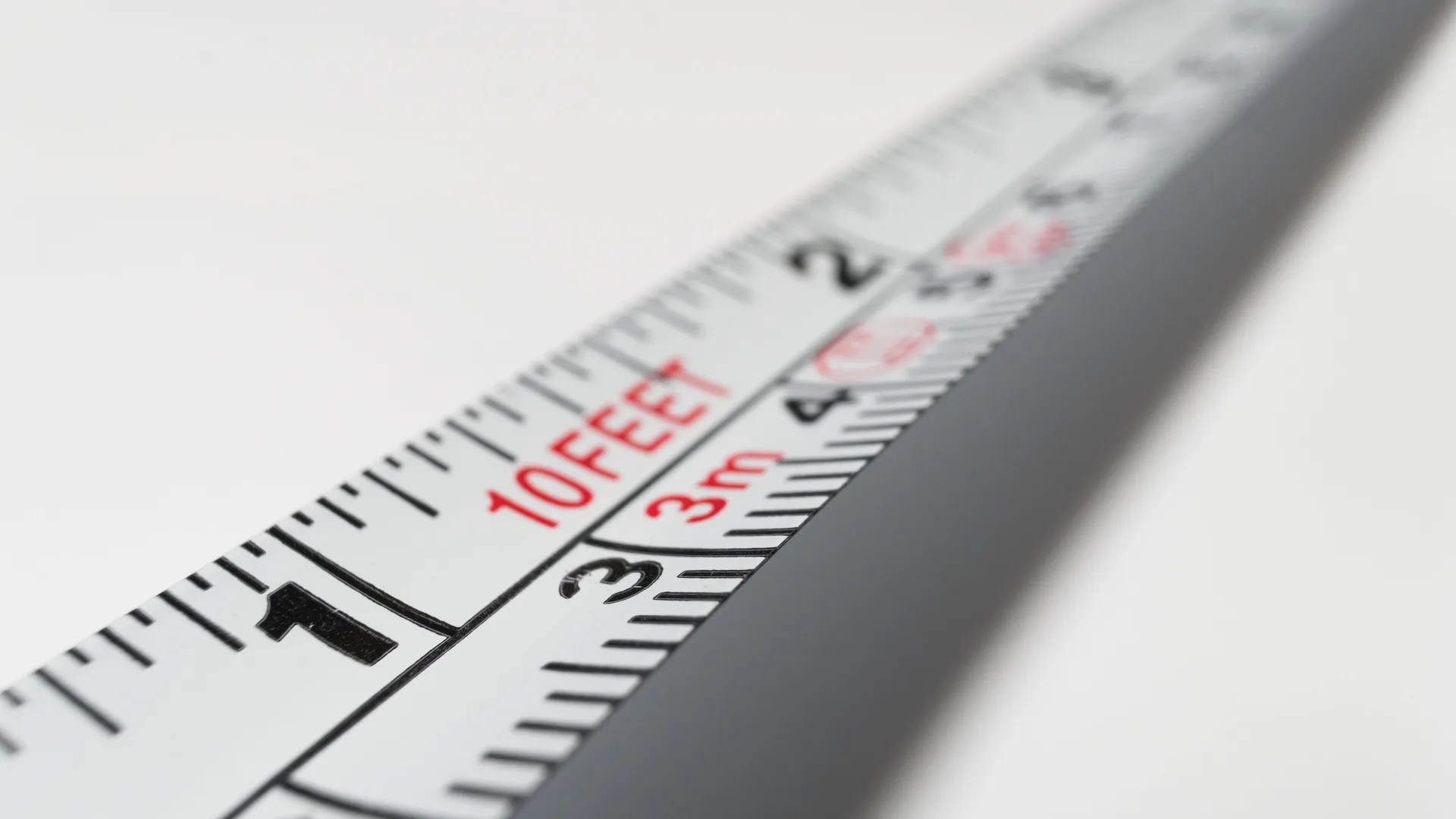
What a Cattell IQ score means on the Wechsler scale
A Cattell IQ test reports on a scale with a standard deviation of 24, so its numbers run higher than a Wechsler score of the same rank: a Cattell 148 and a Wechsler 130 mark the same place. This page converts scores with the arithmetic shown, lists which tests use the scale, sets out Mensa and Triple Nine Society cutoffs, and shows how to read an unlabeled score.
One length, two units: the same rank reads 148 on a Cattell scale with SD 24 and 130 on a Wechsler scale with SD 15.
0 The short answer
A Cattell IQ test reports on a scale with a mean of 100 and a standard deviation of 24, not 15, so a Cattell 148 and a Wechsler 130 both sit two standard deviations above the mean, at about the 98th percentile. To convert a Cattell score, subtract 100, multiply by 0.625 and add 100 (our arithmetic), and first check which Cattell test produced the number, because the Triple Nine Society table read on October 29, 2026 lists three different Cattell entries with three different cutoffs. The real routes to a Cattell scale result are supervised sessions such as Mensa's, while ACIS is a normed online battery that reports on the standard scale with a percentile and a 95 percent confidence interval, for 15 dollars (Quick, about 45 minutes), 30 dollars (Optimized, about 110 minutes) or 50 dollars (Full Scale, about 175 minutes), prices read on October 29, 2026. The decisive limit is that ACIS is online and unsupervised and it is not for admission to high IQ societies, so it can tell you where you stand on the SD 15 scale but cannot replace a supervised administration.
24
Standard deviation of the scale used by the Cattell IIIB and the old form of Raven's Advanced Progressive Matrices, as stated by American Mensa's supervisory psychologist, against 15 for the Wechsler scales.
148
The Cattell score American Mensa and Mensa Canada list for qualifying, the same rank as a Wechsler 130 (both are 2.0 standard deviations above 100, our arithmetic).
0.625
The factor that turns Cattell points above or below 100 into SD 15 points: 15 divided by 24 (our arithmetic).
1 What Is a Cattell IQ Test, and Why Does One Name Cover Several Tests?
"Cattell IQ test" is a family name, not the title of one instrument, and the word "Cattell" on a score report can point to a verbal paper, a culture-reduced reasoning test or a revised edition sold by a publisher today, each with its own norms. The clearest evidence is a single admissions table. The Triple Nine Society's accepted test scores page, opened on October 29, 2026, lists three separate Cattell rows: a combined raw score of 85 on Forms A and B, marked as not valid for test dates after January 2, 2015; the "Cattell Intelligence (verbal) Test, Scale IIIB" at 173; and the "Cattell CFT 20-R Grundintelligenztest" at 146. Three entries carry one surname and three unrelated numbers, because they are three different tests with their own scoring.
American Mensa and Mensa Canada compress the same family into one line. The American Mensa qualifying scores table, read on October 29, 2026, has a single row, "Cattell", with a qualifying score of IQ 148 under tests administered by private psychologists. Mensa Canada's prior evidence page, read the same day, shows the same single row at the same number. Neither page names a form, so a reader holding a result called "Cattell" cannot tell from the table which paper it was.
The name goes back to Raymond Cattell, and the publisher of the CFT 20-R documents the lineage. Hogrefe's product page for the CFT 20-R, opened on October 29, 2026, lists a 2018 edition by Raymond B. Cattell and Rudolf H. Weiß, says it was originally developed by Cattell, gives its age range as 8 years and 6 months to 17 years and its administration time as approximately 60 minutes, and describes two parallel parts of four subtests each: series continuation, classification, matrices and topological conclusions. The same page lists it at 195 dollars plus tax. That is a different object from a society's supervised adult session, and it is one reason a "Cattell score" needs a form, an edition and a date before it means anything.
Two other people share the name in this field. James McKeen Cattell created what the Mensa International page on IQ calls the first mental test, in 1890, and he is a different person from Raymond Cattell. Raymond Cattell wrote The measurement of adult intelligence in Psychological Bulletin in 1943, and the 1963 paper on fluid and crystallized intelligence discussed later on this page. The page on the history of IQ testing places that work in the longer story from Binet to Wechsler.
This page does not describe the Culture Fair test as a test. How its four formats work, what it can and cannot measure and why no test is culture-free are covered on the page on the Culture Fair IQ test, and nothing here reproduces an item from any version.
DisclosureACIS sells a paid cognitive assessment, so this page has a commercial interest and names ACIS as one option among several. Every third party fact, cutoff and price below comes from a document named in the text and opened on October 29, 2026. Cutoffs and prices can change. Any figure we calculated ourselves is labeled as our arithmetic.
2 What Is the Cattell IQ Scale, and How Does a Standard Deviation of 24 Differ From 15?
The Cattell IQ scale is a way of reporting rank in which 100 is the average and every 24 points is one standard deviation, so it uses the same center as the Wechsler scale but a longer ruler. An IQ score is not a count of items solved. It is a transformed score, and the transformation is fixed by two numbers chosen by the test's authors: the mean and the standard deviation. The Mensa International page on IQ, opened on October 29, 2026, says the average of a norming sample was defined as IQ 100 and the spread was defined as, for example, 16 or 24 IQ points above or below it. The words "defined" and "for example" are the point: the unit is a convention of the test, not a law of nature.
Pearson's 2023 primer, Standardized Clinical Assessment for Practitioners, puts the same idea in practical terms. It says standard scores are "standard" because the raw scores are transformed so that the mean and standard deviation take predetermined values, with a mean of 100 and a standard deviation of 15 as its example, and that a standard score of 70 means the same thing on every test normed with that 100 and 15 metric. That 100 and 15 metric is the one the page on the SD 15 scale treats as the default for the Wechsler scales and for ACIS.
The Cattell scale is a different metric. American Mensa's supervisory psychologist, Abbie F. Salny, writes in The Question of "Genius", read on October 29, 2026, that the Cattell IIIB and the old form of Raven's Advanced Progressive Matrices have a mean of 100 and a standard deviation of 24, while the Stanford-Binet and many school tests have a mean of 100 and a standard deviation of 16. The page carries no date. It is a reprint from the American Mensa website, so it describes the instruments as Mensa treats them, and it is the clearest primary statement of the SD 24 convention that we could open.
The consequence is that the three scales agree at the center and drift apart with distance. A person exactly average scores 100 on all of them. A person one standard deviation above average scores 115 on an SD 15 test, 116 on an SD 16 test and 124 on an SD 24 test. A person two standard deviations above scores 130, 132 and 148. In each case the person is in the same place in the population, if the three tests were normed on comparable groups; only the number printed on the report changes. Pearson's primer adds that one and two standard deviations above the mean are the 84th and 98th percentiles, and exact normal curve arithmetic puts them at 84.1 and 97.7 (our arithmetic), so "98th" is a rounded landmark.
Temperature can be reported in Celsius or Fahrenheit, and a bare "30" means nothing until the scale is named. IQ works the same way, except that the unit is a property of the norm sample that the publisher scaled to a convenient number. A bare IQ number should therefore never be compared with another bare IQ number. The page on how IQ scores are normed explains where the mean and standard deviation come from.
3 How Do You Convert a Cattell IQ Score to the Wechsler Scale?
To convert a Cattell score to the SD 15 scale, subtract 100, multiply by 15 and divide by 24 (that is, multiply by 0.625), then add 100; to go the other way, multiply the distance from 100 by 1.6. This is our arithmetic, not a published conversion table, and it rests on one assumption: that the person's rank in the Cattell norm group and in the Wechsler norm group would be the same, which holds only if both groups represent comparable populations and both score distributions are approximately normal. Under that assumption the standard score, the number of standard deviations from the mean, is the same on both scales. A Cattell 148 is (148 minus 100) divided by 24, which is 2.0 standard deviations. On the SD 15 scale, 2.0 standard deviations is 100 plus 2.0 times 15, which is 130.
The same method gives a table. Each row below converts a Cattell score (SD 24) into the equivalent on SD 15 and on the older Stanford-Binet convention of SD 16, then gives the share of a normal population below that score and the approximate odds of reaching it. All values are our arithmetic on the normal curve.
Cattell score (SD 24)
Standard deviations from 100
Wechsler scale (SD 15)
Older Stanford-Binet scale (SD 16)
Share of population below
Roughly 1 person in
76
minus 1.0
85
84
15.9 percent
6 at or below
88
minus 0.5
92.5
92
30.9 percent
3 at or below
100
0
100
100
50.0 percent
2
112
0.5
107.5
108
69.1 percent
3 at or above
124
1.0
115
116
84.1 percent
6 at or above
136
1.5
122.5
124
93.3 percent
15 at or above
148
2.0
130
132
97.7 percent
44 at or above
160
2.5
137.5
140
99.4 percent
161 at or above
172
3.0
145
148
99.9 percent
741 at or above
Three habits keep the table honest. First, the "1 person in" column describes a normal curve, not a head count, and Pearson's primer notes that percentiles and standard deviations line up as expected only for normally distributed constructs. Second, the further out a score sits, the less the number rests on data; the primer says a standard score is only as accurate as the mean and standard deviation of a sufficiently large norm sample. Third, a conversion is a statement about rank, not a promise that the person would earn the converted number on the other test, because each test has its own norms, reliability, content and time limits.
You can reproduce any row with a calculator. A Cattell 130 gives 100 plus 30 times 0.625, which is 118.75, so it is a Wechsler score of about 119, near the 89th percentile, a long way below the 130 it looks like. In the other direction a Wechsler 145 gives 100 plus 45 times 1.6, which is 172 on the Cattell scale. For a percentile instead of a scale, use the IQ percentile calculator, and for the reverse lookup the table that turns a percentile into an IQ. A chart of IQ score ranges and labels shows how SD 15 scores are grouped.
4 Why Do a Cattell 148 and a Wechsler 130 Describe the Same Rank?
A Cattell 148 and a Wechsler 130 describe the same rank because each sits exactly two standard deviations above 100 on its own scale, and Mensa publishes both numbers as its bar for the top 2 percent. The evidence is on Mensa's own pages. The American Mensa table read on October 29, 2026 lists IQ 148 for the Cattell, a Full Scale IQ of 130 for the Wechsler scales, IQ 132 for the Stanford-Binet and IQ 130 for the Stanford-Binet 5. The Mensa International page says that qualifying in the top 2 percent means scoring 132 or more on the Stanford-Binet or 148 or more on the Cattell equivalent. Salny's article adds that the 148 represents exactly the same 98th percentile as 132 on the Stanford-Binet scale, and that Mensa requires 148 for the Cattell IIIB because its standard deviation is 24.
The arithmetic behind that agreement is short. On SD 24, 148 is 48 points above 100, which is 2.0 standard deviations. On SD 16, 132 is 32 points above 100, also 2.0. On SD 15, 130 is 30 points above 100, again 2.0. A score two standard deviations above the mean has about 97.7 percent of a normal population below it, so all three mark the same standing (our arithmetic). The exact 98th percentile is slightly higher than these landmarks: 130.8 on SD 15, 132.9 on SD 16 and 149.3 on SD 24 (our arithmetic). The published whole numbers should therefore be read as the two standard deviation landmark that Mensa rounds to "98th percentile" or "top 2 percent", not as an exact cut.
Reading the numbers in the wrong direction shows how much the scale matters. A Cattell 148 mistaken for a Wechsler score would sit 3.2 standard deviations above the mean, about 1 person in 1,455 (our arithmetic), when the true rank is about 1 in 44, so the mistaken reading makes the person about 33 times rarer than they are. A Wechsler 130 mistaken for a Cattell score would be only 1.25 standard deviations above the mean, near the 89th percentile and about 1 person in 9. The page on how rare a given IQ is runs this kind of lookup for the SD 15 scale. The mismatch is also why IQ scores and percentiles cannot simply be averaged or compared without naming the scale.
Salny's worked example is the cleanest illustration in print. She writes that a 178 on the old Cattell IIIB is equivalent to 152 on the Stanford-Binet. Both numbers are 3.25 standard deviations above 100, on standard deviations of 24 and 16. On the SD 15 scale the same position is 148.75, about 148.8 (our arithmetic), roughly 1 person in 1,700. The headline number for the same person could therefore be anywhere from 148 to 178, depending on the instrument, and the person's rank would not change. A reader who sees "178" in a news story, a forum post or a certificate without the test name has been given a figure that cannot be interpreted.
One caution stops the rule from being stretched too far: "same rank" assumes comparable norm groups. A Cattell norm sample and a Wechsler norm sample may differ in country, age range and the years they were collected. The Standards for Educational and Psychological Testing (AERA, APA and NCME, 2014), which this page reads in the section on where ACIS sits, ask in Standard 5.8 that norms refer to clearly described populations, and a bare score does not carry that description.
5 Which Tests Report on the Cattell Scale, and Which Do Not?
Only some Cattell branded tests and a few older reasoning tests are documented as reporting on a standard deviation of 24, and for most other well known instruments the published listings point to SD 15 or SD 16. The table below collects what the pages opened on October 29, 2026 actually state. It separates a scale that a source states in words from a scale we infer from a cutoff, because the second kind is weaker evidence.
Test or family
Scale or listing found
Where it was stated
Cattell IIIB
Mean 100, SD 24; qualifying score 148 at American Mensa and Mensa Canada, 173 at the Triple Nine Society
Salny (American Mensa); Mensa tables; Triple Nine Society table
Raven's Advanced Progressive Matrices, old form
Mean 100, SD 24
Salny (American Mensa)
Other Cattell Culture Fair scales and forms
Mensa lists one "Cattell" row at 148 with no form named; the Triple Nine Society lists a combined raw score of 85 on Forms A and B, not valid for test dates after January 2, 2015; the scale itself is not stated in any manual we opened
Mensa tables; Triple Nine Society table
CFT 20-R (Cattell and Weiß, 2018 edition)
Triple Nine Society cutoff of 146, the same number it lists for the Wechsler Full Scale IQ and the Stanford-Binet 5; this fits SD 15 but is our inference, not a statement from the publisher
Triple Nine Society table; Hogrefe page
Stanford-Binet, older forms, and many school tests
Mean 100, SD 16; Mensa qualifying score 132; Triple Nine Society 149 for Form LM and the SB-IV
Salny; Mensa tables; Triple Nine Society table
Stanford-Binet 5
Mensa qualifying score 130; Triple Nine Society 146
Mensa tables; Triple Nine Society table
Wechsler scales
Mensa Full Scale IQ 130; Triple Nine Society 146; mean 100 and SD 15 is Pearson's own example of a standard score metric
Mensa tables; Triple Nine Society table; Pearson primer
The pattern in the cutoffs is itself a check on the scale. The Triple Nine Society lists 146 for the Wechsler Full Scale IQ, 149 for the Stanford-Binet SB-IV and 173 for the Cattell IIIB. Those sit at 3.07, 3.06 and 3.04 standard deviations above 100 on SD 15, SD 16 and SD 24 respectively (our arithmetic), so all three ask for roughly the same rank, between about 1 person in 850 and 1 in 920. A 173 on the Cattell IIIB is a 145.6 on SD 15 (our arithmetic). When two tests' cutoffs differ by close to the ratio of their standard deviations, that is the signature of a shared rank.
The row that deserves the most caution is the Culture Fair one. It is the instrument most people mean by "Cattell culture fair test", yet the American Mensa and Mensa Canada tables give it no row of its own, and Mensa's psychologist names the Cattell IIIB, not the Culture Fair scales, when she states the standard deviation of 24. We therefore cannot say from an opened source that every Culture Fair form uses SD 24, and we do not. If you hold a Culture Fair result, the report or manual for your form and edition is the only reliable statement of its scale. Nonverbal tests from other publishers, such as the TONI-4 and the CTONI-2, have their own guides, and the same rule applies to each.
6 How Should You Read a Cattell Score That Does Not State Its Scale?
A score that does not name its test, its form and its standard deviation cannot be placed on any rank, and the honest range of meanings for an unlabeled number is wide. Take the number 145. On SD 15 it is 3.0 standard deviations above the mean, about 1 person in 741. On the Cattell scale it is only 1.88 standard deviations above 100, about 1 person in 33 (our arithmetic). The same two digits span a factor of more than twenty in rarity, and the page on the SD 15 scale makes the same point with other examples. That is the whole case for the five checks below.
Find the instrument. The name of the test, the form (for the Culture Fair family, the scale and whether Form A or B), the edition and the year it was normed. A "Cattell IQ" without these is a surname, not a test.
Find the mean and standard deviation. A report, a manual or a society's table states them. If a source such as Salny's article states the convention for that instrument, as she does for the Cattell IIIB, the check is done. If not, the scale is unknown.
Convert to standard deviations from the mean. Subtract 100 and divide by the standard deviation. This number is the same on every scale, so it is the one to compare.
Convert to a percentile, and compare percentiles. A percentile does not depend on the scale. The IQ score chart shows how SD 15 scores are labeled and grouped, and this page does the conversion for SD 24.
Ask for the error band. A single number hides the uncertainty around it, which the section on precision explains.
A number that fails step 2 should be treated as unanchored. That is not a verdict that the score is false; it is a statement that no one can interpret it. Salny makes the same point in plain words: a score means nothing without the name of the test that produced it. The consequence for the common search "Cattell IQ test max score" is that no single maximum exists. The ceiling is a property of a particular test's norm table, and the Triple Nine Society states one such ceiling: it lists Mensa UK's Cattell IIIB scores as not suitable for its own admission because that test goes only up to 161. On SD 15 a 161 on that paper is a 138.1, about 2.54 standard deviations and 1 person in 181 (our arithmetic). A 161 is a ceiling score on that paper, not a sign of a rank beyond measurement.
7 What Do Mensa and Triple Nine Society Cutoffs Show About the Cattell Scale?
Societies publish a different number for each test because they fix a percentile, not a score, and the Cattell cutoffs are the visible trace of the SD 24 scale. The table below sets out the Cattell and comparison rows from each page opened on October 29, 2026. None of the pages carries a publication date beyond a 2026 copyright line, so the date is the date we read them. These are society rules for admission, not statements about the quality of the tests.
Page (read October 29, 2026)
Cattell entry
Wechsler and Stanford-Binet entries
Other statements
American Mensa, qualifying test scores
Cattell, IQ 148, under tests administered by private psychologists
Tests must be given by a neutral and qualified third party in a traditional testing environment; Wechsler tests must be given in their entirety; the table also has a row for the Armed Forces Qualification Test
Mensa Canada, prior evidence
Cattell, IQ 148
Same four rows as American Mensa
Assessment fee of 90 dollars; no unsupervised or internet test is accepted as prior evidence
Mensa International, what is IQ
148 or more in the Cattell equivalent
132 or more on the Stanford-Binet
Top 2 percent is the bar
Triple Nine Society, accepted test scores
Cattell IIIB, 173; Cattell CFT 20-R, 146; Cattell A and B combined raw score, 85 (not valid for test dates after January 2, 2015)
Wechsler FSIQ 146; SB-5, 146; SB-IV, 149
Mensa UK Cattell IIIB scores are listed as not suitable because that test goes only up to 161; no exceptions to the minimum qualifying scores
Mensa's side of the table is the one most searchers want. American Mensa's testing page says that a qualifying score means you have tested at or above 98 percent of the general population, and the cutoffs it lists are the two standard deviation landmarks discussed above. The page on what score Mensa asks for and how to estimate yours owns that topic, and the comparison of high IQ society requirements puts Mensa beside the other societies. This page adds only the scale lesson: a Mensa qualifying score is not a number to chase on any test, it is a rank, and the number that corresponds to it is different on each test.
The Triple Nine Society column shows two further lessons. Cutoffs expire: the Cattell raw score of 85 is marked invalid for test dates after January 2, 2015, and a Wechsler row carries a similar note about an older edition. Test lists change as norms age, so a society's current page, not a summary written elsewhere, is the authority. And a ceiling matters: when a test's top score sits below a society's bar, as the Triple Nine Society says of Mensa UK's version, no result on it can qualify, however well a candidate performed. A test built to reach beyond common ceilings is a different design problem, and the page on high range IQ tests covers it.
8 What Does a Cattell Style Test Measure in CHC Terms?
A nonverbal Cattell style test samples mainly fluid reasoning (Gf), the broad ability that Cattell's own theory separated from crystallized intelligence (Gc), while a verbal paper draws on words and acquired knowledge, so the two should never be pooled as one "Cattell IQ". The distinction is Cattell's. His 1963 paper in the Journal of Educational Psychology is titled Theory of fluid and crystallized intelligence: A critical experiment, and Horn and Cattell followed it in 1966 with Refinement and test of the theory of fluid and crystallized general intelligences, in the same journal. Those titles carry the Gf and Gc labels that the Cattell-Horn-Carroll model, explained on the page on the CHC model, still uses. In CHC terms, fluid reasoning is solving problems that rest on no prior teaching, and crystallized intelligence is the store of acquired knowledge and its use, which is why vocabulary and general information tasks load on it.
The Hogrefe page described above gives the structure of the CFT 20-R as four subtests: series continuation, classification, matrices and topological conclusions. The subtest names describe figural problems, the design of a test that leans on novel reasoning more than on word knowledge. The Triple Nine Society, by contrast, labels the Cattell IIIB a verbal test. The same surname therefore covers an instrument built around figures and another built around language, and a result from one says little about the other. The page on fluid versus crystallized intelligence sets the two side by side, and it is one reason ACIS reports six domains instead of one number.
A fluid reasoning test is narrower than a battery, and this is the main substantive limit of any single Cattell style score. It returns one broad ability. A Full Scale IQ from a battery blends several abilities and also reports each of them, so a reader can see whether reasoning, vocabulary, working memory or speed is driving the total. A reader who wants the single fluid reasoning number can find it in a battery too. ACIS organizes its Fluid Reasoning Index (FRI) around five subtests, each with its own page. Matrix Reasoning is described there as inferring a missing element from the rule structure in a pattern of shapes, and its page places it under fluid reasoning, inductive reasoning and visual rule detection. Figure Weights asks for the quantitative rule that balances a visual analogy. Visual Number Series asks for the rule that generates a sequence, Logic Grid asks for deduction under several constraints, and Complex Relations asks for several abstract relationships to be combined at once. Quick includes Matrix Reasoning and Figure Weights; Optimized adds Logic Grid; Visual Number Series and Complex Relations are in the Full Scale form only.
The Wechsler batteries also report a fluid reasoning index, discussed on the page on the Fluid Reasoning Index. A stand alone fluid reasoning test suits a question purely about novel problem solving, for example when language is a barrier; a battery suits the question "where am I strong and where am I weak". Neither measures everything people mean by being smart, and the CHC model treats fluid reasoning as one broad ability among several.
9 How Precise Is a Cattell Score, and What Does the Wider Scale Do to Error?
A Cattell score is exactly as uncertain as any other IQ score in rank terms, but its error band is 1.6 times wider in points because each point is smaller, so a plus or minus 8 on the Cattell scale is the same band as a plus or minus 5 on SD 15. The multiplier is our arithmetic: 24 divided by 15 is 1.6, and 5 times 1.6 is 8. Pearson's 2023 primer explains where such bands come from. It says that the confidence interval is a range around an obtained score that includes the examinee's true score with 90 or 95 percent likelihood, that it is derived from the standard error of measurement (SEM), and that the higher the reliability the smaller the SEM and the narrower the interval. It also gives "plus or minus 5 points" as the kind of critical value a test may report.
Because a change of scale stretches every quantity expressed in score points, the SEM and the width of a confidence interval grow by the same factor when the standard deviation grows. A Cattell score of 148 with a band of plus or minus 8 spans about 140 to 156, which converts to roughly 125 to 135 on SD 15 (our arithmetic), the same span as 130 plus or minus 5. The wider scale makes the printed numbers larger, not the measurement more or less discriminating, so comparing a Cattell band with a Wechsler band of the same printed width is a false comparison.
The Standards for Educational and Psychological Testing (AERA, APA and NCME, 2014), opened on October 29, 2026 from the open access copy at testingstandards.net, ask for the same discipline. Standard 2.13 says the standard error of measurement should be provided in units of each reported score, and Standard 6.10 says that when scores are released the interpretations should describe in simple language what the test covers, what scores represent, the precision of the scores and how they are intended to be used, and that precision may be depicted by error bands or likely score ranges. A score without a band, or a band quoted in a scale the reader cannot identify, falls short of both.
Three further sources of error are particular to the Cattell family. First, alternate forms. The Hogrefe page describes the CFT 20-R as two parallel parts, and the Triple Nine Society table lists a Cattell test with Forms A and B. Standard 5.12 says a clear rationale and supporting evidence should be provided for any claim that scale scores earned on alternate forms may be used interchangeably, so a retest on a different form is not automatically comparable. Second, modification. In a 2022 study in Children, Visser and colleagues evaluated an online version of the CFT 20-R in third and fourth grade children. The online version dropped the topological conclusions subtest because it could not be transferred for technical reasons, and the authors built their own grade norms for it, which illustrates why a changed test cannot simply borrow the original norms. Third, extremes, discussed with the conversion table above.
Precision is also why a single subtest or a single index is a weaker basis for a life decision than a battery. The page on reliability and validity in IQ testing walks through the difference.
10 Can You Take a Cattell IQ Test Online or for Free, and What Are the Real Options?
The Cattell instruments whose publisher or society pages we opened are supervised or sold through a publisher, so a free or unsupervised page can offer an estimate on its own scale but not a score that a society or a clinician would accept. The table below lists the real options for an adult who wants a Cattell scale result or a rank on any scale. Prices and times are those printed on the pages we opened on October 29, 2026, and they can change. Where a page is silent, the cell says so.
45 minutes for the 7 subtest FSIQ, 60 minutes for the 10 primary index subtests
Clinician fee not stated; Pearson lists the print kit at 1,784 dollars and a qualification level of C
Scores derived through Pearson's Q-global scoring platform
Hogrefe CFT 20-R
Four subtests (series continuation, classification, matrices, topological conclusions) in two parallel parts
Ages 8 years 6 months to 17 years, with UK specific norm groups
Examiner administered
About 60 minutes
195 dollars plus tax for the product
The test materials
Free page labeled "Cattell"
Unknown unless the page documents it
Unknown unless the page documents it
No
Varies
Free
A number on a scale the page may not state
Job screening practice test
Practice for an employer's aptitude test; not an IQ test
None
No
Varies
Varies
Practice, not a norm referenced score
ACIS Quick, Optimized or Full Scale
Quick: 6 subtests in 3 domains; Optimized: 13 subtests in 5 domains; Full Scale: 20 subtests in 6 domains
Adults aged 16 to 90, reported on mean 100 and SD 15
No
About 45, 110 or 175 minutes
15, 30 or 50 dollars one time
Full Scale IQ with its 95 percent confidence interval, percentiles and, where the subtests are available, index scores
Two practical points follow. American Mensa's testing page lists regular prices of 60 dollars for a local group session and 99 dollars for a private one, read on October 29, 2026. And no supervised entry is a Cattell test by its own page: the Mensa UK page does not name the paper, so ask the society which paper is used before booking.
A free online page cannot be judged from its title. The test is what it publishes: the name and edition of the instrument, the norm group, the mean and standard deviation, and an error band. A page that gives a bare "Cattell IQ" fails the first check above, and its number cannot be set beside a society cutoff. The guide to where to take an IQ test compares the options at length, and the page on IQ tests for adults covers the adult norming question. American Mensa's table also has an Armed Forces Qualification Test row, a route the page on the military IQ test covers.
11 What Should You Do With a Cattell Score You Already Hold?
If you already hold a Cattell score, recover the test name, form, edition, date and scale from the report, convert the score to standard deviations and a percentile, and keep the original number and the converted one together. The first step is to find the document. A score report or certificate from a supervised session should name the instrument and its scale, and the body that issued it is the place to ask which paper was used. The second is to apply the conversion above. For a Cattell IIIB result, the SD 24 convention that Salny states applies. For a Culture Fair result, confirm the scale from the report or manual before converting, because we found no opened source that states it for every form.
Then report honestly. A score should travel with its scale: "148 on the Cattell scale (SD 24), about the 98th percentile" is interpretable, while "148" is not. A converted figure is our arithmetic on a rank, so "about 130 on the Wechsler scale" should be presented as an equivalence, not as a score earned on a Wechsler test. Averaging a Cattell number with a Wechsler number is an error for the reason in the page on IQ scores and percentiles: the two numbers are in different units. If you have several results, convert each to a percentile or to a z score first, then compare.
Dates and norms matter. The Triple Nine Society expiry notes show that lists and norms move, and Standard 5.11 puts on the publisher the duty to renorm often enough for accurate interpretation while leaving the user responsible for avoiding out of date norms. An old Cattell score may be an accurate record of what happened and still a poor guide to rank today, so check the instrument's current status with the body that will rely on it.
If you decide to take a new, normed assessment to see where you stand on the SD 15 scale, conditions in an unsupervised session matter. Use a laptop or desktop in a quiet room, and check the sound before you begin, because Digit Span, Alphanumeric Sequencing and Arithmetic present their items as audio and need working sound. ACIS allows breaks, saves progress between subtests and gives 30 days to complete a form. None of this makes an unsupervised session equivalent to a supervised one, and the result is an estimate of where you stand, to be read with its confidence interval.
12 Where ACIS Sits, and What a Buyer Should Do
ACIS is a normed online battery that reports on the standard scale with a mean of 100 and a standard deviation of 15, not a Cattell test, and it cannot replace the supervised administration that a society or a clinician requires. We sell the assessment, so this section is a disclosure. ACIS has 20 subtests in six CHC domains and reports a Full Scale IQ and up to six primary indices (VCI, FRI, QRI, VSI, WMI and PSI). Every form reports a Full Scale IQ with its 95 percent confidence interval, and results include percentiles and scaled subtest scores from 1 to 19. Adult norms cover ages 16 to 90. Prices read on October 29, 2026 are 15 dollars for Quick (6 subtests in 3 domains, about 45 minutes), 30 dollars for Optimized (13 subtests in 5 domains, about 110 minutes) and 50 dollars for Full Scale (all 20 subtests, about 175 minutes), one time and with no subscription. Custom Test lets a buyer pick subtests at 5 dollars each, and at 10 subtests the Full Scale form costs the same. The free trial needs no card and is limited to one per person.
The limits belong beside those strengths. ACIS is online and unsupervised. It is not a clinical or diagnostic instrument. It is not for hiring, school accommodations or admission to high IQ societies, and it is offered in English only; the technical manual notes that verbal and knowledge tasks are affected by English proficiency and educational exposure. It does not report on the Cattell scale, so a result cannot be placed beside a Cattell cutoff without a conversion like the one above, and that conversion carries the assumptions in this page.
The Standards for Educational and Psychological Testing (AERA, APA and NCME, 2014) give the test for any score that is presented to a reader, ACIS included. Standard 5.1 says users should be given clear explanations of the characteristics, meaning and intended interpretation of scale scores, and their limitations. Standard 5.3 says that where specific misinterpretations of a score scale are likely, users should be explicitly cautioned, and the confusion between SD 15 and SD 24 is a clear example. Standard 5.8 asks that norms refer to clearly described populations, and Standard 6.10 asks for plain language about what a test covers, what scores represent and how precise they are. APA is one of the three sponsoring organizations of the Standards, and the principle in them is the one this page applies throughout: a score is only as interpretable as the information that travels with it. ACIS documents its construction and reporting in the technical manual, and a buyer should read it, and this page, before relying on any number, ours included.
What a buyer should do depends on the goal. For society membership, book the society's own supervised test or submit prior evidence from an approved supervised test, after checking its current list. To place a Cattell score you already hold, convert it as shown above. To see where you stand on the SD 15 scale with a percentile and an interval, start the free trial, which needs no card, or open the Full Scale example report first. ACIS's guarantee reads: "Full refund within 5 days if the report does not deliver the features described at checkout or a technical issue prevents you from accessing your results." It is not an unconditional money back guarantee.
Every figure above is traceable to one of the following, each linked at the point where it is used, and every conversion, percentile and "1 person in" figure that is not in a source is labeled as our arithmetic. Web pages were opened on October 29, 2026 and can change. Prices and cutoffs are those printed on the day.
American Educational Research Association, American Psychological Association and National Council on Measurement in Education. Standards for Educational and Psychological Testing. Washington, DC: American Educational Research Association, 2014 (open access copy at testingstandards.net; Standards 2.13, 5.1, 5.3, 5.8, 5.11, 5.12 and 6.10).
There is no single Cattell IQ test. The name covers a family of tests associated with Raymond Cattell, including a figural Culture Fair series and a verbal Scale IIIB. Their scores are reported on a scale with a standard deviation of 24, so always ask which Cattell test produced a number.
What is the Cattell IQ test scale?
The Cattell IIIB uses a mean of 100 and a standard deviation of 24, according to American Mensa's supervisory psychologist. One standard deviation is therefore 24 points, against 15 on the Wechsler scales and 16 on older Stanford-Binet forms. The center is the same, but the spread is wider.
What is the maximum score on a Cattell IQ test?
No single maximum applies to every Cattell test, because each test's norm table sets its own ceiling. The Triple Nine Society says Mensa UK's Cattell IIIB scores only go up to 161. That is about 138 on the SD 15 scale, by our arithmetic.
Is the Cattell Culture Fair test the same as the Cattell IQ test?
Not exactly. The Culture Fair test is one member of the Cattell family, built around abstract figures. The Triple Nine Society lists the verbal Scale IIIB, the CFT 20-R and a combined Forms A and B raw score as three separate entries, so the form and edition must be named.
Can you take a Cattell IQ test online?
Mensa UK lists an online supervised IQ test of about 1½ hours at 49 pounds, read October 29, 2026, though its page does not name the paper. Mensa Canada accepts no unsupervised or internet test as prior evidence, so an unsupervised online page will not count toward admission.
Is there a free Cattell IQ test?
A free page can only be judged by what it publishes: the instrument and edition, the norm group, the mean, the standard deviation and an error band. Without these its number cannot be set beside a society cutoff, and the societies we checked accept only supervised results.
How do you convert a Cattell IQ to a Wechsler score?
Subtract 100 from the Cattell score, multiply by 0.625, then add 100. A Cattell 148 becomes 130. This is our arithmetic on equal rank, assuming comparable norm groups and approximately normal score distributions. It describes where the person stands, not a score they would earn on a Wechsler test.
What is a Cattell IQ of 148 on the Wechsler scale?
A Cattell 148 equals a Wechsler 130 in rank, because both sit 2.0 standard deviations above 100, near the 97.7th percentile by our arithmetic. American Mensa lists 148 for the Cattell and 130 for the Wechsler scales as its qualifying scores, read October 29, 2026.
How rare is a Cattell score of 160?
A Cattell 160 is 2.5 standard deviations above 100, which equals 137.5 on the SD 15 scale and about 1 person in 161 on a normal curve, by our arithmetic. A Wechsler 160 is 4 standard deviations out, about 1 person in 31,000, which is far rarer.
What did Mensa's psychologist say about a 178 on the Cattell IIIB?
Abbie Salny wrote that a 178 on the old Cattell IIIB is equivalent to 152 on the Stanford-Binet. Both lie 3.25 standard deviations above 100, on standard deviations of 24 and 16. On the SD 15 scale that position is about 148.8, by our arithmetic.
What Cattell score does Mensa require?
American Mensa and Mensa Canada list a Cattell qualifying score of IQ 148, and the Mensa International page says 148 or more on the Cattell equivalent, all read October 29, 2026. Those pages are undated and lists change, so confirm the current table with the chapter before relying on it.
What does the Triple Nine Society list for Cattell tests?
Its table, read October 29, 2026, lists 173 for the Cattell IIIB, 146 for the CFT 20-R and 85 for the Cattell Forms A and B combined raw score, the last marked not valid for test dates after January 2, 2015. It also lists Mensa UK's version as unsuitable.
What is the CFT 20-R?
The CFT 20-R is the version sold by Hogrefe, listed as a 2018 edition by Cattell and Weiß for ages 8 years 6 months to 17 years. It has two parallel parts of four subtests each, takes about 60 minutes, and is priced at 195 dollars on its product page.
Which tests use a standard deviation of 24?
Salny names the Cattell IIIB and the old form of Raven's Advanced Progressive Matrices as having a mean of 100 and a standard deviation of 24. She gives 16 for the Stanford-Binet and many school tests. Wechsler scores use 15. For any other test, check its manual.
Does a higher Cattell number mean higher intelligence than a Wechsler number?
No. A larger number on the Cattell scale reflects its longer unit, not greater ability. A Cattell 124 and a Wechsler 115 are the same rank, one standard deviation above the mean. Compare percentiles or standard deviations from the mean, never the raw numbers across scales.
How accurate is a Cattell IQ score?
Like any IQ score, it carries a measurement error that a confidence interval expresses. Because Cattell points are smaller, the band is 1.6 times wider in points, so plus or minus 8 on that scale matches plus or minus 5 on SD 15, by our arithmetic. Extreme scores are less certain.
What should I do if my score does not state its scale?
Find the test name, form, edition and year, then its mean and standard deviation. Without them the number is unanchored: a 145 could mean about 1 person in 741 on SD 15 or about 1 in 33 on SD 24. Ask the examiner or publisher before using it.
Does an online IQ test count for Mensa?
Not for Mensa Canada, which accepts no unsupervised test or test taken over the internet as prior evidence. American Mensa asks for a neutral and qualified third party in a traditional testing environment. An unsupervised online result, whatever its scale, will not satisfy either, per the pages read October 29, 2026.
What does ACIS report instead of a Cattell score?
ACIS reports a Full Scale IQ and up to six indices on a scale with a mean of 100 and a standard deviation of 15, with percentiles and a 95 percent confidence interval. It does not report on the Cattell scale, and a Cattell number needs converting before comparison.
Is a wider IQ scale better at telling high scores apart?
No. Moving from SD 15 to SD 24 only changes the unit, so the same ranks get larger numbers. Whether a test separates high performers depends on its item difficulty, its reliability and the size and quality of its norm sample at the top, not on the printed number.
Should I take a fluid reasoning test or a full battery?
A fluid reasoning test answers one question about novel problem solving, which suits cases where language is a barrier. A battery shows several abilities at once and reveals what drives the total. Neither is a diagnosis, and neither replaces a supervised administration when a society or clinician requires one.
Take the assessment
You get a profile, not a number
ACIS measures six CHC domains across 20 subtests and reports each one with its own normed score and confidence interval, so you can see where you are strong and where you are not.