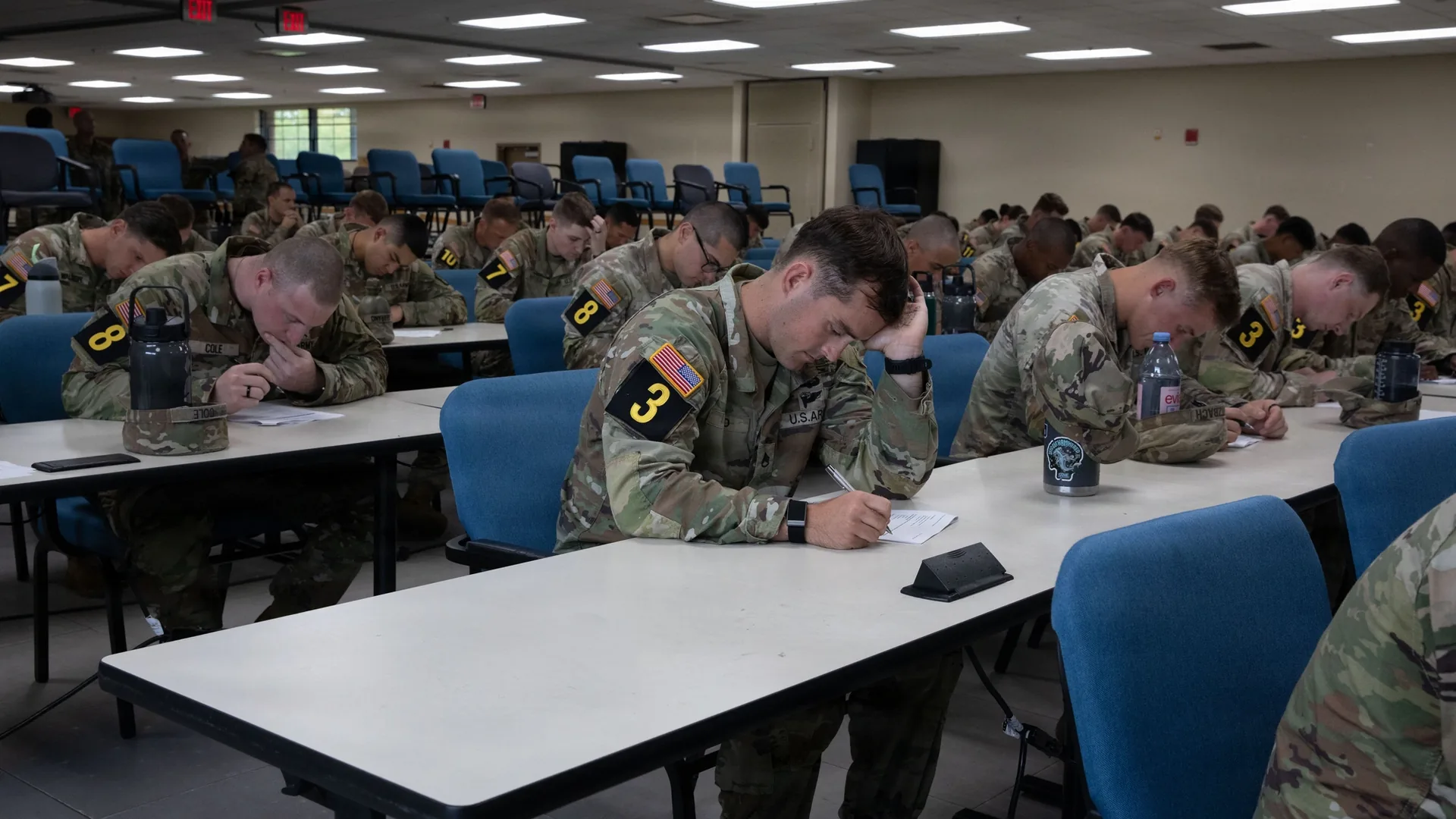
The military IQ test: what the AFQT, Danish and Army tests measure
There is no single military IQ test. Armies use aptitude and classification tests, such as the AFQT inside the ASVAB in the United States and the group tests given to conscripts in Denmark, Norway and Finland, and researchers later reused those scores to study intelligence. This page sets out what each test was built to do, what the data showed, what a score cannot say, and what to take instead.
By January 31, 1919, the U.S. Army had given a psychological examination to 1,726,966 men (Yerkes, 1921).
0 The short answer
There is no single military IQ test: armies use aptitude and classification tests built to sort people for service, and researchers later reused some of those scores as stand-ins for intelligence. In the United States the number that counts is the AFQT, a percentile from four ASVAB subtests, and the Office of People Analytics says the battery was designed to predict success in military training and job performance, while Denmark, Norway and Finland have tested conscripts with their own group tests for decades. None of them returns a personal IQ, and the conversion question is answered on the page about how the AFQT relates to IQ. ACIS is not an enlistment test; as a normed online battery it is one option for the curious, at 15, 30 or 50 dollars for about 45, 110 or 175 minutes (prices read October 29, 2026).
1,726,966
Men given a psychological examination in the US Army before January 31, 1919, according to Yerkes (1921).
0 to 78
The total score range of the older Danish draft board test, Børge Priens Prøve, as described by Teasdale and Owen (2008).
0.77
The test retest reliability Teasdale and colleagues (2011) report for that Danish test.
"Military IQ test" names three different kinds of instrument: a selection score such as the AFQT, a conscription test given to a whole age group of young men, and a historical group test such as Army Alpha, and none of them was built to hand a person an IQ. Someone who types "army IQ test" or "military IQ test scores" usually means the first. The second is how Denmark, Norway and Finland have tested young men for decades, and it is the source of the "Danish army IQ test" that researchers cite, written in English as the Boerge Prien test. The third explains where the idea of testing soldiers began, which the page on the history of IQ testing places in the longer story from Binet to Wechsler.
The table sets the instruments side by side. It holds only what we could read in an official page or a peer reviewed paper on October 29, 2026, and where the source is silent the cell says so, because a guessed time or cost would be worse than a blank. ACIS is not in this table, since it is not a military instrument; the section on what to take instead compares it with the other routes a curious reader has.
Test
What it measures
Compared with whom
Supervised
Time
Cost
What the person receives
AFQT, inside the ASVAB (United States)
Verbal and mathematics skills, from four ASVAB subtests (Office of People Analytics)
A 1997 national sample of 18 to 23 year olds
Not stated on the pages we read
Not stated on the pages we read
Not stated on the pages we read
A percentile from 1 to 99 that the services use for enlistment eligibility, not an IQ
Børge Priens Prøve (Denmark)
Four group tests: letter matrices, verbal analogies, number series, geometric figures
Researchers standardize against a chosen year of conscripts; the draft board uses it to assess suitability
Group administered at the draft board in the older paper form; the current official page describes a test taken from home
About 45 minutes for the four timed parts of the older form (our arithmetic)
Not stated on the pages we read
A total from 0 to 78 in the older form; the official page does not say whether the person sees a score
Norwegian conscript test
Three speeded tests: arithmetic, word similarities, figures
Norwegian men tested at 18 to 19
Not stated on the page we read
Not stated
Not stated
Scores reported in stanines in the research data
Finnish Basic Ability Test (the form used from 1955)
Verbal, visuospatial and arithmetic tests of 40 multiple choice questions each
Not stated on the page we read
Given to new recruits in their first 2 weeks of service
Not stated
Not stated
Not stated
Army Alpha and Beta (1917 to 1919)
A group intelligence examination, Alpha for literate men and Beta for illiterate men and those who failed Alpha
Not stated in the parts we read
Yes, in groups run by examiners
40 to 50 minutes for Alpha, 50 to 60 for Beta
Not stated
A mental rating used to classify and assign soldiers
DisclosureACIS sells a paid cognitive assessment, so this page has a commercial interest. It says plainly that ACIS is not an enlistment, hiring or selection tool. Every third party fact comes from the source named in the text, opened on October 29, 2026, and any figure we derived ourselves is labeled as our arithmetic.
2 How Does the United States Military Test Cognitive Ability?
The United States military does not give recruits an IQ test: it gives the ASVAB, and the AFQT, a percentile built from four of its subtests, is the score the services use to decide whether an applicant is eligible to enlist. The official ASVAB program says on its enlistment eligibility page (dated July 9, 2020, read October 29, 2026) that the AFQT "is used by all of the Services to determine if an applicant is eligible for the military," that four ASVAB subtests are combined to form it, and that the minimum score "varies across the different branches of service." The same page describes the AFQT as measuring "general cognitive ability" and being "composed of verbal and mathematics subtests." It never uses the word IQ.
The clearest statement of purpose comes from the Office of People Analytics (OPA), the Defense Department research office that oversees the battery. Its Executive Note 2025-189, which carries a March 2020 header and is hosted on the official ASVAB site, says the ASVAB "was designed to predict success in military training and military job performance." It lists three validated and approved uses: selection, which determines whether an applicant is qualified to enlist and uses AFQT scores; classification, which assigns applicants to jobs using Service-specific composite scores; and career exploration for students. The note adds that it "strongly" advises against any alternative use and that the office "does not endorse the use of ASVAB scores for purposes other than those for which the test was designed." An IQ estimate is not on that list.
Three more facts from the same note show how operational the AFQT is. The score is a percentile of 1 to 99 that states the share of a reference group scoring at or below it, and for current scores that group is a sample of 18 to 23 year olds who took the ASVAB in a national norming study in 1997. The note says recent evaluations indicate that the 1997 reference group and the 2004 norms remain representative of the current applicant population, which is the office's own judgment. And a footnote states that, for enlistment decisions, scores are considered valid for a maximum of two years, a rule with no counterpart in a personal IQ report.
Congress also limits how many people in a low band may enter. Under 10 U.S.C. 520, the number of people originally enlisted or inducted to serve on active duty in an armed force in a fiscal year whose AFQT score is at or above the tenth percentile and below the thirty first percentile may not exceed 4 percent, a cap the Secretary of Defense can raise on request. We cite the statute only to show that the AFQT works as a cohort level sorting rule. It does not tell any reader that a particular score will or will not be accepted: the services set their own minimums, requirements change, and a recruiter and the official ASVAB program are the places to ask.
Two questions this page leaves to its neighbors. How an AFQT percentile compares with an IQ, and why every conversion is a rank statement and not a measurement, is the work of the AFQT to IQ comparison page. What the Defense Department's recruit tables show for each service, and why a branch has no published average IQ, is covered by the page on average IQ by military branch.
3 What Is the Danish Børge Priens Prøve, and What Does It Measure?
The Børge Priens Prøve (BPP) is the Danish draft board's group test of cognitive ability, and it became a research resource because, for decades, it was given to the young men called before the draft board, a group that covers most of a Danish birth cohort.Teasdale (2009) opens a review in the Scandinavian Journal of Psychology by noting that for over 50 years the Danish draft board used the same test, with four paper and pencil subtests, to assess suitability for conscription. The review identifies over forty studies, some unpublished, that explored the psychometric properties of the BPP and linked its scores to a wide range of biological, social and health related factors. Teasdale and Owen (2008) add that conscription in Denmark has been continuous since the Second World War, that men are required at about 18 to appear before a draft board that assesses their suitability, and that about 5 to 10 percent are exempted from appearing in person, largely men who can document a disqualifying illness.
The four subtests are described in Teasdale and Owen's paper in Intelligence, and we give only their formats, not their items. Letter Matrices has 19 items in 15 minutes and resembles Raven's Progressive Matrices, with the difference that patterns of letters are used and the test taker supplies the answer instead of choosing from alternatives. Verbal Analogies has 24 items in 5 minutes, and the correct response is found in an alphabetical list of 100 words. Number Series has 17 items in 15 minutes: the fifth number following a series of four is to be deduced. Geometric Figures has 18 items in 10 minutes and asks the test taker to partition complex geometric shapes into simpler components. Each test is scored as the number of correct responses, and a total from 0 through 78 is also calculated. The four time limits add up to 45 minutes, which is our arithmetic and not a figure the authors state.
In the vocabulary of the CHC model, our reading is that Letter Matrices samples inductive, fluid reasoning (Gf), Number Series sits between fluid reasoning and quantitative knowledge (Gq), Verbal Analogies samples verbal reasoning and acquired language knowledge (Gc), and Geometric Figures samples visual processing (Gv). That mapping is ours, not the authors'. For readers who want to see what the matrix and number series formats look like in a modern battery, the ACIS pages on Matrix Reasoning and Visual Number Series describe their formats, and they are different tasks from the Danish ones.
How well does the total hold up? Teasdale and Owen report that the total has been found to correlate 0.8 with the Wechsler Adult Intelligence Scale, citing a 1989 study by Mortensen, Reinisch and Teasdale that we did not open. The BPP also shows reliability and validity evidence of its own. Teasdale and colleagues (2011) note that, because the test is used only at the assessment phase, retesting occurs rarely, so its test retest reliability had not been documented. In three new studies they report a test retest reliability of r = 0.77, no positive association between BPP scores and the expressed attitude to being called up, and a correlation between the BPP and a measure of educational level that stayed stable at about 0.5 through the last two decades. The attitude result matters because a compulsory test invites the worry that unwilling men underperform, and the authors tested that worry directly. The page on reliability and validity explains in general terms what a reliability coefficient does and does not say about one person's score.
The test men take today is not described in those papers. The official Danish citizen portal, borger.dk, says that before attending Forsvarets Dag a man must complete a cognitive test from home, that the test "measures your ability to think logically across various areas" (our translation of the Danish) and includes a short memory test, and that a written test is part of the day for anyone who has not done it at home. The link arrives in the digital mailbox about 3 weeks ahead with the summons, and the page says that at Forsvarets Dag it is decided whether the man is suitable for conscript service. The page gives no length, does not name the BPP and does not say how the cognitive test feeds into the decision. We therefore describe the 78 item form from the research literature and make no claim that today's test is the same.
4 What Do Norway and Finland Test?
Norway and Finland also test conscripts with short batteries of arithmetic, verbal and figural tasks, and what is public about them comes mostly from the researchers who analyzed the scores. The Norwegian data are described by Bratsberg and Rogeberg (2018) in Proceedings of the National Academy of Sciences. They use cognitive ability scores from military conscription testing at age 18 to 19, which covers the vast majority of Norwegian born males, for the birth cohorts of 1962 through 1991. The measure combines three speeded tests of arithmetic (30 items), word similarities (54 items) and figures (36 items), and the authors compute an IQ score from each conscript's aggregate stanine with the formula IQ equals 100 plus 7.5 times the difference between the stanine and 5. In their analysis file of 817,611 observations, 736,808 (90.1 percent) had a valid ability score, which means roughly one in ten did not. That gap is a reminder that a conscript sample is close to a population, not all of it.
The Finnish example comes from a cohort study of men born in Helsinki. Kajantie and colleagues (2012) describe the Finnish Defence Forces Basic Ability Test as an obligatory test introduced from 1955 onward and given to new recruits during their first 2 weeks of service. It has verbal, visuospatial and arithmetic subtests, each made of 40 multiple choice questions that increase in difficulty. The authors studied 2,786 men born between 1934 and 1944 in Helsinki who took the test as conscripts, and the title of their paper reports that low visuospatial ability in relation to other abilities predicted stroke and low general intelligence predicted coronary heart disease. We cite it for the design, a test given to recruits that decades later became a research variable, and not as advice about any person's health. A group result of that kind is never a forecast for an individual.
The pattern across the countries is the same. A test was designed for a practical decision, it was given to almost everyone in an age group, and because the scores were kept, researchers could later link them to health and to the question that matters most here: whether a generation's average score rose or fell.
5 Where Did the Idea Come From? Army Alpha and Beta
The first mass military ability test, the US Army's Alpha and Beta examinations of 1917 to 1919, was built to classify soldiers, and its record shows the pattern later conscription tests followed: a sorting purpose, a group format and a research afterlife. The primary source is the memoir by Yerkes (1921), Psychological Examining in the United States Army, published in the Memoirs of the National Academy of Sciences, which we read in its scanned edition on the Internet Archive. It states that a grand total of 1,726,966 men had been given psychological examination before January 31, 1919, of whom about 42,000 were commissioned officers, and that more than 83,500 of the enlisted men also received an individual examination. The work was organized in 35 army training camps.
The stated purposes are a sorting list. The examining manual that the memoir reprints gives as its first purpose "to classify soldiers according to their mental ability," followed by supplying a mental rating that helps personnel officers build organizations of appropriate mental strength, assisting officers with men who are not responding satisfactorily to training, and discovering men of superior mental ability who should be selected for officers' training camps. The memoir also records Yerkes's earlier three part statement, to aid in segregating and eliminating the mentally incompetent, to classify men according to their mental ability, and to assist in selecting competent men for responsible positions. That is a classification brief, not a measurement of the population.
The format followed from the purpose. The manual lays out a plan in which men obviously illiterate are first segregated, then Alpha, the group examination for literates, runs 40 to 50 minutes for 100 to 200 men at a time, and Beta, for illiterates and men failing Alpha, runs 50 to 60 minutes for up to 60 men at a time, with individual examinations for men failing Beta or referred. Among the outcomes the memoir summarizes for April 28, 1918 to January 31, 1919, 7,800 men (0.5 percent) were reported with recommendations for discharge because of mental inferiority, 10,014 for assignment to labor battalions and 9,487 for development battalions. The numbers show how directly a score became a placement.
The same document records the limits. One commanding officer reported that the psychological ratings of the first thousand men in his group were very satisfactory, but that the examinations of the last 500, a great number of whom were illiterates, were not a fair test of the intelligence of the men, and he suggested different methods for men who could not read and write. That sentence anticipates a point the rest of this page keeps returning to: a sorting test can work for its purpose and still be a poor measure of intelligence for people it was not designed around.
6 What Did Researchers Learn From Conscript Scores?
Conscript scores became some of the best evidence on the Flynn effect, because whole age groups of men were tested with the same instrument for decades, and the data show that population test performance rose, peaked and in several countries fell, which says nothing about any one recruit. Teasdale and Owen (2008) write that, among population studies that used the same test at different times, the strongest evidence came from countries in which draftees for military service had been tested. Flynn (1987) assembled data from 14 nations and reported IQ gains ranging from 5 to 25 points in a single generation, and noted that the Norwegian data showed a nation can make significant gains on a culturally reduced test while suffering losses on other tests. The page that explains the effect in full is the Flynn effect explained.
The table gives the three conscript datasets read for this page, from Teasdale and Owen, from Hegelund and colleagues (2021) and from Bratsberg and Rogeberg. Every figure is the authors' own, and the scales differ, so the rows are not directly comparable.
Study
Population
What the authors report
Teasdale and Owen (2008)
Danish draft board; men tested in 1988 (33,833), 1998 (25,020) and 2003 to 2004 (23,598)
Mean IQ, standardized on the 1988 data, was 100.00 in 1988, 101.65 in 1998 and 100.16 in 2003 to 2004; the drop from 1998 was about 1.5 IQ points
Hegelund and colleagues (2021)
All Danish men born 1940 to 2000 who appeared before a draft board before 2020 (1,556,770)
Estimated mean IQ rose from a baseline of 100 for men born in 1940 to 108.9 for those born in 1980, and has decreased since
Bratsberg and Rogeberg (2018)
Norwegian men, birth cohorts 1962 to 1991 (736,808 valid scores)
Average IQ rose from 99.5 for the 1962 cohort to 102.3 for 1975, declined to 99.4 for 1989 and was 99.7 for 1991
Three cautions keep these figures in proportion. First, the zero point is chosen by the researchers: the Danish IQ values are anchored to 1988 in one paper and to men born in 1940 in the other, so they show change within a country and not a ranking of countries. Second, the Hegelund paper interpolates the yearly mean and standard deviation for the middle birth cohorts, as its abstract states. Third, the analyses describe cohorts. Bratsberg and Rogeberg compared brothers and report that the observed Flynn effect, its turning point and the subsequent decline can all be fully recovered from within family variation, and that they find no evidence for causal hypotheses of the decline that involve genes and environmental factors varying between, but not within, families. That is a statement about where causes are not, and it concerns populations.
A meta-analysis adds that the gains are not uniform across abilities. Pietschnig and Voracek (2015) pooled 271 independent samples, totaling almost 4 million participants from 31 countries, and estimated yearly gains of 0.41, 0.30, 0.28 and 0.21 IQ points for fluid, spatial, full scale and crystallized test performance. A fixed norm, such as the 1997 reference group behind the AFQT, can therefore age at different rates for different skills, which is one reason the age of a norm sample matters, and the page on how IQ scores are normed explains how norms are built.
Whether a military test is an IQ test depends on the question being asked: each was designed to sort people for a practical decision and samples fewer abilities than a full battery, yet the Danish total correlates about 0.8 with a Wechsler scale, which is why researchers use such scores as intelligence measures. Two facts have to be held together. The designers' purpose was classification, and the evidence that the scores also track general cognitive ability is real. Neither cancels the other.
The Standards for Educational and Psychological Testing (AERA, APA and NCME, 2014), which we read in the open access edition, frame the issue. Standard 1.1 asks the developer to set forth clearly how scores are intended to be interpreted and used, and its comment says that no test permits interpretations that are valid for all purposes or in all situations and that each recommended interpretation for a given use requires validation. Standard 1.4 says that if a score is interpreted for a use that has not been validated, it is incumbent on the user to justify the new interpretation. The OPA note applies exactly that logic to the ASVAB: validity is not a property of a test, and a test that is meaningful for military selection may be less meaningful, or even misleading, for another purpose such as predicting SAT scores. The APA Guidelines for Psychological Assessment and Evaluation (2020) say in the same spirit that validation evidence primarily addresses the stated purposes and cohorts of the standardization sample, and that when a test is used for purposes that differ from those the developer investigated, psychologists are encouraged to evaluate the validity evidence for that specific use. Read this way, "the AFQT predicts training success" is a validated claim, and "the AFQT is my IQ" is a different claim that needs its own evidence.
For the Danish test the evidence for the second kind of use exists: the 0.8 correlation of the total with the Wechsler scale that Teasdale and Owen report, the correlation of about 0.5 with educational level, and the more than forty studies in Teasdale's review. For the AFQT, the page on IQ versus the ASVAB explains why a percentile that overlaps with IQ is still a different score, which is the line this page draws too: a strong relationship is not an equivalence.
The other difference is coverage. The AFQT is built from two verbal subtests and two mathematics subtests, which OPA names as Word Knowledge, Paragraph Comprehension, Arithmetic Reasoning and Mathematics Knowledge. In CHC terms that is mostly acquired verbal and quantitative knowledge and reasoning (Gc and Gq). The Danish test adds figural and series reasoning. The Norwegian and Finnish tests, as described by their researchers, combine arithmetic, verbal and figural tasks. In the descriptions we read for Denmark, Norway and Finland, none includes a separate measure of working memory (Gwm) or processing speed (Gs), two of the six domains that a broad battery samples. The pages on what IQ measures and on the cognitive domains set out what a wider battery adds, and the sibling page on the Quantitative Reasoning Index is a useful comparison, since arithmetic or mathematics appears in the AFQT and in the Norwegian and Finnish tests.
A narrower sample does not make a score wrong. It makes it a different statement: "this man ranked here on four or five short tasks" instead of "this adult has this profile across the main broad abilities." Researchers tracking cohorts can use the first kind, and a reader who wants a statement about themselves needs the second.
8 What Can a Military Aptitude Score Not Tell You?
A military aptitude score cannot tell a reader their IQ, their worth, their fitness for any job, or whether a service would accept them, because it is a group instrument built for a stated decision, compared with a particular reference group, at a particular time. Nothing on this page tells anyone that a score will or will not qualify them for service. The services set their own requirements and change them, and the official ASVAB program and a recruiter are the places to ask.
The reference group differs by test and by year. The AFQT is read against the 1997 sample, and the Danish and Norwegian research scores against cohorts chosen by the researchers. An "average" therefore has no universal meaning, and the recruit tables that the Defense Department publishes describe who applied and who was accepted, not an average soldier's IQ. The page on average IQ by military branch works through that distinction with the official tables.
Who is in the sample matters as well. About 5 to 10 percent of Danish men are exempted from appearing in person, and 9.9 percent of the Norwegian observations in the Bratsberg and Rogeberg file lacked a valid ability score (our arithmetic from the 90.1 percent they report as valid). Recruits are filtered by rule: the OPA note says no one with an AFQT percentile below 10 may be inducted or enlisted and that no more than 4 percent of an accession cohort may come from the 10 to 30 band, so a group of recruits is truncated at the bottom before anyone describes it.
Effort and context shape scores too. OPA observes that many students who consider military service retake the ASVAB after graduation, which suggests their first scores may not reflect their best efforts. Teasdale and colleagues (2011) tested the worry that compelled men underperform and found no positive association between BPP scores and expressed attitude to conscription. The APA guidelines caution that examinees may underperform for many reasons and that not assessing effort limits the interpretation of results. A single score is a performance on a day.
OPA reports that the ASVAB has been validated against military training grades and job performance, which is a claim about military occupations. The wider evidence on how ability relates to work performance is on the page about IQ and job performance, and hiring tests are a different use again, covered on the page about pre-employment cognitive tests. People also try to turn other aptitude scores into IQ numbers, and the page on the Wonderlic score to IQ asks that question for a hiring test.
Finally, these are group results. The Danish and Norwegian trends say that cohorts changed. The Finnish stroke study reports an association across 2,786 men. None is a forecast for a person, and a group statistic is never an individual diagnosis.
9 How Do You Read a Military Test Score?
Every military test reports on its own scale, so before comparing any number with an IQ, ask four questions: which reference group, which scale, which subtests and which year. The table lists the scales that appear in the sources read for this page. It gives meanings, not conversions, because the only conversions we state are the ones a source states for its own purpose.
Scale
Where it appears
What it states
Source
AFQT percentile, 1 to 99
US enlistment
The share of the 1997 reference group of 18 to 23 year olds who scored at or below it; a 50 means as well as or better than 50 percent of that sample
Office of People Analytics note
ASVAB standard score
US classification and career exploration
A score relative to the same national youth sample; about half the population score at or above 50 and about 16 percent at or above 60
Office of People Analytics note
Stanine
Norwegian conscript data
The authors compute IQ as 100 plus 7.5 times the difference between the stanine and 5, so one stanine is worth 7.5 IQ points in that study only
Bratsberg and Rogeberg (2018)
Total score of 0 to 78 and deviation IQ
Danish draft board research
The raw total, and an IQ the authors set to a mean of 100 and a standard deviation of 15 on the 1988 data
Teasdale and Owen (2008)
Index and Full Scale IQ, with scaled subtest scores
ACIS
Mean 100 and standard deviation 15 for indices and Full Scale IQ, 1 to 19 with mean 10 and standard deviation 3 for subtests, plus percentiles and a 95 percent confidence interval
ACIS home page and technical manual
Percentiles and standard scores are different kinds of number. A percentile tells position, a standard score tells distance in standard deviation units, and the two do not stretch alike. The page on IQ score versus percentile explains why they cannot be averaged, and the page on why the standard deviation is 15 explains the IQ scale. As an illustration of the stretching, and as our arithmetic from the normal curve with a mean of 100 and a standard deviation of 15, the 84th percentile sits near 115 and the 99th near 135, so 15 percentile points at the top span about 20 IQ points, while the 50th to the 65th span about 6. This is a statement about the normal curve, not about any military test. The IQ percentile calculator does the conversion under that assumption, which is why the AFQT page treats any AFQT to IQ translation as a rank statement and not a measurement.
One consequence deserves a sentence. A score scale that stops at 99 cannot separate the top one percent of its reference group. A reader whose interest is at that end, and who wants to see how a battery handles it, can read the page on high range IQ tests. The three conscript datasets above use three different mappings to IQ, which is why their changes are comparable inside a country and not across them.
10 What Can You Take Instead If You Want Your Own IQ?
A reader who wants a personal, IQ style score has four real routes, a psychologist with a full Wechsler battery, a free screener, a quiz sold under a military label, or a normed online battery, and each answers a different question. The military tests above are run by the services and draft boards for their own purposes, and none of them is sold to the public as an IQ test. The table compares the routes that are available, using only figures we opened on October 29, 2026.
Route
What it measures
Normed against whom
Supervised
Time
Published cost, read October 29, 2026
What you receive
Psychologist with the WAIS-5
Broad cognitive abilities across several domains
Listed for ages 16:0 to 90:11 (Pearson)
Given by a psychologist; Pearson lists qualification level C
45 minutes for the 7 subtest Full Scale IQ and 60 minutes for the 10 primary index subtests (Pearson), inside a longer evaluation
No published adult fee verified: ask for a written quote
A professional report with scores and interpretation
Free online screeners
Varies by product
Varies: check whether the page names a reference group and an age band
No
Usually minutes
Free
Varies
Quizzes and practice sets sold under a military or Army label
Varies by product
Varies
No
Varies
Varies
A number that is not the AFQT and is not an IQ unless the page says whose norms it uses
ACIS, a normed online battery
Six indices and a Full Scale IQ, depending on the form
Adults aged 16 to 90
No
About 45, 110 or 175 minutes
15, 30 or 50 dollars one time
Indices and Full Scale IQ with percentiles and a 95 percent confidence interval
A psychologist is the route when a school, an employer or a clinic needs documentation, or when a person wants an examiner who can observe how they work and question an unusual result. Pearson's product page for the WAIS-5, which lists it for ages 16:0 to 90:11 and was published in 2024, gives the administration times above, which cover the testing and not any intake, report or feedback a clinic may add. We found no published adult fee in a source we could verify, so a written quote is the honest answer to "how much."
Free screeners suit curiosity, provided the page names whom the score is compared with. The page on free IQ tests covers what a free route includes and leaves out. The ACIS free trial needs no card and allows one trial per person. The quizzes sold under military labels deserve the same question. We did not evaluate any such quiz. The AFQT is produced under the official ASVAB program, so a number from a quiz is not an AFQT percentile, and it should be read as whatever its page says it is.
ACIS is a one time payment with no subscription. Quick is 15 dollars for 6 subtests in 3 domains, Optimized is 30 dollars for 13 subtests in 5 domains, and Full Scale is 50 dollars for all 20 subtests in six domains. A Custom Test costs 5 dollars per subtest. The refund policy, quoted literally, is: "Full refund within 5 days if the report does not deliver the features described at checkout or a technical issue prevents you from accessing your results." That is a conditional guarantee and not an unconditional money back one. Prices can change.
Which page to read next depends on the question. The page on IQ tests for adults describes the wider adult category, the page on cognitive ability tests explains how a normed ability test works, and the page on the best online IQ tests compares alternatives. Readers who got a score from another instrument and want to compare scales will find an example on the page about the Cattell IQ test, and the page about the Shipley-2 test covers a short fixed form test with its own scales. A conscript is tested at about 19, so readers who are now much older, or who want to see how an age band is handled, can read the page on IQ tests for 30 year olds.
11 What Does an Unsupervised Online Session Need?
An online session differs from a draft board room in every condition that standardization controls, so the reader has to supply them: a quiet room, working sound for three subtests, time for the form and an honest effort. The Army examined literate men in groups of 100 to 200 under examiners, and the Danish draft board gave its older test in a group setting. Denmark's current official page, in contrast, asks a man to complete the test at home. That shows testing outside a room is not unusual, but it does not make the conditions equivalent, and a score from an unsupervised session should carry that caveat.
The Standards for Educational and Psychological Testing (AERA, APA and NCME, 2014) are explicit. A comment to Standard 3.4 says that unproctored test administrations, where standardization cannot be ensured, could provide an advantage to some test takers over others, and that in such situations results should be interpreted with caution. A comment in the chapter on psychological testing and assessment says the interpreter of the results should be informed if a test was unproctored. The APA guidelines add that adhering to standardized testing conditions minimizes confounds that could lead to misinterpretations of test results. An online test hands those conditions to the test taker, and this page is one way of passing them on.
Sound is the first requirement. Three ACIS subtests present their items as audio and need working sound: Digit Span, Alphanumeric Sequencing and Arithmetic. Layer Rotation, by contrast, carries no words at all according to the technical manual, although the test as a whole is English only. Time is the second. The three forms take about 45, 110 and 175 minutes, and because breaks are allowed and progress is saved between subtests, a long form can be spread across days within the 30 days. The third is working alone. A calculator, a search or a friend reading along changes what is measured, and the report then describes the helped performance.
Several military tests are timed, and a time limit rewards fast, accurate work. ACIS reports processing speed as a separate index, drawn from Symbol Search and Coding, and the page on a normed processing speed test shows what a timed subtest looks like. The free trial shows the format before anything is spent.
12 Where ACIS Sits, and What a Buyer Should Do
ACIS is a normed online battery for adults who are curious about their own cognitive profile, with real strengths and plain limits, and it is not an enlistment, hiring or selection tool. The strengths are concrete. It offers a Full Scale IQ and six primary indices, with percentiles and a 95 percent confidence interval, across six CHC domains in its Full Scale form, with breaks allowed, progress saved between subtests and 30 days to finish. Its documentation, including how the battery is built and normed, is in the technical manual, and we state nothing about it here beyond what the report shows. Adult norms cover ages 16 to 90.
The limits are as concrete. ACIS is online and unsupervised, it is not a clinical or diagnostic instrument, it is not for hiring, school accommodations or admission to high IQ societies, and it is English only. The technical manual says verbal and knowledge tasks are affected by English proficiency and educational exposure. It does not predict a service's acceptance of anyone, and it does not replace the official ASVAB program for anyone who needs the AFQT.
The Standards for Educational and Psychological Testing (AERA, APA and NCME, 2014) are the yardstick this page tries to meet, not an endorsement of ACIS. Standard 1.0 asks that each intended score interpretation for a specified use be clearly articulated and supported by validity evidence, Standard 1.3 asks that likely interpretations that have not been evaluated be flagged with a caution to users, Standard 1.4 puts the burden on the user who adopts an unvalidated interpretation, and Standard 5.8 asks that norms refer to clearly described populations that include the people with whom test users will ordinarily wish to compare their examinees. The APA Guidelines for Psychological Assessment and Evaluation (2020) ask psychologists to recognize when the use of an instrument deviates from its intended purpose, and to consider the effort and standardized administration that valid norm comparisons need. The practical reading is simple. Use the ACIS score for curiosity about where you stand, use the official channels for anything that concerns service, and use a psychologist when documentation is needed.
A buyer should do this, in order:
Decide the question. If it concerns enlistment, speak to a recruiter and use the official ASVAB program. If it concerns documentation, start with a licensed psychologist. If it is personal curiosity, continue.
Pick the form that fits. Quick for a first look, Optimized for a broader profile, Full Scale for all six indices and a Full Scale IQ from all 20 subtests.
Start with the free trial. It needs no card and shows the format before anything is spent.
Set up the room. Quiet, working sound, a rested start and a plan for breaks.
Read the report as one source. Keep the confidence interval in view, look at the index profile and not only the total, and do not use the number for a decision it cannot support.
Every figure above is traceable to one of the following, and each is linked at the point where it is used. Prices were read on October 29, 2026 and can change. Any figure we derived ourselves is labeled in the text as our arithmetic.
American Educational Research Association, American Psychological Association and National Council on Measurement in Education. Standards for Educational and Psychological Testing, 2014. Standards 1.0, 1.1, 1.3, 1.4, 3.4 and 5.8 and the comment on unproctored administration, read in the open access edition.
Not as such. Armed forces use aptitude and classification tests, not instruments marketed as IQ tests. In the United States the score that matters is the AFQT percentile from the ASVAB, and in Denmark, Norway and Finland conscripts take group cognitive tests. Researchers have reused some of those scores as intelligence measures.
What IQ test does the army use?
The US Army uses no IQ test. Applicants take the ASVAB, and the AFQT percentile from four of its subtests determines enlistment eligibility, with minimums that vary by service. The first mass Army test, Alpha, dates from 1917 to 1919 and was built to classify soldiers according to mental ability.
What is the Danish army IQ test?
It is the Børge Priens Prøve, the Danish draft board's cognitive ability test, with four timed group subtests in its older form: letter matrices, verbal analogies, number series and geometric figures. It assesses suitability for conscription, and researchers have used the scores in more than forty studies.
Is there a free military IQ test?
Free quizzes with military names exist, but they are not the AFQT or the Danish draft test, and their numbers mean only what their pages say. A free option with a stated reference group is a normed screener, and the ACIS free trial needs no card and allows one trial per person.
Can I take a military IQ test online?
The official AFQT comes from the ASVAB program, and the Danish test is now completed from home by the men called up. Neither is offered as a public IQ test. An online normed battery such as ACIS is a separate product and is not an enlistment test.
What are military IQ test scores?
Military scores are not IQs. The AFQT is a percentile from 1 to 99 against a 1997 reference group of 18 to 23 year olds, ASVAB subtests use standard scores, and Nordic research data use stanines or totals that researchers rescale. Each number means something only on its own scale.
Does the military require a minimum IQ?
The sources we read state no IQ requirement. They describe AFQT percentile minimums that vary by service, and the official ASVAB program and a recruiter state current rules. This page cannot say whether any score qualifies or disqualifies a person, and it should not be used to decide that.
What does the AFQT measure?
The AFQT is a composite of four ASVAB subtests: Arithmetic Reasoning, Mathematics Knowledge, Paragraph Comprehension and Word Knowledge. The official ASVAB program describes it as measuring general cognitive ability through verbal and mathematics subtests. In CHC terms it samples mostly acquired verbal and quantitative abilities.
What are the four parts of the Danish draft board test?
Teasdale and Owen describe Letter Matrices, Verbal Analogies, Number Series and Geometric Figures. They carry 19, 24, 17 and 18 items, and the total runs from 0 to 78. The authors report that the total correlates 0.8 with the Wechsler Adult Intelligence Scale.
How reliable is the Danish draft board test?
Teasdale and colleagues report a test retest reliability of 0.77, based on rare retests because the test is used only once at assessment. They also found that scores were not positively associated with attitude to conscription and that the correlation with education stayed near 0.5 over two decades.
What did Army Alpha and Army Beta measure?
They were group intelligence examinations: Alpha, written, for literate men, and Beta for illiterate men and those who failed Alpha. Yerkes records 1,726,966 men examined by January 31, 1919. The stated aims were to classify soldiers by mental ability and assist assignment, not to produce a national measure.
Why are conscript scores used in research?
Conscription tests nearly everyone in an age group with the same instrument for decades, so the data are close to a whole population and span many birth cohorts. That makes trends visible, such as the Flynn effect. The scores describe groups, and the tests were built for suitability or assignment.
Did IQ scores of conscripts fall?
In Denmark, Teasdale and Owen report a rise to 1998 and a fall of about 1.5 points by 2003 and 2004, and Hegelund and colleagues report a rise to the 1980 birth cohort followed by a decrease. In Norway, scores rose to the 1975 cohort and fell to the 1989 cohort. These are cohort averages.
Why did Norwegian conscript scores rise and then fall?
Bratsberg and Rogeberg compared brothers and found the rise, turning point and decline all recoverable from within family variation. They found no evidence for causes that vary only between families, such as genes. The paper does not identify a single cause, and the result concerns cohorts, not individuals.
Can you convert an AFQT score into an IQ?
Only as a rank statement under stated assumptions, not as a measurement. An AFQT percentile compares a person with a 1997 youth sample, and a conversion assumes a normal curve and an equivalence the test was not designed to support. The dedicated conversion page sets out the arithmetic and its limits.
Does a high military test score mean a high IQ?
Not necessarily, and it should not be assumed. The AFQT samples verbal and mathematics skills and was validated for selection, not as an IQ. A Danish study reports a total correlating 0.8 with a Wechsler scale, so overlap can be strong, but a full battery answers the IQ question more directly.
Is ACIS a military or enlistment test?
No. ACIS is not an enlistment, hiring or selection tool, and it does not predict whether a service would accept anyone. It is a normed online adult battery that reports a Full Scale IQ and six indices with a 95 percent confidence interval, for personal curiosity.
What can I take instead of a military IQ test?
A psychologist with a full Wechsler battery gives a documented result, a free screener gives a quick look, and a normed online battery such as ACIS gives indices and a Full Scale IQ without supervision. Choose by purpose and by whether the page names its reference group.
How long does ACIS take and what does it cost?
Prices read October 29, 2026: Quick is 15 dollars for 6 subtests and about 45 minutes, Optimized is 30 dollars for 13 subtests and about 110 minutes, and Full Scale is 50 dollars for 20 subtests and about 175 minutes. Payment is one time, and prices can change.
Do I need sound to take ACIS?
Yes, for three subtests. Digit Span, Alphanumeric Sequencing and Arithmetic present their items as audio and need working sound. Other subtests do not, and Layer Rotation carries no words at all. Use a quiet room, and check volume before starting the first subtest.
Should I use an online IQ score for an enlistment or job decision?
No. An unsupervised online score is not valid documentation for hiring or selection, and ACIS is not for those uses. Enlistment questions belong with a recruiter and the official ASVAB program, and documentation questions belong with a licensed psychologist, not with any online number.
Take the assessment
You get a profile, not a number
ACIS measures six CHC domains across 20 subtests and reports each one with its own normed score and confidence interval, so you can see where you are strong and where you are not.