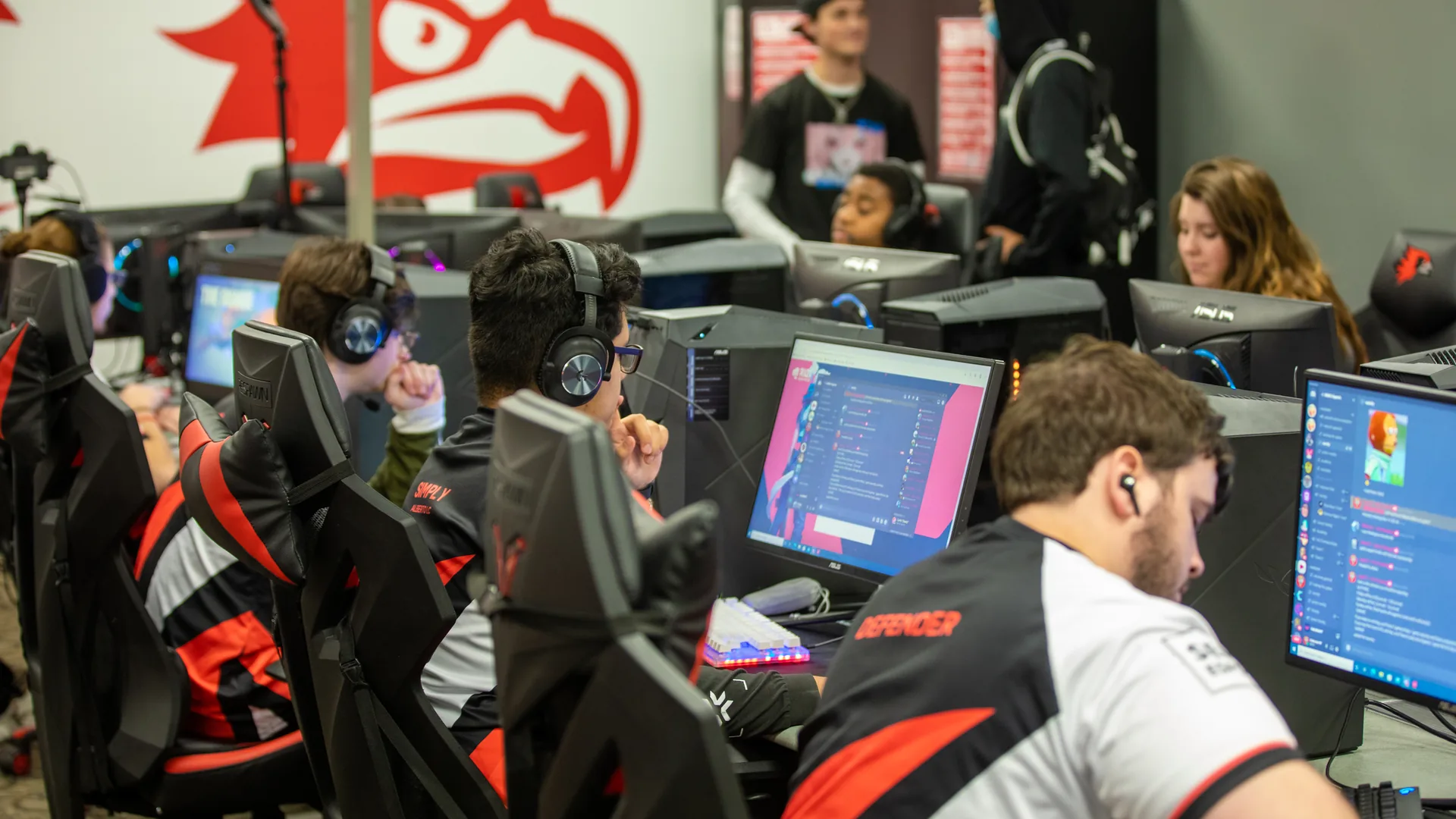
The IQ test for gamers: what your rank and reaction time can and cannot tell you
Gamers search for an IQ test because games feel like a workout for speed, attention and memory. Research does find that action game players outperform non players on some cognitive tasks, but it does not show that games raise general ability. This page sets out what games draw on, what the meta-analyses report, why a rank is not an IQ, and which normed test fits a gamer.
In a meta-analysis, action gamers outperformed non gamers by g = 0.55, while training gains were smaller.
0 The short answer
The right IQ test for a gamer is a normed, multi ability test and not a game: a psychologist's battery such as the WAIS-5 for a clinician's report, or a normed online battery such as ACIS for an adult normed estimate at 15, 30 or 50 dollars and about 45, 110 or 175 minutes (prices read October 29, 2026). Games draw on processing speed, visual attention, working memory and spatial ability, and a 2018 meta-analysis found habitual action game players about half a standard deviation ahead of non players on cognitive tasks (g = 0.55), but that is a difference between groups, and the training studies in the same analysis showed a smaller effect (g = 0.34) that an independent re-analysis questioned. A rank, a reaction time or a puzzle app score is not an IQ, and any online result, ACIS included, is unsupervised and not clinical.
g = 0.55
Average advantage of habitual action game players over non players across cross sectional studies in the Bediou and colleagues meta-analysis (2018).
g = 0.34
Average effect in the long term action game intervention studies of the same meta-analysis, where published effects run an estimated 30 percent above the full literature.
359
Effect sizes in the video game training model of Sala, Tatlidil and Gobet (2018), where the overall effect on cognitive ability was small or null.
1 Which Real Options Does a Gamer Have for an IQ Test?
A gamer has five routes to a number that looks like an IQ, and only two of them compare the person with a defined group of adults across several abilities. The table sets them side by side. Third party prices and facts come from the pages named in the text, opened on October 29, 2026, and can change. The page on where to take an IQ test lists every in person and online option beyond these.
Option
What it measures
Normed against whom
Supervised
Time
Cost, read October 29, 2026
What you receive
Psychologist with the WAIS-5
Broad cognitive abilities, including working memory and processing speed
Adults aged 16:0 to 90:11 (Pearson)
Yes, by an examiner
45 minutes for the 7 subtest Full Scale IQ, 60 minutes for the 10 primary index subtests (Pearson)
Clinician fee not published by Pearson; the complete print kit is 1,784 dollars for the professional
A report with scores and interpretation
American Mensa supervised test
A pass or fail result against a society cutoff
The general population, with a cutoff at the 98th percentile
Yes, proctored by volunteers or at approved facilities
Not stated on the page
60 dollars local group, 99 dollars private electronic (regular prices; a promotion through October 31 was also shown)
A qualification result; Mensa says it cannot provide a detailed report with scores, percentile ranks or an IQ score
Ranked ladder or matchmaking rating
Skill at one game, relative to other players of that game
Other ranked players of that game
Not applicable
Accumulates over many matches
The price of the game
A rank label
Free browser games and reaction timers
Narrow tasks such as reaction time or short term memory
A score compared with other visitors, not a defined adult norm group
No
Seconds to minutes
Free or ad supported; read the page
A number or a chart; the page on Human Benchmark explains why it cannot be converted to an IQ
ACIS, a normed online battery
Six indices and a Full Scale IQ, depending on the form
Adults aged 16 to 90
No
About 45, 110 or 175 minutes
15, 30 or 50 dollars, one time
Indices and Full Scale IQ with percentiles and a 95 percent confidence interval
The Mensa row deserves a note. Its testing page says a qualifying score is one that "tested at, or above, 98 percent of the general population," and it says the society is unable to offer testing to anyone under 14. A pass or fail result tells a gamer whether a cutoff was met and nothing about the shape of the profile, which is the thing a gamer usually wants to know.
DisclosureACIS sells a paid cognitive assessment, so this page has a commercial interest, and it names ACIS as one option among several. Every fact about another option comes from the page named in the text. Any figure we derived ourselves is labeled as our arithmetic.
2 Do Gamers Have Higher IQs? What the Group Comparisons Show
Gamers do score higher than non gamers on some cognitive tasks in some studies, but the gap shrinks or vanishes when the comparison is built carefully, and no representative study gives an average IQ for gamers. The headline number comes from a meta-analysis by Bediou and colleagues in Psychological Bulletin (2018). It covered the period 2000 to 2015, focused on action video games, and reported that cross sectional studies document a positive average effect of about half a standard deviation (g = 0.55) for habitual players. The authors also estimated that average effects in the published literature are 30 percent larger than in the full literature, a sign that publication bias remains a threat.
A cross sectional difference is a snapshot of who plays, not a record of what playing did. People who find fast games rewarding may already have quick visual attention, and a study that recruits "expert gamers" and "non gamers" tells both groups what the experiment is about. Boot, Blakely and Simons made that point in Frontiers in Psychology (2011): the cumulative evidence suggests at first glance a strong relationship between gaming experience and other cognitive abilities, but methodological shortcomings call that conclusion into question.
Two other studies show how much the answer depends on the design. In Unsworth and colleagues (2015, Psychological Science), two experiments measured working memory, fluid intelligence and attention control, and collected a questionnaire on video game experience. In Experiment 1, an extreme groups analysis found that experienced players outperformed non players on several cognitive ability measures. In both experiments, however, when the full range of subjects was analyzed at the task level and at the latent construct level, nearly all the relations between video game experience and cognitive abilities were near zero. Comparing only the extremes produced a gap that the whole sample did not support.
Sala, Tatlidil and Gobet (2018, Psychological Bulletin) ran three random effects meta-analyses. The first (k = 310) examined the correlation between video game skill and cognitive ability, the second (k = 315) compared players with non players, and the third (k = 359) tested training. Small or null overall effects appeared in all three, and the authors concluded that overall cognitive ability and video game skill are only weakly related. The two meta-analyses reach different conclusions, and the live page on IQ and video games walks through that dispute in detail, so we do not repeat it here.
What about the figure that circulates, that PC gamers average above 114 and mobile gamers below 100? It comes from a 2024 survey by WhichBingo, a British online bingo site. As GIGAZINE reported it, the survey tested 1,002 gamers and reported platform averages of 114.1 for PC and 99.9 for mobile and tablet. The report gives no recruitment method, no per game sample sizes and no description of how the scores were calculated or normed, so there is nothing to check the numbers against. We searched for a peer reviewed study with a representative sample that reports an average IQ for gamers and did not find one. The honest answer to "what is the average IQ of gamers" is that, as far as we could find, nobody has measured it in a way that supports a number.
3 Do Games Raise IQ? What the Training Studies Show
Training studies ask a different question from group comparisons, whether playing changes ability, and their answer is that gains are strongest on the trained or closely related tasks and weak or unproven on general ability. The same Bediou meta-analysis reports that long term intervention studies show a smaller average effect of a third of a standard deviation (g = 0.34). It notes that only intervention studies using other commercially available game genres as controls were included, so not all games affect cognition equally, and that action video game play robustly enhanced top-down attention and spatial cognition, with encouraging signs for perception. The authors encouraged more intervention studies, especially those with more than 30 hours of training.
The re-analysis is the reason the number is contested. Hilgard, Sala, Boot and Simons (2019, Collabra: Psychology) re-analyzed the same set of studies with what they describe as more appropriate adjustments for publication bias and found minimal evidence for transfer of training to cognitive ability measures. They also report that studies from the lab of the original meta-analysis's senior author showed larger effects than other labs, and that many of those studies distributed different outcomes from the same or highly overlapping participants across publications without noting the overlap. The Sala, Tatlidil and Gobet paper reaches its own conclusion: no evidence of a causal relationship between playing video games and enhanced cognitive ability, and video game training as no exception to the general difficulty of obtaining far transfer.
Not every study is a randomized experiment, and the observational ones deserve their own caution. Sauce and colleagues (2022, Scientific Reports) analyzed 9,855 children in the ABCD dataset, with intelligence measured at ages 9 to 10 and again two years later. At baseline, time spent watching videos (r = -0.12) and socializing (r = -0.10) correlated negatively with intelligence, while gaming did not correlate. After two years the authors estimated a positive effect of gaming (standardized beta = +0.17) and, unexpectedly, of watching videos (+0.12), which was not significant in a post hoc analysis that controlled parental education instead of socioeconomic status. These are children and not adult gamers, and the design is observational even with genetic and socioeconomic controls. Our cautious reading is that two very different media habits both predicting gains is a reason not to treat the game itself as the proven cause.
One older result explains why the idea took hold. Feng, Spence and Pratt (2007, Psychological Science) reported that after only 10 hours of training with an action video game, subjects realized substantial gains in both spatial attention and mental rotation, with women benefiting more than men, while control subjects who played a non action game showed no improvement. It is a real finding about spatial tasks, and it predates the critiques above. The broader review of brain training by Simons and colleagues (2016, Psychological Science in the Public Interest) found extensive evidence that brain training interventions improve performance on the trained tasks, less evidence for closely related tasks, and little evidence that training enhances performance on distantly related tasks or everyday cognitive performance.
Cross sectional gaps versus training effectsA group difference (g = 0.55) and a training effect (g = 0.34) answer different questions and should never be added together or swapped. If a standardized effect were applied to an IQ scale with a standard deviation of 15, 0.55 would be about 8 points and 0.34 about 5 points. That conversion is our arithmetic and an illustration only, because the studies measured many different laboratory tasks and not IQ tests, and the averages mix many kinds of tasks.
4 Which Abilities Do Games Draw On, in CHC Terms?
Fast games lean on processing speed (Gs), working memory (Gwm), visual processing (Gv) and, in strategy titles, fluid reasoning (Gf), and those are four of the six broad abilities that a normed battery samples. The Cattell-Horn-Carroll (CHC) model, explained on the page about the CHC model, is the vocabulary that ACIS uses for its six domains. In short, Gs is fast, accurate performance on simple tasks, Gwm is holding and manipulating information for a few seconds, Gv is working with shapes and space, and Gf is solving unfamiliar problems. Research on gamers uses a different word, attention, and the meta-analysis by Bediou and colleagues reported robust enhancement in the domains of "top-down attention and spatial cognition." Attention control is not a separate CHC domain. In a normed battery it shows up as a condition of performance: the Digit Span page says performance can depend on attention control, sequencing and resistance to interference.
The evidence for each ability is uneven, and it helps to keep the four apart.
Spatial ability (Gv). The broadest evidence is not about games alone. A meta-analysis of 217 studies by Uttal and colleagues (2013, Psychological Bulletin) found an average effect (Hedges's g) of 0.47 for spatial training relative to control, stable over delays, and with transfer to other spatial tasks that were not directly trained. Feng and colleagues, discussed above, tied one action game to gains in spatial attention and mental rotation. Taken together, spatial skills are malleable, and a gamer who navigates three dimensional maps may well be practicing a skill that a mental rotation test or a spatial IQ test samples. Whether that practice raises a general spatial index is the question the re-analyses leave open.
Fluid reasoning (Gf). In Kokkinakis and colleagues (2017, PLOS ONE), the rank of 56 League of Legends players (51 males, mean age 20.5) correlated with the Matrix subtest of the WASI-II, a short Wechsler scale, with a Spearman correlation of .44 (95 percent confidence interval .24 to .60). In a second study, the age profile of performance in League of Legends and DOTA II matched that of raw fluid intelligence. The authors call the relationship correlational and the first study small and exploratory, and they note that the Study 1 players were all well practiced.
Working memory (Gwm). Games ask a player to hold positions, cooldowns and plans in mind, but we found no meta-analysis that isolates games and working memory with controls strong enough to support a claim. The ACIS Visual Sequence page describes its task as holding ordered visual material in mind and reproducing or rearranging it after brief exposure, which is the closest laboratory analogue to a visual game demand. For the general science of span tasks, the page on working memory tests and the page on visual memory set out what the standard formats measure, and the sibling page on short term memory tests covers the storage side.
Processing speed (Gs). A game demands fast responses, but a response time inside a game mixes perception, decision, motor output, input hardware and strategy. The page on processing speed tests explains what a normed Processing Speed Index measures and why a reaction time in milliseconds is not automatically one.
The table below maps game demands to CHC abilities and to the ACIS subtests whose pages describe them. The mapping of game demands is our own description and not a research finding. The subtest descriptions come from the ACIS subtest pages.
Game demand (our description)
CHC ability
ACIS subtests that sample it
What the subtest page says it measures
Scanning a screen and picking out a target quickly
Processing speed (Gs)
Symbol Search
Rapid visual comparison and decision speed
Fast, repeated, accurate responses to a rule
Processing speed (Gs)
Coding
A symbol key converted quickly and accurately, with visual scanning and steady output
Holding a sequence of visual positions
Working memory (Gwm)
Visual Sequence
Temporary storage for ordered visual or spatial information
Holding and reordering spoken or mixed information
Working memory (Gwm)
Digit Span, Alphanumeric Sequencing
Immediate auditory verbal storage and active reorganization
Mental rotation, figural integration and imagined movement in space
Working out a rule in an unfamiliar situation
Fluid reasoning (Gf)
Matrix Reasoning, Figure Weights
Abstract rule discovery from visual patterns (Matrix Reasoning) and relational balance reasoning (Figure Weights)
The Wechsler batteries also sample the spatial domain with a construction task in which a person builds a pattern from blocks, and the sibling page on the Block Design test covers it below. Games do not require reasoning in every case, and the demands of a rhythm game differ from those of a strategy game, so no single subtest stands for "gaming ability." The ACIS report keeps the six domains separate for that reason.
5 Why Is a Game Rank or an In-Game Score Not an IQ Score?
A rank compares you with other players of one game on one ladder, an IQ compares you with a defined adult group across several abilities, and the two answer different questions even when they correlate. In the Kokkinakis study, rank came from an ELO-like system that depends on the ratio of matches won to matches lost and not on in match performance, and the sample ranged from Silver Division 5 to Masters Division. That is a ladder among people who already play the game regularly. The authors also note that multiplayer outcomes add noise, because teammates and opponents contribute variance. A correlation of .44 inside such a sample is informative about the ladder and says little about how a rank would map to a position in the adult population.
The mismatch has a general form that the Standards for Educational and Psychological Testing (AERA, APA and NCME, 2014) state directly. Standard 1.4 says that if a test score is interpreted for a given use in a way that has not been validated, it is incumbent on the user to justify the new interpretation for that use, providing a rationale and collecting new evidence if necessary. Reading a rank as an IQ is exactly that kind of new interpretation, and we found no study that collected the evidence. Standard 5.8 says norms, if used, should refer to clearly described populations that include the individuals or groups with whom test users will ordinarily wish to compare their examinees. A ladder is a clearly described population, but it is not the one a person means by "average."
Expertise adds a second reason. Skill at a demanding game is built through practice, and the gain in a trained task does not travel automatically to other tasks. Sala, Tatlidil and Gobet found that video game skill and cognitive ability are only weakly related across 310 estimates. The page on the chess IQ test takes the same question to a board game rating, and a gamer who plays chess can read it as a parallel case.
A third reason concerns what a score can be converted into. Browser tests of reaction time and memory give a number with no conversion to an IQ scale, because, as the live page on Human Benchmark documents, the site publishes distributions of what its visitors recorded and has no norms for a defined population. That page goes through each game, so this page does not repeat it.
A last reason is design. An IQ battery standardizes the tasks and states the margin of error that remains, while a ladder outcome mixes in the teammates and opponents a player happens to draw. They are different instruments, and reading one as the other is the error this page exists to prevent.
6 What Should a Gamer Look For in an IQ Test?
A gamer should look for six things in any test that claims to report an IQ: a defined adult norm group, several abilities and not one, a reported margin of error, documentation, disclosed conditions, and honest limits. The checklist is the same for any reader, and the page on the best online IQ tests applies it across products. For a gamer, each item has a specific reason.
A defined norm group. Without one, a number cannot be placed anywhere. The page on how IQ scores are normed explains the process. A leaderboard of site visitors is not that.
Several abilities. A gamer's strengths are probably uneven, and a single reaction time or memory span hides the shape. A battery that reports indices shows whether speed, memory, spatial ability and reasoning agree.
A margin of error. The Standards for Educational and Psychological Testing say, in Standard 2.3, that for each total score, subscore or combination of scores that is to be interpreted, estimates of relevant indices of reliability and precision should be reported. A subtest score without its precision is easy to over-read. The page on reliability and validity explains the terms.
Documentation. A publisher should say what each subtest measures and how scores are built. The ACIS technical manual is the documentation for ACIS, and a buyer should ask any seller for the equivalent.
Disclosed conditions. Whether a session is supervised, timed and how long it takes should be stated before the purchase. The Standards, in the comment to Standard 1.10, list the mode of test administration, such as unproctored online testing versus proctored on-site testing, among the conditions that may affect performance and that users should be able to judge.
Honest limits. A seller that says its result is clinical, diagnostic or valid for hiring when it is an online self-administered test is overstating it.
Free routes cover part of this. The page on a free IQ test explains what a free session includes and what it leaves out, and the page on a cognitive ability test describes how a broader battery differs from a single task.
7 How Does ACIS Cover the Abilities That Games Draw On?
ACIS covers all four abilities in its Full Scale form and a subset in the shorter forms, and the free trial opens its speed and working memory subtests. ACIS has 20 subtests in six CHC domains, reported as a Full Scale IQ and six indices: VCI (verbal comprehension), FRI (fluid reasoning), QRI (quantitative reasoning), VSI (visual spatial), WMI (working memory) and PSI (processing speed). The free trial needs no card, and one trial is allowed per person. Started from the Full Scale form, it opens five subtests (read on the published site on October 29, 2026): Digit Span, Alphanumeric Sequencing, Visual Sequence, Coding and Symbol Search. Finished trial subtests are kept if the person later unlocks a form that includes them.
Adds Coding, Symbol Search, Spatial Comprehension and Layer Rotation, among others, to the reasoning and memory subtests (13 subtests in 5 domains)
Full Scale
50 dollars
About 175 minutes
All 20, including Visual Sequence and Visual Puzzles, which appear only in this form
Custom Test
5 dollars per subtest
Depends on the choice
Any subtests; any domain completed returns its full index score, and every subtest returns its scaled score; the Full Scale IQ needs the Full Scale battery
Every form reports a Full Scale IQ with its 95 percent confidence interval, and prices can change. The speed pair is the Symbol Search subtest, which its page describes as scanning small visual sets, comparing symbols and making a quick discrimination, and the Coding subtest, which asks for a symbol key to be converted quickly and accurately. Visual Sequence, described by its page as holding ordered visual material and reproducing or rearranging it, is the closest ACIS analogue to the visual working memory a game can demand, and the Visual Sequence subtest page describes the format. Layer Rotation "carries no words at all" according to the technical manual, and its page gives 45 seconds per item. Matrix Reasoning is the fluid reasoning option in the Quick form. The tables above and below name task formats and never reproduce items.
The subtest pages we read describe formats and do not state which input device a subtest requires, so a buyer should read the instruction screen before starting. A gamer who wants every ability above in one report needs the Full Scale form, because Visual Sequence and Visual Puzzles are not in the shorter ones, and a gamer who wants only speed and memory can start with the free trial.
8 How Should a Gamer Read an IQ Score?
A normed report gives you a subtest score, an index, a Full Scale IQ and a percentile, and the order of trust runs from the Full Scale IQ down to the single subtest, because the more tasks a score rests on, the less any one lucky or unlucky task moves it. On ACIS, scaled subtest scores run from 1 to 19 with a mean of 10 and a standard deviation of 3, and the six indices and the Full Scale IQ sit on the standard scale with a mean of 100 and a standard deviation of 15, as the page on why the standard deviation is 15 explains. A percentile says what share of the reference group scored at or below the person. Adult norms cover ages 16 to 90, and every form reports a 95 percent confidence interval around the Full Scale IQ. The interval is the honest reading of one number: the score is the center of a range, not a point.
The table converts common standard scores to percentiles. These percentiles are our arithmetic from the normal curve, rounded, and they are not figures from any test. The IQ percentile calculator does the same conversion for any score.
Standard score (mean 100, standard deviation 15)
Share of the reference group at or below (our arithmetic)
85
16 percent
100
50 percent
115
84 percent
130
97.7 percent
145
99.9 percent
A single subtest is the least precise piece of a report. This is general psychometrics and not an ACIS statistic: a subtest rests on one task, an index rests on several, and a Full Scale IQ rests on the most. The Guidelines for Psychological Assessment and Evaluation (APA, 2020) say in Guideline 7 that psychologists strive to use multiple sources of relevant and reliable clinical information, and in its rationale that individual performance on psychological tests is only one piece of assessment. A gamer who gets a high Coding score and a middling Matrix Reasoning score has learned how two samples came out on one day, and not that either number is the true value.
Two features of a gamer's likely profile deserve a note. First, a gap between two indices is ordinary and not a finding by itself; the page on index score differences shows how common gaps are. Second, composites can show whether speed and memory are driving the Full Scale IQ. The page on the General Ability Index describes it as built from the reasoning and knowledge subtests and excluding working memory and processing speed, and the technical manual describes the CPI composite as one that "combines working memory and processing speed as cognitive proficiency." When the subtests for a composite are available, a profile in which the CPI sits above the General Ability Index is a pattern to read, and it is neither a strength to boast about nor a flaw to hide.
9 Does Reaction Speed Peak Early, and What Does That Mean for an Older Gamer?
In a large sample of StarCraft 2 players, the time it took players to act inside the game began to lengthen at age 24, and expertise did not offset it, so speed based scores should always be read against an age referenced group. The study is Thompson, Blair and Henrey (2014, PLoS ONE), which analyzed 3,305 players aged 16 to 44. Using a piecewise regression, the authors found that age related slowing of within game, self-initiated response times begins at 24 years of age. They found no evidence for the common belief that expertise should attenuate domain specific cognitive decline. A second analysis of dual task performance found no evidence of a corresponding age related decline, and an exploratory analysis suggested that older participants may have compensated for slower responses by using game mechanics that reduce cognitive load.
The finding is easy to over-read. It concerns one game, a cross sectional sample and one kind of in game response time, and the authors do not claim it describes every cognitive ability. Its value for a person choosing a test is narrower. It shows that raw speed in a game is entangled with age, so a number such as "my reaction time is 240 milliseconds" means different things at 19 and at 39, and it suggests that players may offset slower responses with strategy. A normed Processing Speed Index handles the first problem by comparing a person with an age appropriate reference group.
For an older gamer the practical point is to be cautious about two opposite inferences. One is that a slower response time in a favorite game says anything about intelligence. The other is that experience must be protecting everything. Neither follows from a game metric, and a normed battery reports the speed domain as its own index, so the reasoning and knowledge indices can be read on their own.
10 How Should a Gamer Prepare for a Normed Test and Set Up the Session?
A gamer does not need to prepare for a normed test, and practicing speed or memory games beforehand may raise the practiced skill without telling you anything about your ability. The brain training review by Simons and colleagues found extensive evidence that training improves the trained tasks, less for closely related tasks and little for distantly related tasks or everyday performance. A reader who grinds a reaction timer for a week and then takes a speed subtest has trained a related task, and any gain on the subtest would reflect familiarity with that kind of task rather than a change in general speed. Take the test as you are, rested, and do not rehearse.
An unsupervised session hands the testing conditions to the test taker, and the Guidelines for Psychological Assessment and Evaluation (APA, 2020), in Guideline 8, ask psychologists to strive to be aware of the need for test selection, scoring and administration to reflect the appropriate normative comparison, situational influences, effort and standardized administration. A gamer can supply those conditions at home with five habits:
Working sound. Three ACIS subtests present items as audio: Digit Span, Alphanumeric Sequencing and Arithmetic. Two of them are in the free trial, so headphones and a volume check belong before the first subtest.
A quiet room and one screen. Notifications, a second monitor with a game running and a voice chat all change what is measured. Turn them off for the session.
A rested start. A form of 175 minutes after an all night session reads fatigue as well as ability. This is general testing practice and not a measured ACIS finding.
Breaks and time. ACIS allows breaks, saves progress between subtests and gives 30 days to complete a form, so a gamer can split it across days.
No help. Looking up a word, using a calculator on a reasoning task or asking a friend changes what is measured. Some subtests are timed per item: the Matrix Reasoning page gives 30 seconds per item plus a shared 120 second extra time bank, and the Layer Rotation page gives 45 seconds per item.
The guarantee on ACIS purchases reads, in the site's words: "Full refund within 5 days if the report does not deliver the features described at checkout or a technical issue prevents you from accessing your results." It is a conditional refund and not an unconditional money back guarantee, and a buyer should read the terms at checkout.
11 What Can a Gamer's Profile Tell You, and What Should You Not Infer?
A profile from a normed battery can tell a gamer where speed, memory, spatial ability and reasoning stand relative to adults, and it cannot say how good the gamer is at any game, why a score is what it is, or whether anything is wrong. Three limits matter.
First, group statistics are not individual predictions. The g = 0.55 in the Bediou meta-analysis is an average over many studies of many tasks, and it says nothing about a particular player. A reader with a high Full Scale IQ cannot infer a high rank, and a reader with a high rank cannot infer a high Full Scale IQ. Kokkinakis and colleagues found a correlation of .44 in 56 players, which leaves most of the variation in rank unexplained by the matrix measure in that sample (our arithmetic: .44 squared is about .19), and they call the work exploratory.
Second, a score does not diagnose. A slow Processing Speed Index, a low Working Memory Index or a big gap between indices does not indicate a clinical condition, and a tired, distracted or unmotivated test taker can produce a low result for reasons unrelated to ability. Anyone concerned about attention, learning or memory should talk to a licensed professional, because an online test cannot document a condition.
Third, a gamer's goals decide which score matters. A player thinking about a technical career can read the sibling page on IQ tests for engineers, which sets out the quantitative, spatial and fluid abilities that page covers. A group of friends who want to compare results can use the sibling page on comparing scores inside a friend group, which explains why gaps of 10 or 15 points are ordinary. The sibling page on the Block Design test covers the construction task that clinicians use for visual spatial ability.
12 Where ACIS Sits, and What a Buyer Should Do
ACIS is an online, unsupervised, English only battery with adult norms for ages 16 to 90, it is not a clinical or diagnostic instrument, and it fits a gamer who wants a profile across speed, memory, spatial ability and reasoning at a price between 15 and 50 dollars. It is not for hiring, school accommodations, admission to high IQ societies or any other high stakes decision. The technical manual says verbal and knowledge tasks are affected by English proficiency and educational exposure, and that bears on a gamer who is a non native English speaker; Layer Rotation, according to the manual, carries no words at all. A psychologist's WAIS-5 is the route for a clinical question, and Pearson lists the WAIS-5 at qualification level C.
The Standards for Educational and Psychological Testing (AERA, APA and NCME, 2014) set the terms on which any score should be read, and four of them apply to this page. Standard 1.4 puts the burden of justification on the user who interprets a score in a way that has not been validated, which rules out reading a game rank as an IQ. Standard 1.10 asks that the conditions of data collection be described well enough for users to judge the relevance of the findings, and its comment lists unproctored online testing versus proctored on-site testing among the conditions that may matter. Standard 2.3 asks for reliability and precision to be reported for each score that is interpreted, which is why the confidence interval around the Full Scale IQ is more informative than the point value. Standard 5.8 asks that norms refer to clearly described populations. The Guidelines for Psychological Assessment and Evaluation (APA, 2020) add that no single score stands alone, and a gamer should read one report as one source beside everything else the gamer knows. The documentation behind ACIS is in the technical manual.
The next step depends on the question. For a clinical or educational question, ask a licensed psychologist, and the page on where to take an IQ test, linked earlier, lists the routes. For curiosity about speed and memory, start the free trial, which needs no card and opens Digit Span, Alphanumeric Sequencing, Visual Sequence, Coding and Symbol Search. For a profile across all six domains, the Full Scale form is 50 dollars and about 175 minutes, and the Quick form is 15 dollars and about 45 minutes for a first look (prices read October 29, 2026). Example reports are available before paying.
Every figure on this page comes from one of the sources below, opened or verified through Crossref on October 29, 2026, and any number we derived ourselves is labeled as our arithmetic.
American Educational Research Association, American Psychological Association and National Council on Measurement in Education (2014). Standards for Educational and Psychological Testing. Washington, DC: AERA. Standards 1.4, 1.10, 2.3 and 5.8. Open access edition.
American Psychological Association (2020). APA Guidelines for Psychological Assessment and Evaluation. Guidelines 7 and 8. APA policy document.
Bediou, B., Adams, D. M., Mayer, R. E., Tipton, E., Green, C. S., and Bavelier, D. (2018). Meta-analysis of action video game impact on perceptual, attentional, and cognitive skills. Psychological Bulletin, 144(1), 77 to 110. https://doi.org/10.1037/bul0000130
Boot, W. R., Blakely, D. P., and Simons, D. J. (2011). Do action video games improve perception and cognition? Frontiers in Psychology, 2. https://doi.org/10.3389/fpsyg.2011.00226
Feng, J., Spence, I., and Pratt, J. (2007). Playing an action video game reduces gender differences in spatial cognition. Psychological Science, 18(10), 850 to 855. https://doi.org/10.1111/j.1467-9280.2007.01990.x
GIGAZINE (October 6, 2024). Report on the WhichBingo survey of gamers' IQ by game and platform, read on October 29, 2026 as a market fact and not as evidence about intelligence. GIGAZINE report
Hilgard, J., Sala, G., Boot, W. R., and Simons, D. J. (2019). Overestimation of action-game training effects: Publication bias and salami slicing. Collabra: Psychology, 5(1). https://doi.org/10.1525/collabra.231
Kokkinakis, A. V., Cowling, P. I., Drachen, A., and Wade, A. R. (2017). Exploring the relationship between video game expertise and fluid intelligence. PLOS ONE, 12(11), e0186621. https://doi.org/10.1371/journal.pone.0186621
Pearson Assessments. Wechsler Adult Intelligence Scale, Fifth Edition (WAIS-5) product page, age range, administration time, qualification level and kit price read on October 29, 2026. Pearson WAIS-5 page
Sala, G., Tatlidil, K. S., and Gobet, F. (2018). Video game training does not enhance cognitive ability: A comprehensive meta-analytic investigation. Psychological Bulletin, 144(2), 111 to 139. https://doi.org/10.1037/bul0000139
Sauce, B., Liebherr, M., Judd, N., and Klingberg, T. (2022). The impact of digital media on children's intelligence while controlling for genetic differences in cognition and socioeconomic background. Scientific Reports, 12. https://doi.org/10.1038/s41598-022-11341-2
Simons, D. J., Boot, W. R., Charness, N., Gathercole, S. E., Chabris, C. F., Hambrick, D. Z., and Stine-Morrow, E. A. L. (2016). Do "brain-training" programs work? Psychological Science in the Public Interest, 17(3), 103 to 186. https://doi.org/10.1177/1529100616661983
Thompson, J. J., Blair, M. R., and Henrey, A. J. (2014). Over the hill at 24: Persistent age-related cognitive-motor decline in reaction times in an ecologically valid video game task begins in early adulthood. PLoS ONE, 9(4), e94215. https://doi.org/10.1371/journal.pone.0094215
Unsworth, N., Redick, T. S., McMillan, B. D., Hambrick, D. Z., Kane, M. J., and Engle, R. W. (2015). Is playing video games related to cognitive abilities? Psychological Science, 26(6), 759 to 774. https://doi.org/10.1177/0956797615570367
Uttal, D. H., Meadow, N. G., Tipton, E., Hand, L. L., Alden, A. R., Warren, C., and Newcombe, N. S. (2013). The malleability of spatial skills: A meta-analysis of training studies. Psychological Bulletin, 139(2), 352 to 402. https://doi.org/10.1037/a0028446
14 Frequently Asked Questions
Is there an IQ test for gamers?
There is no separate IQ test for gamers. The same normed tests apply to everyone, such as a psychologist's WAIS-5 or a normed online battery. What differs is the reason to take one: a gamer can use a profile to see speed, memory, spatial ability and reasoning separately instead of relying on a rank.
Do gamers have higher IQs than non gamers?
Not reliably. Some studies find that action game players outscore non players on certain cognitive tasks, with an average gap of g = 0.55 in one meta-analysis, but careful whole sample analyses find near zero relations, and no study measures gamers' average IQ in a representative sample. Group gaps do not describe individual players.
What is the average IQ of gamers?
No credible figure exists. Circulating averages come from commercial surveys that publish no recruitment method, scoring details or norms, so they cannot be checked. The only defensible answer is that gamers vary as widely as everyone else, and a representative study reporting a gamer average has not been found.
Are there IQ test games for adults?
Yes, but they are puzzle and speed games, not normed IQ tests. Some sample real abilities such as reaction time or memory, yet their scores are not compared with a defined adult group. A game can be enjoyable practice and a legitimate curiosity, and it cannot give an IQ.
Are there free IQ test games?
Many free browser games exist, and a free trial of a normed test is also possible. A free game gives a raw score, often compared with other visitors. A free trial of a normed test reports scores against an adult reference group for the subtests it includes, though not a full profile.
Can a video game measure IQ?
A video game can sample abilities such as speed or spatial attention, but it cannot measure IQ without norms, several abilities and a stated margin of error. One small study found a rank correlated with a fluid reasoning measure in 56 players, which the authors called exploratory, so a game is not a substitute.
Does playing video games make you smarter?
The evidence does not show that games raise general intelligence. Training studies find improvements on trained or closely related tasks, an independent re-analysis found minimal transfer, and a large observational study of children found a positive estimate that cannot establish cause. Games may well be enjoyable, but intelligence gains are unproven.
What did the Bediou meta-analysis find?
It found a positive average effect of about half a standard deviation (g = 0.55) for habitual action game players in cross sectional studies, and a smaller effect of a third of a standard deviation (g = 0.34) in intervention studies. The authors estimated that publication bias made published effects about 30 percent larger.
What is the difference between a cross sectional gap and a training effect?
A cross sectional gap compares existing players with non players at one time, so it may reflect who chooses to play. A training effect compares people before and after assignment to play, so it speaks to cause. The two can differ in size and meaning, and neither is the same as an IQ difference.
Why did the re-analysis disagree with the meta-analysis?
The re-analysis applied stronger adjustments for publication bias to the same set of studies and found minimal evidence of transfer. It also reported that some studies split outcomes from the same participants across publications. The original authors had already warned that publication bias remained a threat, so the dispute concerns how much to correct.
Does a high League of Legends rank mean a high IQ?
No. A study of 56 players found a Spearman correlation of .44 between rank and a matrix reasoning subtest, but that sample was small, exploratory and made of practiced players. A correlation means rank and the measure tend to move together, and it does not let you convert a rank into an IQ.
Which ACIS subtests are in the free trial?
Started from the Full Scale form, the free trial opens five subtests: Digit Span, Alphanumeric Sequencing, Visual Sequence, Coding and Symbol Search (published site, October 29, 2026). It needs no card and allows one trial per person. Finished trial subtests are kept if you later unlock a form including them.
How much does ACIS cost and how long does it take?
ACIS is a one time payment: Quick is 15 dollars for six subtests in about 45 minutes, Optimized is 30 dollars for 13 subtests in about 110 minutes, and Full Scale is 50 dollars for all 20 subtests in about 175 minutes. Prices were read on October 29, 2026 and can change.
Which ACIS subtests cover speed, memory and spatial ability?
Symbol Search and Coding cover processing speed. Digit Span, Alphanumeric Sequencing and Visual Sequence cover working memory. Layer Rotation, Spatial Comprehension and Visual Puzzles cover visual spatial ability. Visual Sequence and Visual Puzzles appear only in the Full Scale form, while the other subtests also appear in shorter forms.
Will practicing games raise my score on an IQ test?
Practice usually improves the practiced task and close relatives, with little evidence it carries to distant tasks. Rehearsing a reaction timer might make a speed subtest feel familiar, but that would reflect familiarity and not a change in ability. Taking the test rested and without rehearsal gives the cleaner reading.
Does reaction speed decline with age?
In one large sample of StarCraft 2 players aged 16 to 44, self-initiated in-game response times began to slow at 24, and skill did not offset it. That is one game and one cross sectional sample, so read it as a reason to compare speed with an age appropriate reference group.
Is an online IQ test result accurate?
An online result can be informative when the test has defined adult norms and reports a margin of error, but it is unsupervised, so noise, distraction or help can distort it. Treat it as an estimate with an interval and not as a clinical measurement,.
Should I take a test after a long gaming session?
It is better not to. A long session can leave you tired, and a tired test taker may score lower for reasons unrelated to ability. This is general testing practice and not a measured ACIS finding. Start rested, with sound working, in a quiet room, and split long forms across days.
What does it mean if my speed score is high and my reasoning score is lower?
It means the two samples differed on that day, which is common and not a diagnosis. Gaps between indices occur in many adults. Read the confidence intervals, check that conditions were good, and compare the profile with other evidence before drawing conclusions about strengths or weaknesses.
Can an IQ test predict esports success?
No evidence supports that. Skill at a game depends on practice, mechanics, teamwork and conditions, and a correlation of .44 between rank and a reasoning measure in a small study leaves most differences unexplained. An IQ profile describes abilities relative to adults and does not rank a player's chances.
Can I use an ACIS result for school, work or a society?
No. ACIS is an online, unsupervised, non clinical test, and it is not for hiring, school accommodations or admission to high IQ societies. If a school, employer or society needs a score, ask them which supervised instrument they accept, and keep your ACIS profile for personal understanding.
Take the assessment
You get a profile, not a number
ACIS measures six CHC domains across 20 subtests and reports each one with its own normed score and confidence interval, so you can see where you are strong and where you are not.